Showing posts with label McDonnell Douglas. Show all posts

20 August 2015

Birth of the Airbus Family: The A310

The Airbus A310 prototype takes flight on 3 April 1982.
In the days following the start of the 1973 Yom Kippur War in Middle East in October that year, the oil producing nations of the Middle East responded to American materiel support of Israel with an oil embargo that sparked a worldwide economic crisis as the price of oil abruptly shot upwards from $3/barrel to over $12/barrel in a short period of time. As a result, the airline industry worldwide embraced fuel efficiency as the new driver for future aircraft designs. While there were high-bypass ratio turbofans that powered the new widebody designs that were entering service (Boeing 747, Douglas DC-10, and Lockheed L-1011 Tristar), turbojets and low-bypass ratio turbofans were still commonplace in the short to medium-haul fleets worldwide. Many airlines indicated to the major manufacturers that there was a market need for a fuel-efficient aircraft in the 150-200 seat range over short to medium haul ranges. Of the big three manufacturers in the United States who dominated the world commercial airliner market, Boeing's plans were the most ambitious with the launch of not just one aircraft, but two aircraft with a common cockpit with the Boeing 757 and 767. It was in many ways the biggest gamble Boeing had ever undertaken, bigger than building the Dash 80 demonstrator that led to the 707 and even bigger than the launch of the 747 ten years earlier. News of Boeing's plans put pressure on Airbus Industrie to respond as all it had produced by that point was the A300. While there were a range of A300 variants with varying engines, payload and fuel capacities, they were all still essentially the same aircraft and hardly a family of aircraft. Two of the primary founders of Airbus and their heads, Roger Béteille (technical director) and Henri Ziegler (general manager), strongly believed that Airbus needed to emulate Boeing's strategy of building a whole family of different aircraft for different markets if the whole enterprise was to have a future beyond the A300. Boeing's idea for commonality with the 757 and 767 designs resonated with the Airbus team who was commonality among varied designs as a way of proving value to the airline customers, not to mention it would be a strong incentive for an Airbus customer to stay loyal to Airbus in the future.

Part of the problem Béteille and Ziegler faced was that most of the Airbus consortium partners saw the A300 as the end result of cooperation instead of the starting point for future cooperation. A lot of that was driven by the atmosphere of fiscal austerity of the 1970s in the wake of the 1973 oil crisis- Airbus' partner nations were hesitant of putting up more money into the venture, particularly when Airbus was still a bit player on the world market despite the success of the A300. In 1978, for example, Airbus delivered 15 aircraft, all of them A300s. That same year Boeing delivered 203 aircraft across three product lines- the 727, 737, and 747. In fact, it wouldn't be until 2003 that Airbus would deliver more aircraft in a single year than Boeing. When Boeing launched the 757 and 767 programs, they were also capitalizing on market vulnerabilities experienced by McDonnell Douglas and Lockheed in the wake of their trijet programs- Airbus wasn't really on Boeing's radar screen at the time. Despite the market effects on McDonnell Douglas and Lockheed, they were still delivering aircraft as well which were entering service on top of Boeing's numbers. You can imagine what a tall order it was for Béteille and Ziegler to convince the Airbus consortium partners that there was value and potential for the long haul beyond the A300 at a time when they were only building less than 5% of the world's commercial jetliners. It wasn't until mid-1975 that the board of Airbus Industrie endorsed the plan for a family of aircraft- and that endorsement is a testament to the persuasive powers of Roger Béteille and Henri Ziegler. In his book Close to the Sun: How Airbus Challenged America's Dominance of the Skies, author Stephen Aris calls that 1975 decision as the most critical decision in Airbus' history. If Airbus failed, then it was only one aircraft, the A300, that failed. But if they became successful, then that one aircraft wouldn't be enough. The leadership of Airbus Industrie by that point had proven themselves remarkably adept in getting the A300 into production and to market while balancing the interests of the partner nations in the consortium. 

Winning a Swissair order was a strategic priority for Airbus
With the backing of the consortium to expand the Airbus product line beyond the A300, the next task at hand was to determine the configuration of the new addition. The first iteration dated back to the oil crisis of 1973 when A300 sales were near dormant (only four A300s were delivered in 1974). In response to what was seen as an evolving market for something smaller than the A300, what was designated the B10 was a minimum-change variant of the A300 that had a shorter fuselage but the same wing and empennage as the larger aircraft. However, the B10 proposal created a significant amount of discord at all levels of Airbus as the consortium partners argued whether it was needed or not. Lufthansa in particular was keen for a smaller A300 derivative and this had gotten the support of Swissair. In those days, Swissair was one of those flagship customers every commercial airframe builder wanted as a customer. They were a tough customer known to be one of the most difficult airlines to negotiate with- but a Swissair order was badge of prestige for any commercial aircraft design and with Swissair now allying with Lufthansa on interest for a smaller A300 derivative, winning Swissair as a launch customer soon became one of Airbus' primary strategic goals. 

By the time the two airlines were briefed on the B10 proposal, Boeing was well on its way to launching the 757/767 program and compared to those aircraft, the B10 had no fans with either Lufthansa or Swissair. Their objections of the proposal stemmed from two points- the first one was that by the time of proposed service entry, the B10 design would be based on technology and a design that was at least a decade old and more importantly, it had a worse payload fraction than the A300. The payload fraction is one way of measuring an aircraft's efficiency- how much payload can it carry compared to its weight. Since the B10 design had a shorter fuselage married to the A300's wings, it had less passengers (therefore less revenue) to offset the costs of carrying a heavier wing structure. This is one of the reasons why shrinks of commercial airframes tend to not do well in the market- like the A318, 737-500, or 747SP, for example. If the B10 proposal was ever going to get off the drawing board, it needed a lighter wing and whole host of improvements over the A300 to win over the airlines who were being offered the latest in technology with the 757/767. In an unusual twist of history, the prospect of trans-Atlantic cooperation offered an potential answer to Airbus' dilemma. Why not combine Airbus' growing widebody fuselage expertise with the technology and industrial muscle of the United States? The first feelers on such an idea came from McDonnell Douglas in the spring of 1975 for a joint venture for a 200-seat design called the DC-X-200. McDonnell Douglas had long been considering a twin-engine version of the DC-10 and the DC-X-200 was the latest iteration along those lines. However, once discussions moved beyond engineering to management, the talks quickly collapsed. That summer another offer came from Boeing who thought there would be some synergies with the B10 proposal and the 767 program. Whether Boeing was serious or just trying to distract Airbus is still a source of debate to this day, but the proposal would have consisted of the A300-based fuselage and 767 wings and empennage. At the end of the day, however, Airbus lost interest as it became apparent that they would end up a Boeing subcontractor in the joint venture. 

Lufthansa was an early A300 customer who drove the design of the A310.
Still keen to win over Lufthansa and Swissair, Airbus decided to follow as Boeing had done with the 757/767 and go with a two-crew flight deck and CRT displays. That would prove to be a relatively easy step to take but it still provoked the ire of the pilots' unions of several European carriers. The need for a new wing, however proved to continue to be problematic. I had posted previously that it had taken the personal intervention of a German politician, Franz Josef Strauss, to fund the A300's wing development and construction by Hawker Siddeley as a result of the British government's withdrawal from the Airbus consortium. Hawker was still the center of the most advanced wing design work in Europe and was in the process of merging with several other entities to form British Aerospace (BAe). With British Aerospace being majority owned by the government, there was considerable anguish at Airbus as to whether or not BAe would participate in the B10 project given the British pull out of the Airbus consortium in 1969.  When Hawker elected to remain an Airbus participant despite the pullout, they had absorbed a portion of the costs of wing development. Now that Hawker was part of BAe, no one was sure that the new entity was willing to front such costs again for the B10 project. Airbus decided at that point to turn to its partners for a wing design- Aerospatiale and VFW-Fokker each submitted wing designs and Roger Béteille was sure that whoever was chosen, it would be the end of Airbus as the other partner would feel jilted. As it turned out, neither was chosen- the German design was aerodynamically superior but the French design was structurally superior. A joint-wing design center was established to combine their efforts and word of this got back to BAe quite quickly that their replacement was in the works. 

The exact political machinations in the UK that resulted will be the subject of a future blog article, but they were contentious with pro-Airbus factions in the British government and those who favored a joint-venture with Boeing on the 757. At the end of the day, however, BAe did end up designing and fabricating the wing which was not only lighter, but was of supercritical section which made it not only more aerodynamically efficient but also offset the smaller size with a deeper airfoil section which offered more fuel capacity. Getting the wing also meant that the British eventually rejoined the Airbus consortium with a 20% share. On 9 June 1978, Lufthansa and Swissair issued a joint specification for the new aircraft and within a month announced intentions of placing orders for what was launched as the Airbus A310. On 15 March 1979, Swissair announced its launch order for 10 aircraft and 10 options with plans to use the A310 as a replacement for its legacy DC-9 fleet on its major intra-European routes. Lufthansa quickly followed with an order for 10 aircraft and soon after Air France and Iberia also placed orders, assuring the production and success of the A310. When the A310 prototype flew, it would later wear Swissair's colors on the right side and Lufthansa's colors on the left side. Many of the advances of the A310 were later incorporated into an upgrade of the A300, the A300-600. 

Source: Close to the Sun: How Airbus Challenged America's Domination of the Skies by Stephen Aris. Agate Books, 2002, pp 90-95. Photos: Wikipedia


11 July 2015

The Rocky History of Ariana Afghan Airlines

Ariana's logo- note the use of the Pan Am font
Prior to the Second World War, air services to Afghanistan were adventurous to say the least, given the inhospitable terrain of the area. Most air links to South Asia of the day that connected the region to Europe passed via India and were controlled by primarily the British. The first air links to Afghanistan, however, came by way of the Soviet Union starting on 14 September 1926 when the Russian airline Dobrolyot connected Kabul to the other Central Asian cities under Soviet control with Junkers F13 monoplanes. Dobrolyot was founded in 1923 to develop air services in the Soviet Union and in 1932 it was Dobrolyot that formed the nucleus of a new airline, Aeroflot. Dobrolyot's air services to Kabul continued until the outbreak of the Second World War. Interestingly enough, Dobrolyot was not the only foreign airline active in Afghanistan in the interwar period- DLH (Deutsche Luft Hansa, predecessor to today's Lufthansa) also opened air services to Afghanistan. At the time, DLH was looking to extend its route network to China where there were substantial German business interests. However, remaining bitterness from the First World War stymied DLH's attempts to open routes to China via India, so going through Afghanistan was seen as a short cut around British influence in the area. DLH extended its network eastward from Istanbul to Baghdad in October 1937 and then extended again from Iraq to the Iranian capital of Teheran in April 1938. Two weeks later, DLH extended its network again, this time connecting the Afghan cities of Kabul and Herat via Teheran and at the time, it was the furthest corner of DLH's airline network. Services ended abruptly, though, in August 1939 on the eve of the outbreak of the Second World War. 

Air services to Afghanistan were spotty at best and ad hoc for the duration of the Second World War  and aside from a small air mail service using Hawker Hart biplanes, it would be an American businessman in India who would forge new air links into Afghanistan again at the end of the war. New York native Peter Baldwin had served with the US Army Air Force in India during the war and returned in 1945 leading a US government mission to oversee the disposal of surplus USAAF aircraft in the region. His job finished, he elected to stay in India and in 1947 formed a company in Bombay (Mumbai today) for the sales of light aircraft and airport equipment. By 1950, he had his own fleet of thirteen Douglas DC-3s that he was flying all over the region on charter flights all over India, the Middle East and as far as Africa. His small charter operation even operated Hajj flights to Mecca. It was in this capacity that he came into partnership with the Afghan government. 

The DC-3 services were a boon to a country without railroads.
In 1951, the Kabul government established a branch of the Royal Afghan Air Force that was tasked with civil aviation development with Colonel Gulbar Khan as the head of what was called the "Hawabazi Mulki". Colonel Khan worked out a partnership with Peter Baldwin to form a new Afghan airline which was established on 27 January 1955 as Aryana Afghan Airlines in Kabul with Peter Baldwin holding 49% ownership of the airline and the Kabul government owning 51%. I haven't been able to determine if the airline's first three DC-3 aircraft were from Baldwin's charter operation, but it would make sense given his signifcant ownership in the new venture. The first services were launched at the end of 1955 connecting Kabul to Mazar-i-Sharif in the north near the Soviet border via the city of Kunduz. What had taken a week on the region's poor roads now only took three hours. 

During the Pan Am years, the Ariana chief pilot was a Pan Am pilot
On 27 June 1956, the Kabul government signed an air transport and development agreement with the United States. At the time, both the Soviet Union and the United States were eager to get Kabul's business and the Afghans astutely played both sides off each other to get economic development agreements. The air agreement with the United States included Pan American buying out Peter Baldwin's interest in Aryana. As a result, Pan Am become responsible for all operational and technical matters and also changed the spelling of the airline's name to Ariana, ostensibly to eliminate any possible references to the word "Aryan" that had been corrupted by the Nazi regime during the Second World War. On 3 June 1956, an Ariana Douglas DC-4 with an all-Afghan crew trained by Pan Am departed New York for Kabul to begin Hajj flights to Mecca. The DC-3s were used for internal domestic services that connected Kabul to Herat, Kandahar, Kunduz, Mazar-i-Sharif, and Maimana. New Delhi was connected to Kabul via the Indian city of Armistar and Karachi, the Pakistani port city, was connected via Kandahar. The DC-4 was used to connect Kabul to Teheran, Beirut and Damascus via Kandahar where American economic development funds were used to build a modern airport and terminal facility. 

Ariana launched services to Europe on 11 September 1959 on what they called the "Marco Polo Route" which used the DC-4 on services to the Turkish capital of Ankara via Beirut. The flight then continued on to Prague and then terminated in Frankfurt. The airline had to replace its DC-4 with a larger DC-6B as adventurous European tourists began to fly the "Marco Polo Route" to Kabul. The airline soon found that it was more profitable for the DC-6B services to bypass Kabul and instead fly Kandahar to New Delhi. Political instability in the region in the 1960s resulted in the termination of services to Karachi and the services that connected Frankfurt to New Delhi could only be flown twice a month- soon after, European services were cut altogether with Ariana's westernmost destination being Beirut by 1962.

Ariana Afghan 727-200
Ariana was near dormant when American development funds arrived again in 1963. This was a time of superpower rivalry and Afghanistan was no different than any other non-aligned nation of the time that had both American and Soviet interests competing for influence. Ariana got an extremely low-interest loan (it was pretty much a gift) that included a second Douglas DC-6 and two ex-Pan American Convair CV-340s to replace the DC-3 on the domestic services. A third CV-340 was purchased from Allegheny Airlines and this allowed a return to Karachi via Kandahar as diplomatic relations between Pakistan and Afghanistan improved. In July 1965, Ariana opened DC-6 services to the Uzbek capital of Tashkent in a pooling agreement with Aeroflot and in the following month, services to Europe resumed with DC-6 services from both Kabul and Kandahar to London Gatwick, stopping only in Beirut and Frankfurt. In April 1968, Ariana got its first jet equipment with a Boeing 727-100 which replaced the DC-6s on the European services. The route to London was reconfigured to route via Teheran, Istanbul and Frankfurt, but as Ariana had no fifth freedom rights, only Kabul/Kandahar-bound passengers could be boarded at London Gatwick. That first 727 crashed in dense fog on approach to London on 5 January 1969, but two more 727s were added- the first a lease from World Airways that was bought outright and a second purchase from Executive Jet Aviation, arriving in 1971. 

Ariana Afghan Airlines Tu-154- note the continued use of the Pan Am font!
The domestic routes of Ariana were spun off under a subsidiary airline called Bakhtar Afghan Airlines. This was a political move more than anything else as some Afghan officials wanted to limit US influence in the northern tier of cities along the Soviet frontier- this was accomplished by cutting Pan Am out of Bakhtar's operations. In 1973, Bakhtar took delivery of three Yakovlev Yak-40 trijets, becoming one of the few non-Soviet client state customers for the 28-seat feeder jet. Pan Am was still needed in the Ariana international operation, though, as Pan Am sold Ariana a Boeing 720B on very generous terms (again, it was pretty much a gift) in May 1973. That year, though, on the heels of a severe drought 1971-1972, Prime Minister Mohammed Daoud Khan seized power in a non-violent coup, deposing King Zahir Shah and ending the Afghan monarchy. A republic was proclaimed to institute economic reforms but only political instability was established as various Afghan leaders relying on tribal loyalties began to vie for control of the country. A series of coups followed starting in 1978, but despite this, Ariana launched Douglas DC-10 Series 30 services with a single aircraft in October 1979 on its services to London which could now be served nonstop. On 24 December 1979, the Soviet Union invaded Afghanistan which for all intents and purposes ended Ariana's operations. The two 727s and DC-10 were parked and eventually sold off under Soviet pressure by 1985. Its regional subsidiary, Bakhtar, took over Ariana's operations with two Tupolev Tu-154M aircraft starting in 1987, but the following year the Ariana name was resurrected and Bakhtar's domestic routes and operations folded into Ariana. 

Ariana's sole Douglas DC-10
The country descended into outright civil war following the Soviet withdrawal in 1989. Communist President Najibullah's regime only lasted to 1992 and with the Taliban takeover in 1996, worldwide sanctions crippled what was left of Ariana's operation. Pakistan set up a temporary maintenance base for the airline in Karachi, and only Dubai remained as the airline's only international destination. During the Taliaban's regime, Al-Qaeda operatives were given Ariana identification to allow them to move arms, personnel and opium shipments between Dubai and Pakistan. There were indications that Russian arms dealers were operating Ariana during this period. By November 2001, only a month before US-led forces toppled the Taliban regime, Ariana was finally grounded for good. Ariana would be resurrected in the post-Taliban era, but that's a subject for another blog posting in the future!

Source: Airlines of Asia Since 1920 by R.E.G. Davies. Palawdr Press, 1997, pp 84-88. Photos: Marc Riboud/Magnum Photos, Wikipedia, National Archives


01 July 2015

Alaska Airlines Selects the MD-80

N936AS in its delivery colors
The 1985 delivery of the first McDonnell Douglas MD-80 aircraft to Seattle-based Alaska Airlines came on the heels of one of the most remarkable coups ever pulled by an airline on an manufacturer to get a good deal. Normally much is made about manufacturers making a crucial sale with an airline, but when it came to Alaska getting the MD-80, the real story was how the airline got a deal that was so good, McDonnell Douglas lost money on the Alaska sale. In 1983, the airline's management formed a team to select a new aircraft that would eventually replace the Boeing 727-100/200 as the flagship of the Alaska fleet. The two candidate aircraft that vied for the contract were the McDonnell Douglas MD-80 and the Boeing 737-300, at the time both new aircraft a generation later in terms of technology and efficiency over the 727s that shouldered the bulk of Alaska's passengers. The scope of the procurement would be the largest order in Alaska's history as prior aircraft purchases were made in small batches, often for used aircraft. The selection process created a tremendous amount of discord in the Seattle headquarters as each aircraft had its proponents for very good reasons. 

Many of Alaska's technical staff and pilot corps were pro-Boeing, understandable given that the airline's long history and experience with not just the Boeing 727-100/200, but also the 737-200 as well. The belly cargo capacity of the 737 with its wider fuselage was much appreciated particularly on the routes between Alaska and the Lower 48 states. But the 737-300 was about twenty seats short of the passenger capacity Alaska desired. The 737 variant that met the airline's capacity requirement was the 737-400, but in 1983-84, that variant had yet to be launched (that would happen with Piedmont's launch order in 1986) which was too far in the future for Alaska's timetable. 

N933AS in the Alaska's livery at time of the first deliveries
The McDonnell Douglas MD-80 did meet Alaska's capacity specification and the marketing department of the airline liked the idea of its five-abreast seating which meant each seat row had only one unpopular middle seat. However, the MD-80's narrower fuselage placed significant constraints on belly cargo space. On the routes between Alaska and the US West Coast, belly cargo revenue was nearly as important as passenger revenue. At the time Alaska began its selection process in 1983, the MD-80 program was having a sales drought and there were even rumors in the industry about the MD-80 production line getting shut down. American Airlines' ground-breaking order that saved the MD-80 program was still about a year and a half in the future. This meant that Alaska's order was potentially the most significant yet for the MD-80 program and many in the leadership at McDonnell Douglas were keen to stick it to Boeing by landing a large order with an airline right in Boeing's backyard. Compared to the 737-300 which was selling very well with a healthy backlog, the slower sales of the MD-80 meant that McDonnell Douglas could guarantee a much earlier delivery than Boeing could offer with the 737-300.

1/400 scale model of an Alaska MD-83.
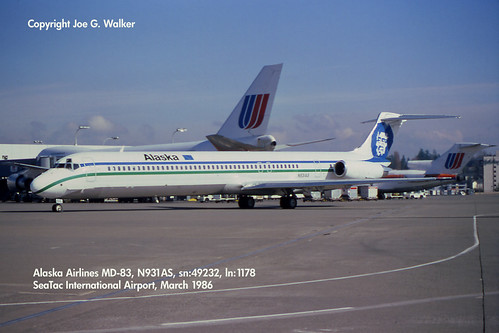
The three most important factors for Alaska came down to passenger capacity, delivery timeframe, and the deal clincher, price. And this is where Alaska scored its coup. Alaska's team knew that McDonnell Douglas was not only eager for an MD-80 sale, they were also wanting desperately a big order with Alaska to rub it in Boeing's face. There are four variants in the MD-80 family- the MD-81 was the initial production version, the MD-82 was an increased gross weight version of the MD-81, the MD-83 was an extended range version of the MD-82, and the later MD-88 had an EFIS cockpit (Delta launched this variant). Through the negotiation process as the deal swung in favor of McDonnell Douglas, the company based its planned contract with Alaska on the MD-82 variant. Alaska, however, knew McDonnell Douglas was coming out with the MD-83 and that was the variant the airline really wanted thanks to its longer range. When Alaska's team arrived in Long Beach for the final negotiations, the sales team presented Alaska with a letter of intent for an initial order of six MD-82s. That's when Alaska pulled out their ace card and told McDonnell Douglas they'd only sign to finalized the deal if they got the MD-83 and only if the MD-83s were at the same price as the MD-82. Backed into a corner, McDonnell Douglas relented and Alaska Airlines became the launch customer for the MD-83 variant. The initial order would be for nine aircraft- the first two to be delivered (N930AS and N931AS) were financed by a Japanese leasing agency while the other six were paid for out of Alaska's financial reserves. 

In Robert Serling's great book on the history of Alaska Airlines, he relates that once the deal for the MD-83 was signed, the CEO of Alaska, Bruce Kennedy, had to meet with the iconic head of Boeing, Thornton Wilson (or as most people knew him as just "T" given his personality) to break the news. Wilson grumbled to Kennedy "Damn it, Bruce, you know we build better airplanes then they do!" Kennedy responded that McDonnell Douglas was more aggressive on price and that the MD-80's seating capacity more closely matched the 727-200 than the 737-300 did. Serling wrote that Wilson cooled down and replied "Well, Bill Allen (a past CEO of Boeing) told me years ago never to regret a sale on which you would have lost money", something that did happen to McDonnell Douglas with the Alaska deal as they had so deeply discounted the MD-83 to make the sale. 

SEASLIDEN931ASsm copy
Alaska's first MD-80, N931AS.

Even though Alaska had signed for the MD-83, the first two aircraft delivered were actually MD-82/83 hybrids- they had the more powerful engines of the MD-83 but had smaller fuselage fuel tanks like the MD-82 get a bit more belly cargo space. The aircraft also had a new heavier landing gear than what the MD-82 had to handle the increased weight. Both aircraft were designated MD-82s, though. The first one delivered was N931AS on 20 February 1985 followed by N930AS on 29 March 1985. The delivery flight from Long Beach of N931AS turned out to be fiasco for Alaska and McDonnell Douglas as technical glitches delayed its departure for Seattle, then the water system on the aircraft failed in flight, preventing any of the toilets from flushing. In addition, to meet Alaska's timetable, the first four aircraft had less powerful engines temporarily fitted than the agreed production standard and that made for a long, slow flight to Seattle.

A total of 48 MD-80s would be operated by Alaska Airlines until the type's retirement in 2008. The most operated at any single time was 44 with one write-off, the tragic crash of Alaska 261 due to a tailplane jackscrew failure in 2000.

Related reading:

How American Airlines Saved the MD-80
Alaska's First Jet: "Seventy-Seven Hotel"
How the Lockheed Hercules Helped Open Alaska to Oil Exploration

Source: Character & Characters: The Spirit of Alaska Airlines by Robert J. Serling. Epicenter Press, 2008, pp 207-212. Fleet information from Planespotters.net. Photos: Wikipedia, JPSantiago, Joe Walker Collection/Flickr.

21 February 2015

The Marine Corps Bet on the Harrier

Hawker P.1172 Kestrel in KES markings
For a large part of the postwar history of American military aviation, the procurement of non-American aircraft was an unusual exception. I had written back in 2011 about the efforts that led to the selection of the Dassault Falcon 20 jet as the basis of the US Coast Guard's HU-25 Guardian medium range search-and-rescue aircraft.  The two most significant prior examples of non-American aircraft procurement were the Martin B-57 Canberra selected by the USAF as its new interdiction bomber in 1951 and the selection of the Hawker AV-8A Harrier which entered service with the Marine Corps in 1971. The story of the Marine Corps' evaluation and procurement of the Harrier is one that readily demonstrates the Marines' political savvy in navigating the treacherous waters of Congressional funding as well as a single-minded commitment to efficient close air support to the Marines on the ground. The predecessor of the Harrier was the Hawker-funded P.1127 Kestrel demonstrator. Two prototypes and four development aircraft were built and then followed by nine more developed P.1127 airframes which in 1963 were to be part of what was called the Kestrel Evaluation Squadron (KES). The aircraft were designated Kestrel FGA Mk1 and the KES was staffed with test pilots from the Royal Air Force, the Royal Navy, the US Navy, US Army, US Air Force, and the German Luftwaffe. Because there were three nations in the Kestrel Evaluation Squadron, it was also referred to as the Tripartite Evaluation Squadron (TES). The unit was formed in 1965 for the purpose of exploring the possibilities of a V/STOL combat aircraft. 

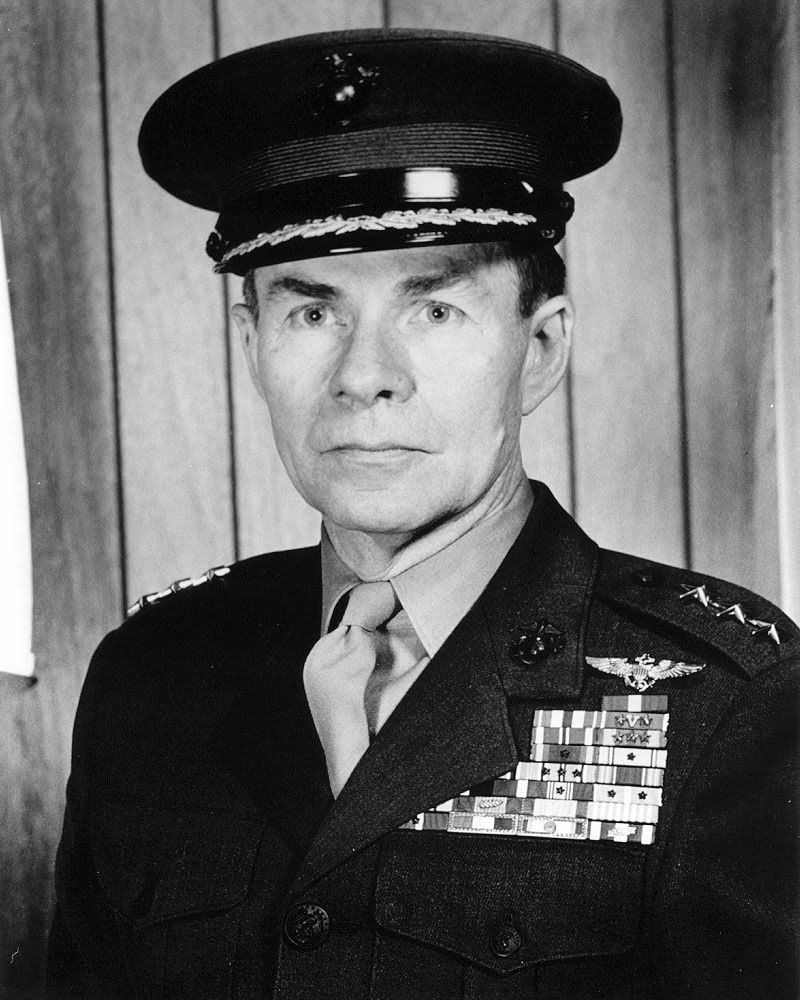
At the time of the KES flight program, Lt. Col. Thomas Miller was assigned to the US Marine Corps' Air Weapons Systems Requirements Branch at the headquarters. It was the job of the staff of this department to review all the latest research and development to see what sort of equipment would be useful to the Marines. Miller and a fellow officer, Lt. Col. John Metzko, had gotten hold of film footage from the British Embassy in Washington DC of the Kestrels in action. By this point, the RAF had committed to getting the Kestrel operational with a more developed aircraft called the Harrier. They had monitored the P.1127 Kestrel program despite not having any Marine pilots in the evaluation squadron and when it became clear the RAF was going to go forward with the Harrier, they immediately briefed the USMC Deputy Chief of Aviation who was none other than General Keith McCutcheon. I had written about him recently as the "Father of Modern Close Air Support" and needless to say, given General McCutcheon's background as a passionate advocate for the Marines' own close air support, he was readily on board to find out more about the Harrier. The next step was the brief the Commandant of the Corps, General Leonard F. Chapman. With the enthusiastic support of the Commandant, the Marines then set about on getting flight time on the new Harrier. The British were adamant that anyone who would be evaluating the Harrier be a qualified test pilot and working through the defense liasons at the British Embassy and Hawker Siddeley, Miller and Marine test pilot Lt. Col. Bud Baker were chosen to head to the UK. Miller's test flying experience was getting the A-4 Skyhawk and F-4 Phantom into Marine service, so he was well versed in what an aircraft had to be able to do to support the Marines on the ground. At the request of the British, the two Marines would clandestinely make 10 flights each in the Harrier and would wear civilian clothing during their stay in Britain during their evaluation. Test pilot John Farley of the Royal Aircraft Establishment worked with Miller and Baker to prepare them for their Harrier flights. It was Farley who made the first flight of the P.1127 Kestrel prototypes in 1964 and he would come to amass 19 years of experience as a Harrier test pilot. 

Gen. McCutcheon, USMC Deputy Chief of Aviation
Miller and Baker realized very quickly during their flights that the Harrier was a new breed of combat aircraft that Marines had to have. To them, it could do everything the A-4 Skyhawk could do but not need a 6,000 foot runway to do it. All it needed was a 1,000 foot strip for rolling STOL takeoffs with an increased weapon load or the deck of an amphibious assault carrier. It was clearly close air support that could not only go where the Marines were, but be readily based close to where the Marines were in action. To get their hands on the Harrier, the Marines needed funding. Not only did the Marines have to deal with the US Navy since the Marine Corps is a department of the Navy, but they weren't sure how the US aircraft industry would react to the Corps wanting a British aircraft. After briefing Commandant Chapman, they met with the Presidential Scientific Advisory Board to get their support.

Fortunately the Navy was receptive and sent over their own team to fly the Harrier as well which allowed them to compare with their earlier Kestrel flights as part of the KES. Also fortuitous for the Marines was that a Marine was in charge of the Navy's A-4 Skyhawk program, Col. Edwin Harper, and he got to fly the Harrier as well, giving him the unique perspective of comparing the Skyhawk with the Harrier. With the ready support of the Navy in 1969, the Marines now had to lobby Congress for the funding. The FY1970 budget didn't have any money for Harrier procurement, but Harper, Miller, Baker and General McCutcheon briefed the Senate Armed Services Committee anyway. McCutcheon made his pitch to the chairman, Senator Barry Goldwater, that he didn't want just a handful of Harriers and do an evaluation. That'd been done already. "We want to buy a whole slug of them and get started and have a meaningful program!" 

Rep. Mendel Rivers (D-South Carolina) crucial to the Harrier program
Though the FY1970 Department of Defense budget was set at their time of their briefing to the Senate Armed Services Committee, the support of the Presidential Scientific Advisory Board insured that supplemental funding was secured as an amendment to the FY1970 budget bill. The supplemental funding was enough to procure 12 Harrier jets at a cost of $57.6 million. But there was a catch- the money was secured via the Marines canceling procurement of 17 McDonnell Douglas F-4 Phantom IIs. It would be necessary to win over McDonnell Douglas. As part of getting Congressional support, the House Armed Services Committee was also briefed on the Harrier plans and the chairman of the House committee, Representative Mendel Rivers of South Carolina, would support the procurement of the 12 Harriers as long as future Harrier buys were aircraft built in the United States. Realizing that the Marines was a significant ground breaking sale into the US defense market, Hawker Siddeley immediately sent representatives to the United States to canvas the aircraft industry and find an American partner for the AV-8A Harrier program. Hawker's team met with eight aircraft manufacturers and narrowed the list down to three- Ling-Temco-Vought, Grumman, and McDonnell Douglas. Hawker felt McDonnell Douglas was the best fit given their naval aircraft experience and at the time, the A-4 Skyhawk program was starting to wind down and the AV-8A Harrier would be good transition for McDD. On 29 September, Hawker Siddeley and McDonnell Douglas signed a 15-year agreement to cooperate on the AV-8A Harrier program. In tandem with this agreement came one from Rolls Royce to team up with Pratt and Whitney on the Pegasus engine. The teams developed a plan to transition production of the Marine's AV-8A Harrier flight as well as the Pegasus engine from UK production to US production over a span of five years. With a planned buy of 114 AV-8A Harriers, it was found by Representative Mendel Rivers' staff that it was cheaper to stick with UK manufacture instead of phasing in production in the United States. During the FY1971 budget debate, discussions centered on the pros and cons of moving production to the United States and eventually Congress agreed with Mendel Rivers' analysis that there was no need to phase in production of the AV-8A in the United States. Though the agreement never resulted in US production, it did lay down the foundations for the later AV-8B Harrier II program. 

AV-8A Harriers of VMA-513, the first USMC Harrier unit
With Mendel Rivers' support now behind them, McDonnell Douglas agreed to become the engineering group responsible for product support of the AV-8A Harrier which was more than adequate compensation for the 17 canceled Phantoms. The AV-8A Harrier first entered service in 1971 at the Navy's Flight Test Center at NAS Patuxent River, Maryland while the first Harrier squadrons prepared for the transition to the AV-8A. The first operational Marine Corps squadron was VMA-513 "Flying Nightmares" which had been flying the F-4 Phantom since 1963. VMA-513 become operational with the AV-8A Harrier in May 1971 at MCAS Beaufort in Representative Mendel Rivers' home state of South Carolina. 

Source: Harrier II: Validating V/STOL by Lon O. Nordeen. Naval Institute Press, 2006, pp 23-30. Photos: Wikipedia, USMC.

27 December 2014

Rockwell Builds the Shuttle by Farming Out the Work

The Grumman Shuttle Orbiter design
On 26 July 1972, NASA announced that Rockwell International had been selected as the prime contractor for the Space Shuttle (specifically the Shuttle Orbiter) after an intense competition with Lockheed, Grumman, and McDonnell Douglas. Each contractor proposal also had to detail management of the complex program as well as its technical aspects and the lengthy proposals then went to a specially convened selection board at NASA which evaluated each submission. The top two proposals belonged to Rockwell and Grumman and showcased the effect that a good management proposal could have in winning the competition. From a technical standpoint, NASA scored the Grumman proposal the best, with Rockwell's orbiter design coming in second. Rockwell's submission, however, impressed the NASA selection board with its management system. With the cost overruns on several military programs like the Lockheed C-5 Galaxy on everyone's mind, Rockwell's management proposal stressed cost controls for what was to be the biggest aviation contract in years. With a technical design not much more inferior that the Grumman design, Rockwell was awarded the contract. 

In the industry slump as Vietnam was winding down, the Orbiter contract was a very big prize for any firm that could clinch the award. At the time of the selection, Rockwell had 6,200 employees in their Space Division and with the award, plans were in place to hire as many as 16,000 by 1975. Priority would given to anyone who had worked on the Apollo program. Despite the buoyant mood at Rockwell, things were considerably more glum at the losing contenders, Grumman, Lockheed, and McDonnell Douglas. Grumman had been a mainstay of the US space program from its early days, best known for its work on the Apollo Lunar Module. Company officials made plans for Grumman to be out of the space business by December 1972 along with the attendant layoffs. 

McDonnell Douglas (via McDonnell) had built the Mercury and Gemini spacecraft and was in the midst of winding down its work as the prime contractor for Skylab. The company was also suffering from a downturn in the world commercial aviation market that was affecting most greatly its Douglas DC-9 program. 11,000 layoffs were planned at McDonnell Douglas by 1973.

While Lockheed didn't have as prominent a role in the US manned spaceflight program in the 1960s as McDonnell Douglas or Grumman, their expertise in high speed flight as well as thermal protection systems was unparalleled in the industry at the time. 

Rockwell, however, recognized two realities that came with winning the Shuttle Orbiter contract. The first one was the limitations of its in-house expertise. Quite simply, Rockwell would need other aerospace companies for their skills and expertise to bring the Orbiter to fruition. The second reality was a bit more prosaic but nonetheless vital. Keep in mind that in the early 1970s there was an atmosphere of budget austerity and NASA was no less exempt from financial realities than any other government agency at the time. Subcontracting work on the Orbiter to other companies in effect would spread the footprint of the endeavor across the districts of multiple Congressional representatives who would be routinely voting on NASA's budgetary allocations for the Space Shuttle program. Subcontracts were a common way as well in the industry of building goodwill- by farming out work to competitors and keeping them active and in business, today's winner might one day become tomorrow's loser on a another program and could hope for subcontract work from a rival. 

Rockwell planned to subcontract at least 53% of the work on the Shuttle Orbiter and this had NASA's blessing as a means of preserving the American industrial base for spaceflight. Just weeks after winning the contract as the prime, Rockwell was already conducting seminars across the nation for potential subcontractors. By March 1973 Rockwell began selecting subcontractors for the program with NASA's approval. Grumman would work on the delta wing, McDonnell Douglas got the OMS (Orbital Maneuvering System), Fairchild Republic got the vertical fin, and the Convair Division of General Dynamics got the mid-fuselage/payload bay. Rockwell would be responsible for the nose and crew compartment as well as the aft fuselage that would house the three Rocketdyne SSME (Space Shuttle Main Engine) packages. Lockheed would get the External Tank while Thiokol got the contract for the SRB (Solid Rocket Booster). 

By the summer of 1975, 34,000 workers across 47 states and a broad host of companies across the American aerospace industry were working on the Space Shuttle program. The peak would be in 1977 with 47,000 workers. The post-Vietnam slump, the Space Shuttle program was very much the crown jewel of the US aviation industry. 

Source: Development of the Space Shuttle 1972-1981: History of the Space Shuttle, Volume Two by T.A. Heppenheimer. Smithsonian Institution Press, 2002. Illustration: Aerospace Projects Review


18 July 2012

The Mach 3 Phantom

In the 1960s the development of high-performance reconnaissance cameras offered greater resolution, but at a price- many of these systems were large and heavy and the current high-altitude spyplane of the time, the first generation variants of the Lockheed U-2, were unable to carry them. One of the premier recon optical systems developed at this time was the General Dynamics HIAC-1- a long range, oblique camera with a focal length of 66 inches that allowed stand-off reconnaissance from high altitudes. The first examples of HIAC-1 were heavy- the prototype camera system weighed over 3,500 lbs, much more than any other camera system in use at the time (excepting the very big Boston Camera carried by the B-36 and C-97 in the 1950s that weighed 3 tons and had a focal length of 240 inches). The only aircraft in the USAF inventory that could carry the HIAC-1 was the RB-57F, a modification of the Martin B-57 Canberra. In 1962 General Dynamics in Fort Worth, Texas, had the contract to maintain the RB-57D fleet which suffered from wing spar fatigue. Since General Dynamics had acquired quite a bit of experience in working on the long-span RB-57Ds, they were asked by the Air Force for an evolved version of the D that could fly higher, carry a heavier load (like the HIAC-1) and not have the same wing spar problems that plagued the RB-57D. The RB-57F was the result- with a longer wing, more powerful TF33 turbofan engines and auxillary J60 turbojets, it was what the USAF needed until the later generation of U-2 spyplanes entered service. In fact, two RB-57Fs are still used today by NASA. 

USAF RF-4C with the large G-139 pod.
Over the course of the RB-57F's operational career, Israel had made repeated requests of obtaining the RB-57F and the HIAC-1 for its own reconnaissance needs, but the requests were always denied by the US State Department and the Defense Department on the grounds that the technology used in the RB-57F would upset the strategic balance in the Middle East. However, a compromise was reached- by 1971 the HIAC-1 had been steadily improved and lightened to the point that it weighed just under 1,500 lbs and that a pod-mounted HIAC-1 carried by the McDonnell Douglas F-4E Phantom, already in the Israeli inventory, would be permissible. Also developed by General Dynamics, the pod-mounted HIAC-1 was designated G-139 and underwent an intensive flight test program with a USAF RF-4C aircraft and the first G-139 pods were delivered to Israel in October 1971. The Israelis found the G-139/HIAC-1 system useful as it allowed the Phantoms to get imagery of Egyptian defenses along the Suez Canal without having to enter the SAM umbrella. But there was a significant issue, the pod was still a heavy store and it generated a significant amount of drag- it limited the Phantoms to a maximum speed of Mach 1.5 and a maximum altitude just under 50,000 feet, not to mention the challenge of handling a G-139-laden F-4E at high altitude. As a result, the special projects division of General Dynamics began work in January 1972 on ways to improve the F-4E's performance to offset the burden of carrying the pod. 

Overview of the modifications to make the Phantom Mach 3-capable.
The first improvements came with getting the most out of the Phantom's J79 engines. Engineers found that the Phantom's intakes were limiting the performance possible from the J79. A new inlet was designed that was not only larger than the standard F-4 inlet, but it featured a new shape that better managed the airflow to the engines with series of new variable-geometry ramps. The standard Phantom inlet did have a variable geometry ramp, but it was much simpler than the General Dynamics design which also featured a large bypass door downstream from the inlet to help manage the internal shockwaves that helped slow the air down before it reached the engines. A series of vortex generators down the inlet also helped improve engine performance. The second improvement was based on 1950s research done by NASA's predecessor agency, NACA, called pre-compressor cooling (PCC). PCC was a form of water injection but used the water to cool in the inlet air before it reached the engines. By reducing the inlet air temperature, it increased the mass of the air akin to taking off on a cold day- engine air flow and thereby thrust would be increased. At high altitudes, PCC would boost engine performance starting at Mach 1.4 as the inlet air started to heat up due to friction. 

General Electric, the manufacturer of the J79, was less than enthused about General Dynamics' work on PCC, but did provide some consultations. Work had already been done with PCC on another of General Dynamics' products, the Convair F-106 Delta Dart, but it never was incorporated into the design. In addition, the USAF's Arnold Engineering Development Center in Tennessee had tested PCC in engine test cells with both the J57 and J75 engines. One J75 engine was run at maximum afterburner for 40 hours with PCC! It had also been looked at by Vought for the aborted F8U-3 Crusader III design (though never flown) and McDonnell had used a rudimentary PCC system in 1962 to break several world speed records with the pre-production F-4 Phantom. Based on all this body of work, General Dynamics refined the PCC system so that the water droplets were very fine at 10 microns to cool the air without having any pooling of water in the engine. Two large water tanks were installed on external blisters along the sides of the F-4E, each blister with three tanks. Each blister could carry 2,500 lbs of demineralized water- since the interior of the Phantom was pretty packed as it was, scabbing these blisters on the fuselage eased the modification and engineering process. 

GD wind tunnel model of the RF-4X.
General Dynamics' modifications led to this version of the Phantom being unofficially designated the F-4X- at this point still carrying the large G-139/HIAC-1 pod underneath on the centerline station. With Israeli funding supplementing internal corporate, work on the F-4X continued through 1972 and refinements to the PCC system and inlets led to a calculated increase in the J79 thrust at high altitude well over 150 percent! On 12 April 1973 the company formally submitted the F-4X proposal to the USAF. Additional funding for more work then came from the USAF which was using the podded HIAC-1 system for stand-off reconnaissance in Korea and were encountering the same issues the Israelis were having in using standard Phantoms with the large camera pod. The following year the design was further refined, but with the Israelis having continued misgivings about using the HIAC-1 in a pod, the design leap was made to incorporate the HIAC-1 into F-4X's nose- with the latest HIAC-1 versions getting even lighter than the 1,500 lb version used in the G-139 pod, integrating the camera into the nose improved performance by eliminating the drag-inducing pod. Designated RF-4X, this version of the Phantom was now capable of cruising at Mach 2.4 at high altitude with burst capability to Mach 3.2. This level of performance now began to alarm the US State Department- up to this point Mach 3+ aircraft were the sole purview of the United States and Soviet Union and in some diplomatic circles there were concerns about the Israelis integrating nuclear weapons delivery with the RF-4X. To allay the State Department's concerns, General Dynamics removed the AN/APQ-120 radar from the nose which would now only house the HIAC-1 and its associated environmental control systems. Permission to sell the RF-4X to the Israelis was approved and on November 1974 an Israeli F-4E was flown to General Dynamics in Fort Worth for a mock up study. For five months engineers used the F-4E as the basis of a full-scale mock-up created with cardboard and tape- both the Mach 3 intakes and the PCC water tanks were mocked up on the Phantom on one side as well as the modified nose housing for the HIAC-1 camera. 

Israeli F-4E with the PCC and intake mock-up on one side.
By 1975 several factors were now working against the RF-4X, the biggest of which was time. The Israeli Air Force wanted the system as soon as possible but it was clear that the integration of the camera, intakes and PCC system was going to take more time than originally estimated. With the McDonnell Douglas F-15 winding up its flight test program and soon to become operational in the following year to replace the Phantom in USAF service, it was politically unpalatable to keep funding the RF-4X which offered a level of performance that exceeded that of the Eagle in some flight regimes. The USAF insisted upon further studies of the PCC system despite the fact that there were already nearly 20 years of data on pre-compressor cooling, some of which done by the USAF itself. Compounded with the engineering delays, Israel and the RF-4X proponents in the USAF lost interest and it was quietly canceled later that year.

Despite the cancellation of the RF-4X, General Dynamics did continue work on just the nose-mounted HIAC-1 component of the design for Israel. Three F-4E Phantoms were modified as F-4E(S) aircraft and delivered to the Israeli Air Force from late 1975 to early 1976. It turned out that the Israelis were unable to fund the RF-4X in its entirety and were only able to afford the HIAC-1 component. As a result, the three F-4E(S) aircraft had standard J79 engines. In IDF service the HIAC-1 was code-named "Shablul", the Hebrew word for "snail". The first operational flights began in 1976 with the aircraft capable of flying at 60,000 feet at Mach 1.9. The pilot and systems officer wore full pressure suits from the David Clark Company which also made the pressure suits used by USAF U-2 and SR-71 crews as well as Space Shuttle crews. Many of the missions flown still remain classified but it is known that Iraq was a frequent target through the 1980s. One of the aircraft is now on public display at the Israeli Air Force Museum. 

Source/Photos: Israeli Phantoms- The 'Kurnass' in IDF/AF Service 1989 Until Today by Andreas Klein and Shlomo Aloni. Double Ugly Books/AirDOC, 2009, p44-70.

01 October 2011

Rivet Haste: Rebirth of the USAF at the end of Vietnam


Heritage Flight F-4E Phantom painted in Vietnam-era colors.
In several prior postings I had talked about how the United States set about improving the performance of its fighter pilots over the skies of Vietnam. The first one dealt with the testing and analysis of MiG fighters that had been obtained secretly by the United States and the second posting covered the origins of Red Flag, the exercises in Nevada that gave pilots valuable experience under simulated combat conditions. The Navy also instituted measures to improve its fighter pilots' performance after the Ault Report was commissioned by the Chief of Naval Operations to review naval air-to-air tactics. One thing to keep in mind is that there were numerous parallel measures being undertaken in the late 1960s and early 1970s to improve the dogfighting skills of American pilots. The main American fighter of the day that was in service with both the US Navy and USAF was the McDonnell Douglas F-4 Phantom II. The Air Force in particular, also looked at ways of improving the performance of the Phantom, a design that was originally intended for fleet air defense but found itself in swirling low speed dogfights over Vietnam for which it was never designed. 

The Phantom had two idiosyncrasies that proved to be a liability in a dogfight. Being a big hulking fighter with two J79 engines that left a nice smoke trail for the enemy to spot were one of just many faults of the aircraft. As the engines of the Phantom were optimized for high speed, so to were the aircraft's aerodynamics. In the low-speed regime during a dogfight, the F-4 was prone to what was called adverse yaw- normally when the pilot wanted to turn one direction, he only had to move the stick in that direction. At low speeds and high angles of attack that were commonplace in a dogfight, however, if a pilot pushed the stick to the left, the downward-deflected aileron on the right wing would produce more drag than lift, causing the Phantom to yaw back to the right even though the pilot wanted to turn left. As the yaw increases, the effective sweep on the left wing decreases and it starts to produce more left and the F-4 snaps to the right and then into a spin. All this happened nearly instantly and pilots had to compensate for the adverse yaw when rolling left or right by using the rudder aggressively during close air combat- instead of moving the stick into the direction of the turn, the rudder was deflected. So a left turn meant keeping the stick centered and pushing the left rudder pedal down. This causes the Phantom to yaw to the left and this decreases the effective sweep on the right wing- it therefore creates more lift and the plane now snap rolls into the direction of the turn. This took a lot of practice and it was suspected that a significant number of Phantom combat losses were due to adverse yaw conditions. 

The ergonomics of the Phantom cockpit weren't exactly great, either, with a mass of switches and dials that most Phantom drivers felt were scattered randomly over the instrument panel and side consoles. Most derided by the pilots were the switches on the panel by the pilot's left knee that controlled the Sidewinder and Sparrow missiles- one of the switches was a three-position switch that cycled through the Sidewinders and Sparrows. It felt identical to the other control switches on the missile panel and the last thing pilots wanted to do was look at the switch to make sure they flipped the right one in the middle of a dogfight. Resourceful pilots in Vietnam got hold a piece of plastic tubing that was used to sample oil from the engines. Cutting it into a two-inch length, it was slipped over the end of the switch so it stuck out from other switches. All a pilot had to do during combat was swat the tubing by his left knee to cycle through his missiles. 

South Korean F-4E shows off its leading edge slats.
When the F-4E entered service, its most obvious advantage was that it had an internal cannon in the nose, rectifying a situation often encountered in Vietnam when the MiGs were inside of the minimum launch parameters for either the Sidewinder or the Sparrow missiles. But the F-4Es had another advantage and that was what was called a "soft wing"- the wing now had leading edge slats that were controlled automatically by the flight control system whenever the angle of attack would reach a certain level. When the AoA hit this preset level, the slats would automatically pop out and it increased the lift across the wing- this had a dual effect on the Phantom- it eliminated the adverse yaw condition, even at high angles of attack. And secondly, the Phantom became practically spin proof as adverse yaw got eliminated- accidents from spins dropped dramatically and pilots could now haul around the beast in the sky without worrying about loss of control. In fact, some pilots felt that the soft wing F-4E flew just like the Northrop T-38 Talons used in advanced flight training. 

When the USAF brass got word of the improvised plastic tubing modification used in Vietnam, it became apparent after some analysis that many MiG kills were missed due to the missile switches being configured incorrectly. And truth be told, it was pretty embarrassing to know that to make a multimillion dollar fighter more effective in combat needed a cheap piece of tubing. The Air Force came out with a modification to the F-4E that was numbered 556. Pilots called it the "five-five-six mod" and what it did was add a switch on the outside of the left throttle. Operated by the pilot's left pinkie finger (hence it was called the "pinkie switch"), it if was pushed forward, the Sparrow missile was selected. If it was in the middle setting, a Sidewinder was selected. And if it was pulled all the way back, the F-4E's gun was selected. Since the pilot's hand was always on the throttles, the switch was readily accessible. The second part of the 556 mod was another switch added to the front of the left throttle that allowed the pilot to instantly reconfigure the weapons systems from air-to-ground to air-to-air. No longer was there a switch sequence to follow. Push one button, that was it. Other changes consolidated the bomb dropping switches into a single small panel. 

TISEO unit on the F-4E.
While the soft wing and the pinkie switch did much to ease the pilot's workload in air combat, there was still the issue of the rules of engagement requiring visual identification of a MiG before shooting. This restriction pretty much rendered the Sparrow useless as a beyond-visual range (BVR) weapon that could swat MiGs down from unseen distances. The biggest problem with the Sparrow with the RoE in use over Vietnam was that most engagements began head-on. At that distance, the Sparrow could be fired at a maximum of ten miles and a minimum of three miles. But head-on, the MiGs were much smaller and harder to see even if with a radar lock. With closure rates approaching one mile every three seconds, by the time the Phantom crew had a positive visual on the MiG, it was already too late to fire a Sparrow. The solution was called TISEO- Target Identification System Electro-Optical. Some F-4Es had an electro-optical telescope mounted on the leading edge of the left wing above the inboard pylon. The telescope had 4x and 10x magnification and displayed the image on the WSO's radar display. Now when the backseater had a radar lock, he could command the TISEO to track the target and then switch to 10x magnification for visual identification while the MiG was still in the firing envelope of the Sparrow missile.

With the soft wing, the pinkie switch, and the TISEO, the USAF realized it had the tools to make its fighter pilots more lethal. In the late summer of 1972, the Rivet Haste program was established. Rivet Haste would be the Air Force's acknowledgement that years of substandard training and poor doctrine had to be reversed. Rivet Haste combined the slatted wing, TISEO, and 556 mod of the F-4E and teamed them up with handpicked crews with combat experience over Vietnam. They were assembled at Nellis AFB and here the key of Rivet Haste would take place- intensive training with the new F-4Es against the secret MiG force that Air Force flew out of Tonopah north of Las Vegas. Each Rivet Haste crew were paired up to stay together through training to deployment for combat- this allowed the pilot and his WSO to develop their own system of coordination in the cockpit and carry that to combat. Six pilots and six WSOs were in each Rivet Haste group and each pilot/WSO would fly at least three missions against the MiGs at Tonopah. Each month, a new group of six pilots and six WSOs were assigned to Rivet Haste. Crews assigned to Rivet Haste saw it as a quantum leap in air combat training that the USAF had never had before, but the war in Vietnam ended less than two weeks after the first Rivet Haste crews arrived in Southeast Asia. 

It wasn't all for naught, though. The 556 mod spawned a cockpit design philosophy called HOTAS- Hands On Throttle And Stick- this meant that every function that a pilot needed in air combat (and even in air to ground combat) would be instantly accessible either on the throttle or stick. Many of the crews that were part of Rivet Haste would go on into important leadership positions in the post-Vietnam USAF that would result in a greater emphasis on realistic training. The realistic training provided to Rivet Haste crews would be one of several foundations that would result in the Red Flag exercises. 

As the saying today goes "Fight like you train, train like you fight". 

Source: Sierra Hotel: Flying Air Force Fighters in the Decade After Vietnam by C.R. Anderegg. Air Force History and Museums Program, 2001, p11-13, 32-35.

27 January 2011

The First Successful Combat Drops of Laser-Guided Bombs

Capt. Thomas Messett led the first combat LGB drop
By 1972 President Richard Nixon's policy of "Vietnamization" was underway as the bulk of responsibility for the defense of South Vietnam transferred from US forces to the South Vietnamese military. Nearly the bulk of US forces in Vietnam had already departed and the Seventh Air Force had already sent half of its combat aircraft back stateside. Only two aircraft carriers remained in the Gulf of Tonkin. The North Vietnamese saw the opportunity to win the war via a conventional attack and on 29 March 1972, twelve of North Vietnam's fifteen divisions made a three-pronged invasion into South Vietnam, leaving only one division in North Vietnam and two divisions in Laos in reserve. Within three days of the Easter invasion, South Vietnamese forces were on the brink of collapse. Over the course of the month of April, a massive influx of US combat aircraft striking the advancing NVA was all that prevented the collapse of the Saigon regime. On 8 May 1972 US Navy aircraft mined the approaches to Haiphong harbor and that evening President Nixon addressed the nation to announce Operation Linebacker, the intensive bombing of North Vietnam, to commence on 10 May 1972. With the North Vietnamese having exposed their logistical tail in their multi-pronged invasion of the South, they left themselves open to air attack on their rear. 

On the first day of Linebacker, sixteen McDonnell Douglas F-4 Phantoms of the 8th Tactical Fighter Wing "Wolfpack" based at RTAFB Ubon in Thailand armed with 2,000 lb electro-optically guided bombs attacked the Paul Doumer Bridge that linked the port city of Haiphong with the capital of Hanoi over the Red River. The weapon systems officers (WSOs) in the back seat of the Phantoms used a TV screen to display the image from the TV camera in the nose of the bomb. Picking out a sharp contrast point between light and dark, the WSOs selected the aim points on the bridge and the bombs were on their way after the dropping aircraft turned for safety. Every electro-optical bomb missed, with the bombs locking on the shadow of the bridge on the water below or suffering a guidance unit failure. Some other supporting aircraft scored hits with conventional bombs, but none of the spans had been dropped. 

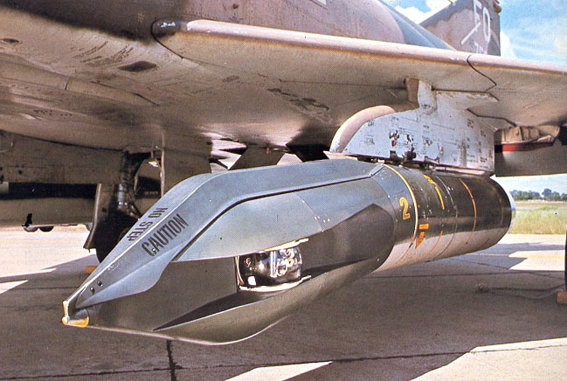
The AN/AVQ-10 Pave Knife, showing the camera/laser aperture
While the first laser-guided bombs were under development prior to the 1968 bombing halt, continued work by Texas Instruments had improved the method from the hand-held "Zot Box" that was used by the WSO while the Phantom flew a pylon turn around the target to podded systems in the form of the AN/AVQ-10 Pave Knife that allowed more flexible attack approaches to be made. The WSO used the laser in the Pave Knife pod to designate the target point for the laser-guided bombs. The 8th TFW at Ubon had six Pave Knife pods and it was decided to use them on the next day to revisit the Paul Doumer Bridge. Compared to the sixteen aircraft from the previous day, on 11 May 1972 only four F-4D Phantoms led by Captain Thomas Messett (who flew in the previous day's raid) would attack the bridge. One Phantom carried two 3,000 lb LGBs and the other three Phantoms carried two 2,000 lb LGBs. Only Captain Messett's F-4 carried a Pave Knife pod. The defenders of the bridge didn't think the four Phantoms were the main strike force and as they dived on the bridge, Messett and his WSO designated target points on the bridge and all eight bombs scored direct hits on the bridge, dropping the entire span on the Hanoi side of the bridge into the Red River. It would be a year before the Paul Doumer Bridge was usable again. 

The 3,000 lb GBU-11 added fins and laser guidance to the M118 bomb
The other bridge that was crucial to hitting at the North Vietnamese logistical support of the Easter invasion was the Thanh Hoa Bridge, an immensely tough rail bridge nicknamed "Dragon's Jaw" that crossed the Song Ma River and connected the rail shipment points from China to Hanoi. During Operation Rolling Thunder from 1965 to 1968 over 1,000 missions flew against the Dragon's Jaw, not one mission succeeding in bringing its spans down. The USAF even resorted to dropping floating bombs upstream of the bridge to try and bring it down in Operation Carolina Moon. Nothing worked, it was known as the toughest target in North Vietnam.  On 13 May 1972, two days after the Paul Doumer Bridge was dropped, the 8th TFW set out to drop the Thanh Hoa Bridge for good with fourteen Phantoms carrying nine 3,000 lb LGBs, fifteen 2,000 lb LGBs, and forty-eight 500 lb conventional bombs (due to a shortage of laser-guided bombs). Attacking through an intense flak barrage, direct hits by the LGBs put the entire western span of the Dragon's Jaw into the Song Ma River below. Before the end of Linebacker I in October, the Navy flew an additional eleven missions against the bridge and the USAF another two to insure the bridge was out for good. 

Post-strike recon photo of the Paul Doumer Bridge
It was a stunning debut for a new age of precision munitions. When the Pave Knife was used against the Paul Doumer and Thanh Hoa Bridges by the 8th TFW, it was technically still a developmental program and was rushed forward in response to Nixon's order to blunt the North Vietnamese invasion. Twelve pods were built for the testing program. When the preparations for Operation Linebacker started, three pods stayed stateside to continue the testing program. Three pods went to the US Navy for use on specially-wired Grumman A-6A Intruders and six pods went to the 8th TFW at Ubon for use on specially-wired F-4D Phantoms. Two pods were lost over North Vietnam during Linebacker I- the remaining four pods became quite valuable and after Paul Doumer and Thanh Hoa, were used only on the most critical and important targets. The commander of the Seventh Air Force, General John Vogt, reportedly told the pilots of the 8th TFW "Don't come back if you don't have that pod with you when you return!"

Source: The Linebacker Raids: The Bombing of North Vietnam, 1972 by John T. Smith. Arms and Armour Press, 1998, p61-75.