Showing posts with label 727. Show all posts

07 April 2016

CHECK SIX: Trans World Airlines Goes All-Jet


As the sun rose on 7 April 1967, history was made as TWA became first US airline to go all pure-jet, having retired its Constellations and Starliners the night prior. The last TWA passenger Connie service was Flight 249 JFK-Philadelphia-Pittsburgh-Columbus-Louisville-St. Louis. The next day the last one flew to storage in Kansas City where there were 35 other Super Constellations and Starliners awaiting their fate. The night of 6 April, ground service crews put a booklet in all the seat back pockets of the TWA passenger aircraft titled "Props Are For Boats". 

The introduction of the Boeing 727 and Douglas DC-9 accelerated the Constellation retirement which by the 1960s were relegated to short haul domestic routes and some cargo flying. Two Connies soldiered on after 7 April on cargo-only duties, though. From the introduction of the Lockheed Constellation with TWA's dramatic 1944 delivery flight to Washington flown by Howard Hughes to its retirement to the 1967 retirement from passenger service, the Constellation family served TWA for 23 years with over 140 examples. 

Within two years, by 1969, Trans World Airlines had surpassed the iconic Pan American in the number of passengers carried across the Atlantic. 

Further reading: 


(Photo: FlyerTalk Forums)

02 February 2016

Amidst Internal Turmoil, TWA Orders the Boeing 727

Trans World Airlines' first Boeing 727-100 and 727-200
(The Chicken Works: The Aviation Art of JP Santiago)
TWA launched its first jet services on 25 January 1959 between New York Idlewild-San Francisco with the Boeing 707 in competition with American Airlines' launch of 707 services between New York Idlewild and Los Angeles. Howard Hughes pushed TWA's finances to the limit to get into jets and while the arrival of the Jet Age to TWA marked the beginning of its zenith, it also laid the groundwork for Howard Hughes' eventual exit from TWA despite the near-limitless capital that he could access from his own parent company, Hughes Toolco. In February 1956 he ordered eight Boeing 707-120s, then followed in June 1956 with an order for 30 Convair 880s, and then 25 more Boeing 707s in May 1957. The value of these three orders was $300 million for the 63 jets, quite a large sum for those days. TWA raised additional funds with a one-to-one stock offering underwritten by Hughes Toolco that also gave Hughes 77% control of the airline. But the money raised from the stock offer wasn't enough and it looked like TWA couldn't meet its payroll obligations for the first quarter of 1958- Hughes borrowed $12 million from the banks, but at this point, one of TWA's original 1945 backers, Equitable Life, wanted a long term financing plan for the 63-jet order as it was getting nervous about Hughes' borrowing to meet basic costs like payroll. 

To ease the creditors, Hughes had Toolco accept the obligations for the jet order who in turn would lease the aircraft to TWA. Aircraft orders were swapped with Pan American (something that pained Hughes to have to approach his rival Juan Trippe to help TWA out) and the Convair order was cut to 20 aircraft. It still wasn't enough and some of Hughes' banks cut off his credit in March 1960. With the other creditors, a short term financing plan was arranged to allow TWA to keep operating provided Toolco assumed all financial liabilities for the airline as long as there was a change in management at TWA. To further put the brakes on Hughes, his shares in TWA were put into a voting trust which essentially (and controversially for the day) locked out Hughes from the airline. While a financing plan agreeable to all the parties was eventually settled upon at the end of 1960, Hughes still found himself shut out of TWA and for six years lawsuit and countersuit after another were filed as he tried to regain control of TWA. He would finally give up in 1966 when in May of that year Hughes Toolco sold off its entire share of TWA stock and he was out of the airline business for the time being - four years later he bought Air West, but that's a topic for a future article!

Despite the legal battle over leadership and control over TWA, the airline still held gravitas in the airline market and with the traveling public, managing to overtake Pan Am in 1969 in numbers of passengers flown across the Atlantic. Despite Hughes' virtual ouster in 1960, TWA's managers realized they had something that rival Pan Am didn't- a domestic route network and it was high time on the heels of the launch of 707 services to bring short haul jet service to TWA's network. In 1961 TWA had ordered 10 Sud-Aviation Caravelles that would have been powered by GE aft fan CJ805 engines, but that order was canceled in May 1962 when Boeing's 727-100 offered greater promise; in fact, TWA had already ordered the Boeing 727-100 (10 aircraft) in March 1962 while it still had the Caravelle order in place. The airline's first two Boeing 727-100s were delivered on the same day, N850TW and N851TW which were delivered on 29 April 1964 with the first 727-100 services started on 1 June 1964 with two daily round trips between New York JFK and Indianapolis with services expanding to Boston, St. Louis, and Kansas City on 5 June. On 1 July 1964, TWA returned to New York La Guardia with four 727 flights per day. By the end of 1964, the 100th jet aircraft in TWA's fleet was in fact a Boeing 727-100 which the airline dubbed the "Jetennial" plane. By the end of 1964, TWA already had sixteen 727-100s in service. 

TWA's 100th Jet was a Boeing 727-100
(TWA Skyliners Collection)
N850TW along with N851TW were TWA's first 727 jets
(The Chicken Works: The Aviation Art of JP Santiago)
The delivery of the Boeing 727-100s allowed TWA to finally retire its last passenger Lockheed Constellations on 6 April 1967 and become the first all-pure jet major airline in the United States. The last cargo Constellations were retired in the following month (12 May) with the introduction of six examples of "quick change" 727-100QC variant in the airline's fleet. The -100QCs were ordered in 1965. 
N12301 was TWA's first Boeing 727-200
(The Chicken Works: The Aviation Art of JP Santiago)
With the 727-100 and the new Douglas DC-9 now flying short/medium jet services, in March 1968 TWA added the larger Boeing 727-200 to its fleet, the first -200 being N12301, delivered on 6 March 1968. Over its history, TWA's 727s were a vital backbone of its fleet with a total of 36 727-100s and 78 727-200s operated total- in fact, the 727 served longer with TWA than any other aircraft type used on a continuous basis by the airline. The Lockheed Constellation family, from the short body L-749 to the L-1649 Starliner, served for about 20 years. The Boeing 707s nearly served 25 years. The 727 at TWA outlasted the Lockheed L-1011 Tristar by nine years and the Boeing 747 by about seven years. The last 727 service at TWA took place on 30 September 2000, a remarkable 36-year history with the venerable trijet with the airline. 

Related reading: 


The TWA Starstream 727 print can be seen in more detail here. Contact me at thechickenworks@gmail.com for details. 

Sources: TWA Skyliner Collection, The State Historical Society of Missouri. TWA: An Airline and Its Aircraft 75 Years of Pioneering Progress by R.E.G. Davies. Palawdr Press, 2000, p75-81. 


14 December 2015

BEA Gets the Trident and More

BEA Trident 1C in the original delivery colors
(Wikipedia)
A while back I had posted about a short lived proposal between Boeing and De Havilland for the former company to license build the DH.121 Trident in the United States. That was but one of many twists and turns in the rivalry between the DH.121 Trident and the Boeing 727. Building on the success of the 707 family, Boeing next launched the 727-100 for the short-haul market and like the Trident, was a T-tailed three-engined aircraft built broadly to the same specifications. But having cut its teeth on the commercial market successfully with the 707, the 727 quickly gained fame as a technological and aerodynamic success that could fly near its limiting Mach number at 37,000 feet smoothly yet possess the high-lift wings to allow it to land at speeds as low as 100mph and serve short airfields and smaller communities. The Trident, on the other hand, wasn't designed for short field performance and had the nickname "Gripper" by its pilots on account of its long takeoff run. Its engines weren't as powerful as the new Pratt & Whitney JT8Ds on the 727 and De Havilland actually pitched the Trident as an "economy aircraft" on contrast with the hot rod performance of the 727. 

De Havilland originally had designed a larger aircraft that could have boasted the seat-mile economics of the 727, but as the aircraft was being designed to British European Airways (BEA) requirements for European services, BEA wanted a smaller aircraft and the first version of the Trident carried only 78 passengers. It ended up having to compete with the successful Caravelle in capacity below the Trident and the Boeing 727 on the top end of the capacity segment. De Havilland even tried to pitch a version of the Trident to American Airlines which at that point hadn't made up its mind yet on the 727 whereas Eastern and United had already committed their launch orders. But in August 1961 American followed United and Eastern in ordering 25 727-100s in a crushing blow to the British sales effort. And to add insult to injury, De Havilland was having a difficult time pleasing BEA, its planned primary customer as BEA kept changing its requirements and asking for changes to the Trident design. Once changed and approved for production, BEA would come back with another set of changes resulting in a small production block with several different variants to suit BEA's wishes. Some in the De Havilland program felt that BEA was trying to sabotage the Trident with its requests while Boeing turned out 727s in only two basic versions by the hundreds. Even later versions of the Trident with higher-powered Rolls-Royce Spey engines and longer fuselages to carry more passengers failed to dent the 727 worldwide sales juggernaut as order after order bypassed the Trident in favor of the 727.

BEA Trident Two- the aircraft was progressively improved
(Wikipedia)
On 22 November 1965 the British Minister of Aviation, John Stonehouse, affirmed the government's support for the longer ranged Trident Two version which interested BEA more than the Trident 1 versions (despite the Trident 1 being built to BEA's own specifications). Parliament even approved funding to launch the Trident Two program. But in the following year, the head of BEA, Sir Anthony Milward, not only said BEA needed less capacity than the Trident Two, but that he had also had discussions with Boeing and Douglas. Some historians feel that Milward was engaged in brinkmanship with the UK government to get the Tridents as the lowest price possible. Milward himself stated publicly that "BEA wanted to buy British, but that it could not afford to buy British if the product was not the best on the market." De Havilland then went on to create the Trident Three, BAC offered a stretched version of the BAC One-Eleven and even Vickers proposed a short-haul version of the VC-10. But the 727-200, 737-200, and the DC-9 were also on BEA's table for discussion. 

With the election of a new Labour Party government keen on supporting British industry, Milward warned that "If a British aircraft was available to do this job at the right price we'd be delighted. At the moment there are no signs that such a British aircraft is available." It was well-known that BEA had asked for approval to purchase 35 727-200s and 737-200s. De Havilland was astonished that after creating larger versions of the Trident, BEA said the market had an overcapacity, but then turned around and wanted order larger American aircraft. 

BEA Trident Three in British European's final livery
(Wikipedia)
Already the Labour government was under fire for campaigning to support British industry but had already ordered the McDonnell Douglas F-4 Phantom, the Lockheed C-130 Hercules, and the General Dynamics F-111 to replace the canceled TSR.2. Despite BEA's desires for American jets, the political winds in London of the day dictated that they had to buy British, no matter what. BAC offered the Two-Eleven successor design to the One-Eleven, but BAC required millions of dollars in launch aid to start work on the Two-Eleven. Eventually the Two-Eleven project had to be abandoned and support had to be shifted over to the penultimate version of the Trident, the Trident Three. BEA was directed to purchase this aircraft and Milward made plain that the Trident Three was BEA's third choice and if it were compelled to operate the Trident Three, then BEA should receive compensation from the British government for not getting the more economical 727-200s and 737-200s they wanted. 

The new Minister of Aviation, John Mulley, found himself backed into a corner by BEA and the British government. BEA had to buy the Trident Three at the direction of the government but BEA wanted compensation to offset the higher operating economics of operating the Trident Three. 

On 13 March 1968, BEA announced it was ordering 26 Trident Threes with options for 10 more. Four months later, the government announced what was called the "Mulley Pledge"- approximately US$50 million was transferred to BEA and was calculated to be the cost difference between the higher seat-mile costs of the Trident Three versus the 727-200. And additional 50% of that initial transfer would be made available later to BEA, fufilling the Labour government's pledge to support the British aircraft industry. 

29 November 2015

Delta Air Lines and the Boeing 747-100

On 9 September 2015, the very first Boeing 747-400 built, N661US, touched down at Atlanta from Honolulu as Delta Flight 836 for the last time in revenue passenger service. Ship 6301 was the Boeing 747-400 prototype which was then delivered to launch customer Northwest Airlines on 8 December 1989 and came over to Delta with the 2008 merger. There are twelve remaining 747-400s flying with Delta, all of which came over from Northwest. Current fleet planning will have these 747s retired in 2017. Delta did however, for a brief time, operate the first variant of the 747 family, the 747-100, from September 1970 to April 1977. Only five aircraft were taken on strength with Delta and while the 747-100 was but a short historical footnote in Delta’s history, its legacy looms large to this day with the airline.

741_Delta_p2.jpg
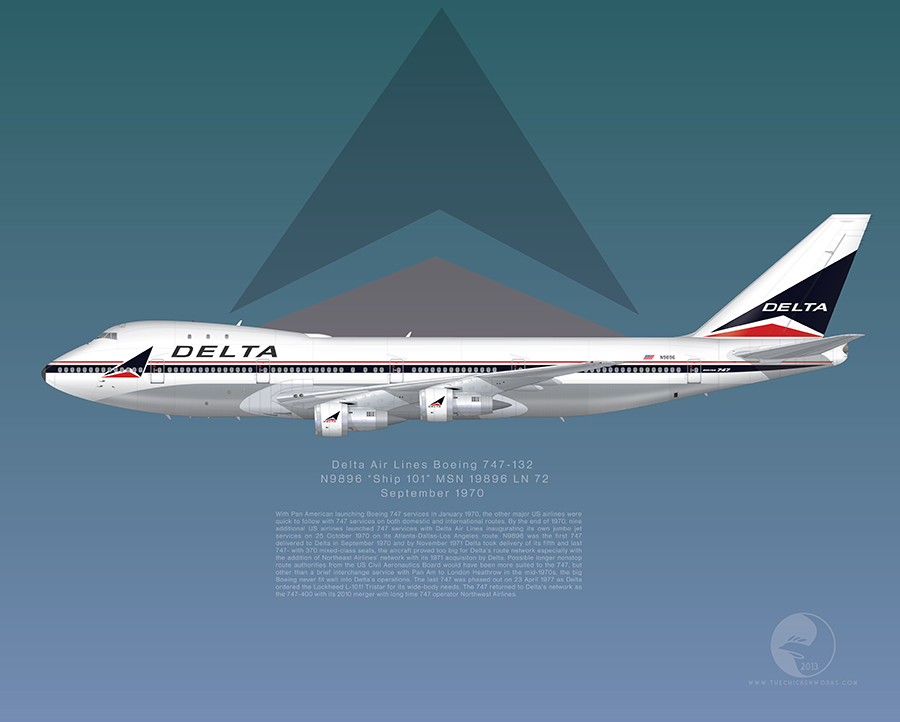
My own profile art of Delta’s first 747-100, N9896 “Ship 101” as it looked on her delivery in 1970.
(JP Santiago)

In order to understand what the 747 was for Delta at the time, one has to consider that as the 1960s were drawing to a close, Delta was in the midst of transition on several fronts. The first change change came with the Southern Transcontinental Route Case of 1961. Prior to deregulation, airlines often had to make a case for the opening of new services and routes to the Civil Aeronautics Board. Often these cases consisted of years of deliberation and often politics played a central role in airlines winning favorable rulings from the CAB. In the 1950s, the CAB favored interchange services as a means for airlines to open up new markets without saturating a given route with an excess of seats, harming profitability. Having a predominantly Southeastern US-anchored network, Delta linked up with several other airlines to offer interchange services which allowed it to fly as far west as California. As traffic grew on the interchange services to the West Coast, Delta petitioned the CAB to operate the West Coast services on its own and in one of the more historic decisions made by the CAB, both Delta and National were given route authorities to California from the southeast in what was called the Southern Transcontinental Route Case. Starting in 1961, the previous interchange agreements were declared redundant and Delta opened up a range of nonstop services to San Diego, Los Angeles, and San Francisco from Atlanta, Dallas, and New Orleans. Within a year, Las Vegas was added as well as Miami which for the first time made Delta a transcontinental airline. By 1963, the CAB permitted Delta to carry West Coast traffic to its Caribbean destinations via New Orleans and onward to Florida (Orlando and Miami) via Atlanta. In an unrelated decision by the CAB, Delta was allowed to interchange on routes to London from Washington Dulles with Pan American and soon Delta’s DC-8s were flying to Europe as part of that interchange agreement.

The second and biggest of these changes came with the death of Delta’s founder, C.E. Woolman, on 11 September 1968. In his 1841 essay “Self-Reliance”, Ralph Waldo Emerson wrote that “An institution is the lengthened shadow of one man...all history resolves itself very easily into the biography of a few stout and earnest persons." From Delta’s founding in 1927 to his death in 1968, no other individual was so closely identified with Delta than C.E. Woolman. He became the airline’s president and general manager in 1945 and became its chairman of the board only a year before his death. Though viewed as a stern autocrat by the press, Woolman was beloved by Delta employees. On his 25th anniversary with Delta, the employees presented him with a new Cadillac and though he had own several other cars, he kept that Cadillac until he died. Though ably succeeded C.H. “Charlie” Dolson, W.T. “Tom” Bebe and David Garrett, there was no question it was still Woolman’s airline for years to come.

The last change that frames the selection and operation of the Boeing 747-100 by Delta was its 1972 merger with Northeast Airlines. Throughout its history, adversity plagued Northeast which always seemed be hobbled by the CAB with a small network and when Northeast finally did break out of New England in 1968 with new routes to Florida, it ran square into the crosshairs of Eastern which was the incumbent giant of the US East Coast at the time. With Northeast literally going from cash crisis to cash crisis, its New England route authorities soon proved to be ripe for acquisition via merger. The first suitor was Northwest Airlines in 1969. Interestingly, the CAB approved the merger in 1970 but it would be without some of Northeast’s more attractive route authorities like Miami-Los Angeles. Northwest withdrew its merger offer in 1971 as a result. Eastern and TWA then offered merger terms, with Eastern in particular seeing a merger as a way of knocking a competitor out of the New England-Florida market. Those negotiations also fell through and ultimately it was Delta that came through with a suitable merger offer that also met with the approval of the CAB. On 19 May 1972, President Richard Nixon signed off on the Delta-Northeast merger (since foreign routes were involved).

So these are three events in which to put the context of the Delta’s order of the Boeing 747-100- the Southern Transcontinental Route Case of 1961, C.E. Woolman’s death in 1968, and the merger with Northeast Airlines in 1972.

Prior to the launch of the Boeing 747, the “big jet” of the day were the Douglas Super Sixty series DC-8s which had surpassed the Boeing 707 in utility and passenger capacity. While the 747’s launch has been historically associated with Juan Trippe and Pan Am, at the time, Boeing was keen on getting one up on Douglas and the 747 was the aircraft that would capture the “jumbo” jet title from the DC-8 Super 61/63. Delta representatives had visited Boeing to view the progress on the 747 program and were suitably impressed with the aircraft. Despite their favorable views on the 747 though, it was clear to all of Delta’s management from the outset that the 747 was too much airplane for the airline which had a predominantly short- and medium-haul route network with its longer routes suitably (not to mention cost-effectively) served by the DC-8 fleet. On the other hand, two of Delta’s biggest competitors, Northwest and American, had already placed orders for the 747. Delta’s fellow “southern transcontinental route” airline, National, was also expected to place orders for the 747 as well. The writing was on the wall- Delta’s DC-8s were no match for the expected spacious comfort of the big Boeing and the prudent move was to get the 747 as well, even if was just a small number on a temporary basis. In April 1967, Charlie Dolson, the airline president of the time, announced Delta’s order for three 747-100s for $20 million each with options for two more aircraft. It marked the very first time that Delta had ordered from Boeing. Preparations were made at six Delta destinations and three alternate cities for operation of the massive jet. When Pan American launched the world’s first 747 passenger services in January 1970, Delta had two representatives aboard the inaugural passenger flight.

741_Delta_p3.jpg
Delta marketed the upper deck lounge of its 747s as the “Private Penthouse”.
(JP Santiago)

While Delta was making preparations for the arrival of the 747, it was carefully considering its future widebody needs which were better met by a smaller aircraft in the form of either the Douglas DC-10 or the Lockheed L-1011. Delta’s technical staff liked both aircraft and it was believed the DC-10 was favored given Delta’s long association with Douglas Aircraft and its extensive use of both the DC-8 and DC-9 in the 1960s. Delta’s close association with Douglas as one of its most loyal customers was the product of a friendship between C.E. Woolman and Donald Douglas. In the 1960s, Douglas encountered repeated financial and technical difficulties with both the DC-8 and DC-9 programs that resulted in financial losses that led to its merger with McDonnell Aircraft in 1967 which effectively put Donald Douglas out of the executive suite. And keep in mind it was the following year that C.E. Woolman passed away. In a sense, Delta was now a “free agent” no longer tied to Douglas. Lockheed, eager to put its reputation back on good standing after the issues with the Lockheed L-188 Electra, pulled out all the stops in the Tristar program, engaging potential airline customers aggressively and early on in the Tristar development, resulting in an aircraft that at least in Delta’s eyes, was practically custom-built for them. Delta did, however, order five DC-10 Series 10s as insurance against the Tristar program when Rolls Royce ran into serious financial trouble during the development of the RB.211 engine used on the Tristar.

Delta’s 747-100 order was fulfilled quickly with N9896 being handed over to Delta on 25 September 1970 with the aircraft arriving in Atlanta to great fanfare on 2 October 1970. N9897 was delivered on 25 October 1970 and N9898 was delivered on 18 November 1970. While Pan American was first to launch 747 services on 22 January 1970 on its New York JFK-London Heathrow route, mostly domestic 747 services were launched in quick succession that year:

25 February: Trans World Airlines, New York JFK-Los Angeles (first domestic 747 service)
2 March: American Airlines, New York JFK-Los Angeles
26 June: Continental Airlines, Chicago-Los Angeles-Honolulu
1 July: Northwest Airlines, Chicago-Seattle-Tokyo
23 July: United Airlines, New York JFK-San Francisco
25 October: National Airlines, Miami-New York, Miami-Los Angeles
25 October: Delta Airlines, Atlanta-Dallas-Los Angeles
21 December: Eastern Airlines, New York JFK-Miami
15 January 1971: Braniff International, Dallas Love Field-Honolulu

By the end of 1970, Delta put the other two 747-100s into service with flights to Chicago, Detroit, and Miami. The options for the two aircraft were exercised the following year with N9899 being delivered to Delta on 30 September 1971 and N9900 arriving on 11 November 1971. While Delta’s 747-100s flew amongst Atlanta, Dallas, Los Angeles, Chicago, Detroit and Miami, they were also put to use on the Pan Am interchange services between Washington Dulles and London Heathrow. In the space of just over ten years, Delta went from a mostly regional airline anchored in the southeastern United States with some Caribbean routes to a transcontinental airline operating the Boeing 747 with limited interchange services to London. Never before in Delta’s prior history had it grown so much. But its fleet was quite diverse as a result of the merger of Northeast Airlines- it had twelve different aircraft with eight different engine types in service- in August 1972, Delta had three variants of the Douglas DC-8 in service, three variants of the Douglas DC-9, two variants of the Boeing 727, the Boeing 747-100, the Convair CV-880, the Fairchild-Hiller FH-227, the Lockheed L-100 Hercules for its cargo division, and it was anticipating the arrival of both the Lockheed L-1011 Tristar and the Douglas DC-10! In the interests of reducing the maintenance costs, standardizing operations, and holding down spare parts inventories, the fleet types had to be pared down. By this point, David Garrett had become president of the airline and it was his legacy that Delta streamlined its fleet which gave it record breaking profits in the late 1970s. Garrett’s primary imperative was fuel savings- the 1973 OPEC oil embargo that followed the Yom Kippur War in the Middle East caused a sharp spike in the cost of fuel.
741_Delta_p5.jpg
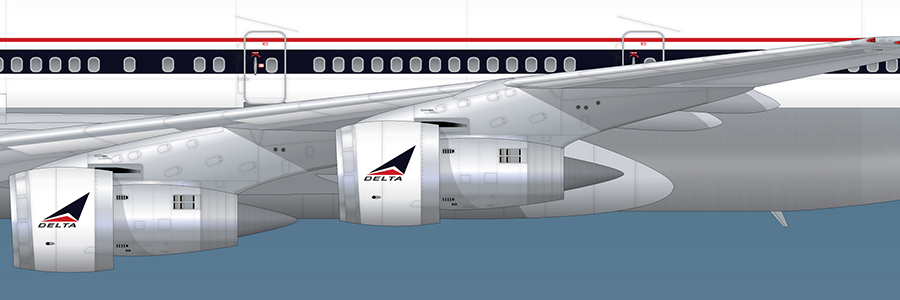
The Pratt & Whitney JT9D was the first production high bypass turbofan used on a production airliner.
(JP Santiago)

For smaller markets and the short- to medium-haul flying, Delta standardized on the Douglas DC-9 Series 32. For medium-sized markets and medium-haul flying, Delta standardized on the Boeing 727-200. It had acquired them via its merger with Northeast Airlines and found them to have superior economics to the Convair CV-880s and to some degree even the DC-8s. In addition, the 727-200 used similar Pratt & Whitney JT8D engines as the DC-9. There were thirteen 727-200s that came over with the merger with Northeast and Delta wanted more- in March 1972, Delta returned to Boeing once again, this time with an order for fourteen 727-200s (the order was placed before final approval of the Northeast merger by President Nixon)- Boeing even took Delta’s remaining Convairs as a trade-ins on the 727 order. By 1977, there would be 88 727-200s in Delta’s fleet. Delta’s first experience in working with Boeing on the 747-100 order was so favorable the airline was eager to work with Boeing quite readily again. The arrival of more 727-200s allowed Delta to dispose of the Convairs and the oldest DC-8s first. While most of the Series 51s and Super 61s were sold off, a sizeable number were kept on for several more years with some of the Super 61s getting the Cammacorp re-engining with the CFM56 to become Super 71s.

By this point it was clear the Lockheed L-1011 Tristar would be the long-haul workhorse of the Delta fleet. The DC-10s were eventually sold off to United. The first Tristar arrived in Atlanta on 12 October 1973 with the first passenger services on 15 December 1973 on the Atlanta-Philadelphia route. By 1974 there were ten Tristars in service but their spacious underfloor cargo holds meant they carried 25% of Delta’s cargo despite being less than 10% of the fleet. That allowed the L-100 Hercules transports to be sold off that year. When the Boeing 747-100 was ordered in 1967, it was with the understanding it was too big of an airplane for Delta but it was needed to compete in the marketplace. With the Tristar quickly proving itself, the 747-100’s days were quickly numbered and arrangements were made for the first two 747-100s to be sold off but the last three stayed on just a bit longer until more Tristars were in service. Delta’s last Boeing 747-100 service was flown 23 April 1977 Las Vegas-Atlanta.
741_Delta_p4.jpg
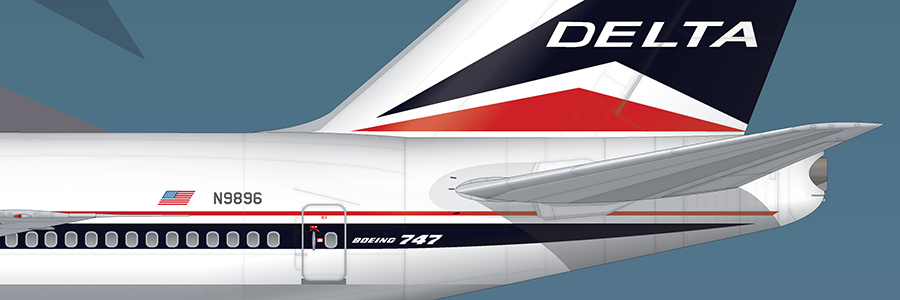
Of the five original Delta 747-100s, only the first one, N9896 “Ship 101” can still be seen today at the Evergreen Aviation Museum.
(JP Santiago)

The fates of Delta’s five 747-100s:

N9896: Returned to Boeing 1974, leased to China Airlines 1976-1978, operated by Pan Am 1978-1991, then flew with Evergreen International. Preserved at the Evergreen Aviation Museum in 2010 (it’s on the roof as part of the waterpark with waterslides coming out of it!)

N9897: Returned to Boeing 1977, operated by Flying Tiger 1977-1989 (leased to El Al Israel for a year), operated by FedEx 1989-1991, operated by Air Hong Kong 1991-1996, then Polar Air Cargo, now scrapped.

N9898: Returned to Boeing 1975, operated by China Airlines 1975-1976, leased out by Guiness Peat Aviation 1976-1984, operated by Pan Am 1984-1991, operated by Evergreen International starting in 1991 and converted to a water bomber “Evergreen Supertanker”, retired with Evergreen’s bankruptcy in 2013. In storage at Pinal Air Park.

N9899: Returned to Boeing 1977, operated by Flying Tiger 1977-1989 (leased to El Al Israel for a year), operated by FedEx 1989-1991, operated by Air Hong Kong 1991-1995, then Polar Air Cargo, now scrapped.

N9900: Returned to Boeing 1977, operated by Flying Tiger 1977-1989, operated by FedEx 1989-1993, operated by Air Hong Kong 1993-1994, operated by Kalitta 1994-2008. Stored at Oscoda, then scrapped 2015.

As an interesting historical footnote, the first officer on the delivery of Delta’s first Lockheed Tristar was Captain Jack McMahan who at the time was one of only two men in the United States certificated to fly the DC-10, L-1011 and 747. The other pilot was an FAA examiner. He was asked by a reporter on his impressions of all three widebodies- he praised the handling of the DC-10, the overall design of the 747, and the advanced systems of the L-1011. He remarked “Flying the three planes is like going out with three sisters. They have the same background but different personalities!

This article was originally posted on AirlineReporter.com on 23 October 2015.

Sources: Delta: The History of an Airline by W. David Lewis and Wesley Phillips Newton. University of Georgia Press, 1979, pp 340-392. Delta: An Airline and Its Aircraft by R.E.G. Davies. Palawdr Press, 1990, pp 76,80-86,96-97. 


11 July 2015

The Rocky History of Ariana Afghan Airlines

Ariana's logo- note the use of the Pan Am font
Prior to the Second World War, air services to Afghanistan were adventurous to say the least, given the inhospitable terrain of the area. Most air links to South Asia of the day that connected the region to Europe passed via India and were controlled by primarily the British. The first air links to Afghanistan, however, came by way of the Soviet Union starting on 14 September 1926 when the Russian airline Dobrolyot connected Kabul to the other Central Asian cities under Soviet control with Junkers F13 monoplanes. Dobrolyot was founded in 1923 to develop air services in the Soviet Union and in 1932 it was Dobrolyot that formed the nucleus of a new airline, Aeroflot. Dobrolyot's air services to Kabul continued until the outbreak of the Second World War. Interestingly enough, Dobrolyot was not the only foreign airline active in Afghanistan in the interwar period- DLH (Deutsche Luft Hansa, predecessor to today's Lufthansa) also opened air services to Afghanistan. At the time, DLH was looking to extend its route network to China where there were substantial German business interests. However, remaining bitterness from the First World War stymied DLH's attempts to open routes to China via India, so going through Afghanistan was seen as a short cut around British influence in the area. DLH extended its network eastward from Istanbul to Baghdad in October 1937 and then extended again from Iraq to the Iranian capital of Teheran in April 1938. Two weeks later, DLH extended its network again, this time connecting the Afghan cities of Kabul and Herat via Teheran and at the time, it was the furthest corner of DLH's airline network. Services ended abruptly, though, in August 1939 on the eve of the outbreak of the Second World War. 

Air services to Afghanistan were spotty at best and ad hoc for the duration of the Second World War  and aside from a small air mail service using Hawker Hart biplanes, it would be an American businessman in India who would forge new air links into Afghanistan again at the end of the war. New York native Peter Baldwin had served with the US Army Air Force in India during the war and returned in 1945 leading a US government mission to oversee the disposal of surplus USAAF aircraft in the region. His job finished, he elected to stay in India and in 1947 formed a company in Bombay (Mumbai today) for the sales of light aircraft and airport equipment. By 1950, he had his own fleet of thirteen Douglas DC-3s that he was flying all over the region on charter flights all over India, the Middle East and as far as Africa. His small charter operation even operated Hajj flights to Mecca. It was in this capacity that he came into partnership with the Afghan government. 

The DC-3 services were a boon to a country without railroads.
In 1951, the Kabul government established a branch of the Royal Afghan Air Force that was tasked with civil aviation development with Colonel Gulbar Khan as the head of what was called the "Hawabazi Mulki". Colonel Khan worked out a partnership with Peter Baldwin to form a new Afghan airline which was established on 27 January 1955 as Aryana Afghan Airlines in Kabul with Peter Baldwin holding 49% ownership of the airline and the Kabul government owning 51%. I haven't been able to determine if the airline's first three DC-3 aircraft were from Baldwin's charter operation, but it would make sense given his signifcant ownership in the new venture. The first services were launched at the end of 1955 connecting Kabul to Mazar-i-Sharif in the north near the Soviet border via the city of Kunduz. What had taken a week on the region's poor roads now only took three hours. 

During the Pan Am years, the Ariana chief pilot was a Pan Am pilot
On 27 June 1956, the Kabul government signed an air transport and development agreement with the United States. At the time, both the Soviet Union and the United States were eager to get Kabul's business and the Afghans astutely played both sides off each other to get economic development agreements. The air agreement with the United States included Pan American buying out Peter Baldwin's interest in Aryana. As a result, Pan Am become responsible for all operational and technical matters and also changed the spelling of the airline's name to Ariana, ostensibly to eliminate any possible references to the word "Aryan" that had been corrupted by the Nazi regime during the Second World War. On 3 June 1956, an Ariana Douglas DC-4 with an all-Afghan crew trained by Pan Am departed New York for Kabul to begin Hajj flights to Mecca. The DC-3s were used for internal domestic services that connected Kabul to Herat, Kandahar, Kunduz, Mazar-i-Sharif, and Maimana. New Delhi was connected to Kabul via the Indian city of Armistar and Karachi, the Pakistani port city, was connected via Kandahar. The DC-4 was used to connect Kabul to Teheran, Beirut and Damascus via Kandahar where American economic development funds were used to build a modern airport and terminal facility. 

Ariana launched services to Europe on 11 September 1959 on what they called the "Marco Polo Route" which used the DC-4 on services to the Turkish capital of Ankara via Beirut. The flight then continued on to Prague and then terminated in Frankfurt. The airline had to replace its DC-4 with a larger DC-6B as adventurous European tourists began to fly the "Marco Polo Route" to Kabul. The airline soon found that it was more profitable for the DC-6B services to bypass Kabul and instead fly Kandahar to New Delhi. Political instability in the region in the 1960s resulted in the termination of services to Karachi and the services that connected Frankfurt to New Delhi could only be flown twice a month- soon after, European services were cut altogether with Ariana's westernmost destination being Beirut by 1962.

Ariana Afghan 727-200
Ariana was near dormant when American development funds arrived again in 1963. This was a time of superpower rivalry and Afghanistan was no different than any other non-aligned nation of the time that had both American and Soviet interests competing for influence. Ariana got an extremely low-interest loan (it was pretty much a gift) that included a second Douglas DC-6 and two ex-Pan American Convair CV-340s to replace the DC-3 on the domestic services. A third CV-340 was purchased from Allegheny Airlines and this allowed a return to Karachi via Kandahar as diplomatic relations between Pakistan and Afghanistan improved. In July 1965, Ariana opened DC-6 services to the Uzbek capital of Tashkent in a pooling agreement with Aeroflot and in the following month, services to Europe resumed with DC-6 services from both Kabul and Kandahar to London Gatwick, stopping only in Beirut and Frankfurt. In April 1968, Ariana got its first jet equipment with a Boeing 727-100 which replaced the DC-6s on the European services. The route to London was reconfigured to route via Teheran, Istanbul and Frankfurt, but as Ariana had no fifth freedom rights, only Kabul/Kandahar-bound passengers could be boarded at London Gatwick. That first 727 crashed in dense fog on approach to London on 5 January 1969, but two more 727s were added- the first a lease from World Airways that was bought outright and a second purchase from Executive Jet Aviation, arriving in 1971. 

Ariana Afghan Airlines Tu-154- note the continued use of the Pan Am font!
The domestic routes of Ariana were spun off under a subsidiary airline called Bakhtar Afghan Airlines. This was a political move more than anything else as some Afghan officials wanted to limit US influence in the northern tier of cities along the Soviet frontier- this was accomplished by cutting Pan Am out of Bakhtar's operations. In 1973, Bakhtar took delivery of three Yakovlev Yak-40 trijets, becoming one of the few non-Soviet client state customers for the 28-seat feeder jet. Pan Am was still needed in the Ariana international operation, though, as Pan Am sold Ariana a Boeing 720B on very generous terms (again, it was pretty much a gift) in May 1973. That year, though, on the heels of a severe drought 1971-1972, Prime Minister Mohammed Daoud Khan seized power in a non-violent coup, deposing King Zahir Shah and ending the Afghan monarchy. A republic was proclaimed to institute economic reforms but only political instability was established as various Afghan leaders relying on tribal loyalties began to vie for control of the country. A series of coups followed starting in 1978, but despite this, Ariana launched Douglas DC-10 Series 30 services with a single aircraft in October 1979 on its services to London which could now be served nonstop. On 24 December 1979, the Soviet Union invaded Afghanistan which for all intents and purposes ended Ariana's operations. The two 727s and DC-10 were parked and eventually sold off under Soviet pressure by 1985. Its regional subsidiary, Bakhtar, took over Ariana's operations with two Tupolev Tu-154M aircraft starting in 1987, but the following year the Ariana name was resurrected and Bakhtar's domestic routes and operations folded into Ariana. 

Ariana's sole Douglas DC-10
The country descended into outright civil war following the Soviet withdrawal in 1989. Communist President Najibullah's regime only lasted to 1992 and with the Taliban takeover in 1996, worldwide sanctions crippled what was left of Ariana's operation. Pakistan set up a temporary maintenance base for the airline in Karachi, and only Dubai remained as the airline's only international destination. During the Taliaban's regime, Al-Qaeda operatives were given Ariana identification to allow them to move arms, personnel and opium shipments between Dubai and Pakistan. There were indications that Russian arms dealers were operating Ariana during this period. By November 2001, only a month before US-led forces toppled the Taliban regime, Ariana was finally grounded for good. Ariana would be resurrected in the post-Taliban era, but that's a subject for another blog posting in the future!

Source: Airlines of Asia Since 1920 by R.E.G. Davies. Palawdr Press, 1997, pp 84-88. Photos: Marc Riboud/Magnum Photos, Wikipedia, National Archives


01 July 2015

Alaska Airlines Selects the MD-80

N936AS in its delivery colors
The 1985 delivery of the first McDonnell Douglas MD-80 aircraft to Seattle-based Alaska Airlines came on the heels of one of the most remarkable coups ever pulled by an airline on an manufacturer to get a good deal. Normally much is made about manufacturers making a crucial sale with an airline, but when it came to Alaska getting the MD-80, the real story was how the airline got a deal that was so good, McDonnell Douglas lost money on the Alaska sale. In 1983, the airline's management formed a team to select a new aircraft that would eventually replace the Boeing 727-100/200 as the flagship of the Alaska fleet. The two candidate aircraft that vied for the contract were the McDonnell Douglas MD-80 and the Boeing 737-300, at the time both new aircraft a generation later in terms of technology and efficiency over the 727s that shouldered the bulk of Alaska's passengers. The scope of the procurement would be the largest order in Alaska's history as prior aircraft purchases were made in small batches, often for used aircraft. The selection process created a tremendous amount of discord in the Seattle headquarters as each aircraft had its proponents for very good reasons. 

Many of Alaska's technical staff and pilot corps were pro-Boeing, understandable given that the airline's long history and experience with not just the Boeing 727-100/200, but also the 737-200 as well. The belly cargo capacity of the 737 with its wider fuselage was much appreciated particularly on the routes between Alaska and the Lower 48 states. But the 737-300 was about twenty seats short of the passenger capacity Alaska desired. The 737 variant that met the airline's capacity requirement was the 737-400, but in 1983-84, that variant had yet to be launched (that would happen with Piedmont's launch order in 1986) which was too far in the future for Alaska's timetable. 

N933AS in the Alaska's livery at time of the first deliveries
The McDonnell Douglas MD-80 did meet Alaska's capacity specification and the marketing department of the airline liked the idea of its five-abreast seating which meant each seat row had only one unpopular middle seat. However, the MD-80's narrower fuselage placed significant constraints on belly cargo space. On the routes between Alaska and the US West Coast, belly cargo revenue was nearly as important as passenger revenue. At the time Alaska began its selection process in 1983, the MD-80 program was having a sales drought and there were even rumors in the industry about the MD-80 production line getting shut down. American Airlines' ground-breaking order that saved the MD-80 program was still about a year and a half in the future. This meant that Alaska's order was potentially the most significant yet for the MD-80 program and many in the leadership at McDonnell Douglas were keen to stick it to Boeing by landing a large order with an airline right in Boeing's backyard. Compared to the 737-300 which was selling very well with a healthy backlog, the slower sales of the MD-80 meant that McDonnell Douglas could guarantee a much earlier delivery than Boeing could offer with the 737-300.

1/400 scale model of an Alaska MD-83.
The three most important factors for Alaska came down to passenger capacity, delivery timeframe, and the deal clincher, price. And this is where Alaska scored its coup. Alaska's team knew that McDonnell Douglas was not only eager for an MD-80 sale, they were also wanting desperately a big order with Alaska to rub it in Boeing's face. There are four variants in the MD-80 family- the MD-81 was the initial production version, the MD-82 was an increased gross weight version of the MD-81, the MD-83 was an extended range version of the MD-82, and the later MD-88 had an EFIS cockpit (Delta launched this variant). Through the negotiation process as the deal swung in favor of McDonnell Douglas, the company based its planned contract with Alaska on the MD-82 variant. Alaska, however, knew McDonnell Douglas was coming out with the MD-83 and that was the variant the airline really wanted thanks to its longer range. When Alaska's team arrived in Long Beach for the final negotiations, the sales team presented Alaska with a letter of intent for an initial order of six MD-82s. That's when Alaska pulled out their ace card and told McDonnell Douglas they'd only sign to finalized the deal if they got the MD-83 and only if the MD-83s were at the same price as the MD-82. Backed into a corner, McDonnell Douglas relented and Alaska Airlines became the launch customer for the MD-83 variant. The initial order would be for nine aircraft- the first two to be delivered (N930AS and N931AS) were financed by a Japanese leasing agency while the other six were paid for out of Alaska's financial reserves. 

In Robert Serling's great book on the history of Alaska Airlines, he relates that once the deal for the MD-83 was signed, the CEO of Alaska, Bruce Kennedy, had to meet with the iconic head of Boeing, Thornton Wilson (or as most people knew him as just "T" given his personality) to break the news. Wilson grumbled to Kennedy "Damn it, Bruce, you know we build better airplanes then they do!" Kennedy responded that McDonnell Douglas was more aggressive on price and that the MD-80's seating capacity more closely matched the 727-200 than the 737-300 did. Serling wrote that Wilson cooled down and replied "Well, Bill Allen (a past CEO of Boeing) told me years ago never to regret a sale on which you would have lost money", something that did happen to McDonnell Douglas with the Alaska deal as they had so deeply discounted the MD-83 to make the sale. 

SEASLIDEN931ASsm copy
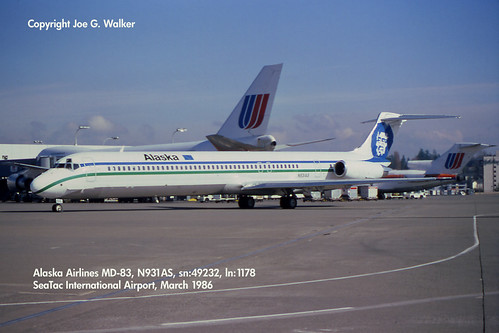
Alaska's first MD-80, N931AS.

Even though Alaska had signed for the MD-83, the first two aircraft delivered were actually MD-82/83 hybrids- they had the more powerful engines of the MD-83 but had smaller fuselage fuel tanks like the MD-82 get a bit more belly cargo space. The aircraft also had a new heavier landing gear than what the MD-82 had to handle the increased weight. Both aircraft were designated MD-82s, though. The first one delivered was N931AS on 20 February 1985 followed by N930AS on 29 March 1985. The delivery flight from Long Beach of N931AS turned out to be fiasco for Alaska and McDonnell Douglas as technical glitches delayed its departure for Seattle, then the water system on the aircraft failed in flight, preventing any of the toilets from flushing. In addition, to meet Alaska's timetable, the first four aircraft had less powerful engines temporarily fitted than the agreed production standard and that made for a long, slow flight to Seattle.

A total of 48 MD-80s would be operated by Alaska Airlines until the type's retirement in 2008. The most operated at any single time was 44 with one write-off, the tragic crash of Alaska 261 due to a tailplane jackscrew failure in 2000.

Related reading:

How American Airlines Saved the MD-80
Alaska's First Jet: "Seventy-Seven Hotel"
How the Lockheed Hercules Helped Open Alaska to Oil Exploration

Source: Character & Characters: The Spirit of Alaska Airlines by Robert J. Serling. Epicenter Press, 2008, pp 207-212. Fleet information from Planespotters.net. Photos: Wikipedia, JPSantiago, Joe Walker Collection/Flickr.

12 April 2010

The Boeing 727 JATO Option


I've always had a soft spot for the Boeing 727. Maybe it was all those flights as kid growing up in the Midwest where we'd board a Braniff Flying Colors 727 out of Wichita and head off to different parts of the country back in the day when you flew Braniff north or south out of Kansas to interline with different airlines to head to the East Coast or West Coast. Flights to the south usually interlined with Continental or American and flights to the north interlined with United, sometimes TWA if I remember right from my youth. But even those flights were 727s, too, and then one day all of a sudden it seems, sometime after September 11, the 727s were all put out to pasture by most of the US majors. I could go on and on (but thankfully won't) on why I think the 727 is the Chuck Norris of jetliners, but suffice to say for today's aviation trivia there's just one feature, though not unique to the 727, adds to that coolness for "Trisaurus Rex".

There was a JATO option. That's right. Rocket assisted takeoff. What a shame it wasn't picked up by everyone else, but it was an option on the 727-200 which of course was a lot heavier than the shorter 727-100. Until the 727-200 Advanced came along and included JT8D engines if increased power, the early 727-200s were a bit short on the power stick due to the heavier weight but essentially the same engines as the -100s.

Now don't everyone write me, I know the reasons why the JATO option didn't roll out across the board for most production 727-200s. There were only 12 727-200s that were built with the JATO provision and they were actually the more powerful 727-200 Advanced versions. Mexicana was in a unique position of serving several high-altitude airports in its network where the 727-200 as built would have been payload restricted to account for the possibility of the loss of one of the three engines at takeoff.

As a side track to illustrate that point, at airports at higher elevations, particularly on hot days, wings will generate less lift and jet engines will develop less power than at a lower elevation airport. That's why the runways at airports like Denver or La Paz, Bolivia, are so long. In fact, back in the 1970s many US airlines didn't sent the 727-100QC variants to Denver Stapleton Airport as the heavier structural reinforcing of the main deck to handle cargo loads cut into the passenger payload during the summer months.

Mexicana took delivery of twelve 727-200s that got around this limitation by having a JATO installation in the lower aft fuselage just behind the wings. These aircraft could be identified by having a shallow dorsal fairing ahead of the #2 intake that accommodated some of the rerouted avionics and air conditioning ducting that was displaced by the JATO provision. There's a misconception that this fairing is a reinforcement brace, though.

The aircraft were unofficially designated 727-200/JATO by Boeing and the rocket installation was intended for emergency use only when flying out of a hot and high airport at maximum gross weight. Without the JATO, the aircraft would have to be payload restricted to account for the need to reach a safe altitude in the event of an engine loss after committing to takeoff. By having the JATO provision, Mexicana could operate its 727-200s at full payload. In the event of a loss of engine at past V1, the JATO unit would fire and allow the heavily-laden jet to reach a safe altitude and get aerodynamically cleaned up.

The JATO provision was eventually made obsolete by later developments in the JT8D engine that featured APR- automatic power reserve. It sensed a power decrease from one of the engines failing on takeoff and automatically boosted the power to the remaining two engines by a significant margin.

Source: Boeing 727 (Modern Civil Aircraft:13) by Peter Gilchrist. Ian Allan Press, 1996, p62.

26 February 2010


One year before Boeing announced the go-ahead of the Boeing 727 program on 5 December 1960, there were serious reservations within the manufacturer about whether or not to proceed with the 727. At the time Boeing's commercial division was still quite a bit smaller than the military aircraft division and the company's desire to have wide customer base resulted in numerous variations in the Boeing 707/720 family that stretched the company's resources to the point that for every 707 delivered, Boeing was taking a $1 million loss. At this point, the De Havilland in Britain was about a year ahead of Boeing on work on its own trijet, the DH.121 Trident which was designed to broadly meet a similar set of specifications as that of the 727.

De Havilland saved itself a lot of time as it was specified from the start to have three engines while Boeing's design studies alternated between four and two-engined designs before settling on three engines. Before a T-tail design was settled upon for the 727, a group of Boeing engineers visited De Havilland's Hatfield factory to review the progress on the Trident and the visit was reciprocated shortly afterwards when a group of engineers from De Havilland visited Boeing's Seattle facilities to review the progress on the 727. At this point, the British firm suggested an Anglo-American alliance with Boeing building the Trident under license and worldwide sales markets divided between the American Trident team and the British Trident team. De Havilland would have a bigger customer base and lower unit price for its Trident design and Boeing wouldn't have to commit what was estimated to be $100 million to get the 727 program to completion of the prototypes and first flight.

As surprising as it may sound today, Boeing was very unsure of itself in the commercial market and the De Havilland proposal offered a low-risk way of getting into the short-haul market and there was a considerable amount of convergence in the two designs. However, Boeing wanted the capability to operate from a 5,000 foot runway, a specification that didn't factor into the Trident design (as a matter of fact, the Trident's early versions had a reputation amongst pilots as "ground grippers"). The two teams then looked at the possibility of putting the 727's high lift wing on the Trident, but the costs of the engineering required were identical to that of proceeding with the 727 program. The proposal for the alliance quietly died and to many at De Havilland came as no surprise.

When the 727 was rolled out, there were accusations in the British press that it was copied from the Trident, but De Havilland's engineers were adamant in interviews in dismissing the furor and reminded a skeptical public that Boeing did have first-class wind tunnel facilities and some of the finest aerodynamicists and engineers in the world would would have arrived naturally at some of the conclusions that resulted in the layout of both aircraft!

Source: Boeing 727 (Modern Civil Aircraft:13) by Peter Gilchrist. Ian Allan Press, 1996, p7-16.