Showing posts with label Lockheed. Show all posts

18 May 2016

CHECK SIX: The Douglas DC-7

18 MAY 1953: FIRST FLIGHT OF THE DOUGLAS DC-7

Douglas launched the DC-7 program at the prodding of C.R. Smith of American Airlines who wanted a competitor to TWA's Lockheed Super Constellations for the first transcontinental nonstop services. American's requirement even called for the same engines as the Super Constellation, the Wright R-3350 Turbo Compound (the DC-6 used the Pratt & Whitney R-2800 Double Wasp) radial. Douglas didn't think there was a market for such an aircraft, but Smith ordered 25 of what would become the DC-7 for $40 million which pretty much covered Douglas' development costs. To save time and make the most of the $40 million, the DC-7 was a stretched DC-6 with Wright R-3350 engines. The DC-7 was slightly faster than the Super Consellation and could under *ideal* conditions (which was rare) do a nonstop transcon in under 8 hours. 


The first variant of the DC-7 was good for transcon runs but was no better than the DC-6 for oceanic routes. That first variant went exclusively to US operators- American (34), United (57), Delta (10), and National (4). American Airlines inaugurated its own nonstop "Mercury Service" DC-7 flights between Los Angeles and New York Idlewild on 29 November 1953. As the DC-7 had a higher cruising speed than the Super Constellation, the eastbound LA-New York run was made easily in 7 hours, 15 minutes (a fact not lost upon American's marketing department, hence the name "Mercury Service"), but the westbound run from New York to LA couldn't be made within 8 hours. Despite over a dozen modifications to the DC-7s made by American's engineers which included tweaks of the Wright R-3350 radial engines to squeeze every bit of horsepower out of the engines, the DC-7s still couldn't beat the prevailing winds. American's pilot union repeatedly pointed this fact out, but C.R. Smith's influence in Washington left the issue unaddressed by federal regulators. In the following year, federal regulators adjusted the time limit to allow the flight to be made legally and American's DC-7s blocked in at 8 hours, 15 minutes on a westbound nonstop.

The next DC-7 variant was the DC-7B which had uprated engines and more fuel tanks in the engine nacelles which made oceanic crossings possible. Pan American launched its own transatlantic services in the summer of 1955 and South African Airways was finally able to fly Johannesburg-London nonstop.

The final DC-7 variant had longer wings and a stretched fuselage, the DC-7C "Seven Seas". The fuel capacity of the Seven Seas allowed full westbound nonstop transatlantic capability, something that the DC-7B couldn't routinely perform. 


There was a DC-7D which would have Rolls-Royce Tyne turboprops (same engine as the Vickers Vanguard) and a swept back vertical fin, but it never made it off the drawing board as Donald Douglas decided jets were the way to go and development of the DC-8 was given priority. 

Further reading: 


(Photos: Vintage Ad Browser, California Classic Forums)

04 May 2016

A Giant Ahead of Its Time: The Lockheed R6V Constitution

Before the start of the Second World War, Pan American Airways was the world's biggest operator of large ocean-going flying boats with the Boeing 314, Martin M-130 and Sikorsky S-42 in the fleet that spanned Pan American's worldwide network. However, the airline recognized that the pace of development in aviation technology meant that landplanes would be the dominant airline aircraft of the future. Pan Am worked with Boeing to bring the Boeing 307 Stratoliner to fruition (the world's first pressurized airliner). But with the start of the war for the United States in 1941, Pan American's operations were shifted to support the war effort and in this capacity the airline solicited the US Navy for the construction of a true heavy-lift landplane transport. This was finalized with the US Navy, Lockheed, and Pan American in November 1942 with what became the Lockheed Model 49 Constitution. 


The R6V Constitution on final approach at Moffett Field in California
(Wikipedia/US Navy)
The requirements issued by the Navy as suggested by Pan American were for a range of 5,000 miles, 17,500 lb payload at 255 mph at 25,000 feet cruising altitude. A year later on 1 November 1943 the contract was formally issued to Lockheed. Pan American's engineers led by their head engineer, Andre Priester, worked alongside Lockheed's engineers and their head, Willis Hawkins (he also designed the Constellation and later on would work on the F-80 Shooting Star, F-104 Starfighter, and the C-130 Hercules). The fuselage of the Constitution was a double deck, double lobed cross-section design with the large wing passing through the mid-fuselage between decks. With a fully-pressurized double-deck, the Constitution could carry up to 204 military passengers but the normal complement would be 168 passengers. Pan American's plans were for 51 passengers on the lower deck and 58 passengers on the top deck. Cargo doors were installed on the lower deck and the wings were deep enough to allow mechanics to access the four radial engines in flight for maintenance. The Constitution was also the first large transport aircraft to have multi wheel main landing gear bogies (four wheels to each main landing gear). 

The wing itself was based on the layout and structure of the wings used on the Constellation and the P-38 Lightning. Four 3,000 horsepower Pratt & Whitney R-4360 28-cylinder Wasp Major engines drove four bladed props. Unusually, the upper surface trailing edge root of the wings could hold RATO units to shorten takeoff runs. There were three units in each wing- they were fired when the landing gear retraction sequence started. As the landing gears took 14 seconds to retract, the RATO units burned for 15 seconds.

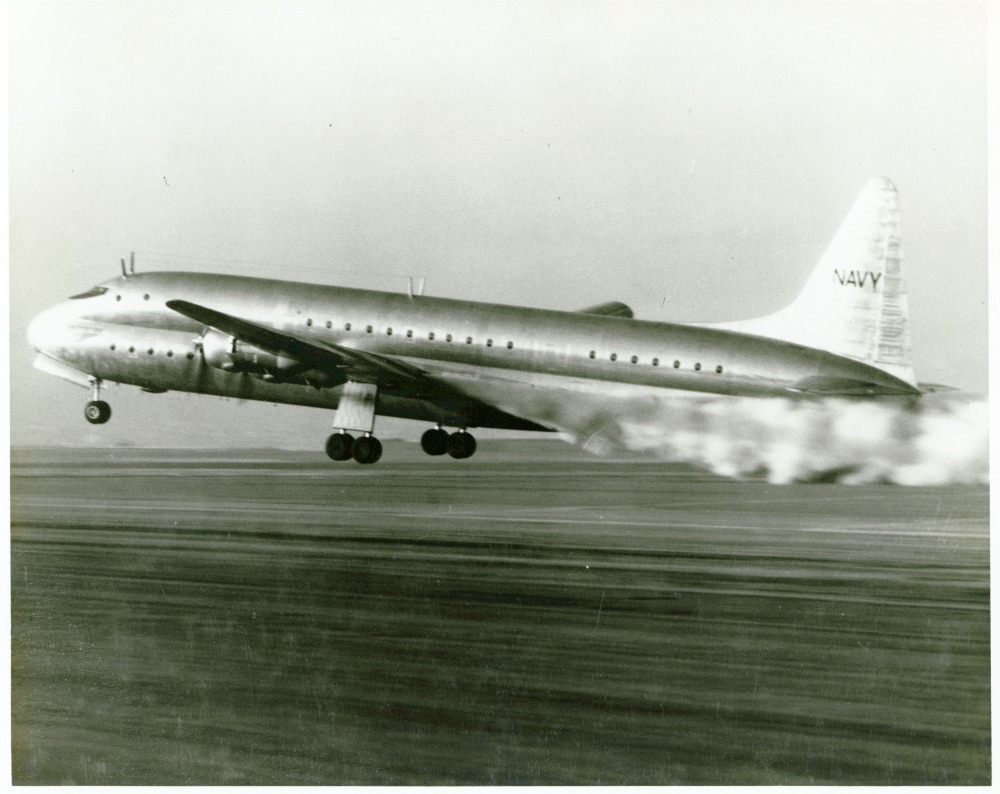
Takeoff using the overwing integral RATO units
(San Diego Air & Space Museum)
Since the Constitution was a low-priority project during the war, it wasn't until well after the war ended in August 1945 that the aircraft was completed. Though standard for today's design work on modern airliners, Lockheed used a full-scale hydraulic and electrical systems test rig that today would be known as an "iron bird". The system was loaded so the hydraulics and flight control systems would "experience" loads similar to what would be found inflight and were invaluable in letting the Constitution's test pilots get familiar with the large aircraft. The first flight came on 9 November 1946 and after the first 44 flight hours of testing the Constitution was found to be significantly underpowered. More powerful versions of the R-4360 Wasp Major were installed that theoretically produced 3,500 horsepower, but in practice even these engines could only garner 2,900 to 3,300 horsepower and that was with water injection and bypassing the superchargers on takeoff. As a result, use of the integral RATO units was commonplace. 

To keep Pan American interested in the project, Lockheed proposed the civilian version of the Constitution be powered by Wright 5,500 horsepower Typhoon turboprop under development, but by this point Pan American had thrown its lot with the Boeing Stratocruiser and bowed out of the Constitution program. Designated XR6O-1 by the US Navy, the first Constitution underwent a full year of flight testing at NAS Patuxent River, Maryland. The second XR6O-1 made its first flight on 9 June 1948 and unlike the first aircraft, the upper deck was fitted out for VIP passenger service with 92 seats while the lower deck was fitted out to carry as much as 40,000 lbs of cargo. Dual spiral staircases at each end of the cabin provided access to the upper deck from the lower deck and passenger entry was via the nose gear well which was large enough to allow airstairs to be pulled up just in front of the nose gear. 

The Constitution on static display during an open house at San Francisco Airport
(San Francisco International Airport/FlySFO.com)
In February 1949 the second R6O (the X prefix was dropped) was commissioned into service at NAS Moffett Field, California, with the fleet logistics support squadron VR-44. Soon joined by the first R6O, the Navy embarked on a series of publicity flights across the country, using the Constitution to not only transport personnel and materiel, but also to stimulate interest in naval aviation. The R6O carried one and a half times more cargo than the next biggest Navy transport, the Douglas R5D (C-54 Skymaster/DC-4). In 1950, the two R6Os were redesigned R6V; in the Navy's aircraft designation system used prior to 1962, "V" stood for the Vega Division of Lockheed that had built the PV-1 Ventura and PV-2 Harpoon in the Second World War- the "O" of Lockheed was dropped as it could be confused with the number zero and "V" took it's place as the Lockheed designator code. They were reassigned to VR-5 for expanded operational duties that included flights to Hawaii and Alaska. With a total of 3,760 flight hours between the two aircraft, in 1953 the R6O Constitutions were retired and placed in storage at NAF Lichtfield Park, Arizona. The aircraft were offered to the airlines on a proposed five-year lease, but no interest came about. 

The first Constitution ended up in Las Vegas as a promotional billboard for Alamo Airways at McCarran Airport and plans were floated to move the aircraft to the Strip to be part of a casino. However, the plans were never materialized and when Howard Hughes acquired the property that the aircraft sat on, he also gained ownership of the aircraft and had it scrapped in 1970. The second Constitution ended up in Opa Locka, Florida, where it was to be sold to a German businessman who wanted to use it for a restaurant in Barcelona, Spain. The deal fell through and the aircraft mysteriously caught fire which gutted the interior but spared the exterior. After several years of legal wrangling, the aircraft was scrapped in 1979.

Further reading: 

The Convair Model 6: A Jumbo Jet Before Its Time
Pan American and the Boeing 314 Toilet Scandal
The Cadillac of the Constellation Line

Source: Lockheed R6O/R6V Constitution (Naval Fighers No. 83) by Steve Ginter. Ginter Books, 2009.

07 April 2016

CHECK SIX: Trans World Airlines Goes All-Jet


As the sun rose on 7 April 1967, history was made as TWA became first US airline to go all pure-jet, having retired its Constellations and Starliners the night prior. The last TWA passenger Connie service was Flight 249 JFK-Philadelphia-Pittsburgh-Columbus-Louisville-St. Louis. The next day the last one flew to storage in Kansas City where there were 35 other Super Constellations and Starliners awaiting their fate. The night of 6 April, ground service crews put a booklet in all the seat back pockets of the TWA passenger aircraft titled "Props Are For Boats". 

The introduction of the Boeing 727 and Douglas DC-9 accelerated the Constellation retirement which by the 1960s were relegated to short haul domestic routes and some cargo flying. Two Connies soldiered on after 7 April on cargo-only duties, though. From the introduction of the Lockheed Constellation with TWA's dramatic 1944 delivery flight to Washington flown by Howard Hughes to its retirement to the 1967 retirement from passenger service, the Constellation family served TWA for 23 years with over 140 examples. 

Within two years, by 1969, Trans World Airlines had surpassed the iconic Pan American in the number of passengers carried across the Atlantic. 

Further reading: 


(Photo: FlyerTalk Forums)

29 December 2015

The First American Covert Overflights of the Soviet Union

1st Lieutenant Bryce Poe II, USAF
(Gathering of Eagles Association)
The introduction of nuclear weapons at the end of the Second World War had a profound influence in many combat doctrines and none nowhere else as much as that of airborne reconnaissance. In November 1945, General Henry "Hap" Arnold of the US Army Air Forces warned the US government that in the future, American leaders would require "continuous knowledge of potential enemies, including all aspects of their political, social, industrial, scientific and military life" if the United States was to avoid a surprise attack with nuclear weapons. Traditional reconnaissance doctrines had the use of airborne assets in support of ongoing combat operations. General Arnold and many of his contemporaries at the dawn of the Cold War recognized that airborne reconnaissance was needed to provide an assessment and early warning of potential enemies, namely the Soviet Union that was rapidly tightening its grip on Eastern Europe. The start of the Berlin Blockade in June 1948 pressed the issue further that up-to-date reconnaissance was needed of the Soviet Union should tensions escalate to an all-out conflict. Interestingly while the highest levels of the US government tried to determine the best way to make such an assessment, the United States Far East Air Forces (FEAF) based in Japan took the initiative to begin its own assessment of Soviet forces in their region in response to the rising tensions during the Berlin Blockade. The commander in chief of the US FEAF, Major General George Stratemeyer, ordered the 8th Tactical Reconnaissance Squadron and its Lockheed RF-80 Shooting Stars to begin a series of covert overflights of the Soviet Far East. Based at Yokota Air Base, Stratemeyer ordered the 8th TRS to deploy to Misawa AB on the northern Japanese home island of Hokkaido. Two pilots were selected with 1st Lieutenant Bryce Poe as the primary pilot for the secret missions to assess Soviet air strength in the region. The RF-80s were modified with larger wingtip tanks for longer range. Poe was instructed that if the coastline was free of clouds, dash into Soviet airspace, photograph the targets and dash back out and head back to Misawa as fast as possible. 

The first reconnaissance overflight (and USAF jet reconnaissance mission) of the Soviet Union took place on 10 May 1948 with 1Lt. Poe departing Misawa AB to overfly targets on Kuril Islands. Missions were flown to photograph targets on Sakhalin Island as well further to the north. The first overflight of the Soviet mainland took place on 10 March 1950 to photograph bases around the port of Vladivostok. Most of the airfields Poe had photographed were full of not just only Lend-Lease Bell -39 Airacobras and P-63 Kingcobras, but also late model Lavochkin piston fighters like the La-9 and La-11. Although jet powered, the RF-80s had increased drag and lower speeds with the larger external tanks needed for the recon missions which cut down on the performance margin over the Lavochkin fighters which often tried to give chase to the missions. 

Lockheed RF-80 with the enlarged camera nose section
(Wikipedia)
What was impressive about these first overflights is that they were done at the initiative and discretion of General Stratemeyer without any prior clearance from Washington and they were done in the face of significant technical and logistical obstacles. The reconnaissance cameras used on the RF-80 were designed for piston-engined aircraft and lacked the capability to do stereo images in a high speed aircraft like the RF-80. Spare parts were in constant short supply and given that Misawa at the time was on the far northern part of a still rebuilding Japan, insuring even basic food rations for the 8th TRS personnel deployed north proved challenging. Many F-80 units based in Japan at the time found themselves the subject of "moonlight parts acquisitions" so the secret overflights could continue. 

Despite the failure of the Berlin Blockade which was finally lifted on 11 May 1949 and the formation of NATO, tensions remained high with the first detonation of a Soviet atomic bomb on 29 August 1949 followed by Mao Tse-Tung's Communist victory in China on 1 October 1949 over the Nationalists. With Stalin feeling more confident about the Soviet posture on the world stage, on 25 June 1950, the North Korean Army smashed across the DMZ on the Korean Peninsula, igniting the Korean War. In order to prevent further escalation the conflict, American reconnaissance pilots were instructed to avoid Chinese and Russian air space, however, the advance of North Korean forces meant that 1st Lt. Bryce Poe was called upon again by General Stratemeyer to begin a new set of secret overflights. In August 1950, he was called to FEAF HQ to again deploy out of Misawa and fly a series of missions against Soviet airfields in the region. While Soviet fighters tried more aggressively to intercept the RF-80s, none came close to getting shot down. By this point, the intelligence from Poe's flights was deemed critical by the Joint Chiefs of Staff and on 28 July 1950, the JCS requested official permission from the Secretary of Defense, Louis Johnson, for overflights of Chinese bases on the coasts adjacent to the Korea. Just four days later, President Truman gave his approval and again, because of his prior expertise, 1st Lt. Bryce Poe flew the missions against Chinese coastal targets and additional missions by other pilots were flown against Chinese ports opposite of Taiwan to make sure no amphibious assault preparations were underway to move against Taiwan. 

By the summer of 1950 discussions had been taking place at the Pentagon about using the more-capable North American RB-45 Tornado for overflight missions of Chinese and Soviet targets, but the aircraft being a bomber, it was felt at the time to be too politically risky, particularly as the Pentagon was seeking authority for overflights of Soviet targets in Europe as well as in the Far East. By this point Allied fortunes in the Korean War had improved following the landings at Inchon. Poe was once again called to FEAF HQ for a third set of covert overflights but the other pilot that he had been working with on the prior sets of overflights had been killed in action, so for this next set of missions, Bryce Poe would be the only pilot flying. Due to the secrecy of the missions, Poe did all his own flight planning. He was told by General Douglas MacArthur and General Stratemeyer what information they needed and Poe himself figured out the targets, routes, photographic equipment, times and altitudes. Despite the ongoing war in Korea, Poe found that the defensive posture of the Soviet airfields had only modestly increased, but as a precaution, F-80 Shooting Star fighters would meet Poe on his outbound leg to make sure no Soviet fighters were trying to tail him. 

Major General Bryce Poe II before retirement
(USAF)
Once he landed, the film was developed by one warrant officer and Poe himself did all the photo interpretation work and then hand carried the imagery to brief General MacArthur as well as General Stratemeyer and his FEAF deputy. It was a remarkable degree of authority given to a 1st lieutenant! Stratemeyer felt only barest minimum of individuals needed to be involved in the secret overflights. Bryce Poe rotated back to the United States in January 1951 after making nineteen secret overflights of Chinese and Soviet territory as well as 90 unclassified tactical reconnaissance missions in support of operations in Korea. After Korea, Poe flew as an exchange pilot with several NATO nations before serving as the executive officer to General Bernard Schriever at the Western Development Division where ICBM development was taking place. He then served as an Atlas ICBM missile officer with the Strategic Air Command before returning to reconnaissance in time for Vietnam. As vice-commander of the 460th Tactical Reconnaissance Wing, he flew 213 recon missions in the RF-4C Phantom in Vietnam. He later commanded the 26th Tactical Reconnaissance Wing with the United States Air Forces Europe. Following his USAFE assignments, he assumed command positions with the Ogden Air Logistics Center in Utah and at Wright Patterson AFB in Ohio. He retired in 1981 as a very decorated four-star general and veteran of two wars, flying west on 20 November 2000. 

Sources: Shadow Flights: America's Secret Air War Against the Soviet Union by Curtis Peebles. Presidio Press, 2000, pp 4-39.

24 December 2015

Saving Lockheed for Christmas

Carl Squier
(Wikipedia)
I had written this article a year ago for Christmas but I think it's worth reposting given this is Christmas Eve. There are a lot of folks in aviation little known to history but whose actions footnotes of the time set the stage for larger events in history. Carl Squier is one such individual- the 13th licensed pilot in the United States, in 1917 he became an Army pilot and flew in France in the first World War and became a long time friend of American ace Eddie Rickenbacker.

In 1928 he became the VP of the Eastman Flying Boat company after a career barnstorming after he returned from the Western Front. That year Eastman was bought by the Detroit Aircraft Company and they sent him to California to manage a struggling subsidiary they had just also acquired, Lockheed Aircraft in Burbank. While running Lockheed for the parent company, he found himself a home in aviation and became a patron of the employees at the Burbank plant.
With the stock market crash and the Great Depression, Detroit Aircraft went bankrupt and it dragged Lockheed into the red. No one was sure if Lockheed would survive. A few days before Christmas, he sent the employees home early from the Burbank plant and at the exit, handed each demoralized employee a ten dollar bill (a hearty sum in those days) and wished them a Merry Christmas. All one-hundred ten employees of Lockheed Aircraft went home that evening with ten dollars, all from Carl Squier's own savings which he emptied for his employees. The following January he mortgaged his own car and home to make payroll for the employees. When Lockheed finally succumbed to bankruptcy a few months later, Lockheed only had three employees- his secretary, an accountant, and a stock clerk who doubled as the night watchman for the Burbank hangar of the company.

Carl Squier with Howard Hughes
(Pinterest)
Squier so believed the Lockheed name was too good to pass into history and the people he came to lead too good to abandon, he convinced an investor, Robert Gross, Gross' brother Courtlandt, three other men, and what he had left of his own savings to purchase Lockheed's remaining assets. Gross wanted to run an aircraft company of his own and in 1932 the group purchased what was left of Lockheed for $40,000. In the bankruptcy courtroom that day sitting in the back was none other than Allan Lockheed himself, who on his way out told Gross "I hope you know what you're doing". With a shoestring staff led by a young engineer they recruited, Hal Hibbard, Lockheed came back to life with its Lockheed Model 10 Electra. The Model 10 Electra was Amelia Earhart's aircraft on her ill-fated 1937 around the world flight. As Lockheed had limited resources and facilities at the time of the program launch, much of the wind tunnel work was done at the University of Michigan. Much of the tunnel work was done by a master's student at the school, a young engineer named Clarence "Kelly" Johnson. It was Johnson's suggestions based on the tunnel work on the Electra design that the aircraft switch from a single tail fin to twin tail fins as well as the deletion of the original large wing root fillets. When Kelly Johnson completed his master's degree, he was hired full time at Lockheed. 

Hal Hibbard and Robert Gross would go on to build Lockheed into one of the giants of American aviation and Kelly Johnson would design some of the most iconic aircraft of the century, but it all started with the passion, generosity, and salesmanship of Carl Squier. It was said that if it wasn't for Carl Squier, there wouldn't be a Lockheed. He retired in 1956 as the VP of sales and flew west in 1967.

Source: The Electra Story: Aviation's Greatest Mystery (Bantam Air & Space Series No. 9) by Robert Serling. Bantam Publishing, 1962, 1991.

19 December 2015

Navy Observation Squadron SIXTY-SEVEN (VO-67): Sub Hunters on the Ho Chi Minh Trail

Squadron patch of VO-67
(VO-67 Association)
Given the restrictions by the Johnson Administration that adopted as policy in prosecuting the war in Vietnam that the port of Haiphong was off limits as well as overland supply routes from China, the only way to stem the material support and infiltration of South Vietnam was the interdiction of traffic along the Ho Chi Minh Trail that ran west of Vietnam through Laos and Vietnam. Supplies and personnel flowed down the trail to Viet Cong insurgents operating throughout South Vietnam. Despite Laos' neutrality established in 1962, North Vietnam moved freely through Laos up and down the supply routes. In April 1965, with the permission of the Laotian government, the United States initiated Operation Steel Tiger to try and disrupt trail traffic. All targets on the trail were identified visually, a challenging proposition with dense jungle and often uncooperative tropical weather. Army ground teams were introduced to Operation Steel Tiger in October 1965. A progressive ramp up of airborne and ground reconnaissance failed to deprive the Viet Cong of the virtual river of supplies flowing through Laos. Needless to say, this state of affairs preoccupied the Secretary of Defense, Robert McNamara, who believed technology could provide a solution. Through the summer of 1966, academic and technology experts came up with the Jason Study. It suggested an electronic fence of detectors combined with airborne assets to stop the flow of materiel down the trail. The Defense Communications Planning Group (DCPG) was established by McNamara in September 1966 to develop and deploy the technology for the "electronic fence". To keep a handle on costs, the DCPG examined existing military technology to see what could be adapted for use on the Ho Chi Minh Trail. 

The modifications that resulted in the OP-2E Neptune
(ARC Forums)
The DCPG found that sonobuoys, used by the Navy for hunting submarines since the Second World War, could be adapted for land use, fitted with not only acoustic sensors but also seismic equipment to detect traffic on the Ho Chi Minh Trail. There were obvious parallels to finding an elusive enemy in the thick jungle and hunting Soviet subs in the open oceans. These land-based sonobuoys could then relay their findings to overhead aircraft to summon air strikes. In January 1967, McNamara briefed the White House on "Practice Nine" which was the code name for what become Operation Igloo White. "Muscle Shoals" was the code name for the electronic surveillance of the Ho Chi Minh Trail- "Igloo White" referred to the technologies used in adapting the Navy's sonobuoys into what were called spikebuoys (equipped with seismic sensors) and acoubuoys (acoustic sensors). Camouflaged and their aerials designed to look like branches, the spikebuoys implanted themselves in the ground while the acoubuoys were designed to snag the branches of the jungle canopy and hang in the trees. Given that the sensors were based on sonobuoy technology, the US Navy was tasked with seeding the Ho Chi Minh Trail by air with the new devices. 

By this point in the war, the North had fortified the trail with anti aircraft guns and there were discussions on how best to deliver the sensors. While the US Air Force prepared for the delivery of the sensors with F-4 Phantoms which would be less vulnerable, the Navy provided interim capability with a twelve-aircraft squadron using heavily modified Lockheed P-2 Neptunes. As the Navy's maritime patrol mission was being taken over the Lockheed P-3 Orion, surplus Neptunes were readily available. Martin Aircraft outside of Baltimore was tasked with the modification process which entailed the removal of the ASW equipment from the P-2s. Extensive armor plating was installed to protect the crews while the defensive weapons included underwing gun pods as well as two hatches in the aft fuselage for pintle-mounted M60 machine guns. A terrain-avoidance radar was added in a chin radome along with a whole host of defensive electronic warfare equipment. 

The MR tail code led to its radio call sign "Mud River"
(San Diego Air and Space Museum Archives)
With Navy crews well versed with low level sonobuoy delivery, there were no issues with delivering the acoustic sensors which would hang in the jungle canopy. However, the seismic sensors had to be dropped from higher altitudes as they had to implant themselves in the ground to detect truck traffic. The altitudes needed were much different than that used for sonobuoy delivery and it was found that old Norden bombsights in the nose worked well following a convincing demonstration at Eglin AFB in Florida. Twelve Norden sights were secured from storage and overhauled- since the bomb sights hadn't been used in years, the Navy had to locate retired Norden bombsight technicians to carry out the work. The USAF supplied an instructor who used to train bombardiers on the sight and he was sent to NAS Alameda to train the crews of the new secret Navy squadron which was designated VO-67. A training film on the use of the Norden was found at the Smithsonian Institution and was sent to VO-67. 

Designated the OP-2E Neptune, the first three VO-67 aircraft departed NAS Alameda on 6 November 1967 for RTAFB Nakhon Phanom in Thailand (nicknamed "Naked Fanny" by US crews or simply abbreviated "NKP"). At NKP, the crews of VO-67 flew with USAF forward air controller (FAC) pilots to see for themselves their operating areas over the Ho Chi Minh Trail. In fact, VO-67 personnel formed a close working relationship and even friendship with the USAF FAC pilots. FAC pilots who had just returned from patrols over the area often were met by VO-67 crews to review what the FAC pilots encountered over the trail. Each crew planned its own mission- the acoustic sensors were dropped at high speed and at low altitude, usually 500 feet, with plenty of jinking to avoid AAA fire. Terrain masking was frequently used. Often the Neptune pilots would dive down from 12,000 as they approached their target areas, drop a string of acoustic sensors and then use the terrain to egress the area. Seismic sensors were initially dropped from 2500 feet, later 5000 feet. Some Neptune crews would dive down during their seismic sensor drops to build up speed for the egress. Often times the underwing gun pods and rear M60 mounts were used for suppressive fire to keep the enemy's heads down during their target runs. 

CDR Paul Millius
(US Navy)
The missions were demanding and losses did take place- January 1968 (one aircraft lost), February 1968 (two aircraft lost). The last of the modified OP-2E aircraft joined the squadron at NKP just days after the third loss. During the Tet Offensive, the Marine fire base at Khe Sanh was under siege by an estimated 200,000 North Vietnamese troops. Along with some of the most intensive close air support of the Vietnam War, the Neptunes of VO-67 also dashed into the area to lay acoustic sensors to help detect NVA advances. By May of 1968, the USAF was ready to start delivering the sensors with its Phantoms with the job assigned to the 25th Tactical Fighter Squadron (part of the "Wolfpack" 8th Tactical Fighter Wing). The Phantoms would be less vulnerable than the lumbering Neptunes over the increasingly thick air defenses over the Ho Chi Minh Trail. The last VO-67 sensor drop mission took place on 25 June 1968 with the squadron being disestablished on 1 July 1968 and its personnel and aircraft returning to the United States. 

During its brief tour of duty, VO-67 lost one-quarter of its aircraft and 20 crewmen- and thanks to the airmanship of the crews and the invaluable help of the USAF FAC pilots who worked with VO-67, this loss rate is only half of what was expected at the start of VO-67's deployment. One pilot, Commander Paul Millius, was lost in action after his aircraft was hit at heavy caliber anti aircraft fire. One crewman was killed instantly and he kept flying until the other seven of his crew could bail out and survive. He was seen bailing out last, but was never found. He was promoted to the rank of Captain in 1972 and in 1978, he was presumed killed in action and posthumously awarded the Navy Cross. In 1995, the Navy launched the Arleigh Burke-class AEGIS destroyer USS Millius (DDG 69) in his honor, one of the few ships named for a naval aviator. The motto of the ship is "Alii Prae Me" (Others before me).

Related reading: 


Sources: Batcats: The United States Air Force 553rd Reconnaissance Wing in Southeast Asia by Jack Sikora and Larry Westin. iUniverse Publishing, 2003, pp 11-18, 73-75. VO-67 Association's Squadron History page at http://www.vo-67.org/vo67_history.html. 

29 November 2015

Delta Air Lines and the Boeing 747-100

On 9 September 2015, the very first Boeing 747-400 built, N661US, touched down at Atlanta from Honolulu as Delta Flight 836 for the last time in revenue passenger service. Ship 6301 was the Boeing 747-400 prototype which was then delivered to launch customer Northwest Airlines on 8 December 1989 and came over to Delta with the 2008 merger. There are twelve remaining 747-400s flying with Delta, all of which came over from Northwest. Current fleet planning will have these 747s retired in 2017. Delta did however, for a brief time, operate the first variant of the 747 family, the 747-100, from September 1970 to April 1977. Only five aircraft were taken on strength with Delta and while the 747-100 was but a short historical footnote in Delta’s history, its legacy looms large to this day with the airline.

741_Delta_p2.jpg
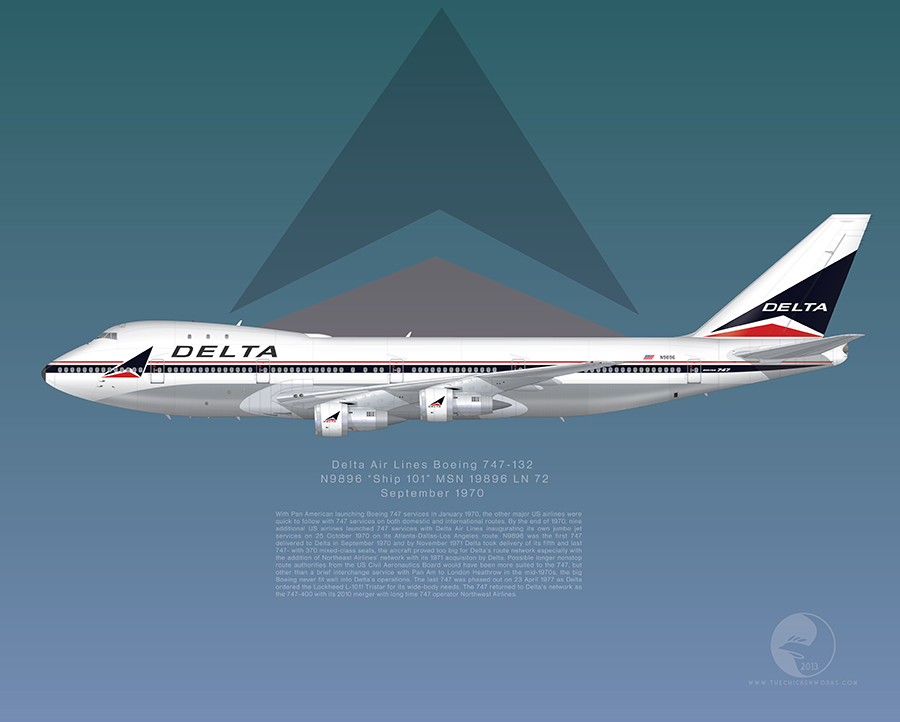
My own profile art of Delta’s first 747-100, N9896 “Ship 101” as it looked on her delivery in 1970.
(JP Santiago)

In order to understand what the 747 was for Delta at the time, one has to consider that as the 1960s were drawing to a close, Delta was in the midst of transition on several fronts. The first change change came with the Southern Transcontinental Route Case of 1961. Prior to deregulation, airlines often had to make a case for the opening of new services and routes to the Civil Aeronautics Board. Often these cases consisted of years of deliberation and often politics played a central role in airlines winning favorable rulings from the CAB. In the 1950s, the CAB favored interchange services as a means for airlines to open up new markets without saturating a given route with an excess of seats, harming profitability. Having a predominantly Southeastern US-anchored network, Delta linked up with several other airlines to offer interchange services which allowed it to fly as far west as California. As traffic grew on the interchange services to the West Coast, Delta petitioned the CAB to operate the West Coast services on its own and in one of the more historic decisions made by the CAB, both Delta and National were given route authorities to California from the southeast in what was called the Southern Transcontinental Route Case. Starting in 1961, the previous interchange agreements were declared redundant and Delta opened up a range of nonstop services to San Diego, Los Angeles, and San Francisco from Atlanta, Dallas, and New Orleans. Within a year, Las Vegas was added as well as Miami which for the first time made Delta a transcontinental airline. By 1963, the CAB permitted Delta to carry West Coast traffic to its Caribbean destinations via New Orleans and onward to Florida (Orlando and Miami) via Atlanta. In an unrelated decision by the CAB, Delta was allowed to interchange on routes to London from Washington Dulles with Pan American and soon Delta’s DC-8s were flying to Europe as part of that interchange agreement.

The second and biggest of these changes came with the death of Delta’s founder, C.E. Woolman, on 11 September 1968. In his 1841 essay “Self-Reliance”, Ralph Waldo Emerson wrote that “An institution is the lengthened shadow of one man...all history resolves itself very easily into the biography of a few stout and earnest persons." From Delta’s founding in 1927 to his death in 1968, no other individual was so closely identified with Delta than C.E. Woolman. He became the airline’s president and general manager in 1945 and became its chairman of the board only a year before his death. Though viewed as a stern autocrat by the press, Woolman was beloved by Delta employees. On his 25th anniversary with Delta, the employees presented him with a new Cadillac and though he had own several other cars, he kept that Cadillac until he died. Though ably succeeded C.H. “Charlie” Dolson, W.T. “Tom” Bebe and David Garrett, there was no question it was still Woolman’s airline for years to come.

The last change that frames the selection and operation of the Boeing 747-100 by Delta was its 1972 merger with Northeast Airlines. Throughout its history, adversity plagued Northeast which always seemed be hobbled by the CAB with a small network and when Northeast finally did break out of New England in 1968 with new routes to Florida, it ran square into the crosshairs of Eastern which was the incumbent giant of the US East Coast at the time. With Northeast literally going from cash crisis to cash crisis, its New England route authorities soon proved to be ripe for acquisition via merger. The first suitor was Northwest Airlines in 1969. Interestingly, the CAB approved the merger in 1970 but it would be without some of Northeast’s more attractive route authorities like Miami-Los Angeles. Northwest withdrew its merger offer in 1971 as a result. Eastern and TWA then offered merger terms, with Eastern in particular seeing a merger as a way of knocking a competitor out of the New England-Florida market. Those negotiations also fell through and ultimately it was Delta that came through with a suitable merger offer that also met with the approval of the CAB. On 19 May 1972, President Richard Nixon signed off on the Delta-Northeast merger (since foreign routes were involved).

So these are three events in which to put the context of the Delta’s order of the Boeing 747-100- the Southern Transcontinental Route Case of 1961, C.E. Woolman’s death in 1968, and the merger with Northeast Airlines in 1972.

Prior to the launch of the Boeing 747, the “big jet” of the day were the Douglas Super Sixty series DC-8s which had surpassed the Boeing 707 in utility and passenger capacity. While the 747’s launch has been historically associated with Juan Trippe and Pan Am, at the time, Boeing was keen on getting one up on Douglas and the 747 was the aircraft that would capture the “jumbo” jet title from the DC-8 Super 61/63. Delta representatives had visited Boeing to view the progress on the 747 program and were suitably impressed with the aircraft. Despite their favorable views on the 747 though, it was clear to all of Delta’s management from the outset that the 747 was too much airplane for the airline which had a predominantly short- and medium-haul route network with its longer routes suitably (not to mention cost-effectively) served by the DC-8 fleet. On the other hand, two of Delta’s biggest competitors, Northwest and American, had already placed orders for the 747. Delta’s fellow “southern transcontinental route” airline, National, was also expected to place orders for the 747 as well. The writing was on the wall- Delta’s DC-8s were no match for the expected spacious comfort of the big Boeing and the prudent move was to get the 747 as well, even if was just a small number on a temporary basis. In April 1967, Charlie Dolson, the airline president of the time, announced Delta’s order for three 747-100s for $20 million each with options for two more aircraft. It marked the very first time that Delta had ordered from Boeing. Preparations were made at six Delta destinations and three alternate cities for operation of the massive jet. When Pan American launched the world’s first 747 passenger services in January 1970, Delta had two representatives aboard the inaugural passenger flight.

741_Delta_p3.jpg
Delta marketed the upper deck lounge of its 747s as the “Private Penthouse”.
(JP Santiago)

While Delta was making preparations for the arrival of the 747, it was carefully considering its future widebody needs which were better met by a smaller aircraft in the form of either the Douglas DC-10 or the Lockheed L-1011. Delta’s technical staff liked both aircraft and it was believed the DC-10 was favored given Delta’s long association with Douglas Aircraft and its extensive use of both the DC-8 and DC-9 in the 1960s. Delta’s close association with Douglas as one of its most loyal customers was the product of a friendship between C.E. Woolman and Donald Douglas. In the 1960s, Douglas encountered repeated financial and technical difficulties with both the DC-8 and DC-9 programs that resulted in financial losses that led to its merger with McDonnell Aircraft in 1967 which effectively put Donald Douglas out of the executive suite. And keep in mind it was the following year that C.E. Woolman passed away. In a sense, Delta was now a “free agent” no longer tied to Douglas. Lockheed, eager to put its reputation back on good standing after the issues with the Lockheed L-188 Electra, pulled out all the stops in the Tristar program, engaging potential airline customers aggressively and early on in the Tristar development, resulting in an aircraft that at least in Delta’s eyes, was practically custom-built for them. Delta did, however, order five DC-10 Series 10s as insurance against the Tristar program when Rolls Royce ran into serious financial trouble during the development of the RB.211 engine used on the Tristar.

Delta’s 747-100 order was fulfilled quickly with N9896 being handed over to Delta on 25 September 1970 with the aircraft arriving in Atlanta to great fanfare on 2 October 1970. N9897 was delivered on 25 October 1970 and N9898 was delivered on 18 November 1970. While Pan American was first to launch 747 services on 22 January 1970 on its New York JFK-London Heathrow route, mostly domestic 747 services were launched in quick succession that year:

25 February: Trans World Airlines, New York JFK-Los Angeles (first domestic 747 service)
2 March: American Airlines, New York JFK-Los Angeles
26 June: Continental Airlines, Chicago-Los Angeles-Honolulu
1 July: Northwest Airlines, Chicago-Seattle-Tokyo
23 July: United Airlines, New York JFK-San Francisco
25 October: National Airlines, Miami-New York, Miami-Los Angeles
25 October: Delta Airlines, Atlanta-Dallas-Los Angeles
21 December: Eastern Airlines, New York JFK-Miami
15 January 1971: Braniff International, Dallas Love Field-Honolulu

By the end of 1970, Delta put the other two 747-100s into service with flights to Chicago, Detroit, and Miami. The options for the two aircraft were exercised the following year with N9899 being delivered to Delta on 30 September 1971 and N9900 arriving on 11 November 1971. While Delta’s 747-100s flew amongst Atlanta, Dallas, Los Angeles, Chicago, Detroit and Miami, they were also put to use on the Pan Am interchange services between Washington Dulles and London Heathrow. In the space of just over ten years, Delta went from a mostly regional airline anchored in the southeastern United States with some Caribbean routes to a transcontinental airline operating the Boeing 747 with limited interchange services to London. Never before in Delta’s prior history had it grown so much. But its fleet was quite diverse as a result of the merger of Northeast Airlines- it had twelve different aircraft with eight different engine types in service- in August 1972, Delta had three variants of the Douglas DC-8 in service, three variants of the Douglas DC-9, two variants of the Boeing 727, the Boeing 747-100, the Convair CV-880, the Fairchild-Hiller FH-227, the Lockheed L-100 Hercules for its cargo division, and it was anticipating the arrival of both the Lockheed L-1011 Tristar and the Douglas DC-10! In the interests of reducing the maintenance costs, standardizing operations, and holding down spare parts inventories, the fleet types had to be pared down. By this point, David Garrett had become president of the airline and it was his legacy that Delta streamlined its fleet which gave it record breaking profits in the late 1970s. Garrett’s primary imperative was fuel savings- the 1973 OPEC oil embargo that followed the Yom Kippur War in the Middle East caused a sharp spike in the cost of fuel.
741_Delta_p5.jpg
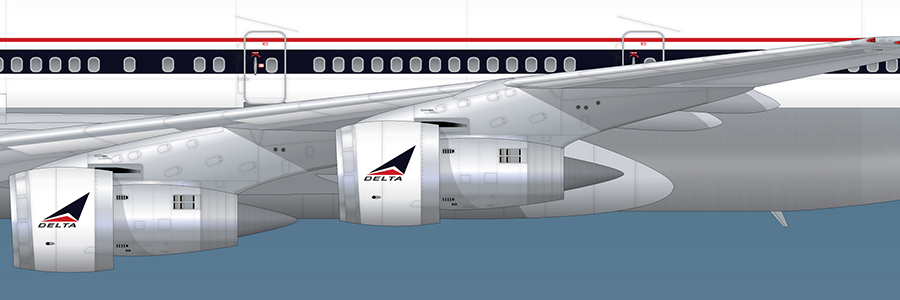
The Pratt & Whitney JT9D was the first production high bypass turbofan used on a production airliner.
(JP Santiago)

For smaller markets and the short- to medium-haul flying, Delta standardized on the Douglas DC-9 Series 32. For medium-sized markets and medium-haul flying, Delta standardized on the Boeing 727-200. It had acquired them via its merger with Northeast Airlines and found them to have superior economics to the Convair CV-880s and to some degree even the DC-8s. In addition, the 727-200 used similar Pratt & Whitney JT8D engines as the DC-9. There were thirteen 727-200s that came over with the merger with Northeast and Delta wanted more- in March 1972, Delta returned to Boeing once again, this time with an order for fourteen 727-200s (the order was placed before final approval of the Northeast merger by President Nixon)- Boeing even took Delta’s remaining Convairs as a trade-ins on the 727 order. By 1977, there would be 88 727-200s in Delta’s fleet. Delta’s first experience in working with Boeing on the 747-100 order was so favorable the airline was eager to work with Boeing quite readily again. The arrival of more 727-200s allowed Delta to dispose of the Convairs and the oldest DC-8s first. While most of the Series 51s and Super 61s were sold off, a sizeable number were kept on for several more years with some of the Super 61s getting the Cammacorp re-engining with the CFM56 to become Super 71s.

By this point it was clear the Lockheed L-1011 Tristar would be the long-haul workhorse of the Delta fleet. The DC-10s were eventually sold off to United. The first Tristar arrived in Atlanta on 12 October 1973 with the first passenger services on 15 December 1973 on the Atlanta-Philadelphia route. By 1974 there were ten Tristars in service but their spacious underfloor cargo holds meant they carried 25% of Delta’s cargo despite being less than 10% of the fleet. That allowed the L-100 Hercules transports to be sold off that year. When the Boeing 747-100 was ordered in 1967, it was with the understanding it was too big of an airplane for Delta but it was needed to compete in the marketplace. With the Tristar quickly proving itself, the 747-100’s days were quickly numbered and arrangements were made for the first two 747-100s to be sold off but the last three stayed on just a bit longer until more Tristars were in service. Delta’s last Boeing 747-100 service was flown 23 April 1977 Las Vegas-Atlanta.
741_Delta_p4.jpg
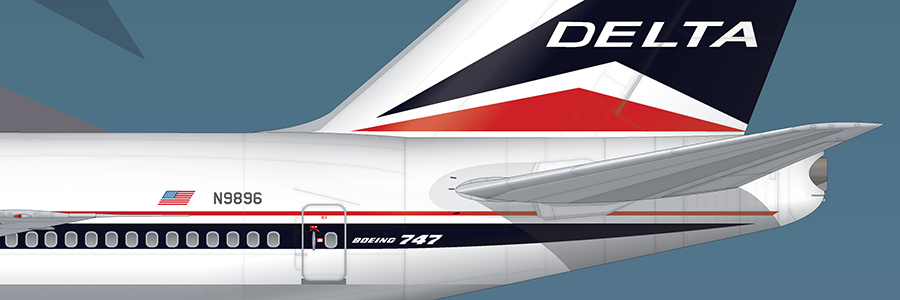
Of the five original Delta 747-100s, only the first one, N9896 “Ship 101” can still be seen today at the Evergreen Aviation Museum.
(JP Santiago)

The fates of Delta’s five 747-100s:

N9896: Returned to Boeing 1974, leased to China Airlines 1976-1978, operated by Pan Am 1978-1991, then flew with Evergreen International. Preserved at the Evergreen Aviation Museum in 2010 (it’s on the roof as part of the waterpark with waterslides coming out of it!)

N9897: Returned to Boeing 1977, operated by Flying Tiger 1977-1989 (leased to El Al Israel for a year), operated by FedEx 1989-1991, operated by Air Hong Kong 1991-1996, then Polar Air Cargo, now scrapped.

N9898: Returned to Boeing 1975, operated by China Airlines 1975-1976, leased out by Guiness Peat Aviation 1976-1984, operated by Pan Am 1984-1991, operated by Evergreen International starting in 1991 and converted to a water bomber “Evergreen Supertanker”, retired with Evergreen’s bankruptcy in 2013. In storage at Pinal Air Park.

N9899: Returned to Boeing 1977, operated by Flying Tiger 1977-1989 (leased to El Al Israel for a year), operated by FedEx 1989-1991, operated by Air Hong Kong 1991-1995, then Polar Air Cargo, now scrapped.

N9900: Returned to Boeing 1977, operated by Flying Tiger 1977-1989, operated by FedEx 1989-1993, operated by Air Hong Kong 1993-1994, operated by Kalitta 1994-2008. Stored at Oscoda, then scrapped 2015.

As an interesting historical footnote, the first officer on the delivery of Delta’s first Lockheed Tristar was Captain Jack McMahan who at the time was one of only two men in the United States certificated to fly the DC-10, L-1011 and 747. The other pilot was an FAA examiner. He was asked by a reporter on his impressions of all three widebodies- he praised the handling of the DC-10, the overall design of the 747, and the advanced systems of the L-1011. He remarked “Flying the three planes is like going out with three sisters. They have the same background but different personalities!”

This article was originally posted on AirlineReporter.com on 23 October 2015.

Sources: Delta: The History of an Airline by W. David Lewis and Wesley Phillips Newton. University of Georgia Press, 1979, pp 340-392. Delta: An Airline and Its Aircraft by R.E.G. Davies. Palawdr Press, 1990, pp 76,80-86,96-97. 


30 August 2015

The Boeing YB-40 Bomber Escort and Its Tall Tales

Boeing YB-40 in flight. Note the second dorsal turret.
It quickly became apparent with the start of daylight strategic bomber missions over Europe that fighter escort was desperately needed to get the heavy bombers to their targets and back. During the design phase of the Boeing B-17 Flying Fortress, air doctrine of the day called for the mutually supporting defensive fire from the bomber formation to be sufficient defense against enemy fighters. Early B-17 missions were against targets in northern France which were well within the range of Royal Air Force Spitfires which could provide escort cover- but as the Eighth Air Force began to dispatch its growing B-17 force against further targets, the Spitfires lacked the range. The Republic P-47 Thunderbolt and North American P-51 Mustang had yet to reach sufficient numbers in Europe to provide long-range escort and the only fighter in theater with the range, the P-38 Lightning, was desperately needed in the North Africa campaign. In those early days of unescorted daylight missions, only a quarter of combat losses were coming from anti-aircraft flak- the majority of bomber losses came from Luftwaffe fighters. The only aircraft with the range to escort the B-17s was quite obviously (at least to planners then) another B-17, so why not swap out a bomb-load for increased defensive armament as a large bomber escort? The passage of time has us not knowing who came up with the idea of a heavily armed B-17 as an escort, but in November 1942 the first XB-40 was ordered- taking a stock B-17F Flying Fortress from the license production line at Lockheed Vega (both Lockheed and Douglas were building Flying Fortresses to augment Boeing's own production), the XB-40 was modified with a chin turret with twin fifty-caliber guns to defeat head-on attacks by Luftwaffe fighters. In addition, the waist positions were staggered so the waist gunners had more freedom of movement and each gunner got a twin fifty-caliber on a flexible mount instead of a single fifty-caliber gun which was standard. Finally, a second dorsal turret was added where the radio room was located, this turret also had twin fifty-caliber machine guns. Space in the bomb bay was devoted to additional ammunition storage and fuel. Compared to a standard B-17F, the XB-40 had three times the ammunition for its beefed up gun armament. 

Interior layout of the YB-40 showing the increased guns.
A further twenty-four B-17Fs were taken from Lockheed Vega's production and delivered to the Douglas B-17 plant in Tulsa for modification to YB-40 standard (the "Y" prefix indicating a service test aircraft as opposed to an experimental prototype which would use the "X" prefix). There were only minor differences between the first XB-40 and the YB-40 series of aircraft. Some sources suggest different armament combinations were trailed including cannons, but the aircraft were sent to Europe standardized on the Browning fifty-caliber machine gun for all the defensive positions. The 92nd Bomb Group at RAF Alconbury would be the first unit to take the YB-40 into combat to prove the concept. Of that group of twenty five aircraft (including the XB-40), thirteen would be sent to Europe- one was lost on the ferry flight, making a forced landing in a Scottish bog, leaving twelve to continue on to Alconbury. The first mission was flown on 29 May 1943 with seven YB-40s accompanying a B-17 force to hit the Kriegsmarine U-boat pens at Saint-Nazaire, France. The YB-40s, loaded with extra guns and ammunition, were slower than regular B-17Fs and handling at altitude was sluggish. The entire formation had to slow down to allow the YB-40s to keep up. On the return leg, the now empty B-17Fs could fly higher and faster no longer burdened with their bomb-loads, but the YB-40s still had their guns as they didn't exactly lighten over the course of the mission as they didn't have a heavy bomb-load to drop. Marauding German fighters focused on stragglers in the bomber formations and while the YB-40s had the defensive fire to fend off the attacks,  no one was thrilled about the prospect of being the formation straggler on every mission. The Eighth Air Force command was less than impressed- the last mission was flown on 29 July 1943 with only two months of operating experience- nine missions were flown with the loss of one aircraft. Five German fighters were confirmed as shot down by the YB-40s with two probable kills. It was hardly a resounding performance and the YB-40 program quietly wound down. Through 1943 until early 1944, the YB-40s returned to the United States. Twelve aircraft of the original twenty four never left the United States and were ultimately scrapped. 

Layout of the YB-40's additional gun armament.
The experience of the YB-40, though, did leave a legacy with the B-17 force. The next variant of the B-17 to follow the B-17F, the B-17G, featured the chin turret and the staggered waist gun positions that were used on the YB-40s. Some sources indicate that the improved "Cheyenne tail turret" (so named from the United Air Lines modification center in Cheyenne, Wyoming) was also an outgrowth of the YB-40 program. 

Two tall tales have sprung up from the YB-40 story that are often repeated on websites, publications and even books. Both of them are just that- fanciful stories and we'll discuss both of them for the record and why they're tall tales and not true historical events. 

The first story concerns a B-17 pilot with the Twelfth Air Force in the Mediterranean named Harold Fischer (in some stories spelled Fisher). Returning to their base in North Africa after a mission against the Italian island of Pantellaria, Fischer's B-17 lagged behind the formation as it had two of its engines shot out. A lone P-38 Lightning formed up on his bomber and offered to escort them. It soon took up position behind the crippled B-17 and shot it down over the sea with Fischer as the only survivor. His story was met with disbelief until USAAF intelligence officers corroborated his story that a P-38 that had gotten lost had fallen into the hands of the Italians and it was being flown by a Regia Aeronautica ace, Guido Rossi, to shoot down B-17 stragglers. Fischer was the first B-17 crewman to have survived Rossi's ruse as he had already downed nine bombers with the captured P-38. Fischer came up with a plan to exact revenge on Guido Rossi and a YB-40 was requested from the Eighth Air Force in August 1943 which Fischer would fly, playing the part of a B-17 straggler to trap Rossi. After two weeks of flying, they hadn't gotten Rossi but the Italian added more kills to his P-38. Determined to get him, Fischer worked with Allied intelligence to find out as much as he could about Guido Rossi and learned his wife and child were living in an Italian city that was in Allied hands. Fischer went to the home of Gina Rossi to meet her and had an artist paint a portrait of her on the side of the YB-40 which he aptly named "Gina". 

On the next mission to Pisa, Italy, Fischer's YB-40 took heavy damage and ended up getting met by Rossi's P-38. Noting the nose art, Rossi asked Fischer if the woman on the nose of the plane was from his own town. Realizing they had Rossi, Fischer confirmed Rossi's suspicions and began to sing the praises of Gina's lovemaking abilities. Filled with rage, Rossi attacked the YB-40 and a running gun duel ensued with Rossi at one point trying to ram the bomber. Rossi was eventually shot down over the sea and survived. As the story goes, Fischer got the Distinguished Flying Cross for it and the two flyers eventually met after the war, but Fischer was killed in a crash during the Berlin Airlift.

Sounds like a great story, but there was no Italian ace named Guido Rossi. A P-38 did fall into Italian hands during the war and its pilot was known and the aircraft as only flown in an evaluation role. There is no record of the YB-40 operating in the Mediterranean theater of operations- while there were two bomb groups with B-17s assigned to the Twelfth Air Force, neither of them operated the YB-40 either. And most damning to the veracity of this story, there is a pilot named Harold Fischer who got the DFC- but he was USAF F-86 Sabre pilot in the Korean War- he was the 25th ace of the war and was imprisoned by the Chinese after getting shot down and wasn't released until 1955. 

The second tale relates to one 1st Lt. Harry Reid with the 95th Bomb Group of the Eighth Air Force who with one of his lead pilots, had noted a lone B-17 that would tail their bomber formations on their missions over Europe. In June 1944 as the story goes, Reid and his lead pilot, Captain Glenn Infield, hatched a plan on their own initiative to use a parked YB-40 at their base to get this lone B-17 which they suspected was a captured Flying Fortress being flown by the Luftwaffe to tail formations and give position, altitude and heading information on the formations to defending Luftwaffe fighters. On a mission against a target in Brussels, Reid and Infield set their plan in motion. Sighting the lone B-17, they closed on it. The aircraft then veered away from them, confirming their suspicions as a one B-17 would have formed up with any other B-17 right away for mutual defensive fire from the gunners. Pursuing the German-flown Flying Fortress, the YB-40 was bounced by six Focke Wulf Fw 190 fighters. Reid and Infield astutely realized if they stayed close to the captured B-17, it made the Fw 190's task harder out of fear of hitting the wrong B-17. Their radio operator happened to speak fluent German and he got on the Luftwaffe's fighter frequency and directed the Fw 190 pilots to attack the captured B-17 while they made a sharp break to the right. Thinking they had gotten direction from their own B-17, the Fw 190 pilots made their attack before their own B-17 could protest! With the captured B-17 damaged, the YB-40 completed a full turn to the right and came up and behind the other Flying Fortress, finishing it off just as escort fighters arrived on the scene. Because their plan was hatched of their own initiative without the approval of their superiors, Reid and Infield were never formally decorated for their actions. 

Again, sounds like a great story, but the last YB-40s were documented to have returned to the United States by March 1944. Most of the original twelve that flew missions had returned through 1943 but three were left in Great Britain at the start of 1944. One returned to the United States in January 1944 and the last two returned in March 1944, making the timeline of this second tale impossible. In addition, while the 95th Bomb Group was co-located with the 92nd Bomb Group at RAF Alconbury, there is no documentation of the 95th BG having flown the YB-40. Only the 91st, 92nd, and 303d BGs ever flew the YB-40. 

Sources: Aerial Gunners: The Unknown Aces of World War II by Charles Watry and Duane Hall. California Aero Press, 1986, p167-174. "Brilliant Mistakes: The YB-40" by Robert Dorr. Defense Media Network at http://www.defensemedianetwork.com/stories/my-brilliant-mistake-the-yb-40/. Photos: USAF Museum, 92nd Air Refueling Wing Historians, Squadron Publications via War Thunder Forums.