Showing posts with label Operation Linebacker. Show all posts

31 March 2011

Operation Teaball: Network-Centric Real-Time Intelligence During Vietnam

In 1972, US fighters had an added resource in the fight against MiGs
In past blog posts I've discussed some of the measures taken by the military to reverse the decline in air combat proficiency in the skies over Vietnam. This past November I had blogged about the origins of Red Flag as well as the top secret USAF program to obtain and fly MiGs. Back in March I wrote about the US Navy's own efforts that began with the Ault Report. While these were all steps that would benefit fighter pilots in the skies over Vietnam, there was another effort that took place that has received scant attention in the history books and presaged today's military buzzword of "network-centric" warfare. Between the bombing halt of 1968 and the start of the North Vietnamese Easter Offensive in 1972, air combat over North Vietnam was nearly non-existent. With the start of the NVA offensive in 1972, though, President Nixon reversed the gradual drawdown of US forces in Southeast Asia with a massive buildup and bombing offensive under Operation Linebacker I and Linebacker II. With the ramp up of offensive air strikes on North Vietnam, US aircrews found themselves embroiled in multiplane dogfights that were resulting in growing US losses. In the three months following the start of Linebacker in May 1972, the US lost 48 aircraft, 21 to VNAF MiGs and 27 to improved ground defenses. In the same period, only 31 MiGs were shot down by US aircraft and things worsened in the summer with 13 US aircraft lost to MiGs and only 11 MiGs shot down. 

At the same time, the policy of rotation of air crews meant that experienced personnel were rotated out of combat and replaced with novice air crews on their first combat tour. In the days before Red Flag and dissimilar air combat training, the loss rate of first tour air crews was staggering enough the General John Vogt, commander of the Seventh Air Force which oversaw combat air operations in Southeast Asia, ordered the minutes of mission critique conferences to be disseminated to all units in theater, not just the units involved. But it wasn't enough for General Vogt. He reported to the USAF Chief of Staff, General John Ryan, that the US was losing the air war over Vietnam in 1972. As a result, General Ryan ordered his staff to create a plan to assist US pilots in the skies over Vietnam- no studies, no plans, but what General Ryan wanted was something in place that could offset the fact that the VNAF MiG pilots were battle-experienced and had excellent GCI controllers who could relay the MiG air crews detailed descriptions of the tactical situation. 

General John Vogt, commander USAF Seventh Air Force
Ryan tasked a three-man "action group" with setting something up- USAF officers Lt. Col. William Kirk and Maj. Ernie Short teamed up with Delmar Lang, an intelligence specialist with the National Security Agency. Lang was brought in as he had several times in the years prior repeated offered to set up an eavesdropping facility that could listen in on the communications between the VNAF MiG pilots and their GCI controllers to provide real time information to US pilots. Lang's idea had historical precedence- during the Korean War, the USAF had a listening post on the island of Cho-do off the coast of Korea that was staffed with linguists and air control specialists that would listen in on North Korean, Chinese, and Russian communications to give US pilots a real-time picture of what was going on in "MiG Alley". Since the Korean War, the pace of technological progress in electronic and signals intelligence (ELINT and SIGINT) improved by leaps and bounds, but national security and a variety of compartmentalized secret programs kept many of these new methods out of sight to those on the front line. Delmar Lang's NSA position, however, coupled with the access given Lt. Col. Kirk and Maj. Short, intended to cut through the institutional resistance to using those technological resources to win the war in the skies of over Vietnam. 

On 26 July 1972, literally in just one month, General Ryan's "action group" set up the Operation Teaball Weapons Control Center at the Thai air base of Nakhon Phanom (nicknamed "Naked Fanny" by US pilots). Working with the intelligence specialists of the USAF's 6908th Security Squadron, the Teaball control room had map displays where data from a variety of intelligence sources already in place was collected and synthesized to form a single tactical picture that could be disseminated to US pilots in real time by specialist ground controllers. Orbiting high over the Gulf of Tonkin and Laos, specialist ELINT/SIGINT RC-135s listened in on communications between MiG pilots and their GCI controllers- this data was then relayed to a Lockheed U-2 orbiting high overhead that then relayed the information direct to the Teaball control center at Nakhon Phanom. Ground and ship-based (like "Red Crown" in the Gulf of Tonkin) radar pictures were added to refine the tactical picture. Finally, radar and SIGINT data from specialist EC-121s- such as the famous radar early warning EC-121 that used the call sign "Disco"- was also relayed to the Teaball specialists as well. Also little known was a US capability to trigger the IFF systems of the MiGs so they could be easily tracked. The stream of data from all these sources made use of a top-secret NSA computer system called "Ironhorse" that was designed to analyze and synthesize all the data to create a cohesive tactical picture that was then displayed on the map screens for the Teaball controllers to relay via another radio relay RC-135 to US pilots over North Vietnam. Once the system was up and running, the delay was as little as 45 to 60 seconds before the Teaball controllers were issuing advisories to US pilots!

"Combat Lightning" was one many specialist KC-135 variants used
Each combat air crew, regardless of service branch, were notified of a discrete UHF channel to monitor that advisories from the Teaball control center were broadcast. Teaball controllers also knew the call signs of each and every combat mission for that day going into North Vietnam. Positions of VNAF MiGs were given in relation to a notional point called the "Bull's Eye" which was Hanoi. Distance and bearing from the Bull's Eye was given and air crews often programmed the Bull's Eye into their aircraft's own navigational equipment. "Blue Bandits" were MiG-21s, "White Bandits" were MiG-19s, and "Red Bandits" were MiG-17s. The code word "Green Bandit" indicated an exceptionally experienced VNAF MiG pilot was airborne. "Heads up" meant MiGs were nearby. Teaball controllers and analysts noted that certain combat flights were targeted especially heavily by the MiGs at times, and these US air crews were designated "Queen for a Day". A Teaball controller might inform a flight of F-4s about "Red Bandits, 25 miles SE of Bull's Eye, heading NE 300 knots" over a designated UHF channel. In effect, the Teaball controller acted as a GCI controller for the US pilots, constantly feeding them information on the position and action of any MiGs nearby to allow the US pilots to exploit the situation.

Lt. Col. Kirk briefed every unit that was flying combat missions over Vietnam and warned them explicitly "Pay attention when I call you on that channel!" Within the first month of Operation Teaball's operation, American fighters had moved from a 1:1 kill ratio to a 3:1 ratio and by the end of the Linebacker operations, the ratio had risen to 4:1 in favor of US air crews. The system saved many an air crew's life in the skies over North Vietnam, to the point that inbound flights often checked in with the Teaball control center once they had taken off to be sure they had their call signs!

Operation Teaball was one of the earliest and most successful uses of data fusion and what today we would call "network-centric" warfare- to use diverse data collection sources fused together to give situational awareness to our men and women in combat. It was the first time that such diverse sources of intelligence that were once the sole realm of distant analysts in the United States were used to deliver real-time actionable information to win battles. 

Sources: The Linebacker Raids: The Bombing of North Vietnam, 1972 by John T. Smith. Arms and Armour, 1998, p95-97. Air Force Magazine, July 2008, Volume 91, Number 7. "The Teaball Tactic" by Walter Boyne.


14 February 2011

Operation MARHUK: The Combat Debut of the Marine's AH-1J SeaCobra

Marine SeaCobras took a beating operating at sea
The first US Marine Corps AH-1 Cobra gunships in action were actually AH-1Gs which were ordered by the Marines in 1967- having closely watched the Army development of the Cobra gunship, 72 helicopters were requested for one helicopter attack squadron in each of its three Marine Air Wings. Despite having the approval of the Secretary of the Navy, Defense Secretary McNamara overruled the decision and only allowed the Marines to order 38 of the single-engined AH-1G variant. With the first Marine AH-1Gs going into action in Vietnam in April 1969, reports from the field couldn't have been more salutatory in the effectiveness of the Cobra gunship. Based on that initial experience, the Marines wanted a more powerful Cobra- one with twin engines, Marine avionics, a rotor brake for shipboard operations and a harder-hitting gun in the undernose turret. After overcoming the resistance of an obstinate Secretary McNamara, the AH-1J SeaCobra went into production with the first examples undergoing combat evaluation in South Vietnam in February 1971. With the onset of the Easter invasion by North Vietnam of the south and the American response, Operation Linebacker, the first Marine helicopter attack squadron, HMA-369 based in Okinawa, was called upon shortly after its establishment to conduct offensive operations against North Vietnam. 

The USMC had the AH-1J built from the start to operate from ships
At the time, Army Cobra gunship were operating in South Vietnam against the invasion thrusts of the North Vietnamese Army. Despite having just received its new AH-1J SeaCobras, Admiral John McCain, Jr, head of the US Pacific Command, wanted to make sure that the blockade of North Vietnam was complete. Even though carrier aircraft had sown mines closing Haiphong Harbor, the North's main port, the North Vietnamese had resorted to having Chinese and Soviet cargo ships anchor offshore various locations and cargo would be offloaded into smaller sampans for transfer to the shore. This way the mined sea lanes could be avoided. Because fixed wing carrier aircraft were urgently needed for Operation Linebacker attacks on North Vietnam, it was decided that the AH-1J SeaCobra would be ideal for the role of maritime interdiction off the coast of North Vietnam. In the entire Pacific theatre, only HMA-369 in Okinawa had suitable helicopters for the job and Operation MARHUK (Marine Hunter-Killer) was born. It would be the Bell AH-1J SeaCobra's baptism of fire and off the coast of the heavily defended North Vietnamese coast, no less. 

HMA-369's "Marhuker" patch

 HMA-369 originally wanted a helicopter carrier to be based on for Operation MARHUK, but the Navy's LPHs were heavily committed else where and the 18 officers, 99 men and seven AH-1J SeaCobras of HMA-369 that were ready to deploy in June 1972 were shoehorned into the amphibious transport ship USS Denver (LPD-9). Marine brass give the squadron officers a blank check to do what ever was necessary to get HMA-369 to the war zone and the nickname "Marhukers" was given to the officers who improvised and bent and possibly broke many rules to make their SeaCobras combat ready. Even 5-inch Zuni rockets were procured, a weapon that had not yet been cleared for use from the AH-1J. The ship and its escorts would be positioned near the Hong La anchorage further south down the coast from Haiphong. Here Chinese and Soviet merchant ships anchored offshore and North Vietnamese sampans offloaded cargo offshore to bring into Hong La. Since the rules of engagement forbade hitting the merchant ships, the SeaCobras stayed at least 500 yards away from the ships and remained overwater the whole time as the North Vietnamese had heavy AAA guns on  the shoreline. The SeaCobras operated in pairs and would sink the sampans with their Zuni rockets and 20mm undernose cannon. The pilots were also trained to call in naval gunfire and air strikes while the gunners in front seats of the AH-1Js focused on the sampans. After several weeks, the shore-based heavy AAA guns learned not to fire on the SeaCobras thanks to the naval fire support and air strikes the pilots would call in. 

In August 1972 HMA-369 moved to the USS Cleveland (LPD 7) and then again to the USS Dubuque (LPD 8). Over the course of Operation MARHUK, the AH-1J SeaCobras were called on to provide air cover for downed aviators in the North as well as functioning as forward air controllers for Navy strike aircraft. Missions ranged from 80 miles north of the DMZ to as far north as 80 miles south of Hanoi inland! When Operation MARHUK ended on 26 January 1973 with the end of Operation Linebacker II, nearly 1,000 sorties had been flown with 123 sampans sunk, further straining the logistics of North Vietnam that eventually drove them to the bargaining table. It was quite a stunning debut for the AH-1J SeaCobra. 

Source: Helicopter Gunships: Deadly Combat Weapon Systems by Wayne Mutza. Specialty Press, 2010, p72-76.
27 January 2011

The First Successful Combat Drops of Laser-Guided Bombs

Capt. Thomas Messett led the first combat LGB drop
By 1972 President Richard Nixon's policy of "Vietnamization" was underway as the bulk of responsibility for the defense of South Vietnam transferred from US forces to the South Vietnamese military. Nearly the bulk of US forces in Vietnam had already departed and the Seventh Air Force had already sent half of its combat aircraft back stateside. Only two aircraft carriers remained in the Gulf of Tonkin. The North Vietnamese saw the opportunity to win the war via a conventional attack and on 29 March 1972, twelve of North Vietnam's fifteen divisions made a three-pronged invasion into South Vietnam, leaving only one division in North Vietnam and two divisions in Laos in reserve. Within three days of the Easter invasion, South Vietnamese forces were on the brink of collapse. Over the course of the month of April, a massive influx of US combat aircraft striking the advancing NVA was all that prevented the collapse of the Saigon regime. On 8 May 1972 US Navy aircraft mined the approaches to Haiphong harbor and that evening President Nixon addressed the nation to announce Operation Linebacker, the intensive bombing of North Vietnam, to commence on 10 May 1972. With the North Vietnamese having exposed their logistical tail in their multi-pronged invasion of the South, they left themselves open to air attack on their rear. 

On the first day of Linebacker, sixteen McDonnell Douglas F-4 Phantoms of the 8th Tactical Fighter Wing "Wolfpack" based at RTAFB Ubon in Thailand armed with 2,000 lb electro-optically guided bombs attacked the Paul Doumer Bridge that linked the port city of Haiphong with the capital of Hanoi over the Red River. The weapon systems officers (WSOs) in the back seat of the Phantoms used a TV screen to display the image from the TV camera in the nose of the bomb. Picking out a sharp contrast point between light and dark, the WSOs selected the aim points on the bridge and the bombs were on their way after the dropping aircraft turned for safety. Every electro-optical bomb missed, with the bombs locking on the shadow of the bridge on the water below or suffering a guidance unit failure. Some other supporting aircraft scored hits with conventional bombs, but none of the spans had been dropped. 

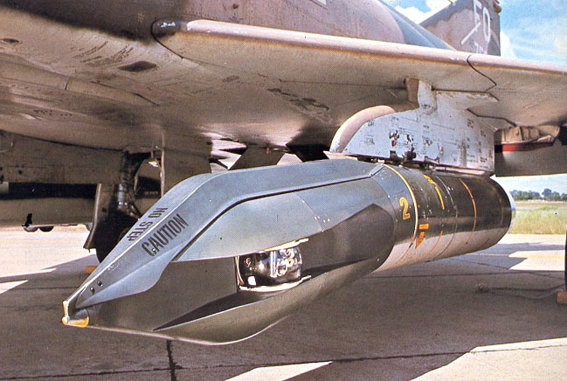
The AN/AVQ-10 Pave Knife, showing the camera/laser aperture
While the first laser-guided bombs were under development prior to the 1968 bombing halt, continued work by Texas Instruments had improved the method from the hand-held "Zot Box" that was used by the WSO while the Phantom flew a pylon turn around the target to podded systems in the form of the AN/AVQ-10 Pave Knife that allowed more flexible attack approaches to be made. The WSO used the laser in the Pave Knife pod to designate the target point for the laser-guided bombs. The 8th TFW at Ubon had six Pave Knife pods and it was decided to use them on the next day to revisit the Paul Doumer Bridge. Compared to the sixteen aircraft from the previous day, on 11 May 1972 only four F-4D Phantoms led by Captain Thomas Messett (who flew in the previous day's raid) would attack the bridge. One Phantom carried two 3,000 lb LGBs and the other three Phantoms carried two 2,000 lb LGBs. Only Captain Messett's F-4 carried a Pave Knife pod. The defenders of the bridge didn't think the four Phantoms were the main strike force and as they dived on the bridge, Messett and his WSO designated target points on the bridge and all eight bombs scored direct hits on the bridge, dropping the entire span on the Hanoi side of the bridge into the Red River. It would be a year before the Paul Doumer Bridge was usable again. 

The 3,000 lb GBU-11 added fins and laser guidance to the M118 bomb
The other bridge that was crucial to hitting at the North Vietnamese logistical support of the Easter invasion was the Thanh Hoa Bridge, an immensely tough rail bridge nicknamed "Dragon's Jaw" that crossed the Song Ma River and connected the rail shipment points from China to Hanoi. During Operation Rolling Thunder from 1965 to 1968 over 1,000 missions flew against the Dragon's Jaw, not one mission succeeding in bringing its spans down. The USAF even resorted to dropping floating bombs upstream of the bridge to try and bring it down in Operation Carolina Moon. Nothing worked, it was known as the toughest target in North Vietnam.  On 13 May 1972, two days after the Paul Doumer Bridge was dropped, the 8th TFW set out to drop the Thanh Hoa Bridge for good with fourteen Phantoms carrying nine 3,000 lb LGBs, fifteen 2,000 lb LGBs, and forty-eight 500 lb conventional bombs (due to a shortage of laser-guided bombs). Attacking through an intense flak barrage, direct hits by the LGBs put the entire western span of the Dragon's Jaw into the Song Ma River below. Before the end of Linebacker I in October, the Navy flew an additional eleven missions against the bridge and the USAF another two to insure the bridge was out for good. 

Post-strike recon photo of the Paul Doumer Bridge
It was a stunning debut for a new age of precision munitions. When the Pave Knife was used against the Paul Doumer and Thanh Hoa Bridges by the 8th TFW, it was technically still a developmental program and was rushed forward in response to Nixon's order to blunt the North Vietnamese invasion. Twelve pods were built for the testing program. When the preparations for Operation Linebacker started, three pods stayed stateside to continue the testing program. Three pods went to the US Navy for use on specially-wired Grumman A-6A Intruders and six pods went to the 8th TFW at Ubon for use on specially-wired F-4D Phantoms. Two pods were lost over North Vietnam during Linebacker I- the remaining four pods became quite valuable and after Paul Doumer and Thanh Hoa, were used only on the most critical and important targets. The commander of the Seventh Air Force, General John Vogt, reportedly told the pilots of the 8th TFW "Don't come back if you don't have that pod with you when you return!"

Source: The Linebacker Raids: The Bombing of North Vietnam, 1972 by John T. Smith. Arms and Armour Press, 1998, p61-75.


20 May 2010

The Flamboyant Markings of VF-51's Phantoms in Vietnam


During Operation Linebacker over Vietnam in 1972, the two McDonnell Douglas F-4 Phantom II squadrons aboard the USS Coral Sea, VF-111 "Sundowners" and VF-51 "Screaming Eagles" each had their own obstacles to overcome to become some of the premier Phantom units in Southeast Asia. VF-51, in particular, had a double uphill climb as the squadron had just transitioned from the Vought F-8H Crusader AND their new Phantoms weren't so new- they were old F-4B models that had been rejected by the Marines as unairworthy and had been left in storage at MCAS El Toro in California for years.

Many of the senior cadre of pilots at VF-51 were ex-Crusader jocks who lamented the loss of their 20mm cannon and what they perceived the hassle of having a RIO (radar intercept officer) in the back seat. "I'd rather have 500 lbs of fuel than babysit an NFO (naval flight officer, the category of flight crew that were assigned as Phantom RIOs)." The pilots resented their transition training to the Phantom with VF-121 at NAS Miramar where they had veteran RIO instructors in the back seat. "About as fun as having your mother with you on a date" complained one pilot. VF-51's commander, Tom Tucker, ordered his pilots to "dummy up" and play nice with the RIOs to make the transition as smooth as possible.

Soon the ex-Crusader jocks fell in love with their new mounts. Having more power and a better radar than the Crusader was well-appreciated and a few of the former single-seat pilots also started to like having the extra set of eyeballs afforded by the RIOs. Before long, the pilots started to have preferences for certain RIOs but the RIOs themselves were an independent minded bunch. There's an anecdotal story of one RIO teaching his pilot a lesson on crew coordination when during a training mission the RIO shut down all the key radar and avionic systems and told his pilot "Okay, badass, see how well you can fly and fight now." Since the RIO had the switches for those systems, the pilot was left with little to do but keep from crashing. So an unspoken rule developed at VF-51 that RIOs also had say in which pilots they flew with. Many of the Phantom crews ended up flying with the same pilots and RIOs through much of the Coral Sea's 1972 combat cruise.

Having to get the elderly F-4Bs up and running proved to be VF-51's other difficulty in the run up to the 1972 combat cruise. The latest production model was the F-4J which rectified many of the problems with the F-4B, but as the rapid build-up of forces under President Nixon accelerated, any and all Phantoms that could be spared were snapped up by deploying squadrons. In VF-51's case, that meant a motley assortment of hangar queens from MCAS El Toro that hadn't flown since 1968. VF-51 was given free reign to press into service any maintenance crew from any squadron at NAS Miramar to form "Tiger Teams" that worked day and night to get the F-4Bs ready for combat.

With the pilots transitioned and finally working well with their RIOs and the F-4Bs ready to head to war, the only thing left was the come up with new squadron markings for VF-51's mounts. One of the squadron ensigns was sent to a corrosion control and painting course at NAS North Island and he had figured out which panels were opened up the most during routine combat operations. Squadron markings were devised that avoided these panels so they scheme stayed intact and it was one of the most flamboyant Phantom markings to go to sea- what rival squadrons called the "Supersonic Can Opener" was a bright eagle marking with tail feathers that splayed out on the rear fuselage. Even the main landing gear doors were painted with full color eagle talons.

Some of the Miramar command staff told VF-51 that the only thing their Phantoms were missing now were mudflaps and a raccoon tail attached to an aerial! One of the future MiG-killers of VF-51, CDR Jerry "Devil" Houston, recounted in an interview that while other squadrons were looking at ways to tone down their markings and even conceal their aircraft, for morale they wanted VF-51's markings "to be audacious; we wanted to be a magnet for MiGs...intruders in our airspace didn't have to speculate about who just whipped their ass."

Sister squadron VF-111 on the Coral Sea in response adopted an equally flamboyant sunburst tail marking for their 1972 combat cruise as well.

Source: Gray Ghosts: US Navy and Marine Corps F-4 Phantoms by Peter E. Davies. Schiffer Publishing, 2000, p151-153.