Showing posts with label Alaska Airlines. Show all posts

01 July 2015

Alaska Airlines Selects the MD-80

N936AS in its delivery colors
The 1985 delivery of the first McDonnell Douglas MD-80 aircraft to Seattle-based Alaska Airlines came on the heels of one of the most remarkable coups ever pulled by an airline on an manufacturer to get a good deal. Normally much is made about manufacturers making a crucial sale with an airline, but when it came to Alaska getting the MD-80, the real story was how the airline got a deal that was so good, McDonnell Douglas lost money on the Alaska sale. In 1983, the airline's management formed a team to select a new aircraft that would eventually replace the Boeing 727-100/200 as the flagship of the Alaska fleet. The two candidate aircraft that vied for the contract were the McDonnell Douglas MD-80 and the Boeing 737-300, at the time both new aircraft a generation later in terms of technology and efficiency over the 727s that shouldered the bulk of Alaska's passengers. The scope of the procurement would be the largest order in Alaska's history as prior aircraft purchases were made in small batches, often for used aircraft. The selection process created a tremendous amount of discord in the Seattle headquarters as each aircraft had its proponents for very good reasons. 

Many of Alaska's technical staff and pilot corps were pro-Boeing, understandable given that the airline's long history and experience with not just the Boeing 727-100/200, but also the 737-200 as well. The belly cargo capacity of the 737 with its wider fuselage was much appreciated particularly on the routes between Alaska and the Lower 48 states. But the 737-300 was about twenty seats short of the passenger capacity Alaska desired. The 737 variant that met the airline's capacity requirement was the 737-400, but in 1983-84, that variant had yet to be launched (that would happen with Piedmont's launch order in 1986) which was too far in the future for Alaska's timetable. 

N933AS in the Alaska's livery at time of the first deliveries
The McDonnell Douglas MD-80 did meet Alaska's capacity specification and the marketing department of the airline liked the idea of its five-abreast seating which meant each seat row had only one unpopular middle seat. However, the MD-80's narrower fuselage placed significant constraints on belly cargo space. On the routes between Alaska and the US West Coast, belly cargo revenue was nearly as important as passenger revenue. At the time Alaska began its selection process in 1983, the MD-80 program was having a sales drought and there were even rumors in the industry about the MD-80 production line getting shut down. American Airlines' ground-breaking order that saved the MD-80 program was still about a year and a half in the future. This meant that Alaska's order was potentially the most significant yet for the MD-80 program and many in the leadership at McDonnell Douglas were keen to stick it to Boeing by landing a large order with an airline right in Boeing's backyard. Compared to the 737-300 which was selling very well with a healthy backlog, the slower sales of the MD-80 meant that McDonnell Douglas could guarantee a much earlier delivery than Boeing could offer with the 737-300.

1/400 scale model of an Alaska MD-83.
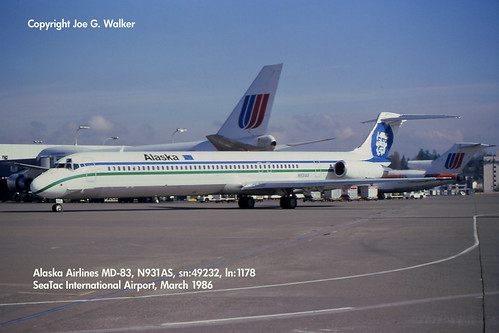
The three most important factors for Alaska came down to passenger capacity, delivery timeframe, and the deal clincher, price. And this is where Alaska scored its coup. Alaska's team knew that McDonnell Douglas was not only eager for an MD-80 sale, they were also wanting desperately a big order with Alaska to rub it in Boeing's face. There are four variants in the MD-80 family- the MD-81 was the initial production version, the MD-82 was an increased gross weight version of the MD-81, the MD-83 was an extended range version of the MD-82, and the later MD-88 had an EFIS cockpit (Delta launched this variant). Through the negotiation process as the deal swung in favor of McDonnell Douglas, the company based its planned contract with Alaska on the MD-82 variant. Alaska, however, knew McDonnell Douglas was coming out with the MD-83 and that was the variant the airline really wanted thanks to its longer range. When Alaska's team arrived in Long Beach for the final negotiations, the sales team presented Alaska with a letter of intent for an initial order of six MD-82s. That's when Alaska pulled out their ace card and told McDonnell Douglas they'd only sign to finalized the deal if they got the MD-83 and only if the MD-83s were at the same price as the MD-82. Backed into a corner, McDonnell Douglas relented and Alaska Airlines became the launch customer for the MD-83 variant. The initial order would be for nine aircraft- the first two to be delivered (N930AS and N931AS) were financed by a Japanese leasing agency while the other six were paid for out of Alaska's financial reserves. 

In Robert Serling's great book on the history of Alaska Airlines, he relates that once the deal for the MD-83 was signed, the CEO of Alaska, Bruce Kennedy, had to meet with the iconic head of Boeing, Thornton Wilson (or as most people knew him as just "T" given his personality) to break the news. Wilson grumbled to Kennedy "Damn it, Bruce, you know we build better airplanes then they do!" Kennedy responded that McDonnell Douglas was more aggressive on price and that the MD-80's seating capacity more closely matched the 727-200 than the 737-300 did. Serling wrote that Wilson cooled down and replied "Well, Bill Allen (a past CEO of Boeing) told me years ago never to regret a sale on which you would have lost money", something that did happen to McDonnell Douglas with the Alaska deal as they had so deeply discounted the MD-83 to make the sale. 
SEASLIDEN931ASsm copy
Alaska's first MD-80, N931AS.

Even though Alaska had signed for the MD-83, the first two aircraft delivered were actually MD-82/83 hybrids- they had the more powerful engines of the MD-83 but had smaller fuselage fuel tanks like the MD-82 get a bit more belly cargo space. The aircraft also had a new heavier landing gear than what the MD-82 had to handle the increased weight. Both aircraft were designated MD-82s, though. The first one delivered was N931AS on 20 February 1985 followed by N930AS on 29 March 1985. The delivery flight from Long Beach of N931AS turned out to be fiasco for Alaska and McDonnell Douglas as technical glitches delayed its departure for Seattle, then the water system on the aircraft failed in flight, preventing any of the toilets from flushing. In addition, to meet Alaska's timetable, the first four aircraft had less powerful engines temporarily fitted than the agreed production standard and that made for a long, slow flight to Seattle.

A total of 48 MD-80s would be operated by Alaska Airlines until the type's retirement in 2008. The most operated at any single time was 44 with one write-off, the tragic crash of Alaska 261 due to a tailplane jackscrew failure in 2000.

Related reading:

How American Airlines Saved the MD-80
Alaska's First Jet: "Seventy-Seven Hotel"
How the Lockheed Hercules Helped Open Alaska to Oil Exploration

Source: Character & Characters: The Spirit of Alaska Airlines by Robert J. Serling. Epicenter Press, 2008, pp 207-212. Fleet information from Planespotters.net. Photos: Wikipedia, JPSantiago, Joe Walker Collection/Flickr.

06 February 2015

How the Lockheed Hercules Helped Open Alaska to Oil Exploration


The Lockheed L-100 prototype loading in Fairbanks. Note the Alaska titles.
In the spring of 1965, there were seven different oil exploration groups prospecting on Alaska's North Slope and they had run into significant logistical difficulties in bringing in not just the equipment needed but also basic supplies for the personnel. The only way at the time was to bring it in on ocean-going barges that only had access to Alaska's northern coast a few weeks at a time during the summer thanks to the extensive ice pack of the Arctic Ocean. There were no roads or railways that connected the North Slope to the cities of Fairbanks and Anchorage further south. The Yukon River was the first geographic barrier between Fairbanks and where the oil was, but even more significant was the Brooks Range that stretched east to west across Alaska for over 700 miles with peaks as high as 9,000 feet. A straight line distance from Fairbanks to the North Slope is easily 500 miles across the most remote and untouched wilderness in the United States. Engineers for the oil companies involved with North Slope exploration had devised a massive caterpillar land train, but it would cost over $1 million to build just one and it would take a year to transit from Fairbanks to the North Slope, threading its way through the mountain passes in the Brooks Range. During the summer months, no one was quite sure if the tundra could support the weight of the proposed massive land train. That left airlift as the only solution but in 1965 there were no civilian aircraft that had the right combination of load carrying capacity, ability to take in outsize loads, the performance to get into and out of what would be very short gravel airstrips, not to mention an ability to keep working in the extreme Alaskan winters. 

The answer came from Charlie Willis, who had been the head of Alaska Airlines since 1957. The year prior, Lockheed had flown the prototype L-100, a civilian cargo version of the C-130 Hercules. The L-100 was basically a demilitarized version of the C-130E and made its first flight on 20 April 1964. Lockheed was eager for commercial sales of the L-100 and Willis struck a deal with Lockheed to wet-lease the prototype in what became known as the "Thirty Day Miracle"- with only Alaska Airlines titles on the landing gear sponsons, the wet-lease included not just the aircraft but the Lockheed pilots and crew as well. This way there would be no delay in getting an Alaska crew up to speed on the new aircraft. 

During the four-week airlift to the North Slope, the lone L-100 prototype moved over 2 million pounds of out-sized cargo to improvised air strips all along the North Slope. Charlie Willis was thrilled with the lease, exclaiming to the Alaska press covering the airlift "This aircraft can airlift heavy machinery, large earth moving equipment, and prefabricated structures on the same day at less cost by conventional surface means." The first company to benefit from the airlift was Richfield Oil who struck oil at Prudhoe Bay, sparking the Alaska Oil Rush. The Prudhoe Bay oil field is the largest not just in the United States but in North America as well. With over 25 billion barrels of oil, this field is more than double the size of the next biggest oil field in the United States which is in East Texas and extends to the Gulf of Mexico. By the end of 1965, five oil fields and eleven gas fields had been opened up on the North Slope. The challenge then became how to get the oil and gas from the North Slope and the only economically feasible option would be the construction of the Trans-Alaska Pipeline that would run from Prudhoe Bay to the port of Valdez in the south. 

One of Alaska International's Herks that supported pipeline construction.
Alaska International Airlines had ordered the Lockheed L-100 after seeing it in action during the "Thirty Day Miracle". When construction of the pipeline began in March 1974, AIA devoted six L-100s to airlift missions to support the pipeline contstruction. The six aircraft were moving 1 million pounds of cargo *each* day into improvised gravel air strips along the pipeline construction route. From heavy equipment to fuel to prefabricated housing for the workers, AIA's L-100s averaged 12 hours of flying each day, some aircraft flying as much as 21 hours in a day. The aircraft were indispensable to the construction effort and along with the "Thirty Day Miracle" part of the lore that has surrounded the Lockheed C-130 Hercules. 

Source: Herk: Hero of the Skies by Joseph Earl Dabney. Copple House Books, 1979, pp 231-249. Photos: Lockheed Martin Archives


24 July 2010

Alaska Airlines' First Jet, "Seventy-Seven Hotel"

Throughout the 1950s, Alaska Airlines' propliners wore a very elegant blue scheme with a golden eagle logo on the tail. The services from the lower 48 states to Alaska as well as on internal Alaska routes were advertised as "Golden Nugget" service in reference to Alaska's rich prospecting history. But despite popular services, Alaska in the 1950s was financially strapped and woefully unable to finance new equipment. At one point, Howard Hughes even offered to lease Alaska up to six Convair 880s to get into the jet age at very reasonable prices that unfortunately, were still too stiff for Alaska's austere budget.

But jets were what were needed and Alaska's competitor, Pacific Northern Airlines, had just ordered the Boeing 720 for delivery in 1962. There was simply no way for Alaska's DC-6s to compete with PNA's 720s on the Anchorage-Seattle run.

Charlie Willis, then Alaska's president, approached Convair to plead for very favorable financial terms to get jet equipment as Alaska saw the greater speed of the CV-880 as one way to meet the threat to market share posed by PNA's Boeing jets. Fortunately for him, Convair's sales team was desperately looking for a sale as the Convair jet was facing tough competition from the larger Boeing 707s and Douglas DC-8s. Willis returned to Anchorage with a contract for one Convair 880M, which boasted a whole range of improvements over the first baseline 880 model.

Of course, Convair was more than happy to be able to place one of their jets right in Boeing's hometown of Seattle where Alaska had a large presence in the late 1950s and early 1960s. N8477H (often called Seventy-Seven Hotel by Alaska crews) inaugurated Golden Nugget Jet services between Seattle, Anchorage and Fairbanks on 30 August 1961 and the service was cleverly pitched as "Four Jets Daily to Alaska".

Alaska's single CV-800 had high utilization as it was Alaska's only jet until the first Boeing 727s arrived in 1966 and Seventy-Seven Hotel was sold to Cathay Pacific. At one point, Alaska's sole 880 even carried cargo in the lounge area of the aircraft when demand was down in the winter months. The livery Alaska used on the CV-880 was based on the stylized eagle logo used on the DC-6s, but instead of blue, a very attractive red/gold scheme was used that was unique to Seventy-Seven Hotel and was not used on the rest of Alaska's fleet. The 727s that replaced the 880M had a Golden Nugget "meatball" style logo on the tail instead of the eagle on a red field. So not only was Alaska's 880 unique, it also wore a livery unique to it as well.

Source: Convair 880 & 990 (Great Airliners Series, Volume 1) by John Proctor. World Transport Press, 1996, p27.

09 July 2009

In 1965 seven US oil companies were prospecting Alaska's North Slope for oil and found that getting drilling equipment to the area was near impossible- there were no roads to the North Slope and the only way would have been to barge the equipment in via the Arctic Ocean but that could only take place for a few weeks each summer.

The problem was solved by Alaska Airlines who "wet-leased" the civilian Lockheed L-100 Hercules demonstrator from Lockheed for one month. In what became known as the "Thirty Day Miracle" the sole Hercules transported over 2 million pounds of equipment and cargo to dirt strips in the North Slope. Richfield Oil subsequently struck oil at Prudhoe Bay and that set off the great Alaskan oil rush.

Source: Herk: Hero of the Skies, by Joseph Earl Dabney, Copple House Books, 1979, p237-241.