Showing posts with label USAF. Show all posts

29 April 2016

The American V-1 Program 1944-1950

Beginning in 1942, Allied intelligence began a systematic analysis of the Fiesler Fi 103 flying bomb better known as the V-1. Analysis of crashed test articles combined with photoreconnaissance and intelligence collected by agents within occupied Europe led the United States in particular to restart its flying bomb programs in 1943 that had laid dormant for the most of the Second World War on account of what was felt to be beyond the current state of the art. In 1944, Northrop was contracted to begin development of the first US flying bomb, designated the JB-1. Running parallel to the Northrop effort was the reverse-engineering of the V-1 using 2,500 lbs of salvaged V-1 parts that had been provided by Great Britain. The parts arrived at Wright-Patterson Field in Dayton, Ohio, on 13 July 1944 and the US Army Air Forces directed the engineering staff there to build 13 copies of the V-1. Quite remarkably, the USAAF technical staff completed the first copy in just three weeks! To put the scope of the success of the Allied intelligence effort and the work the Wright-Patterson Field team into perspective, the first German V-1s struck Britain on 12-13 June 1944. By the end of the following month, the USAAF had its first copy of the V-1 and they had test fired the reverse-engineered pulse jet engine. A memo from the technical team responsible to General Henry Arnold, head of the USAAF, recommended mass production at the earliest opportunity- however, General Arnold and his advisors were well aware of the V-1's inaccuracy and despite reservations that production of an American V-1 would divert crucial wartime resources and manpower from battle-proven weapons, it was felt that if the guidance of the V-1 could be improved, an American version might be useful. 

The Republic-Ford JB-2 differed from the V-1 in minor details
(USAF/Wikipedia)
Republic Aviation was tasked with producing the American V-1 which was designated JB-2 with the first of the thirteen USAAF copies arriving on 8 September 1944 from Wright-Patterson Field. The USAAF ordered 1,000 JB-2s from Republic. The Ford Motor Company was tasked with producing the JB-2's pulse jet engine which was designated the PJ31. With Republic's resources nearly all committed to the production of the P-47 Thunderbolt, the company subcontracted the airframe assembly to Willys-Overland, the same company that built the Jeep. With Ford responsible for engine production, the Jack & Heintz Company of Cleveland which had been building aircraft electrical components and autopilots as a subcontractor was given responsibility for the JB-2's control system. Alloy Products of Wisconsin was given responsibility for the fuel tanks and pressure vessels used in the JB-2 while the Northrop was contracted for the JB-2's launch sled. The booster rockets that actually propelled the JB-2 off the ground were contracted to Monsanto. 

By the end of September 1944, the USAAF revised its initial order for 1,000 JB-2s to 1,000 JB-2s *per* month with a target goal to reach that rate by April 1945. The first JB-2 launch took place at Eglin Airfield in Florida on 12 October 1944- just three months had elapsed since start of the German V-1 campaign against London and the first American copy had made its first flight! Flight testing was also carried out at Wendover Field in Utah at the same time that the B-29 Superfortress unit that dropped the atomic bombs, the 509th Composite Group, was a tenant at Wendover training for their special mission. The flight tests didn't go too smoothy- by the first week of December, there were two successful flights out of ten launches. 

JB-2 air launch from a B-17 at Eglin Army Air Field in 1944
(USAF/Wikipedia)
Northrop's own flying bomb design, the JB-1, made its first launch in December 1944 but crashed after launch. (The JB-1 will be the subject of its own later article here at Tails Through Time.) With the the early failures of the JB-1 and problems with its jet powerplant, the USAAF decided to continue with the development of the Northrop design but production and operational priority went to the JB-2. Despite issues with accuracy in the flight tests at Eglin and Wendover, the USAAF leadership pushed for an increased production rate for the JB-2 to at least 3,000 per month. On 14 January 1945, General Arnold ordered another 75,000 JB-2s with the ability to launch 100 per day by September and 500 per day by January 1946 in anticipate of the invasion of Japan. On the next day, the JB-2 program got the same priority that was given to the B-29 Superfortress program. 

Despite the enthusiasm from the USAAF leadership, theater and operational commanders were skeptical of the JB-2. The generally poor European weather that was interfering with the strategic bombing campaign, however, offered perhaps some utility for the JB-2 as it wasn't dependent on clear weather- a view supported by Sir Trafford Leigh-Mallory, the head of the Royal Air Force and commander-in-chief of Allied air forces for the Normandy invasion as well as General Carl Spaatz, head of US Strategic Air Forces Europe. Spaatz, however, was a bit more measured in his support for the employment of the JB-2. He felt that it was more a harassment weapon that could be used when bad weather precluded a strategic bombing mission and outlined his planned use at 300 JB-2s per day only 10 days out of the month. But General Spaatz was very specific that operational employment of the JB-2 could not interfere with heavy bomber operations and he personally expressed concerns to General Arnold regarding the JB-2's cost-effectiveness given its inaccuracy. 

The JB-2 flight test program centered primarily on improving the weapon's accuracy. The first successful flights in the fall of 1944 showed an average error of eight miles at a range of just over 120 miles, not much better than what the Germans were averaging in their own V-1 campaign. The next step by the USAAF was to install radio guidance control in the JB-2. Using a radar beacon and remote control, it was thought the JB-2's accuracy could be improved. However, continued flight tests showed in 20 flight tests with the new guidance system, the JB-2's average error was no better than it was before with preset controls. Things did get better though- by war's end, the JB-2 with preset controls was averaging 5 miles error over a range of 150 miles and 1/4 mile error over a range of 100 miles with radio guidance. 

The biggest stumbling block to the operational deployment of the JB-2 in Europe in 1945, believe it or not, was logistical. The sheer numbers of JB-2s needed competed with other munitions production and it was estimated by some in the War Department that just transporting the JB-2 and its associated equipment to Europe would take up nearly 25% of Allied shipping capacity in the Atlantic. Brief consideration was given to moving JB-2 production to Europe, but there simply wasn't the production capacity anywhere else but the United States to produce the numbers of JB-2s planners envisioned using. 

With the end of the war in Europe, JB-2 production numbers remained in flux as planners debated what was needed for the planned invasion of Japan. By this point, however, the production and logistical concerns for the mass deployment of the JB-2 had exhausted the initial enthusiasm for the weapon. Production was halted initially at the end of January 1945 but then reinstated at a lower rate. By the time of the Japanese surrender, 1,385 JB-2s had been built when production was terminated.

Concurrent with the USAAF testing, the US Navy worked on a navalized version of the JB-2 that would have been launched from specially-modified LSTs and escort carriers during the invasion of Japan. Fifty-one JB-2s were requested by the Navy for its own testing program in September 1944 when production was launched. While airborne launches from B-17 Flying Fortresses were done during testing at Eglin Field, the Navy planned to launch JB-2s from Consolidated PB4Y Privateers as well. Navy planners, however, didn't expect operational capability with the JB-2 (which was called the Loon by the Navy) until August or September 1946. The first Navy Loon launch was on 7 January 1946 with the Secretary of the Navy approving the conversion of two submarines for Loon operations in March 1946. Conversion of the USS Cusk (SS-348) began in January 1947. The Cusk entered the history books on 18 February 1947 as the world's first missile submarine when it made its first Loon launch...which ended in failure after only 3.5 miles of flight. The Cusk finally had its first successful launch on 7 March 1947 after five tries. Submarine launch had become the Navy's focus for the Loon program with the USS Carbonero (SS-337) also modified for the program and by 1949 finally carried out a firing from a surface ship, the test ship USS Norton Sound. In March 1950, the Navy terminated in the Loon in favor of the more promising Regulus cruise missile. 

The USS Cusk fires a JB-2 Loon
(US Navy/Wikipedia)
With the US Air Force becoming independent in 1947, the JB-2 program was reactivated in March 1948 at Holloman AFB in New Mexico as part of a program for the development of missile guidance systems and seeker technology. Work using the JB-2 benefitted the later Matador cruise missile program with the JB-2 program winding down by 1949 with test airframes successfully being flown remotely and skid landed for recovery. A joint effort with Eglin AFB also used the JB-2 as a target drone for the development of gunsights. Interestingly "Flakzielgerät 76" was the German cover name for the V-1 during its development which loosely translates as anti-aircraft target device.

Further reading:

British Defenses Against the Summer 1944 V-1 Bombardment
Regulus: The US Navy's First Operational Nuclear Missile
CHECK SIX: Ships Damaged or Sunk by the Yokosuka MXY7 Ohka

Sources: The Evolution of the Cruise Missile: Comprehensive History from the V-1 and V-2 to the Tomahawk and Snark by Kenneth P. Werrell. Air University Press/USAF, 1983, pp 79-85. V-1 Flying Bomb 1942-1952: Hitler's Infamous Doodlebug (New Vanguard No. 106) by Steven J. Zaloga. Osprey Publishing, 2005, pp 39-41.


22 February 2016

Operation Moked: The Premiere of the Anti-Runway Bomb

In the run up to the 1967 Six-Day War in the Middle East, the Israeli Air Force was significantly outnumbered by the Arab air forces of Egypt, Syria, and Jordan and Iraq as well. Egypt's air force alone had 50 percent more comparable combat aircraft than the Israelis. As early as 1953 it was clear that neutralization of the Arab air bases would be vital in any future conflict. By 1960 operational planning centered around executing a simultaneous strike on all the Arab bases in range of Israel. The operations branch commander of the IAF, Rafi Har-Lev, and the top navigator in the air force, Rafi Sivron, began work on Operation Moked- the simultaneous neutralization of the Arab air bases.

The MATRA BLU-107 Durandal on a USAF F-111
(Wikipedia)
The basis of the planning was intelligence- not only were the dispositions and activity cycles of the Arab squadrons determined, but they also were able to secure information on the runway thickness and design of the bases. Planning began in earnest in 1963 and was continually updated by the flow on intelligence from reconnaissance and human sources.

Since trapping the Arab combat aircraft on the ground was key, the Israelis and the French (before their abrupt change in foreign policy under Charles De Gaulle shifted away from Israel in 1967 after the Six-Day War) co-developed a new type of bomb specifically designed for destroying runways. After its release, a first rocket acted as a braking rocket to slow the munition to get it to the optimum penetration angle. A second rocket then fired that drove the bomb through the runway and within six seconds the explosives detonated, creating a larger crater than would have been possible with a conventional bomb. Israeli Military Industries (IMI or "Taas", it's Hebrew name) was the lead contractor for the new weapon.

Aircraft carrying the new bombs would target eighteen air bases in Egypt, six bases in Syria, and two bases in Jordan. Once the runways were knocked out, the rest of the strike force could pick off the grounded Arab aircraft with guns and rockets. On 5 June 1967 at 0700 hours, the command went out from the IDF headquarters in Tel Aviv "Execute Moked". One-hundred sixty aircraft took off in the first wave. Jordanian radar detected the strike force but assumed that they were US Navy aircraft of the Sixth Fleet which were known to be in the region. At 0745 hours, Egyptian fighter aircraft were finishing up landing after their dawn patrols of the airspace adjoining Israel. Maintenance crews and pilots were in the process of heading to breakfast before the next patrol cycle began and that was when the Israelis struck. As each aircraft delivered the new runway bombs, they swung around and commenced strafing runs against the flight lines of trapped aircraft. While ten percent of the strike force was lost, within six hours the air forces of Egypt, Syria, and Jordan were neutralized. As Mordechai Hod, the commander of the Israeli Air Force said before the attacks "A jet aircraft is the deadliest weapon in existence- in the sky. On the ground, it is useless."

Operation Moked was a hugely successful gamble. The Israelis committed nearly all of its aircraft to the strikes, leaving only 12 fighters to protect Tel Aviv, something that the IDF commanders didn't fully reveal to the Israeli government.

Durandal test round dropped by a Mirage III
(Sistemsadearmas.br)
The runway cratering bomb was further developed starting in 1971 by the French weapons firm MATRA as the Durandal, named for a mythical French sword. The Durandal differed from the 1967 anti-runway munition in that after release, a braking parachute was used to stabilize the bomb instead of a braking rocket. There is a oft-repeated misconception that Durandal was used in Operation Moked, but that would have been nearly ten years before Durandal was available. Rather, the 1967 weapon was a distinct program that led to the current Durandal weapon. The Durandal was put into production for the French in 1977 and in 1982, it was evaluated by the United States Air Force for use by the General Dynamics F-111. It would subsequently be cleared as well for the McDonnell Douglas F-15E Strike Eagle and received the designation BLU-107 and was used to great effect during Operation Desert Storm. The Durandal was designed for a shelf life of 11 years and if was carried on three sorties and not used, it was withdrawn from use. As such, the BLU-107 Durandal is no longer in use by the USAF.

Further reading:

Operation Drugstore: The 1982 Air Battles Over the Bekaa Valley
Foxbats Over the Sinai
Selling the Skyhawk to Israel and a Watershed Change in American Foreign Policy
Birth of the Lion: The Development of the IAI Kfir

Source: Air Combat Reader: Historic Feats and Aviation Legends, edited by Walter Boyne and Philip Handleman. Brassey's, 1999, p235-245.

07 February 2016

The End of the Line for Curtiss Aircraft

XP-87 Blackhawk prototype
(USAF Museum)
In the summer of 1945 the US Army Air Force was in the process of outlining its combat aircraft needs in the post-war world. For fighter aircraft, there were three classes of aircraft that the USAAF wanted- an all-weather offensive fighter, a point-defense interceptor, and a long-range penetration fighter. It was expected that because of the state of the technology of the day that the all-weather offensive fighter would be the biggest of the three. On 28 August 1945 the USAAF issued its RfP (Request for Proposals) for the all-weather offensive fighter- a speed of 525 mph at 35,000 feet, 12 minutes to reach 35,000 feet and a 600-mile combat radius. It was thought at the time that piston engines would be necessary, but a refinement of the USAAF requirements a few months later laid out the service's desire for an aircraft that could seek out and destroy both enemy aircraft and ground targets in all weather conditions, day or night. Bell, Consolidated (Convair), Curtiss, Douglas, Goodyear, and Northrop submitted entries; Bell, Convair, and Goodyear were eliminated quickly due to performance deficiencies. Curtiss submitted a large four jet design based on the XA-43 attack jet design they had been working on for a different ground attack specification. Douglas submitted a land-based version of their F3D Skyknight, and Northrop submitted three designs- a refined version of the P-61 Black Widow, one based on the XP-79 flying wing fighter, and an all-new twinjet design. 

The political winds of change meant that the USAAF favored Curtiss heavily for the reasons that the previously dominant aircraft manufacturer had no contracts to sustain it in the postwar period and no civilian designs readily available for the growing passenger market. What was left of the funding for the XA-43 project was used to contract with Curtiss for prototypes of their design to be designated the XP-87. But the USAAF was sufficiently interested in Northrop's all-new twinjet design to contract for prototypes of that design as well to be designated XP-89. The USAAF also contracted with Martin Aircraft for a nose mounted turret that would allow the cannons to be swiveled to off-center targets that was to be fitted to both the XP-87 and XP-89. 

The XA-43. Note the differences from the XP-87 design.
(The Unwanted Blog at up-ship.com)
The designation XA-43 is often and mistakenly used interchangeably with the XP-87 designation- they were in fact two different aircraft that only resembled each other in basic layout. The XA-43 had a tandem cockpit, oval cross-section nacelles that were mounted inline with the wing, and was 65% larger than the XP-87 which had a side-by-side cockpit, rectangular nacelles under the wing. The XA-43's horizontal tail was low set and the design also featured a tail gun. The fact that the first XP-87 prototype was contracted with XA-43 funding led to the confusion that still is seen to this day. The XA-43 was ordered in November 1944 for a jet-powered ground attack bomber but it soon outgrew its proposed powerplants. By the time of the all-weather fighter RfP, the USAAF had lost interest in the XA-43 and allowed Curtiss to redirect its XA-43 efforts to the XP-87. But since policy of the time dictated two prototype aircraft in case of the loss of one, the original XA-43 contract was amended to allow for the construction of a second XP-87 prototype. In August 1946 Curtiss requested to name the XP-87 the Bat, but as there was already a US Navy glide bomb called the Bat, the request was turned down and a month later the XP-87 was given the name Blackhawk. 

By 1947 a review was underway to determine which of the fighters under development at the time might be suitable as a tactical reconnaissance aircraft- due to the size and carrying capacity of the XP-87, it was decided that it would also be developed into a reconnaissance version designated the RP-87. In order to not slow down the development, Curtiss was to complete both prototypes as all-weather fighters and then convert the second aircraft into the reconnaissance configuration at the completion of the prototype flight tests. In June 1947 Curtiss raised concerns with the USAAF on the power output of using four Westinghouse J34 engines in the paired nacelles and suggested changing to the Allison J33 as a single J33 engine had the power of two J34s not to mention the simplification of maintenance having only two engines instead of four. The change was approved for the production model but the prototypes would be completed with the four J34 engines. 

Only the XP-87 prototypes were to have four paired engines
(USAF Museum)
The first prototype was built at Curtiss' production facility in Columbus, Ohio, that once housed wartime production of the SB2C Helldiver. Taxi testing and ground tests took place at Columbus, but the USAAF wanted all flight testing to occur at Muroc AAF (later renamed Edwards AFB) in California. The first XP-87 was partially disassembled and loaded onto a trailer for transport to California- on going under the first highway overpass near the Columbus plant, the height was misjudged and the vertical fin hit the overpass, resulting in significant damage. With the damaged fin removed, he convoy headed out again and outside of Tulsa, Oklahoma got into an accident that damaged the nacelle for the left two engines. It was felt repairs could be made at Muroc and after month, the convoy reached the base where a new vertical fin and a team of  engineers were waiting to repair the prototype. The first flight was finally made on 1 March 1948 on a reasonably uneventful 58-minute maiden flight. The next several flights discovered buffeting in the tail due to it having a lower critical Mach number than the rest of the aircraft. Curtiss proposed a redesigned swept empennage for the production aircraft that was also duly approved by the USAAF. A total of 55 contractor test flights were made with the Blackhawk prototype and the flights confirmed the need to change to the Allison J33 on the production fighter- the Westinghouse J34s were unreliable and needed constant repair and replacement. By the time of the next series of flights with service test pilots, the USAAF was now the US Air Force and the first USAF flights were made on 3 June 1948. A week later the USAF placed a preliminary order for 57 P-87B Blackhawks (J33 engines and swept empennage were features of the production "B" version) and 30 RP-87B photo-recon aircraft. The following day the USAF switched from P-for-pursuit to F-for-fighter, the Blackhawk becoming the XF-87.

The now-designated XF-87 from the rear
(USAF Museum)
After 19 USAF test flights, a recommendation was made to Curtiss for a slightly larger wing to help reduce the stall speed and it was agreed that the second prototype XF-87 under construction would have the larger wing, the J33 engines, the swept empennage and reconnaissance modifications and would be designated XF-87C. In October 1948 the USAF held a fly-off evaluation with the XF-87 Blackhawk prototype, the Northrop XF-89 which got the name Scorpion, and a borrowed Navy F3D Skyknight to represent the Douglas submission as it was felt the Douglas design was close enough to the production Skyknight that it could act as a stand-in. With pilots of the Air Defense Command participating, while the XF-87 Blackhawk and F3D Skyknight had their strong points (side-by-side seating being one of the strongest suits of both designs in the opinion of the ADC pilots), the Northrop XF-89 Scorpion came out overall ahead in the evaluation and it was selected for production as having the best development potential. 

It was a crushing blow for Curtiss-Wright as the XF-87 was its only postwar jet design to take to the air. The Navy had canceled the XF15C mixed-propulsion fighter a few years earlier after only three examples were built. The company, in effect, was betting its future as an aircraft manufacturer on the XF-87 Blackhawk. The first prototype was  ferried to Wright-Patterson AFB in Ohio in December 1948 and was eventually scrapped by 1950. The second unfinished prototype was never completed and what was done got parted out for other projects that the company was attempting. With no other designs in advanced development, Curtiss-Wright was forced to shut down its Airplane Division and its assets were sold to North American Aircraft and the Columbus plant would be used for the manufacture of the F-86 Sabre. Curtiss-Wright's propeller division remained active into the 1960s and was responsible for the X-19 radial lift test aircraft. Some feel the X-19 was Curtiss' last aircraft design, but in reality it was the XF-87 Blackhawk that represented the end of the line for Curtiss-Wright Aircraft, a company that just ten years earlier was one of the dominant aircraft manufacturers of the United States. 
Source: Experimental & Prototype U.S.Air Force Jet Fightersby Dennis R. Jenkins and Tony R. Landis. Specialty Press, 2008, p95-101. 


23 January 2016

What Your Kitchen Refrigerator and Ballistic Missiles Have in Common: Freon


While liquid-fueled rocket engines have been the mainstay for the satellite launch industry, the long road of technological development in solid-fuel rockets have also benefited the aerospace industry. Often times unique solutions were needed in the development of solid-fuel rockets. One of the more unusual ones was the use of liquid freon to direct the exhaust flame from solid-fueled rockets. That's right. Liquid. Freon. How? I'll get to that.

Minuteman II test launch
(National Park Service/Minuteman Missile NHS)
In the 1950s the conventional wisdom in ICBM development was that only liquid-fueled engines had the power to lift the heavy nuclear warheads of the day. The two main ICBMs in development, the Atlas and the Titan, used liquid-fueled engines. But the US Navy, seeking to put ICBMs on nuclear submarines as a sea-based strategic deterrent, considered liquid-fuels on a submarine wholly impractical and not just for safety reasons. As a result, the engineers who were developing the Polaris SLBM focused their efforts on solid-fuel rocket motors for the missile. They were storable and could be quickly fired. In addition, with enough right mix of solid propellants, the missile could be much smaller than a comparable liquid-fueled missile.

The advantages of a storable propellant and rapidity of launch made solid-fuel an attractive option for a land-based ICBM as well. In the US Air Force, General Bernard Schriever was in charge of the Air Force's ICBM development effort as the head of the Western Development Division. While he initially believed that liquid-fueled engines were the only way to power an operational ICBM, he was ably convinced by several of his engineers to look at solid-fuels as an alternative. That tangent then took on an important priority equal to that of the Atlas and Titan programs, becoming the Minuteman ICBM which was developed in the same time frame as the Navy's Polaris missile. The two weapons shared many similar characteristics due to their solid-fuel rocket engines. The first variant of the Minuteman, the LGM-30A Minuteman I, became operational at Malmstrom AFB in Montana in 1962. 
First SLBM launch, 23 July 1960.
Polaris A1 from the USS George Washington
(US Navy)
The first solid rockets used tabs that jutted into the exhaust stream to deflect the plume for directional control. It was the simplest system but to provide effective control and deflection, the tabs had to be of a size that inevitably cut into the exhaust stream's total velocity. The next solution was what the Polaris team called "jetevators". The exhaust cone of the solid rocket had an extension at the bottom of the cone that was in effect, a gimbaled extension of the skirt (rather than moving the whole nozzle assembly) and small actuators moved the whole extension. Jetevators were used on the first versions of the Polaris SLBM, the A1 and A2 variants. The main disadvantage of jetevators was they added technical complexity to the solid rocket motor as well as weight. Small jetevators could only provide slight corrections but to provide more significant directional control, larger and heavier jetevators would be needed.

Both the early versions of Polaris and Minuteman used jetevators on each of the three stages of the missiles, with the first and second stages of both missiles having four nozzles that could be differentially vectored to provide control. By 1962, however, the next versions of the missiles were already in development- for Polaris it was the A3 version (third version) and for the Minuteman it was the Minuteman II (second version, obviously). In both missiles a range increase was desired and one way to get it was to lighten the missile itself. For both new versions, the second stage switched from four nozzles with jetevators to a single nozzle that used what was called "liquid injection thrust vectoring control". For both the LGM-30B Minuteman II and the UGM-27C Polaris A3, a bigger second stage with the new liquid injection thrust control got the range increases needed. 

1964 patent diagram for liquid
injection thrust vectoring control.
(Google Patents)
Around the perimeter of the nozzle about 1/2 the way up were a series of four ports that angled slightly upward. Liquid freon was injected into one of the ports and as it did, it created a shockwave in the nozzle that pushed the exhaust stream in a direction up to 7 to 10 degress opposite from the port the freon entered. The freon didn't react with the hot plume, it merely created a thermal shockwave that pushed the plume one direction. By injecting freon into the various ports, directional control could be achieved for a lot less weight than traditional actuator-driven control mechanisms. 

On the Minuteman II, the second stage carried 262 pounds of freon in a rubber bladder to use for thrust vectoring. The Minuteman II and Polaris A3 weren't the first missiles to use this novel method of control. That honor goes to the Lance short-range battlefield missile that was used by the US Army until the 1960s. The knowledge gained from the Minuteman II and Polaris A3 in liquid injection thrust vectoring control would be used to its fullest on the large solid rocket boosters used on the Titan III and Titan IV launchers, long the mainstay of US expendable heavy-lift vehicles. Both boosters on the Titan launchers used liquid injection thrust vectoring control. If you look at a picture of a Titan III/IV at launch, you'll notice a small external tank attached to the core rocket's base, one for each booster. That's the reservoir for the liquids used for the thrust vectoring system of the solid rocket boosters.
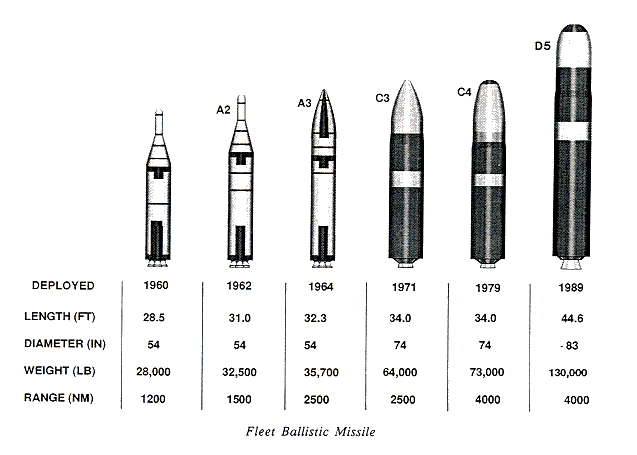
From left to right: Polaris A1, Polaris A2, Polaris A3, Poseidon C3, Poseidon C4, Trident D5
(Federation of American Scientists)
The Polaris was superseded in the Navy's strategic deterrent by the Poseidon, which was followed by  the current missile, the Trident. The Minuteman II was retired from service and the land-based ICBM deterrent for the United States relies on the Minuteman III.

Further reading: 

Martin, the Titan I and the Titan II Ballistic Missiles
One of the Most Important Missions of the Douglas C-133 Cargomaster: Transporting ICBMs


Source: To Reach the High Frontier- A History of US Launch Vehicles, edited by Roger D. Launius and Dennis Jenkins. The University Press of Kentucky, 2002, p262-266.

03 January 2016

Martin, the Titan I, and the Titan II Ballistic Missiles

Titan I ICBM elevated out of its silo for laugh
(USAF Museum)
When George M. Bunker took over the reins of Martin Aircraft from Glenn Martin in 1952, Bunker wanted to diversify Martin which up to that point had produced only aircraft. With an able group of lead engineers that Glenn Martin had literally hand picked in the years prior to his retirement from his company, Bunker moved some of Martin's engineering and research efforts into the rocket and missile arena that bore first fruit with the Viking research rocket and the Vanguard light satellite launcher built for the Navy. While many in the growing rocket and missile division were focusing their efforts on the Vanguard program, it was Jess Sweetser, Martin's VP for Sales and Requirements, who pushed the company to bid for the second USAF ICBM contract. At the time, General Bernard Schriever was heading the Western Development Division (WDD) in Los Angeles which directed the ICBM effort that started off with the Atlas ICBM built by Convair. Schriever wanted a second ICBM system fielded as a backup to the Atlas and the WDD issued a requirement that spelled out the range, guidance and throw weight (the payload of the missile, which was the nuclear warhead). Left up to the contractors would be the missile configuration, liquid vs. solid propellants, staging and number of engines.

Sweetser got to know General Schriever so well they became golfing buddies* in their free time and as a result, he was able to anticipate the need for a second ICBM program from his conversations with the general. As a result, when the WDD issued the requirement, Martin's team of engineers was already doing preliminary work in addition to their work on the Vanguard launcher for the Navy. It became clear from further directions from the Western Development Division as well as the operator of the ICBMs, the Strategic Air Command, that not just a backup ICBM was wanted, but one that was a true alternative to the Atlas ICBM and if possible, more advanced. With both Boeing and Lockheed in the competition for the alternative ICBM contract, George Bunker split the rocket and missiles team into two parts- one group stayed on the East Coast and worked on the Vanguard launcher, the other group set up shop in Los Angeles next to the WDD to work on their ICBM design. Martin's design was based on work that had been already done for the Vanguard launcher- instead of the thin, pressurized balloon skin arrangement used on the Atlas, the Martin proposal used two liquid propellant stages made of a rigid framework of copper-aluminum alloy with the tank wall integral to the rocket walls for weight savings as had been done on the Vanguard. The first stage would use two powerful 150,000 lb thrust engines and the second stage used a single 80,000 lb thrust engine that would be ignited in zero-gravity in near-space, a first for such a large engine. The Vanguard had proved that near-space ignition of the second stage was possible, but this would be the first large-scale application. 

In addition, Martin's ICBM design would be modular, allowing the design to be enlarged over time for heavier payloads. The sweetener of the proposal that would win the USAF contract for Martin in December 1955 was the creation of an all-new development, testing, and production facility in one location at the base of the Rocky Mountains in Littleton, Colorado. This was chosen for two reasons- first, the valleys in some of the mountains could house engine test stands with the mountains acting as natural sound insulators for the surrounding area, and secondly, Martin pointed out that a mid-continent facility was furthest away from the coasts which could be vulnerable to Soviet submarine missile launches and bomber attacks. Ground was broken on the Littleton facility outside of Denver in February 1956 for the missile that the USAF christened the Titan. As a result of the USAF's requirement that everything that went into the Titan missile be thoroughly tested, the first facilities built were the test stands, some of which replicated full size launch pads were complete Titan missiles could be tested. 

Just three years after the start of construction on the facility itself, the first Titan I missile was flight tested from Cape Canaveral on 6 February 1959. The second, third, and fourth test flight were a success, unprecedented in a new rocket or missile program. The fifth and sixth flights were failures with explosions on the launch pad, but the seventh flight was a success and by 1960 Martin had 11 more successful Titan I test flights. Out of 18 test flights, only two Titan I test flights failed, a success rate that was stunning and groundbreaking given the technology of the time. 

Titan I 3x3 ICBM base layout
(USAF Museum)
The first Titan I silos were built in 1959 in the Lowry AFB gunnery range just east of Denver. The first Titan I ICBMs went on nuclear alert on schedule in August 1962 at Lowry AFB. As the Titan I used liquid oxygen as an oxidizer, the missiles were kept the silos until the launch order was given. At this point a massive elevator lifted the Titan I out its silo to an above ground position where it was fueled for launch. All of the necessary facilities were deep underground, even the propellant storage tanks. Each ICBM squadron had nine Titan Is in groups of three. Each group of three missiles were part of a single launch complex. Once the missiles were fueled, the radio guidance domes also were elevated from their own silos. The radio guidance system tracked the missiles after launch and fed the necessary course corrections, much like the guidance system used on the Atlas ICBMs. 

With advances in Soviet ICBMs, though, while the Titan I flight test program was taking place, Martin's engineers were already working on a successor, Titan II. Titan II had an even bigger warhead and the modularity of the Titan design paid off as the engineers merely had to fatten the second stage to the same diameter as the first stage and then lengthened both stages for a bigger missile. To replace the radio guidance system on the Titan I, AC Delco and MIT created a new inertial guidance system that set the standard for ICBMs. No longer would radio signals from the launch site be necessary, minimizing the Titan II's vulnerability to a counterstrike. The liquid oxygen was also replaced as the oxidizer and Titan II now had non-cryogenic storable liquid propellants- Aerozine-50, which was a mix of hydrazine and unsymmetrical dimethylhydrazine (UDMH) and dinitrogen tetroxide as the oxidizer. As a result, no fueling process was needed. 

Titan II silo "hot launch"
(USAF Museum)
The simplification of the Titan II launch complexes compared to the Titan I was dramatic. Major underground structures dropped from 42 to just 18 structures, 6,000 feet of service tunnels were reduced to just 945 feet, the power requirements dropped from 12,000 kilowatts per squadron to just 2,700 kilowatts. Only half the wiring connections were needed and the need for periodic checkout of missile systems dropped by an astounding 90%.  As a result, the silos could be more widely dispersed. With a formal contract awarded in 1960, the Titan II flight test program went smoothly- of 33 test launches, 25 were successful- in fact, the last 13 test launches were so successful and reliable, the Titan II was selected by NASA to be the launcher for Project Gemini. 

With this reliability came the need to solve the basing issue. The Titan I was housed in silos, but it was lifted out of the silo for launch. Martin's engineers argued that it was possible to launch the Titan II right out of its silo, dramatically reducing its response time. Significant debate ensued about the feasibility let alone the safety of launching the 110-foot Titan II with its 430,000 lbs of first stage thrust right out of a silo. On 19 February 1963, a test Titan I was successfully launched from a Titan II test silo at Vandenberg AFB in California, validating the concept so clearly that the USAF had Boeing incorporate silo-launch on its Minuteman ICBM. The first Titan II missiles went on nuclear alert in 1963 just one year after the first Titan I missiles went on alert! 

The Titan I missile squadrons were operational from 1962 to 1965 at Lowry AFB in Colorado, Ellsworth AFB in South Dakota, Beale AFB in California, Larson AFB in Washington, and Mountain Home AFB in Idaho. Only Lowry AFB was home to two Titan I missile squadrons while the other bases only hosted a single squadrons. The Titan II missile squadrons were grouped three squadrons to a missile wing and were operational from 1963 to 1987 at McConnell AFB in Kansas, Little Rock AFB in Arkansas, and Davis-Monthan AFB in Arizona. The modularity of the Titan design, though, made it a versatile heavy-lift space launcher. Not only did the Titan II launch the manned Gemini missions, but it was also used as a satellite launcher until 2003. Titan III and Titan IV were exclusively space launchers, with the last Titan IV launch in 2005. In 1995, when Lockheed merged with Martin Marietta, the Colorado facility became part of the Lockheed Space and Missiles Division. Since the retirement of the Titan IV launcher, the Littleton facility is now the headquarters of United Launch Alliance, the joint venture of Lockheed Martin and Boeing for the Delta and Atlas launch vehicles. Although no production takes place there any longer, ULA still has its mission control, testing and engineering facilities at the same location that was the birthplace of the Titan missile when ground was broken over fifty years ago.

Historical tangent: 

I had mentioned above how Martin Aircraft's VP for Sales and Requirements Jess Sweetser, had become a golfing buddy of USAF General Bernard Schriever. Before he came to work for Martin Aircraft, Jess Sweetser was a championship golfer in the 1920s. While a student at Yale, Sweetser had won the National Intercollegiate Championship in 1920, placed 11th at the US Open the following year despite his youth, and won the Metropolitan Championship  in 1922 in his junior year at Yale. He then won the US Amateur Championship that same year and then became the first American to win the British Amateur Championship in 1926 despite having the flu. He played on the first Walker Cup team (a trophy for amateur golfers in the United States, Great Britain and Ireland) in 1922 and five more teams in years following. After graduation from Yale, he worked as a stockbroker and played golf on weekends. His first job in aviation was with Curtiss-Wright before he came to Martin Aircraft. 

Source: Raise Heaven and Earth: The Story of Martin Marietta People and Their Pioneering Achievements by William B. Harwood. Simon and Schuster, 1993, p299-325

14 October 2015

The Spyplane Codenamed "Pie Face": The Birth of the Big Safari Program

The Big Safari emblem
(Big Safari Association)
At the end of the Second World War, Germany was divided into four occupation zones administered by the victorious Allied powers. The capital, Berlin, was in turn also divided into four zones. When The Soviet Union established East Germany from its occupation zone, West Germany was formed from the American, British and French occupation zones. Berlin was also divided into East Berlin and West Berlin with the western part of the capital surrounded on all sides by East Germany. By agreement, there were travel corridors to allow surface and air connections to West Berlin from West Germany. The air corridors were only 20 miles wide at a maximum altitude of 10,000 feet. The northern air corridor followed a Hamburg-West Berlin line, the central air corridor followed a Hannover-West Berlin line and the southern air corridor followed a Frankfurt-West Berlin air corridor. In the summer of 1952, the head of United States Air Forces Europe, General Lauris Norstad, made a special request to the USAF Chief of Staff, General Hoyt Vandenberg, for reconnaissance aircraft to use in Europe that in particular, could fly unnoticed in the West Berlin air corridors as a routine courier flight. Vandenberg convened a group of specially selected officers and civilians who would develop not just the aircraft needed for the requested USAFE mission but also a set of rule and procedures in order to field such an aircraft quickly and in secrecy. Lieutenant General Thomas Rhodes worked with a reconnaissance systems specialist, Furman E. O'Rear, to develop the procedures that would get the specialized aircraft into service. 

Rhodes and O'Rear laid down the "ground rules" for the project: 
  1. Only the minimum amount of documentation was needed. Personal contact and direct communication was preferred. 
  2. Strict security clearances would be issued on a need to know basis with a minimum of personnel. 
  3. No limit on funds for the project. Special capabilities needed in the field shouldn't worry about funding. 
  4. Primary responsibility for the program lay with the Director of Air Force Maintenance and Engineering (this later became Air Force Systems Command) who would direct the Air Force Materiel Command (this later become the Air Force Logistics Command in 1961).
  5. Coordination was the utmost importance between the different commands of the USAF and the intelligence community. A single project head would act as the point of contact for all the diverse interests involved. 
  6. Aircraft contractors selected would also issue strict security clearances to a closed off work area for any aircraft modifications. 
  7. The contractor selected would be responsible for yearly upgrades to any aircraft system. 
  8. It was agreed upon ahead of time that any modifications or changes needed to the aircraft systems would be approved to expedite the fielding and subsequent upgrades to any special capability aircraft. 
In addition to these ground rules, it was also agreed that any project would make use of an existing aircraft rather than develop a new aircraft. The project office was authorized initially with a five year commitment on the reconnaissance aircraft that would be fielded by the USAFE for use in the Berlin air corridors. When it was realized in 1953 that the program's set up lent itself well to other special projects, it was given its own code name by which it is still known today: BIG SAFARI.

The Boston Camera the USAF Museum
(USAF Museum)
The year before General Norstad's 1952 special request for a reconnaissance aircraft, a very large special optical camera had been flight tested on a Convair B-36. The camera, developed by optical scientists and engineers at Boston University in 1947-1949, was designated the K-42 but was known as the Boston Camera as well as the code names BIG BERTHA and DAISY MAE. With a 240 inch focal length (6096mm), it weighed nearly three tons and used very large 18x36 inch frame film. It would be the largest aerial camera ever built. The lens was fixed at f/8 with an electrically tripped shutter speed of 1/400 second. Allegedly it had the resolution to image a golf ball on the ground from 45,000 feet. During the flight test program it was decided that a bomber carrying the Boston Camera would have been conspicuous if not downright provocative and it would be better used mounted in a transport aircraft. The aircraft had to be large so as not to have any external modifications that would give away its carriage of the large camera. PIE FACE was the code name assigned to the effort to mount the camera in a transport aircraft. The first PIE FACE contractor was actually Boeing who had offered a YC-97 Stratofreighter- one YC-97 in fact had flown a handful of Berlin Airlift missions. Boeing at the time was preoccupied with other programs and afforded the PIE FACE program little attention to the point that security was constantly being compromised with the aircraft frequently parked in the open at the property perimeter fence line in Seattle. 

As a result, the PIE FACE contractor was changed from Boeing to Convair Fort Worth. This would become Detachment 1 of the Big Safari program. The general manager of Convair, August Esenwein, took a personal stake in the project and made sure the USAF had the necessary secure hangar space as well as any engineering personnel needed make sure PIE FACE was fielded quickly. Esenwein's personal involvement pleased the USAF and the working relationship between the USAF and Convair at Detachment 1 set the standard for future contractor relationships in the Big Safari program. In fact, Detachment 1 would run for twenty years with 87 different aircraft passing through Convair Fort Worth over that time span. 

PIE FACE would have looked just like this KC-97
(Wikipedia)
While the Boston Camera did fly in Europe for six weeks on the YC-97, it was clear that as an early variant of the Stratofreighter it was less capable than the later KC-97 variants already in service. With less powerful engines, the YC-97 with the Boston Camera onboard was significantly altitude restricted. Given that the camera was used for stand-off oblique photography, a higher altitude meant that more of East Germany could be photographed from the air corridors. From 19 December 1952 to 23 February 1953, the Boston Camera was moved from the YC-97 to a KC-97 that had its boom removed, 49-2592. Both aircraft were literally cut in half behind the cockpit to move the camera from one aircraft to the other. The manual controls of the camera were upgraded with electrical and electromechanical controls as it was installed on the KC-97. Covert sliding doors were used to cover the camera ports when it wasn't in use. In addition to the installation of the Boston Camera, a 100-inch K-30 camera and a trimetrogon system of three K-17 cameras were also installed, all synchronized with the Boston Camera to give wider angle photographic coverage of the target areas and assist with mapping. A camera operator's station was installed in the cockpit with a special slaved sight to trigger the camera system. 

West Berlin air corridors
(German History in Documents and Images,
 http://germanhistorydocs.ghi-dc.org)
After flight testing with specially selected USAF crews, the PIE FACE KC-97 was assigned to 7499th Support Squadron (later renumbered to the 7405th) at Rhein-Main AB, the main USAFE transport hub in Europe. With each of the three air corridors to West Berlin being 20 miles wide, that was already 1/6th of East Germany that lay underneath any aircraft within the corridors. The addition of oblique photography added tremendously to the area surveilled- at the 10,000 foot maximum imposed by the Soviets, the majority of East Germany could be photographed by the PIE FACE aircraft. In addition to flying in the air corridors, perimeter flights along the border were also flown at altitudes as high at 32,000 feet. Just in the last six months of 1953 when it was first fielded, the specially-equipped aircraft had flown 13 missions (quite remarkable given the complexity of maintaining the camera system). The aircraft also stood alert for short notice missions and flew as far as the Arctic and the Middle East. Intelligence requirements soon outpaced the abilities of the aircraft and eleven other aircraft were added to supplement PIE FACE starting in 1954. Those aircraft will be the subject of a future article here at Tails Through Time, so stay tuned!

PIE FACE was scheduled to end in 1962 and 49-2592 was flown back to Convair Fort Worth for demodification. By that point the aircraft had already rotated through Fort Worth eight times for upgrades and further modifications. Engineers there had developed a pneumatic shutter system for the cameras in only 28 days that became the standard for any Big Safari photoreconnaissance system. But PIE FACE wasn't over just yet as the Cuban Missile Crisis erupted just as the aircraft was about to be demodified. Approximately 17 missions were flown from MacDill AFB in Tampa around the periphery of Cuba, PIE FACE's imagery supplementing that taken by the Lockheed U-2 overflight missions. In March 1965, 49-2592 returned to Convair Fort Worth for good as the airframe was worn out and given over for salvage. The Boston Camera ended up at the National Museum of the United States Air Force in Dayton, Ohio, where it can be seen today displayed with a Convair B-36 Peacemaker. 

Source: The History of Big Safari by Col. Bill Grimes, USAF (Ret). Archway Publishing in cooperation with the Big Safari Association, 2014, pp 1-16. 

24 September 2015

The Ultimate Superfortress: The B/RB-54A

Concept art of the B/RB-54A in flight
(Boeing Historical Archives)
During the Second World War Boeing worked extensively on further improvements to the B-29 Superfortress. The most important of these improved variants was the B-29D that involved swapping out the Wright R-3350 radial engines with the more powerful Pratt & Whitney R-4360 Wasp Major radial engine. In July 1945 the USAAF signed a contract for 200 B-29Ds, but with the end of the war and the rapid postwar demobilization, the B-29D contract was canceled. With the creation of an independent United States Air Force in 1947, there was a need for interim bombers pending the arrival of more advanced jet bombers. The USAF was already getting the Convair B-36 which took on the mantle of the heavy bomber, but the USAF also wanted the B-29D which would be redesignated as a medium bomber. The USAF had the B-29D redesignated as the B-50 to avoid the appearance of ordering a "wartime" bomber. Making its maiden flight on 25 June 1947, the B-50 Superfortress would eventually result in 320 examples of all variants produced.

Boeing, however, was working on an even more powerful and longer-ranged development of the B-50. Designated the B-50C, this evolution into the ultimate Superfortress was designed to extract as much speed and performance as was possible using a new version of the Pratt & Whitney R-4360 Wasp Major engine that added what was called a "variable discharge turbine" (VDT) to the engine. The standard Wasp Major used on the B-50 developed approximately 3,500 horsepower and a Wasp Major with a VDT could easily produce 4,000 horsepower, making it one of the most powerful production piston engines in the world.

The Wasp Major VDT
(from the Engine History website)
The VDT consisted of two General Electric CHM-2 turbosuperchargers that collected the hot exhaust gases from the 28 cylinders of the Wasp Major. A portion of the hot gases were diverted through an intercooler to provide turbosupercharging at high altitudes. The bulk of the hot gases went through the CHM-2 turbines and were exhausted out a variable area nozzle that resembled a set of eyelids. By adjusting the size of the nozzle, jet thrust could be achieved that had the potential to add as much as 15% to the speed of the B-50C over the production standard B-50. The Wasp Major VDT was already flying at this point on the Republic XF-12/XR-12 Rainbow long range reconnaissance aircraft. 

The scope of the changes needed to for the B/RB-54 resulted in a redesignation to B-54 with the planned reconnaissance variant being the RB-54. The jump in power output from the use of the Wasp Major VDT resulted in a redesign of the wings that resulted in a wingspan that was over 20 feet longer than that of the B-50 with a chord increase as well- an additional six feet of chord at the wing root and an additional four feet of chord at the wing tip. This provided additional fuel capacity along with external fuel tanks which were three times the capacity of the external tanks used on the B-50A on the outboard wings. The wingspan increase was so much that outrigger gears were needed under the outermost engine nacelles. Wind tunnel testing had shown that the new wing and powerful engine output also required a longer fuselage and the B/RB-54's fuselage was stretched 10 feet. Instead of the plexiglass domes used by the gunners on the B-29/B-50, low drag hemispheric sights were used. These used a fish eye hemispheric optical element that the gunner sighted through. Glenn's Computer Museum has some great pictures of the R/RB-54 hemispheric gunsight. The tail gunner also had a hemispheric gunsight but also had a radar to direct the four-gun turret as well which was mounted in fairing above the gun turret but below the hemispheric gunsight. Fairings were also present on the nose and under the forward fuselage for bombing and navigation radars. 

As a comparison, the B-29 weighed 120,000 lbs fully loaded and the B/RB-54 would weighed in at 207,000 lbs at takeoff. The Wright R-3350 engines of the B-29 developed 2,200 horsepower and the bomber had a range of approximately 3,250 miles. The B/RB-54 would have been able to push 8,000 miles of range. The mockups were completed in 1948 and the contract was signed for 43 bombers as an initial production lot. While the Secretary of the Air Force Stuart Symington and the USAF Chief of Staff General Hoyt Vandenberg were supportive of the B/RB-54 project, General Curtis LeMay, the head of the Strategic Air Command, felt that the B/RB-54 was inferior to the Convair B-36 Peacemaker particularly the B-36D that added four J47 jet engines under the outer wings. Pending the arrival of the B-52 Stratofortress, LeMay felt deterrence was better served by the B-36 which could fly faster, farther, higher, and carry a significantly larger bomb load. In the postwar atmosphere of austerity, more B-36s couldn't be accommodated in the Air Force budget and Secretary Symington offered LeMay more B-50s instead of increased numbers of B-36s. This was even more unsatisfactory to the outspoken SAC commander who then argued that if he couldn't get more B-36s, then the funding set aside for the B/RB-54 should be shifted over to get more of the Boeing B-47 Stratojet which made its first flight in December 1947. This was agreeable to all involved, even for Boeing as it meant more funding for the Stratojet program. The B/RB-54 project was cancelled with the prototype approximately 75% complete (it was converted from a B-50A) at Boeing's Seattle facilities. In addition, the addition of the outrigger gears wasn't popular with SAC as many of its bases would need widened taxiways and runways to accommodate the B/RB-54. 

The B-29 lineage would live on, though, in the C/KC-97 Stratofreighter (the last examples being retired in 1978) and in the commercial Boeing 377 Stratocruiser. But neither would have matched the leap in performance of the B/RB-54, the "ultimate" Superfortress.

The Retromechanix page has a series of superb photos via the National Archives that show the B/RB-54A mockup in detail as well as some schematic drawings. It's well worth the time to browse them!

Source: Boeing B-29 Superfortress (Crowood Aviation Series) by Steve Pace. The Crowood Press Ltd, 2003, p166-168. Boeing B-50 (Air Force Legends Number 215 by Geoffrey Hays. Ginter Books, 2012, pp 118-121.

10 August 2015

Canada's Nuclear Strike Force: 1st Air Division 1964-1972

Canada's CF-104s wore bare metal with white wings in the nuclear strike role.
For eight years, Canada maintained a small, but potent, nuclear strike force in Europe equipped with license-built Lockheed F-104 Starfighters under the auspices of the 1st Air Division. The 1st Air Division was established in 1952 in France as part of Canada's NATO air defense commitment. Four wings made up the 1st Air Division and each wing had three squadrons. For most of the 1950s, the Air Division was flew F-86 Sabres which were then replaced by CF-100 Canucks to provide all-weather/night air defense capability. In the late 1950s, Canada embarked on a search for a supersonic replacement for the CF-100 fleet. At the time, air defense was on Canada's mind but the political winds of the Cold War were such that as one of the charter members of NATO, considerable pressure was brought on Canada to contribute to the nuclear deterrent forces in Europe. With a generous industrial offset, the Lockheed F-104 Starfighter was chosen as the replacement aircraft for the 1st Air Division with the aircraft being license built by Canadair in Montreal as the CF-104. Originally the designation was to be the CF-111, but it was quickly decided to adopt the CF-104 designation to simplify administrative matters as some of Canadair's production would also be for NATO partners to augment European license production of the Starfighter. Coinciding with the selection of the Starfighter, on 2 July 1959, Canadian Defence Minister George Pearkes announced that the 1st Air Division (which became 1 Canadian Air Division in due time) would transition from the air defense role to the strike/reconnaissance role but little mention was made about the adaptation of nuclear strike as one of the Division's primary tasks. 

Reorganization of the Division's assets as part of NATO's 4th Allied Tactical Air Force would put two squadrons assigned to each of 1 Canadian Air Division's four wings- 1 Wing based at Marville AB in France would have 439 and 441 Squadrons, 2 Wing based at Groestenquin AB in France would have 421 and 430 Squadrons, 3 Wing based at Zweibrucken in West Germany would have 427 and 434 Squadron and 4 Wing based at Baden-Soellingen also in West Germany would have 422 and 444 Squadron. Following France's withdrawal from NATO military command in 1967, 1 Canadian Air Division was reorganized again with just three wings all based in West Germany- 1 Wing at Lahr, 3 Wing at Zweibrucken, and 4 Wing at Baden-Soellingen. 

The acquisition of nuclear weapons by the 1 Canadian Air Division was part of a broader umbrella agreement signed with the United States by the government of Prime Minister Lester Pearson. Interestingly the acquisition of nuclear-capable platforms like the Starfighter was made by the previous administration, that of Prime Minster John Diefenbaker. Pearson and the Liberal Party had scored political points attacking Diefenbaker for shifting Canada towards a nuclear-capable defense policy, but after defeating the Conservative Party in the 1963 elections, one of Pearson's first acts was to reverse the Liberal Party's course and actually acquire nuclear weapons. His change of heart occurred during the run up to the national elections and as an interesting historical side note, future Canadian prime minister Pierre Trudeau temporarily left the Liberal Party in disgust during this period of policy upheaval for the Liberal party. On 16 August 1963, an agreement was finalized and signed with the United States that provided for nuclear weapons for four weapons systems- the CF-104 Starfighters in Europe along with Honest John short range ballistic missiles for the Canadian Army in Europe as well as BOMARC missiles and Genie nuclear-tipped rockets for the CF-101 Voodoo force for the air defense of Canada. While a full analysis of the change in position by Prime Minister Pearson and the Cabinet is beyond the scope of this article, it primarily hinged upon improving the bilateral relationship with the United States, raising Canada's military posture within NATO, and a desire for a more effective defense policy. Given that the agreement was signed in the wake of the Partial Test Ban Treaty, the Canadian government did much to minimize the military's new nuclear role- for the Starfighter force, it wasn't until 1990 that the true extent of the 1 Canadian Air Division's nuclear capability was known. Some military officials went as far as to publicly point out to the Canadian press that the CF-104 was "too small" to carry a "large" nuclear weapon and it was a fighter, not a strike aircraft. 

Canadian officials inspect a CF-104. Note the faired over gunport.
In fact, the CF-104s were optimized for the nuclear strike mission- unlike most other nations' Starfighters, the Canadians didn't have the M61 Vulcan cannon installed and added an additional fuel cell in its place to extend its combat radius. The skill set and tactics for nuclear strike in Europe were also applicable to low level reconnaissance, so the CF-104s also could carry a centerline VICON camera pod that had 70mm cameras that photographed targets of interest on each side of the aircraft, straight down, and ahead. In the nuclear strike role, the wingtip fuel tanks were augmented by under wing fuel drop tanks with the nuclear weapon mounted on the centerline station. Three different nuclear stores were used by the CF-104 fleet and each had its own unique Canadian designation. The most common weapon was the B28 which came in two versions- the B28EX (which the Canadians referred to as "Weapon #1) which was a free fall weapon and the B28RE ("Weapon #2) which was a parachute retarded version of the B28EX. The B28 warhead was capable of different yields ranging from 70 kilotons to 1.45 Megatons,  but in practice only the 70 kt and 350 kt yields were used by the 1 Canadian Air Division.  A four digit code was required for the permissive action link (PAL) to arm the weapon. The B28EX was delivered in an over the shoulder toss while the B28RE was delivered at low altitudes, the parachute allowed the CF-104 pilot to make his escape before detonation. 

The B43 nuclear bomb (referred to by the Canadians as "Weapon #3") was only used by 4 Wing and it had a massive 1 Mt warhead and had the option of being parachute retarded and like the B28s, also had a PAL for arming. The fourth nuclear store used by the CF-104 force was the B57 and was a low-yield weapon with an explosive force of 5-20 kilotons. The B57 ("Weapon #4) was much lighter than the other stores as it was developed for the US Navy who wanted a lightweight tactical nuclear weapon. Like the other weapons, the B57 had an option for parachute delivery and also had a four-digit PAL code to arm the warhead. 

Kit box art showing the four tank configuration of the CF-104.
The B28 weapons were delivered first, starting in May 1964. The B57 was next to arrive in 1966 and the B43 was the last to arrive at Canadian bases in 1968. Because the weapons remained in US custody even on Canadian bases, it gave the Pearson government political cover that it wasn't contributing to proliferation. At each base the weapon storage area was manned by USAF personnel and the PAL codes were kept in a safe at the quick-reaction area (QRA) which was accessible only by the USAF alert duty officer. Release of weapons was under dual-key authority in which both US and Canadian command authorities had to provide authorization. Loading of a live weapon took about 30 minutes, so each Canadian base had a QRA area where fully-armed Starfighters stood nuclear alert. Double barrier fencing surrounded each QRA area and no individual could work on the alert aircraft alone- two personnel had to be present for even the most minor of tasks to be done to the QRA Starfighters. 

CF-104 in flight showing the white wings and large roundels.
The targets of the 1 Canadian Air Division consisted primarily of the logistical depots and airfields of the Group of Soviet Forces in Germany (GSFG). Major bridges that would be used in the event of a Warsaw Pact invasion of Western Europe were also on the Canadians' target list. The exact targets to be hit were provided by Supreme Allied Command Europe (SACEUR) HQ, but it was up to each squadron and its pilots to plan the inbound and outbound routes to the targets and any particular tactics to be used during the mission. Each squadron had a target evaluation board which would review each mission plan for acceptance. Once accepted, it was forward to the headquarters of the Strategic Air Command in Omaha, Nebraska, where it was included in the Single Integrated Operations Plan (SIOP), which was the US military's nuclear war plan. This way Canadian missions (and any other mission planned by NATO allies or other US military branches) could be deconflicted. This meant a high degree of timing precision was needed, typically inside of a 30 second window to hit each navigational waypoint to avoid flying into someone else's thermonuclear detonation. In practice missions, the Canadian pilots proved to be highly skilled, usually hitting each navigational waypoint within 10 seconds of the plan. Once fully operational in the nuclear strike role, the 1 Canadian Air Division was responsible for 20% of the 4th Allied Tactical Air Force's nuclear muscle- 4ATAF covered central and southern West Germany and included two Luftwaffe divisions, the USAF's Seventeenth Air Force, and a large number of Army air defense units. The squadrons of the 1 Canadian Air Division were subject to each and everyone of the nuclear inspection and readiness drills that any nuclear-capable USAF unit had to not just endure, but pass with near perfect scores. 

Prime Minister Lester Pearson's 1968 announcement that he planned to step down (and would be succeeded by Pierre Trudeau) coincided with a drawdown of Canada's NATO nuclear commitment. The social changes going in both Canada and the United States in the late 1960s required more focus on domestic issues in Canada and nuclear alert duty in Europe was quite expensive. Despite some of 1 Canadian Air Division's squadrons being operational with nuclear weapons for a short period of time (1 Wing only started nuclear alert duties in 1969), the drawdown began in 1970 with the last nuclear alert being stood on 31 December 1971 by 4 Wing. The last of the weapons were removed from the Canadian bases in 1972 as the Starfighter force was re-tasked with tactical air support- not only did the CF-104's get the M61 Vulcan cannon installed, they also were given a two tone dark gray/dark green camouflage as part of their new conventional tasking. 

The following message was sent from Canadian Forces HQ in Canada to the head of the 1st Canadian Air Division on 17 January 1972: 

"Final phase out of special weapons on 12 January marked the end of an era which started in 1964. Thank you for the great credit which you have brought to the Canadian Armed Forces in Europe."

Sources: Canadian Nuclear Weapons: The Untold Story of Canada's Cold War Arsenal by John Clearwater. Dandurn Press, 1998, pp38-61, 130-219. Additional information from Starfighter CF-104 by Anthony L. Stachiw and Andrew Tattersall. In Canadian Service Aircraft Series #4, Vanwell Publishing, 2007. Photos: Wikipedia, Aircraft Resource Center forums, RCAF Starfighter Association.