
 |
| Hawker P.1172 Kestrel in KES markings |
For a large part of the postwar history of American military aviation, the procurement of non-American aircraft was an unusual exception. I had written back in 2011 about the efforts that led to the selection of the Dassault Falcon 20 jet as the basis of the US Coast Guard's HU-25 Guardian medium range search-and-rescue aircraft. The two most significant prior examples of non-American aircraft procurement were the Martin B-57 Canberra selected by the USAF as its new interdiction bomber in 1951 and the selection of the Hawker AV-8A Harrier which entered service with the Marine Corps in 1971. The story of the Marine Corps' evaluation and procurement of the Harrier is one that readily demonstrates the Marines' political savvy in navigating the treacherous waters of Congressional funding as well as a single-minded commitment to efficient close air support to the Marines on the ground. The predecessor of the Harrier was the Hawker-funded P.1127 Kestrel demonstrator. Two prototypes and four development aircraft were built and then followed by nine more developed P.1127 airframes which in 1963 were to be part of what was called the Kestrel Evaluation Squadron (KES). The aircraft were designated Kestrel FGA Mk1 and the KES was staffed with test pilots from the Royal Air Force, the Royal Navy, the US Navy, US Army, US Air Force, and the German Luftwaffe. Because there were three nations in the Kestrel Evaluation Squadron, it was also referred to as the Tripartite Evaluation Squadron (TES). The unit was formed in 1965 for the purpose of exploring the possibilities of a V/STOL combat aircraft.
At the time of the KES flight program, Lt. Col. Thomas Miller was assigned to the US Marine Corps' Air Weapons Systems Requirements Branch at the headquarters. It was the job of the staff of this department to review all the latest research and development to see what sort of equipment would be useful to the Marines. Miller and a fellow officer, Lt. Col. John Metzko, had gotten hold of film footage from the British Embassy in Washington DC of the Kestrels in action. By this point, the RAF had committed to getting the Kestrel operational with a more developed aircraft called the Harrier. They had monitored the P.1127 Kestrel program despite not having any Marine pilots in the evaluation squadron and when it became clear the RAF was going to go forward with the Harrier, they immediately briefed the USMC Deputy Chief of Aviation who was none other than General Keith McCutcheon. I had written about him recently as the "Father of Modern Close Air Support" and needless to say, given General McCutcheon's background as a passionate advocate for the Marines' own close air support, he was readily on board to find out more about the Harrier. The next step was the brief the Commandant of the Corps, General Leonard F. Chapman. With the enthusiastic support of the Commandant, the Marines then set about on getting flight time on the new Harrier. The British were adamant that anyone who would be evaluating the Harrier be a qualified test pilot and working through the defense liasons at the British Embassy and Hawker Siddeley, Miller and Marine test pilot Lt. Col. Bud Baker were chosen to head to the UK. Miller's test flying experience was getting the A-4 Skyhawk and F-4 Phantom into Marine service, so he was well versed in what an aircraft had to be able to do to support the Marines on the ground. At the request of the British, the two Marines would clandestinely make 10 flights each in the Harrier and would wear civilian clothing during their stay in Britain during their evaluation. Test pilot John Farley of the Royal Aircraft Establishment worked with Miller and Baker to prepare them for their Harrier flights. It was Farley who made the first flight of the P.1127 Kestrel prototypes in 1964 and he would come to amass 19 years of experience as a Harrier test pilot.
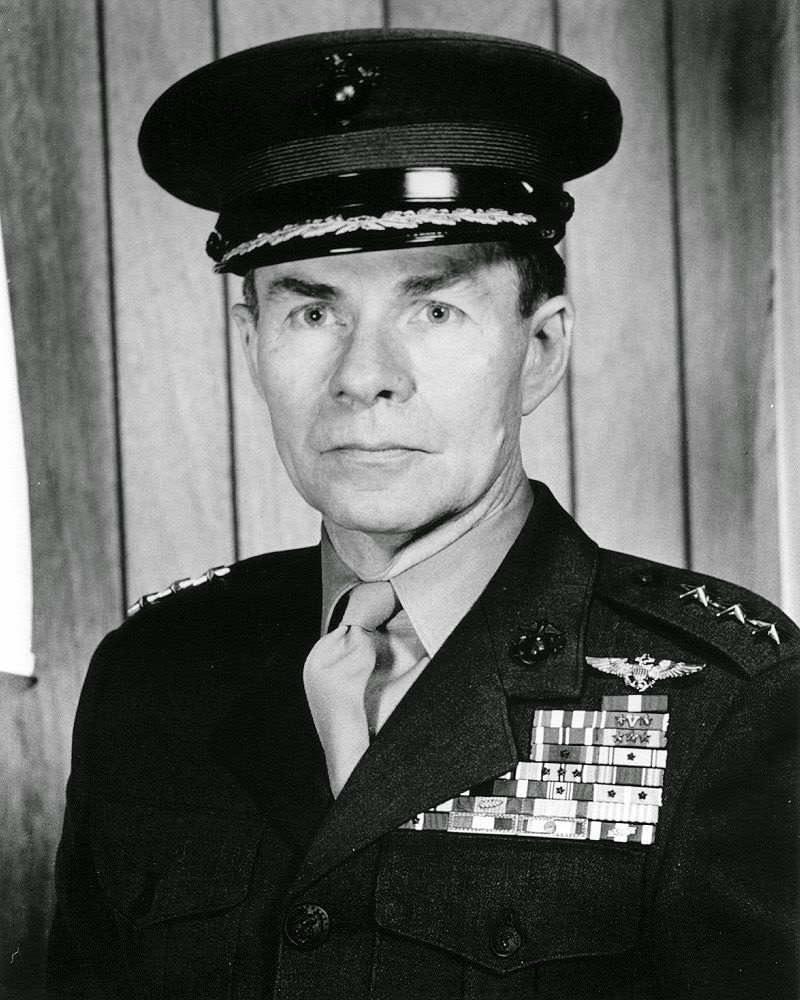 |
| Gen. McCutcheon, USMC Deputy Chief of Aviation |
Miller and Baker realized very quickly during their flights that the Harrier was a new breed of combat aircraft that Marines had to have. To them, it could do everything the A-4 Skyhawk could do but not need a 6,000 foot runway to do it. All it needed was a 1,000 foot strip for rolling STOL takeoffs with an increased weapon load or the deck of an amphibious assault carrier. It was clearly close air support that could not only go where the Marines were, but be readily based close to where the Marines were in action. To get their hands on the Harrier, the Marines needed funding. Not only did the Marines have to deal with the US Navy since the Marine Corps is a department of the Navy, but they weren't sure how the US aircraft industry would react to the Corps wanting a British aircraft. After briefing Commandant Chapman, they met with the Presidential Scientific Advisory Board to get their support.
Fortunately the Navy was receptive and sent over their own team to fly the Harrier as well which allowed them to compare with their earlier Kestrel flights as part of the KES. Also fortuitous for the Marines was that a Marine was in charge of the Navy's A-4 Skyhawk program, Col. Edwin Harper, and he got to fly the Harrier as well, giving him the unique perspective of comparing the Skyhawk with the Harrier. With the ready support of the Navy in 1969, the Marines now had to lobby Congress for the funding. The FY1970 budget didn't have any money for Harrier procurement, but Harper, Miller, Baker and General McCutcheon briefed the Senate Armed Services Committee anyway. McCutcheon made his pitch to the chairman, Senator Barry Goldwater, that he didn't want just a handful of Harriers and do an evaluation. That'd been done already. "We want to buy a whole slug of them and get started and have a meaningful program!"
 |
| Rep. Mendel Rivers (D-South Carolina) crucial to the Harrier program |
Though the FY1970 Department of Defense budget was set at their time of their briefing to the Senate Armed Services Committee, the support of the Presidential Scientific Advisory Board insured that supplemental funding was secured as an amendment to the FY1970 budget bill. The supplemental funding was enough to procure 12 Harrier jets at a cost of $57.6 million. But there was a catch- the money was secured via the Marines canceling procurement of 17 McDonnell Douglas F-4 Phantom IIs. It would be necessary to win over McDonnell Douglas. As part of getting Congressional support, the House Armed Services Committee was also briefed on the Harrier plans and the chairman of the House committee, Representative Mendel Rivers of South Carolina, would support the procurement of the 12 Harriers as long as future Harrier buys were aircraft built in the United States. Realizing that the Marines was a significant ground breaking sale into the US defense market, Hawker Siddeley immediately sent representatives to the United States to canvas the aircraft industry and find an American partner for the AV-8A Harrier program. Hawker's team met with eight aircraft manufacturers and narrowed the list down to three- Ling-Temco-Vought, Grumman, and McDonnell Douglas. Hawker felt McDonnell Douglas was the best fit given their naval aircraft experience and at the time, the A-4 Skyhawk program was starting to wind down and the AV-8A Harrier would be good transition for McDD. On 29 September, Hawker Siddeley and McDonnell Douglas signed a 15-year agreement to cooperate on the AV-8A Harrier program. In tandem with this agreement came one from Rolls Royce to team up with Pratt and Whitney on the Pegasus engine. The teams developed a plan to transition production of the Marine's AV-8A Harrier flight as well as the Pegasus engine from UK production to US production over a span of five years. With a planned buy of 114 AV-8A Harriers, it was found by Representative Mendel Rivers' staff that it was cheaper to stick with UK manufacture instead of phasing in production in the United States. During the FY1971 budget debate, discussions centered on the pros and cons of moving production to the United States and eventually Congress agreed with Mendel Rivers' analysis that there was no need to phase in production of the AV-8A in the United States. Though the agreement never resulted in US production, it did lay down the foundations for the later AV-8B Harrier II program.
 |
| AV-8A Harriers of VMA-513, the first USMC Harrier unit |
With Mendel Rivers' support now behind them, McDonnell Douglas agreed to become the engineering group responsible for product support of the AV-8A Harrier which was more than adequate compensation for the 17 canceled Phantoms. The AV-8A Harrier first entered service in 1971 at the Navy's Flight Test Center at NAS Patuxent River, Maryland while the first Harrier squadrons prepared for the transition to the AV-8A. The first operational Marine Corps squadron was VMA-513 "Flying Nightmares" which had been flying the F-4 Phantom since 1963. VMA-513 become operational with the AV-8A Harrier in May 1971 at MCAS Beaufort in Representative Mendel Rivers' home state of South Carolina.
Source: Harrier II: Validating V/STOL by Lon O. Nordeen. Naval Institute Press, 2006, pp 23-30. Photos: Wikipedia, USMC.


