Showing posts with label F-4 Phantom. Show all posts

28 May 2016

CHECK SIX: The F-4 Phantom's F3H Demon Roots

With yesterday being the 58th anniversary of the F-4 Phantom II's maiden flight, here's some interesting trivia. There is actually a continuous line of evolution from the McDonnell F3H Demon to the F-4 Phantom (which was designated F4H when it first flew). This photo is of the full scale mock up of the main missing link that connects the F3H Demon to the F4H Phantom. In 1953, the McDonnell team headed by Herman Barkey was looking at ways of extending the Demon's viability and expanding its versatility. McDonnell had the in house designation F3H-X for the design as it was considered an evolution of the Demon. 

F3H-C "Super Demon": This design was first, it was powered by a single J67 engine. The J67 was to be have been a license-built version of the Rolls Royce Olympus. No J67s were ever built in the US and the Navy wasn't keen on an unproven engine. 

F3H-E: This was different enough from the Demon that it was given the Model 98A designator. It was also powered by the J67 but had a bigger wing than the Demon and had a level stance on the ground instead of the nose-high stance of the Demon.

Full scale mock up of the F3H-G design
(Wikipedia)

F3H-G (Model 98B): This one had twin J65 engines, a license built British Sapphire engine like that used on the Hawker Hunter. It had lateral intakes that looked more like the Phantoms and exhausts that looked also more like the eventual Phantom design. The Navy was attracted to twin engines for safety. The wing was also further enlarged from the F3H-E. It had four 20mm cannon and had an impressive external stores capability. 

F3H-H: This was was the F3H-G but with two of the then-new and promising GE J79 engines. 

Model 98C: Delta winged version of the F3H-G/98B with J65 engines. 

Model 98D: Delta winged version of the F3H-G/98B with J79 engines. 

F3H-J (Model 98E): Similar to the 98C/D, but with an even larger delta wing. 

Model 98F: Recon version of the 98C. 

Tail section of the F3H-G mockup showing the two different engine sizes-
The J79 was on the right side, the J65 was on the left side.
(Wikipedia)
Barkey's team decided the F3H-G/98B was the most promising of the designs and built a full scale mockup, but one side was sized for the J65 engine and the other side sized for the J79 engine. On 19 September 1953 McDonnell submitted the design as an unsolicited proposal to the Navy. Though impressed with the design, the Navy had already ordered the Grumman F11F Tiger and Vought F8U Crusader for its supersonic fighter needs. The Navy, however, encouraged Herman Barkley's team to refine the design to meet an all-weather attack requirement. This design was submitted to the Navy in 1954 and two prototypes were ordered as the AH-1 which had four 20mm cannon and eleven weapons stations. 

F4H full scale mock up showing the originally
planned trapeze launchers for the Sparrow missiles.
(Wikipedia)
The following year the all-weather attack program was canceled and McDonnell was asked to redesign the AH-1 into a two-seat interceptor with a single centerline station for a 600-gallon fuel tank and AIM-7 Sparrow capability. The J65 engine was dropped from contention when the Chief of Naval Operations selected the J79 engine for the new aircraft which would be designated F4H Phantom II. 

And the rest is history! 

Further reading: 


19 December 2015

Navy Observation Squadron SIXTY-SEVEN (VO-67): Sub Hunters on the Ho Chi Minh Trail

Squadron patch of VO-67
(VO-67 Association)
Given the restrictions by the Johnson Administration that adopted as policy in prosecuting the war in Vietnam that the port of Haiphong was off limits as well as overland supply routes from China, the only way to stem the material support and infiltration of South Vietnam was the interdiction of traffic along the Ho Chi Minh Trail that ran west of Vietnam through Laos and Vietnam. Supplies and personnel flowed down the trail to Viet Cong insurgents operating throughout South Vietnam. Despite Laos' neutrality established in 1962, North Vietnam moved freely through Laos up and down the supply routes. In April 1965, with the permission of the Laotian government, the United States initiated Operation Steel Tiger to try and disrupt trail traffic. All targets on the trail were identified visually, a challenging proposition with dense jungle and often uncooperative tropical weather. Army ground teams were introduced to Operation Steel Tiger in October 1965. A progressive ramp up of airborne and ground reconnaissance failed to deprive the Viet Cong of the virtual river of supplies flowing through Laos. Needless to say, this state of affairs preoccupied the Secretary of Defense, Robert McNamara, who believed technology could provide a solution. Through the summer of 1966, academic and technology experts came up with the Jason Study. It suggested an electronic fence of detectors combined with airborne assets to stop the flow of materiel down the trail. The Defense Communications Planning Group (DCPG) was established by McNamara in September 1966 to develop and deploy the technology for the "electronic fence". To keep a handle on costs, the DCPG examined existing military technology to see what could be adapted for use on the Ho Chi Minh Trail. 

The modifications that resulted in the OP-2E Neptune
(ARC Forums)
The DCPG found that sonobuoys, used by the Navy for hunting submarines since the Second World War, could be adapted for land use, fitted with not only acoustic sensors but also seismic equipment to detect traffic on the Ho Chi Minh Trail. There were obvious parallels to finding an elusive enemy in the thick jungle and hunting Soviet subs in the open oceans. These land-based sonobuoys could then relay their findings to overhead aircraft to summon air strikes. In January 1967, McNamara briefed the White House on "Practice Nine" which was the code name for what become Operation Igloo White. "Muscle Shoals" was the code name for the electronic surveillance of the Ho Chi Minh Trail- "Igloo White" referred to the technologies used in adapting the Navy's sonobuoys into what were called spikebuoys (equipped with seismic sensors) and acoubuoys (acoustic sensors). Camouflaged and their aerials designed to look like branches, the spikebuoys implanted themselves in the ground while the acoubuoys were designed to snag the branches of the jungle canopy and hang in the trees. Given that the sensors were based on sonobuoy technology, the US Navy was tasked with seeding the Ho Chi Minh Trail by air with the new devices. 

By this point in the war, the North had fortified the trail with anti aircraft guns and there were discussions on how best to deliver the sensors. While the US Air Force prepared for the delivery of the sensors with F-4 Phantoms which would be less vulnerable, the Navy provided interim capability with a twelve-aircraft squadron using heavily modified Lockheed P-2 Neptunes. As the Navy's maritime patrol mission was being taken over the Lockheed P-3 Orion, surplus Neptunes were readily available. Martin Aircraft outside of Baltimore was tasked with the modification process which entailed the removal of the ASW equipment from the P-2s. Extensive armor plating was installed to protect the crews while the defensive weapons included underwing gun pods as well as two hatches in the aft fuselage for pintle-mounted M60 machine guns. A terrain-avoidance radar was added in a chin radome along with a whole host of defensive electronic warfare equipment. 

The MR tail code led to its radio call sign "Mud River"
(San Diego Air and Space Museum Archives)
With Navy crews well versed with low level sonobuoy delivery, there were no issues with delivering the acoustic sensors which would hang in the jungle canopy. However, the seismic sensors had to be dropped from higher altitudes as they had to implant themselves in the ground to detect truck traffic. The altitudes needed were much different than that used for sonobuoy delivery and it was found that old Norden bombsights in the nose worked well following a convincing demonstration at Eglin AFB in Florida. Twelve Norden sights were secured from storage and overhauled- since the bomb sights hadn't been used in years, the Navy had to locate retired Norden bombsight technicians to carry out the work. The USAF supplied an instructor who used to train bombardiers on the sight and he was sent to NAS Alameda to train the crews of the new secret Navy squadron which was designated VO-67. A training film on the use of the Norden was found at the Smithsonian Institution and was sent to VO-67. 

Designated the OP-2E Neptune, the first three VO-67 aircraft departed NAS Alameda on 6 November 1967 for RTAFB Nakhon Phanom in Thailand (nicknamed "Naked Fanny" by US crews or simply abbreviated "NKP"). At NKP, the crews of VO-67 flew with USAF forward air controller (FAC) pilots to see for themselves their operating areas over the Ho Chi Minh Trail. In fact, VO-67 personnel formed a close working relationship and even friendship with the USAF FAC pilots. FAC pilots who had just returned from patrols over the area often were met by VO-67 crews to review what the FAC pilots encountered over the trail. Each crew planned its own mission- the acoustic sensors were dropped at high speed and at low altitude, usually 500 feet, with plenty of jinking to avoid AAA fire. Terrain masking was frequently used. Often the Neptune pilots would dive down from 12,000 as they approached their target areas, drop a string of acoustic sensors and then use the terrain to egress the area. Seismic sensors were initially dropped from 2500 feet, later 5000 feet. Some Neptune crews would dive down during their seismic sensor drops to build up speed for the egress. Often times the underwing gun pods and rear M60 mounts were used for suppressive fire to keep the enemy's heads down during their target runs. 

CDR Paul Millius
(US Navy)
The missions were demanding and losses did take place- January 1968 (one aircraft lost), February 1968 (two aircraft lost). The last of the modified OP-2E aircraft joined the squadron at NKP just days after the third loss. During the Tet Offensive, the Marine fire base at Khe Sanh was under siege by an estimated 200,000 North Vietnamese troops. Along with some of the most intensive close air support of the Vietnam War, the Neptunes of VO-67 also dashed into the area to lay acoustic sensors to help detect NVA advances. By May of 1968, the USAF was ready to start delivering the sensors with its Phantoms with the job assigned to the 25th Tactical Fighter Squadron (part of the "Wolfpack" 8th Tactical Fighter Wing). The Phantoms would be less vulnerable than the lumbering Neptunes over the increasingly thick air defenses over the Ho Chi Minh Trail. The last VO-67 sensor drop mission took place on 25 June 1968 with the squadron being disestablished on 1 July 1968 and its personnel and aircraft returning to the United States. 

During its brief tour of duty, VO-67 lost one-quarter of its aircraft and 20 crewmen- and thanks to the airmanship of the crews and the invaluable help of the USAF FAC pilots who worked with VO-67, this loss rate is only half of what was expected at the start of VO-67's deployment. One pilot, Commander Paul Millius, was lost in action after his aircraft was hit at heavy caliber anti aircraft fire. One crewman was killed instantly and he kept flying until the other seven of his crew could bail out and survive. He was seen bailing out last, but was never found. He was promoted to the rank of Captain in 1972 and in 1978, he was presumed killed in action and posthumously awarded the Navy Cross. In 1995, the Navy launched the Arleigh Burke-class AEGIS destroyer USS Millius (DDG 69) in his honor, one of the few ships named for a naval aviator. The motto of the ship is "Alii Prae Me" (Others before me).

Related reading: 


Sources: Batcats: The United States Air Force 553rd Reconnaissance Wing in Southeast Asia by Jack Sikora and Larry Westin. iUniverse Publishing, 2003, pp 11-18, 73-75. VO-67 Association's Squadron History page at http://www.vo-67.org/vo67_history.html. 

14 September 2015

Operation Drugstore: The 1982 Air Battles Over the Bekaa Valley


In 1976, the Lebanese Civil War had been raging for a year when the Syrian military poured across the border into the region to ostensibly stabilize the situation. Securing the Bekaa Valley and the main Beirut-Damascus highway that crossed the central part of the country with massive numbers of troops and armor, soon the Palestinian Liberation Organization (PLO) and its Muslim allies in Lebanon were receiving support from the Syrians. To cover the Syrian left flank facing Israel, the Syrian 10th Armored Divsion was arrayed across the Bekaa Valley with three brigades of surface-to-air missile units to protect them from an Israeli attack. A total of 19 batteries covered the valley consisting of two SA-2 batteries, two SA-3 batteries, and fifteen new SA-6 batteries. During the next several years the Israelis provided support to the Christian factions in the civil war while maintaining a close eye on the strengthening Syrian integrated air defense system (IADS) that stretched across the Bekaa Valley. Overflights to pinpoint the SAM sites required use of Firebee recon drones due to the dense air defense network that the Syrians had established. In the late May to early June of 1982, the PLO conducted a 12-day artillery and rocket attack on northern Israel that resulted in 60 civilian casualties. The last straw for the Israelis came on 3 June when the PLO attempted to assassinate in London the Israeli ambassador to the United Kingdom.

On 6 June, seven Israeli mechanized divisions with 60,000 troops and 500 tanks crossed into southern Lebanon in three prongs- one up the coastal plain, one through the central mountains, and a third push into the Bekaa Valley to keep the Syrian 10th Armored Division from intervening against the Israeli right flank. On the first three days of the ground invasion, seven Syrian MiG fighters were shot down. By 8 June Israeli forward elements were at the entrance to the Bekaa Valley but weren't able to push any further north as the Syrian forces held steady under the protective umbrella of their IADS, denying close air support to the Israeli ground forces. For several weeks prior to the invasion, though, the IDF/AF had been planning to deal with the Syrian IADS umbrella over the Bekaa Valley. Years of meticulous reconnaissance and eavesdropping gave the IDF/AF the locations, operating frequencies and modes of the SAM batteries in the valley. Operation Drugstore was their plan for not just the suppression of enemy air defenses (SEAD) but what was being called "DEAD"- destruction of enemy air defenses. This is what made Operation Drugstore a landmark operation in air combat- prior to 1982, suppression was the name of the game as it had been practiced in Vietnam by the United States- keep the enemy's heads down while strike packages went in and hit targets. For Israel, nothing less than the complete elimination of the Syrian IADS was acceptable- air superiority against the Syrian fighters was meaningless if the IADS prevented close air support from assisting the ground forces' objectives. 

The opening phase of Operation Drugstore saw large numbers of Delilah ground-launched drones being launched towards the Bekaa Valley, giving the impression of a large Israeli strike force. As the SAM batteries went active to engage what they thought were Israeli aircraft, battlefield surface-to-surface missiles were fired at each SAM battery. One of the missiles used was the Keres, which was an Israeli modification of the AGM-78 Standard anti-radiation missile used by Wild Weasel aircraft. The mobile launcher fired three Keres missiles and even a local modification of the smaller AGM-45 Shrike was used that added a second stage booster to allow a ground launch. In the first ten minutes of the operation, ten of the 19 batteries had been knocked out either due to missile hits or because they had run out of missiles engaging the Delilah drones. Four minutes later, the first wave of ground attack aircraft swept into the Bekaa Valley- 26 McDonnell Douglas F-4E Phantoms and a similar number of IAI Kfir C2s, with the Phantoms using AGM-65 Maverick missiles as well as Shrike and Standard ARMs to hit the remaining SAM sites while the Kfirs targeted the control vans and storage areas of the missile sites. With no losses, a second wave of over forty A-4 Skyhawks and IAI Kfir C2s swept in attacking the SAM sites with cluster bombs while the F-4Es returned using laser-guided bombs against any surviving control vans. In just two hours, 17 of the 19 Syrian SAM sites had been destroyed. 

The next phase of Operation Drugstore saw Israeli strike aircraft next hit the Syrian mobile GCI (ground-controlled intercept) sites that provided directions to the Syrian MiG force. With the destruction of the GCI sites and their radars, the Syrian IADS was now blinded as F-15 Eagles and F-16 Fighting Falcons established combat air patrols over the Bekaa Valley. The timing was perfect- as the Syrian commanders realized that their IADS umbrella was being systematically demolished, three squadrons of MiG-21s and MiG-23s were scrambled from their Syrian bases- it's estimated that up to sixty Syrian fighters raced to the Bekaa Valley where the F-15s and F-16s were waiting. They were tasked to hit the Israeli strike forces that were attacking the components of their IADS, but instead found that Israeli Grumman E-2 Hawkeyes orbiting over southern Lebanon had given the combat air patrols ample warning of the inbound MiGs. Because the Syrians relied on GCI controllers to provide them with vectors and targeting information, the loss of the GCI sites meant they were flying into the Bekaa Valley blind while the F-15s and F-16s' longer ranged radars already had them targeted. With communcations and radars being jammed, most of the Syrian MiGs never saw what hit them- ten MiG-21s fell within minutes. At the end of the day, only one F-15 had been hit, and the pilot managed to recover his Eagle safely to Ramat David AB in northern Israel. 

The following morning the last two Syrian SAM batteries were destroyed while the Syrians scrambled more MiG-21s and MiG-23s to make up for the previous day's losses. Since the MiG-23 Floggers were the most capable of the Syrian fighters, the F-15s were tasked with eliminating them and six were shot down in short order. As Israeli armored units engaged Syrian armor in the valley, two waves of Syrian Sukhoi Su-22 fighter bombers were sent into to attack the Israeli units, escorted by a squadron of MiG-21s. It was a turkey shoot as over 20 Syrian aircraft were shot down by the Israeli fighters patrolling the skies of the Bekaa Valley. The Syrians then tried to send in anti-tank Gazelle helicopters to go after the Israeli armor and those were shot down as well. 

11 June was the last day of continuous fighting as a cease fire was to go into effect later than day. Hoping to stave off defeat and entering the ceasefire at a disadvantage, the Syrians poured their MiG-23 Floggers into the battle against the F-15s and F-16s, leaving the MiG-21s to escort the strike version of the Flogger, the MiG-23BN. Several Syrian MiG-25 Foxbats made high altitude runs over the Bekaa Valley, hoping to distract the Israeli fighters into looking "upward", distracted from the inbound MiG-23s. At lower altitudes, two waves of Syrian MiG-23BNs would attempt to hit the Israeli armored units once again where the Sukhois had failed the previous day. The Syrian fighter sweep failed as their presence was once again known thanks to the E-2 Hawkeyes. Six Floggers were shot down in their first pass over the valley. Another six MiG-21s were shot down as well and the MiG-23BN attacks had little effect on the Israeli positions. 

By the time of the ceasefire took effect, the Syrians lost 30% of their air force in just one week of fighting for a total of 88 aircraft shot down. Of those 88 kills, 44 belonged to F-15 Eagles and 33 belonged to F-16s. Israeli losses have never been fully admitted, but it's believed to include one F-16, one F-4E, one Kfir C2, two A-4s and several helicopters. Following the battle in the skies over the Bekaa Valley, the Israeli Defense Forces Air Force (IDF/AF) was secretly debriefed by US military experts from the US Air Force and other branches of the military. The lessons gleaned from Operation Drugstore would strongly influence Coalition tactics on the opening night of Operation Desert Storm. In what was called "Poobah's Party" (from the callsign of Brigadier General Larry Henry, a leading USAF tactician and expert on air defenses), approximately one-hundred drones were fired from ground sites in Saudi Arabia to trigger the Iraqi IADS into action to they could be targeted for destruction by Coalition air assets. With the stealthy Lockheed F-117A Nighthawks going "downtown" to Baghdad to take out the command and control centers of the IADS, individual radar and SAM sites then were left on their own to find their own targets in the midst of some intense jamming. Iraqi radar sites could burn through the jamming, and when they did, they detected the drones of Poobah's Party. Sites that hadn't expended their missiles on the drones found themselves targeted by F-4G Wild Weasels. 

Source: F-15 Eagle Engaged: The World's Most Successful Fighter by Steve Davies and Doug Dildy. Osprey, 2007, p146-147. Photos: Wikipedia, USAF Featured Art Gallery

21 February 2015

The Marine Corps Bet on the Harrier

Hawker P.1172 Kestrel in KES markings
For a large part of the postwar history of American military aviation, the procurement of non-American aircraft was an unusual exception. I had written back in 2011 about the efforts that led to the selection of the Dassault Falcon 20 jet as the basis of the US Coast Guard's HU-25 Guardian medium range search-and-rescue aircraft.  The two most significant prior examples of non-American aircraft procurement were the Martin B-57 Canberra selected by the USAF as its new interdiction bomber in 1951 and the selection of the Hawker AV-8A Harrier which entered service with the Marine Corps in 1971. The story of the Marine Corps' evaluation and procurement of the Harrier is one that readily demonstrates the Marines' political savvy in navigating the treacherous waters of Congressional funding as well as a single-minded commitment to efficient close air support to the Marines on the ground. The predecessor of the Harrier was the Hawker-funded P.1127 Kestrel demonstrator. Two prototypes and four development aircraft were built and then followed by nine more developed P.1127 airframes which in 1963 were to be part of what was called the Kestrel Evaluation Squadron (KES). The aircraft were designated Kestrel FGA Mk1 and the KES was staffed with test pilots from the Royal Air Force, the Royal Navy, the US Navy, US Army, US Air Force, and the German Luftwaffe. Because there were three nations in the Kestrel Evaluation Squadron, it was also referred to as the Tripartite Evaluation Squadron (TES). The unit was formed in 1965 for the purpose of exploring the possibilities of a V/STOL combat aircraft. 

At the time of the KES flight program, Lt. Col. Thomas Miller was assigned to the US Marine Corps' Air Weapons Systems Requirements Branch at the headquarters. It was the job of the staff of this department to review all the latest research and development to see what sort of equipment would be useful to the Marines. Miller and a fellow officer, Lt. Col. John Metzko, had gotten hold of film footage from the British Embassy in Washington DC of the Kestrels in action. By this point, the RAF had committed to getting the Kestrel operational with a more developed aircraft called the Harrier. They had monitored the P.1127 Kestrel program despite not having any Marine pilots in the evaluation squadron and when it became clear the RAF was going to go forward with the Harrier, they immediately briefed the USMC Deputy Chief of Aviation who was none other than General Keith McCutcheon. I had written about him recently as the "Father of Modern Close Air Support" and needless to say, given General McCutcheon's background as a passionate advocate for the Marines' own close air support, he was readily on board to find out more about the Harrier. The next step was the brief the Commandant of the Corps, General Leonard F. Chapman. With the enthusiastic support of the Commandant, the Marines then set about on getting flight time on the new Harrier. The British were adamant that anyone who would be evaluating the Harrier be a qualified test pilot and working through the defense liasons at the British Embassy and Hawker Siddeley, Miller and Marine test pilot Lt. Col. Bud Baker were chosen to head to the UK. Miller's test flying experience was getting the A-4 Skyhawk and F-4 Phantom into Marine service, so he was well versed in what an aircraft had to be able to do to support the Marines on the ground. At the request of the British, the two Marines would clandestinely make 10 flights each in the Harrier and would wear civilian clothing during their stay in Britain during their evaluation. Test pilot John Farley of the Royal Aircraft Establishment worked with Miller and Baker to prepare them for their Harrier flights. It was Farley who made the first flight of the P.1127 Kestrel prototypes in 1964 and he would come to amass 19 years of experience as a Harrier test pilot. 

Gen. McCutcheon, USMC Deputy Chief of Aviation
Miller and Baker realized very quickly during their flights that the Harrier was a new breed of combat aircraft that Marines had to have. To them, it could do everything the A-4 Skyhawk could do but not need a 6,000 foot runway to do it. All it needed was a 1,000 foot strip for rolling STOL takeoffs with an increased weapon load or the deck of an amphibious assault carrier. It was clearly close air support that could not only go where the Marines were, but be readily based close to where the Marines were in action. To get their hands on the Harrier, the Marines needed funding. Not only did the Marines have to deal with the US Navy since the Marine Corps is a department of the Navy, but they weren't sure how the US aircraft industry would react to the Corps wanting a British aircraft. After briefing Commandant Chapman, they met with the Presidential Scientific Advisory Board to get their support.

Fortunately the Navy was receptive and sent over their own team to fly the Harrier as well which allowed them to compare with their earlier Kestrel flights as part of the KES. Also fortuitous for the Marines was that a Marine was in charge of the Navy's A-4 Skyhawk program, Col. Edwin Harper, and he got to fly the Harrier as well, giving him the unique perspective of comparing the Skyhawk with the Harrier. With the ready support of the Navy in 1969, the Marines now had to lobby Congress for the funding. The FY1970 budget didn't have any money for Harrier procurement, but Harper, Miller, Baker and General McCutcheon briefed the Senate Armed Services Committee anyway. McCutcheon made his pitch to the chairman, Senator Barry Goldwater, that he didn't want just a handful of Harriers and do an evaluation. That'd been done already. "We want to buy a whole slug of them and get started and have a meaningful program!" 

Rep. Mendel Rivers (D-South Carolina) crucial to the Harrier program
Though the FY1970 Department of Defense budget was set at their time of their briefing to the Senate Armed Services Committee, the support of the Presidential Scientific Advisory Board insured that supplemental funding was secured as an amendment to the FY1970 budget bill. The supplemental funding was enough to procure 12 Harrier jets at a cost of $57.6 million. But there was a catch- the money was secured via the Marines canceling procurement of 17 McDonnell Douglas F-4 Phantom IIs. It would be necessary to win over McDonnell Douglas. As part of getting Congressional support, the House Armed Services Committee was also briefed on the Harrier plans and the chairman of the House committee, Representative Mendel Rivers of South Carolina, would support the procurement of the 12 Harriers as long as future Harrier buys were aircraft built in the United States. Realizing that the Marines was a significant ground breaking sale into the US defense market, Hawker Siddeley immediately sent representatives to the United States to canvas the aircraft industry and find an American partner for the AV-8A Harrier program. Hawker's team met with eight aircraft manufacturers and narrowed the list down to three- Ling-Temco-Vought, Grumman, and McDonnell Douglas. Hawker felt McDonnell Douglas was the best fit given their naval aircraft experience and at the time, the A-4 Skyhawk program was starting to wind down and the AV-8A Harrier would be good transition for McDD. On 29 September, Hawker Siddeley and McDonnell Douglas signed a 15-year agreement to cooperate on the AV-8A Harrier program. In tandem with this agreement came one from Rolls Royce to team up with Pratt and Whitney on the Pegasus engine. The teams developed a plan to transition production of the Marine's AV-8A Harrier flight as well as the Pegasus engine from UK production to US production over a span of five years. With a planned buy of 114 AV-8A Harriers, it was found by Representative Mendel Rivers' staff that it was cheaper to stick with UK manufacture instead of phasing in production in the United States. During the FY1971 budget debate, discussions centered on the pros and cons of moving production to the United States and eventually Congress agreed with Mendel Rivers' analysis that there was no need to phase in production of the AV-8A in the United States. Though the agreement never resulted in US production, it did lay down the foundations for the later AV-8B Harrier II program. 

AV-8A Harriers of VMA-513, the first USMC Harrier unit
With Mendel Rivers' support now behind them, McDonnell Douglas agreed to become the engineering group responsible for product support of the AV-8A Harrier which was more than adequate compensation for the 17 canceled Phantoms. The AV-8A Harrier first entered service in 1971 at the Navy's Flight Test Center at NAS Patuxent River, Maryland while the first Harrier squadrons prepared for the transition to the AV-8A. The first operational Marine Corps squadron was VMA-513 "Flying Nightmares" which had been flying the F-4 Phantom since 1963. VMA-513 become operational with the AV-8A Harrier in May 1971 at MCAS Beaufort in Representative Mendel Rivers' home state of South Carolina. 

Source: Harrier II: Validating V/STOL by Lon O. Nordeen. Naval Institute Press, 2006, pp 23-30. Photos: Wikipedia, USMC.

18 July 2012

The Mach 3 Phantom

In the 1960s the development of high-performance reconnaissance cameras offered greater resolution, but at a price- many of these systems were large and heavy and the current high-altitude spyplane of the time, the first generation variants of the Lockheed U-2, were unable to carry them. One of the premier recon optical systems developed at this time was the General Dynamics HIAC-1- a long range, oblique camera with a focal length of 66 inches that allowed stand-off reconnaissance from high altitudes. The first examples of HIAC-1 were heavy- the prototype camera system weighed over 3,500 lbs, much more than any other camera system in use at the time (excepting the very big Boston Camera carried by the B-36 and C-97 in the 1950s that weighed 3 tons and had a focal length of 240 inches). The only aircraft in the USAF inventory that could carry the HIAC-1 was the RB-57F, a modification of the Martin B-57 Canberra. In 1962 General Dynamics in Fort Worth, Texas, had the contract to maintain the RB-57D fleet which suffered from wing spar fatigue. Since General Dynamics had acquired quite a bit of experience in working on the long-span RB-57Ds, they were asked by the Air Force for an evolved version of the D that could fly higher, carry a heavier load (like the HIAC-1) and not have the same wing spar problems that plagued the RB-57D. The RB-57F was the result- with a longer wing, more powerful TF33 turbofan engines and auxillary J60 turbojets, it was what the USAF needed until the later generation of U-2 spyplanes entered service. In fact, two RB-57Fs are still used today by NASA. 

USAF RF-4C with the large G-139 pod.
Over the course of the RB-57F's operational career, Israel had made repeated requests of obtaining the RB-57F and the HIAC-1 for its own reconnaissance needs, but the requests were always denied by the US State Department and the Defense Department on the grounds that the technology used in the RB-57F would upset the strategic balance in the Middle East. However, a compromise was reached- by 1971 the HIAC-1 had been steadily improved and lightened to the point that it weighed just under 1,500 lbs and that a pod-mounted HIAC-1 carried by the McDonnell Douglas F-4E Phantom, already in the Israeli inventory, would be permissible. Also developed by General Dynamics, the pod-mounted HIAC-1 was designated G-139 and underwent an intensive flight test program with a USAF RF-4C aircraft and the first G-139 pods were delivered to Israel in October 1971. The Israelis found the G-139/HIAC-1 system useful as it allowed the Phantoms to get imagery of Egyptian defenses along the Suez Canal without having to enter the SAM umbrella. But there was a significant issue, the pod was still a heavy store and it generated a significant amount of drag- it limited the Phantoms to a maximum speed of Mach 1.5 and a maximum altitude just under 50,000 feet, not to mention the challenge of handling a G-139-laden F-4E at high altitude. As a result, the special projects division of General Dynamics began work in January 1972 on ways to improve the F-4E's performance to offset the burden of carrying the pod. 

Overview of the modifications to make the Phantom Mach 3-capable.
The first improvements came with getting the most out of the Phantom's J79 engines. Engineers found that the Phantom's intakes were limiting the performance possible from the J79. A new inlet was designed that was not only larger than the standard F-4 inlet, but it featured a new shape that better managed the airflow to the engines with series of new variable-geometry ramps. The standard Phantom inlet did have a variable geometry ramp, but it was much simpler than the General Dynamics design which also featured a large bypass door downstream from the inlet to help manage the internal shockwaves that helped slow the air down before it reached the engines. A series of vortex generators down the inlet also helped improve engine performance. The second improvement was based on 1950s research done by NASA's predecessor agency, NACA, called pre-compressor cooling (PCC). PCC was a form of water injection but used the water to cool in the inlet air before it reached the engines. By reducing the inlet air temperature, it increased the mass of the air akin to taking off on a cold day- engine air flow and thereby thrust would be increased. At high altitudes, PCC would boost engine performance starting at Mach 1.4 as the inlet air started to heat up due to friction. 

General Electric, the manufacturer of the J79, was less than enthused about General Dynamics' work on PCC, but did provide some consultations. Work had already been done with PCC on another of General Dynamics' products, the Convair F-106 Delta Dart, but it never was incorporated into the design. In addition, the USAF's Arnold Engineering Development Center in Tennessee had tested PCC in engine test cells with both the J57 and J75 engines. One J75 engine was run at maximum afterburner for 40 hours with PCC! It had also been looked at by Vought for the aborted F8U-3 Crusader III design (though never flown) and McDonnell had used a rudimentary PCC system in 1962 to break several world speed records with the pre-production F-4 Phantom. Based on all this body of work, General Dynamics refined the PCC system so that the water droplets were very fine at 10 microns to cool the air without having any pooling of water in the engine. Two large water tanks were installed on external blisters along the sides of the F-4E, each blister with three tanks. Each blister could carry 2,500 lbs of demineralized water- since the interior of the Phantom was pretty packed as it was, scabbing these blisters on the fuselage eased the modification and engineering process. 

GD wind tunnel model of the RF-4X.
General Dynamics' modifications led to this version of the Phantom being unofficially designated the F-4X- at this point still carrying the large G-139/HIAC-1 pod underneath on the centerline station. With Israeli funding supplementing internal corporate, work on the F-4X continued through 1972 and refinements to the PCC system and inlets led to a calculated increase in the J79 thrust at high altitude well over 150 percent! On 12 April 1973 the company formally submitted the F-4X proposal to the USAF. Additional funding for more work then came from the USAF which was using the podded HIAC-1 system for stand-off reconnaissance in Korea and were encountering the same issues the Israelis were having in using standard Phantoms with the large camera pod. The following year the design was further refined, but with the Israelis having continued misgivings about using the HIAC-1 in a pod, the design leap was made to incorporate the HIAC-1 into F-4X's nose- with the latest HIAC-1 versions getting even lighter than the 1,500 lb version used in the G-139 pod, integrating the camera into the nose improved performance by eliminating the drag-inducing pod. Designated RF-4X, this version of the Phantom was now capable of cruising at Mach 2.4 at high altitude with burst capability to Mach 3.2. This level of performance now began to alarm the US State Department- up to this point Mach 3+ aircraft were the sole purview of the United States and Soviet Union and in some diplomatic circles there were concerns about the Israelis integrating nuclear weapons delivery with the RF-4X. To allay the State Department's concerns, General Dynamics removed the AN/APQ-120 radar from the nose which would now only house the HIAC-1 and its associated environmental control systems. Permission to sell the RF-4X to the Israelis was approved and on November 1974 an Israeli F-4E was flown to General Dynamics in Fort Worth for a mock up study. For five months engineers used the F-4E as the basis of a full-scale mock-up created with cardboard and tape- both the Mach 3 intakes and the PCC water tanks were mocked up on the Phantom on one side as well as the modified nose housing for the HIAC-1 camera. 

Israeli F-4E with the PCC and intake mock-up on one side.
By 1975 several factors were now working against the RF-4X, the biggest of which was time. The Israeli Air Force wanted the system as soon as possible but it was clear that the integration of the camera, intakes and PCC system was going to take more time than originally estimated. With the McDonnell Douglas F-15 winding up its flight test program and soon to become operational in the following year to replace the Phantom in USAF service, it was politically unpalatable to keep funding the RF-4X which offered a level of performance that exceeded that of the Eagle in some flight regimes. The USAF insisted upon further studies of the PCC system despite the fact that there were already nearly 20 years of data on pre-compressor cooling, some of which done by the USAF itself. Compounded with the engineering delays, Israel and the RF-4X proponents in the USAF lost interest and it was quietly canceled later that year.

Despite the cancellation of the RF-4X, General Dynamics did continue work on just the nose-mounted HIAC-1 component of the design for Israel. Three F-4E Phantoms were modified as F-4E(S) aircraft and delivered to the Israeli Air Force from late 1975 to early 1976. It turned out that the Israelis were unable to fund the RF-4X in its entirety and were only able to afford the HIAC-1 component. As a result, the three F-4E(S) aircraft had standard J79 engines. In IDF service the HIAC-1 was code-named "Shablul", the Hebrew word for "snail". The first operational flights began in 1976 with the aircraft capable of flying at 60,000 feet at Mach 1.9. The pilot and systems officer wore full pressure suits from the David Clark Company which also made the pressure suits used by USAF U-2 and SR-71 crews as well as Space Shuttle crews. Many of the missions flown still remain classified but it is known that Iraq was a frequent target through the 1980s. One of the aircraft is now on public display at the Israeli Air Force Museum. 

Source/Photos: Israeli Phantoms- The 'Kurnass' in IDF/AF Service 1989 Until Today by Andreas Klein and Shlomo Aloni. Double Ugly Books/AirDOC, 2009, p44-70.

01 October 2011

Rivet Haste: Rebirth of the USAF at the end of Vietnam


Heritage Flight F-4E Phantom painted in Vietnam-era colors.
In several prior postings I had talked about how the United States set about improving the performance of its fighter pilots over the skies of Vietnam. The first one dealt with the testing and analysis of MiG fighters that had been obtained secretly by the United States and the second posting covered the origins of Red Flag, the exercises in Nevada that gave pilots valuable experience under simulated combat conditions. The Navy also instituted measures to improve its fighter pilots' performance after the Ault Report was commissioned by the Chief of Naval Operations to review naval air-to-air tactics. One thing to keep in mind is that there were numerous parallel measures being undertaken in the late 1960s and early 1970s to improve the dogfighting skills of American pilots. The main American fighter of the day that was in service with both the US Navy and USAF was the McDonnell Douglas F-4 Phantom II. The Air Force in particular, also looked at ways of improving the performance of the Phantom, a design that was originally intended for fleet air defense but found itself in swirling low speed dogfights over Vietnam for which it was never designed. 

The Phantom had two idiosyncrasies that proved to be a liability in a dogfight. Being a big hulking fighter with two J79 engines that left a nice smoke trail for the enemy to spot were one of just many faults of the aircraft. As the engines of the Phantom were optimized for high speed, so to were the aircraft's aerodynamics. In the low-speed regime during a dogfight, the F-4 was prone to what was called adverse yaw- normally when the pilot wanted to turn one direction, he only had to move the stick in that direction. At low speeds and high angles of attack that were commonplace in a dogfight, however, if a pilot pushed the stick to the left, the downward-deflected aileron on the right wing would produce more drag than lift, causing the Phantom to yaw back to the right even though the pilot wanted to turn left. As the yaw increases, the effective sweep on the left wing decreases and it starts to produce more left and the F-4 snaps to the right and then into a spin. All this happened nearly instantly and pilots had to compensate for the adverse yaw when rolling left or right by using the rudder aggressively during close air combat- instead of moving the stick into the direction of the turn, the rudder was deflected. So a left turn meant keeping the stick centered and pushing the left rudder pedal down. This causes the Phantom to yaw to the left and this decreases the effective sweep on the right wing- it therefore creates more lift and the plane now snap rolls into the direction of the turn. This took a lot of practice and it was suspected that a significant number of Phantom combat losses were due to adverse yaw conditions. 

The ergonomics of the Phantom cockpit weren't exactly great, either, with a mass of switches and dials that most Phantom drivers felt were scattered randomly over the instrument panel and side consoles. Most derided by the pilots were the switches on the panel by the pilot's left knee that controlled the Sidewinder and Sparrow missiles- one of the switches was a three-position switch that cycled through the Sidewinders and Sparrows. It felt identical to the other control switches on the missile panel and the last thing pilots wanted to do was look at the switch to make sure they flipped the right one in the middle of a dogfight. Resourceful pilots in Vietnam got hold a piece of plastic tubing that was used to sample oil from the engines. Cutting it into a two-inch length, it was slipped over the end of the switch so it stuck out from other switches. All a pilot had to do during combat was swat the tubing by his left knee to cycle through his missiles. 

South Korean F-4E shows off its leading edge slats.
When the F-4E entered service, its most obvious advantage was that it had an internal cannon in the nose, rectifying a situation often encountered in Vietnam when the MiGs were inside of the minimum launch parameters for either the Sidewinder or the Sparrow missiles. But the F-4Es had another advantage and that was what was called a "soft wing"- the wing now had leading edge slats that were controlled automatically by the flight control system whenever the angle of attack would reach a certain level. When the AoA hit this preset level, the slats would automatically pop out and it increased the lift across the wing- this had a dual effect on the Phantom- it eliminated the adverse yaw condition, even at high angles of attack. And secondly, the Phantom became practically spin proof as adverse yaw got eliminated- accidents from spins dropped dramatically and pilots could now haul around the beast in the sky without worrying about loss of control. In fact, some pilots felt that the soft wing F-4E flew just like the Northrop T-38 Talons used in advanced flight training. 

When the USAF brass got word of the improvised plastic tubing modification used in Vietnam, it became apparent after some analysis that many MiG kills were missed due to the missile switches being configured incorrectly. And truth be told, it was pretty embarrassing to know that to make a multimillion dollar fighter more effective in combat needed a cheap piece of tubing. The Air Force came out with a modification to the F-4E that was numbered 556. Pilots called it the "five-five-six mod" and what it did was add a switch on the outside of the left throttle. Operated by the pilot's left pinkie finger (hence it was called the "pinkie switch"), it if was pushed forward, the Sparrow missile was selected. If it was in the middle setting, a Sidewinder was selected. And if it was pulled all the way back, the F-4E's gun was selected. Since the pilot's hand was always on the throttles, the switch was readily accessible. The second part of the 556 mod was another switch added to the front of the left throttle that allowed the pilot to instantly reconfigure the weapons systems from air-to-ground to air-to-air. No longer was there a switch sequence to follow. Push one button, that was it. Other changes consolidated the bomb dropping switches into a single small panel. 

TISEO unit on the F-4E.
While the soft wing and the pinkie switch did much to ease the pilot's workload in air combat, there was still the issue of the rules of engagement requiring visual identification of a MiG before shooting. This restriction pretty much rendered the Sparrow useless as a beyond-visual range (BVR) weapon that could swat MiGs down from unseen distances. The biggest problem with the Sparrow with the RoE in use over Vietnam was that most engagements began head-on. At that distance, the Sparrow could be fired at a maximum of ten miles and a minimum of three miles. But head-on, the MiGs were much smaller and harder to see even if with a radar lock. With closure rates approaching one mile every three seconds, by the time the Phantom crew had a positive visual on the MiG, it was already too late to fire a Sparrow. The solution was called TISEO- Target Identification System Electro-Optical. Some F-4Es had an electro-optical telescope mounted on the leading edge of the left wing above the inboard pylon. The telescope had 4x and 10x magnification and displayed the image on the WSO's radar display. Now when the backseater had a radar lock, he could command the TISEO to track the target and then switch to 10x magnification for visual identification while the MiG was still in the firing envelope of the Sparrow missile.

With the soft wing, the pinkie switch, and the TISEO, the USAF realized it had the tools to make its fighter pilots more lethal. In the late summer of 1972, the Rivet Haste program was established. Rivet Haste would be the Air Force's acknowledgement that years of substandard training and poor doctrine had to be reversed. Rivet Haste combined the slatted wing, TISEO, and 556 mod of the F-4E and teamed them up with handpicked crews with combat experience over Vietnam. They were assembled at Nellis AFB and here the key of Rivet Haste would take place- intensive training with the new F-4Es against the secret MiG force that Air Force flew out of Tonopah north of Las Vegas. Each Rivet Haste crew were paired up to stay together through training to deployment for combat- this allowed the pilot and his WSO to develop their own system of coordination in the cockpit and carry that to combat. Six pilots and six WSOs were in each Rivet Haste group and each pilot/WSO would fly at least three missions against the MiGs at Tonopah. Each month, a new group of six pilots and six WSOs were assigned to Rivet Haste. Crews assigned to Rivet Haste saw it as a quantum leap in air combat training that the USAF had never had before, but the war in Vietnam ended less than two weeks after the first Rivet Haste crews arrived in Southeast Asia. 

It wasn't all for naught, though. The 556 mod spawned a cockpit design philosophy called HOTAS- Hands On Throttle And Stick- this meant that every function that a pilot needed in air combat (and even in air to ground combat) would be instantly accessible either on the throttle or stick. Many of the crews that were part of Rivet Haste would go on into important leadership positions in the post-Vietnam USAF that would result in a greater emphasis on realistic training. The realistic training provided to Rivet Haste crews would be one of several foundations that would result in the Red Flag exercises. 

As the saying today goes "Fight like you train, train like you fight". 

Source: Sierra Hotel: Flying Air Force Fighters in the Decade After Vietnam by C.R. Anderegg. Air Force History and Museums Program, 2001, p11-13, 32-35.

27 January 2011

The First Successful Combat Drops of Laser-Guided Bombs

Capt. Thomas Messett led the first combat LGB drop
By 1972 President Richard Nixon's policy of "Vietnamization" was underway as the bulk of responsibility for the defense of South Vietnam transferred from US forces to the South Vietnamese military. Nearly the bulk of US forces in Vietnam had already departed and the Seventh Air Force had already sent half of its combat aircraft back stateside. Only two aircraft carriers remained in the Gulf of Tonkin. The North Vietnamese saw the opportunity to win the war via a conventional attack and on 29 March 1972, twelve of North Vietnam's fifteen divisions made a three-pronged invasion into South Vietnam, leaving only one division in North Vietnam and two divisions in Laos in reserve. Within three days of the Easter invasion, South Vietnamese forces were on the brink of collapse. Over the course of the month of April, a massive influx of US combat aircraft striking the advancing NVA was all that prevented the collapse of the Saigon regime. On 8 May 1972 US Navy aircraft mined the approaches to Haiphong harbor and that evening President Nixon addressed the nation to announce Operation Linebacker, the intensive bombing of North Vietnam, to commence on 10 May 1972. With the North Vietnamese having exposed their logistical tail in their multi-pronged invasion of the South, they left themselves open to air attack on their rear. 

On the first day of Linebacker, sixteen McDonnell Douglas F-4 Phantoms of the 8th Tactical Fighter Wing "Wolfpack" based at RTAFB Ubon in Thailand armed with 2,000 lb electro-optically guided bombs attacked the Paul Doumer Bridge that linked the port city of Haiphong with the capital of Hanoi over the Red River. The weapon systems officers (WSOs) in the back seat of the Phantoms used a TV screen to display the image from the TV camera in the nose of the bomb. Picking out a sharp contrast point between light and dark, the WSOs selected the aim points on the bridge and the bombs were on their way after the dropping aircraft turned for safety. Every electro-optical bomb missed, with the bombs locking on the shadow of the bridge on the water below or suffering a guidance unit failure. Some other supporting aircraft scored hits with conventional bombs, but none of the spans had been dropped. 

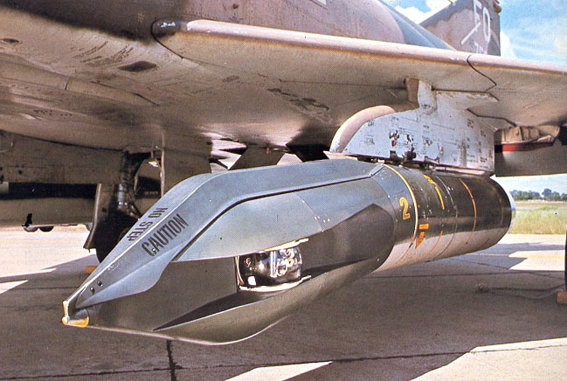
The AN/AVQ-10 Pave Knife, showing the camera/laser aperture
While the first laser-guided bombs were under development prior to the 1968 bombing halt, continued work by Texas Instruments had improved the method from the hand-held "Zot Box" that was used by the WSO while the Phantom flew a pylon turn around the target to podded systems in the form of the AN/AVQ-10 Pave Knife that allowed more flexible attack approaches to be made. The WSO used the laser in the Pave Knife pod to designate the target point for the laser-guided bombs. The 8th TFW at Ubon had six Pave Knife pods and it was decided to use them on the next day to revisit the Paul Doumer Bridge. Compared to the sixteen aircraft from the previous day, on 11 May 1972 only four F-4D Phantoms led by Captain Thomas Messett (who flew in the previous day's raid) would attack the bridge. One Phantom carried two 3,000 lb LGBs and the other three Phantoms carried two 2,000 lb LGBs. Only Captain Messett's F-4 carried a Pave Knife pod. The defenders of the bridge didn't think the four Phantoms were the main strike force and as they dived on the bridge, Messett and his WSO designated target points on the bridge and all eight bombs scored direct hits on the bridge, dropping the entire span on the Hanoi side of the bridge into the Red River. It would be a year before the Paul Doumer Bridge was usable again. 

The 3,000 lb GBU-11 added fins and laser guidance to the M118 bomb
The other bridge that was crucial to hitting at the North Vietnamese logistical support of the Easter invasion was the Thanh Hoa Bridge, an immensely tough rail bridge nicknamed "Dragon's Jaw" that crossed the Song Ma River and connected the rail shipment points from China to Hanoi. During Operation Rolling Thunder from 1965 to 1968 over 1,000 missions flew against the Dragon's Jaw, not one mission succeeding in bringing its spans down. The USAF even resorted to dropping floating bombs upstream of the bridge to try and bring it down in Operation Carolina Moon. Nothing worked, it was known as the toughest target in North Vietnam.  On 13 May 1972, two days after the Paul Doumer Bridge was dropped, the 8th TFW set out to drop the Thanh Hoa Bridge for good with fourteen Phantoms carrying nine 3,000 lb LGBs, fifteen 2,000 lb LGBs, and forty-eight 500 lb conventional bombs (due to a shortage of laser-guided bombs). Attacking through an intense flak barrage, direct hits by the LGBs put the entire western span of the Dragon's Jaw into the Song Ma River below. Before the end of Linebacker I in October, the Navy flew an additional eleven missions against the bridge and the USAF another two to insure the bridge was out for good. 

Post-strike recon photo of the Paul Doumer Bridge
It was a stunning debut for a new age of precision munitions. When the Pave Knife was used against the Paul Doumer and Thanh Hoa Bridges by the 8th TFW, it was technically still a developmental program and was rushed forward in response to Nixon's order to blunt the North Vietnamese invasion. Twelve pods were built for the testing program. When the preparations for Operation Linebacker started, three pods stayed stateside to continue the testing program. Three pods went to the US Navy for use on specially-wired Grumman A-6A Intruders and six pods went to the 8th TFW at Ubon for use on specially-wired F-4D Phantoms. Two pods were lost over North Vietnam during Linebacker I- the remaining four pods became quite valuable and after Paul Doumer and Thanh Hoa, were used only on the most critical and important targets. The commander of the Seventh Air Force, General John Vogt, reportedly told the pilots of the 8th TFW "Don't come back if you don't have that pod with you when you return!"

Source: The Linebacker Raids: The Bombing of North Vietnam, 1972 by John T. Smith. Arms and Armour Press, 1998, p61-75.


20 May 2010

The Flamboyant Markings of VF-51's Phantoms in Vietnam


During Operation Linebacker over Vietnam in 1972, the two McDonnell Douglas F-4 Phantom II squadrons aboard the USS Coral Sea, VF-111 "Sundowners" and VF-51 "Screaming Eagles" each had their own obstacles to overcome to become some of the premier Phantom units in Southeast Asia. VF-51, in particular, had a double uphill climb as the squadron had just transitioned from the Vought F-8H Crusader AND their new Phantoms weren't so new- they were old F-4B models that had been rejected by the Marines as unairworthy and had been left in storage at MCAS El Toro in California for years.

Many of the senior cadre of pilots at VF-51 were ex-Crusader jocks who lamented the loss of their 20mm cannon and what they perceived the hassle of having a RIO (radar intercept officer) in the back seat. "I'd rather have 500 lbs of fuel than babysit an NFO (naval flight officer, the category of flight crew that were assigned as Phantom RIOs)." The pilots resented their transition training to the Phantom with VF-121 at NAS Miramar where they had veteran RIO instructors in the back seat. "About as fun as having your mother with you on a date" complained one pilot. VF-51's commander, Tom Tucker, ordered his pilots to "dummy up" and play nice with the RIOs to make the transition as smooth as possible.

Soon the ex-Crusader jocks fell in love with their new mounts. Having more power and a better radar than the Crusader was well-appreciated and a few of the former single-seat pilots also started to like having the extra set of eyeballs afforded by the RIOs. Before long, the pilots started to have preferences for certain RIOs but the RIOs themselves were an independent minded bunch. There's an anecdotal story of one RIO teaching his pilot a lesson on crew coordination when during a training mission the RIO shut down all the key radar and avionic systems and told his pilot "Okay, badass, see how well you can fly and fight now." Since the RIO had the switches for those systems, the pilot was left with little to do but keep from crashing. So an unspoken rule developed at VF-51 that RIOs also had say in which pilots they flew with. Many of the Phantom crews ended up flying with the same pilots and RIOs through much of the Coral Sea's 1972 combat cruise.

Having to get the elderly F-4Bs up and running proved to be VF-51's other difficulty in the run up to the 1972 combat cruise. The latest production model was the F-4J which rectified many of the problems with the F-4B, but as the rapid build-up of forces under President Nixon accelerated, any and all Phantoms that could be spared were snapped up by deploying squadrons. In VF-51's case, that meant a motley assortment of hangar queens from MCAS El Toro that hadn't flown since 1968. VF-51 was given free reign to press into service any maintenance crew from any squadron at NAS Miramar to form "Tiger Teams" that worked day and night to get the F-4Bs ready for combat.

With the pilots transitioned and finally working well with their RIOs and the F-4Bs ready to head to war, the only thing left was the come up with new squadron markings for VF-51's mounts. One of the squadron ensigns was sent to a corrosion control and painting course at NAS North Island and he had figured out which panels were opened up the most during routine combat operations. Squadron markings were devised that avoided these panels so they scheme stayed intact and it was one of the most flamboyant Phantom markings to go to sea- what rival squadrons called the "Supersonic Can Opener" was a bright eagle marking with tail feathers that splayed out on the rear fuselage. Even the main landing gear doors were painted with full color eagle talons.

Some of the Miramar command staff told VF-51 that the only thing their Phantoms were missing now were mudflaps and a raccoon tail attached to an aerial! One of the future MiG-killers of VF-51, CDR Jerry "Devil" Houston, recounted in an interview that while other squadrons were looking at ways to tone down their markings and even conceal their aircraft, for morale they wanted VF-51's markings "to be audacious; we wanted to be a magnet for MiGs...intruders in our airspace didn't have to speculate about who just whipped their ass."

Sister squadron VF-111 on the Coral Sea in response adopted an equally flamboyant sunburst tail marking for their 1972 combat cruise as well.

Source: Gray Ghosts: US Navy and Marine Corps F-4 Phantoms by Peter E. Davies. Schiffer Publishing, 2000, p151-153.

24 March 2010

The Ault Report: Improving USN Fighter Effectiveness


After the dismal performance of the naval fighter pilots during the Rolling Thunder campaign in Vietnam between 1964 to 1968, the Chief of Naval Operations (CNO), Admiral Thomas Moorer, ordered a wide-ranging and critical review of US Navy air-to-air missile performance during the first half of the war. He put in charge of the study Captain Frank Ault, who served as captain of the aircraft carrier USS Coral Sea in 1966-67. During Ault's command of the Coral Sea, his air wing suffered fifty combat losses, three of them to North Vietnamese MiG fighters and only a single air-to-air victory by the entire air wing. He had made suggestions on improving the performance in particular of the semi-active radar homing AIM-7 Sparrow and in 1968 he was commissioned by the CNO to review the Navy's air-to-air weapons, training and tactics in what is now known as the Ault Report.

The most visible result of Ault's investigation and recommendations was the creation of the Navy's Fighter Weapons School better known as TOPGUN. But Ault's purview also included a review of missile performance as the Navy's F-4 Phantoms had no guns and had rely on missiles for air-to-air kills. In the Ault Report's review of missile performance, the maintenance of the missiles themselves came under scrutiny.

During the conflict in Vietnam, there were numerous occasions where the AIM-7 Sparrow had been fired correctly, but the solid rocket motor failed to ignite and propel the missile to the target or the electronics failed altogether, creating "one expensive unguided rocket". Rather than load "fresh" Sparrow missiles to the underfuselage recesses on the Phantom before each mission, the hard-pressed carrier deck crews often left the delicate missiles on the aircraft for the next mission and it wasn't unusual for a Sparrow missile to sit in its recess on the Phantom for months at a time, flying mission after mission (it was common for an unfired Sparrow missile to fly over 50 missions before it was demounted for maintenance work) and the delicate electronics getting jarred repeatedly by multiple catapult shots and arrested landings. In addition, the tropical moisture and salt air as well as the changes in temperature from the heat of the carrier deck to the freezing cold of the Phantom's cruising altitudes took their toll on the Sparrow missiles.

During the same time period the USAF's standard was to at least demount the missile and bench check the electronics and systems after every ten missions flown. Simple maintenace procedures were found to vastly improve the reliability of the Sparrow missiles. For example, there was a disposable "wafer" switch that allowed an electrical connection between the Sparrow's rocket motor and the Phantom. This switch was designed as a one-time use item to be removed at the end of a mission and replaced with a new switch, but in the interests of saving time and money, Navy Phantom squadrons never changed out the component which caused it to corrode and fail, causing a significant number of the Sparrow missile malfunctions.

While TOPGUN is the most visible result of the Ault Report, his recommendations would wide-ranging implications that not only increased the combat effectiveness of the US Navy's fighter squadrons in Vietnam, but also influenced contractor and logistical support of all of the Navy's aviation assets in years to come.

Source: Gray Ghosts: US Navy and Marine Corps F-4 Phantoms by Peter E. Davies. Schiffer Publishing, 2000, p139-140.

15 March 2010


Unlike the Navy's F-4 Phantoms which operated from carriers in the Gulf of Tonkin, the Phantoms of the US Marine Corps operated from two land bases in support of Marine troops- Da Nang and Chu Lai. Da Nang housed both USAF and USMC units and in the summer of 1966, Chu Lai was built to relieve the congestion at Da Nang- the first Marine Phantom and Skyhawk units at Chu Lai, though, had to use SATS- short airfield for tactical support- which was pretty much the elements of a carrier deck from the catapults and arresting gear used on a land based. The SATS equipment was used until the main runway at Chu Lai was completed in the following year.

Marine Phantoms sat "hot pad alert" at both Chu Lai and Da Nang. The Phantoms were usually loaded with a combination of Mk.82 Snakeye bombs and napalm. At each end of the runways were revetments for the alert Phantoms that allowed them to start up and head out immediately on the runway.

Marine crews rotated eight hour shifts on hot pad alert. There were at least two crews sitting in a ready room adjacent to the hot pad fully suited up and waiting for the urgent call for air support by a Marine unit in the field. The F-4s were full preflighted at the start of each eight hour period and the same ground crews worked the same eight hour shifts to keep the planes "cocked and ready". Once the alert bell went off, the crews made the short run to their aircraft where the plane captains got them strapped in while the RIO got the information on the target, the forward air controller to contact and the necessary frequencies while the pilot got the big fighter started up. Once cleared by the tower and the chocks were pulled, the two alert Phantoms rolled out and onto the runway for an afterburner takeoff. With practice, the flight and ground crews could get the alert Phantoms airborne within five minutes of the alert bell going off.

Should the alert crews be launched, there were two back up flight crews, one on 15-minute alert and one on one-hour alert. As soon as the alert Phantoms were launched, a new pair of aircraft were rolled onto the hot pad already armed and fueled and preflighted by the ground crews. The flight crew on 15-minute alert then became the new alert crew and the one-hour alert crew moved up to the 15-minute spot. If things in the field were hectic (like it was during the siege of the Marine Corps firebase at Khe Sanh, there would a crew on 30-minute alert as well.

Over the course of a week, both the A-4 Skyhawk and F-4 Phantom USMC squadrons in residence at Chu Lai and Da Nang rotated hot pad alert and at Da Nang, the F-4s of the USAF's 366th Tactical Fighter Wing also shared the hot pad alert.

The Marines also had a hot pad for air-to-air alerts for MiG activity, but this was rarely used as the Navy BARCAP (barrier combat air patrol) shouldered most of the patrols for the occasional MiG activity. It got to the point that the Marines just parked a hangar queen Phantom on the air-to-air pad for appearances!

Source: Gray Ghosts: US Navy and Marine Corps F-4 Phantoms by Peter E. Davies. Schiffer Publishing, 2000, p83-101.