Showing posts with label Pegasus. Show all posts

17 April 2015

The Last Savoia-Marchetti Airliner

Italian aeronautical engineer Alessandro Marchetti
The Italian aircraft manufacturer Savoia had a history dating back to its founding in 1915 by Umberto Savoia and after the end of World War I, it merged with SIAI (Società Idrovolanti Alta Italia), another firm known for its seaplanes. The company became Savoia-Marchetti (sometimes also referred to as SIAI-Marchetti) when the designer Alessandro Marchetti became its chief engineer in 1922 and quickly became famous for his work on the S.55 twin-hull flying boat. Many of Marchetti's designs during the interwar period would set speed and endurance records in flight. Most of what Alessandro Marchetti is best known for, though, was his line of three-engined aircraft that began with the SM.79 Sparviero that first flew in 1934 as a fast eight-passenger transport capable of air racing. With the storm clouds of war fast coming to Europe, the Sparviero became Italy's primary bomber aircraft and one of the few Italian designs produced in significant quantities during the Second World War. The trimotor layout of the Sparviero set the pattern for a whole seriesof aircraft from Savoia-Marchetti, In 1934 the Italian airline Ala Litorria asked Marchetti for a modern long range airliner to which the SM.75 Marsupiale transport resulted. The Marsupiale had its inaugural revenue flights with Ala Littoria in 1938 with the Italian air arm, the Regia Aeronautica, taking interest in the aircraft as a transport. 

With war embroiling Europe in 1941, Marchetti began work on a four-engined derivative of the SM.75 that accommodated 18 passengers on long-range flights. It was a departure from Marchetti's land plane designs which were nearly all trimotors save the obscure SM.74 of which only three were built of this pre-war shoulder-wing airliner. The new aircraft was designated the SM.95 and a prototype and two pre-production examples were built in 1942. In addition, work began on a long-range bomber version designated SM.95B. The original design called for either 14- or 18-cylinder Piaggio radial engines, but wartime availability meant that Marchetti had to settle for a 9-cylinder Alfa Romeo engine producing 780 horsepower. Typical for Marchetti's designs of the period, the SM.95 was of mixed construction with a welded steel tube fuselage with metal alloy skin for the nsoe section and underside and fabric covering for the rest of the fuselage. The wings were plywood-skinned with three wood wing spars. The mixed-material construction likely also made the aircraft much lighter given the fact that lower-powered engines were used instead of what was originally planned. 

The prototype first flew on 8 May 1943 and was immediately impressed into transport service by the Luftwaffe. The fate of the first pre-production aircraft is unknown but is believed to have also been impressed into Luftwaffe service. The second pre-production aircraft was stretched and designed SM.95GA for "Grande Autonomia", featuring increased fuel capacity and revised cockpit instrumentation. Work on the SM.95 was soon hampered by the Italian Armistice in September 1943, but work was completed on the SM.95B bomber prototype with had the wings, engines, and empennage of the transport variant married to a new fuselage that was deepened to allow a bomb bay below the wing spar carry-through structure. A glazed nose accommodated the bombardier with the flight deck moved forward with defensive armament consisting of 12.7mm Breda guns in a turret aft of the flight deck and lateral positions in the aft fuselage and a ventral position forward of the bomb bay. No known photographs of the SM.95B are known to exist though the bomber prototype did fly at least once in 1945. 

Alitalia's SM.95 I-DALL "Marco Polo"
The third SM.95, the SM.95GA, finally made its first flight on 28 July 1945. It and the next aircraft built were put into military service with the Aeronautica Militare. The stretched fuselage of the SM.95GA became the production standard, the nine-foot fuselage stretch allowing for the carriage of 30 passengers in three-abreast seating. The military transports entered operational service starting in May 1946. The new Italian flag airline Alitalia had just been established in September 1946 and orders for six SM.95s were placed. The first two were I-DALJ "Cristoforo Colombo" and I-DALK "Amerigo Vespucci", delivered at the end of 1947 to Alitalia and promptly put into airline service. The production SM.95s had upgraded 9-cylinder Alfa Romeo radials that had increased power output from 780 horsepower on the wartime prototypes to 930 horsepower to accommodate the increased weights of the increased fuel and stretched fuselage. The balance of Alitalia's order, though, was completed with British Bristol Pegasus engines that delivered 1,000 horsepower- these aircraft were I-DALL "Marco Polo", I-DALM, I-DALN "Sebastiano Caboto" and I-DALO "Ugolino Vivaldi". The first two Alitalia SM.95s were subsequently re-engined with the more powerful Bristol Pegasus. It was I-DALN "Sebastiano Caboto" that inaugurated Alitalia's first postwar services to Great Britain on 3 April 1948. 

One of LATI's three SM.95s, I-LATI "San Francesco"
Another Italian airline also ordered the SM.95- Linee Aeree Transcontinentali Italiane (LATI), which had operated air services between Italy and South America prior to the Second World War. LATI had ordered three SM.95s which were all delivered by 1949- I-LAIT "San Antonio", I-LATI "San Francesco" and I-LITA "San Cristoforo". When LATI ceased operations in 1950, their three SM.95s were assumed by Alitalia. Interestingly the only other airline operator of the SM.95 was SAIDE of Egypt, which operated three aircraft to connect Cairo with European capitals. While Alitalia configured its aircraft for 20 passengers, LATI flew shorter routes than Alitalia and configured its aircraft for 26 passengers but SAIDE operated even shorter routes and packed in 38 passengers on their aircraft. Both LATI and SAIDE's aircraft were powered not by the Pegasus radial engine but Pratt & Whitney R-1830 Twin Wasp 14-cylinder engines producing 1,200 horsepower. 

Only a total of 12 production SM.95s operated commercial services out of a total of 20 airframes built including the prototypes. The mixed material construction wasn't terribly robust with the rigors of scheduled passenger services and lacking pressurization also limited their usefulness. Compared to the Douglas DC-4 and the Lockheed L-749 Constellation of the time, the SM.95 was an outdated design. The last passenger flights took place in 1950 less than a year after the last production aircraft was completed. 

Interestingly, there was a plan by the Regia Aeronautica called "Operation S" prior to the 1943 armistice that would have used a modified SM.95GA to fly at very long ranges to bomb New York City. Benito Mussolini, however, would only allow the mission to drop propaganda leaflets as he didn't want to alienate the large population of Italian-Americans in the city. The mission was under preparation when the 1943 armistice occurred. 

Source: Air International "Plane Facts" Volume 10 Number 2, February 1976. Photos: Wikipedia, Alitalia, Air International

21 February 2015

The Marine Corps Bet on the Harrier

Hawker P.1172 Kestrel in KES markings
For a large part of the postwar history of American military aviation, the procurement of non-American aircraft was an unusual exception. I had written back in 2011 about the efforts that led to the selection of the Dassault Falcon 20 jet as the basis of the US Coast Guard's HU-25 Guardian medium range search-and-rescue aircraft.  The two most significant prior examples of non-American aircraft procurement were the Martin B-57 Canberra selected by the USAF as its new interdiction bomber in 1951 and the selection of the Hawker AV-8A Harrier which entered service with the Marine Corps in 1971. The story of the Marine Corps' evaluation and procurement of the Harrier is one that readily demonstrates the Marines' political savvy in navigating the treacherous waters of Congressional funding as well as a single-minded commitment to efficient close air support to the Marines on the ground. The predecessor of the Harrier was the Hawker-funded P.1127 Kestrel demonstrator. Two prototypes and four development aircraft were built and then followed by nine more developed P.1127 airframes which in 1963 were to be part of what was called the Kestrel Evaluation Squadron (KES). The aircraft were designated Kestrel FGA Mk1 and the KES was staffed with test pilots from the Royal Air Force, the Royal Navy, the US Navy, US Army, US Air Force, and the German Luftwaffe. Because there were three nations in the Kestrel Evaluation Squadron, it was also referred to as the Tripartite Evaluation Squadron (TES). The unit was formed in 1965 for the purpose of exploring the possibilities of a V/STOL combat aircraft. 

At the time of the KES flight program, Lt. Col. Thomas Miller was assigned to the US Marine Corps' Air Weapons Systems Requirements Branch at the headquarters. It was the job of the staff of this department to review all the latest research and development to see what sort of equipment would be useful to the Marines. Miller and a fellow officer, Lt. Col. John Metzko, had gotten hold of film footage from the British Embassy in Washington DC of the Kestrels in action. By this point, the RAF had committed to getting the Kestrel operational with a more developed aircraft called the Harrier. They had monitored the P.1127 Kestrel program despite not having any Marine pilots in the evaluation squadron and when it became clear the RAF was going to go forward with the Harrier, they immediately briefed the USMC Deputy Chief of Aviation who was none other than General Keith McCutcheon. I had written about him recently as the "Father of Modern Close Air Support" and needless to say, given General McCutcheon's background as a passionate advocate for the Marines' own close air support, he was readily on board to find out more about the Harrier. The next step was the brief the Commandant of the Corps, General Leonard F. Chapman. With the enthusiastic support of the Commandant, the Marines then set about on getting flight time on the new Harrier. The British were adamant that anyone who would be evaluating the Harrier be a qualified test pilot and working through the defense liasons at the British Embassy and Hawker Siddeley, Miller and Marine test pilot Lt. Col. Bud Baker were chosen to head to the UK. Miller's test flying experience was getting the A-4 Skyhawk and F-4 Phantom into Marine service, so he was well versed in what an aircraft had to be able to do to support the Marines on the ground. At the request of the British, the two Marines would clandestinely make 10 flights each in the Harrier and would wear civilian clothing during their stay in Britain during their evaluation. Test pilot John Farley of the Royal Aircraft Establishment worked with Miller and Baker to prepare them for their Harrier flights. It was Farley who made the first flight of the P.1127 Kestrel prototypes in 1964 and he would come to amass 19 years of experience as a Harrier test pilot. 

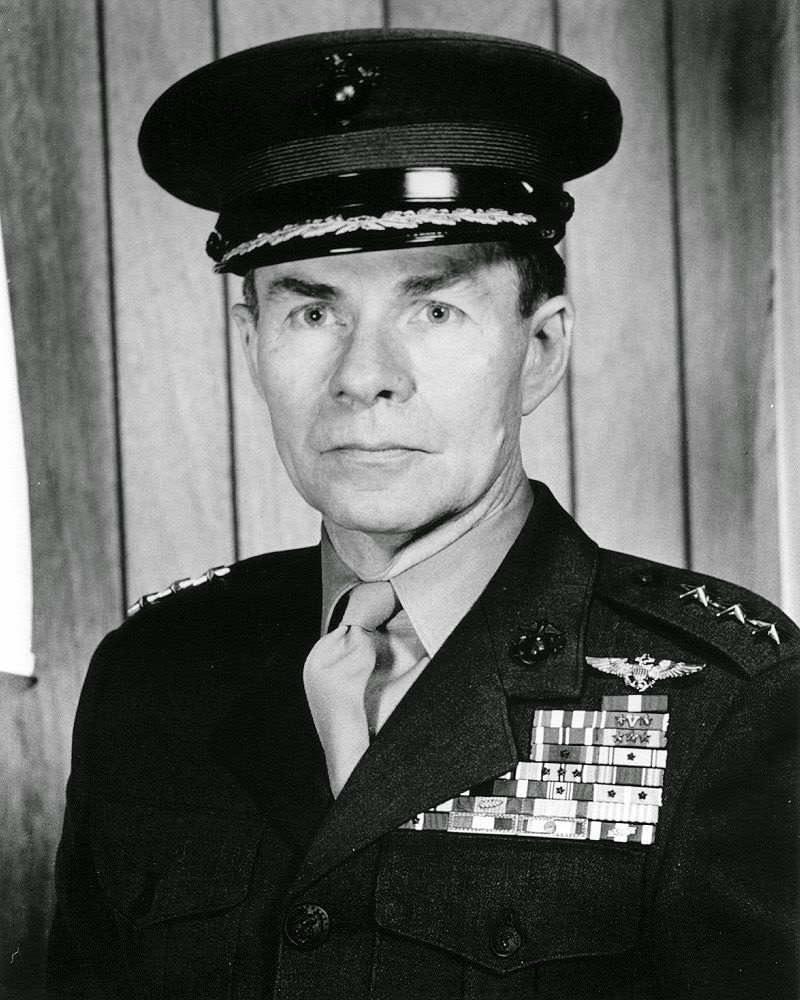
Gen. McCutcheon, USMC Deputy Chief of Aviation
Miller and Baker realized very quickly during their flights that the Harrier was a new breed of combat aircraft that Marines had to have. To them, it could do everything the A-4 Skyhawk could do but not need a 6,000 foot runway to do it. All it needed was a 1,000 foot strip for rolling STOL takeoffs with an increased weapon load or the deck of an amphibious assault carrier. It was clearly close air support that could not only go where the Marines were, but be readily based close to where the Marines were in action. To get their hands on the Harrier, the Marines needed funding. Not only did the Marines have to deal with the US Navy since the Marine Corps is a department of the Navy, but they weren't sure how the US aircraft industry would react to the Corps wanting a British aircraft. After briefing Commandant Chapman, they met with the Presidential Scientific Advisory Board to get their support.

Fortunately the Navy was receptive and sent over their own team to fly the Harrier as well which allowed them to compare with their earlier Kestrel flights as part of the KES. Also fortuitous for the Marines was that a Marine was in charge of the Navy's A-4 Skyhawk program, Col. Edwin Harper, and he got to fly the Harrier as well, giving him the unique perspective of comparing the Skyhawk with the Harrier. With the ready support of the Navy in 1969, the Marines now had to lobby Congress for the funding. The FY1970 budget didn't have any money for Harrier procurement, but Harper, Miller, Baker and General McCutcheon briefed the Senate Armed Services Committee anyway. McCutcheon made his pitch to the chairman, Senator Barry Goldwater, that he didn't want just a handful of Harriers and do an evaluation. That'd been done already. "We want to buy a whole slug of them and get started and have a meaningful program!" 

Rep. Mendel Rivers (D-South Carolina) crucial to the Harrier program
Though the FY1970 Department of Defense budget was set at their time of their briefing to the Senate Armed Services Committee, the support of the Presidential Scientific Advisory Board insured that supplemental funding was secured as an amendment to the FY1970 budget bill. The supplemental funding was enough to procure 12 Harrier jets at a cost of $57.6 million. But there was a catch- the money was secured via the Marines canceling procurement of 17 McDonnell Douglas F-4 Phantom IIs. It would be necessary to win over McDonnell Douglas. As part of getting Congressional support, the House Armed Services Committee was also briefed on the Harrier plans and the chairman of the House committee, Representative Mendel Rivers of South Carolina, would support the procurement of the 12 Harriers as long as future Harrier buys were aircraft built in the United States. Realizing that the Marines was a significant ground breaking sale into the US defense market, Hawker Siddeley immediately sent representatives to the United States to canvas the aircraft industry and find an American partner for the AV-8A Harrier program. Hawker's team met with eight aircraft manufacturers and narrowed the list down to three- Ling-Temco-Vought, Grumman, and McDonnell Douglas. Hawker felt McDonnell Douglas was the best fit given their naval aircraft experience and at the time, the A-4 Skyhawk program was starting to wind down and the AV-8A Harrier would be good transition for McDD. On 29 September, Hawker Siddeley and McDonnell Douglas signed a 15-year agreement to cooperate on the AV-8A Harrier program. In tandem with this agreement came one from Rolls Royce to team up with Pratt and Whitney on the Pegasus engine. The teams developed a plan to transition production of the Marine's AV-8A Harrier flight as well as the Pegasus engine from UK production to US production over a span of five years. With a planned buy of 114 AV-8A Harriers, it was found by Representative Mendel Rivers' staff that it was cheaper to stick with UK manufacture instead of phasing in production in the United States. During the FY1971 budget debate, discussions centered on the pros and cons of moving production to the United States and eventually Congress agreed with Mendel Rivers' analysis that there was no need to phase in production of the AV-8A in the United States. Though the agreement never resulted in US production, it did lay down the foundations for the later AV-8B Harrier II program. 

AV-8A Harriers of VMA-513, the first USMC Harrier unit
With Mendel Rivers' support now behind them, McDonnell Douglas agreed to become the engineering group responsible for product support of the AV-8A Harrier which was more than adequate compensation for the 17 canceled Phantoms. The AV-8A Harrier first entered service in 1971 at the Navy's Flight Test Center at NAS Patuxent River, Maryland while the first Harrier squadrons prepared for the transition to the AV-8A. The first operational Marine Corps squadron was VMA-513 "Flying Nightmares" which had been flying the F-4 Phantom since 1963. VMA-513 become operational with the AV-8A Harrier in May 1971 at MCAS Beaufort in Representative Mendel Rivers' home state of South Carolina. 

Source: Harrier II: Validating V/STOL by Lon O. Nordeen. Naval Institute Press, 2006, pp 23-30. Photos: Wikipedia, USMC.