Showing posts with label AIM-7. Show all posts

28 May 2016

CHECK SIX: The F-4 Phantom's F3H Demon Roots

With yesterday being the 58th anniversary of the F-4 Phantom II's maiden flight, here's some interesting trivia. There is actually a continuous line of evolution from the McDonnell F3H Demon to the F-4 Phantom (which was designated F4H when it first flew). This photo is of the full scale mock up of the main missing link that connects the F3H Demon to the F4H Phantom. In 1953, the McDonnell team headed by Herman Barkey was looking at ways of extending the Demon's viability and expanding its versatility. McDonnell had the in house designation F3H-X for the design as it was considered an evolution of the Demon. 

F3H-C "Super Demon": This design was first, it was powered by a single J67 engine. The J67 was to be have been a license-built version of the Rolls Royce Olympus. No J67s were ever built in the US and the Navy wasn't keen on an unproven engine. 

F3H-E: This was different enough from the Demon that it was given the Model 98A designator. It was also powered by the J67 but had a bigger wing than the Demon and had a level stance on the ground instead of the nose-high stance of the Demon.

Full scale mock up of the F3H-G design
(Wikipedia)

F3H-G (Model 98B): This one had twin J65 engines, a license built British Sapphire engine like that used on the Hawker Hunter. It had lateral intakes that looked more like the Phantoms and exhausts that looked also more like the eventual Phantom design. The Navy was attracted to twin engines for safety. The wing was also further enlarged from the F3H-E. It had four 20mm cannon and had an impressive external stores capability. 

F3H-H: This was was the F3H-G but with two of the then-new and promising GE J79 engines. 

Model 98C: Delta winged version of the F3H-G/98B with J65 engines. 

Model 98D: Delta winged version of the F3H-G/98B with J79 engines. 

F3H-J (Model 98E): Similar to the 98C/D, but with an even larger delta wing. 

Model 98F: Recon version of the 98C. 

Tail section of the F3H-G mockup showing the two different engine sizes-
The J79 was on the right side, the J65 was on the left side.
(Wikipedia)
Barkey's team decided the F3H-G/98B was the most promising of the designs and built a full scale mockup, but one side was sized for the J65 engine and the other side sized for the J79 engine. On 19 September 1953 McDonnell submitted the design as an unsolicited proposal to the Navy. Though impressed with the design, the Navy had already ordered the Grumman F11F Tiger and Vought F8U Crusader for its supersonic fighter needs. The Navy, however, encouraged Herman Barkley's team to refine the design to meet an all-weather attack requirement. This design was submitted to the Navy in 1954 and two prototypes were ordered as the AH-1 which had four 20mm cannon and eleven weapons stations. 

F4H full scale mock up showing the originally
planned trapeze launchers for the Sparrow missiles.
(Wikipedia)
The following year the all-weather attack program was canceled and McDonnell was asked to redesign the AH-1 into a two-seat interceptor with a single centerline station for a 600-gallon fuel tank and AIM-7 Sparrow capability. The J65 engine was dropped from contention when the Chief of Naval Operations selected the J79 engine for the new aircraft which would be designated F4H Phantom II. 

And the rest is history! 

Further reading: 


24 March 2010

The Ault Report: Improving USN Fighter Effectiveness


After the dismal performance of the naval fighter pilots during the Rolling Thunder campaign in Vietnam between 1964 to 1968, the Chief of Naval Operations (CNO), Admiral Thomas Moorer, ordered a wide-ranging and critical review of US Navy air-to-air missile performance during the first half of the war. He put in charge of the study Captain Frank Ault, who served as captain of the aircraft carrier USS Coral Sea in 1966-67. During Ault's command of the Coral Sea, his air wing suffered fifty combat losses, three of them to North Vietnamese MiG fighters and only a single air-to-air victory by the entire air wing. He had made suggestions on improving the performance in particular of the semi-active radar homing AIM-7 Sparrow and in 1968 he was commissioned by the CNO to review the Navy's air-to-air weapons, training and tactics in what is now known as the Ault Report.

The most visible result of Ault's investigation and recommendations was the creation of the Navy's Fighter Weapons School better known as TOPGUN. But Ault's purview also included a review of missile performance as the Navy's F-4 Phantoms had no guns and had rely on missiles for air-to-air kills. In the Ault Report's review of missile performance, the maintenance of the missiles themselves came under scrutiny.

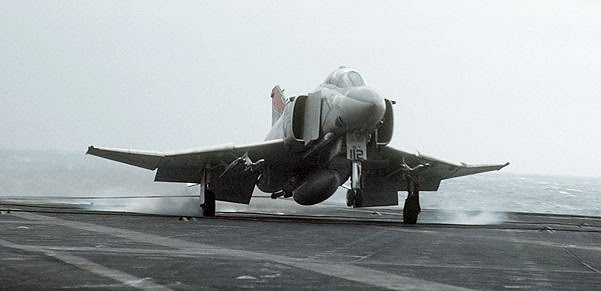
During the conflict in Vietnam, there were numerous occasions where the AIM-7 Sparrow had been fired correctly, but the solid rocket motor failed to ignite and propel the missile to the target or the electronics failed altogether, creating "one expensive unguided rocket". Rather than load "fresh" Sparrow missiles to the underfuselage recesses on the Phantom before each mission, the hard-pressed carrier deck crews often left the delicate missiles on the aircraft for the next mission and it wasn't unusual for a Sparrow missile to sit in its recess on the Phantom for months at a time, flying mission after mission (it was common for an unfired Sparrow missile to fly over 50 missions before it was demounted for maintenance work) and the delicate electronics getting jarred repeatedly by multiple catapult shots and arrested landings. In addition, the tropical moisture and salt air as well as the changes in temperature from the heat of the carrier deck to the freezing cold of the Phantom's cruising altitudes took their toll on the Sparrow missiles.

During the same time period the USAF's standard was to at least demount the missile and bench check the electronics and systems after every ten missions flown. Simple maintenace procedures were found to vastly improve the reliability of the Sparrow missiles. For example, there was a disposable "wafer" switch that allowed an electrical connection between the Sparrow's rocket motor and the Phantom. This switch was designed as a one-time use item to be removed at the end of a mission and replaced with a new switch, but in the interests of saving time and money, Navy Phantom squadrons never changed out the component which caused it to corrode and fail, causing a significant number of the Sparrow missile malfunctions.

While TOPGUN is the most visible result of the Ault Report, his recommendations would wide-ranging implications that not only increased the combat effectiveness of the US Navy's fighter squadrons in Vietnam, but also influenced contractor and logistical support of all of the Navy's aviation assets in years to come.

Source: Gray Ghosts: US Navy and Marine Corps F-4 Phantoms by Peter E. Davies. Schiffer Publishing, 2000, p139-140.