Showing posts with label B-17 Flying Fortress. Show all posts

14 May 2016

CHECK SIX: The Rollout of the Boeing 367-80


14 May 1954: The rollout at Boeing's Renton Field facility of the aircraft that would change jet transport, the Boeing 367-80. Bill Boeing was 72 at the time and had long since divested his holdings in the company he founded, but he was present at the rollout of the the Dash 80 and Boeing's wife, Bertha, christened the aircraft with champagne while the Renton High School band played "Wild Blue Yonder", the USAF theme. I always thought this Boeing photo was cool- it's the Boeing president at the time, Bill Allen, showing the 367-80 to Bill Boeing. 

Allen bet the company on Dash 80, investing $16 million of the company's money to gear up for production tooling before having an order from either any airline or the US Air Force. 

But then again, taking a bold risk was something the company did three times undeniably in its history. The first time was in 1934. Boeing president Claire Egdtvedt proceeded with the Boeing 299 without any orders or contracts from the US Army Air Corps for a four engined bomber- the 299 is better known as the B-17 Flying Fortress. When Egdtvedt took his gamble on the 299 prototype, he asked his friend for guidance- who happened to be Bill Allen, who at the time was the company lawyer.

Almost twenty years later Bill Allen found himself in the same position when he launched what become both the KC-135 Stratotanker and the Boeing 707 with the Dash 80 prototype. 

And about 10 years later, Bill Allen was fishing in Puget Sound with Pan American chairman Juan Trippe when Trippe pressed Allen on building a jumbo-sized jetliner- legend has it that Trippe asked Allen "Would you build it if I buy it?" and Allen responded "Would you buy it if I build it?" and by the end of the day, the Boeing 747 was launched on a handshake. According to aviation author Robert Gandt, Allen thought to himself the 747 "would be the perfect swan song if he could step down knowing that he had launched the world’s mightiest ship of the sky. It would secure Boeing’s future well into the century. Or it could ruin Boeing".

Further reading: 


19 September 2015

The XB-15: Getting Boeing Back On Its Feet

Clairmont Egtvedt led Boeing during its most precarious times
(Boeing Historical Archives)
The Boeing Company of the mid-1930s was existing by only a razor-thin margin and at any moment in those times, could have shut down for good with the Boeing name a mere footnote in aviation history. Why one of the dominant aviation companies of today nearly ceased to exist eighty years ago we have to move the clock back to 1929 when President Herbert Hoover appointed Walter Fogler Brown to be the Postmaster General. Within a year, Brown had lobbied Congress for more authority to improve the air mail system which he felt was inefficient and piecemeal in the organization of the existing airline networks that carried the mail. The Air Mail Act of 1930 (also known as the McNary-Watres Act after its Senate sponsors) gave Brown the authority to rationalize the US air mail system, which in effect, led to the rationalization of the US airline system of the day. The details of that controversial move will of course will be the topic of a future blog article here at Tails Through Time- but the key event here was the so-called "Spoils Conference" of 1930 where Brown consolidated the existing air mail routes which by extent led to the consolidation of the US airline system to just three airlines- United, TWA, and American- essentially forcing out of business the other airlines. One of the effects of this move was that Bill Boeing teamed up with Frederick Rentschler of Pratt & Whitney to form a large business conglomerate with diverse interests in aviation called United Aircraft and Transport Corporation. United Aircraft was the holding company for both Boeing Aircraft and Pratt & Whitney and also held ownership of Hamilton Standard, the propeller manufacturer, as well as the aircraft companies of Chance Vought, Sikorsky, and Stearman along with United Air Lines. In late 1933, Senate investigations opened on the 1930 Spoils Conference which led to the Air Mail Scandal of 1934 which led to the Roosevelt Administration canceling all the air mail contracts and handing the air mail delivery to the US Army Air Corps with disastrous results. With no choice but to return air mail service to the airlines, the government did so with punitive conditions that large consolidated aviation firms with airline interests had to be broken up in order to win back air mail contracts. United Aircraft was broken up back into its constituent companies and Bill Boeing resigned from aviation altogether. 

Replacing Bill Boeing was his general manager, Clairmont "Claire" Egtvedt, who had risen up the ranks at Boeing after starting out as a draftsman in 1917 fresh out of college. Of all the pieces of the now-broken up United Aircraft, Egtvedt had to take charge of the smallest and weakest piece- Boeing Aircraft itself which included its Stearman subsidiary in Wichita, Kansas. The first year of Boeing's new independent existence found it operating at a loss of over $200,000, a crushing loss in those days. Egtvedt wanted to get Boeing back into business by building a twin-engined bomber and twin-engined transport, but there was just barely enough money in the company's accounts to make payroll. By the late summer of 1934, Boeing's workforce had fallen from 2,275 a year earlier to only 600. The remaining employees as a testament to their faith in Boeing, offered up a plan to Egtvedt where half the group would work two weeks and then the other half of the group would then work the next two weeks and keep alternating so that only half the employees needed to be paid but the core experience of Boeing could be kept intact. Egtvedt naturally approved of the plan and true to the loyalty of the Boeing employees, some of those where not assigned to work in a particular two week block came to work anyway to help out without asking for payment. 

What Boeing products were available needed to be sold overseas to earn income for the company, so Egtvedt hired a young engineer, Wellwood Beall, who had been an instructor at Boeing's own school of aeronautics. Beall was an enthusiastic and gregarious individual who Egtvedt tasked with selling the Boeing P-26 Peashooter to the Chinese, who ended up ordering eleven aircraft in 1935. But it wasn't enough, and even the in-house company newspaper shut down publication to save money. Ever looking for opportunities to turn Boeing's fortunes around, Egtvedt had always thought the Boeing 247 airliner was too small, which as it turned out, became its biggest liability to the roomier and bigger Douglas DC-3 which proved to be an immense success. Several years earlier Egtvedt actually watched flight operations with Boeing fighters aboard the first US aircraft carrier, the USS Langley. A Navy rear admiral who was hosting the Boeing delegation remarked that battleships made more sense than bombers (this was in the wake of General Billy Mitchell's demonstration where he sank captured German warships with bombers) for US defense because a battleship could defend itself. When pressed further by Egtvedt, the admiral responded that the only practical bomber would be one that would be able to defend itself like a "flying dreadnaught". The remark must have stuck with Egtvedt that bigger was the way to go, but the only large aircraft of the day in the United States was the Barling bomber of 1920 that had a 120-foot wingspan, six engines and needed a tailwind to break 90 mph and had a range of only 300 miles on account of its heavy weight. Large aircraft simply had a lousy track record in those days. But that didn't stop Egtvedt from thinking about the large aircraft problem. Bill Boeing himself once said: 

"I've tried to make the men around me feel as I do, that we are embarked as pioneers upon a new science and industry in which our problems are so new and unusual that it behooves no one to dismiss any novel idea with the statement that 'It can't be done'. Our job is to keep everlastingly at research and experiment, to adapt our laboratory results and those of other laboratories to production as soon as practicable, to let no new improvement in flying and flying equipment pass us by."

The XB-15
(Boeing Historical Archives)
Boeing wasn't just thinking about bigger aircraft. There were also some officers with the US Army Air Corps that saw Billy Mitchell's 1921 demonstrations as prescient and the key to making the United States an aviation power. At the lowest point of Boeing's fortunes in the spring of 1934, Egtvedt got a phone call from Brigadier General Conger Pratt who was head of the Air Corps Materiel Division at Wright Field in Dayton, Ohio (predecessor to today's USAF Systems Command). Pratt wanted Egtvedt's presence at a secret conference in Dayton to which he also invited the heads of several other aircraft companies. Within the Air Corps, many of Mitchell's subordinates were imbuing the USAAC with ideas of long range bombers which received high level support with the command staff in Washington. At the meeting on 14 May 1934, General Pratt informed the aircraft company leaders that the Army wanted proposals for a long range bomber that could carry at least 2,000 lbs of bombs at least 3,000 miles and weigh no more than 32 tons. Nothing like it had been done before and the invited guests were quite startled. 

Egtvedt immediately put Boeing engineers to work on a 150-foot wingspan bomber called "Project A". The speed at which Boeing got to work on Project A resulted in a design contract from the Army. A large hangar at Boeing Field was set aside with a partitioned area only cleared personnel were allowed along with Army representatives from Wright Field. Excitement built quickly at Boeing with word of a mammoth bomber in the works. Despite the Army contract, Boeing's financial state was still quite precarious, but Egtvedt pressed on- Boeing, in his mind, had to learn how to build large aircraft if it was going to survive and Project A would be the company's school house, even if the company ran in the red- which it did. 

With work proceeding on what would become the XB-15, a second proposal was issued by Air Corps Materiel Division at Wright Field. While the first project was to be a technology demonstrator of a large bomber aircraft, the second proposal that was issued on 8 August 1934 just months later called for a production bomber with a 2,000 lb bomb load, a top speed of 250 mph, a range of 2,200 miles and a crew of around six. Companies were asked for designs and bids for an initial production run of just over 200 aircraft. You can imagine Claire Egtvedt's excitement with this second proposal- he had been thinking about larger aircraft and Boeing was learning all about designing and building larger aircraft with the XB-15 demonstrator. He had been thinking about a flying dreadnaught that a Navy admiral referred to years earlier and now the Army was asking for that very aircraft. Egtvedt wanted the Boeing proposal for the production bomber to be a four engine aircraft, but in those days, four engine aircraft were rare and seen as risky from a technological standpoint. He even flew to Wright Field to get further clarification on the production bomber specifications to be sure a four-engined design was acceptable. 

Egtvedt didn't just want to submit a proposal- he wanted to something daring. He wanted to proceed with a prototype of Boeing's proposal and fly it to Wright Field to demonstrate its performance. This was an immense gamble- Boeing was already operating in the red, it was busy working on the XB-15 project and now Egtvedt wanted to build and fly a prototype of Boeing's submission within one year. Egtvedt turned to his friend for guidance- Boeing's company lawyer and future CEO, William M. Allen. Allen came from the University of Montana but had a Harvard law degree- he first worked with Boeing in setting up Boeing Air Transport in 1926 (the predecessor to United Air Lines). Allen was an unusual sort for the Boeing team- he wasn't a pilot and he wasn't an engineer. But he had a remarkable clarity of thought that many at Boeing came to rely on to help with tough decisions and he asked Egtvedt bluntly "Do you think you can build a successful four-engined airplane in a year?" Egtvedt's response evoked the spirit of Bill Boeing: "Yes I know I can." So with Bill Allen's support, on 26 September 1934, Boeing's board of directors authorized Egtvedt to borrow money to the limit to begin work on the Model 299. 

Model 299 prototype
(USAF Museum)
In less than three months the production drawings for the Model 299 were in the hands of assembly shop who began building the prototype, all while work continued on the XB-15 program. As assembly of the Model 299 prototype began, the company ran out of money and the board, putting its faith in Claire Egtvedt, arranged to borrow more money. While it was clear that the XB-15 would never be a production aircraft, what had been learned from the design effort paid dividends for Boeing in the speed at which the design and fabrication of the Model 299 proceeded. Final assembly began in June 1935 and soon workers disregarded their shifts in an all-out effort to finish the Model 299 prototype. At sunrise on a Sunday, 28 July 1935, the Model 299 prototype was rolled out at Boeing Field for its successful maiden flight. Keep in mind the go-ahead to launch the Model 299 program was on 26 September 1934! After a stunning first flight, the Model 299 was then flown to Wright Field on 20 August 1935, taking only nine hours to cover over 2,000 miles with an average speed of 252 mph. Boeing's other competitors also built flying prototypes of their submissions but they paled in comparison to the Model 299. Martin entered the YB-12 which was just a re-engined version of the B-10 twin-engined bomber and Douglas entered the B-18 Bolo which was based on the DC-2 airliner. 

Then tragedy struck. During a flight test out of Wright Field in October, the control locks were left in place and the Model 299 prototype stalled at takeoff and crashed with the loss the pilot and varying degrees of injuries to the rest of the crew. Under the rules of the competition laid down by the Army, the Model 299 had to be eliminated from competition as it was unable to complete its flight tests. It was a somber Christmas 1935 when Douglas won the contract with the B-18 Bolo. But there was a silver lining in the loss of the Model 299 prototype- the flight test program won the Model 299 many advocates within the US Army Air Corps who saw the Boeing design as the future of long range bombers. A service order was placed for thirteen aircraft and a fourteenth aircraft that would be a structural test article. The aircraft's designation would be a name that would echo in the annals in the history of aviation- B-17. When the Seattle Times reporter Richard Williams dubbed the Model 299 a "flying fortress" on account of its six gun turrets, Boeing astutely saw the value of the name and the B-17 became the Flying Fortress. 

Work did continue on the XB-15, though- it made its first flight on 15 October 1937. It was 26 feet longer than the B-17 with a 36-foot greater wingspan and at the time of its rollout, it was the largest bomber ever built. The aircraft was christened "Old Grandpappy" in recognition of the role its design played in the B-17 Flying Fortress. The service history of the XB-15 will also be the subject of a future article here at Tails Through Time, so stay tuned! 

Sources: Boeing: The First Century by Eugene E. Bauer. TABA Publishing, 2000, pp 59-69. Legend & Legacy: The Story of Boeing and Its People by Robert J. Serling. St. Martin's Press, 1992, pp 27-35.

30 August 2015

The Boeing YB-40 Bomber Escort and Its Tall Tales

Boeing YB-40 in flight. Note the second dorsal turret.
It quickly became apparent with the start of daylight strategic bomber missions over Europe that fighter escort was desperately needed to get the heavy bombers to their targets and back. During the design phase of the Boeing B-17 Flying Fortress, air doctrine of the day called for the mutually supporting defensive fire from the bomber formation to be sufficient defense against enemy fighters. Early B-17 missions were against targets in northern France which were well within the range of Royal Air Force Spitfires which could provide escort cover- but as the Eighth Air Force began to dispatch its growing B-17 force against further targets, the Spitfires lacked the range. The Republic P-47 Thunderbolt and North American P-51 Mustang had yet to reach sufficient numbers in Europe to provide long-range escort and the only fighter in theater with the range, the P-38 Lightning, was desperately needed in the North Africa campaign. In those early days of unescorted daylight missions, only a quarter of combat losses were coming from anti-aircraft flak- the majority of bomber losses came from Luftwaffe fighters. The only aircraft with the range to escort the B-17s was quite obviously (at least to planners then) another B-17, so why not swap out a bomb-load for increased defensive armament as a large bomber escort? The passage of time has us not knowing who came up with the idea of a heavily armed B-17 as an escort, but in November 1942 the first XB-40 was ordered- taking a stock B-17F Flying Fortress from the license production line at Lockheed Vega (both Lockheed and Douglas were building Flying Fortresses to augment Boeing's own production), the XB-40 was modified with a chin turret with twin fifty-caliber guns to defeat head-on attacks by Luftwaffe fighters. In addition, the waist positions were staggered so the waist gunners had more freedom of movement and each gunner got a twin fifty-caliber on a flexible mount instead of a single fifty-caliber gun which was standard. Finally, a second dorsal turret was added where the radio room was located, this turret also had twin fifty-caliber machine guns. Space in the bomb bay was devoted to additional ammunition storage and fuel. Compared to a standard B-17F, the XB-40 had three times the ammunition for its beefed up gun armament. 

Interior layout of the YB-40 showing the increased guns.
A further twenty-four B-17Fs were taken from Lockheed Vega's production and delivered to the Douglas B-17 plant in Tulsa for modification to YB-40 standard (the "Y" prefix indicating a service test aircraft as opposed to an experimental prototype which would use the "X" prefix). There were only minor differences between the first XB-40 and the YB-40 series of aircraft. Some sources suggest different armament combinations were trailed including cannons, but the aircraft were sent to Europe standardized on the Browning fifty-caliber machine gun for all the defensive positions. The 92nd Bomb Group at RAF Alconbury would be the first unit to take the YB-40 into combat to prove the concept. Of that group of twenty five aircraft (including the XB-40), thirteen would be sent to Europe- one was lost on the ferry flight, making a forced landing in a Scottish bog, leaving twelve to continue on to Alconbury. The first mission was flown on 29 May 1943 with seven YB-40s accompanying a B-17 force to hit the Kriegsmarine U-boat pens at Saint-Nazaire, France. The YB-40s, loaded with extra guns and ammunition, were slower than regular B-17Fs and handling at altitude was sluggish. The entire formation had to slow down to allow the YB-40s to keep up. On the return leg, the now empty B-17Fs could fly higher and faster no longer burdened with their bomb-loads, but the YB-40s still had their guns as they didn't exactly lighten over the course of the mission as they didn't have a heavy bomb-load to drop. Marauding German fighters focused on stragglers in the bomber formations and while the YB-40s had the defensive fire to fend off the attacks,  no one was thrilled about the prospect of being the formation straggler on every mission. The Eighth Air Force command was less than impressed- the last mission was flown on 29 July 1943 with only two months of operating experience- nine missions were flown with the loss of one aircraft. Five German fighters were confirmed as shot down by the YB-40s with two probable kills. It was hardly a resounding performance and the YB-40 program quietly wound down. Through 1943 until early 1944, the YB-40s returned to the United States. Twelve aircraft of the original twenty four never left the United States and were ultimately scrapped. 

Layout of the YB-40's additional gun armament.
The experience of the YB-40, though, did leave a legacy with the B-17 force. The next variant of the B-17 to follow the B-17F, the B-17G, featured the chin turret and the staggered waist gun positions that were used on the YB-40s. Some sources indicate that the improved "Cheyenne tail turret" (so named from the United Air Lines modification center in Cheyenne, Wyoming) was also an outgrowth of the YB-40 program. 

Two tall tales have sprung up from the YB-40 story that are often repeated on websites, publications and even books. Both of them are just that- fanciful stories and we'll discuss both of them for the record and why they're tall tales and not true historical events. 

The first story concerns a B-17 pilot with the Twelfth Air Force in the Mediterranean named Harold Fischer (in some stories spelled Fisher). Returning to their base in North Africa after a mission against the Italian island of Pantellaria, Fischer's B-17 lagged behind the formation as it had two of its engines shot out. A lone P-38 Lightning formed up on his bomber and offered to escort them. It soon took up position behind the crippled B-17 and shot it down over the sea with Fischer as the only survivor. His story was met with disbelief until USAAF intelligence officers corroborated his story that a P-38 that had gotten lost had fallen into the hands of the Italians and it was being flown by a Regia Aeronautica ace, Guido Rossi, to shoot down B-17 stragglers. Fischer was the first B-17 crewman to have survived Rossi's ruse as he had already downed nine bombers with the captured P-38. Fischer came up with a plan to exact revenge on Guido Rossi and a YB-40 was requested from the Eighth Air Force in August 1943 which Fischer would fly, playing the part of a B-17 straggler to trap Rossi. After two weeks of flying, they hadn't gotten Rossi but the Italian added more kills to his P-38. Determined to get him, Fischer worked with Allied intelligence to find out as much as he could about Guido Rossi and learned his wife and child were living in an Italian city that was in Allied hands. Fischer went to the home of Gina Rossi to meet her and had an artist paint a portrait of her on the side of the YB-40 which he aptly named "Gina". 

On the next mission to Pisa, Italy, Fischer's YB-40 took heavy damage and ended up getting met by Rossi's P-38. Noting the nose art, Rossi asked Fischer if the woman on the nose of the plane was from his own town. Realizing they had Rossi, Fischer confirmed Rossi's suspicions and began to sing the praises of Gina's lovemaking abilities. Filled with rage, Rossi attacked the YB-40 and a running gun duel ensued with Rossi at one point trying to ram the bomber. Rossi was eventually shot down over the sea and survived. As the story goes, Fischer got the Distinguished Flying Cross for it and the two flyers eventually met after the war, but Fischer was killed in a crash during the Berlin Airlift.

Sounds like a great story, but there was no Italian ace named Guido Rossi. A P-38 did fall into Italian hands during the war and its pilot was known and the aircraft as only flown in an evaluation role. There is no record of the YB-40 operating in the Mediterranean theater of operations- while there were two bomb groups with B-17s assigned to the Twelfth Air Force, neither of them operated the YB-40 either. And most damning to the veracity of this story, there is a pilot named Harold Fischer who got the DFC- but he was USAF F-86 Sabre pilot in the Korean War- he was the 25th ace of the war and was imprisoned by the Chinese after getting shot down and wasn't released until 1955. 

The second tale relates to one 1st Lt. Harry Reid with the 95th Bomb Group of the Eighth Air Force who with one of his lead pilots, had noted a lone B-17 that would tail their bomber formations on their missions over Europe. In June 1944 as the story goes, Reid and his lead pilot, Captain Glenn Infield, hatched a plan on their own initiative to use a parked YB-40 at their base to get this lone B-17 which they suspected was a captured Flying Fortress being flown by the Luftwaffe to tail formations and give position, altitude and heading information on the formations to defending Luftwaffe fighters. On a mission against a target in Brussels, Reid and Infield set their plan in motion. Sighting the lone B-17, they closed on it. The aircraft then veered away from them, confirming their suspicions as a one B-17 would have formed up with any other B-17 right away for mutual defensive fire from the gunners. Pursuing the German-flown Flying Fortress, the YB-40 was bounced by six Focke Wulf Fw 190 fighters. Reid and Infield astutely realized if they stayed close to the captured B-17, it made the Fw 190's task harder out of fear of hitting the wrong B-17. Their radio operator happened to speak fluent German and he got on the Luftwaffe's fighter frequency and directed the Fw 190 pilots to attack the captured B-17 while they made a sharp break to the right. Thinking they had gotten direction from their own B-17, the Fw 190 pilots made their attack before their own B-17 could protest! With the captured B-17 damaged, the YB-40 completed a full turn to the right and came up and behind the other Flying Fortress, finishing it off just as escort fighters arrived on the scene. Because their plan was hatched of their own initiative without the approval of their superiors, Reid and Infield were never formally decorated for their actions. 

Again, sounds like a great story, but the last YB-40s were documented to have returned to the United States by March 1944. Most of the original twelve that flew missions had returned through 1943 but three were left in Great Britain at the start of 1944. One returned to the United States in January 1944 and the last two returned in March 1944, making the timeline of this second tale impossible. In addition, while the 95th Bomb Group was co-located with the 92nd Bomb Group at RAF Alconbury, there is no documentation of the 95th BG having flown the YB-40. Only the 91st, 92nd, and 303d BGs ever flew the YB-40. 

Sources: Aerial Gunners: The Unknown Aces of World War II by Charles Watry and Duane Hall. California Aero Press, 1986, p167-174. "Brilliant Mistakes: The YB-40" by Robert Dorr. Defense Media Network at http://www.defensemedianetwork.com/stories/my-brilliant-mistake-the-yb-40/. Photos: USAF Museum, 92nd Air Refueling Wing Historians, Squadron Publications via War Thunder Forums.

16 July 2015

The Unconventional Genius of Carl Norden

Carl L. Norden
After the Manhattan Project to develop the atomic bomb, the next biggest top secret defense program in the United States at the time was the development and production of the Norden bombsight. The Norden sights were used in all of the United States Army Air Forces heavy bombers (the Boeing B-17 Flying Fortress, the Consolidated B-24 Liberator, and the Boeing B-29 Superfortress) primarily and it was a Norden sight that bombardiers used to drop the atomic bombs on Hiroshima and Nagasaki that brought the Second World War to a close. Despite its crucial role in strategic bombing campaigns in both the European and Pacific Theatres, the Norden bombsight was a Navy program and every Norden sight used by the US Army Air Force had passed through the hands of Navy inspectors. How this state of affairs came to be is the story of how an unconventional but brilliant Dutchman, Carl Norden, came to be employed by the Navy prior to the start of the Second World War. 

Carl Norden was born on 23 April 1880 in Semarang, Java, in what was the Dutch East Indies (modern day Indonesia), the middle child of five siblings in a household with absent father. From a young age, his mother considered him the most reliable and responsible of his siblings- in a sense, he became the "man of the family". He had wanted to become an artist, but when his older brother decided to pursue an artistic career, Carl decided to pursue a lucrative career in order provide for his mother and his siblings, enrolling in the Federal Polytechnic Institute in Zurich, Switzerland and graduating in 1904 as a mechanical engineer. Although Dutch by birth, Norden's father was a naturalized Dutch citizen from German and Norden's own wife was from Austria. Norden's German ties dovetailed into his natural engineering and mathematical prowess- it was said that Carl Norden viewed everything in life in mechanical terms governed by mathematical formulas, the universe being nothing more than a great mechanical timepiece. After his graduation in 1904, he emigrated to the United States where he had a wealthy uncle who had made his fortune in the cotton business. Norden worked for a series of companies as a mechanical design engineer, but it was painfully obvious that he was difficult to employ as he was very much a prima donna. But there was no question of Norden's brilliant mind and after a series of employers over six years, he finally came to work for Elmer Sperry Sr. and his sons, Elmer and Lawrence at the Sperry Gyroscope Company. Norden's mechanical aptitude fit well into the work the Sperrys were doing for the Navy in developing gyroscopes to improve the accuracy of naval gunnery from moving ships. Norden's work with Sperry was invaluable for the company and Norden made many contacts within the Navy as a result. Norden tolerated Sperry as the work was interesting, but the relationship soured when, after solving the problem of gyroscopic oscillation, Norden got what he thought was an insulting $25/week raise as a reward. Norden quit and became a consulting engineer to the Navy, but it was the start of a feud between Norden and Sperry for years. Norden often dismissively told people Sperry "would patent gravity if he could" and Sperry for years tried to legally dispute many of Norden's later patents. 

In 1913, Norden set up shop near the Brooklyn Navy Yard and continued to work on the ship stabilization project for the Navy much to Sperry's chagrin. The Navy was enamored with Norden's genius and that relationship in large part protected Norden from Sperry's multiple legal challenges. With the progress on the ship stabilization project slow in coming, the Navy astutely put Norden's mind to work on other projects, starting the aerial gyroscopes for the aerial torpedo project as well as designing catapults and arresting gear for aircraft carriers. The arresting gear of the USS Lexington and USS Saratoga were designed by Norden himself on his dining room table!

At the time, the Navy was pursing a bombsight program as it felt that the best way to sink ships from the air was via high altitude level bombing. General Billy Mitchell's ship-bombing tests in the summer of 1921 against captured German warships convinced the Navy that it had to find a way to sink ships at sea. The Navy's Bureau of Ordinance (BuOrd) was responsible for the bombsight program and many different types, including some from Sperry, were tested. Officers with the Aviation Section of BuOrd came to know Carl Norden from his work on the aerial torpedo project as he had been consulted as an outside expert to evaluate Sperry's work (something which truly irritated Sperry to no end). They were impressed with the comments made in the reports and not knowing who Carl Norden was, found a report signed "Norden". A quick check of the Brooklyn telephone book and a few calls got the officers from BuOrd in touch with Norden who agreed to review the Navy's bombsight program. The gyroscopic stabilization work he had done for the ship and aerial torpedo project dovetailed neatly into the bombsight problem as Norden recommended that the bombsights be not only gyroscopically stabilized, but also connected to either an autopilot or pilot director so that during the bomb run, the bombardier was the one "flying" the aircraft. Eventually modifying existing bombsights turned out to be a failure and the BuOrd and Norden decided to start from scratch and create a whole new bombsight that would launch the Norden bombsight into aviation history. 

That's not to say that Norden's genius resulted in success. For most of the 1920s, many of the literally handcrafted Norden sights had dismal performance. But Norden wasn't one to give up and the Navy was an incredibly accommodating employer. Well aware of Norden's personality- they nicknamed him "Old Man Dynamite", they gave him tremendous latitude as long as he kept delivering results in the form of progressive improvements to his bombsight designs. Unlike most engineers, Norden did his own drafting. He didn't have an extensive engineering library, he preferred to work with his slide rule, a set of engineering tables and a few select references. He often stayed at his mother's home in Zurich, Switzerland, to ponder mechanical problems and develop solutions. His drawings and correspondence were then delivered to the US Navy by diplomatic pouch from US embassy in Switzerland. The State Department wasn't keen on this but high level pressure from the US Navy encouraged diplomatic officials to be as accommodating to "Old Man Dynamite" as possible. Sometimes it was his family he sent to Switzerland so he could be alone to solve some problems back in New York. Also unique to the Navy's relationship with Norden was that any patents were held by the Navy and classified as top secret. In this way, not only was Norden shielded from Sperry's legal challenges, but it also meant that the Navy didn't have to follow the prescribed competitive bidding rules to pay Norden for his work. Many of Norden's patents sponsored by the Navy from the 1920s and 1930s weren't even declassified until 1947! In contrast to the US Army Air Corps (forerunner of the US Army Air Forces) who held open competitive bidding in its own bombsight program and trialled bombsights from several different manufacturers, the Navy only did business with Norden and Norden alone. In fact, the Navy was Norden's only client! 


Theodore Barth at a circus held for Norden employees
As work on the Norden sights continued in the 1920s, BuOrd recommended that Norden partner up with an engineer to start moving the bombsight project towards mass production. Knowing Norden well, the Navy partnered him up with a former Army colonel and engineer by the name of Theodore Barth and it was the start of a very close relationship between the two men for many years. Norden's own children regarded Barth as a secondary father figure in their lives, so close was Barth to Norden. It was Barth who was tasked by the Navy to take Norden's designs and put them into production. Compared to Norden, Barth was very personable and possessed quite a bit of business acumen as well- Norden may have been the brains of the operation but it was Barth who made everything work and kept everyone happy. During the Second World War, Barth took it as his job to take care of all of the employees that were building bombsights. He often gave away baseball tickets and even rented out Madison Square Garden for a circus just for Norden's employees. 

From the time Norden was contacted by the Aviation Section of the Bureau of Ordinance to the delivery of the first production bombsight to the fleet, the Norden Mark XI, nine years had elapsed. During those nine years Norden progressively refined the design of what was essentially a clocklike analog computer that was gyroscopically stabilized and linked to the autopilot. The Navy, though, did hedge its bets just a bit- during that time it had contracted with General Electric for a back up bombsight design called "Scheme B" or the Mark XIII. After three years, the Navy found the GE bombsight was woefully inferior to Norden's designs and canceled "Scheme B". 

Norden M-1 bombsight
By the early 1930s, the US Army Air Corps became aware of the Norden program and was keen to get its hands on the bombsights for its own testing. The head of the Army Air Corps, General Henry "Hap" Arnold (who would head the USAAF during the Second World War), was shocked to hear of the working arrangement between the Navy's BuOrd and Carl Norden, from Norden not even being a US citizen to the fact that Norden did a lot of his work abroad in Switzerland and then sent drawings back via diplomatic couriers to New York City for Theodore Barth and Navy officials to review. The Navy wasn't about to change the way it did business with Carl Norden to assuage General Arnold's concerns, though. It basically came down to something along the lines "If you want Norden bombsights for Army bombers, this is the arrangement you have to live with!". As a modest concession, though, the Navy had the FBI provide a security detail for Norden and agents were planted in Norden's production facilities in New York City to root out any foreign spies. At all times, at least two armed agents were with Norden at all times. There is an apocryphal story that when Norden wasn't getting his way with the Navy, he'd insinuate he'd leave the United States and go to work for the British. He would later remark it was empty threat "As no self-respecting Dutchman would ever work for the British!"

By 1928, Norden was at work at a massive improvement to the Mark XI sight called the Mark XV. He delivered the Mark XV prototype to BuOrd in 1930 and it was this sight that pretty much ended the GE alternate bombsight program. The bombsights that came from the Mark XV design were known as the Norden M-series sights and those would become standard on American heavy bombers.  By this point, however, the Navy was drifting away from relying on high altitude level bombing at sea as dive bombing was explored by units in the fleet. But the arrangements between the Navy and Carl Norden remained with his New York City factory essentially being a Navy factory! By 1934, Norden's bombsights became the standard for the Army Air Corps, first being installed on Martin B-10s. It's estimated that approximately $1.5 billion was spent on the development and production of Norden bombsights. 

Carl Norden was passed away in 1965 in his beloved Switzerland. His company lived on as Norden Systems to be acquired by Westinghouse which was in turn acquired by Northrop Grumman. Norden and Barth also set up a second company called Barden to manufacture bombsight components- Barden is still  around today, fabricating ball bearings for a variety of industries including aerospace. Carl Norden was inducted into the National Aviation Hall of Fame in 1994. 

Source: America's Pursuit of Precision Bombing, 1910-1945 by Stephen L. McFarland. Smithsonian Institution Press, 1995, pp 45-76. Photos: Norden Systems Division via Stephen L. McFarland's book, Wikipedia

15 March 2015

Flying High This Past Week (Spring Break Edition): 1 March-15 March


I was on the road last week on Spring Break (at least here in Texas last week is our Spring Break), so there wasn't an installment of Flying High This Past Week last week. I'll thrown in a bit extra this week! So here's what's been getting a lot of page views this past week here at TAILS THROUGH TIME:
  • The 24th Combat Mapping Squadron: Unsung Heroes of the Pacific War: The crews of the 24th CMS fought their battles not with bombs but with rolls of film. They were instrumental in getting good quality maps made of the China-Burma-India theater but also participated in postwar mapping efforts for several nations.
  • The US Navy's First Nuclear Bomber: From 1948-1951 the strategic deterrent of the US Navy rested with three-plane detachments of Lockheed P2V Neptunes aboard the three aircraft carriers of the Midway-class. Their crews were tasked with essentially one way missions should the balloon have gone up and they had to strike Soviet targets. There was no recovery back aboard the carrier- the P2Vs lacked the provisions. The crews were to make for a shore base or bail out. After 1951, the North American AJ Savage took over the role and it wasn't until 1958 that the Navy had a submarine based deterrent when the first Regulus patrol went to sea.
  • The Birth of Indian Commercial Aviation and Its Father: Unsually amongst Britain's colonial possessions in the 1920s and 1930s, commercial aviation development was neglected in India. Imperial Airways was only concerned with connecting India with London and it would take a growing merchant class in India to nuture airline development with J.R.D. Tata, head of the Tata Sons industrial conglomerate, to lead the way. Tata Air Lines became Air India International in 1946 with the technical assistance of TWA.
  • Fox Two! The Birth of the AIM-9 Sidewinder Missile: Probably one of the most significant air combat weapons since the gun, the Sidewinder's simplicity stemmed from its humble beginnings as a free-time project by small group of engineers at China Lake. The push for simplicity made the Sidewinder successful and its operating principles influenced a generation of heat-seeking air to air missiles as a result. 
  • The Story of "5 Grand", the 5000th B-17 Flying Fortress Built: A flying tribute to the employees of Boeing that made their contribution to the war effort building the B-17, sadly the aircraft was lost to history out of penny-pinching by government officials. 
Now for the special Spring Break edition, here are five articles from the archives you may have missed or might be of interest to new readers to my blog: 
  • The Cadillac of the Constellation Line: In my opinion, one of the most graceful airliners built along with the Vickers VC-10 is the Lockheed L-1649 Starliner. The Starliner's new wing gave it the highest aspect ratio (12:1) of any propliner along with 2,000 lbs more fuel than the Super Constellation. In a lot of ways, the Starliner was the propliner counterpart of the Boeing 747SP as few airlines in the world of the day had routes long enough with demand for nonstop service that dovetailed with the Starliner's performance. 
  • Foxbats Over the Sinai: From 1971 to 1972, Russian-operated Mikoyan MiG-25 Foxbats reconnoitered Israeli defenses in the Sinai that assisted with Egyptian planning for the 1973 Yom Kippur War. The Sinai deployment proved the Foxbat's capabilities in an operational environment, convincing the Soviet Air Force to accept the aircraft for service. 
  • The Australian Canberra in Vietnam: From 1967 to 1971, No. 2 Squadron of the Royal Australian Air Force flew combat missions all over South Vietnam from Phan Rang AB. The Aussie Canberras got very good at visual bombing from altitude and as a result, the RAAF Canberra force was the only combat unit to routinely use level bombing with visual bombsights from altitude.
  • The L-1000: Lockheed's Own Jet Engine: Probably one of the more interesting turns in aviation history would have to be when Lockheed was developing its own jet engine that compared to contemporary engines of the day, was quite a bit more advanced.
  • Martin, the Titan I and the Titan II Ballistic Missiles: The Titan program started out as a back up to the Convair Atlas ICBM but soon become an advanced successor to the Atlas. The modular design of the Titan and its rock-solid reliability led it to become a stalwart of the space program starting with Project Gemini and its use as a heavy-life satellite launcher until the last Titan IV launch in 2005.


22 February 2015

Flying High This Past Week


This is a new little feature for the blog I thought I'd start doing on a weekly basis called "Flying High This Past Week". I've noticed in following the stats and page views for this blog that sometimes some unexpected past posts become popular for a variety of reasons ranging from an external link on a forum or another website to Google searches that direct folks to a particular topic. Think of this little feature as a way of finding some past articles I've written that you may have missed that might feed your inner avgeek!

  • The Marine Corps Bet On the Harrier: This is the latest article posted on 21 February, this one takes a look at how the Marines adeptly navigated the treacherous waters of military procurement to get their hands on an aircraft that would not be picked up by any other of the US military branches. "We want to buy a whole slug of them and get started and have a meaningful program! - General McCutcheon, USMC Deputy Chief of Aviation in 1969, in his testimony to the Senate Armed Services Committee.
  • The Sud-Ouest SO 6000: France's First Jet Aircraft: Posted 16 February, this article takes a look at the first French jet aircraft that had a rather unique development story and unique among pioneering jet aircraft of the day, might be well considered the very first VLJ.
  • The Messerschmitt Me 163 Komet Takes To the Air Again: Posted on 1 February 2011, this article looks at a Komet glider replica built by Josef Kurz, a glider enthusiast in postwar Germany. The replica glider was as close to the original Komet as possible (minus the Walter rocket engine, of course) and was first flown in 1996 and is part of the EADS Heritage Flight. 
  • Operation Ranch Hand and Agent Orange: I had posted this article on 7 April 2010 on the background and operation of the airborne spraying of defoliants in Vietnam. The unfortunate legacies of Ranch Hand still linger in the health problems of many who were exposed to the Agent Orange herbicide during the flights that were conducted from 1962 to 1971.
  • The Genesis of the Predator UAV: Posted on 26 February 2011, this article took a look at Abraham Karem, an Israeli immigrant and inventor in the United States, who in 1982 secured DARPA seed money to create a long endurance UAV that was quite unlike any of the prior long endurance UAVs that had flown before. Please also note the comments from some of my readers in this article that corrected some of my errors in the original article in regards to the operational deployment of the first Predators to the Balkans.
  • The Turboprop B-17 Flying Fortress: From 19 June 2010, this is what happens you take a surplus B-17 and fit it with the Rolls Royce Dart engines from a Vickers Viscount!


03 April 2011

The Last Operational B-17 Flying Fortresses

The Israeli B-17s originally flew without any defensive armament
On the day prior to the expiration of the British Mandate over Plestine on 15 May 1948, David Ben-Gurion declared the independence of the new State of Israel and within hours, Arab forces from Egypt, Jordan, Syria, and Lebanon invaded, starting the 1948 Arab-Israeli War, or the War of Independence in Israel. At the time of the declaration, the hastily-organized aviation assets of the fledgling state became the nascent Israeli Air Force, which in turn became part of the IDF, Israeli Defense Forces, on 26 May 1948. Initially outclassed by the Arab air forces with only a modest light plane fleet, the air war began to swing in favor of the Israelis on 20 May with the arrival of the first Avia S-199s from Czechoslovakia- the Junkers Jumo-powered version of the Messerschmitt Bf109 leveled the playing field against the Egyptian Spitfires. Despite a UN arms embargo on the participant parties on the 1948 war, resourceful Israelis and supporters worldwide (who were called "machal") insured a supply of arms through rather creative means, often involving subterfuge. Al Schwimmer was a long time flight engineer for Trans World Airlines who organized the transfer of arms to Israeli in 1948. At first Schwimmer got surplus C-47 transports transferred via Panama to form the nucleus of the IDF's air transport arm, but he soon recruited a former government purchasing agent, Charlie Winters, who at the time was based in Miami and was using three civilianized Boeing B-17 Flying Fortresses to transport produce between Puerto Rico and Florida. Winters sold the B-17s to the Israelis for $15,000 a piece and organized a team of former USAAF mechanics and engineers to make the aircraft combat ready.

Aircraft 1602 had a Mickey Mouse cartoon on its tail
The three B-17s (44-83811, 44-83753, and 44-83851) were covertly flown from the United States to an airfield in Czechoslovakia that was acting as the European terminus for the aerial supply line to Israel. Bogus flight plans to Brazil were filed to cover their tracks. Winters himself flew one of the B-17s across the Atlantic. He had arranged for a fourth B-17 as well, but this aircraft after eluding authorities in Canada managed to reach the Azores only to be impounded by the Portuguese government. At the Czech airfield of Zatek, the B-17s were further upgraded with improved instrumentation. They were loaded with bombs for the flight to Israel on 15 July 1948, but with the military situation becoming tenuous for the Israelis that summer, during their delivery flight they were diverted to hit Egyptian targets since they were carrying bombs anyway. One B-17 was to hit Gaza City, the second B-17 was assigned the Egyptian air base at El-Arish, and the third B-17 was assigned King Farouk's Royal Palace in Cairo. The first two B-17s had problems finding their assigned targets but the third B-17 did manage to bomb Cairo, which, like the Doolittle Raid's psychological effect on the Japanese in 1942, caused significant anxiety in Egypt as Cairo was felt to be immune from attacks by Israel's rag-tag air force of what was thought to be just light aircraft. The first two aircraft ended up bombing an Egyptian target in Rafiah instead but the overall effect of the raids not only damaged Egyptian morale, it served to boost Israeli morale as well. Since all three aircraft had been hurriedly made combat ready, numerous technical problems beset them on their delivery flight/first combat mission- one of the more notable issues was that the oxygen system kept quitting, which on several occasions during the flight from Czechoslovakia to Israel by way of Egypt had caused some of the crew members to pass out. 

The three Israeli B-17s at various points in their careers
All three B-17s landed safely at Ekron airfield in Israel following their highly eventful delivery flight- the leader of the flight, a former USAAF pilot named Bill Katz, was named commander of a new squadron based at the former RAF base of Ramat David that would operate the B-17s- 69 Squadron "Patishim" or "The Hammers". The three aircraft were camouflaged and serialed 1601, 1602, and 1603. At the time the IDF had been relying on converted transports as bombers, so the arrival of the B-17s represented a significant leap in offensive capability for the Israelis. The following day on 16 July the three bombers flew three combat missions together, the first one to bomb the El-Arish air base that was missed the previous day, the second mission later in the day to bomb advancing Egyptian forces in the south and that night the third mission was against advancing Syrian forces in the north. Over the next several days multiple bombing missions were flown each day against Egyptian, Jordanian, and Syrian forces. Several attacks were mounted against Arab air bases in the belligerent countries and even several missions were flown against targets in the Syrian capital of Damascus. At first the missions were flown with fighter escort by Israeli Spitfires and Avia S-199s, but as the Arab air forces' losses mounted, soon the B-17s were able to operate without fighter escort. By the time of the armistice in February and March of 1949, over 200 combat missions had been flown by 69 Squadron. With the end of the war, the squadron eventually moved to the new air base at Hazor.

One of the B-17s, aircraft 1602, was modified to carry a search radar under the nose where the chin turret was located. This aircraft through the first half of the 1950s was stripped of its desert camouflage and operated as a maritime patrol aircraft in bare metal colors in the Mediterranean. By this time, enough spares had been acquired to allow all three B-17s to be retrofitted with gun turrets and at least two of the B-17s were kept operational at any given time. By July 1956 the long serving bombers were placed in storage. 

During the 1956 War, Israeli B-17s wore yellow/black identification bands
The Suez Crisis of 1956 brought the three B-17s back out of storage that October. Israeli involvement in the 1956 war began on 29 October with Operation Kadesh, the Israeli invasion of the Sinai Peninsula. On 31 October 1956 the three B-17s attacked Egyptian positions in the Gaza Strip, but a series of mounting technical problems over the course of the war spelled the end of B-17 operations for the IDF. The bombers were finally retired in November 1958 as the last operational B-17 Flying Fortresses in action. 69 Squadron was disbanded as well, but would be reformed in 1969 as the second Israeli Air Force squadron to operated the F-4E Phantom II. Today 69 Squadron operates the F-15I Ra'am, the Israeli variant of the F-15E Strike Eagle. Al Schwimmer, the TWA flight engineer who was instrumental in organizing Israel's air force, would go on after the 1948 War to establish Israeli Aircraft Industries. His activities were called by David Ben-Gurion as the "single biggest contribution by the Diaspora towards the survival of the State of Israel". Charlie Winters was an Irish Protestant who helped the Israelis as a favor to his Jewish friends in Miami. As a result, he was charged by the US District Attorney in Miami for violating US laws and was fined $5,000 and sent to prison for 18 months. Two other Americans were also charged who aided Israel- one was Al Schwimmer, who never served prison time as he was convicted in absentia and was pardoned by President Bill Clinton in 2000. The other American in the operation was Hank Greenspun, who also never served an prison time and was pardoned in 1961 by President John F. Kennedy. 

Charlie Winters passed away in 1984 having never told his children of his role in the creation of the State of Israel. It was only after the Israeli government sent an arrangement of blue and white flowers did his family learn of his activities in 1948. His ashes were interred in the ancient Templars' Cemetery in Jerusalem. In 2008, Winters was pardoned by President George W. Bush as only the second posthumous pardon in history. 

Sources/Images: Aviation Classics, Issue 8. "The Israeli Air Force and the B-17" by Tim Callaway, p118-119. B-17G Flying Fortress in Israeli Air Force Service 1948-1957 by Alex Yofe. White Crow Publications, 2010.
20 September 2010

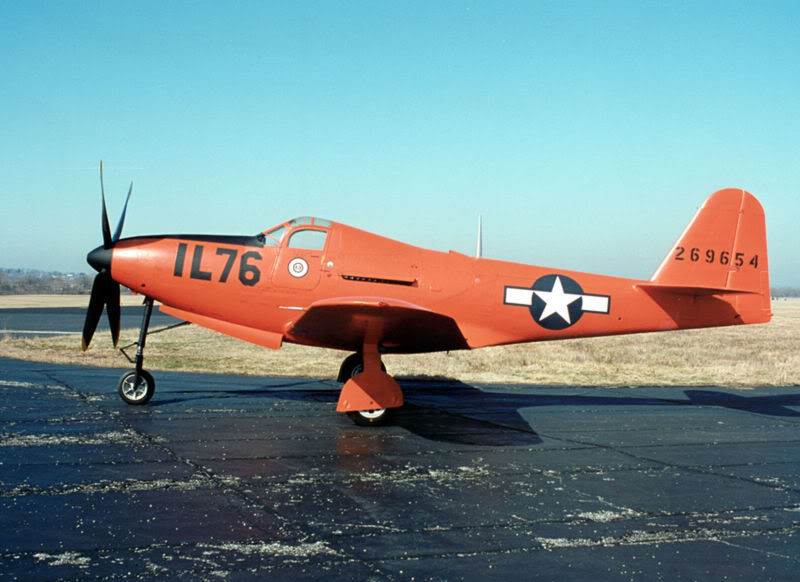
The Bell RP-63 Pinball

As the strategic bombing campaign over Germany built up in the spring of 1943, losses over the skies of the Reich began to mount as mission momentum increased over the course of that summer. While the ever-present flak was a significant threat to the B-17 Flying Fortresses and B-24 Liberators of the US Eighth Air Force based in the UK, it was the fighters of the Luftwaffe that were mauling the formations. From June into the autumn, losses were mounting and doubts were starting to be raised on the operational wisdom of daylight strategic bombing. The breaking point came on 14 October 1943 with the second attack on the ball-bearing plants at Schweinfurt, Germany. Already bruised from a vicious mauling at the hands of the Luftwaffe on the first raid on the Scweinfurt (which was attacked along with Regensburg on 17 August 1943 with the loss of 60 bombers), of the 291 B-17s sent on the mission, 77 bombers were lost and 122 were damaged. The day was named "Black Thursday" for having the highest number of crewmen lost on a single USAAF mission- 590 killed, 65 taken prisoner. Deep penetration missions of Germany were suspended until February 1944 when the long-range P-51 Mustangs arrived. 

But warnings were raised as early as 1942 stateside when Major Cameron Fairchild of the USAAF sought ways to improve the aerial gunnery skills of the men who manned the defensive positions on the heavy bombers. The techniques of training at the time were fairly basic, ranging from skeet shooting to firing at towed targets. Fairchild surmised the best aerial gunnery training would consist of being able to fire live ammunition at an actual fighter aircraft. His first task was to develop a bullet that had the same characteristics as a 30- or 50-caliber round but would splinter harmlessly on impact. Working with researchers at Duke University, the University of Michigan, and the Bakelite Corporation (one of the pioneering manufacturers of plastics), Fairchild and his team came up with a frangible bullet that was weighted with powdered lead to give it the proper weight and density. 

Fairchild proved to be willing to circumvent the usual Army bureaucracy to promote his ideas. Instead of working through the usual Army weapons development channels, he teamed up with academics to validate his ideas. Fortunately, the heavy losses of 1943 showed that aerial gunnery skills were lacking and Fairchild's frangible training bullets gained traction with the USAAF. He then selected the Bell P-63 Kingcobra as the target aircraft. As it was a type not used by front-line USAAF units, it was easily available. The P-63, designated RP-63, was given 1-inch thick armored glass with special armor in vulnerable areas. Sensors underneath the RP-63 registered hits and lights on the spinner and on the fuselage would light up, giving rise to the name "Pinball". 

Beginning in early 1945 RP-63 Pinballs would fly attack profiles against bombers with student gunners before they were assigned to a combat unit. A training B-17 might have 12 student gunners each having 2,000 rounds of Fairchild's special frangible ammunition to fire at the Pinballs. The Pinball pilots, flying RP-63s that were painted either dayglo orange or yellow, flew 2-3 missions a day from bases throughout the United States. Minor damage was easily repaired on the flightline but the Achilles heel of the Pinball was the wingroot air ducts that provided cooling air to the mid-fuselage mounted Allison V-1710 liquid-cooled engine. If a frangible bullet got into the duct, the fragments could damage the cooling system, resulting in an overheating engine and a mandatory deadstick landing or a bailout by the RP-63 pilot. 

A total of 300 P-63s were converted to the RP-63 Pinball configuration. Some aircraft also trained B-29 Superfortress gunners, but by 1947, the Pinball program was wound down and the last aircraft retired. Much of the early demise of the program came with the introduction of the centralized gunner control system in the Boeing B-29 Superfortress where analog systems provided the necessary lead and tracking for the gunners which used sights that remotely operated the turrets. Targets could be handed off from one gunner's sight to another and it made aerial gunnery training obsolete. The second factor in the demise of the Pinball program came with the gun-laying radar that was first introduced on the tail cannons of the Convair B-36 Peacemaker. Radar simplified tracking and accurately shooting at target aircraft. But the Pinball program lives on as an unique wartime solution that undoubtedly did its part to hasten the demise of the Axis in the Second World War.

Source: Air & Space Smithsonian, November 2010, Vol. 25, No. 5. "Just Shoot Me: In World War II, P-63 pilots had to learn to take it- and not take it personally" by James Dunaway, p50-53. RP-63 model by Scott Van Aken.

19 June 2010

The Turboprop B-17 Flying Fortress

In the late-1950s, many of the surplus Boeing B-17 Flying Fortresses that were used by the Navy, Air Force, and Coast Guard in the air-sea rescue role found their way into the hands of several civilian fire bomber operations that for the first time along with surplus Consolidated PB4Y-2 Privateers, offered a quantum leap in performance with the ability to carry significant loads of fire retardant. In fact, prior to the arrival of the B-17s and PB4Y-2s, no other civilian fire bomber then in use even remotely approached the fire retardant capacity of the converted four-engined bombers. In 1960, the first of about two dozen B-17s were converted with bomb bay tanks for aerial delivery of fire retardants.

The bomb bays were fitted with tanks that could carry 2,000 lbs of retardant. The tank was then subdivided into four compartments, each compartment having its own quick-opening door to empty that tank on a forest fire target. The converted B-17s were based on the -F and -G variants primarily (the USAF's air-sea rescue SB-17G, for example). Stripped of all non-essential equipment, the B-17 offered a significant increase in power in the typical-high altitude areas that most forest fires were found. Most of the conversions flew on contracts with the US Forest Service.

However, by the late-1960s many of the fire bomber B-17s were retired from service as aircraft like the Douglas DC-6 and ex-military Douglas C-54s were converted for the role. In addition, the Wright R-1820 Cyclone radial engines of the B-17s were becoming increasingly difficult to support with spare parts. One enterprising outfit got around this issue by re-engining their B-17 fire bomber with four Rolls-Royce Dart turboprops that once belonged to Vickers Viscount. As the Dart engines were much lighter than the Wright Cyclone radials, the nacelles had to be extended far forward to maintain the center of gravity with the propeller spinners being nearly in line with the nose of the B-17. Only one B-17, N1304N, was converted in 1970. Some sources indicate that the aircraft had the nickname "Batmobile" and she was so overpowered, that with both outboard engines shut down and feathered, she was still faster than a stock B-17 and this was while carrying a full load of fire retardant. When the pilots made their drop, they had to shut down and feather the outboard engines to keep from overspeeding the airframe.

This unique and one-of-a-kind B-17 Flying Fortress was unfortunately lost in the same year it was converted. While fighting a forest fire near Dubois, Wyoming, the engines lost power due to excessive ingestion of heated air and smoke from the fire and the aircraft failed to pull out of a retardant drop.

Source: Boeing B-17 Flying Fortress (Warbird Tech No. 7) by Frederick A. Johnsen. Specialty Press, 2002, p97-99.

16 June 2010

Trans World Airlines' Executive Transport B-17 Flying Fortress

Although in excess of 25 different versions of the Boeing B-17 Flying Fortress had flown since its first flight prior to the start of the Second World War, one of the most unique versions would have to be the only B-17 to be operated by US major airline after the war ended. During the war, many US airlines contributed to the war effort by training pilots, carrying priority passengers and delivering cargo to far-flung destinations well beyond their traditional domestic route networks. Immediately following the Japanese surrender in 1945, the airlines began the process of gearing up for normal civilian operations as rapid demobilization was the order of the day. One of those airlines was TWA, at the time was still known as Transcontinental & Western Airlines but would soon rename itself as Trans World Airlines.

During the war, TWA's five Boeing 307 Stratoliners were put into military service as transports starting in 1942. When they were returned to the airline in 1945, however, they had been heavily used with an untold number of flight hours and for what TWA wanted to do next, the "used" Stratoliners weren't up to the job. In 1946 TWA president Jack Frye and several of his deputies visited one of the RFC (Reconstruction Finance Corporation) depots at Altus AAF in Oklahoma to buy a low-time B-17G Flying Fortress. Several hundred stored B-17Gs were reviewed and their log books inspected. A Vega-built B-17G, 44-85728, was selected as it had very few flight hours on it. In fact, after it was built by Lockheed Vega and delivered to the US Army Air Forces in Burbank, California, it was flown directly into storage.

The sale was finalized on 26 June 1946 and the B-17G was assigned a civilian ferry registration of NX4600 for the flight to Boeing Field in Seattle where it would get conversion work for the role for TWA's mission. Jack Frye also made sure to make the arrangements for TWA to be the owner of a Limited Type Certificate for the B-17. In late 1946 the US Civil Aeronautics Board made these special LTCs available for certain surplus military aircraft that could be sold to civilian owners with the provisions that they not be used for carrying fare-paying passengers or revenue cargo- this restriction was a concession to the aircraft industry which feared that large numbers of surplus aircraft would hurt postwar sales of civilian designs. Most of the LTCs used in the postwar period were used to convert medium bombers into either forest fire-fighting water bombers or executive conversions that were common with the Douglas A-26 Invader and North American B-25 Mitchell.

At Boeing Field, TWA's B-17G was quite literally taken apart as all the military items were removed and extensive soundproofing and comfortable cabin appointments were installed. Additional windows were installed in the fuselage and upgraded avionics, engines, and propellers were installed. Boeing's designation for the B-17 was Model 299 and all the variants had a letter suffix. Since Boeing had already reached the designation Model 299Z, TWA's custom converted B-17G became the Model 299AB. With basic TWA markings and the tail number NL1B, the airline's B-17 would be used for long-range proving flights on prospective routes.

On 11 February 1946 the United States and the United Kingdom signed the Bermuda agreement that governed bilateral air services between the two nations (this would subsequently be reinforced with the Bermuda II agreement in 1977 which was only recently superseded by the Open Skies agreement with the EU just a few years ago). The British were well aware that the United States was on the cusp of domination in of the world's airline industry and the Bermuda agreement restricted US competition in the trans-Atlantic market between the two nations. While TWA and its rival Pan American came out ahead of other US airlines in the Bermuda agreement, Jack Frye wanted to use the B-17 for route proving to find ways of circumventing the Bermuda treaty.

TWA's officials set out on the flights in the newly-converted B-17 and brokered technical and financial agreements with airlines worldwide such as Saudia, Linee Aeree Italiane, Trans-Mediterranian Airways, Ethiopian Airways, and Iran Air. TWA would invest in these airlines and others in exchange for the airlines getting training and maintenance agreements with TWA. In the case of Iran Air, the airline invested in 10% of the Iranian airline and also got a five-year contract to manage Iran Air. On April 1947, TWA's luxuriously appointed B-17 was presented to the Shah of Iran as "deal sweetener" and re-registered as EP-HIM and flown by TWA crews.

Two years later a restructuring of Iran Air led to the TWA contact being nullified and in 1952 the B-17 was sold to the IGN (Institute Geographique National) as F-BGOE for scientific and global mapping survey flights. The IGN used the B-17 until about 1967 and it was scrapped 1972, ending the story of one of the most unique of B-17 Flying Fortresses.

Source: Aeroplane Monthly, June 2010, Volume 38, Number 6. "The Flying Fortress Airliner: The Original Stratofortress?" by Marshall Wainwright, p56-59.

14 June 2010

The Story of "5 Grand", the 5,000th B-17 Flying Fortress Built

To boost morale on the home front during the Second World War, aircraft manufacturers celebrated production aircraft milestones. Lockheed, for example, painted the 5,000th P-38 Lightning red and named it "YIPEE". But Boeing wanted to do something different as it approached the 5,000 B-17 Flying Fortress to be built since the attack on Pearl Harbor when the US entered the war against the Axis. Aircraft number 40-37716, a B-17G, was that aircraft and early on it was marked with a notice on the fuselage that it was the 5,000th Flying Fortress to be built since the US entry into the war. Every worker who played a part in the construction of this particular aircraft was invited to sign the aircraft as it advanced down the production line in Seattle.

It celebrated the efforts of the thousands of workers who emigrated to Seattle to escape the effects of the Great Depression and work on Boeing's massive production facilities. The enthusiasm that workers applied their signatures even surprised the Boeing management as even parts from the subcontractors bound for 40-37716 were even signed, even though they'd be hidden away deep inside the aircraft. Appropriately, the B-17G was named "5 Grand" and before leaving the Renton plant was already being celebrated in newsreels and war bond drives. Instead of towing the B-17G out as had always been the protocol of the day upon completion, the workers themselves pushed 5 Grand out the factory doors to great fanfare.

In May 1944 5 Grand was officially delivered to the US Army Air Forces at Boeing Field and a bottle of champagne was ceremonially broken over the aircraft's nose. The USAAF even made sure that the crew assigned to 5 Grand were made up of locals from the Puget Sound area with Edward C. Unger of Seattle selected as the aircraft commander/pilot. 5 Grand was then flown to Kearney AAF depot in Nebraska for further modifications to make her combat ready. When she left the United States for the Eighth Air Force's bomber bases in Britain, over 35,000 signatures adorned the baremetal finish of 5 Grand. Some thought that the plane should be stripped as the Luftwaffe might make special effort to shoot down 5 Grand, but it was decided the signatures would stay in place. On the trans-Atlantic flight, the crew found the B-17G was about 7 mph slower than a stock B-17G due to the weight of the ink and paint used on the signatures and the surface roughness from some of the more colorful applications! The fuel consumption was higher and stronger-than-forecast winds aloft resulted in one of 5 Grand's engines cutting out on landing in the UK due to fuel starvation.

Assigned to the 333rd Bomber Squadron of the 96th Bomber Group at Snetterton Heath in Norfolk, one of its first local flights before combat missions were flown ended in near disaster when the electrical system failed and 5 Grand made a crash landing after ejecting its ball turret. She was repaired and reassigned to the 388th Bomber Group and would fly 78 missions over the Reich adorned with her signatures with her gunners claiming two Luftwaffe fighters destroyed.

On 14 June 1945 5 Grand returned home to the United States, first landing at Bradley Field in Connecticut before continuing on to Boeing Field in Seattle for refurbishment to go on a war bond tour. While in Seattle, many employees found their signatures still in place. Local officials wanted to preserve 5 Grand as a memorial to the city's home front war effort, but while the Seattle politicians debated the cost, 5 Grand was flown to Lubbock AAF in Texas for further repairs and refurbishment before being flown into storage at Kingman AAF in Arizona to be held in storage while Seattle officials decided how to proceed on the planned memorial incorporating 5 Grand. The US Army Air Forces were willing to donate 5 Grand to Seattle for the memorial planned by the Seattle Historical Society, but on 3 January 1946, Seattle city officials declined the donation of 5 Grand on the grounds that building a memorial with the aircraft represented too costly an endeavor.

Despite the efforts of Boeing employees who had signed 5 Grand, no one in the local government wished to take responsibility and the aircraft, still resplendent with its signatures, was sold off by the Reconstruction Finance Corporation to the scrapper where 5 Grand was unceremoniously broken up and molten down, forever lost to history.

Source: Aeroplane Monthly, June 2010, Volume 38, Number 6. "A Fort Named 5 Grand" by Howard Carter, p40-45.

12 February 2010

The First Serious Proposal for Air Refueling on a Combat Mission


The first serious proposal to use air-to-air refueling in a combat mission came in early 1942 just weeks after the Japanese attack on Pearl Harbor. The United States wanted to strike back as expeditiously possible at Japan and early efforts focused on the US Army Air Corps inviting the British firm Flight Refueling Ltd to send some engineering staff to Wright Field in Dayton, Ohio, to discuss converting the Consolidated B-24 Liberator into a tanker and the Boeing B-17 Flying Fortress into a receiver aircraft. The USAAC (soon to become the US Army Air Forces) ordered on set of inflight refueling equipment similar to what Flight Refueling used in its 1939 trans-Atlantic trials.

With the assistance of Flight Refueling engineers, Pennsylvania Central Airlines modified a B-24 and a B-17 with the refueling equipment (PCA would later be renamed Capital Air Lines which was then absorbed by United Air Lines in 1961). By April 1943 the first flight trials were conducted at Eglin Field in Florida. By this time, however, the Doolittle raid on Tokyo had already taken place but the USAAF wanted to further examine the feasibility of air refueling in strategic bombing operations.

Using Flight Refueling's grapple method, the B-17 receiver trailed a hauling line with a weight and hook at the end. The B-24 tanker approached from the side and below and deployed a contact line that crossed over the hauling line of the B-17 and engaged the hook. The B-24 tanker then moved above the B-17, pulling in the hauling line with the contact line. The refueling hose was then attached to the hauling line and it was then pulled down to the B-17 which had a refueling receptacle in the tail gunner's position and refueling commenced.

At the conclusion of the tests, the B-17's range with a full bomb load could be extended to 5,800 miles (compared to its standard 2,000 mile range). Plans were conceived to have B-17s based in the Aleutian Islands and strike Japan with air-refueling, proceed on to bases in China and then reverse the process. However, the time needed convert and train sufficient bombers and crews to sustain a strategic bombing campaign on Japan were seen as too long with Boeing getting ready to produce the B-29 Superfortress and Admiral Nimitz's successes in the Central Pacific in securing possible islands to use as bomber bases.

Source: History of Air-to-Air Refueling by Richard M. Tanner, MBE. Pen & Sword Books, 2006, p24.