Showing posts with label Pan American. Show all posts

18 May 2016

CHECK SIX: The Douglas DC-7

18 MAY 1953: FIRST FLIGHT OF THE DOUGLAS DC-7

Douglas launched the DC-7 program at the prodding of C.R. Smith of American Airlines who wanted a competitor to TWA's Lockheed Super Constellations for the first transcontinental nonstop services. American's requirement even called for the same engines as the Super Constellation, the Wright R-3350 Turbo Compound (the DC-6 used the Pratt & Whitney R-2800 Double Wasp) radial. Douglas didn't think there was a market for such an aircraft, but Smith ordered 25 of what would become the DC-7 for $40 million which pretty much covered Douglas' development costs. To save time and make the most of the $40 million, the DC-7 was a stretched DC-6 with Wright R-3350 engines. The DC-7 was slightly faster than the Super Consellation and could under *ideal* conditions (which was rare) do a nonstop transcon in under 8 hours. 


The first variant of the DC-7 was good for transcon runs but was no better than the DC-6 for oceanic routes. That first variant went exclusively to US operators- American (34), United (57), Delta (10), and National (4). American Airlines inaugurated its own nonstop "Mercury Service" DC-7 flights between Los Angeles and New York Idlewild on 29 November 1953. As the DC-7 had a higher cruising speed than the Super Constellation, the eastbound LA-New York run was made easily in 7 hours, 15 minutes (a fact not lost upon American's marketing department, hence the name "Mercury Service"), but the westbound run from New York to LA couldn't be made within 8 hours. Despite over a dozen modifications to the DC-7s made by American's engineers which included tweaks of the Wright R-3350 radial engines to squeeze every bit of horsepower out of the engines, the DC-7s still couldn't beat the prevailing winds. American's pilot union repeatedly pointed this fact out, but C.R. Smith's influence in Washington left the issue unaddressed by federal regulators. In the following year, federal regulators adjusted the time limit to allow the flight to be made legally and American's DC-7s blocked in at 8 hours, 15 minutes on a westbound nonstop.

The next DC-7 variant was the DC-7B which had uprated engines and more fuel tanks in the engine nacelles which made oceanic crossings possible. Pan American launched its own transatlantic services in the summer of 1955 and South African Airways was finally able to fly Johannesburg-London nonstop.

The final DC-7 variant had longer wings and a stretched fuselage, the DC-7C "Seven Seas". The fuel capacity of the Seven Seas allowed full westbound nonstop transatlantic capability, something that the DC-7B couldn't routinely perform. 


There was a DC-7D which would have Rolls-Royce Tyne turboprops (same engine as the Vickers Vanguard) and a swept back vertical fin, but it never made it off the drawing board as Donald Douglas decided jets were the way to go and development of the DC-8 was given priority. 

Further reading: 


(Photos: Vintage Ad Browser, California Classic Forums)

14 May 2016

CHECK SIX: The Rollout of the Boeing 367-80


14 May 1954: The rollout at Boeing's Renton Field facility of the aircraft that would change jet transport, the Boeing 367-80. Bill Boeing was 72 at the time and had long since divested his holdings in the company he founded, but he was present at the rollout of the the Dash 80 and Boeing's wife, Bertha, christened the aircraft with champagne while the Renton High School band played "Wild Blue Yonder", the USAF theme. I always thought this Boeing photo was cool- it's the Boeing president at the time, Bill Allen, showing the 367-80 to Bill Boeing. 

Allen bet the company on Dash 80, investing $16 million of the company's money to gear up for production tooling before having an order from either any airline or the US Air Force. 

But then again, taking a bold risk was something the company did three times undeniably in its history. The first time was in 1934. Boeing president Claire Egdtvedt proceeded with the Boeing 299 without any orders or contracts from the US Army Air Corps for a four engined bomber- the 299 is better known as the B-17 Flying Fortress. When Egdtvedt took his gamble on the 299 prototype, he asked his friend for guidance- who happened to be Bill Allen, who at the time was the company lawyer.

Almost twenty years later Bill Allen found himself in the same position when he launched what become both the KC-135 Stratotanker and the Boeing 707 with the Dash 80 prototype. 

And about 10 years later, Bill Allen was fishing in Puget Sound with Pan American chairman Juan Trippe when Trippe pressed Allen on building a jumbo-sized jetliner- legend has it that Trippe asked Allen "Would you build it if I buy it?" and Allen responded "Would you buy it if I build it?" and by the end of the day, the Boeing 747 was launched on a handshake. According to aviation author Robert Gandt, Allen thought to himself the 747 "would be the perfect swan song if he could step down knowing that he had launched the world’s mightiest ship of the sky. It would secure Boeing’s future well into the century. Or it could ruin Boeing".

Further reading: 


04 May 2016

A Giant Ahead of Its Time: The Lockheed R6V Constitution

Before the start of the Second World War, Pan American Airways was the world's biggest operator of large ocean-going flying boats with the Boeing 314, Martin M-130 and Sikorsky S-42 in the fleet that spanned Pan American's worldwide network. However, the airline recognized that the pace of development in aviation technology meant that landplanes would be the dominant airline aircraft of the future. Pan Am worked with Boeing to bring the Boeing 307 Stratoliner to fruition (the world's first pressurized airliner). But with the start of the war for the United States in 1941, Pan American's operations were shifted to support the war effort and in this capacity the airline solicited the US Navy for the construction of a true heavy-lift landplane transport. This was finalized with the US Navy, Lockheed, and Pan American in November 1942 with what became the Lockheed Model 49 Constitution. 


The R6V Constitution on final approach at Moffett Field in California
(Wikipedia/US Navy)
The requirements issued by the Navy as suggested by Pan American were for a range of 5,000 miles, 17,500 lb payload at 255 mph at 25,000 feet cruising altitude. A year later on 1 November 1943 the contract was formally issued to Lockheed. Pan American's engineers led by their head engineer, Andre Priester, worked alongside Lockheed's engineers and their head, Willis Hawkins (he also designed the Constellation and later on would work on the F-80 Shooting Star, F-104 Starfighter, and the C-130 Hercules). The fuselage of the Constitution was a double deck, double lobed cross-section design with the large wing passing through the mid-fuselage between decks. With a fully-pressurized double-deck, the Constitution could carry up to 204 military passengers but the normal complement would be 168 passengers. Pan American's plans were for 51 passengers on the lower deck and 58 passengers on the top deck. Cargo doors were installed on the lower deck and the wings were deep enough to allow mechanics to access the four radial engines in flight for maintenance. The Constitution was also the first large transport aircraft to have multi wheel main landing gear bogies (four wheels to each main landing gear). 

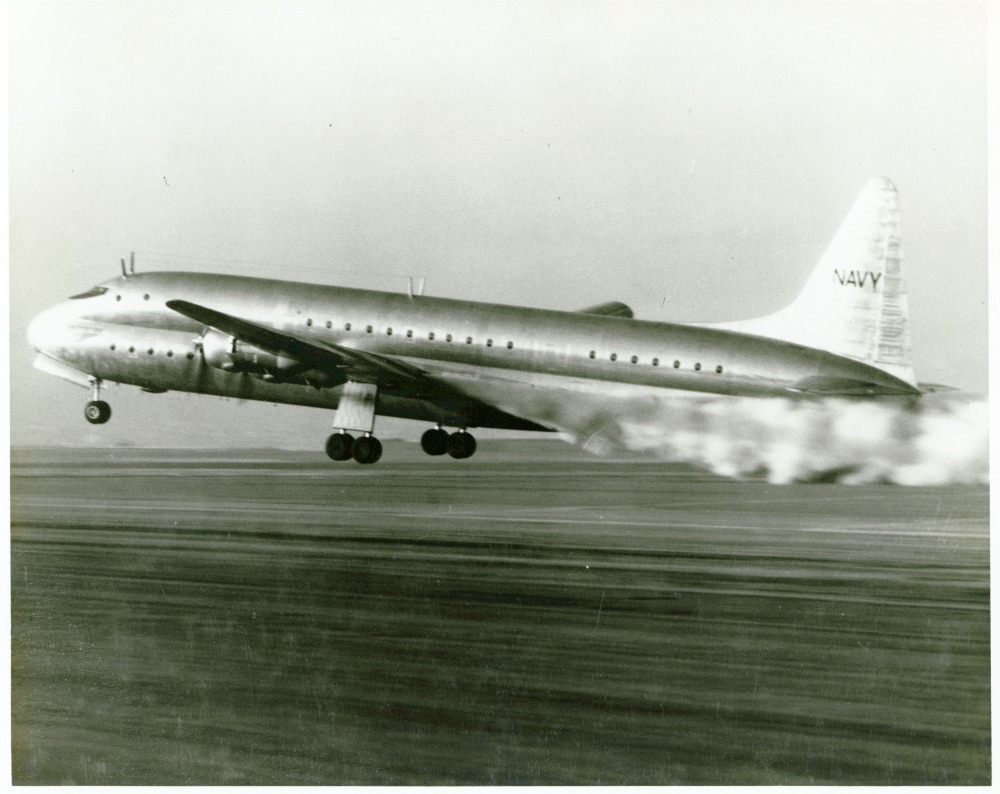
The wing itself was based on the layout and structure of the wings used on the Constellation and the P-38 Lightning. Four 3,000 horsepower Pratt & Whitney R-4360 28-cylinder Wasp Major engines drove four bladed props. Unusually, the upper surface trailing edge root of the wings could hold RATO units to shorten takeoff runs. There were three units in each wing- they were fired when the landing gear retraction sequence started. As the landing gears took 14 seconds to retract, the RATO units burned for 15 seconds.

Takeoff using the overwing integral RATO units
(San Diego Air & Space Museum)
Since the Constitution was a low-priority project during the war, it wasn't until well after the war ended in August 1945 that the aircraft was completed. Though standard for today's design work on modern airliners, Lockheed used a full-scale hydraulic and electrical systems test rig that today would be known as an "iron bird". The system was loaded so the hydraulics and flight control systems would "experience" loads similar to what would be found inflight and were invaluable in letting the Constitution's test pilots get familiar with the large aircraft. The first flight came on 9 November 1946 and after the first 44 flight hours of testing the Constitution was found to be significantly underpowered. More powerful versions of the R-4360 Wasp Major were installed that theoretically produced 3,500 horsepower, but in practice even these engines could only garner 2,900 to 3,300 horsepower and that was with water injection and bypassing the superchargers on takeoff. As a result, use of the integral RATO units was commonplace. 

To keep Pan American interested in the project, Lockheed proposed the civilian version of the Constitution be powered by Wright 5,500 horsepower Typhoon turboprop under development, but by this point Pan American had thrown its lot with the Boeing Stratocruiser and bowed out of the Constitution program. Designated XR6O-1 by the US Navy, the first Constitution underwent a full year of flight testing at NAS Patuxent River, Maryland. The second XR6O-1 made its first flight on 9 June 1948 and unlike the first aircraft, the upper deck was fitted out for VIP passenger service with 92 seats while the lower deck was fitted out to carry as much as 40,000 lbs of cargo. Dual spiral staircases at each end of the cabin provided access to the upper deck from the lower deck and passenger entry was via the nose gear well which was large enough to allow airstairs to be pulled up just in front of the nose gear. 

The Constitution on static display during an open house at San Francisco Airport
(San Francisco International Airport/FlySFO.com)
In February 1949 the second R6O (the X prefix was dropped) was commissioned into service at NAS Moffett Field, California, with the fleet logistics support squadron VR-44. Soon joined by the first R6O, the Navy embarked on a series of publicity flights across the country, using the Constitution to not only transport personnel and materiel, but also to stimulate interest in naval aviation. The R6O carried one and a half times more cargo than the next biggest Navy transport, the Douglas R5D (C-54 Skymaster/DC-4). In 1950, the two R6Os were redesigned R6V; in the Navy's aircraft designation system used prior to 1962, "V" stood for the Vega Division of Lockheed that had built the PV-1 Ventura and PV-2 Harpoon in the Second World War- the "O" of Lockheed was dropped as it could be confused with the number zero and "V" took it's place as the Lockheed designator code. They were reassigned to VR-5 for expanded operational duties that included flights to Hawaii and Alaska. With a total of 3,760 flight hours between the two aircraft, in 1953 the R6O Constitutions were retired and placed in storage at NAF Lichtfield Park, Arizona. The aircraft were offered to the airlines on a proposed five-year lease, but no interest came about. 

The first Constitution ended up in Las Vegas as a promotional billboard for Alamo Airways at McCarran Airport and plans were floated to move the aircraft to the Strip to be part of a casino. However, the plans were never materialized and when Howard Hughes acquired the property that the aircraft sat on, he also gained ownership of the aircraft and had it scrapped in 1970. The second Constitution ended up in Opa Locka, Florida, where it was to be sold to a German businessman who wanted to use it for a restaurant in Barcelona, Spain. The deal fell through and the aircraft mysteriously caught fire which gutted the interior but spared the exterior. After several years of legal wrangling, the aircraft was scrapped in 1979.

Further reading: 

The Convair Model 6: A Jumbo Jet Before Its Time
Pan American and the Boeing 314 Toilet Scandal
The Cadillac of the Constellation Line

Source: Lockheed R6O/R6V Constitution (Naval Fighers No. 83) by Steve Ginter. Ginter Books, 2009.

14 April 2010

How a Small Airline First Cracked Pan American's Monopoly


Prior to the Second World War, international airline services from the United States were dominated by Pan American World Airways and its politically influential chairman, Juan Trippe. With implicit backing from the US State Department, Trippe forged Pan American into a "Chosen Instrument" of overseas American commerce with his extensive air network of services covering the Pacific, Latin America, and across the Atlantic. However, the demands of the Second World War resulted in most of the US airlines expanding their operations into overseas flying for the military to support the war effort. As a result, many airlines that had traditionally not flown outside US borders gained valuable experience in overseas operations.

As a result, many of those airlines began to look at what the postwar commercial aviation market might look like and airlines like American (via its subsidiary American Overseas Airlines), Trans World Airlines, and even smaller airlines like Northeast began to prepare applications to the Civil Aeronautics Board for international route authorities.

In March 1944, Senator Patrick McCarran of Nevada proposed a bill in Congress that would create what he called the "All-American Flag Line", a single international airline that would be jointly-0wned and operated by existing US airlines with an operating certificate dating prior to the 1938 passage of the Civil Aeronautics Act. McCarran's airline would be prohibited from domestic services and US airlines would be prohibited from international services outside of their participation in the "All-American Flag Line". Senator McCarran wanted to a single prestigious American international airline that all the other US airlines funneled traffic into from domestic gateways.

The "All-American Flag Line" would be a federally-chartered private airline starting with $200 million of federal capital and each participating US airline could purchase up to $50 million in stock of the airline. As Pan American had developed most of the international routes before the Second World War, Juan Trippe would hold ownership of 25% of the proposed airline.

This arrangement, of course, did not sit well with the smaller US airlines. While the US majors like TWA, United, American, and Eastern saw the McCarran bill as a way to gain entry into the international arena without the capital expenditure of expanding overseas on their own (since this seed money would be provided by the federal government), smaller airlines balked at the price of investment and being consigned to having a small voice compared to that of Juan Trippe, much less that of the larger airlines as well.

One of the most eloquent and vocal critics of the McCarran bill was Carleton Putnam of Chicago & Southern Airlines. In June 1933 as a young law student, Carleton Putnam started Pacific Seaboard Airlines operating Bellanca Pacemakers between San Francisco and Los Angeles. When President Roosevelt canceled the air mail contracts in 1934 during the infamous Air Mail Scandal, Pacific Seaboard Airlines lost its primary revenue stream. After the US Army Air Corps tried in vain to carry air mail, the contracts were once again put up for bid and Putnam in desperation to save his small airline bid on an air mail route in the Mississippi Valley that connected Chicago to New Orleans. To the surprise of many, Putnam won the contract and in 1934 he moved his entire operation to Memphis, Tennessee and on 17 July 1935 he launched passenger services as Chicago & Southern Airlines.

During the Second World War, Chicago & Southern operated a vital contract flying troops and cargo throughout Alaska during the Aleutian campaign to oust the Japanese from the area. Putnam even applied for postwar international route authorities to fly to Singapore and Batavia (modern day Jakarta) from Chicago via Alaska in what may very well be the first proposal to use a Great Circle Route that is now a primary routing for air traffic between North America and Asia.

Trippe of course was supportive of the McCarran bill and he certainly didn't expect such tenacious opposition from someone like Chicago & Southern and Carleton Putnam. Putnam rallied the other smaller airlines, pointing out that it should be the free market and competition that should determine who was most suitable for international services rather than have the government virtually enshrine Pan American as the default international airline.

To go against someone as powerful in Congress as Senator McCarran who was highly influential in aviation affairs and to simultaneously take on Juan Trippe of Pan American, probably the most influential airline head of the day? That's quite a set of brass ones and Putnam managed to pull it off and have the McCarran bill killed off. While Chicago & Southern Airlines didn't get its Great Circle route to Asia, it was handsomely rewarded by the CAB with route authorities into Pan Am's traditional Caribbean stronghold with services to Cuba, Jamaica, Haiti and the Dominican Republic, Puerto Rico and all the way to Caracas, Venezuela from New Orleans.

Carleton Putnam won the admiration of many in the industry for his stand against McCarran and Trippe, most importantly with C.E. Woolman, founder and head of Delta Air Lines. Woolman saw in Putnam and Chicago & Southern a kindred spirit that shared his own business ethics and ideals. Having grown weary of trying to expand services to New York but failing thanks to the maneuverings of Eastern Air Lines and its acerbic president, Eddie Rickenbacker, Woolman embarked on expanding Delta westward through a merger with Chicago & Southern that was finalized in 1953.

And perhaps more importantly, the stage was set for overseas services by any US airline that could show to the CAB that it had the wherewithal to operate internationally, cracking Pan Am's long dominance of international services.

Source: Delta: The History of the Airline by W. David Lewis and Wesley Phillips Newton. University of Georgia Press, 1979, p200-201.

17 February 2010


With the Martin M-130 flying boat operating on Pan American's prestigious trans-Pacific route between San Francisco and Hong Kong, the airline in 1937 sought out newer and larger equipment to expand the Pacific network. Martin was the incumbent, having built three M-130s for Pan American that were christened "China Clipper", "Philippine Clipper", and "Hawaii Clipper." The M-130 served as the basis for enlarged derivative designated the M-156 which had essentially an M-130 fuselage mated to an enlarged wing with four more powerful radial engines and a twin-fin tailplane mounted on a pylon on the aft fuselage.

In a surprise to many, Pan American rejected the M-156 and instead with the M-156's competitor, the Boeing 314 flying boat. The Boeing 314 was a bigger, faster and more spacious aircraft that easily won the airline's chairman, Juan Trippe, over with comforts that were possible due to its bigger size.

Martin, however, had already been in negotiations with the Soviet Union for the M-156 not just for purchase, but also for license production. The M-156 design was far more advanced in design and capability than what either was in production in the Soviet Union or up for sale by the nations of Western Europe. The contract signed with the Soviet government was for the transfer of production drawings and equipment to allow the Soviets to build their own M-156s for Aeroflot passenger services in the Russian Far East. In December 1937, the M-156 prototype was transferred to the Soviet Union along with a series of production drawings that had to be converted from imperial units to the metric system (which would lead to problems for the Soviets). Rather unusually, though, it was transported by ship to Leningrad rather than being flown across the Atlantic.

Plans were in place, however, to use the M-156 (dubbed "Soviet Clipper" by Martin) as the basis of a long range bomber operated by the naval aviation. A full-scale fuselage mockup was built that incorporated bomb bays and defensive gun turrets. Stalinist purges of the aircraft industry, though, impeded progress on the bomber version of the M-156 but the prototype aircraft by 1940 was already flying passenger services in the Russian Far East for Aeroflot. As the Second World War dragged on, spare parts problems, fuel shortages and accidents cut into the Soviet Clipper's flying hours and by 1944 the aircraft was effectively grounded and is believed to have been scrapped sometime around 1946.

Source: Pan American's Clippers- The Golden Age of Flying Boats by James Troutman. Boston Mills Press, 2007, p49. Supplemental material from www.airwar.ru/enc/cw1/m156.html

06 February 2010

Pan American and the Boeing 314 Toilet Scandal


When Pan American signed a $4.8 million order with Boeing for six Model 314 flying boats with options on an additional six, at the time in the 1930s it was the most expensive airliner sale yet with a cost of $512,000 per flying boat, five times the cost of a Douglas DC-3. Not only did Boeing manage to break into the large transport aircraft market for the first time with as prestigious a customer as Pan American, but the Boeing 314 was a quantum leap on performance and luxury over the previous Martin and Sikorsky models the airline was using on its worldwide network.

The Boeing 314 boasted a 3,500 mile range (with a wing based on that of the Boeing XB-15) with a cruising speed of 183 mph and carried up to 74 passengers in ocean liner luxury. Boeing engineer Wellwood Beall who supervised the Model 314's development, even included a bridal suite and spiral staircase connecting the upper and lower decks of the spacious flying boat. Pan Am chairman Juan Trippe was so enamored with the interior accommodations of the 314 that despite the delays in the program, he refused to invoke the contractual penalty clauses in the contract. Trippe even ignored his most famous technical advisor, Charles Lindbergh, who was unhappy with the Boeing 314's design as he didn't believe Boeing could build commercial aircraft.

But the least-publicized groundbreaking feature (and the one Wellwood Beall was most proud of) was that the Boeing 314 was the first airliner to have flushing toilets. Beall himself was responsible for the design of the flying boat's toilets. When the seat lid was closed, the bowl of the toilet sat inside a rotating drum that turned 180 degrees to upside down which emptied the toilet bowl's contents out a vent into the sea and then righted back up again for the next passenger.

The toilet, however, nearly caused a rift between Wellwood Beall and Andre Priester, a fiery Dutchman who was in charge of Pan American's engineering department. On the inaugural Boeing 314 flight from San Francisco to Honolulu, Beall was an invited guest on board and was asleep in his berth when Priester angrily woke him up to complain that neither of the airliner's two toilets were working. Beall managed to get them working again, but on the return flight to the mainland, the toilets malfunctioned again and this time Beall couldn't get them fixed. Priester was furious and Beall hurried back to Seattle to consult with Boeing's engineers. They were mystified- they'd tested the design for over a year and were confident that it would work flawlessly.

It turned out that the the toilet paper Pan American was using was quilted and thicker than what Boeing used in its tests. The thicker and heavier Pan American toilet paper would clog the system and prevent the drum in the flushing mechanism from rotating. It's said that it was one of the few times in Andre Priester's career that he laughed and admitted he was wrong!

Source: Legend & Legacy: The Story of Boeing and Its People by Robert J. Serling. St. Martin's Press, 1992, p38-41.