Showing posts with label B-36 Peacemaker. Show all posts

14 October 2015

The Spyplane Codenamed "Pie Face": The Birth of the Big Safari Program

The Big Safari emblem
(Big Safari Association)
At the end of the Second World War, Germany was divided into four occupation zones administered by the victorious Allied powers. The capital, Berlin, was in turn also divided into four zones. When The Soviet Union established East Germany from its occupation zone, West Germany was formed from the American, British and French occupation zones. Berlin was also divided into East Berlin and West Berlin with the western part of the capital surrounded on all sides by East Germany. By agreement, there were travel corridors to allow surface and air connections to West Berlin from West Germany. The air corridors were only 20 miles wide at a maximum altitude of 10,000 feet. The northern air corridor followed a Hamburg-West Berlin line, the central air corridor followed a Hannover-West Berlin line and the southern air corridor followed a Frankfurt-West Berlin air corridor. In the summer of 1952, the head of United States Air Forces Europe, General Lauris Norstad, made a special request to the USAF Chief of Staff, General Hoyt Vandenberg, for reconnaissance aircraft to use in Europe that in particular, could fly unnoticed in the West Berlin air corridors as a routine courier flight. Vandenberg convened a group of specially selected officers and civilians who would develop not just the aircraft needed for the requested USAFE mission but also a set of rule and procedures in order to field such an aircraft quickly and in secrecy. Lieutenant General Thomas Rhodes worked with a reconnaissance systems specialist, Furman E. O'Rear, to develop the procedures that would get the specialized aircraft into service. 

Rhodes and O'Rear laid down the "ground rules" for the project: 
  1. Only the minimum amount of documentation was needed. Personal contact and direct communication was preferred. 
  2. Strict security clearances would be issued on a need to know basis with a minimum of personnel. 
  3. No limit on funds for the project. Special capabilities needed in the field shouldn't worry about funding. 
  4. Primary responsibility for the program lay with the Director of Air Force Maintenance and Engineering (this later became Air Force Systems Command) who would direct the Air Force Materiel Command (this later become the Air Force Logistics Command in 1961).
  5. Coordination was the utmost importance between the different commands of the USAF and the intelligence community. A single project head would act as the point of contact for all the diverse interests involved. 
  6. Aircraft contractors selected would also issue strict security clearances to a closed off work area for any aircraft modifications. 
  7. The contractor selected would be responsible for yearly upgrades to any aircraft system. 
  8. It was agreed upon ahead of time that any modifications or changes needed to the aircraft systems would be approved to expedite the fielding and subsequent upgrades to any special capability aircraft. 
In addition to these ground rules, it was also agreed that any project would make use of an existing aircraft rather than develop a new aircraft. The project office was authorized initially with a five year commitment on the reconnaissance aircraft that would be fielded by the USAFE for use in the Berlin air corridors. When it was realized in 1953 that the program's set up lent itself well to other special projects, it was given its own code name by which it is still known today: BIG SAFARI.

The Boston Camera the USAF Museum
(USAF Museum)
The year before General Norstad's 1952 special request for a reconnaissance aircraft, a very large special optical camera had been flight tested on a Convair B-36. The camera, developed by optical scientists and engineers at Boston University in 1947-1949, was designated the K-42 but was known as the Boston Camera as well as the code names BIG BERTHA and DAISY MAE. With a 240 inch focal length (6096mm), it weighed nearly three tons and used very large 18x36 inch frame film. It would be the largest aerial camera ever built. The lens was fixed at f/8 with an electrically tripped shutter speed of 1/400 second. Allegedly it had the resolution to image a golf ball on the ground from 45,000 feet. During the flight test program it was decided that a bomber carrying the Boston Camera would have been conspicuous if not downright provocative and it would be better used mounted in a transport aircraft. The aircraft had to be large so as not to have any external modifications that would give away its carriage of the large camera. PIE FACE was the code name assigned to the effort to mount the camera in a transport aircraft. The first PIE FACE contractor was actually Boeing who had offered a YC-97 Stratofreighter- one YC-97 in fact had flown a handful of Berlin Airlift missions. Boeing at the time was preoccupied with other programs and afforded the PIE FACE program little attention to the point that security was constantly being compromised with the aircraft frequently parked in the open at the property perimeter fence line in Seattle. 

As a result, the PIE FACE contractor was changed from Boeing to Convair Fort Worth. This would become Detachment 1 of the Big Safari program. The general manager of Convair, August Esenwein, took a personal stake in the project and made sure the USAF had the necessary secure hangar space as well as any engineering personnel needed make sure PIE FACE was fielded quickly. Esenwein's personal involvement pleased the USAF and the working relationship between the USAF and Convair at Detachment 1 set the standard for future contractor relationships in the Big Safari program. In fact, Detachment 1 would run for twenty years with 87 different aircraft passing through Convair Fort Worth over that time span. 

PIE FACE would have looked just like this KC-97
(Wikipedia)
While the Boston Camera did fly in Europe for six weeks on the YC-97, it was clear that as an early variant of the Stratofreighter it was less capable than the later KC-97 variants already in service. With less powerful engines, the YC-97 with the Boston Camera onboard was significantly altitude restricted. Given that the camera was used for stand-off oblique photography, a higher altitude meant that more of East Germany could be photographed from the air corridors. From 19 December 1952 to 23 February 1953, the Boston Camera was moved from the YC-97 to a KC-97 that had its boom removed, 49-2592. Both aircraft were literally cut in half behind the cockpit to move the camera from one aircraft to the other. The manual controls of the camera were upgraded with electrical and electromechanical controls as it was installed on the KC-97. Covert sliding doors were used to cover the camera ports when it wasn't in use. In addition to the installation of the Boston Camera, a 100-inch K-30 camera and a trimetrogon system of three K-17 cameras were also installed, all synchronized with the Boston Camera to give wider angle photographic coverage of the target areas and assist with mapping. A camera operator's station was installed in the cockpit with a special slaved sight to trigger the camera system. 

West Berlin air corridors
(German History in Documents and Images,
 http://germanhistorydocs.ghi-dc.org)
After flight testing with specially selected USAF crews, the PIE FACE KC-97 was assigned to 7499th Support Squadron (later renumbered to the 7405th) at Rhein-Main AB, the main USAFE transport hub in Europe. With each of the three air corridors to West Berlin being 20 miles wide, that was already 1/6th of East Germany that lay underneath any aircraft within the corridors. The addition of oblique photography added tremendously to the area surveilled- at the 10,000 foot maximum imposed by the Soviets, the majority of East Germany could be photographed by the PIE FACE aircraft. In addition to flying in the air corridors, perimeter flights along the border were also flown at altitudes as high at 32,000 feet. Just in the last six months of 1953 when it was first fielded, the specially-equipped aircraft had flown 13 missions (quite remarkable given the complexity of maintaining the camera system). The aircraft also stood alert for short notice missions and flew as far as the Arctic and the Middle East. Intelligence requirements soon outpaced the abilities of the aircraft and eleven other aircraft were added to supplement PIE FACE starting in 1954. Those aircraft will be the subject of a future article here at Tails Through Time, so stay tuned!

PIE FACE was scheduled to end in 1962 and 49-2592 was flown back to Convair Fort Worth for demodification. By that point the aircraft had already rotated through Fort Worth eight times for upgrades and further modifications. Engineers there had developed a pneumatic shutter system for the cameras in only 28 days that became the standard for any Big Safari photoreconnaissance system. But PIE FACE wasn't over just yet as the Cuban Missile Crisis erupted just as the aircraft was about to be demodified. Approximately 17 missions were flown from MacDill AFB in Tampa around the periphery of Cuba, PIE FACE's imagery supplementing that taken by the Lockheed U-2 overflight missions. In March 1965, 49-2592 returned to Convair Fort Worth for good as the airframe was worn out and given over for salvage. The Boston Camera ended up at the National Museum of the United States Air Force in Dayton, Ohio, where it can be seen today displayed with a Convair B-36 Peacemaker. 

Source: The History of Big Safari by Col. Bill Grimes, USAF (Ret). Archway Publishing in cooperation with the Big Safari Association, 2014, pp 1-16. 

20 September 2010

The Bell RP-63 Pinball

As the strategic bombing campaign over Germany built up in the spring of 1943, losses over the skies of the Reich began to mount as mission momentum increased over the course of that summer. While the ever-present flak was a significant threat to the B-17 Flying Fortresses and B-24 Liberators of the US Eighth Air Force based in the UK, it was the fighters of the Luftwaffe that were mauling the formations. From June into the autumn, losses were mounting and doubts were starting to be raised on the operational wisdom of daylight strategic bombing. The breaking point came on 14 October 1943 with the second attack on the ball-bearing plants at Schweinfurt, Germany. Already bruised from a vicious mauling at the hands of the Luftwaffe on the first raid on the Scweinfurt (which was attacked along with Regensburg on 17 August 1943 with the loss of 60 bombers), of the 291 B-17s sent on the mission, 77 bombers were lost and 122 were damaged. The day was named "Black Thursday" for having the highest number of crewmen lost on a single USAAF mission- 590 killed, 65 taken prisoner. Deep penetration missions of Germany were suspended until February 1944 when the long-range P-51 Mustangs arrived. 

But warnings were raised as early as 1942 stateside when Major Cameron Fairchild of the USAAF sought ways to improve the aerial gunnery skills of the men who manned the defensive positions on the heavy bombers. The techniques of training at the time were fairly basic, ranging from skeet shooting to firing at towed targets. Fairchild surmised the best aerial gunnery training would consist of being able to fire live ammunition at an actual fighter aircraft. His first task was to develop a bullet that had the same characteristics as a 30- or 50-caliber round but would splinter harmlessly on impact. Working with researchers at Duke University, the University of Michigan, and the Bakelite Corporation (one of the pioneering manufacturers of plastics), Fairchild and his team came up with a frangible bullet that was weighted with powdered lead to give it the proper weight and density. 

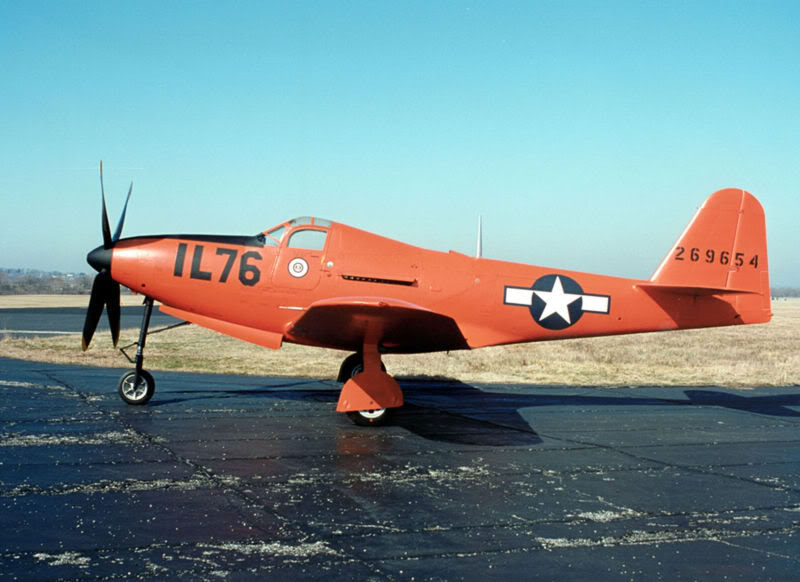
Fairchild proved to be willing to circumvent the usual Army bureaucracy to promote his ideas. Instead of working through the usual Army weapons development channels, he teamed up with academics to validate his ideas. Fortunately, the heavy losses of 1943 showed that aerial gunnery skills were lacking and Fairchild's frangible training bullets gained traction with the USAAF. He then selected the Bell P-63 Kingcobra as the target aircraft. As it was a type not used by front-line USAAF units, it was easily available. The P-63, designated RP-63, was given 1-inch thick armored glass with special armor in vulnerable areas. Sensors underneath the RP-63 registered hits and lights on the spinner and on the fuselage would light up, giving rise to the name "Pinball". 

Beginning in early 1945 RP-63 Pinballs would fly attack profiles against bombers with student gunners before they were assigned to a combat unit. A training B-17 might have 12 student gunners each having 2,000 rounds of Fairchild's special frangible ammunition to fire at the Pinballs. The Pinball pilots, flying RP-63s that were painted either dayglo orange or yellow, flew 2-3 missions a day from bases throughout the United States. Minor damage was easily repaired on the flightline but the Achilles heel of the Pinball was the wingroot air ducts that provided cooling air to the mid-fuselage mounted Allison V-1710 liquid-cooled engine. If a frangible bullet got into the duct, the fragments could damage the cooling system, resulting in an overheating engine and a mandatory deadstick landing or a bailout by the RP-63 pilot. 

A total of 300 P-63s were converted to the RP-63 Pinball configuration. Some aircraft also trained B-29 Superfortress gunners, but by 1947, the Pinball program was wound down and the last aircraft retired. Much of the early demise of the program came with the introduction of the centralized gunner control system in the Boeing B-29 Superfortress where analog systems provided the necessary lead and tracking for the gunners which used sights that remotely operated the turrets. Targets could be handed off from one gunner's sight to another and it made aerial gunnery training obsolete. The second factor in the demise of the Pinball program came with the gun-laying radar that was first introduced on the tail cannons of the Convair B-36 Peacemaker. Radar simplified tracking and accurately shooting at target aircraft. But the Pinball program lives on as an unique wartime solution that undoubtedly did its part to hasten the demise of the Axis in the Second World War.

Source: Air & Space Smithsonian, November 2010, Vol. 25, No. 5. "Just Shoot Me: In World War II, P-63 pilots had to learn to take it- and not take it personally" by James Dunaway, p50-53. RP-63 model by Scott Van Aken.

21 June 2010

The Convair Model 6: A Jumbo Before Its Time

People sometimes ask me how I decide what to feature on Aviation Trivia of the Day. I'd say that the majority of the time it's something I've come across as I'm reading one of my aviation-related books. I'm one of those sub-clinical attention-deficit types who can't finish one book before starting another. I'll quite literally have quite a handful of books that I'm rotating through at any given moment. If I run across an interesting bit that I want to feature sometime in this blog, I'll make a small dog ear at the bottom corner of the page. So yeah, I have lots of books with lots of those little lower corner dog ears. But sometimes it can come from more unconventional directions.

I'm on Twitter as @SentinelChicken and the other day I was exchanging tweets with a fellow avgeek, @flyingwithfish who has a great blog here (Flying With Fish: The Blog for Those Who Fly & Those Who Want to Fly Smarter) about an entry he had on his blog regarding double-deck jets that came before the Airbus A380. His blog entry discusses the McDonnell Douglas MD-12 and I had tweeted to him about the Convair design that combined the fuselage of the production version of the XC-99 transport with the wings, jet engines and empennage of the YB-60 which was designated the Convair Model 6. He's going to be doing a write up in his blog on my artwork, so it wanted to return the favor the best I could be crediting him with giving me the idea for today's entry.

But before I can talk about the Convair Model 6, I have to jump back a bit and talk about both the XC-99 and the YB-60 as they're both derivatives of the B-36 Peacemaker. Convair's work on the B-36 began in the midst of the Second World War as there was a concern that Great Britain would fall to the Reich and we would need strategic bombers that could reach Europe from the United States. But in parallel to the development of the B-36 there were design efforts that looked at passenger versions of the B-36. As early as May 1942 Convair had been looking at a transport version of the B-36 called the Model 37 that combined the wing, six pusher piston engines and empennage of the B-36 to a new fuselage unit. In December 1942 the USAAF signed a contract with Convair to build a single example of what was designated the XC-99 on the stipulation that the XC-99 would not divert resources from the B-36 project. Convair saw the XC-99 as a way to validate some of the design concepts of the B-36 quickly as it would not need military equipment (what's called government-furnished equipment) for the transport role.

Despite the ongoing war, Convair pitched the XC-99 as a passenger transport to the airlines, even succeeding in getting 15 orders from Pan American World Airways for what the airline was calling the "Super Clipper". Production was to begin at the end of the war and the Convair Super Clipper would have carried 204 passengers in luxury across the Atlantic.

As the B-36 was built in Fort Worth, the XC-99 would have to be built at Convair's San Diego Lindbergh Field facility. The wings and empennage were shipped to San Diego from Fort Worth and on 23 November 1947 the XC-99 made its first flight. The XB-36, by comparison, made its first flight in Fort Worth on 8 August 1945. By January 1949 the XC-99 was retrofitted with four-wheel main bogies that allowed it to use any airfield in the United States and abroad that could accommodate the production B-36. The following year it got fitted with production standard Pratt & Whitney R-4360 radial engines that were more powerful than the earlier version installed.

In its 1950 incarnation, the XC-99 could carry over 100,000 lbs of cargo or 400 fully-equipped troops, or 300 litter patients on a double deck layout. Based at Kelly AFB and operated by the San Antonio Air Materiel Depot, the XC-99 flew on operational transport missions in the United States for several years before being retired. A production version of the XC-99 proposed by Convair would have moved the flight deck to a B-36 "bubble" atop the fuselage with the nose gear installed in a bulge under the nose (similar to what you see on the Lockheed C-5 Galaxy). Moving the flight deck upward to the top deck allowed straight through loading via aft clamshell doors and a ramp and nose doors and a ramp, a feature that the USAF didn't have at the time in its transport aircraft. This production version would have had a range of 3,800 miles with a full payload. The USAF, however, decided on the Boeing C-97/KC-97 Stratofreighter and the Douglas C-124 Globemaster II for its long distance heavy airlift needs, both aircraft that paled in performance of the proposed production version of the XC-99.

Now the YB-60 is often seen as the competitor to the Boeing B-52 Stratofortress on account of having the same eight engines in the same four paired nacelles, but the USAF never conducted a true competition for the role filled by the Boeing B-52, though Douglas and Convair did work on designs to fill that role even though Boeing was set to build the replacement for the Convair B-36. In August 1950, Convair submitted an unsolicited proposal for a jet-powered, swept-wing version of the B-36 Peacemaker. As Convair intended to use many B-36 components, the USAF was sufficiently interested to order two YB-60s (the original designation being B-36G). Using many of the structural components of the B-36F, construction of the first YB-60 began in Fort Worth in the spring of 1951 and it made its first flight on 18 April 1952, only three days after the first flight of the Boeing YB-52 Stratofortress.

Although there was no formal competition between the YB-60 and the YB-52, it was quite obvious that by using B-36 components, the YB-60 was significantly cheaper than the Stratofortress. But as the Stratofortress was designed from the outset as high-speed jet intercontinental jet bomber, its performance blew the YB-60 away. The YB-52 was 100mph faster (the thick B-36-based wing of the YB-60 was one of its biggest liabilities) and it had more refined aerodynamics as the YB-60 flight test program turned up multiple stability and control deficiencies. As a result, after only 66 flight hours the USAF canceled the YB-60 program with the second YB-60 being 95% complete.

So here's where the XC-99 and the YB-60 meet. Given the parallel design efforts taking place with several key personnel in common, it was inevitable that Convair would propose an all-jet version of the C-99 production version transport. First proposed in 1950, the jet-powered C-99 combined the swept-wings and eight jet engines in paired nacelles and swept empennage of the YB-60 with the production version fuselage of the C-99. It would have been an impressive transport with both nose and aft loading cargo doors, a double deck with the upper deck being pressurized and it jet form. And this was in the early 1950s- the USAF didn't have intercontinental jet cargo capability until the first flight of the Lockheed C-141A in December 1963 and while the Starlifter would have been faster than the Convair Model 6 jet transport, it didn't have the immense load capacity, being only able to carry about 70,000 lbs compared to 100,000 lbs of the Convair Model 6. And it wouldn't be until the first flight of the Lockheed C-5A Galaxy in June 1968 that the USAF had a double deck jet transport with straight through loading via the nose and tail! The Galaxy showed the march of technological progress by being able to carry over two and a half times the payload of the Convair Model 6 at higher speeds and farther distances.

But considering the technology of the day, the Convair Model 6 wasn't out of reach as it used components from both the XC-99 and the YB-60 that were already flight proven.

Source: Cold War Peacemaker: The Story of Cowtown and the Convair B-36 by Don Pyeatt and Dennis R. Jenkins. Specialty Press, 2010, p176-191.

09 June 2010

The 1952 Carswell AFB Tornado

Prior to the arrival of the Boeing B-52 Stratofortress, the responsibility for the long-range strategic deterrent of the United States rested with the Convair B-36 Peacemaker in the 1950s. The Atlas ICBMs were still years away from becoming operations and the first Polaris submarine-launched ballistic missiles were still on the drawing boards. The other bombers of the USAF's Strategic Air Command, the Boeing B-50 Superfortress and the Boeing B-47 Stratojet, were medium range bombers that could not strike Soviet targets from the United States. Only the B-36 had the range to reach the Soviet Union and the capacity to carry any of the nuclear bombs in the US stockpile.

As the B-36 was built and flight tested in Fort Worth at Convair's mile-long plant at Carswell AFB, the first of SAC's bomb wings to receive the Peacemaker were based at Carswell. The 7th Bomb Wing was the first to put the Convair's "big stick" into service, followed by the co-located 11th Bomb Wing. With Convair right across the runway at the base, any technical problems could be readily addressed. As a result, the majority of the United States' long range striking power was concentrated in Fort Worth.

On Labor Day, 1 September 1952, many of the base personnel and flight crews had the long weekend off. Weather forecasters had predicted severe thunderstorms for North Central Texas that afternoon with estimated winds of 60mph. As few personnel were on duty, few precautions were taken other than securing the B-36 aircraft with 3/8 inch steel cables. At 6:42pm, a tornado touched down on the base perimeter and struck the B-36 flightline directly. Maintenance docks used to work on the large bombers outdoors were thrown about and the steel cables tying down the bombers snapped as the planes were thrown about by the tornado like toys. Ruptured fuel tanks spilled thousands of gallons of high octane avgas all over the ramps. The anemometer on the Carswell control tower registered sustained winds over 90mph before being torn away by the storm. As the storm subsided, operations had to be transferred to nearby Meacham Field and other bases in the Southwest.

Two-thirds of the entire B-36 Peacemaker force was either damaged or destroyed in the tornado. One aircraft was completely shattered and would have to be written off while 72 bombers on the flightline and adjoining aprons were damaged and unflyable. Fortunately there were no fatalities given the long holiday weekend. Another 10 B-36s parked at the Convair plant were also damaged. Some of the bombers were shoved on top of each other and many had lost wings, empannages, or large fuselage sections. Because of the national priority placed on the B-36 fleet, by 5:30 the next morning a repair plan was underway with 1/3 of the repairs to be carried out by SAC, 1/3 of the repair work to be done by repair teams dispatched from Kelly AFB in San Antonio (the site of one of the USAF's heavy logistics centers), and remaining 1/3 would be carried out by Convair. So urgent was the matter than a 1-page typed letter was the basis of a multi-million dollar contract for Convair for its share of the repair work. Project FIXIT returned one bomber to operational service the first week, and nine more B-36s in the second week after the tornado. In less than a month, the 7th Bomb Wing was back at full operational strength of only one B-36 had to be written off out of the 83 damaged. By the end of the month, the round-the-clock effort had the 11th Bomb Wing operational and by the first week of October, 51 more aircraft were returned to service. The last repaired B-36 returned to duty on 11 May 1953.

Having 2/3 of the B-36 force knocked out in less than 30 minutes taught SAC a lesson. Each time severe weather threatened Carswell AFB, as many B-36s as possible were flown out to other bases and would return the next day. 

Senator Lyndon B. Johnson of Texas and his Military Preparedness Committee conducted an investigation that concluded the base commanders had taken all the adequate measures proscribed at the time with an approaching storm. The investigations called for improved weather forecasting and an increase in the research of tornadic thunderstorms which over the years would not only benefit the USAF, but the general public as well.

Source: Cold War Peacemaker: The Story of Cowtown and the Convair B-36 by Dennis R. Jenkins and Don Pyeatt. Speciality Press, 2010, p149-151.