Showing posts with label B-24 Liberator. Show all posts

16 July 2015

The Unconventional Genius of Carl Norden

Carl L. Norden
After the Manhattan Project to develop the atomic bomb, the next biggest top secret defense program in the United States at the time was the development and production of the Norden bombsight. The Norden sights were used in all of the United States Army Air Forces heavy bombers (the Boeing B-17 Flying Fortress, the Consolidated B-24 Liberator, and the Boeing B-29 Superfortress) primarily and it was a Norden sight that bombardiers used to drop the atomic bombs on Hiroshima and Nagasaki that brought the Second World War to a close. Despite its crucial role in strategic bombing campaigns in both the European and Pacific Theatres, the Norden bombsight was a Navy program and every Norden sight used by the US Army Air Force had passed through the hands of Navy inspectors. How this state of affairs came to be is the story of how an unconventional but brilliant Dutchman, Carl Norden, came to be employed by the Navy prior to the start of the Second World War. 

Carl Norden was born on 23 April 1880 in Semarang, Java, in what was the Dutch East Indies (modern day Indonesia), the middle child of five siblings in a household with absent father. From a young age, his mother considered him the most reliable and responsible of his siblings- in a sense, he became the "man of the family". He had wanted to become an artist, but when his older brother decided to pursue an artistic career, Carl decided to pursue a lucrative career in order provide for his mother and his siblings, enrolling in the Federal Polytechnic Institute in Zurich, Switzerland and graduating in 1904 as a mechanical engineer. Although Dutch by birth, Norden's father was a naturalized Dutch citizen from German and Norden's own wife was from Austria. Norden's German ties dovetailed into his natural engineering and mathematical prowess- it was said that Carl Norden viewed everything in life in mechanical terms governed by mathematical formulas, the universe being nothing more than a great mechanical timepiece. After his graduation in 1904, he emigrated to the United States where he had a wealthy uncle who had made his fortune in the cotton business. Norden worked for a series of companies as a mechanical design engineer, but it was painfully obvious that he was difficult to employ as he was very much a prima donna. But there was no question of Norden's brilliant mind and after a series of employers over six years, he finally came to work for Elmer Sperry Sr. and his sons, Elmer and Lawrence at the Sperry Gyroscope Company. Norden's mechanical aptitude fit well into the work the Sperrys were doing for the Navy in developing gyroscopes to improve the accuracy of naval gunnery from moving ships. Norden's work with Sperry was invaluable for the company and Norden made many contacts within the Navy as a result. Norden tolerated Sperry as the work was interesting, but the relationship soured when, after solving the problem of gyroscopic oscillation, Norden got what he thought was an insulting $25/week raise as a reward. Norden quit and became a consulting engineer to the Navy, but it was the start of a feud between Norden and Sperry for years. Norden often dismissively told people Sperry "would patent gravity if he could" and Sperry for years tried to legally dispute many of Norden's later patents. 

In 1913, Norden set up shop near the Brooklyn Navy Yard and continued to work on the ship stabilization project for the Navy much to Sperry's chagrin. The Navy was enamored with Norden's genius and that relationship in large part protected Norden from Sperry's multiple legal challenges. With the progress on the ship stabilization project slow in coming, the Navy astutely put Norden's mind to work on other projects, starting the aerial gyroscopes for the aerial torpedo project as well as designing catapults and arresting gear for aircraft carriers. The arresting gear of the USS Lexington and USS Saratoga were designed by Norden himself on his dining room table!

At the time, the Navy was pursing a bombsight program as it felt that the best way to sink ships from the air was via high altitude level bombing. General Billy Mitchell's ship-bombing tests in the summer of 1921 against captured German warships convinced the Navy that it had to find a way to sink ships at sea. The Navy's Bureau of Ordinance (BuOrd) was responsible for the bombsight program and many different types, including some from Sperry, were tested. Officers with the Aviation Section of BuOrd came to know Carl Norden from his work on the aerial torpedo project as he had been consulted as an outside expert to evaluate Sperry's work (something which truly irritated Sperry to no end). They were impressed with the comments made in the reports and not knowing who Carl Norden was, found a report signed "Norden". A quick check of the Brooklyn telephone book and a few calls got the officers from BuOrd in touch with Norden who agreed to review the Navy's bombsight program. The gyroscopic stabilization work he had done for the ship and aerial torpedo project dovetailed neatly into the bombsight problem as Norden recommended that the bombsights be not only gyroscopically stabilized, but also connected to either an autopilot or pilot director so that during the bomb run, the bombardier was the one "flying" the aircraft. Eventually modifying existing bombsights turned out to be a failure and the BuOrd and Norden decided to start from scratch and create a whole new bombsight that would launch the Norden bombsight into aviation history. 

That's not to say that Norden's genius resulted in success. For most of the 1920s, many of the literally handcrafted Norden sights had dismal performance. But Norden wasn't one to give up and the Navy was an incredibly accommodating employer. Well aware of Norden's personality- they nicknamed him "Old Man Dynamite", they gave him tremendous latitude as long as he kept delivering results in the form of progressive improvements to his bombsight designs. Unlike most engineers, Norden did his own drafting. He didn't have an extensive engineering library, he preferred to work with his slide rule, a set of engineering tables and a few select references. He often stayed at his mother's home in Zurich, Switzerland, to ponder mechanical problems and develop solutions. His drawings and correspondence were then delivered to the US Navy by diplomatic pouch from US embassy in Switzerland. The State Department wasn't keen on this but high level pressure from the US Navy encouraged diplomatic officials to be as accommodating to "Old Man Dynamite" as possible. Sometimes it was his family he sent to Switzerland so he could be alone to solve some problems back in New York. Also unique to the Navy's relationship with Norden was that any patents were held by the Navy and classified as top secret. In this way, not only was Norden shielded from Sperry's legal challenges, but it also meant that the Navy didn't have to follow the prescribed competitive bidding rules to pay Norden for his work. Many of Norden's patents sponsored by the Navy from the 1920s and 1930s weren't even declassified until 1947! In contrast to the US Army Air Corps (forerunner of the US Army Air Forces) who held open competitive bidding in its own bombsight program and trialled bombsights from several different manufacturers, the Navy only did business with Norden and Norden alone. In fact, the Navy was Norden's only client! 


Theodore Barth at a circus held for Norden employees
As work on the Norden sights continued in the 1920s, BuOrd recommended that Norden partner up with an engineer to start moving the bombsight project towards mass production. Knowing Norden well, the Navy partnered him up with a former Army colonel and engineer by the name of Theodore Barth and it was the start of a very close relationship between the two men for many years. Norden's own children regarded Barth as a secondary father figure in their lives, so close was Barth to Norden. It was Barth who was tasked by the Navy to take Norden's designs and put them into production. Compared to Norden, Barth was very personable and possessed quite a bit of business acumen as well- Norden may have been the brains of the operation but it was Barth who made everything work and kept everyone happy. During the Second World War, Barth took it as his job to take care of all of the employees that were building bombsights. He often gave away baseball tickets and even rented out Madison Square Garden for a circus just for Norden's employees. 

From the time Norden was contacted by the Aviation Section of the Bureau of Ordinance to the delivery of the first production bombsight to the fleet, the Norden Mark XI, nine years had elapsed. During those nine years Norden progressively refined the design of what was essentially a clocklike analog computer that was gyroscopically stabilized and linked to the autopilot. The Navy, though, did hedge its bets just a bit- during that time it had contracted with General Electric for a back up bombsight design called "Scheme B" or the Mark XIII. After three years, the Navy found the GE bombsight was woefully inferior to Norden's designs and canceled "Scheme B". 

Norden M-1 bombsight
By the early 1930s, the US Army Air Corps became aware of the Norden program and was keen to get its hands on the bombsights for its own testing. The head of the Army Air Corps, General Henry "Hap" Arnold (who would head the USAAF during the Second World War), was shocked to hear of the working arrangement between the Navy's BuOrd and Carl Norden, from Norden not even being a US citizen to the fact that Norden did a lot of his work abroad in Switzerland and then sent drawings back via diplomatic couriers to New York City for Theodore Barth and Navy officials to review. The Navy wasn't about to change the way it did business with Carl Norden to assuage General Arnold's concerns, though. It basically came down to something along the lines "If you want Norden bombsights for Army bombers, this is the arrangement you have to live with!". As a modest concession, though, the Navy had the FBI provide a security detail for Norden and agents were planted in Norden's production facilities in New York City to root out any foreign spies. At all times, at least two armed agents were with Norden at all times. There is an apocryphal story that when Norden wasn't getting his way with the Navy, he'd insinuate he'd leave the United States and go to work for the British. He would later remark it was empty threat "As no self-respecting Dutchman would ever work for the British!"

By 1928, Norden was at work at a massive improvement to the Mark XI sight called the Mark XV. He delivered the Mark XV prototype to BuOrd in 1930 and it was this sight that pretty much ended the GE alternate bombsight program. The bombsights that came from the Mark XV design were known as the Norden M-series sights and those would become standard on American heavy bombers.  By this point, however, the Navy was drifting away from relying on high altitude level bombing at sea as dive bombing was explored by units in the fleet. But the arrangements between the Navy and Carl Norden remained with his New York City factory essentially being a Navy factory! By 1934, Norden's bombsights became the standard for the Army Air Corps, first being installed on Martin B-10s. It's estimated that approximately $1.5 billion was spent on the development and production of Norden bombsights. 

Carl Norden was passed away in 1965 in his beloved Switzerland. His company lived on as Norden Systems to be acquired by Westinghouse which was in turn acquired by Northrop Grumman. Norden and Barth also set up a second company called Barden to manufacture bombsight components- Barden is still  around today, fabricating ball bearings for a variety of industries including aerospace. Carl Norden was inducted into the National Aviation Hall of Fame in 1994. 

Source: America's Pursuit of Precision Bombing, 1910-1945 by Stephen L. McFarland. Smithsonian Institution Press, 1995, pp 45-76. Photos: Norden Systems Division via Stephen L. McFarland's book, Wikipedia

24 February 2012

The 24th Combat Mapping Squadron: Unsung Heroes of the Pacific War


Squadron emblem of the 24th Combat Mapping Squadron
While much has been written about the superiority of the Consolidated B-24 Liberator versus the Boeing B-17 Flying Fortress in the Pacific Theater during the Second World War (in short, it could carry more a longer range and at higher speeds than the B-17), there is one role that the B-24 played in the Pacific that still remains relatively unknown to most, that of combat mapping. The missions flown in particular by the 24th Combat Mapping Squadron in the China-Burma-India theater were of tremendous contribution to the overall war effort even though the crews of the 24th CMS fought their battles with rolls of film rather than bombs. 

On 2 September 1942, the 24th Combat Mapping Squadron was established as the 24th Photo Mapping Squadron at Petersen Field in Colorado Springs, Colorado. They were subsequently moved to Will Rogers Field in Oklahoma City to operate the reconnaissance variant of the Consolidated B-24 Liberator which was designated the F-7. Prior to the creation of an independent United States Air Force, the "F" designator was used for photo reconnaissance aircraft while the "P" (for Pursuit) was used for fighter aircraft. The first F-7s arrived in January 1943 as basic conversions of the B-24D Liberator which removed all bombing equipment and replaced with eleven cameras. All the defensive armament of the Liberator was retained. Most of the conversions to F-7s were done at Lowry Army Air Field in Denver, but additional examples were also converted by Northwest Orient Airlines at their Minneapolis maintenance base. Most of what the 24th did in Oklahoma City was the training of crews to prepare for deployment to the Pacific. Unlike other reconnaissance crews, though, the 24th CMS would be tasked with providing detailed aerial photography of the China-Burma-India area for the creation of detailed navigation maps as well as other types of maps needed for the war effort. 

The unit arrived at Guskhara, India in January 1944 with improved versions of the F-7 which were designated F-7A. The F-7A photo recon Liberator was based on the nose-turret equipped B-24J Liberator. A trimetrogon arrangement of cameras were mounted in the nose (an additional window was fitted in the lower side of the nose for the lateral cameras of the trimetrogon cameras) and a pair of vertical cameras for stereo-photography were fitted in the aft bomb bay (a pair of windows were fitted in the aft bomb bay). The additional windows were the identifying features of the F-7A. The forward bomb bay carried additional fuel tanks while the aft bay was sealed shut to provide a compartment for the camera technicians and environmental systems that kept the cameras and long rolls of film at a constant temperature. Again, like the original F-7 variant, the full defensive armament was retained. 

Developing the photos from a mapping mission.
The first missions to map the CBI area commenced in March 1944 in support of the US Army Air Forces' Tenth and Fourteenth Air Forces- it was the Fourteenth Air Force under General Claire Chennault that replaced the original American Volunteer Group which was also known as the "Flying Tigers". In addition, the 24th CMS also flew missions mapping Burma in support of the British 14th Army. While provisionally based in India, the squadron sent detachments of aircraft to operate from forward bases in China as well as more remote parts of India closer to the Burmese border. At the time, the only heavy bomber group based in China was the 308th Bombardment Group which flew B-24Js. The only logistical route for the support of the war effort in China came via the air route over the Himalayas called "The Hump". Frequently the B-24Js of the 308th BG had to be stripped of armament and fly their own bombs and fuel supplies from India over "Hump" the bases in China. It usually took three "Hump" missions by a single B-24J to transport the bombs and fuel needed for it to fly a single mission from China against Japanese targets all along the Pacific Coast of China, Vietnam, and Malaya. The photo-mapping F-7As of the 24th CMS also flew their own transport missions over the "Hump", with 182 "Hump" crossings made in 1944, often at well above maximum gross takeoff weight. Six F-7As were lost on these transport missions alone in 1944. 

Large areas of China lacked any maps at all, much to the frustration of the 308th BG. Many of the missions to map the interior of China were well over 2,500 miles in length. In addition, detailed mapping flights were made over Malaya (modern-day Malaysia), Vietnam, Thailand, and Burma. During the summer of 1944 the Japanese went on the offensive in central China to eliminate the forward bases of the 308th BG and numerous overflights of territory being contested were made to provide battlefield commanders accurate maps to blunt the Japanese offensive. Detailed maps were also made from overflights of all the Pacific ports of China that were being used by the Japanese to bring supplies to their forces in area. A less hazardous mission involved photo-mapping the entire supply routes from Allied bases in India over the "Hump" to Chinese forward bases. Air Transport Command's pilots benefited from a detailed map that covered a 50-mile wide strip from Calcutta all the way to Kunming in central China. 
24th CMS Consolidated F-7A Liberator. Note the camera windows.

By 1945 the 24th CMS had mapped 455,000 square miles of territory in India, Burma, Thailand, and Malaya. An additional 435,000 square miles of China were also mapped. The greatest challenge in the area for the 24th CMS wasn't Japanese resistance as the F-7As operating singly or in pairs were usually left alone but the weather. An astounding 50% of the missions flown were unsuccessful because of bad weather in the areas to be mapped!

Just prior to the end of the Pacific War the 24th CMS had a forward detachment also based in Clark AB in the Philippines to assist with mapping of that nation as the last of the Japanese resistance was mopped up. Following the Japanese surrender, another detachment was established in Sydney, Australia, to assist the Australians with the mapping of the continent which lasted well into 1946. By that point, the unit was converting to the photo reconnaissance version of the Boeing B-29 Superfortress, the F-13A. The unit returned stateside in late 1947 to Hamilton AFB in California before being disbanded in 1953 at Lake Charles AFB, Louisiana. 

Sources: B-24 Liberator Units of the CBI (Osprey Combat Aircraft No. 87) by Edward M. Young. Osprey Books, 2011, p88-89. Combat WWII Squadrons of the United States Air Force: The Official Military Record of Every Active Squadron, edited by M. Maurer and the USAF Historical Division. Smithmark Publishers, 1992, p126-127. Photos: University of Chicago, Mark Styling (illustrator for the Osprey title).

20 September 2010

The Bell RP-63 Pinball

As the strategic bombing campaign over Germany built up in the spring of 1943, losses over the skies of the Reich began to mount as mission momentum increased over the course of that summer. While the ever-present flak was a significant threat to the B-17 Flying Fortresses and B-24 Liberators of the US Eighth Air Force based in the UK, it was the fighters of the Luftwaffe that were mauling the formations. From June into the autumn, losses were mounting and doubts were starting to be raised on the operational wisdom of daylight strategic bombing. The breaking point came on 14 October 1943 with the second attack on the ball-bearing plants at Schweinfurt, Germany. Already bruised from a vicious mauling at the hands of the Luftwaffe on the first raid on the Scweinfurt (which was attacked along with Regensburg on 17 August 1943 with the loss of 60 bombers), of the 291 B-17s sent on the mission, 77 bombers were lost and 122 were damaged. The day was named "Black Thursday" for having the highest number of crewmen lost on a single USAAF mission- 590 killed, 65 taken prisoner. Deep penetration missions of Germany were suspended until February 1944 when the long-range P-51 Mustangs arrived. 

But warnings were raised as early as 1942 stateside when Major Cameron Fairchild of the USAAF sought ways to improve the aerial gunnery skills of the men who manned the defensive positions on the heavy bombers. The techniques of training at the time were fairly basic, ranging from skeet shooting to firing at towed targets. Fairchild surmised the best aerial gunnery training would consist of being able to fire live ammunition at an actual fighter aircraft. His first task was to develop a bullet that had the same characteristics as a 30- or 50-caliber round but would splinter harmlessly on impact. Working with researchers at Duke University, the University of Michigan, and the Bakelite Corporation (one of the pioneering manufacturers of plastics), Fairchild and his team came up with a frangible bullet that was weighted with powdered lead to give it the proper weight and density. 

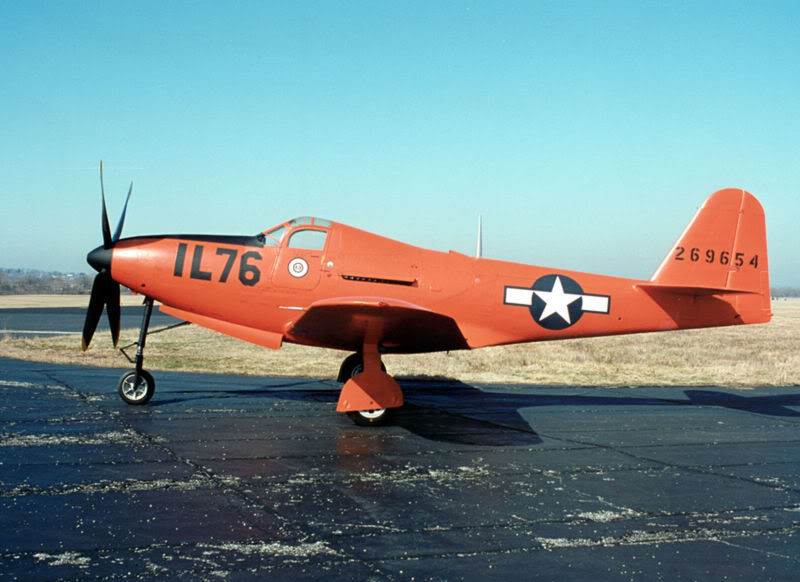
Fairchild proved to be willing to circumvent the usual Army bureaucracy to promote his ideas. Instead of working through the usual Army weapons development channels, he teamed up with academics to validate his ideas. Fortunately, the heavy losses of 1943 showed that aerial gunnery skills were lacking and Fairchild's frangible training bullets gained traction with the USAAF. He then selected the Bell P-63 Kingcobra as the target aircraft. As it was a type not used by front-line USAAF units, it was easily available. The P-63, designated RP-63, was given 1-inch thick armored glass with special armor in vulnerable areas. Sensors underneath the RP-63 registered hits and lights on the spinner and on the fuselage would light up, giving rise to the name "Pinball". 

Beginning in early 1945 RP-63 Pinballs would fly attack profiles against bombers with student gunners before they were assigned to a combat unit. A training B-17 might have 12 student gunners each having 2,000 rounds of Fairchild's special frangible ammunition to fire at the Pinballs. The Pinball pilots, flying RP-63s that were painted either dayglo orange or yellow, flew 2-3 missions a day from bases throughout the United States. Minor damage was easily repaired on the flightline but the Achilles heel of the Pinball was the wingroot air ducts that provided cooling air to the mid-fuselage mounted Allison V-1710 liquid-cooled engine. If a frangible bullet got into the duct, the fragments could damage the cooling system, resulting in an overheating engine and a mandatory deadstick landing or a bailout by the RP-63 pilot. 

A total of 300 P-63s were converted to the RP-63 Pinball configuration. Some aircraft also trained B-29 Superfortress gunners, but by 1947, the Pinball program was wound down and the last aircraft retired. Much of the early demise of the program came with the introduction of the centralized gunner control system in the Boeing B-29 Superfortress where analog systems provided the necessary lead and tracking for the gunners which used sights that remotely operated the turrets. Targets could be handed off from one gunner's sight to another and it made aerial gunnery training obsolete. The second factor in the demise of the Pinball program came with the gun-laying radar that was first introduced on the tail cannons of the Convair B-36 Peacemaker. Radar simplified tracking and accurately shooting at target aircraft. But the Pinball program lives on as an unique wartime solution that undoubtedly did its part to hasten the demise of the Axis in the Second World War.

Source: Air & Space Smithsonian, November 2010, Vol. 25, No. 5. "Just Shoot Me: In World War II, P-63 pilots had to learn to take it- and not take it personally" by James Dunaway, p50-53. RP-63 model by Scott Van Aken.

14 February 2010


When Colonel William J. Donovan formed the Office of Strategic Services (OSS), the CIA's antecedent organization in World War II, one of his first acts was to create a research and development branch headed by noted chemist Dr. Stanley Lovell. Lovell's R&D section of the OSS was composed of engineers, chemists and other technical professions he recruited from American industry and academia. Their purpose was to develop the tools and weapons not just for espionage but for unconventional warfare and weaponry.

One of the projects the OSS examined was suggested by a civilian dentist, Lytle Adams. Project X-Ray sprang from Adams' suggestion that small incendiary device could be attached to a bat. These bats would be released over Japan and the bats would roost in inaccessible places on buildings that were predominantly of wood construction. After a time-delay, the incendiary would go off, and fires would break out all over Japanese cities.

Louis Frieser, the inventor of napalm, created a one ounce timed-delay incendiary that was attached to the Mexican free-tailed bat, a prolific bat species found throughout the American Southwest. The bat bomb itself had forty trays, each holding 26 bats. Dropped from at least 5,000 feet, the bomb descended by parachute before the casing opened at 1,000 feet, dispersing the bats. By dropping the bombs at dawn, the bats would instinctively seek shelter in buildings. It was estimated that 10 Consolidated B-24 Liberators each carrying 100 bat bombs staging from Alaska could release over 1 million bats over the industrial cities around Tokyo and Osaka.

Tests conducted at Carlsbad Army Air Field in New Mexico resulted in the burning down (unintentionally) of several new hangars at the base. Further tests validated the concept but by 1944 the project was canceled it as it wouldn't be ready by 1945.

Source: Spycraft- The Secret History of the CIA's Spytechs, from Communism to Al-Qaeda by Robert Wallace and H. Keith Melton. Plume Books, 2009, 11-13.

12 February 2010

The First Serious Proposal for Air Refueling on a Combat Mission


The first serious proposal to use air-to-air refueling in a combat mission came in early 1942 just weeks after the Japanese attack on Pearl Harbor. The United States wanted to strike back as expeditiously possible at Japan and early efforts focused on the US Army Air Corps inviting the British firm Flight Refueling Ltd to send some engineering staff to Wright Field in Dayton, Ohio, to discuss converting the Consolidated B-24 Liberator into a tanker and the Boeing B-17 Flying Fortress into a receiver aircraft. The USAAC (soon to become the US Army Air Forces) ordered on set of inflight refueling equipment similar to what Flight Refueling used in its 1939 trans-Atlantic trials.

With the assistance of Flight Refueling engineers, Pennsylvania Central Airlines modified a B-24 and a B-17 with the refueling equipment (PCA would later be renamed Capital Air Lines which was then absorbed by United Air Lines in 1961). By April 1943 the first flight trials were conducted at Eglin Field in Florida. By this time, however, the Doolittle raid on Tokyo had already taken place but the USAAF wanted to further examine the feasibility of air refueling in strategic bombing operations.

Using Flight Refueling's grapple method, the B-17 receiver trailed a hauling line with a weight and hook at the end. The B-24 tanker approached from the side and below and deployed a contact line that crossed over the hauling line of the B-17 and engaged the hook. The B-24 tanker then moved above the B-17, pulling in the hauling line with the contact line. The refueling hose was then attached to the hauling line and it was then pulled down to the B-17 which had a refueling receptacle in the tail gunner's position and refueling commenced.

At the conclusion of the tests, the B-17's range with a full bomb load could be extended to 5,800 miles (compared to its standard 2,000 mile range). Plans were conceived to have B-17s based in the Aleutian Islands and strike Japan with air-refueling, proceed on to bases in China and then reverse the process. However, the time needed convert and train sufficient bombers and crews to sustain a strategic bombing campaign on Japan were seen as too long with Boeing getting ready to produce the B-29 Superfortress and Admiral Nimitz's successes in the Central Pacific in securing possible islands to use as bomber bases.

Source: History of Air-to-Air Refueling by Richard M. Tanner, MBE. Pen & Sword Books, 2006, p24.

02 February 2010


Initially deemed unsuitable as night bombers by the RAF, the first Consolidated LB-30 Liberators were found with their long range to be ideal in the transport role. In mid-1941 the North Atlantic Return Ferry Service began to bring RAF flight crews to Canada where they would pick up US Lend-Lease aircraft to fly back to Europe. As a result, the Liberator was the first aircraft to make the North Atlantic crossing carrying passengers on a regular service. On 24 September 1941 BOAC took over the North Atlantic services from the RAF and also took on the Liberator transports.

The BOAC Liberators wore either civil registrations or RAF roundels but could be identified by the Speedbird logo on the nose of the aircraft. Flights connected Prestwick with St-Hubert in Quebec via Gander, Newfoundland. In January 1942 the first BOAC Liberators started passenger services to Cairo (via North Africa) and in the following year passenger services extended to Moscow (via North Africa and Iran to avoid occupied Europe).

By 1947 the RAF had already withdrawn its own Liberators from service but BOAC continued use of the Liberator in cargo services London and Montreal via Prestwick and Gander. From 4 February to 28 May 1948 BOAC inaugurated nonstop Liberator service between London and Montreal using inflight air-refueling. Flight Refueling Limited, an early pioneer in aerial refueling, purchased four Avro Lancastrians from Trans-Canada Airlines and converted them into refueling tankers. Two of them were based in Shannon, Ireland, and the other two were based in Newfoundland. The Liberators flying eastbound needed only a single refueling usually about 200 miles east of Gander. Flying westbound, two refuelings were needed to fly against prevailing winds- the first one 200 miles west of Shannon and the second one in the vicinity of Goose Bay, Labrador.

Of forty-five refuelings, only three were aborted- one due to radar and heating problems in the tanker, one due to fuel transfer problems and a third one due to a nervous BOAC captain who refused to carry out the aerial rendezvous! Despite the success of the trials and Flight Refueling's attempt to convince BOAC that aerial refueling was feasible for civilian flights, BOAC instead opted to use Lockheed Constellations and Boeing Stratocruisers to carry out nonstop North Atlantic services.

Source: International Air Power Review, Volume 15. AIRtime Publishing, 2005, "RAF Liberators at War- Part 1: UK-based Operations" by Jon Lake, p160-161, 172-173.