Showing posts with label P-63 Kingcobra. Show all posts

19 December 2011

The Bell L-39 Swept-Wing Demonstrator


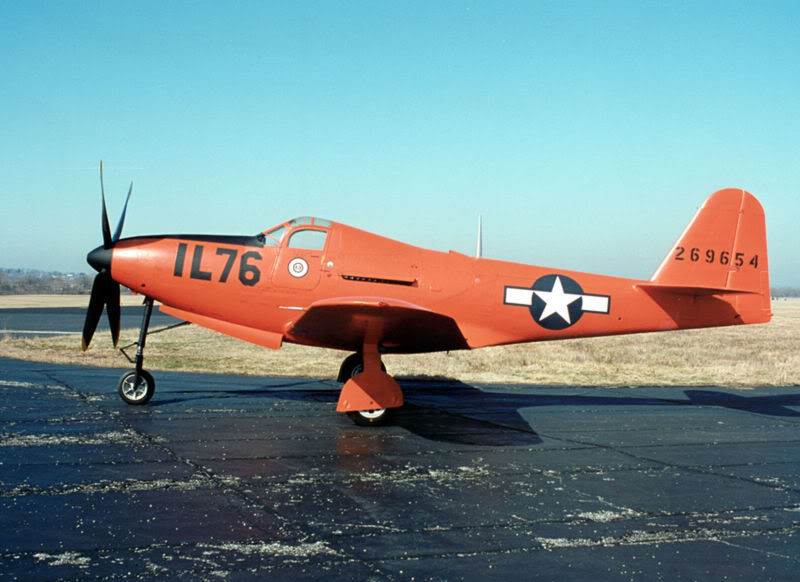
The Bell L-39 making a simulated carrier approach.
Following the end of the Second World War, captured German aerodynamic research had indicated the high-speed benefits of swept wings and many designs under development in the mid to late 1940s were revised to incorporate swept wings- two such examples being the North American F-86 Sabre and the Boeing B-47 Stratojet. While the USAF might have been enthusiastic about the benefits of swept wings, the US Navy still had its reservations- the Bureau of Aeronautics (BuAer), the Navy organization tasked with the development and support of naval aircraft, had concerns about the low-speed handling characteristics of swept wings as it was this particular flight regime that was critical in flight operations aboard aircraft carriers. While there was no questioning the high-speed benefits, the Navy didn't have the luxury of long runways to land at high speeds. To determine the scope of the problem, BuAer solicited bids from industry for a swept-wing flying demonstrator to explore the low-speed handling qualities of swept wings. Grumman tendered two proposals, one based on a modified F4F Wildcat as well as an all new aircraft that would have allowed wings of differing sweep to attached to the fuselage. Bell submitted a modification of its P-63 Kingcobra which won the contract as it offered lower development costs using two P-63 aircraft. The aircraft would be designated L-39. In those days, the Navy designated its research aircraft with a letter denoting the manufacturer followed by the manufacturer's model number- as exemplified by the more well-known D-558 Skystreak and later Skyrocket- "D" for Douglas, Model 558. In the case of the L-39, "L" was Bell Aircraft's letter designation and the swept wing demonstrator had the company designation Model 39. The design had really only a tangential relationship to the P-39 Airacobra (more on this in a bit). 

The wings were basically P-63 Kingcobra outer wing panels that were modified to be swept to 35 degrees and attached to an unswept center stub section. This was done for aerodynamic balance purposes. The wings were further modified with slats which could be positioned before flight either open or closed. Because of the wing modifications, the landing gear was non-retractable, but since BuAer was more interested in low speed landing, this was of no consequence. Two L-39s were built, differing only in the size of the slats.

The swept outer panels attached to an unswept center section.
The first L-39 was ready to fly only 10 weeks after the go-ahead from the Navy and made its first flight on 23 April 1946. The initial set of flight tests showed some handling issues that were easily resolved with further modification to the first aircraft- namely a fuselage extension aft of the wing to increase the moment arm of the tailplane to provide more pitch authority, a ventral fin for stability, and to shift the center of gravity rearward more, the original four-bladed P-63 propeller was replaced with a lighter three-bladed unit from a P-39 Airacobra (and thus the only real link between the P-39 and the L-39). The second L-39 demonstrator was completed with the additional modifications and joined the flight test program.

It was quickly determined that the swept wing with the slats closed possessed entirely unacceptable stall characteristics- namely it was abrupt and caused the aircraft to roll to one side. However, if the wing were slatted, then the stall characteristics become acceptable. Simulated carrier approaches and landings were made by both BuAer test pilots and even Corky Meyer, Grumman's chief test pilot (as Grumman was in the process of designing swept wing aircraft for the Navy). Handling and stall characteristics in the low speed regime around the carrier were quickly determined to not be an issue as long as the swept wing were slatted and the L-39 flight test program concluded in August 1946.

Close up of the L-39's wing slats.
One issue that did come up during the L-39 test program was that swept wings needed a responsive power source in the carrier landing pattern. On aircraft there is a relationship between power required for flight and airspeed. As the airspeed decreases, the power needed also decreases, but it then reaches a point due to drag that the power needed starts to go up even as the airspeed decreases. This is called the "back side" of the curve. In carrier aircraft, they are flown on this backside because the approach to the deck must be at as low as a speed is possible. On a propeller-driven aircraft, power can be immediately applied to halt the aircraft from settling in the approach and striking the ramp. But swept wings had a steeper "back side" and early jet engines took time to spool up. And it would be jet engine development that would later dog the Navy's aircraft programs in the 1950s. But more on that in a later post!

Source: U.S. Naval Air Superiority- Development of Shipborne Jet Fighters 1943-1962 by Tommy H. Thompson. Specialty Press, 2008, p69-73.

20 September 2010

The Bell RP-63 Pinball

As the strategic bombing campaign over Germany built up in the spring of 1943, losses over the skies of the Reich began to mount as mission momentum increased over the course of that summer. While the ever-present flak was a significant threat to the B-17 Flying Fortresses and B-24 Liberators of the US Eighth Air Force based in the UK, it was the fighters of the Luftwaffe that were mauling the formations. From June into the autumn, losses were mounting and doubts were starting to be raised on the operational wisdom of daylight strategic bombing. The breaking point came on 14 October 1943 with the second attack on the ball-bearing plants at Schweinfurt, Germany. Already bruised from a vicious mauling at the hands of the Luftwaffe on the first raid on the Scweinfurt (which was attacked along with Regensburg on 17 August 1943 with the loss of 60 bombers), of the 291 B-17s sent on the mission, 77 bombers were lost and 122 were damaged. The day was named "Black Thursday" for having the highest number of crewmen lost on a single USAAF mission- 590 killed, 65 taken prisoner. Deep penetration missions of Germany were suspended until February 1944 when the long-range P-51 Mustangs arrived. 

But warnings were raised as early as 1942 stateside when Major Cameron Fairchild of the USAAF sought ways to improve the aerial gunnery skills of the men who manned the defensive positions on the heavy bombers. The techniques of training at the time were fairly basic, ranging from skeet shooting to firing at towed targets. Fairchild surmised the best aerial gunnery training would consist of being able to fire live ammunition at an actual fighter aircraft. His first task was to develop a bullet that had the same characteristics as a 30- or 50-caliber round but would splinter harmlessly on impact. Working with researchers at Duke University, the University of Michigan, and the Bakelite Corporation (one of the pioneering manufacturers of plastics), Fairchild and his team came up with a frangible bullet that was weighted with powdered lead to give it the proper weight and density. 

Fairchild proved to be willing to circumvent the usual Army bureaucracy to promote his ideas. Instead of working through the usual Army weapons development channels, he teamed up with academics to validate his ideas. Fortunately, the heavy losses of 1943 showed that aerial gunnery skills were lacking and Fairchild's frangible training bullets gained traction with the USAAF. He then selected the Bell P-63 Kingcobra as the target aircraft. As it was a type not used by front-line USAAF units, it was easily available. The P-63, designated RP-63, was given 1-inch thick armored glass with special armor in vulnerable areas. Sensors underneath the RP-63 registered hits and lights on the spinner and on the fuselage would light up, giving rise to the name "Pinball". 

Beginning in early 1945 RP-63 Pinballs would fly attack profiles against bombers with student gunners before they were assigned to a combat unit. A training B-17 might have 12 student gunners each having 2,000 rounds of Fairchild's special frangible ammunition to fire at the Pinballs. The Pinball pilots, flying RP-63s that were painted either dayglo orange or yellow, flew 2-3 missions a day from bases throughout the United States. Minor damage was easily repaired on the flightline but the Achilles heel of the Pinball was the wingroot air ducts that provided cooling air to the mid-fuselage mounted Allison V-1710 liquid-cooled engine. If a frangible bullet got into the duct, the fragments could damage the cooling system, resulting in an overheating engine and a mandatory deadstick landing or a bailout by the RP-63 pilot. 

A total of 300 P-63s were converted to the RP-63 Pinball configuration. Some aircraft also trained B-29 Superfortress gunners, but by 1947, the Pinball program was wound down and the last aircraft retired. Much of the early demise of the program came with the introduction of the centralized gunner control system in the Boeing B-29 Superfortress where analog systems provided the necessary lead and tracking for the gunners which used sights that remotely operated the turrets. Targets could be handed off from one gunner's sight to another and it made aerial gunnery training obsolete. The second factor in the demise of the Pinball program came with the gun-laying radar that was first introduced on the tail cannons of the Convair B-36 Peacemaker. Radar simplified tracking and accurately shooting at target aircraft. But the Pinball program lives on as an unique wartime solution that undoubtedly did its part to hasten the demise of the Axis in the Second World War.

Source: Air & Space Smithsonian, November 2010, Vol. 25, No. 5. "Just Shoot Me: In World War II, P-63 pilots had to learn to take it- and not take it personally" by James Dunaway, p50-53. RP-63 model by Scott Van Aken.