Showing posts with label ICBM. Show all posts

23 January 2016

What Your Kitchen Refrigerator and Ballistic Missiles Have in Common: Freon


While liquid-fueled rocket engines have been the mainstay for the satellite launch industry, the long road of technological development in solid-fuel rockets have also benefited the aerospace industry. Often times unique solutions were needed in the development of solid-fuel rockets. One of the more unusual ones was the use of liquid freon to direct the exhaust flame from solid-fueled rockets. That's right. Liquid. Freon. How? I'll get to that.

Minuteman II test launch
(National Park Service/Minuteman Missile NHS)
In the 1950s the conventional wisdom in ICBM development was that only liquid-fueled engines had the power to lift the heavy nuclear warheads of the day. The two main ICBMs in development, the Atlas and the Titan, used liquid-fueled engines. But the US Navy, seeking to put ICBMs on nuclear submarines as a sea-based strategic deterrent, considered liquid-fuels on a submarine wholly impractical and not just for safety reasons. As a result, the engineers who were developing the Polaris SLBM focused their efforts on solid-fuel rocket motors for the missile. They were storable and could be quickly fired. In addition, with enough right mix of solid propellants, the missile could be much smaller than a comparable liquid-fueled missile.

The advantages of a storable propellant and rapidity of launch made solid-fuel an attractive option for a land-based ICBM as well. In the US Air Force, General Bernard Schriever was in charge of the Air Force's ICBM development effort as the head of the Western Development Division. While he initially believed that liquid-fueled engines were the only way to power an operational ICBM, he was ably convinced by several of his engineers to look at solid-fuels as an alternative. That tangent then took on an important priority equal to that of the Atlas and Titan programs, becoming the Minuteman ICBM which was developed in the same time frame as the Navy's Polaris missile. The two weapons shared many similar characteristics due to their solid-fuel rocket engines. The first variant of the Minuteman, the LGM-30A Minuteman I, became operational at Malmstrom AFB in Montana in 1962. 
First SLBM launch, 23 July 1960.
Polaris A1 from the USS George Washington
(US Navy)
The first solid rockets used tabs that jutted into the exhaust stream to deflect the plume for directional control. It was the simplest system but to provide effective control and deflection, the tabs had to be of a size that inevitably cut into the exhaust stream's total velocity. The next solution was what the Polaris team called "jetevators". The exhaust cone of the solid rocket had an extension at the bottom of the cone that was in effect, a gimbaled extension of the skirt (rather than moving the whole nozzle assembly) and small actuators moved the whole extension. Jetevators were used on the first versions of the Polaris SLBM, the A1 and A2 variants. The main disadvantage of jetevators was they added technical complexity to the solid rocket motor as well as weight. Small jetevators could only provide slight corrections but to provide more significant directional control, larger and heavier jetevators would be needed.

Both the early versions of Polaris and Minuteman used jetevators on each of the three stages of the missiles, with the first and second stages of both missiles having four nozzles that could be differentially vectored to provide control. By 1962, however, the next versions of the missiles were already in development- for Polaris it was the A3 version (third version) and for the Minuteman it was the Minuteman II (second version, obviously). In both missiles a range increase was desired and one way to get it was to lighten the missile itself. For both new versions, the second stage switched from four nozzles with jetevators to a single nozzle that used what was called "liquid injection thrust vectoring control". For both the LGM-30B Minuteman II and the UGM-27C Polaris A3, a bigger second stage with the new liquid injection thrust control got the range increases needed. 

1964 patent diagram for liquid
injection thrust vectoring control.
(Google Patents)
Around the perimeter of the nozzle about 1/2 the way up were a series of four ports that angled slightly upward. Liquid freon was injected into one of the ports and as it did, it created a shockwave in the nozzle that pushed the exhaust stream in a direction up to 7 to 10 degress opposite from the port the freon entered. The freon didn't react with the hot plume, it merely created a thermal shockwave that pushed the plume one direction. By injecting freon into the various ports, directional control could be achieved for a lot less weight than traditional actuator-driven control mechanisms. 

On the Minuteman II, the second stage carried 262 pounds of freon in a rubber bladder to use for thrust vectoring. The Minuteman II and Polaris A3 weren't the first missiles to use this novel method of control. That honor goes to the Lance short-range battlefield missile that was used by the US Army until the 1960s. The knowledge gained from the Minuteman II and Polaris A3 in liquid injection thrust vectoring control would be used to its fullest on the large solid rocket boosters used on the Titan III and Titan IV launchers, long the mainstay of US expendable heavy-lift vehicles. Both boosters on the Titan launchers used liquid injection thrust vectoring control. If you look at a picture of a Titan III/IV at launch, you'll notice a small external tank attached to the core rocket's base, one for each booster. That's the reservoir for the liquids used for the thrust vectoring system of the solid rocket boosters.
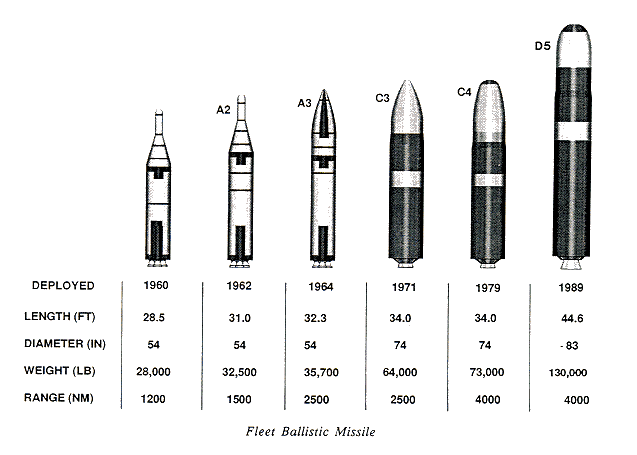
From left to right: Polaris A1, Polaris A2, Polaris A3, Poseidon C3, Poseidon C4, Trident D5
(Federation of American Scientists)
The Polaris was superseded in the Navy's strategic deterrent by the Poseidon, which was followed by  the current missile, the Trident. The Minuteman II was retired from service and the land-based ICBM deterrent for the United States relies on the Minuteman III.

Further reading: 

Martin, the Titan I and the Titan II Ballistic Missiles
One of the Most Important Missions of the Douglas C-133 Cargomaster: Transporting ICBMs


Source: To Reach the High Frontier- A History of US Launch Vehicles, edited by Roger D. Launius and Dennis Jenkins. The University Press of Kentucky, 2002, p262-266.

03 January 2016

Martin, the Titan I, and the Titan II Ballistic Missiles

Titan I ICBM elevated out of its silo for laugh
(USAF Museum)
When George M. Bunker took over the reins of Martin Aircraft from Glenn Martin in 1952, Bunker wanted to diversify Martin which up to that point had produced only aircraft. With an able group of lead engineers that Glenn Martin had literally hand picked in the years prior to his retirement from his company, Bunker moved some of Martin's engineering and research efforts into the rocket and missile arena that bore first fruit with the Viking research rocket and the Vanguard light satellite launcher built for the Navy. While many in the growing rocket and missile division were focusing their efforts on the Vanguard program, it was Jess Sweetser, Martin's VP for Sales and Requirements, who pushed the company to bid for the second USAF ICBM contract. At the time, General Bernard Schriever was heading the Western Development Division (WDD) in Los Angeles which directed the ICBM effort that started off with the Atlas ICBM built by Convair. Schriever wanted a second ICBM system fielded as a backup to the Atlas and the WDD issued a requirement that spelled out the range, guidance and throw weight (the payload of the missile, which was the nuclear warhead). Left up to the contractors would be the missile configuration, liquid vs. solid propellants, staging and number of engines.

Sweetser got to know General Schriever so well they became golfing buddies* in their free time and as a result, he was able to anticipate the need for a second ICBM program from his conversations with the general. As a result, when the WDD issued the requirement, Martin's team of engineers was already doing preliminary work in addition to their work on the Vanguard launcher for the Navy. It became clear from further directions from the Western Development Division as well as the operator of the ICBMs, the Strategic Air Command, that not just a backup ICBM was wanted, but one that was a true alternative to the Atlas ICBM and if possible, more advanced. With both Boeing and Lockheed in the competition for the alternative ICBM contract, George Bunker split the rocket and missiles team into two parts- one group stayed on the East Coast and worked on the Vanguard launcher, the other group set up shop in Los Angeles next to the WDD to work on their ICBM design. Martin's design was based on work that had been already done for the Vanguard launcher- instead of the thin, pressurized balloon skin arrangement used on the Atlas, the Martin proposal used two liquid propellant stages made of a rigid framework of copper-aluminum alloy with the tank wall integral to the rocket walls for weight savings as had been done on the Vanguard. The first stage would use two powerful 150,000 lb thrust engines and the second stage used a single 80,000 lb thrust engine that would be ignited in zero-gravity in near-space, a first for such a large engine. The Vanguard had proved that near-space ignition of the second stage was possible, but this would be the first large-scale application. 

In addition, Martin's ICBM design would be modular, allowing the design to be enlarged over time for heavier payloads. The sweetener of the proposal that would win the USAF contract for Martin in December 1955 was the creation of an all-new development, testing, and production facility in one location at the base of the Rocky Mountains in Littleton, Colorado. This was chosen for two reasons- first, the valleys in some of the mountains could house engine test stands with the mountains acting as natural sound insulators for the surrounding area, and secondly, Martin pointed out that a mid-continent facility was furthest away from the coasts which could be vulnerable to Soviet submarine missile launches and bomber attacks. Ground was broken on the Littleton facility outside of Denver in February 1956 for the missile that the USAF christened the Titan. As a result of the USAF's requirement that everything that went into the Titan missile be thoroughly tested, the first facilities built were the test stands, some of which replicated full size launch pads were complete Titan missiles could be tested. 

Just three years after the start of construction on the facility itself, the first Titan I missile was flight tested from Cape Canaveral on 6 February 1959. The second, third, and fourth test flight were a success, unprecedented in a new rocket or missile program. The fifth and sixth flights were failures with explosions on the launch pad, but the seventh flight was a success and by 1960 Martin had 11 more successful Titan I test flights. Out of 18 test flights, only two Titan I test flights failed, a success rate that was stunning and groundbreaking given the technology of the time. 

Titan I 3x3 ICBM base layout
(USAF Museum)
The first Titan I silos were built in 1959 in the Lowry AFB gunnery range just east of Denver. The first Titan I ICBMs went on nuclear alert on schedule in August 1962 at Lowry AFB. As the Titan I used liquid oxygen as an oxidizer, the missiles were kept the silos until the launch order was given. At this point a massive elevator lifted the Titan I out its silo to an above ground position where it was fueled for launch. All of the necessary facilities were deep underground, even the propellant storage tanks. Each ICBM squadron had nine Titan Is in groups of three. Each group of three missiles were part of a single launch complex. Once the missiles were fueled, the radio guidance domes also were elevated from their own silos. The radio guidance system tracked the missiles after launch and fed the necessary course corrections, much like the guidance system used on the Atlas ICBMs. 

With advances in Soviet ICBMs, though, while the Titan I flight test program was taking place, Martin's engineers were already working on a successor, Titan II. Titan II had an even bigger warhead and the modularity of the Titan design paid off as the engineers merely had to fatten the second stage to the same diameter as the first stage and then lengthened both stages for a bigger missile. To replace the radio guidance system on the Titan I, AC Delco and MIT created a new inertial guidance system that set the standard for ICBMs. No longer would radio signals from the launch site be necessary, minimizing the Titan II's vulnerability to a counterstrike. The liquid oxygen was also replaced as the oxidizer and Titan II now had non-cryogenic storable liquid propellants- Aerozine-50, which was a mix of hydrazine and unsymmetrical dimethylhydrazine (UDMH) and dinitrogen tetroxide as the oxidizer. As a result, no fueling process was needed. 

Titan II silo "hot launch"
(USAF Museum)
The simplification of the Titan II launch complexes compared to the Titan I was dramatic. Major underground structures dropped from 42 to just 18 structures, 6,000 feet of service tunnels were reduced to just 945 feet, the power requirements dropped from 12,000 kilowatts per squadron to just 2,700 kilowatts. Only half the wiring connections were needed and the need for periodic checkout of missile systems dropped by an astounding 90%.  As a result, the silos could be more widely dispersed. With a formal contract awarded in 1960, the Titan II flight test program went smoothly- of 33 test launches, 25 were successful- in fact, the last 13 test launches were so successful and reliable, the Titan II was selected by NASA to be the launcher for Project Gemini. 

With this reliability came the need to solve the basing issue. The Titan I was housed in silos, but it was lifted out of the silo for launch. Martin's engineers argued that it was possible to launch the Titan II right out of its silo, dramatically reducing its response time. Significant debate ensued about the feasibility let alone the safety of launching the 110-foot Titan II with its 430,000 lbs of first stage thrust right out of a silo. On 19 February 1963, a test Titan I was successfully launched from a Titan II test silo at Vandenberg AFB in California, validating the concept so clearly that the USAF had Boeing incorporate silo-launch on its Minuteman ICBM. The first Titan II missiles went on nuclear alert in 1963 just one year after the first Titan I missiles went on alert! 

The Titan I missile squadrons were operational from 1962 to 1965 at Lowry AFB in Colorado, Ellsworth AFB in South Dakota, Beale AFB in California, Larson AFB in Washington, and Mountain Home AFB in Idaho. Only Lowry AFB was home to two Titan I missile squadrons while the other bases only hosted a single squadrons. The Titan II missile squadrons were grouped three squadrons to a missile wing and were operational from 1963 to 1987 at McConnell AFB in Kansas, Little Rock AFB in Arkansas, and Davis-Monthan AFB in Arizona. The modularity of the Titan design, though, made it a versatile heavy-lift space launcher. Not only did the Titan II launch the manned Gemini missions, but it was also used as a satellite launcher until 2003. Titan III and Titan IV were exclusively space launchers, with the last Titan IV launch in 2005. In 1995, when Lockheed merged with Martin Marietta, the Colorado facility became part of the Lockheed Space and Missiles Division. Since the retirement of the Titan IV launcher, the Littleton facility is now the headquarters of United Launch Alliance, the joint venture of Lockheed Martin and Boeing for the Delta and Atlas launch vehicles. Although no production takes place there any longer, ULA still has its mission control, testing and engineering facilities at the same location that was the birthplace of the Titan missile when ground was broken over fifty years ago.

Historical tangent: 

I had mentioned above how Martin Aircraft's VP for Sales and Requirements Jess Sweetser, had become a golfing buddy of USAF General Bernard Schriever. Before he came to work for Martin Aircraft, Jess Sweetser was a championship golfer in the 1920s. While a student at Yale, Sweetser had won the National Intercollegiate Championship in 1920, placed 11th at the US Open the following year despite his youth, and won the Metropolitan Championship  in 1922 in his junior year at Yale. He then won the US Amateur Championship that same year and then became the first American to win the British Amateur Championship in 1926 despite having the flu. He played on the first Walker Cup team (a trophy for amateur golfers in the United States, Great Britain and Ireland) in 1922 and five more teams in years following. After graduation from Yale, he worked as a stockbroker and played golf on weekends. His first job in aviation was with Curtiss-Wright before he came to Martin Aircraft. 

Source: Raise Heaven and Earth: The Story of Martin Marietta People and Their Pioneering Achievements by William B. Harwood. Simon and Schuster, 1993, p299-325

15 March 2015

Flying High This Past Week (Spring Break Edition): 1 March-15 March


I was on the road last week on Spring Break (at least here in Texas last week is our Spring Break), so there wasn't an installment of Flying High This Past Week last week. I'll thrown in a bit extra this week! So here's what's been getting a lot of page views this past week here at TAILS THROUGH TIME:
  • The 24th Combat Mapping Squadron: Unsung Heroes of the Pacific War: The crews of the 24th CMS fought their battles not with bombs but with rolls of film. They were instrumental in getting good quality maps made of the China-Burma-India theater but also participated in postwar mapping efforts for several nations.
  • The US Navy's First Nuclear Bomber: From 1948-1951 the strategic deterrent of the US Navy rested with three-plane detachments of Lockheed P2V Neptunes aboard the three aircraft carriers of the Midway-class. Their crews were tasked with essentially one way missions should the balloon have gone up and they had to strike Soviet targets. There was no recovery back aboard the carrier- the P2Vs lacked the provisions. The crews were to make for a shore base or bail out. After 1951, the North American AJ Savage took over the role and it wasn't until 1958 that the Navy had a submarine based deterrent when the first Regulus patrol went to sea.
  • The Birth of Indian Commercial Aviation and Its Father: Unsually amongst Britain's colonial possessions in the 1920s and 1930s, commercial aviation development was neglected in India. Imperial Airways was only concerned with connecting India with London and it would take a growing merchant class in India to nuture airline development with J.R.D. Tata, head of the Tata Sons industrial conglomerate, to lead the way. Tata Air Lines became Air India International in 1946 with the technical assistance of TWA.
  • Fox Two! The Birth of the AIM-9 Sidewinder Missile: Probably one of the most significant air combat weapons since the gun, the Sidewinder's simplicity stemmed from its humble beginnings as a free-time project by small group of engineers at China Lake. The push for simplicity made the Sidewinder successful and its operating principles influenced a generation of heat-seeking air to air missiles as a result. 
  • The Story of "5 Grand", the 5000th B-17 Flying Fortress Built: A flying tribute to the employees of Boeing that made their contribution to the war effort building the B-17, sadly the aircraft was lost to history out of penny-pinching by government officials. 
Now for the special Spring Break edition, here are five articles from the archives you may have missed or might be of interest to new readers to my blog: 
  • The Cadillac of the Constellation Line: In my opinion, one of the most graceful airliners built along with the Vickers VC-10 is the Lockheed L-1649 Starliner. The Starliner's new wing gave it the highest aspect ratio (12:1) of any propliner along with 2,000 lbs more fuel than the Super Constellation. In a lot of ways, the Starliner was the propliner counterpart of the Boeing 747SP as few airlines in the world of the day had routes long enough with demand for nonstop service that dovetailed with the Starliner's performance. 
  • Foxbats Over the Sinai: From 1971 to 1972, Russian-operated Mikoyan MiG-25 Foxbats reconnoitered Israeli defenses in the Sinai that assisted with Egyptian planning for the 1973 Yom Kippur War. The Sinai deployment proved the Foxbat's capabilities in an operational environment, convincing the Soviet Air Force to accept the aircraft for service. 
  • The Australian Canberra in Vietnam: From 1967 to 1971, No. 2 Squadron of the Royal Australian Air Force flew combat missions all over South Vietnam from Phan Rang AB. The Aussie Canberras got very good at visual bombing from altitude and as a result, the RAAF Canberra force was the only combat unit to routinely use level bombing with visual bombsights from altitude.
  • The L-1000: Lockheed's Own Jet Engine: Probably one of the more interesting turns in aviation history would have to be when Lockheed was developing its own jet engine that compared to contemporary engines of the day, was quite a bit more advanced.
  • Martin, the Titan I and the Titan II Ballistic Missiles: The Titan program started out as a back up to the Convair Atlas ICBM but soon become an advanced successor to the Atlas. The modular design of the Titan and its rock-solid reliability led it to become a stalwart of the space program starting with Project Gemini and its use as a heavy-life satellite launcher until the last Titan IV launch in 2005.


05 May 2010


Following the October 1957 launch of Sputnik 1, the US was badly in need of a morale boost in the nascent space race. The Navy's Vanguard rocket program was given the green light to launch in December 1957 and the first stage failed on the launch pad, giving the Soviets a propaganda coup as the launch was publicized in advance. The Army's Jupiter program led by Werner Von Braun had been given the green light after the failure and on 1 February 1958 a modified Jupiter IRBM designated Juno I put the Explorer 1 satellite into orbit.

By the summer of 1958 the Soviet Union had already orbited Sputnik 2 (carrying the dog Laika and the first satellite to weigh over 1,000 lbs) and Sputnik 3, the first satellite to weigh over a ton. It didn't take much to realize that the Soviet Union had already put over 3,000 lbs worth of satellites in orbit using the massive R-7 ICBM and the United States only had less than 70 lbs in orbit, Explorer 1 and the diminutive Vanguard 1 weighing only 3.5 lbs. The head of the Advanced Research Projects Agency (ARPA, which later became DARPA), Roy Johnson, contacted the Air Force about the possibility of orbiting an entire Atlas ICBM which would put four tons into orbit and constitute a huge morale boost for the struggling US space effort.

The concept of putting an entire Atlas missile into orbit was radical- only eight Atlas missiles had been test-flown up to that point and only three were successful. Those early Atlas missiles were the Atlas A variant which had only two engines while the Atlas B had three engines (two of which were dropped as boosters, leaving the center engine to act as the sustainer) and it had just failed on its maiden flight. But Roy Johnson, having seen the Atlas A test data, knew that the performance estimates were conservative and that the Atlas A test flights indicated that the three-engined Atlas B could do it, particularly if all the heavy test and telemetry instrumentation were removed from the missile. But if it could be down, it would but the entire missile and a 300-lb payload into orbit minus the two booster engines. It would be in his words "A master-stroke in the space war" against the Soviets.

ARPA and the USAF agreed on the plan to secretly prepare an Atlas B for launch into orbit. Along the way it was decided that the payload would be a recording and transmitting package that would broadcast a message of peace from President Eisenhower. It would orbit the Earth every 90 minutes at an altitude of 100 miles. The program became Project SCORE (Signal Communication by Orbital Relay Equipment).

Only 88 engineers at Convair and the USAF worked on Project SCORE. Atlas missile 10B was selected for the mission and Rocketdyne, the maker of the Atlas engines, introduced performance enhancements and tweaks to a select group of engines called "Hotrods". Eisenhower, however, was reluctant to lose any more face in the competition with the Soviets particularly in light of the failure on the maiden flight of the Atlas B (designated 3B). The successful test flight of Atlas 4B failed to sway the President but ARPA and the USAF convinced him that the SCORE payload was a crucial test of communications technology and if the missile failed to reach orbit, they could always say that it was a successful ballistic missile test down the Atlantic Missile Range from Cape Canaveral.

Reducing the weight of the Atlas was essential and many systems planned for the Atlas C were incorporated into the 10B vehicle. As it was necessary to allow the various other personnel and contractors to go about their usual work, the 88 individuals (who called themselves the "88 Club") who knew of Project SCORE had to give excuses to non-cleared staff to allow the project to move forward. The head of the project, Col. Asa Gibbs, and his counterparts at Convair kept a notebook of all the excuses they used in an effort to be consistent while guarding the secrecy of the project.

The SCORE package developed by the Army Signal Corps had two tape recorders with one acting as back up as well as the necessary communications equipment to be activated from ground stations. The recording from President Eisenhower arrived at the Cape on the eve of the flight on 18 December 1958 but the SCORE payload was already buttoned up on the Atlas. So the Army had to transmit the message from a trailer hidden in a swamp near the launch pad, but when they did so, part of the President's message got erased. No problem, they could re-upload the recording once the Atlas was in orbit.

The following day on 19 December 1958 the Atlas successfully reached orbit and for many years it was the largest object ever put into orbit with a weight of 8,660 lbs. The command channel to upload the President's message, however, was inadvertently triggered by a radio station in New England that by coincidence happened to be on the same frequency broadcasting a dance band. It took two orbits to get the dance band recording erased and the President's message uploaded. This was President Eisenhower's message:
"This is the President of the United States speaking. Through the marvels of scientific advance, my voice is coming to you from a satellite circling in outer space. My message is a simple one. Through this unique means I will convey to you and to all of mankind America's wish for peace on Earth and goodwill toward men everywhere."

Project SCORE made 34 orbits broadcasting Eisenhower's message repeatedly before the batteries ran out and the Atlas burned up over Africa just over a year later. Even though SCORE was more a propaganda victory for the United States, it was the first demonstration of the potential of space-borne communications relay. While the SCORE payload was active, more than 78 transmissions were made between the satellite and ground stations making it the first communications satellite in the world.

Roy Johnson as the prime mover behind Project SCORE was invited to autograph the side of the Atlas before its launch and after it success, he had commemorative plaques made, one each for the members of the "88 Club" that worked in secrecy in addition to their regular duties to Convair and the USAF.

Source: Atlas- The Ultimate Weapon by Chuck Wallace with John Powell. Apogee Books, 2005, p224-230.

14 March 2010


A year ago today I created this blog as an extension of my own fascination with aviation history, from the aircraft to the personalities that shaped the development and use of aviation since its earliest days. I've always been an inverterate reader when it comes to aviation books and any given time I'll have several books I'm rotating through covering diverse topics in aviation history. I started this blog last March to share even just a bit of the enjoyment I get out of my trips through the history of flight and that became the subtitle for Aviation Trivia of the Day- "Short Trips on the Long Road of Aviation History".

I thought finding an appropriate bit of aviation trivia for Christmas was challenging, trying to think of something appropriate for the one year anniversary of this blog was even harder. I remembered one time having a discussion on Airlinebuzz with my fellow aviation geeks about heroes and role models in aviation. A lot of what happens now in aviation is shaped by many individuals working for a common goal and less so do we have figures like the Orville and Wilbur Wrights or the Donald Douglases or Scott Crossfields and Neil Armstrongs to even individuals like C.R. Smith or C.E. Woolman. Sure, we have standouts now and then these days like Burt Rutan or Herb Kelleher, but I suspect that kids today don't name the personalities of aviation as their role models and heroes.

Mind you, I was virtually an "avgeek" from the get-go, so growing up I had an natural inclination to want to read as much about these folks as I could, whether it was aces like James Jabara or Robin Olds, designers like Igor Sikorsky or Jack Northrop, test pilots like Al White, or pioneers like Amelia Earhart or Yuri Gagarin.

I'm every bit still an avgeek despite a day job that has nothing to do with aviation. So I figured for today I'd talk a bit about one of these aviation figures that always impressed me and to this day as an adult still do. I'll admit this is an unusual choice, but for me it's a mix of what United States Air Force General Bernard Schriever set out to do and what his legacy today has become.

Born in 1910 in Bremen, German, Bernard Schriever found himself bound for the United States as a young boy when the passenger ship his father served on was interned during the First World War in New York. His family settled in the Texas Hill Country where many German immigrants of the day settled and though his father passed away in an industrial accident in 1918, the young Schriever worked hard in school, graduating with honors from San Antonio High School and would go on to graduate with honors as well with a degree in architectural engineering from Texas A&M in 1931. He excelled in ROTC and this earned him his pilot's wings at Kelly Field in San Antonio in 1933.

But Schriever applied himself to his hobbies as well- he worked as a caddy through school and managed to become quite the golfer himself. During the inter-war period, he even briefly played professional golf in addition to flying with the US Army's air mail service, commanding a Civilian Conservation Corps, and even flew for a while for Northwest Airlines.

But his calling came with World War II, flying 63 combat missions in the Pacific with the USAAF's 19th Bombardment Group. He was one of the key personalities in the postwar independent United States Air Force that shaped the USAF's emphasis on technology as he had come to work with the famed aerodynamicist Theodore Von Karman on emerging technologies that would be of use for the nascent USAF. He became the defacto technical expert in the USAF in this field, often clashing with the pragmatic and often bombastic Curtis LeMay, head of the Strategic Air Command.

In the 1950s, LeMay's emphasis on the manned bomber as the main nuclear deterrent force on the United States was near-unassailable. The Navy had a small carrierborne deterrent, but that was it. Schriever saw the future of nuclear deterrence and the security of his adopted homeland would not be with bombers, but with ballistic missiles as he observed the leaps and bounds made by the Russians in their space program. After all, if they could put in Sputnik into orbit, it wasn't that much more of an effort to put a nuclear warhead in the United States.

Having won the confidence of his superiors with his technical knowledge and unassuming style (Schriever's superiors also happened to be General LeMay's superiors) that enabled him to outpace LeMay, he became the head of what was then called the Western Development Division of the USAF and given nearly free-reign to not just handpick his staff and subordinates, but also to engage a new defense procurement and management style that was radical for the day- the WDD would act as a systems manager and integrator, and subcontract parts of weapons systems to defense companies. He actively promoted competition amongst the contractors to spur technological progress but also divided subprojects amongst deserving companies to reduce risk.

When President Eisenhower declared fielding an operational intercontinental ballistic missile was of the "utmost national priority", General Schriever had all the pieces in place to lead the development and fielding of a nuclear deterrent that would eclipse LeMay's bomber force in strength, technology, and security. This was one of the reasons LeMay saw Schriever as a threat- what Schriever could deliver would make LeMay's massive bomber fleets irrelevant in the nation's nuclear strategy. When Schriever got his fourth star, LeMay remarked "If it were up to me, he'd never have gotten that star."

By the time the Atlas ICBM project was underway, the Western Development Division had along with the contractors over 18,000 scientists, 17 major defense companies, over 200 subcontractors, 3,500 suppliers for a total of approximately 70,000 people in an effort that dwarfed the Manhattan Project. Just before Sputnik's launch in 1957, the Western Development Division became the USAF's Ballistic Missile Division (BMD) and under Schriever's leadership, the USAF not only rapidly fielded the Atlas missile (first flight was in June 1957 and the first missile went on alert in January 1958), but also developed, flight tested and fielded the Thor IRBM, two version of the Titan ICBM (the Titan I and the more advanced Titan II) and three versions of the Minuteman ICBM (Minuteman I and II, and Minuteman III, today still the cornerstone of the United States' missile deterrent). And this all occurred in a seven year period between the first Atlas contractor awards in January 1955 and the first operational Minuteman missiles going on alert in November 1962!

By comparison in the same time period, the Convair F-102 Delta Dagger interceptor took ten years from initial awards to operational deployment. To this day, what General Bernard Schriever accomplished in such a short period of time is still unparalleled. The technological burst that arose from the ICBM programs not only benefited the US space program, but formed the robust seed of the modern American industrial technology from advances in materials science, computing, and production methods.

But General Schriever's name is little known in many historical and business/industrial circles this day, but then I suspect from what I've read of him that was fine by him. In his later years, he always considered what his work brought to the US manned space program and scientific exploration of the solar system to be of greater satisfaction and significance than the creation of the ICBM force.

General Schriever passed away in 2005. He was laid to rest amongst other heroes at Arlington National Cemetery where his head stone reads "Bernard A Schriever General US Air Force, Father of the Air Force's Ballistic Missile and Space Programs". Noted military historian Walter Boyne puts it more succinctly "The Right Man in the Right Place at the Right Time".

Source: Beyond the Wild Blue- A History of the United States Air Force, 1947-2007, Second Edition by Walter J. Boyne. Thomas Dunne Books/St. Martin's Press, 2007, p117-123.

25 January 2010


In the late 1960s the backbone of the Soviet Union's Strategic Rocket Forces (which in the USSR was an independent branch of the military) was the UR-100 ICBM designed by noted Russian rocket designer Vladimir Chelomei. The UR-100 had the NATO designation SS-11 and the code name "Sego" and was a two-stage, liquid propellant missile with a single warhead and was of relatively low accuracy but broadly comparable to the first generation of American Minuteman ICBMs. The Sego was an attempt to reach numerical parity with the United States with a missile that was relatively easy to produce and deploy, reaching IOC with the Strategic Rocket Forces in 1966 after three years of development and flight testing.

With the deployment of the American Minuteman III ICBM which now had three MIRV (multiple independently-targetable re-entry vehicle) warheads instead of a single warhead on the Minuteman I, the Soviets needed to match this technology and in the 1970s to the amazement of US intelligence analysts, deployed three ICBM types to replace the older SS-11 Sego.

The first to reach IOC in 1974 was an upgrade of the SS-11/UR-100 Sego- the UR-100U or SS-11 Mod 3 was based on the original SS-11 design but now had three warheads but the real centerpiece of the upgrade was a newly-hardened missile silo that could better withstand a US nuclear counterstrike.

Next to reach IOC in mid-1975 was the UR-100N which had the NATO designation SS-19 and the code name "Stilleto", which was also designed by Vladimir Chelomei to replace the UR-100/SS-11 Sego missile. The Stilleto was a two-stage liquid fueled missile with six MIRV warheads.

Right behind the Stilleto in reaching IOC with the Strategic Rocket Forces was the competing design to that missile, the UR-100MR which had the NATO designation SS-17 and the code name "Spanker". The Spanker was the first Russian ICBM to be designed with MIRV warheads, having four of them and in a first for the Russians, it used a cold-launch system where compressed gases were used to eject the missile out of the silo before engine ignition. The Spanker was designed by Vladimir Chelomei's rival, Mikhail Yangel .

But the real reason three ICBM systems were fielded by the Soviet Union was that there was disagreement over nuclear strategy. Yangel's SS-17 design would need new hardened silos but offered four warheads over the SS-11's single warhead, making it an effective counterforce to insure retaliation if the USSR were attacked by the United States. However, it was the most expensive of the systems. Chelomei originally offered the upgraded SS-11 Mod 3, which would have fit in existing silos but weren't as hardened as the SS-17 design's silos. Thus, this missile offered more warheads for less money, making it a threatening first strike weapon since it would have been vulnerable to a US counterstrike.

Soviet Premier Leonid Brezhnev called a meeting at his vacation home in Yalta to resolve the dispute with the president of the Russian Academy of Sciences, Mstislav Keldysh, appointed as head of the commission to resolve the dispute and set out a clear Soviet nuclear strategy. Halfway through the meetings Chelomei offered the SS-19 with its six warheads in competition to Yangel's four-warhead SS-17 design. Keldysh lamented in his memoirs that there was a rush to build missiles but there hadn't even been a decision on a strategic nuclear doctrine.

In the end, it was decided the best path forward was to accommodate everyone's interests and that is how in the 1970s the Soviet Union's Strategic Rocket Forces ended up fielding three new ICBM systems at tremendous cost, something that would further hasten the deterioration of the Soviet economy that led the the collapse of the USSR twenty years later.

Source: The Dead Hand: The Untold Story of the Cold War Arms Race and its Dangerous Legacy by David E. Hoffman. Doubleday Books, 2009, p18-19.

09 August 2009

As the Atlas ICBM entered service with the USAF in the late 1950s and early 1960s, there were numerous design changes taking place rapidly that would have to quickly disseminated from engineers at the Convair plant in San Diego where the missile were produced to Convair engineering liasons in the field that were assisting the USAF in standing up the Atlas ICBM force at bases throughout the country.

In most cases the changes being done flowed out from Convair and into the field. In on case, however, some inventive USAF base crew came up with fix that while ingenious, was potentially dangerous. At Francis E. Warren AFB in Cheyenne, Wyoming, the crews were having trouble with a water line that serviced an Atlas launch pad. It would freeze over easily due to the proximity of a liquid oxygen fuel line combined with the extreme winters in that part of the United States.

Base personnel built a wooden box around the problematic water line and filled it with horse manure. As the manure decomposed, it gave off heat that kept the water line from freezing. However, manure also made a great fuel source that combined with liquid oxygen could have had potentially explosive results. This was noted by a Convair field engineer who had it removed and being diligent, sent a memo back to Convair-San Diego about a change to not enact!

Source: Atlas- The Ultimate Weapon by Chuck Wallace with John Powell. Apogee Books, 2005, p71-72.

29 May 2009

The Air Force Space Command was formed in September 1982 initially responsible for space monitoring and space-related activities connected with the defense of the United States and Canada. In 1993 the ICBM force passed from the Air Combat Command to the Space Command and since then AFSPC has been responsible for the ICBM nuclear deterrent force, the early warning of ballistic missile launches, the launch and operation of military satellites (including the GPS constellation) and worldwide space surveillance.

But the only manned aircraft assigned to the Air Force Space Command are approximately 26 Bell UH-1Ns assigned to three Flights to fly launch crews to ICBM missile silos and transport security teams to ICBM sites. The three Flights are based at three Air Force bases of the 20th Air Force, the operating AF for the ICBM force- Francis E. Warren AFB, Wyoming (tail code "FE"), Minot AFB, North Dakota ("MT"), and Malmstrom AFB, Montana ("MT"). A fourth Flight of UH-1s is based at Vandenberg AFB ("HV") to support missile and space launch activities.

Source: US Air Force: The New Century by Bob Archer. Midland Publishing, 2000, p29.