Showing posts with label United Airlines. Show all posts

04 October 2015

Birth of a Breed: The Development of the Douglas DC-1

The Douglas DC-1 at its 1933 handover to TWA
(San Diego Air and Space Museum Archives)
The crash of a TWA (Transcontinental & Western Air) Flight 599 on 31 March 1931 served as a major catalyst in the airline industry for adoption of all-metal aircraft. The Fokker F.10 was on a scheduled flight from Kansas City to Los Angeles when it encountered turbulence on its first leg between Kansas City and Wichita. As the Fokker F.10 airline had wings of wood laminate, accumulated moisture had caused a weakening of the glue used which led to delamination and structural failure. Aboard Flight 599 was the famed Notre Dame head football coach Knute Rockne, who along with five other passengers and two crew, were lost in the crash when the aircraft went down between the rural Kansas towns of Bazaar and Matfield Green. As a result of the crash, the Bureau of Air Commerce required operators of aircraft with wood wing structures to undergo frequent inspections- as this was economically unfeasible for most operators, all-metal designs were procured as soon as possible. TWA nearly shut down for good while its Fokker fleet was grounded for  inspections. Most of the types that were procured were interim types- but in 8 February 1933, a new airliner made its first flight that was a quantum leap over anything that had proceeded it, and that was the Boeing 247 which entered service with United Air Lines just fifty days later. All metal with a retractable undercarriage, the Boeing 247 was sleek and much faster than anything that had flown passenger services up to that point. Even the most current designs were instantly obsolete- for example, the Curtiss Condor biplane airliner had entered service with Eastern Air Lines and American Airlines just five weeks before United put its Boeing 247s into service. 

United's main rival on the transcontinental market was TWA- the Boeing 247 could now make the east to west transcontinental run in only 21 hours 30 minutes including technical stops. By comparison, TWA's Fokkers took 28 hours 43 minutes to fly from New York to Los Angeles. When TWA learned of United's order for the Boeing 247, he contacted Boeing about ordering the aircraft for TWA, but at the time, United and Boeing were part of the same holding company, United Aircraft and Transport Corporation and Boeing was contractually bound to deliver 60 Boeing 247s to United before it could supply airframes to other customers. TWA's vice president for operations, Jack Frye, wasted little time in sending a letter to other aircraft manufacturers soliciting interest in building at least 60 three-engined airliners for the airline. That letter went to Consolidated Aircraft, Curtiss-Wright, Douglas Aircraft, General Aviation Manufacturing, Stout (Ford) Aircraft, and Glenn Martin Aircraft. The letter included general performance specifications that any design had to meet: 

Jack Frye of TWA
(FindAGrave.com)

1. All metal, trimotor preferred, combination structures and biplane would be considered, but the internal structure had to be metal. 
2. Thee engines of 500-550 hp. 
3. Maximum gross weight of 14,200 lbs. 
4. Weight allowance for radio and mail carriage of 350 lbs. 
5. Weight allowance for full instrumentation, including night flying, fuel to fly 1,080 miles at 150 mph, crew of two, at least 12 passengers in comfort. Payload had to be at least 2,500 lbs with full equipment and fuel for maximum range. 
6. Minimum top speed of 185 mph, cruising speed at least 146 mph. Landing speed not to exceed 65 mph, rate of climb at least 1,200 feet/min, minimum service ceiling of 21,000 feet and a minimum service ceiling with one engine out of 10,000 feet. 


The specifications page also emphasized that any design, fully loaded, "must make satisfactory take-offs under good control at any TWA airport on any combination of two engines." This landmark letter from Jack Frye is considered the "birth certificate" of the DC-1. When Donald Douglas received the letter in Santa Monica, he immediately convened a meeting with his top heads- James "Dutch" Kindelberger (of P-51 Mustang fame) who was his chief engineer, Arthur Raymond who was the deputy to Kindelberger, and Harry Wetzel, the Douglas Santa Monica plant director. With the United States in the midst of the Great Depression, it didn't take long for them to decide this was a tremendous business opportunity for the company. Just ten days after Jack Frye sent his letter of proposal, Douglas dispatched Arthur Raymond and Harry Wetzel with a ten-person team by transcontinental train to New York to meet with TWA. The Douglas team by this point had moved quickly and concluded that even though TWA was leaning towards a three engined design, they would offer a twin engined design that would be equal if not superior to TWA's specifications. The design would be an all-metal monoplane with a retractable undercarriage that would have passenger comfort as a priority. With Kindelberger supervising the design work in California and telephoning design details to Raymond and Wetzel as they were enroute to New York, the design was refined as the team prepared for its presentation to the TWA evaluation team which consisted of Jack Frye, Richard Robbins, president of TWA, and Charles Lindbergh, the airline's technical consultant. Also present were the teams from four other aircraft manufacturers, all of whom tendered three-engined designs. 

Having prior flying experience with other Douglas designs, Frye was favorable to the Douglas proposal, but Lindbergh had his doubts that a twin engined design could meet the airline's stringent specifications. Lindbergh in particular was concerned about single-engined performance at TWA's hot and high airports in the southwestern United States. The Douglas team in consultation with the engineerings staff in California rechecked their calculations repeatedly to be sure that their design could take off with a single engine from any of TWA's airports. With considerable trepidation, Douglas instructed his team meeting with TWA that he would agree to a contract provision guaranteeing this particular specification to satisfy Lindbergh's concerns. On 20 September 1932, TWA signed a contract for the first Douglas DC-1 for $125,000 (about $2 million of today's dollars) with options for 60 more aircraft based on the flight tests and performance of the DC-1. As an insurance policy against a possible failure of the DC-1, General Motors, which owned TWA, had its General Aviation Manufacturing subsidiary work on the GA-38X which was a three-engined larger derivative of the smaller single engined GA-43 airliner. Construction had started on the prototype, but work ceased early on when it became clear the DC-1 would be successful. 

Arthur E. Raymond, chief designer for the Douglas DC-1
(General Aviation News)
With a signed contract in hand, Donald Douglas assigned Arthur Raymond as the DC-1 project manager. Assisting him would be the legendary Jack Northrop, who was at the time managing the Douglas El Segundo division and would be managing the structural design of the DC-1. Other able Douglas engineers were put in charge of various systems and components for the DC-1. In addition and a first for a transport aircraft, extensive wind tunnel testing at Cal Tech's facilities in Pasadena, California, would be an integral part of the design and development process. Cal Tech's aeronautical faculty would head this effort to uncover as many issues as possible before any metal got cut for the prototype- it was wind tunnel testing that found the planned wing design was unstable and further wind tunnel testing at Cal Tech showed that sweeping the wing leading edge back addressed the stability issue. This was how the DC-1 and later DC-2 and DC-3 got their unique wing shape. 

With passenger comfort a priority, it was decided that the benchmark would be the interior noise of a Pullman rail car. The DC-1 cabin had to have the same level of noise or less. As the design effort proceeded, the early specifications for the Boeing 247 were published in Popular Mechanics and Arthur Raymond had copies of the article posted everywhere with the admonition "Do Better than Boeing!" It was vital at every step of the design process that the DC-1 be more comfortable than the Boeing 247 and an important design step was Northrop's wing design that would fit at the bottom of the fuselage without intruding into the cabin as was the case with the Boeing 247. Northrop's wing center section was relatively flat with the engine nacelles at the ends, outboard of which the outer wing panels were attached with the needed dihedral for stability. In a unique feature of the day, the passenger seats could also be reclined. Heating, ventilation, and the aforementioned soundproofing efforts were as considerable as any aircraft system to meet Douglas's desire for the DC-1 to be comfortable. The aisle width was a then-generous 16 inches (Americans in those days were nowhere near as obese as they are now) with a cabin height of 6 feet 4 inches. This would lay down the reputation of Douglas aircraft for years to come to be considered passenger-friendly.

Note the faired struts ahead of the wings on the DC-1
(San Diego Air and Space Museum Archives)
Both the Pratt and Whitney 9-cylinder R-1690 Hornet radial engine and the Wright 9-cylinder R-1820 Cyclone radial engine were evaluated with the Douglas team selecting the Hornet as the DC-1's power plant. Fixed pitch metal propellers were to be used for the prototype. Developments of both engines would figure prominently in American aircraft of the Second World War- the Cyclone would be progressively developed into larger versions that would power the B-17 Flying Fortress, the TBF Avenger, the B-25 Mitchell and in its ultimate development, the B-29 Superfortress and Lockheed Constellation. The Pratt and Whitney Hornet radial engine was a modest success but was developed into a twin row radial as the Twin Wasp which would be used on the DC-3 which in turn was developed into the outstanding Double Wasp and Wasp Major engines. The engine development is of course a future topic here at Tails Through Time! The engines of the DC-1 were one of the first transport aircraft to use the NACA cowling which streamlined radial engines by as much as 60%. When the prototype was rolled out in the summer of 1933, there were also faired struts that connected the forward fuselage with the engine nacelles ahead of the wings- in the prototype these carried sensor cables from the engines for test instrumentation but were later removed. 

On 9 April 1934, Dutch Kingleberger and Arthur Raymond filed for Patent No. 94,427 "Design for an Airplane" which described the layout and configuration of the DC-1 and later DC-2 development. Despite the patent's rather sparse documentation, it was issued by the US Patent Office in the following year. 

On 1 July 1933, the DC-1 would make its first flight as the birth of the Douglas breed of airliners. The story of the flight test program and service history of the DC-1 will be the subject of a subsequent article here, but it should be noted that in 1918, a very young Donald Douglas was working for Glenn L. Martin where he designed bombers for Martin but it was a transport derivative of his bomber designs that fascinated Douglas- the GMT or Glenn Martin Transport was a 15 seat aircraft that had a fully enclosed cockpit. Only one was built and it was destroyed in an accident in March 1920. The GMT was the first Douglas-designed transport and it was where Donald Douglas resolved that his dream was to design and build an aircraft that whose sole purpose was to carry passengers in comfort. That was in 1919-1920, the DC-1 when it made its maiden flight in 1933 was just the start of Donald Douglas's dreams coming true. 

Source: Douglas Propliners: Skyleaders, DC-1 to DC-7 by Rene J. Francillon. Haynes Publishing, 2011, pp 9-11, 46-53. 


19 September 2015

The XB-15: Getting Boeing Back On Its Feet

Clairmont Egtvedt led Boeing during its most precarious times
(Boeing Historical Archives)
The Boeing Company of the mid-1930s was existing by only a razor-thin margin and at any moment in those times, could have shut down for good with the Boeing name a mere footnote in aviation history. Why one of the dominant aviation companies of today nearly ceased to exist eighty years ago we have to move the clock back to 1929 when President Herbert Hoover appointed Walter Fogler Brown to be the Postmaster General. Within a year, Brown had lobbied Congress for more authority to improve the air mail system which he felt was inefficient and piecemeal in the organization of the existing airline networks that carried the mail. The Air Mail Act of 1930 (also known as the McNary-Watres Act after its Senate sponsors) gave Brown the authority to rationalize the US air mail system, which in effect, led to the rationalization of the US airline system of the day. The details of that controversial move will of course will be the topic of a future blog article here at Tails Through Time- but the key event here was the so-called "Spoils Conference" of 1930 where Brown consolidated the existing air mail routes which by extent led to the consolidation of the US airline system to just three airlines- United, TWA, and American- essentially forcing out of business the other airlines. One of the effects of this move was that Bill Boeing teamed up with Frederick Rentschler of Pratt & Whitney to form a large business conglomerate with diverse interests in aviation called United Aircraft and Transport Corporation. United Aircraft was the holding company for both Boeing Aircraft and Pratt & Whitney and also held ownership of Hamilton Standard, the propeller manufacturer, as well as the aircraft companies of Chance Vought, Sikorsky, and Stearman along with United Air Lines. In late 1933, Senate investigations opened on the 1930 Spoils Conference which led to the Air Mail Scandal of 1934 which led to the Roosevelt Administration canceling all the air mail contracts and handing the air mail delivery to the US Army Air Corps with disastrous results. With no choice but to return air mail service to the airlines, the government did so with punitive conditions that large consolidated aviation firms with airline interests had to be broken up in order to win back air mail contracts. United Aircraft was broken up back into its constituent companies and Bill Boeing resigned from aviation altogether. 

Replacing Bill Boeing was his general manager, Clairmont "Claire" Egtvedt, who had risen up the ranks at Boeing after starting out as a draftsman in 1917 fresh out of college. Of all the pieces of the now-broken up United Aircraft, Egtvedt had to take charge of the smallest and weakest piece- Boeing Aircraft itself which included its Stearman subsidiary in Wichita, Kansas. The first year of Boeing's new independent existence found it operating at a loss of over $200,000, a crushing loss in those days. Egtvedt wanted to get Boeing back into business by building a twin-engined bomber and twin-engined transport, but there was just barely enough money in the company's accounts to make payroll. By the late summer of 1934, Boeing's workforce had fallen from 2,275 a year earlier to only 600. The remaining employees as a testament to their faith in Boeing, offered up a plan to Egtvedt where half the group would work two weeks and then the other half of the group would then work the next two weeks and keep alternating so that only half the employees needed to be paid but the core experience of Boeing could be kept intact. Egtvedt naturally approved of the plan and true to the loyalty of the Boeing employees, some of those where not assigned to work in a particular two week block came to work anyway to help out without asking for payment. 

What Boeing products were available needed to be sold overseas to earn income for the company, so Egtvedt hired a young engineer, Wellwood Beall, who had been an instructor at Boeing's own school of aeronautics. Beall was an enthusiastic and gregarious individual who Egtvedt tasked with selling the Boeing P-26 Peashooter to the Chinese, who ended up ordering eleven aircraft in 1935. But it wasn't enough, and even the in-house company newspaper shut down publication to save money. Ever looking for opportunities to turn Boeing's fortunes around, Egtvedt had always thought the Boeing 247 airliner was too small, which as it turned out, became its biggest liability to the roomier and bigger Douglas DC-3 which proved to be an immense success. Several years earlier Egtvedt actually watched flight operations with Boeing fighters aboard the first US aircraft carrier, the USS Langley. A Navy rear admiral who was hosting the Boeing delegation remarked that battleships made more sense than bombers (this was in the wake of General Billy Mitchell's demonstration where he sank captured German warships with bombers) for US defense because a battleship could defend itself. When pressed further by Egtvedt, the admiral responded that the only practical bomber would be one that would be able to defend itself like a "flying dreadnaught". The remark must have stuck with Egtvedt that bigger was the way to go, but the only large aircraft of the day in the United States was the Barling bomber of 1920 that had a 120-foot wingspan, six engines and needed a tailwind to break 90 mph and had a range of only 300 miles on account of its heavy weight. Large aircraft simply had a lousy track record in those days. But that didn't stop Egtvedt from thinking about the large aircraft problem. Bill Boeing himself once said: 

"I've tried to make the men around me feel as I do, that we are embarked as pioneers upon a new science and industry in which our problems are so new and unusual that it behooves no one to dismiss any novel idea with the statement that 'It can't be done'. Our job is to keep everlastingly at research and experiment, to adapt our laboratory results and those of other laboratories to production as soon as practicable, to let no new improvement in flying and flying equipment pass us by."

The XB-15
(Boeing Historical Archives)
Boeing wasn't just thinking about bigger aircraft. There were also some officers with the US Army Air Corps that saw Billy Mitchell's 1921 demonstrations as prescient and the key to making the United States an aviation power. At the lowest point of Boeing's fortunes in the spring of 1934, Egtvedt got a phone call from Brigadier General Conger Pratt who was head of the Air Corps Materiel Division at Wright Field in Dayton, Ohio (predecessor to today's USAF Systems Command). Pratt wanted Egtvedt's presence at a secret conference in Dayton to which he also invited the heads of several other aircraft companies. Within the Air Corps, many of Mitchell's subordinates were imbuing the USAAC with ideas of long range bombers which received high level support with the command staff in Washington. At the meeting on 14 May 1934, General Pratt informed the aircraft company leaders that the Army wanted proposals for a long range bomber that could carry at least 2,000 lbs of bombs at least 3,000 miles and weigh no more than 32 tons. Nothing like it had been done before and the invited guests were quite startled. 

Egtvedt immediately put Boeing engineers to work on a 150-foot wingspan bomber called "Project A". The speed at which Boeing got to work on Project A resulted in a design contract from the Army. A large hangar at Boeing Field was set aside with a partitioned area only cleared personnel were allowed along with Army representatives from Wright Field. Excitement built quickly at Boeing with word of a mammoth bomber in the works. Despite the Army contract, Boeing's financial state was still quite precarious, but Egtvedt pressed on- Boeing, in his mind, had to learn how to build large aircraft if it was going to survive and Project A would be the company's school house, even if the company ran in the red- which it did. 

With work proceeding on what would become the XB-15, a second proposal was issued by Air Corps Materiel Division at Wright Field. While the first project was to be a technology demonstrator of a large bomber aircraft, the second proposal that was issued on 8 August 1934 just months later called for a production bomber with a 2,000 lb bomb load, a top speed of 250 mph, a range of 2,200 miles and a crew of around six. Companies were asked for designs and bids for an initial production run of just over 200 aircraft. You can imagine Claire Egtvedt's excitement with this second proposal- he had been thinking about larger aircraft and Boeing was learning all about designing and building larger aircraft with the XB-15 demonstrator. He had been thinking about a flying dreadnaught that a Navy admiral referred to years earlier and now the Army was asking for that very aircraft. Egtvedt wanted the Boeing proposal for the production bomber to be a four engine aircraft, but in those days, four engine aircraft were rare and seen as risky from a technological standpoint. He even flew to Wright Field to get further clarification on the production bomber specifications to be sure a four-engined design was acceptable. 

Egtvedt didn't just want to submit a proposal- he wanted to something daring. He wanted to proceed with a prototype of Boeing's proposal and fly it to Wright Field to demonstrate its performance. This was an immense gamble- Boeing was already operating in the red, it was busy working on the XB-15 project and now Egtvedt wanted to build and fly a prototype of Boeing's submission within one year. Egtvedt turned to his friend for guidance- Boeing's company lawyer and future CEO, William M. Allen. Allen came from the University of Montana but had a Harvard law degree- he first worked with Boeing in setting up Boeing Air Transport in 1926 (the predecessor to United Air Lines). Allen was an unusual sort for the Boeing team- he wasn't a pilot and he wasn't an engineer. But he had a remarkable clarity of thought that many at Boeing came to rely on to help with tough decisions and he asked Egtvedt bluntly "Do you think you can build a successful four-engined airplane in a year?" Egtvedt's response evoked the spirit of Bill Boeing: "Yes I know I can." So with Bill Allen's support, on 26 September 1934, Boeing's board of directors authorized Egtvedt to borrow money to the limit to begin work on the Model 299. 

Model 299 prototype
(USAF Museum)
In less than three months the production drawings for the Model 299 were in the hands of assembly shop who began building the prototype, all while work continued on the XB-15 program. As assembly of the Model 299 prototype began, the company ran out of money and the board, putting its faith in Claire Egtvedt, arranged to borrow more money. While it was clear that the XB-15 would never be a production aircraft, what had been learned from the design effort paid dividends for Boeing in the speed at which the design and fabrication of the Model 299 proceeded. Final assembly began in June 1935 and soon workers disregarded their shifts in an all-out effort to finish the Model 299 prototype. At sunrise on a Sunday, 28 July 1935, the Model 299 prototype was rolled out at Boeing Field for its successful maiden flight. Keep in mind the go-ahead to launch the Model 299 program was on 26 September 1934! After a stunning first flight, the Model 299 was then flown to Wright Field on 20 August 1935, taking only nine hours to cover over 2,000 miles with an average speed of 252 mph. Boeing's other competitors also built flying prototypes of their submissions but they paled in comparison to the Model 299. Martin entered the YB-12 which was just a re-engined version of the B-10 twin-engined bomber and Douglas entered the B-18 Bolo which was based on the DC-2 airliner. 

Then tragedy struck. During a flight test out of Wright Field in October, the control locks were left in place and the Model 299 prototype stalled at takeoff and crashed with the loss the pilot and varying degrees of injuries to the rest of the crew. Under the rules of the competition laid down by the Army, the Model 299 had to be eliminated from competition as it was unable to complete its flight tests. It was a somber Christmas 1935 when Douglas won the contract with the B-18 Bolo. But there was a silver lining in the loss of the Model 299 prototype- the flight test program won the Model 299 many advocates within the US Army Air Corps who saw the Boeing design as the future of long range bombers. A service order was placed for thirteen aircraft and a fourteenth aircraft that would be a structural test article. The aircraft's designation would be a name that would echo in the annals in the history of aviation- B-17. When the Seattle Times reporter Richard Williams dubbed the Model 299 a "flying fortress" on account of its six gun turrets, Boeing astutely saw the value of the name and the B-17 became the Flying Fortress. 

Work did continue on the XB-15, though- it made its first flight on 15 October 1937. It was 26 feet longer than the B-17 with a 36-foot greater wingspan and at the time of its rollout, it was the largest bomber ever built. The aircraft was christened "Old Grandpappy" in recognition of the role its design played in the B-17 Flying Fortress. The service history of the XB-15 will also be the subject of a future article here at Tails Through Time, so stay tuned! 

Sources: Boeing: The First Century by Eugene E. Bauer. TABA Publishing, 2000, pp 59-69. Legend & Legacy: The Story of Boeing and Its People by Robert J. Serling. St. Martin's Press, 1992, pp 27-35.

02 April 2015

The Early History of the Air Line Pilots Association, ALPA

David L. Behncke, founder of ALPA
The early history of the Air Line Pilots Association union is singularly identified with David Behncke. Born on a farm in Wisconsin to immigrant German parents in 1897, Behncke joined the Army in 1916 and would get his pilot wings and a commission as a second lieutenant in 1917. Following his Army service, he flew around the Midwest and Great Lakes region in the 1920s with his own barnstorming outfit as well as participating in air races. To supplement his income, he made a bit of a local name for himself in Illinois flying custom tailored suits from Chicago to various cities. It was in this capacity he came to the attention of a Minneapolis businessman, Charles Dickenson, who had just been awarded a lucrative air mail contract between Minneapolis and Chicago. Behncke became Dickenson Airlines' first pilot in 1926. Designated Air Mail Route 9, Dickenson had trouble with his nascent operation and was threatened with the loss of his air mail contract. A syndicate of Detroit and Minneapolis businessmen led by Lewis H. Brittin bought Dickenson out and reformed his airline as Northwest Airways, Northwest Airlines' predecessor. Northwest moved into passenger transport like many of the air mail carriers of the day and it was David Behncke who flew Northwest's first passengers on 1 February 1927. 

An airline pilot's fortunes in those days waxed and waned often at the whim of the airline owners and before long, Behncke changed jobs and by 1928 was flying for Boeing Air Transport out of Chicago, which later become United Airlines. It was during this transition period that Behncke starting contemplating organizing airline pilots into a union which wouldn't be limited to one airline, but encompass pilots from other airlines as well. Flying professionally in the 1920s was still a hazardous job and for many airlines, the attitude of the owners was typical for the 1920s that espoused an accumulation of wealth with little regard for the workers. For the airlines of the day, this meant the pilots were often low paid on top of what was already considered a hazardous job. There were two main factors that led to Behncke to move forward with his plans for a pilots' union. The first one was off course the "robber baron" attitudes of the day. Even though passengers were increasing in numbers, it was the air mail contracts that made money and the US Post Office paid airlines by the pound. It wasn't unusual in those days for airlines to mail heavy useless items to pad their bill and get more from the Post Office. Many individuals who ran airlines became quite wealthy as a consequence and for a average low paid pilot who routinely saw the sorts of things done to boost air mail profits, it was unsettling. Many of the pilots of the day served in the First World War and rightly proud of their services and felt that what was going on in those days was contrary to how they ended up with their pilots' wings. The industrialist E.L. Cord who was an early owner of what become American Airlines, for instance, wasn't shy about stating his low regard for the pilots of the airlines he owned. "Any normal person can handle an airplane" he declared in 1930. 

The practice of pilot pushing was the second factor. Even with the carriage of passengers, there was tremendous pressure on pilots to fly with poorly repaired aircraft or in unsafe weather conditions. Many airlines offered financial incentives to pilots who would take a flight that had been turned down by a fellow pilot. With the Depression underway, there were plenty of out of work pilots to replace pilots who refused for fly for safety or weather reasons. In the 1920s there was a social organization of pilots called the National Air Pilots Association, NAPA. In 1928 while still working for what become United Airlines, Behncke was elected to a high position in NAPA and he urged the organization to take a vocal stand against pilot pushing by adopting the slogan "Don't overfly a brother pilot!". Unfortunately only a small fraction of NAPA's members were professional pilots and Behncke's proposals fell on deaf ears. Behncke felt the financial incentives to fly in unsafe conditions were the worst evil of the profession. In fact, in 1928 most air mail pilots only had about a 25% chance of surviving several years flying the line. For many airline owners, the loss of an aircraft and pilot were easy costs to absorb given the lucrative air mail rates of the day. 

Behncke decided he had to form a union on his own and by early 1931 word was out what Behncke was up to. Many of the airline heads that would later have formative roles in the US airline and commercial aircraft industry were quite intense in their anti-union opinions. The iconic head of United Airlines, for example, Pat Patterson, quite openly declared that "Nobody can belong to a union and fly for United!". Gathering up twenty four trusted fellow pilots from other airlines, Behncke and the so-called "Key Men" met at the Morrison Hotel in Chicago on 27 July 1931 to form the Air Line Pilots Association, ALPA. Because of the intense dislike of their activities by their respective employers, the "Key Men" were referred to by letter codes in an attempt to hide their roles from their employers. Bryon Warner of United, for example, was known as "Mr. A". While that date is considered the birth of ALPA, a year prior Behncke did meet with a closed inner circle from three different airlines to set the wheels in motion for the 1931 meeting. They were Walter Hallgren and Lawrence Harris from American, R. Lee Smith of Northwest, J.L. Brandon of United, and another United pilot whose name is lost to history as he had switched over to management not long after the 1930 meeting- the so called "Lost Founder" of ALPA. 

As membership of ALPA grew in that first year, Behncke had to move the operation out of his home and into a two-room suite at a Chicago hotel. Many pilots were tired of how they were treated at their respective airlines but many airline managers were quite open in their threats to fire anyone joining ALPA. Many of the "Key Men" from the 1931 meeting did end up losing their jobs. And if the airline didn't fire you for joining ALPA, they certainly did what they could to make you miserable. TWA, for example, often shuttled pilots among different crew bases at short notice in an effort to make their families' lives difficult as well. Schedules were often used punitively against anyone even suspected of ALPA membership. Many pilots who weren't fired found themselves demoted from airliners to open cockpit biplanes flying mail at night. Many airline managers felt they needed to stamp out ALPA quickly before it gained momentum. Eddie Rickenbacker of Eastern Air Lines in particular became a lifelong foe of the union. 
E.L. Cord from the 18 January 1932 cover of Time

In 1932, Behncke was working on getting ALPA affiliated with the American Federation of Labor (AFL) when a strike at a small airline thrust him and ALPA into the national spotlight. E.L. Cord was an aggressive businessman that in a few short years via acquisition headed an impressive industrial and transportation conglomerate that started out with automakers of the day given his background as an auto salesman for Auburn Auto. In fact, Auburn Auto was one of his first acquisitions in 1924, turning the company around to the point it was introducing several new models a year, but this was accomplished by a ruthless attack on labor costs that would set the pattern of his business dealings in future corporate acquisitions. In short order, he acquired Dusenburg Automobiles as well as both Yellow Cab and Checker Cab. He then moved into aviation, acquiring Stinson Aircraft (he was a private pilot who owned a Stinson Detroiter) and Lycoming Engines. Cord owned Stinson Aircraft when the company produced the Stinson Trimotor. It competed for airline orders with the Ford Trimotor, which cost $40,000. Cord's eye towards draconian cuts in labor costs meant he could offer the Stinson Trimotor for only $25,000. In 1930 he decided to get into the airline business seeing the profit potential with air mail subsidies. He started Century Airlines which began flying in March 1931 with three daily round trips between Chicago and St. Louis via Springfield and three daily round trips between Chicago and Cleveland via Toledo. And quite naturally, Century Airlines flew Stinson Trimotors. He then set up other similar airlines around the nation, all with "Century" as part of their name. In addition, he acquired other smaller carriers like a small Texas-based outfit called American Airways. Lacking a lucrative air mail contract, Cord cut costs as far down as he could, reasoning that if he could operate his airlines at half the cost of the established airlines, air mail contracts those airlines had would be canceled and given to him. With lower costs already, he stood to make a significant profit as a result. He had figured out he could pay pilots as little as $150/month at his Century Pacific operation between San Francisco and Los Angeles and still find pilots willing to work for him. Century Airlines based in Chicago had higher paid pilots at $350/month which was still quite a bit lower than the industry standard of the day. Since he was getting away with only $150/month with Century Pacific, Cord cut the salaries of the 25 pilots working at Century Airlines to $150. The chief pilot at Century, Duke Skonning, called the rates "starvation wages" and wanted to bargain with Cord. Cord agreed to a 10-day period before instituting the new wage cut, but he had no intention of bargaining with the pilots who already held in disregard. At the end of the 10-day period, as each Century flight arrived at Chicago Midway (it was called Chicago Municipal back then), each pilot was escorted off the plane by Cord's guards and made to sign a new agreement to $150/month. Every single pilot refused, setting off the first strike in the airline industry. Those pilots now locked out, showed up at Behncke's door led by their chief pilot, Duke Skonning, who told Behncke "Well, here we are. We have been locked out. What is the Association going to do about it?"

Behncke's work to get affiliated with the AFL paid off quickly. Immediately the AFL had its Chicago chapter work with ALPA and the striking pilots. Behncke asked each ALPA member at other airlines to chip in $25 to help pay the bills of the striking Century pilots. Soon radio spots were airing throughout Chicago to bring attention to the Century strike. Cord quickly hired strikebreakers but before they could show up for work, ALPA members would meet with them to explain what was stake. Most still went to work with Cord, but some stayed with ALPA with the promise of help finding a non-strikebreaking flying job. This infuriated Cord who then sequestered his new hires under armed guard at the airport. This in turn angered the City Council of Chicago who didn't like Cord treating city property as a prison. He was subpoenaed to appear before the council but Cord snubbed them, which further hurt his cause. The AFL made sure Congress knew of Cord's actions and this was how ALPA gained its first political ally- Representative Fiorello La Guardia from New York emerged to champion ALPA's cause in Congress. It spawned a friendship between David Behncke and La Guardia that lasted long after La Guardia become mayor of New York City. With congressional pressure on him, Cord sent a letter to each member of Congress referring to ALPA and the Century pilots on strike as communists- since most pilots had military backgrounds, this backfired on Cord and set many Congressional officials against him to side with ALPA. Cord's luck was running out fast and in 1932 he gave up control (but not ownership) of his airline ventures. They were all folded into holding company and in short order a few years later rebranded as American Air Lines. Cord dispatched one of his young executives to Texas to run the airline for him- an accountant named C. R. Smith, who would come to lead American Airlines until 1968. Putting Smith in charge was his concession to Congress to avoid getting American's air mail contracts canceled as a penalty. 

By 1936, Behncke found pilot jobs for all of the striking pilots from Century Airlines. He also made sure all the strikebreakers at Century were exposed. It was in an editorial that Behncke first used the term "scab" in reference to airline labor practices. Many of those strikebreaking pilots found it difficult to find jobs in the industry and Behncke did agree to take them into ALPA for assistance finding work provided each striking pilot from Century Airlines found work first. The Century Airlines strike gave ALPA national recognition which wouldn't have been possible without the help of the AFL and the friendship of Fiorello La Guardia. But with a newfound stature and friends in all the right places, many of the airlines that only a few years earlier tried to stamp out ALPA now quietly acquiesced its presence among its pilot ranks. 

Source: Flying the Line: The First Half Century of the Air Line Pilots Association by George E. Hopkins. The Air Line Pilots Association Press, 1982, pp 10-53. The Wisconsin Aviation Hall of Fame http://www.wisconsinaviationhalloffame.org/. Photos: The Wisconsin Aviation Hall of Fame, Time magazine.


18 March 2015

Two's Company and Three's A Crowd: The Boeing 737-200 Flight Crew Controversy

In the late 1950s and early 1960s propliners still served a lot of the shorter routes in the US domestic market as jets were becoming the fashionable on the longer routes where the time savings of the jets over propliners was most apparent. However, the travelling public was irreversibly enamored with jet aircraft for travel and soon shorter domestic routes would be singing with jet noise- the first designs for the medium-range domestic routes, the Convair 880 and the Boeing 720, were too large and uneconomical to operate on short-range routes. Boeing responded with the 727 which would prove to be one of its outstanding commercial successes, but airlines were looking for an even smaller jet. By the early 1960s the Douglas DC-9, BAC 1-11, and the Sud-Aviation Caravelle were established in the market and Boeing's smallest offering, the 727-100, was too big for most short-range routes. When long-time Boeing customer American Airlines turned to Great Britain for the BAC 1-11 for a short-range jet to complement its 727 services, the engineers at Renton got yet another kick in the pants to produce an offering to compete with the twin-jets. 

With the first generation of twin-jets disproving the skeptics that thought short-range routes would too uneconomical for jets, Boeing designers aimed for a small twin jet that was more flexible than the existing competition that could not only fly into smaller communities and smaller airports, but would blend seamlessly with larger jet operations at major airports. Key in making this possible was the decision by 737 lead engineer John Steiner to make the new 737 the same cross-section as the 707 and the 727. This would give the 737 the lead in comfort by offering 3-3 seating whereas the competition could only offer 3-2 seating. For the first time, big jet comfort was possible on shorter sectors. 

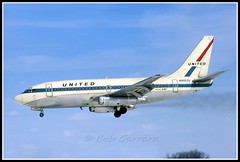
N9052U United Airlines
A United Boeing 737-200 in its delivery livery, the Mainliner scheme.

But the design decision had an unforeseen consequence that would result in considerable controversy between the pilots, the airlines, and the FAA who would be certifying the aircraft. At the time, the FAA had imposed a limit on the size of aircraft that could be operated by a two-man flight crew- it was set at 80,000 pounds maximum takeoff weight (MTOW). This limit dictated the size of the first DC-9s and as the BAC 1-11s were below the limit, Braniff and American who had ordered One-Elevens operated them with two-man crews. Aircraft over the 80,000 pound limit required three crew in the cockpit. Boeing's original 737 proposals weighed in at 79,000 pounds, but potential customers found the design too small. Eastern and United in particular wanted a larger aircraft. Even despite a rule change by the FAA raising the two-man crew limit to 90,000 pounds, the revised 737 design needed a three-man crew as it tipped the scales at 93,000 pounds. 

In April 1965 the FAA announced that it was abolishing the weight limit criteria and from then on, aircraft would be certified for two-crew operation on an individual basis. This followed two years of deliberation and consultations with the pilots' unions, airline managers, airframe manufacturers and human factors studies. 

Of the four major airlines in the US at the time ("The Big Four"), three had already made their choices in the short-range jet category. Eastern and TWA ordered the DC-9 and American ordered the BAC 1-11. That left United as the only major interested in the 737. Of the early orders for the 737, only United's order was sizable (40 -200s ordered in 1965). Lufthansa also had a significant order, but they weren't encumbered by the FAA-mandated weight restrictions on two-man crew operations. However, United's managers found the 737 to have a political disadvantage since the pilots' unions at the time felt that as the largest of the twin jets available, it should be operated with a crew of three. While expensive for the airlines in terms of labor costs, the 737 design from the outset was intended for a two-man crew. Only a small jumpseat was available on the flight deck.

Now the third crew issue had already been visited previously before the introduction of aircraft like the 737. In the late 1950s the Lockheed Electra sparked considerable debate among its customer airlines. However, in each of the three cases, the issue was deferred- Eastern's dispute revolved around whether or not the third crew should be a pilot or a flight engineer. In the cases involving National and Western, ALPA used the two-crew issue as a test case to set a precedent (even though the Electra was never intended to be used by two pilots). National put the issue in arbitration that deferred the issue. Western's management was more inflexible and for four months a pilots' strike nearly grounded Western until it was agreed by both parties to defer the issue. So from a precedent standpoint, the impending dispute over the 737 flight deck had no prior rulings or standards to build upon for either side involved. 

In late 1965 Boeing showed a mockup of the 737 cockpit to representatives from United's ALPA union, the FAA, and airline managers. While the FAA felt that the mockup was inconclusive from a certification standpoint, the pilots' union disapproved of the two-man cockpit. A year later, a working mockup that was "functional" and more detailed to test workloads was presented and again the United pilots balked at the layout for two-crew. Not long afterward, ALPA's leadership made it the union's official recommendation that the 737 be operated with a three-man crew at all times. During this same time, the pilots' contract at United was up for negotiation and the 737 crew issue became a major stumbling block in the discussions for a new contract. To further complicate the picture, the FAA at the same time also tentatively approved two-man operation of the 737 pending the start of flight testing in 1967. 

By 1967 the dispute at United still had not been settled and a presidential mediation board was convened to help in reaching a compromise between ALPA and United's management. That summer the board failed in reconciling both sides and a strike vote taken showed 92% of United's pilots in favor of striking if the 737 couldn't be operated by a three-man crew. As an effort to reach out for a compromise, ALPA proposed to the FAA that the 737 as well as the BAC 1-11 and DC-9 be operated with a three-man crew. This proposal provoked the ire of the airlines that already had the One-Eleven and the DC-9 in service and the proposal was quietly shelved with the assent of ALPA members at those other airlines. By this point the dispute was discouraging further US sales of the 737 and indirectly helped Douglas with it's DC-9 which now offered increased capacity versions to regional airlines since it had already set the precedent for two crew operations with the first DC-9 Series 10 models. 

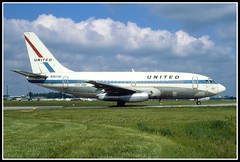
N9013U United Airlines "Mainliner City of Charlotte"
N9013U "Mainliner City of Charlotte"

The 737 made its maiden flight in April 1967 and over the Thanksgiving holiday week of that year, the FAA decided to run a series of tests to put the crew number issue to rest. One of the 737s was borrowed from Boeing and two-crew operations would be tested in the busy Boston-New York-Washington corridor. One pilot was from Boeing, the other pilot from the FAA. Two round-trips were made each day that week in both day and night conditions, both VFR and IFR weather conditions, as well as operations below minimum landing conditions, diversion operations, simulated instrument failures and even simulated crew incapacitation (could one pilot fly the 737 to safety). As a result of these tests, the FAA issued the following statement:

"The far-reaching evaluation of the Boeing 737 was started in September 1965, with the evaluation of the cockpit mock-up. Continuous evaluations over the past two years included regular operations of the aircraft in a high-density air traffic environment to determine workload, complexity, and safety of operations in a fail-safe concept. These flights were part of a very extensive flight-testing programme accomplished by the FAA and Boeing personnel. The technical findings coming out of these evaluations are that the aircraft can be safely flown with a minimum of two pilots."

Certification by the FAA of both the 737-100 and 737-200 followed in December 1967 for full airline operations. 
The third flight deck crew sat on the jumpseat on United 737-200s
Despite the issue being settled by the FAA, several airline pilot unions continued the crew issue as a bargaining chip in labor negotiations with airline management. Anxious to avert a strike in 1967, United reached an agreement with ALPA as part of a broader contract agreement to crew the 737-200 with a crew of three. Western Airlines, Frontier Airlines, and Wien Air Alaska were the only other US airlines bound by contract agreements with the pilots' union to use three crew in the flight deck. Frontier and Wien switched to a two-crew flight deck in 1976 and 1979 respectively. It wasn't until 1981 (ostensibly due to the impending introduction of the 737-300) that United finally went to a two-crew operation on the 737-200. At United, the third crewman sat in the jumpseat which is sited immediately in front of the cockpit door. Duties of the third crewman included preflight, performing the checklists, performance calculations (weight, balance, takeoff and landing distances, etc.) and company communications. All the relevant controls such as radio, electrical, hydraulic and other functions necessary were reachable from the jumpseat. Once United reverted to a two-crew flight deck in 1981, no modifications were necessary to the -200 cockpits.

Source: Boeing 737 (Crowood Aviation Series) by Malcolm L. Hill. Crowood Publishing, 2002, pp 23-31. Photos: Bob Garrard Collection/Flickr, JP Santiago

03 November 2010

The Rise of Coach Class Airfares

Prior to the Second World War, several small airlines tried to break into the market by offering low fares, but none of them survived as at the time, passenger operations were only sustainable at charging fares that were roughly 10 cents a mile. The first serious attempt at low fares on a sustained basis came from United Air Lines which started what it called "Sky Coach" service on 10 April 1940 between San Francisco and Los Angeles with intermediate stops with a fare over the whole route coming out to $13.90 (approximately 3.5 cents per mile). The reasoning for the Sky Coach service's low fares were that it would only use 10-passenger Boeing 247s that were already old and paid off, therefore cheaper to operate and would offer a less extravagant level of service than on United's primary services between the two cities. The "Sky Coach" ended on 23 April 1942 with the mobilization of the US airline fleet to support the war effort. 

In the immediate postwar period, the boom in air travel meant there were more passengers than seats and the airlines were in no rush to cut prices. In those days, fares were governed by the US Civil Aeronautics Board (CAB) and any rate cut had to pass their review as not being detrimental to the general interest of the industry and the route in question. If an airline wished to offer low fares, they had to provide rationale to the CAB to approve those fares in the days before deregulation. A growing number of charter and non-scheduled airlines, however, began to slowly nip away at the passenger market that was long the exclusive domain on the established trunk and local service carriers. These airlines offered low-frills services at cut rate prices that eventually forced the established airlines to act. The first out of the block with the first scheduled coach class service in the United States on 4 November 1948 was Capital Airlines on the lucrative Chicago-New York route. Capital charted only 4 cents per mile instead of the standard 6 cents per mile on the route established by the CAB. It justified the coach class fares to the CAB by using older Douglas DC-4s with high-density seating for 60 passengers. Only the minimum of inflight services was provided and the flights were scheduled at off peak hours and late at night so not to detract from Capital's own premium services. After approving Capital's coach class services, other airlines raced to establish their own coach class services and the CAB was so flooded with applications for approval that it was forced to issue a policy statement, apprehensive that the airlines would end up offering services that was out of balance with their operating costs:

"We would caution the carriers that the burden of proof for additional coach class service is clearly on them. We do not propose to allow the indiscriminate extension of coach fares, no do we intend to permit a general debasement of the existing passenger fare level."

Regardless, on a case-by-case basis, the CAB approved numerous other coach class services and within a year of Capital's ground breaking services, coach fares could be found on most major routes. On 27 December 1949, both American Airlines and TWA offered the first transcontinental coach class services on high-density seating DC-4s with several stops. The fares were around $110, and due to the success of the services, in less than a year both airlines replaced the elderly DC-4s with better equipment- American put DC-6s on the routes and TWA put Lockheed Constellations on the coach routes. Curiously, though, United refused to start its own coach services despite its own experiments in 1940 with the Sky Coach. William "Pat" Patterson, United's paternalistic president, warned that expansion of coach fares would lead to chaos in the market and ruin the fare structure of the industry. After holding out, United finally introduced its own coach services on 14 May 1950 with 60-seat DC-4s between Los Angeles and San Francisco at 3 cents per mile. United's services ran at night and at off peak hours until later than summer when Western Air Lines added its own daytime coach services. For the remainder of the year, United and Western fought a small fare war on coach services in California.
To get CAB approval for these services, the airlines had voluntarily imposed all sorts of restrictions on the fares from off-peak schedules, no discounts, no refunds, less on-board amenities, and reduced seat pitch. Most of this was done freely by the industry to protect their own premium services. In 1950 the CAB issued another policy statement that the objective of fares should be to balance the ratio of fares to seating standards so that the net revenue per flight should be the same, irrespective of the ticket prices. This had the effect of eroding many of the previous restrictions on coach fares due to competition- since an airline merely had to demonstrate to the CAB that the net revenue on a given route didn't change much, airlines began to incorporate coach class cabins on their regular flights. Coach fares were now available for daytime flights and peak times. As a result, United set its coach fares on all flights on the West Coast at 4.5 cents per mile and for flights within California, coach fares were set at 3.5 cents per mile. Much to United's surprise (and undoubtedly to that of Pat Patterson), United's coach fares were a huge success and the airline aggressively introduced coach class cabins on its transcontinental services between San Francisco and New York at only $110 on 25 September 1951. 

But the expansion of United's coach class cabins got the attention of the United States Senate's Select Committee on Small Business. The committee investigated the CAB decisions regarding coach class services and found that the Board had unfairly been favoring the established airlines and criticized the CAB's strict policies on charter airlines and non-scheduled airlines that had shown a market for low airfares. So in November 1951 the CAB reversed direction but instead of taking a more favorable approach to the charter and non-scheduled carriers, the CAB denied transcontinental applications of several carriers and instead directed the established airlines to expand coach class fares on their network. Many of the smaller airlines cried foul, but the political influence of the established airlines maintained the CAB's change in policy. The airlines now began to aggressively push coach class fares, particularly on the transcontinental routes by by 1952 the coach class fare between New York and Los Angeles had fallen to $99 and New York to Chicago fell to only $32. By 1955, coach class fares had grown exponentially to the point that on some routes, the coach class cabin took up more space than the first class cabins that once made up the entire cabin of airliners of the day. As traffic soared into the 1960s, the majority of airline passengers in the United States would travel via coach class fares, laying down the foundation for the beginnings of deregulation in the 1970s.

Source: Airlines of the United States Since 1914 by R.E.G. Davies. Smithsonian Institution Press, 1998, p336-338.

26 October 2010

The Holy Grail of Nonstop Transcontinental Service


The growth of US postwar air travel didn't reach a point until the 1950s that justified nonstop transcontinental services even though aircraft theoretically capable of such flights were already in airline use at the end of the Second World War. During the course of the war, Douglas DC-4s and Lockheed Constellations seconded to the US Army Air Forces routinely made trans-Atlantic crossings safely. But the exigencies of war are far removed from market demand and in the second half of the 1940s traffic demand simply wasn't there and what passengers did travel transcontinentally were few in number and used existing multistop services. In fact, many airlines believed that passengers preferred enroute stops to stretch their legs. But more significantly, federal regulations prohibited flights more than 8 hours without a backup crew aboard and to the airlines, that increased labor costs on long distance flights. It was more economical to change crews enroute. Of course, TWA and Pan American operated their trans-Atlantic services with backup crews, but this was a matter of obvious necessity.

As air travel numbers experienced major growth in the early 1950s, American Airlines was the first out of the gate with an announcement that it would begin nonstop transcontinental services between New York and Los Angeles once it had taken delivery of its Douglas DC-7 propliners. Eager to upstage American Airlines and its iconic head, C.R. Smith, Howard Hughes had TWA launch its own transcontinental nonstop service on the same route using its new Lockheed L-1049 Super Constellations. On 19 October 1953, Trans World Airlines' "Ambassador Service" Flight 2 departed Los Angeles for New York Idlewild and just barely got into New York under the federal eight hour crew limit at 7 hours, 55 minutes. The westbound Ambassador Service flight had to deal with prevailing winds at altitude and thus couldn't make the flight nonstop within 8 hours- a 15 minute technical stop was scheduled enroute at Chicago Midway to allow for a crew change but no local passenger traffic.

The following month American Airlines inaugurated its own nonstop "Mercury Service" DC-7 flights between Los Angeles and New York Idlewild on 29 November. As the DC-7 had a higher cruising speed than the Super Constellation, the eastbound LA-New York run was made easily in 7 hours, 15 minutes (a fact not lost upon American's marketing department, hence the name "Mercury Service"), but the westbound run from New York to LA couldn't be made within 8 hours. Despite over a dozen modifications to the DC-7s made by American's engineers which included tweaks of the Wright R-3350 radial engines to squeeze every bit of horsepower out of the engines, the DC-7s still couldn't beat the prevailing winds. American's pilot union repeatedly pointed this fact out, but C.R. Smith's influence in Washington left the issue unaddressed by federal regulators. In the following year, federal regulators adjusted the time limit to allow the flight to be made legally and American's DC-7s blocked in at 8 hours, 15 minutes on a westbound nonstop.

Although TWA had reached an agreement with its Super Constellation pilots for overtime pay on the westbound nonstops to eliminate the technical stop for a crew change in Chicago, no such agreement existed with American and following deadlocked negotiations, American's pilots striked on 31 July 1954. C.R. Smith was furious but had no choice to accept an agreement for overtime pay on the westbound Mercury nonstops that exceeded 8 hours. After a punishing 24-day strike, American's pilots returned to work under new rules for transcontinental flights in excess of 8 hours.

Arriving late to the transcontinental battle was United Air Lines. United took delivery of its DC-7s six months after American Airlines but didn't inaugurate nonstop services until 1 June 1954 on it's "Red Carpet" services between San Francisco and New York Idlewild. United's nonstops were eastbound only and rather unusually, westbound nonstops weren't added by the airline until 1955, nearly a year later after the Red Carpet services started.

It should be noted, though, that although these services were operated by Lockheed Super Constellations and Douglas DC-7s, on 3 February 1948 TWA inadvertently operated the first eastbound nonstop when TWA Flight 12, operated by a Lockheed L-049 Constellation, had its regular stops in Kansas City and Chicago Midway canceled due to winter weather and the flight had to continue on to New York, arriving after covering 2,470 miles in 6 hours, 55 minutes.

Source: From Props to Jets: Commercial Aviation's Transition to the Jet Age 1952-1962 by Craig Kodera, Mike Machat, and Jon Proctor. Specialty Press, 2010, p46-47.

26 September 2010

The Boeing 247 Flying Laboratory of United Air Lines


United Air Lines' legendary president William "Pat" Patterson listed his corporate goals in what he called his "Rule of Five"- safety, passenger comfort, dependability, honesty, and sincerity. To Pat Patterson, the goal of safety was the most important that he asked each and everyone one of his employees to strive for above all else. Despite the rapid advances in aviation technology in the 1920s and 1930s, airline flying was nowhere near the routine that we today take for granted. Patterson believed that the industry as a whole would benefit from investing in technology that increased aircraft safety. His first tangible commitment to that goal came in 1929 when the United Communications Laboratory based on the second floor of a hangar at Chicago Midway was established as the airline industry's only communications laboratory. One of the first developments from United Air Lines engineers assigned to the Communications Lab was a practical two-way radio for aviation use. 
In 1937, one of United Air Lines' Boeing 247Ds, NC13365, was pulled off the line and assigned to the airline's laboratory at Chicago Midway. This particular aircraft also happened to be the last Boeing 247 built. Re-registered as NX13365, the interior was fitted with test benches to hold equipment and the ceiling hat racks were modified to carry wire bundles to and from the various test equipment being used. Nicknamed the "Flying Lab", the Boeing 247D made its first flights for what became the United Flight Research Lab (as its efforts moved beyond communications and into general flight safety) the standard all-over gray color used on United's 247 fleet at the time. Before long, however, NX13365 was repainted in an attractive white and red scheme with "Flight Research" titles on the fuselage. 

The first assignment flown by NX13365 was the problem of static electricity build-up on the airframe. Particularly during bad weather, the static build-up on the airframe could reach levels sufficient to interfere with the communications and navigation equipment. Several Boeing 247s were lost due to accidents directly attributable to static build up on the airframe during flight. Working together with the Bendix Radio Corporation, NX13365 would log over 25,000 miles of flying developing a practical static "suppressor". A long wire extended from the tail that drew the static charge away from the airframe and dissipated it harmlessly. A resistor was part of the wire and a small waxed cup at the end of the wire kept it deployed in flight. Today we know these wires as the static wick dischargers on the wings and tail of modern aircraft. The first static dischargers were five foot long wires and true to his word, Pat Patterson had them fitted on every aircraft in the United fleet and shared the his lab's findings with the industry. 
NX13365 was also used for the development of what the lab called a "terrain clearance indicator". With many crashes at the time due to CFIT in poor weather (controlled flight into terrain), United's engineers worked with Western Electric and Bell Telephone to create the first radio altimeter which provided the pilots constant updates of the relative height above the ground. If the aircraft descended too low, a red light on the radio altimeter came on, alerting the flight crew. The first public demonstration of the radio altimeter was conducted on a flight above New York City that continued north over the Hudson River and over the Palisades. Following the completion of tests of the radio altimeter, again and true to his word, Pat Patterson had radio altimeters installed on everyone of United's aircraft and as he did with the static discharger, shared the findings with the rest of the industry. 

Before NX13365 was retired, United's engineers also developed an instrument landing system as well as a terrain-viewing television system in cooperation with the US Army Air Corps and also trialled different antenna configurations. In October 1945, United modified the aircraft back to passenger configuration and sold it to LAMSA (Lineas Aereas Mineras S.A.), a Mexican airline that United had invested in back in 1942. After flying with LAMSA for two years as XA-FIH "Estado de Sinaloa", it passed through several Mexican owners before ending up with an air taxi service that crashed the aircraft in Mexico City in 1952. 

Source: The Boeing 247: The First Modern Airliner by F. Robert Van Der Linden. University of Washington Press, 1991, p155-158.

31 August 2010

American Airlines Picks the DC-10

American Airlines' involvement in the development of the Lockheed and McDonnell Douglas widebody trijets was extensive. It all goes back to when George Spater took over the reins of the airline from the legendary C.R. Smith.  In the 1960s, Spater was faced with trying to decide between the Lockheed L-1011 Tristar and the McDonnell Douglas DC-10. By some accounts, it was probably the most difficult decision Spater had to make while at the helm of American, all while living in the shadow of C.R. Smith.

Back in 1966, American's VP of development engineering, Frank Kolk, was worried about the frenzy surrounding Boeing's launch of the 747 program with order committments from Pan Am. Many airlines besides American began to wonder if they could fill 400 seats and at American, it was Kolk who sounded the alarms to C.R. Smith. "C.R., it's just too damn big for our route network!" he'd exhort every chance he got. But because American's transcontinental 707 services boasted the highest load factors in the airline's network, the 747 order was placed anyway. But, since C.R. Smith found Kolk's arguments compelling, he sent Kolk to talk with the major airframe manufacturers about a smaller widebody jet.

Boeing wasn't interested as it was immersed with the 747 and the 727/737 production lines were running at maximum capacity. The manpower just couldn't be spared. Douglas was also not interested as it had its own financial problems that would result in its merger with McDonnell the following year- the DC-8 line hadn't recouped its costs yet and the company was scrambling to pacify its DC-9 customers who were upset with production problems and delays (at one point Eastern even filed suit).

Lockheed, however was very receptive and went to work immediately on a design based on Kolk's specifications for a twin-aisle twinjet that carried 250 passengers and could operate out of New York La Guardia. But other airlines, once briefed on Lockheed's work, didn't like two engines. United, in particular, wanted four but could live with three engines. Eastern would accept no less than three engines as the overwater flight rules of the day dictated that a twin jet could not fly further than 60 minutes from a diversion airport. With many of its destinations in the Caribbean, a three or four engined jet could fly direct over the Atlantic from the Northeastern United States. As other potential customers like TWA provided their opinions, the consensus over-ruled American Airlines and the Lockheed widebody jet would be a trijet.

With Douglas financially invigorated after the merger with McDonnell, in-house studies to Kolk's initial brief would become the DC-10 to compete with what would become the Lockheed L-1011 Tristar. American now faced a choice between two very similar widebody trijets. But there was a hitch- American preferred the new Rolls-Royce RB.211 engine, but the RB.211, being a more compact design thanks to its three-spool system, was too short for the DC-10 tail nacelle. As advanced as the Tristar was, Spater and the American engineering staff preferred the DC-10. Though C.R. Smith himself expressed a strong preference for the Tristar, it was Spater's call to make. Some accounts on this period in American's history point to the experience with the Lockheed Electra having biased the airline against Lockheed despite the more advanced features of the L-1011 Tristar.

Spater even talked with the head of Rolls Royce about modifying the RB.211 for the DC-10, but given that American was the only airline making the request, no guarantees could be offered to American.

There was even consensus among the various US airlines that there wasn't a sufficient market to justify two competing widebody trijet designs and there were even discussions between Spater and other airline presidents about settling on a single type. Many analysts crunching the numbers for the airlines pointed out that both aircraft being produced would eventually (and prophetically) be detrimental to the future of the commercial aircraft manufacturing at both Douglas and Lockheed. When Delta, Eastern, and TWA ordered the L-1011, the assumption was that American and United would follow suit. But United refused to accept a British engine and ordered the the DC-10 with the General Electric CF6 engine. With what was thought to be a unified front shattered by United's surprise decision to break ranks, Spater felt more comfortable and went ahead and sign a launch order for  25 DC-10s along with United Air Lines with ordered 30 aircraft. On 29 July 1971 at a joint delivery ceremony at Long Beach, the first DC-10s for United and American were handed over together.

Source: Eagle- The Story of American Airlines by Robert Serling. St. Martin's Press, 1987.

30 July 2010

The 1938 Hurricane Relief Flights That Led to the Air Transport Command

The relief efforts following natural disasters have often reminded me of the first humanitarian airlift in the United States after a natural disaster. It was September of 1938 and one of the few Category 5 storms to strike the US mainland had just come ashore with unprecedented destructiveness in New England, causing widespread devastation throughout Long Island, Connecticut, Rhode Island, and Massachusetts.

While the forecasting technology of the day paled in comparison with what we have today, there are sufficient meteorological records from 1938 that give an impressive picture of what historians call "The Long Island Express". The storm formed off the coast of West Africa and tracked westward. Lacking offshore weather buoys, the US Weather Bureau (the National Weather Service's predecessor) relied on reports from ships at sea to track the progress of the storm. From a climatological standpoint, most hurricanes in the late part of the hurricane season that form in the Eastern Atlantic usually track to the west and curve back to the northeast, remaining out to sea and having little effect on the US East Coast.

However, on the morning of 21 September 1938 as the storm was off the coast of Norfolk, Virginia, it made a sudden veer due north instead of continuing out to sea on a northeast heading. Not only did this storm head due north for New England, it also picked up speed with a storm motion of 70mph, making the "Long Island Express" one of the fastest moving hurricanes in recorded history.

The sudden change in direction caught most of New England unprepared and when the hurricane made landfall that night, wind speeds gusting to as high as 185mph were recorded along the coast of New England. The extreme forward speed of the storm made the right quadrant winds 70mph faster than they were and this put Long Island, Rhode Island, and eastern Massachusetts square in the crosshairs of this monster. A 12+ foot storm surge slammed into Providence, Rhode Island and all throughout the area, lines of communication were cut- roads, railroads, phone and telegraph lines. Not until Hurricane Andrew hit Florida in 1992 would there be a storm that caused as much damage as "The Long Island Express". The Boston area found itself cut off from the rest of the nation as thousands were made homeless and the local infrastructure of the area was destroyed.

Enter C.R. Smith. Two years earlier Jack Frye of TWA decided the US airline industry needed a common voice to work with the government in improving air safety and efficiency. He managed to convince C.R. Smith of American, Eddie Rickenbacker of Eastern, and Pat Patterson of United to form the ATA- Air Transport Association. Headed by a former military aviator of unqualified technical experience, Edgar Gorrell, one of the ATA's first acts under Gorrell was to propose that the airlines form a plan to organize their resources in the event of a national emergency to form what Gorrell called a "civil reserve air fleet".

Now keep in mind that this was a time when the airlines were run by rugged individualists like Rickenbacker or Smith. Just the fact that four disparate personalities of the magnitude of Smith, Frye, Rickenbacker, and Patterson even agreed to form the ATA was a miracle in and of itself. But to form a unified plan in case of national emergency? The other member airlines of the ATA balked at the idea despite Gorrell's pleadings- "If we don't have our own plan, the government will shove one down our throats!" But only one airline president backed the ATA proposal and that was C.R. Smith of American Airlines. The ATA proposal languished for two years until that dark night that the "Long Island Express" came ashore.

The only airline that operated on the New York-Boston route was American Airlines and C.R. Smith immediately assigned every available DC-3 the airline had to fly humanitarian missions to Boston Logan Airport which was pretty much the only functioning airport in the area in the hurricane aftermath. Flights were cancelled throughout American's system as DC-3s were pulled for the airlift. Within 24 hours, C.R. Smith realized the job couldn't be done alone- usually American carried 200 passengers a day between Boston and New York and on the first flight out of Boston, over 1000 people were looking for seats on American's mercy flights. With the local authorities also wanting to deploy medical personnel as well as rescue and construction crews to New England, American needed help.

C.R. Smith phoned Edgar Gorrell for an urgent request for help- Gorrell in turn telephoned Jack Frye at TWA, Eddie Rickenbacker at Eastern and Pat Patterson at United. Each of these airlines had the most capable airliner of the day, the DC-3, and Gorrell asked them to pull their DC-3s out of service to fly the humanitarian airlift. Without question, without argument, the three airline presidents had DC-3s streaming into Newark within hours of Gorrell's call. He then secured temporary route authority for them to fly the New York-Boston route from Washington (the nation's airlines had their route structures regulated by the federal government in those days).

For the seven days following the hurricane's landfall, the four airlines operated 24 hours a day, flying over 60,000 tons of medical supplies into Boston, carrying over 1000 rescue workers into the area, and flying out over 1500 refugees out of the area. Those numbers pale in comparison to the airlift that took place after Hurricane Katrina in 2005, but keep in mind that the DC-3 only carried 21 passengers and was the state of the art in 1938. American and TWA even added their older DC-2s to the airlift. Newark, as the bridgehead of the airlift, was the scene of unprecedented cooperation by the rival airlines. American's crews often led formations of other aircraft to Boston as some of TWA and United's pilots had never flown on the East Coast. Airlines shared spare parts, even mechanics to keep the airlift running.

By the time the airlift ended and the airlines and their personnel returned to normal operations, Gorrell as well as the presidents of the four airlines realized the potential of the US airline industry to step up to the plate in times of crisis. When the first bombs dropped on Pearl Harbor just three years later, Edgar Gorrell already had a template in place to organize the US airline industry to provide airlift for the war effort- during the Second World War, the Air Transport Command (ATC) was formed by the US airline industry with government backing. And to head this massive undertaking, Edgar Gorrell turned to C.R. Smith. Not only did C.R. Smith demonstrate initiative in organizing the 1938 airlift, in 1940, a full year before Pearl Harbor, C.R. Smith had already had his own experts formulating an emergency war mobilization plan involving all of the US airline industry.

On 13 December 1941 President Franklin D. Roosevelt was prepared to sign an executive order to nationalize the US airline industry. Sitting in the Oval Office with FDR on that day were Edgar Gorrell and the chief of the US Army Air Corps, General Henry "Hap" Arnold. Both of them convinced FDR to tear up the executive order as Gorrell showed the President C.R. Smith's war plan to mobilize the airlines. In his postwar autobiography Global Mission, General Arnold noted that air power was useless without air transport.

Source: When the Airlines Went to War: The Dramatic, Never-Before-Told Story of America's Civilian Air Warriors by Robert J. Serling. Kensington Press, 1997.