On 9 September 2015, the very first Boeing 747-400 built, N661US, touched down at Atlanta from Honolulu as Delta Flight 836 for the last time in revenue passenger service. Ship 6301 was the Boeing 747-400 prototype which was then delivered to launch customer Northwest Airlines on 8 December 1989 and came over to Delta with the 2008 merger. There are twelve remaining 747-400s flying with Delta, all of which came over from Northwest. Current fleet planning will have these 747s retired in 2017. Delta did however, for a brief time, operate the first variant of the 747 family, the 747-100, from September 1970 to April 1977. Only five aircraft were taken on strength with Delta and while the 747-100 was but a short historical footnote in Delta’s history, its legacy looms large to this day with the airline.
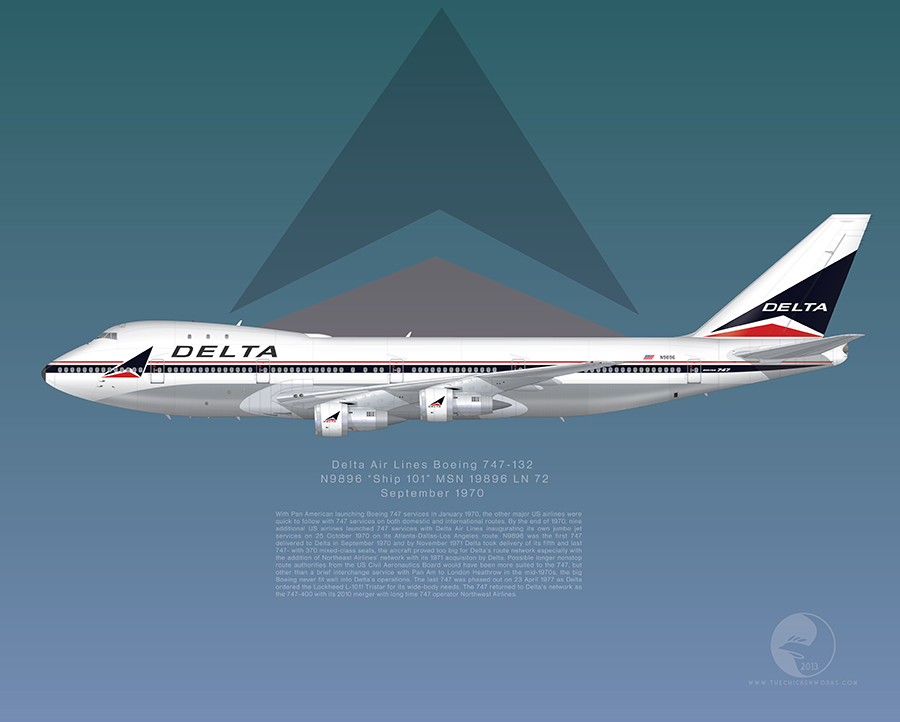
My own profile art of Delta’s first 747-100, N9896 “Ship 101” as it looked on her delivery in 1970.
(JP Santiago)
In order to understand what the 747 was for Delta at the time, one has to consider that as the 1960s were drawing to a close, Delta was in the midst of transition on several fronts. The first change change came with the Southern Transcontinental Route Case of 1961. Prior to deregulation, airlines often had to make a case for the opening of new services and routes to the Civil Aeronautics Board. Often these cases consisted of years of deliberation and often politics played a central role in airlines winning favorable rulings from the CAB. In the 1950s, the CAB favored interchange services as a means for airlines to open up new markets without saturating a given route with an excess of seats, harming profitability. Having a predominantly Southeastern US-anchored network, Delta linked up with several other airlines to offer interchange services which allowed it to fly as far west as California. As traffic grew on the interchange services to the West Coast, Delta petitioned the CAB to operate the West Coast services on its own and in one of the more historic decisions made by the CAB, both Delta and National were given route authorities to California from the southeast in what was called the Southern Transcontinental Route Case. Starting in 1961, the previous interchange agreements were declared redundant and Delta opened up a range of nonstop services to San Diego, Los Angeles, and San Francisco from Atlanta, Dallas, and New Orleans. Within a year, Las Vegas was added as well as Miami which for the first time made Delta a transcontinental airline. By 1963, the CAB permitted Delta to carry West Coast traffic to its Caribbean destinations via New Orleans and onward to Florida (Orlando and Miami) via Atlanta. In an unrelated decision by the CAB, Delta was allowed to interchange on routes to London from Washington Dulles with Pan American and soon Delta’s DC-8s were flying to Europe as part of that interchange agreement.
The second and biggest of these changes came with the death of Delta’s founder, C.E. Woolman, on 11 September 1968. In his 1841 essay “Self-Reliance”, Ralph Waldo Emerson wrote that “An institution is the lengthened shadow of one man...all history resolves itself very easily into the biography of a few stout and earnest persons." From Delta’s founding in 1927 to his death in 1968, no other individual was so closely identified with Delta than C.E. Woolman. He became the airline’s president and general manager in 1945 and became its chairman of the board only a year before his death. Though viewed as a stern autocrat by the press, Woolman was beloved by Delta employees. On his 25th anniversary with Delta, the employees presented him with a new Cadillac and though he had own several other cars, he kept that Cadillac until he died. Though ably succeeded C.H. “Charlie” Dolson, W.T. “Tom” Bebe and David Garrett, there was no question it was still Woolman’s airline for years to come.
The last change that frames the selection and operation of the Boeing 747-100 by Delta was its 1972 merger with Northeast Airlines. Throughout its history, adversity plagued Northeast which always seemed be hobbled by the CAB with a small network and when Northeast finally did break out of New England in 1968 with new routes to Florida, it ran square into the crosshairs of Eastern which was the incumbent giant of the US East Coast at the time. With Northeast literally going from cash crisis to cash crisis, its New England route authorities soon proved to be ripe for acquisition via merger. The first suitor was Northwest Airlines in 1969. Interestingly, the CAB approved the merger in 1970 but it would be without some of Northeast’s more attractive route authorities like Miami-Los Angeles. Northwest withdrew its merger offer in 1971 as a result. Eastern and TWA then offered merger terms, with Eastern in particular seeing a merger as a way of knocking a competitor out of the New England-Florida market. Those negotiations also fell through and ultimately it was Delta that came through with a suitable merger offer that also met with the approval of the CAB. On 19 May 1972, President Richard Nixon signed off on the Delta-Northeast merger (since foreign routes were involved).
So these are three events in which to put the context of the Delta’s order of the Boeing 747-100- the Southern Transcontinental Route Case of 1961, C.E. Woolman’s death in 1968, and the merger with Northeast Airlines in 1972.
Prior to the launch of the Boeing 747, the “big jet” of the day were the Douglas Super Sixty series DC-8s which had surpassed the Boeing 707 in utility and passenger capacity. While the 747’s launch has been historically associated with Juan Trippe and Pan Am, at the time, Boeing was keen on getting one up on Douglas and the 747 was the aircraft that would capture the “jumbo” jet title from the DC-8 Super 61/63. Delta representatives had visited Boeing to view the progress on the 747 program and were suitably impressed with the aircraft. Despite their favorable views on the 747 though, it was clear to all of Delta’s management from the outset that the 747 was too much airplane for the airline which had a predominantly short- and medium-haul route network with its longer routes suitably (not to mention cost-effectively) served by the DC-8 fleet. On the other hand, two of Delta’s biggest competitors, Northwest and American, had already placed orders for the 747. Delta’s fellow “southern transcontinental route” airline, National, was also expected to place orders for the 747 as well. The writing was on the wall- Delta’s DC-8s were no match for the expected spacious comfort of the big Boeing and the prudent move was to get the 747 as well, even if was just a small number on a temporary basis. In April 1967, Charlie Dolson, the airline president of the time, announced Delta’s order for three 747-100s for $20 million each with options for two more aircraft. It marked the very first time that Delta had ordered from Boeing. Preparations were made at six Delta destinations and three alternate cities for operation of the massive jet. When Pan American launched the world’s first 747 passenger services in January 1970, Delta had two representatives aboard the inaugural passenger flight.

Delta marketed the upper deck lounge of its 747s as the “Private Penthouse”.
(JP Santiago)
While Delta was making preparations for the arrival of the 747, it was carefully considering its future widebody needs which were better met by a smaller aircraft in the form of either the Douglas DC-10 or the Lockheed L-1011. Delta’s technical staff liked both aircraft and it was believed the DC-10 was favored given Delta’s long association with Douglas Aircraft and its extensive use of both the DC-8 and DC-9 in the 1960s. Delta’s close association with Douglas as one of its most loyal customers was the product of a friendship between C.E. Woolman and Donald Douglas. In the 1960s, Douglas encountered repeated financial and technical difficulties with both the DC-8 and DC-9 programs that resulted in financial losses that led to its merger with McDonnell Aircraft in 1967 which effectively put Donald Douglas out of the executive suite. And keep in mind it was the following year that C.E. Woolman passed away. In a sense, Delta was now a “free agent” no longer tied to Douglas. Lockheed, eager to put its reputation back on good standing after the issues with the Lockheed L-188 Electra, pulled out all the stops in the Tristar program, engaging potential airline customers aggressively and early on in the Tristar development, resulting in an aircraft that at least in Delta’s eyes, was practically custom-built for them. Delta did, however, order five DC-10 Series 10s as insurance against the Tristar program when Rolls Royce ran into serious financial trouble during the development of the RB.211 engine used on the Tristar.
Delta’s 747-100 order was fulfilled quickly with N9896 being handed over to Delta on 25 September 1970 with the aircraft arriving in Atlanta to great fanfare on 2 October 1970. N9897 was delivered on 25 October 1970 and N9898 was delivered on 18 November 1970. While Pan American was first to launch 747 services on 22 January 1970 on its New York JFK-London Heathrow route, mostly domestic 747 services were launched in quick succession that year:
25 February: Trans World Airlines, New York JFK-Los Angeles (first domestic 747 service)
2 March: American Airlines, New York JFK-Los Angeles
26 June: Continental Airlines, Chicago-Los Angeles-Honolulu
1 July: Northwest Airlines, Chicago-Seattle-Tokyo
23 July: United Airlines, New York JFK-San Francisco
25 October: National Airlines, Miami-New York, Miami-Los Angeles
25 October: Delta Airlines, Atlanta-Dallas-Los Angeles
21 December: Eastern Airlines, New York JFK-Miami
15 January 1971: Braniff International, Dallas Love Field-Honolulu
By the end of 1970, Delta put the other two 747-100s into service with flights to Chicago, Detroit, and Miami. The options for the two aircraft were exercised the following year with N9899 being delivered to Delta on 30 September 1971 and N9900 arriving on 11 November 1971. While Delta’s 747-100s flew amongst Atlanta, Dallas, Los Angeles, Chicago, Detroit and Miami, they were also put to use on the Pan Am interchange services between Washington Dulles and London Heathrow. In the space of just over ten years, Delta went from a mostly regional airline anchored in the southeastern United States with some Caribbean routes to a transcontinental airline operating the Boeing 747 with limited interchange services to London. Never before in Delta’s prior history had it grown so much. But its fleet was quite diverse as a result of the merger of Northeast Airlines- it had twelve different aircraft with eight different engine types in service- in August 1972, Delta had three variants of the Douglas DC-8 in service, three variants of the Douglas DC-9, two variants of the Boeing 727, the Boeing 747-100, the Convair CV-880, the Fairchild-Hiller FH-227, the Lockheed L-100 Hercules for its cargo division, and it was anticipating the arrival of both the Lockheed L-1011 Tristar and the Douglas DC-10! In the interests of reducing the maintenance costs, standardizing operations, and holding down spare parts inventories, the fleet types had to be pared down. By this point, David Garrett had become president of the airline and it was his legacy that Delta streamlined its fleet which gave it record breaking profits in the late 1970s. Garrett’s primary imperative was fuel savings- the 1973 OPEC oil embargo that followed the Yom Kippur War in the Middle East caused a sharp spike in the cost of fuel.
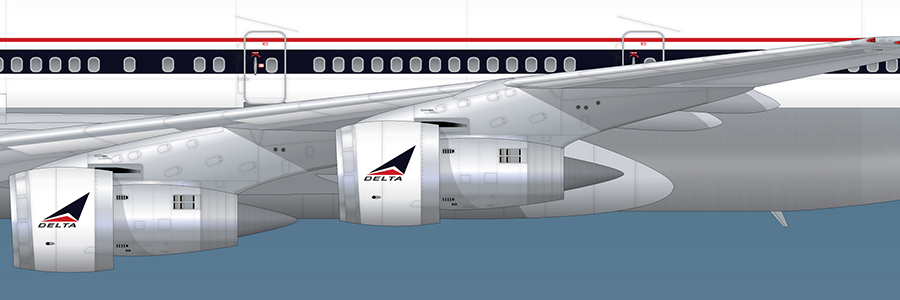
The Pratt & Whitney JT9D was the first production high bypass turbofan used on a production airliner.
(JP Santiago)
For smaller markets and the short- to medium-haul flying, Delta standardized on the Douglas DC-9 Series 32. For medium-sized markets and medium-haul flying, Delta standardized on the Boeing 727-200. It had acquired them via its merger with Northeast Airlines and found them to have superior economics to the Convair CV-880s and to some degree even the DC-8s. In addition, the 727-200 used similar Pratt & Whitney JT8D engines as the DC-9. There were thirteen 727-200s that came over with the merger with Northeast and Delta wanted more- in March 1972, Delta returned to Boeing once again, this time with an order for fourteen 727-200s (the order was placed before final approval of the Northeast merger by President Nixon)- Boeing even took Delta’s remaining Convairs as a trade-ins on the 727 order. By 1977, there would be 88 727-200s in Delta’s fleet. Delta’s first experience in working with Boeing on the 747-100 order was so favorable the airline was eager to work with Boeing quite readily again. The arrival of more 727-200s allowed Delta to dispose of the Convairs and the oldest DC-8s first. While most of the Series 51s and Super 61s were sold off, a sizeable number were kept on for several more years with some of the Super 61s getting the Cammacorp re-engining with the CFM56 to become Super 71s.
By this point it was clear the Lockheed L-1011 Tristar would be the long-haul workhorse of the Delta fleet. The DC-10s were eventually sold off to United. The first Tristar arrived in Atlanta on 12 October 1973 with the first passenger services on 15 December 1973 on the Atlanta-Philadelphia route. By 1974 there were ten Tristars in service but their spacious underfloor cargo holds meant they carried 25% of Delta’s cargo despite being less than 10% of the fleet. That allowed the L-100 Hercules transports to be sold off that year. When the Boeing 747-100 was ordered in 1967, it was with the understanding it was too big of an airplane for Delta but it was needed to compete in the marketplace. With the Tristar quickly proving itself, the 747-100’s days were quickly numbered and arrangements were made for the first two 747-100s to be sold off but the last three stayed on just a bit longer until more Tristars were in service. Delta’s last Boeing 747-100 service was flown 23 April 1977 Las Vegas-Atlanta.
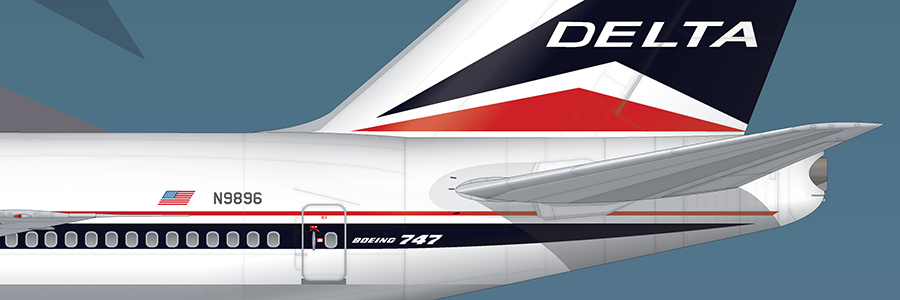
Of the five original Delta 747-100s, only the first one, N9896 “Ship 101” can still be seen today at the Evergreen Aviation Museum.
(JP Santiago)
The fates of Delta’s five 747-100s:
N9896: Returned to Boeing 1974, leased to China Airlines 1976-1978, operated by Pan Am 1978-1991, then flew with Evergreen International. Preserved at the Evergreen Aviation Museum in 2010 (it’s on the roof as part of the waterpark with waterslides coming out of it!)
N9897: Returned to Boeing 1977, operated by Flying Tiger 1977-1989 (leased to El Al Israel for a year), operated by FedEx 1989-1991, operated by Air Hong Kong 1991-1996, then Polar Air Cargo, now scrapped.
N9898: Returned to Boeing 1975, operated by China Airlines 1975-1976, leased out by Guiness Peat Aviation 1976-1984, operated by Pan Am 1984-1991, operated by Evergreen International starting in 1991 and converted to a water bomber “Evergreen Supertanker”, retired with Evergreen’s bankruptcy in 2013. In storage at Pinal Air Park.
N9899: Returned to Boeing 1977, operated by Flying Tiger 1977-1989 (leased to El Al Israel for a year), operated by FedEx 1989-1991, operated by Air Hong Kong 1991-1995, then Polar Air Cargo, now scrapped.
N9900: Returned to Boeing 1977, operated by Flying Tiger 1977-1989, operated by FedEx 1989-1993, operated by Air Hong Kong 1993-1994, operated by Kalitta 1994-2008. Stored at Oscoda, then scrapped 2015.
As an interesting historical footnote, the first officer on the delivery of Delta’s first Lockheed Tristar was Captain Jack McMahan who at the time was one of only two men in the United States certificated to fly the DC-10, L-1011 and 747. The other pilot was an FAA examiner. He was asked by a reporter on his impressions of all three widebodies- he praised the handling of the DC-10, the overall design of the 747, and the advanced systems of the L-1011. He remarked “Flying the three planes is like going out with three sisters. They have the same background but different personalities!”
Sources: Delta: The History of an Airline by W. David Lewis and Wesley Phillips Newton. University of Georgia Press, 1979, pp 340-392. Delta: An Airline and Its Aircraft by R.E.G. Davies. Palawdr Press, 1990, pp 76,80-86,96-97.