
In the late 1950s and early 1960s propliners still served a lot of the shorter routes in the US domestic market as jets were becoming the fashionable on the longer routes where the time savings of the jets over propliners was most apparent. However, the travelling public was irreversibly enamored with jet aircraft for travel and soon shorter domestic routes would be singing with jet noise- the first designs for the medium-range domestic routes, the Convair 880 and the Boeing 720, were too large and uneconomical to operate on short-range routes. Boeing responded with the 727 which would prove to be one of its outstanding commercial successes, but airlines were looking for an even smaller jet. By the early 1960s the Douglas DC-9, BAC 1-11, and the Sud-Aviation Caravelle were established in the market and Boeing's smallest offering, the 727-100, was too big for most short-range routes. When long-time Boeing customer American Airlines turned to Great Britain for the BAC 1-11 for a short-range jet to complement its 727 services, the engineers at Renton got yet another kick in the pants to produce an offering to compete with the twin-jets.
With the first generation of twin-jets disproving the skeptics that thought short-range routes would too uneconomical for jets, Boeing designers aimed for a small twin jet that was more flexible than the existing competition that could not only fly into smaller communities and smaller airports, but would blend seamlessly with larger jet operations at major airports. Key in making this possible was the decision by 737 lead engineer John Steiner to make the new 737 the same cross-section as the 707 and the 727. This would give the 737 the lead in comfort by offering 3-3 seating whereas the competition could only offer 3-2 seating. For the first time, big jet comfort was possible on shorter sectors.
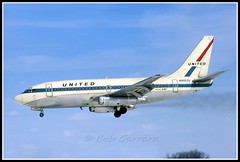
A United Boeing 737-200 in its delivery livery, the Mainliner scheme.
But the design decision had an unforeseen consequence that would result in considerable controversy between the pilots, the airlines, and the FAA who would be certifying the aircraft. At the time, the FAA had imposed a limit on the size of aircraft that could be operated by a two-man flight crew- it was set at 80,000 pounds maximum takeoff weight (MTOW). This limit dictated the size of the first DC-9s and as the BAC 1-11s were below the limit, Braniff and American who had ordered One-Elevens operated them with two-man crews. Aircraft over the 80,000 pound limit required three crew in the cockpit. Boeing's original 737 proposals weighed in at 79,000 pounds, but potential customers found the design too small. Eastern and United in particular wanted a larger aircraft. Even despite a rule change by the FAA raising the two-man crew limit to 90,000 pounds, the revised 737 design needed a three-man crew as it tipped the scales at 93,000 pounds.
In April 1965 the FAA announced that it was abolishing the weight limit criteria and from then on, aircraft would be certified for two-crew operation on an individual basis. This followed two years of deliberation and consultations with the pilots' unions, airline managers, airframe manufacturers and human factors studies.
Of the four major airlines in the US at the time ("The Big Four"), three had already made their choices in the short-range jet category. Eastern and TWA ordered the DC-9 and American ordered the BAC 1-11. That left United as the only major interested in the 737. Of the early orders for the 737, only United's order was sizable (40 -200s ordered in 1965). Lufthansa also had a significant order, but they weren't encumbered by the FAA-mandated weight restrictions on two-man crew operations. However, United's managers found the 737 to have a political disadvantage since the pilots' unions at the time felt that as the largest of the twin jets available, it should be operated with a crew of three. While expensive for the airlines in terms of labor costs, the 737 design from the outset was intended for a two-man crew. Only a small jumpseat was available on the flight deck.
Now the third crew issue had already been visited previously before the introduction of aircraft like the 737. In the late 1950s the Lockheed Electra sparked considerable debate among its customer airlines. However, in each of the three cases, the issue was deferred- Eastern's dispute revolved around whether or not the third crew should be a pilot or a flight engineer. In the cases involving National and Western, ALPA used the two-crew issue as a test case to set a precedent (even though the Electra was never intended to be used by two pilots). National put the issue in arbitration that deferred the issue. Western's management was more inflexible and for four months a pilots' strike nearly grounded Western until it was agreed by both parties to defer the issue. So from a precedent standpoint, the impending dispute over the 737 flight deck had no prior rulings or standards to build upon for either side involved.
In late 1965 Boeing showed a mockup of the 737 cockpit to representatives from United's ALPA union, the FAA, and airline managers. While the FAA felt that the mockup was inconclusive from a certification standpoint, the pilots' union disapproved of the two-man cockpit. A year later, a working mockup that was "functional" and more detailed to test workloads was presented and again the United pilots balked at the layout for two-crew. Not long afterward, ALPA's leadership made it the union's official recommendation that the 737 be operated with a three-man crew at all times. During this same time, the pilots' contract at United was up for negotiation and the 737 crew issue became a major stumbling block in the discussions for a new contract. To further complicate the picture, the FAA at the same time also tentatively approved two-man operation of the 737 pending the start of flight testing in 1967.
By 1967 the dispute at United still had not been settled and a presidential mediation board was convened to help in reaching a compromise between ALPA and United's management. That summer the board failed in reconciling both sides and a strike vote taken showed 92% of United's pilots in favor of striking if the 737 couldn't be operated by a three-man crew. As an effort to reach out for a compromise, ALPA proposed to the FAA that the 737 as well as the BAC 1-11 and DC-9 be operated with a three-man crew. This proposal provoked the ire of the airlines that already had the One-Eleven and the DC-9 in service and the proposal was quietly shelved with the assent of ALPA members at those other airlines. By this point the dispute was discouraging further US sales of the 737 and indirectly helped Douglas with it's DC-9 which now offered increased capacity versions to regional airlines since it had already set the precedent for two crew operations with the first DC-9 Series 10 models.
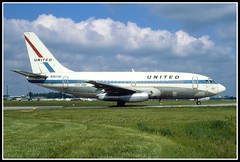
N9013U "Mainliner City of Charlotte"
The 737 made its maiden flight in April 1967 and over the Thanksgiving holiday week of that year, the FAA decided to run a series of tests to put the crew number issue to rest. One of the 737s was borrowed from Boeing and two-crew operations would be tested in the busy Boston-New York-Washington corridor. One pilot was from Boeing, the other pilot from the FAA. Two round-trips were made each day that week in both day and night conditions, both VFR and IFR weather conditions, as well as operations below minimum landing conditions, diversion operations, simulated instrument failures and even simulated crew incapacitation (could one pilot fly the 737 to safety). As a result of these tests, the FAA issued the following statement:
"The far-reaching evaluation of the Boeing 737 was started in September 1965, with the evaluation of the cockpit mock-up. Continuous evaluations over the past two years included regular operations of the aircraft in a high-density air traffic environment to determine workload, complexity, and safety of operations in a fail-safe concept. These flights were part of a very extensive flight-testing programme accomplished by the FAA and Boeing personnel. The technical findings coming out of these evaluations are that the aircraft can be safely flown with a minimum of two pilots."
Certification by the FAA of both the 737-100 and 737-200 followed in December 1967 for full airline operations.
 |
| The third flight deck crew sat on the jumpseat on United 737-200s |
Despite the issue being settled by the FAA, several airline pilot unions continued the crew issue as a bargaining chip in labor negotiations with airline management. Anxious to avert a strike in 1967, United reached an agreement with ALPA as part of a broader contract agreement to crew the 737-200 with a crew of three. Western Airlines, Frontier Airlines, and Wien Air Alaska were the only other US airlines bound by contract agreements with the pilots' union to use three crew in the flight deck. Frontier and Wien switched to a two-crew flight deck in 1976 and 1979 respectively. It wasn't until 1981 (ostensibly due to the impending introduction of the 737-300) that United finally went to a two-crew operation on the 737-200. At United, the third crewman sat in the jumpseat which is sited immediately in front of the cockpit door. Duties of the third crewman included preflight, performing the checklists, performance calculations (weight, balance, takeoff and landing distances, etc.) and company communications. All the relevant controls such as radio, electrical, hydraulic and other functions necessary were reachable from the jumpseat. Once United reverted to a two-crew flight deck in 1981, no modifications were necessary to the -200 cockpits.
Source: Boeing 737 (Crowood Aviation Series) by Malcolm L. Hill. Crowood Publishing, 2002, pp 23-31. Photos: Bob Garrard Collection/Flickr, JP Santiago


 by R.E.G. Davies. Smithsonian Institution Press, 1998, p336-338.