Showing posts with label Donald Douglas. Show all posts

18 May 2016

CHECK SIX: The Douglas DC-7

18 MAY 1953: FIRST FLIGHT OF THE DOUGLAS DC-7

Douglas launched the DC-7 program at the prodding of C.R. Smith of American Airlines who wanted a competitor to TWA's Lockheed Super Constellations for the first transcontinental nonstop services. American's requirement even called for the same engines as the Super Constellation, the Wright R-3350 Turbo Compound (the DC-6 used the Pratt & Whitney R-2800 Double Wasp) radial. Douglas didn't think there was a market for such an aircraft, but Smith ordered 25 of what would become the DC-7 for $40 million which pretty much covered Douglas' development costs. To save time and make the most of the $40 million, the DC-7 was a stretched DC-6 with Wright R-3350 engines. The DC-7 was slightly faster than the Super Consellation and could under *ideal* conditions (which was rare) do a nonstop transcon in under 8 hours. 


The first variant of the DC-7 was good for transcon runs but was no better than the DC-6 for oceanic routes. That first variant went exclusively to US operators- American (34), United (57), Delta (10), and National (4). American Airlines inaugurated its own nonstop "Mercury Service" DC-7 flights between Los Angeles and New York Idlewild on 29 November 1953. As the DC-7 had a higher cruising speed than the Super Constellation, the eastbound LA-New York run was made easily in 7 hours, 15 minutes (a fact not lost upon American's marketing department, hence the name "Mercury Service"), but the westbound run from New York to LA couldn't be made within 8 hours. Despite over a dozen modifications to the DC-7s made by American's engineers which included tweaks of the Wright R-3350 radial engines to squeeze every bit of horsepower out of the engines, the DC-7s still couldn't beat the prevailing winds. American's pilot union repeatedly pointed this fact out, but C.R. Smith's influence in Washington left the issue unaddressed by federal regulators. In the following year, federal regulators adjusted the time limit to allow the flight to be made legally and American's DC-7s blocked in at 8 hours, 15 minutes on a westbound nonstop.

The next DC-7 variant was the DC-7B which had uprated engines and more fuel tanks in the engine nacelles which made oceanic crossings possible. Pan American launched its own transatlantic services in the summer of 1955 and South African Airways was finally able to fly Johannesburg-London nonstop.

The final DC-7 variant had longer wings and a stretched fuselage, the DC-7C "Seven Seas". The fuel capacity of the Seven Seas allowed full westbound nonstop transatlantic capability, something that the DC-7B couldn't routinely perform. 


There was a DC-7D which would have Rolls-Royce Tyne turboprops (same engine as the Vickers Vanguard) and a swept back vertical fin, but it never made it off the drawing board as Donald Douglas decided jets were the way to go and development of the DC-8 was given priority. 

Further reading: 


(Photos: Vintage Ad Browser, California Classic Forums)

29 November 2015

Delta Air Lines and the Boeing 747-100

On 9 September 2015, the very first Boeing 747-400 built, N661US, touched down at Atlanta from Honolulu as Delta Flight 836 for the last time in revenue passenger service. Ship 6301 was the Boeing 747-400 prototype which was then delivered to launch customer Northwest Airlines on 8 December 1989 and came over to Delta with the 2008 merger. There are twelve remaining 747-400s flying with Delta, all of which came over from Northwest. Current fleet planning will have these 747s retired in 2017. Delta did however, for a brief time, operate the first variant of the 747 family, the 747-100, from September 1970 to April 1977. Only five aircraft were taken on strength with Delta and while the 747-100 was but a short historical footnote in Delta’s history, its legacy looms large to this day with the airline.

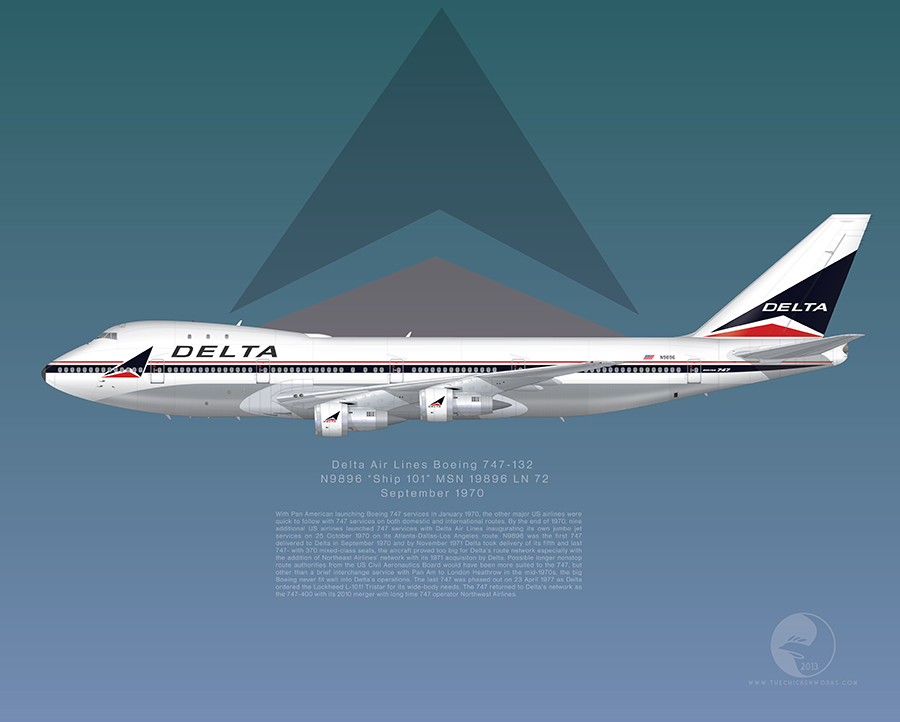
741_Delta_p2.jpg
My own profile art of Delta’s first 747-100, N9896 “Ship 101” as it looked on her delivery in 1970.
(JP Santiago)

In order to understand what the 747 was for Delta at the time, one has to consider that as the 1960s were drawing to a close, Delta was in the midst of transition on several fronts. The first change change came with the Southern Transcontinental Route Case of 1961. Prior to deregulation, airlines often had to make a case for the opening of new services and routes to the Civil Aeronautics Board. Often these cases consisted of years of deliberation and often politics played a central role in airlines winning favorable rulings from the CAB. In the 1950s, the CAB favored interchange services as a means for airlines to open up new markets without saturating a given route with an excess of seats, harming profitability. Having a predominantly Southeastern US-anchored network, Delta linked up with several other airlines to offer interchange services which allowed it to fly as far west as California. As traffic grew on the interchange services to the West Coast, Delta petitioned the CAB to operate the West Coast services on its own and in one of the more historic decisions made by the CAB, both Delta and National were given route authorities to California from the southeast in what was called the Southern Transcontinental Route Case. Starting in 1961, the previous interchange agreements were declared redundant and Delta opened up a range of nonstop services to San Diego, Los Angeles, and San Francisco from Atlanta, Dallas, and New Orleans. Within a year, Las Vegas was added as well as Miami which for the first time made Delta a transcontinental airline. By 1963, the CAB permitted Delta to carry West Coast traffic to its Caribbean destinations via New Orleans and onward to Florida (Orlando and Miami) via Atlanta. In an unrelated decision by the CAB, Delta was allowed to interchange on routes to London from Washington Dulles with Pan American and soon Delta’s DC-8s were flying to Europe as part of that interchange agreement.

The second and biggest of these changes came with the death of Delta’s founder, C.E. Woolman, on 11 September 1968. In his 1841 essay “Self-Reliance”, Ralph Waldo Emerson wrote that “An institution is the lengthened shadow of one man...all history resolves itself very easily into the biography of a few stout and earnest persons." From Delta’s founding in 1927 to his death in 1968, no other individual was so closely identified with Delta than C.E. Woolman. He became the airline’s president and general manager in 1945 and became its chairman of the board only a year before his death. Though viewed as a stern autocrat by the press, Woolman was beloved by Delta employees. On his 25th anniversary with Delta, the employees presented him with a new Cadillac and though he had own several other cars, he kept that Cadillac until he died. Though ably succeeded C.H. “Charlie” Dolson, W.T. “Tom” Bebe and David Garrett, there was no question it was still Woolman’s airline for years to come.

The last change that frames the selection and operation of the Boeing 747-100 by Delta was its 1972 merger with Northeast Airlines. Throughout its history, adversity plagued Northeast which always seemed be hobbled by the CAB with a small network and when Northeast finally did break out of New England in 1968 with new routes to Florida, it ran square into the crosshairs of Eastern which was the incumbent giant of the US East Coast at the time. With Northeast literally going from cash crisis to cash crisis, its New England route authorities soon proved to be ripe for acquisition via merger. The first suitor was Northwest Airlines in 1969. Interestingly, the CAB approved the merger in 1970 but it would be without some of Northeast’s more attractive route authorities like Miami-Los Angeles. Northwest withdrew its merger offer in 1971 as a result. Eastern and TWA then offered merger terms, with Eastern in particular seeing a merger as a way of knocking a competitor out of the New England-Florida market. Those negotiations also fell through and ultimately it was Delta that came through with a suitable merger offer that also met with the approval of the CAB. On 19 May 1972, President Richard Nixon signed off on the Delta-Northeast merger (since foreign routes were involved).

So these are three events in which to put the context of the Delta’s order of the Boeing 747-100- the Southern Transcontinental Route Case of 1961, C.E. Woolman’s death in 1968, and the merger with Northeast Airlines in 1972.

Prior to the launch of the Boeing 747, the “big jet” of the day were the Douglas Super Sixty series DC-8s which had surpassed the Boeing 707 in utility and passenger capacity. While the 747’s launch has been historically associated with Juan Trippe and Pan Am, at the time, Boeing was keen on getting one up on Douglas and the 747 was the aircraft that would capture the “jumbo” jet title from the DC-8 Super 61/63. Delta representatives had visited Boeing to view the progress on the 747 program and were suitably impressed with the aircraft. Despite their favorable views on the 747 though, it was clear to all of Delta’s management from the outset that the 747 was too much airplane for the airline which had a predominantly short- and medium-haul route network with its longer routes suitably (not to mention cost-effectively) served by the DC-8 fleet. On the other hand, two of Delta’s biggest competitors, Northwest and American, had already placed orders for the 747. Delta’s fellow “southern transcontinental route” airline, National, was also expected to place orders for the 747 as well. The writing was on the wall- Delta’s DC-8s were no match for the expected spacious comfort of the big Boeing and the prudent move was to get the 747 as well, even if was just a small number on a temporary basis. In April 1967, Charlie Dolson, the airline president of the time, announced Delta’s order for three 747-100s for $20 million each with options for two more aircraft. It marked the very first time that Delta had ordered from Boeing. Preparations were made at six Delta destinations and three alternate cities for operation of the massive jet. When Pan American launched the world’s first 747 passenger services in January 1970, Delta had two representatives aboard the inaugural passenger flight.

741_Delta_p3.jpg
Delta marketed the upper deck lounge of its 747s as the “Private Penthouse”.
(JP Santiago)

While Delta was making preparations for the arrival of the 747, it was carefully considering its future widebody needs which were better met by a smaller aircraft in the form of either the Douglas DC-10 or the Lockheed L-1011. Delta’s technical staff liked both aircraft and it was believed the DC-10 was favored given Delta’s long association with Douglas Aircraft and its extensive use of both the DC-8 and DC-9 in the 1960s. Delta’s close association with Douglas as one of its most loyal customers was the product of a friendship between C.E. Woolman and Donald Douglas. In the 1960s, Douglas encountered repeated financial and technical difficulties with both the DC-8 and DC-9 programs that resulted in financial losses that led to its merger with McDonnell Aircraft in 1967 which effectively put Donald Douglas out of the executive suite. And keep in mind it was the following year that C.E. Woolman passed away. In a sense, Delta was now a “free agent” no longer tied to Douglas. Lockheed, eager to put its reputation back on good standing after the issues with the Lockheed L-188 Electra, pulled out all the stops in the Tristar program, engaging potential airline customers aggressively and early on in the Tristar development, resulting in an aircraft that at least in Delta’s eyes, was practically custom-built for them. Delta did, however, order five DC-10 Series 10s as insurance against the Tristar program when Rolls Royce ran into serious financial trouble during the development of the RB.211 engine used on the Tristar.

Delta’s 747-100 order was fulfilled quickly with N9896 being handed over to Delta on 25 September 1970 with the aircraft arriving in Atlanta to great fanfare on 2 October 1970. N9897 was delivered on 25 October 1970 and N9898 was delivered on 18 November 1970. While Pan American was first to launch 747 services on 22 January 1970 on its New York JFK-London Heathrow route, mostly domestic 747 services were launched in quick succession that year:

25 February: Trans World Airlines, New York JFK-Los Angeles (first domestic 747 service)
2 March: American Airlines, New York JFK-Los Angeles
26 June: Continental Airlines, Chicago-Los Angeles-Honolulu
1 July: Northwest Airlines, Chicago-Seattle-Tokyo
23 July: United Airlines, New York JFK-San Francisco
25 October: National Airlines, Miami-New York, Miami-Los Angeles
25 October: Delta Airlines, Atlanta-Dallas-Los Angeles
21 December: Eastern Airlines, New York JFK-Miami
15 January 1971: Braniff International, Dallas Love Field-Honolulu

By the end of 1970, Delta put the other two 747-100s into service with flights to Chicago, Detroit, and Miami. The options for the two aircraft were exercised the following year with N9899 being delivered to Delta on 30 September 1971 and N9900 arriving on 11 November 1971. While Delta’s 747-100s flew amongst Atlanta, Dallas, Los Angeles, Chicago, Detroit and Miami, they were also put to use on the Pan Am interchange services between Washington Dulles and London Heathrow. In the space of just over ten years, Delta went from a mostly regional airline anchored in the southeastern United States with some Caribbean routes to a transcontinental airline operating the Boeing 747 with limited interchange services to London. Never before in Delta’s prior history had it grown so much. But its fleet was quite diverse as a result of the merger of Northeast Airlines- it had twelve different aircraft with eight different engine types in service- in August 1972, Delta had three variants of the Douglas DC-8 in service, three variants of the Douglas DC-9, two variants of the Boeing 727, the Boeing 747-100, the Convair CV-880, the Fairchild-Hiller FH-227, the Lockheed L-100 Hercules for its cargo division, and it was anticipating the arrival of both the Lockheed L-1011 Tristar and the Douglas DC-10! In the interests of reducing the maintenance costs, standardizing operations, and holding down spare parts inventories, the fleet types had to be pared down. By this point, David Garrett had become president of the airline and it was his legacy that Delta streamlined its fleet which gave it record breaking profits in the late 1970s. Garrett’s primary imperative was fuel savings- the 1973 OPEC oil embargo that followed the Yom Kippur War in the Middle East caused a sharp spike in the cost of fuel.
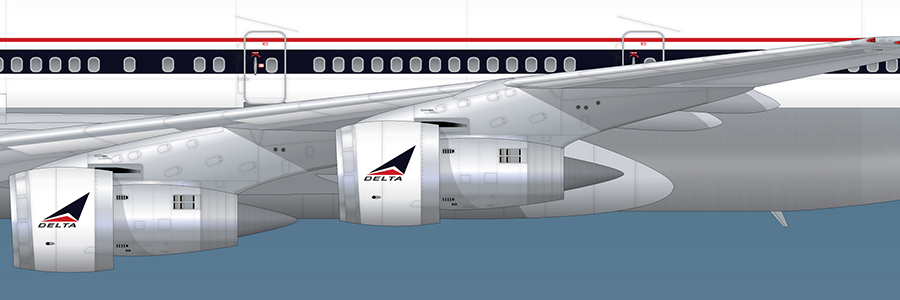
741_Delta_p5.jpg
The Pratt & Whitney JT9D was the first production high bypass turbofan used on a production airliner.
(JP Santiago)

For smaller markets and the short- to medium-haul flying, Delta standardized on the Douglas DC-9 Series 32. For medium-sized markets and medium-haul flying, Delta standardized on the Boeing 727-200. It had acquired them via its merger with Northeast Airlines and found them to have superior economics to the Convair CV-880s and to some degree even the DC-8s. In addition, the 727-200 used similar Pratt & Whitney JT8D engines as the DC-9. There were thirteen 727-200s that came over with the merger with Northeast and Delta wanted more- in March 1972, Delta returned to Boeing once again, this time with an order for fourteen 727-200s (the order was placed before final approval of the Northeast merger by President Nixon)- Boeing even took Delta’s remaining Convairs as a trade-ins on the 727 order. By 1977, there would be 88 727-200s in Delta’s fleet. Delta’s first experience in working with Boeing on the 747-100 order was so favorable the airline was eager to work with Boeing quite readily again. The arrival of more 727-200s allowed Delta to dispose of the Convairs and the oldest DC-8s first. While most of the Series 51s and Super 61s were sold off, a sizeable number were kept on for several more years with some of the Super 61s getting the Cammacorp re-engining with the CFM56 to become Super 71s.

By this point it was clear the Lockheed L-1011 Tristar would be the long-haul workhorse of the Delta fleet. The DC-10s were eventually sold off to United. The first Tristar arrived in Atlanta on 12 October 1973 with the first passenger services on 15 December 1973 on the Atlanta-Philadelphia route. By 1974 there were ten Tristars in service but their spacious underfloor cargo holds meant they carried 25% of Delta’s cargo despite being less than 10% of the fleet. That allowed the L-100 Hercules transports to be sold off that year. When the Boeing 747-100 was ordered in 1967, it was with the understanding it was too big of an airplane for Delta but it was needed to compete in the marketplace. With the Tristar quickly proving itself, the 747-100’s days were quickly numbered and arrangements were made for the first two 747-100s to be sold off but the last three stayed on just a bit longer until more Tristars were in service. Delta’s last Boeing 747-100 service was flown 23 April 1977 Las Vegas-Atlanta.
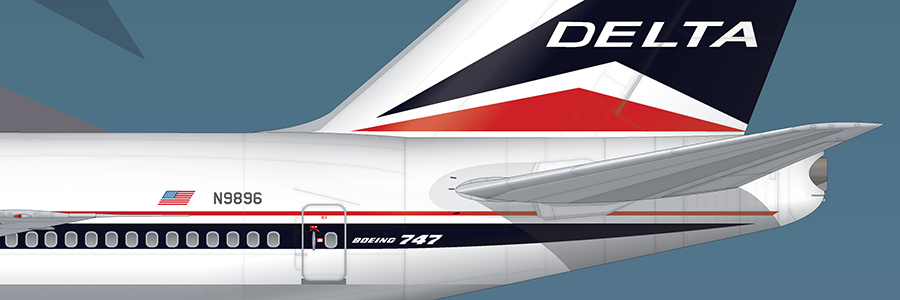
741_Delta_p4.jpg
Of the five original Delta 747-100s, only the first one, N9896 “Ship 101” can still be seen today at the Evergreen Aviation Museum.
(JP Santiago)

The fates of Delta’s five 747-100s:

N9896: Returned to Boeing 1974, leased to China Airlines 1976-1978, operated by Pan Am 1978-1991, then flew with Evergreen International. Preserved at the Evergreen Aviation Museum in 2010 (it’s on the roof as part of the waterpark with waterslides coming out of it!)

N9897: Returned to Boeing 1977, operated by Flying Tiger 1977-1989 (leased to El Al Israel for a year), operated by FedEx 1989-1991, operated by Air Hong Kong 1991-1996, then Polar Air Cargo, now scrapped.

N9898: Returned to Boeing 1975, operated by China Airlines 1975-1976, leased out by Guiness Peat Aviation 1976-1984, operated by Pan Am 1984-1991, operated by Evergreen International starting in 1991 and converted to a water bomber “Evergreen Supertanker”, retired with Evergreen’s bankruptcy in 2013. In storage at Pinal Air Park.

N9899: Returned to Boeing 1977, operated by Flying Tiger 1977-1989 (leased to El Al Israel for a year), operated by FedEx 1989-1991, operated by Air Hong Kong 1991-1995, then Polar Air Cargo, now scrapped.

N9900: Returned to Boeing 1977, operated by Flying Tiger 1977-1989, operated by FedEx 1989-1993, operated by Air Hong Kong 1993-1994, operated by Kalitta 1994-2008. Stored at Oscoda, then scrapped 2015.

As an interesting historical footnote, the first officer on the delivery of Delta’s first Lockheed Tristar was Captain Jack McMahan who at the time was one of only two men in the United States certificated to fly the DC-10, L-1011 and 747. The other pilot was an FAA examiner. He was asked by a reporter on his impressions of all three widebodies- he praised the handling of the DC-10, the overall design of the 747, and the advanced systems of the L-1011. He remarked “Flying the three planes is like going out with three sisters. They have the same background but different personalities!

This article was originally posted on AirlineReporter.com on 23 October 2015.

Sources: Delta: The History of an Airline by W. David Lewis and Wesley Phillips Newton. University of Georgia Press, 1979, pp 340-392. Delta: An Airline and Its Aircraft by R.E.G. Davies. Palawdr Press, 1990, pp 76,80-86,96-97. 


04 October 2015

Birth of a Breed: The Development of the Douglas DC-1

The Douglas DC-1 at its 1933 handover to TWA
(San Diego Air and Space Museum Archives)
The crash of a TWA (Transcontinental & Western Air) Flight 599 on 31 March 1931 served as a major catalyst in the airline industry for adoption of all-metal aircraft. The Fokker F.10 was on a scheduled flight from Kansas City to Los Angeles when it encountered turbulence on its first leg between Kansas City and Wichita. As the Fokker F.10 airline had wings of wood laminate, accumulated moisture had caused a weakening of the glue used which led to delamination and structural failure. Aboard Flight 599 was the famed Notre Dame head football coach Knute Rockne, who along with five other passengers and two crew, were lost in the crash when the aircraft went down between the rural Kansas towns of Bazaar and Matfield Green. As a result of the crash, the Bureau of Air Commerce required operators of aircraft with wood wing structures to undergo frequent inspections- as this was economically unfeasible for most operators, all-metal designs were procured as soon as possible. TWA nearly shut down for good while its Fokker fleet was grounded for  inspections. Most of the types that were procured were interim types- but in 8 February 1933, a new airliner made its first flight that was a quantum leap over anything that had proceeded it, and that was the Boeing 247 which entered service with United Air Lines just fifty days later. All metal with a retractable undercarriage, the Boeing 247 was sleek and much faster than anything that had flown passenger services up to that point. Even the most current designs were instantly obsolete- for example, the Curtiss Condor biplane airliner had entered service with Eastern Air Lines and American Airlines just five weeks before United put its Boeing 247s into service. 

United's main rival on the transcontinental market was TWA- the Boeing 247 could now make the east to west transcontinental run in only 21 hours 30 minutes including technical stops. By comparison, TWA's Fokkers took 28 hours 43 minutes to fly from New York to Los Angeles. When TWA learned of United's order for the Boeing 247, he contacted Boeing about ordering the aircraft for TWA, but at the time, United and Boeing were part of the same holding company, United Aircraft and Transport Corporation and Boeing was contractually bound to deliver 60 Boeing 247s to United before it could supply airframes to other customers. TWA's vice president for operations, Jack Frye, wasted little time in sending a letter to other aircraft manufacturers soliciting interest in building at least 60 three-engined airliners for the airline. That letter went to Consolidated Aircraft, Curtiss-Wright, Douglas Aircraft, General Aviation Manufacturing, Stout (Ford) Aircraft, and Glenn Martin Aircraft. The letter included general performance specifications that any design had to meet: 

Jack Frye of TWA
(FindAGrave.com)

1. All metal, trimotor preferred, combination structures and biplane would be considered, but the internal structure had to be metal. 
2. Thee engines of 500-550 hp. 
3. Maximum gross weight of 14,200 lbs. 
4. Weight allowance for radio and mail carriage of 350 lbs. 
5. Weight allowance for full instrumentation, including night flying, fuel to fly 1,080 miles at 150 mph, crew of two, at least 12 passengers in comfort. Payload had to be at least 2,500 lbs with full equipment and fuel for maximum range. 
6. Minimum top speed of 185 mph, cruising speed at least 146 mph. Landing speed not to exceed 65 mph, rate of climb at least 1,200 feet/min, minimum service ceiling of 21,000 feet and a minimum service ceiling with one engine out of 10,000 feet. 


The specifications page also emphasized that any design, fully loaded, "must make satisfactory take-offs under good control at any TWA airport on any combination of two engines." This landmark letter from Jack Frye is considered the "birth certificate" of the DC-1. When Donald Douglas received the letter in Santa Monica, he immediately convened a meeting with his top heads- James "Dutch" Kindelberger (of P-51 Mustang fame) who was his chief engineer, Arthur Raymond who was the deputy to Kindelberger, and Harry Wetzel, the Douglas Santa Monica plant director. With the United States in the midst of the Great Depression, it didn't take long for them to decide this was a tremendous business opportunity for the company. Just ten days after Jack Frye sent his letter of proposal, Douglas dispatched Arthur Raymond and Harry Wetzel with a ten-person team by transcontinental train to New York to meet with TWA. The Douglas team by this point had moved quickly and concluded that even though TWA was leaning towards a three engined design, they would offer a twin engined design that would be equal if not superior to TWA's specifications. The design would be an all-metal monoplane with a retractable undercarriage that would have passenger comfort as a priority. With Kindelberger supervising the design work in California and telephoning design details to Raymond and Wetzel as they were enroute to New York, the design was refined as the team prepared for its presentation to the TWA evaluation team which consisted of Jack Frye, Richard Robbins, president of TWA, and Charles Lindbergh, the airline's technical consultant. Also present were the teams from four other aircraft manufacturers, all of whom tendered three-engined designs. 

Having prior flying experience with other Douglas designs, Frye was favorable to the Douglas proposal, but Lindbergh had his doubts that a twin engined design could meet the airline's stringent specifications. Lindbergh in particular was concerned about single-engined performance at TWA's hot and high airports in the southwestern United States. The Douglas team in consultation with the engineerings staff in California rechecked their calculations repeatedly to be sure that their design could take off with a single engine from any of TWA's airports. With considerable trepidation, Douglas instructed his team meeting with TWA that he would agree to a contract provision guaranteeing this particular specification to satisfy Lindbergh's concerns. On 20 September 1932, TWA signed a contract for the first Douglas DC-1 for $125,000 (about $2 million of today's dollars) with options for 60 more aircraft based on the flight tests and performance of the DC-1. As an insurance policy against a possible failure of the DC-1, General Motors, which owned TWA, had its General Aviation Manufacturing subsidiary work on the GA-38X which was a three-engined larger derivative of the smaller single engined GA-43 airliner. Construction had started on the prototype, but work ceased early on when it became clear the DC-1 would be successful. 

Arthur E. Raymond, chief designer for the Douglas DC-1
(General Aviation News)
With a signed contract in hand, Donald Douglas assigned Arthur Raymond as the DC-1 project manager. Assisting him would be the legendary Jack Northrop, who was at the time managing the Douglas El Segundo division and would be managing the structural design of the DC-1. Other able Douglas engineers were put in charge of various systems and components for the DC-1. In addition and a first for a transport aircraft, extensive wind tunnel testing at Cal Tech's facilities in Pasadena, California, would be an integral part of the design and development process. Cal Tech's aeronautical faculty would head this effort to uncover as many issues as possible before any metal got cut for the prototype- it was wind tunnel testing that found the planned wing design was unstable and further wind tunnel testing at Cal Tech showed that sweeping the wing leading edge back addressed the stability issue. This was how the DC-1 and later DC-2 and DC-3 got their unique wing shape. 

With passenger comfort a priority, it was decided that the benchmark would be the interior noise of a Pullman rail car. The DC-1 cabin had to have the same level of noise or less. As the design effort proceeded, the early specifications for the Boeing 247 were published in Popular Mechanics and Arthur Raymond had copies of the article posted everywhere with the admonition "Do Better than Boeing!" It was vital at every step of the design process that the DC-1 be more comfortable than the Boeing 247 and an important design step was Northrop's wing design that would fit at the bottom of the fuselage without intruding into the cabin as was the case with the Boeing 247. Northrop's wing center section was relatively flat with the engine nacelles at the ends, outboard of which the outer wing panels were attached with the needed dihedral for stability. In a unique feature of the day, the passenger seats could also be reclined. Heating, ventilation, and the aforementioned soundproofing efforts were as considerable as any aircraft system to meet Douglas's desire for the DC-1 to be comfortable. The aisle width was a then-generous 16 inches (Americans in those days were nowhere near as obese as they are now) with a cabin height of 6 feet 4 inches. This would lay down the reputation of Douglas aircraft for years to come to be considered passenger-friendly.

Note the faired struts ahead of the wings on the DC-1
(San Diego Air and Space Museum Archives)
Both the Pratt and Whitney 9-cylinder R-1690 Hornet radial engine and the Wright 9-cylinder R-1820 Cyclone radial engine were evaluated with the Douglas team selecting the Hornet as the DC-1's power plant. Fixed pitch metal propellers were to be used for the prototype. Developments of both engines would figure prominently in American aircraft of the Second World War- the Cyclone would be progressively developed into larger versions that would power the B-17 Flying Fortress, the TBF Avenger, the B-25 Mitchell and in its ultimate development, the B-29 Superfortress and Lockheed Constellation. The Pratt and Whitney Hornet radial engine was a modest success but was developed into a twin row radial as the Twin Wasp which would be used on the DC-3 which in turn was developed into the outstanding Double Wasp and Wasp Major engines. The engine development is of course a future topic here at Tails Through Time! The engines of the DC-1 were one of the first transport aircraft to use the NACA cowling which streamlined radial engines by as much as 60%. When the prototype was rolled out in the summer of 1933, there were also faired struts that connected the forward fuselage with the engine nacelles ahead of the wings- in the prototype these carried sensor cables from the engines for test instrumentation but were later removed. 

On 9 April 1934, Dutch Kingleberger and Arthur Raymond filed for Patent No. 94,427 "Design for an Airplane" which described the layout and configuration of the DC-1 and later DC-2 development. Despite the patent's rather sparse documentation, it was issued by the US Patent Office in the following year. 

On 1 July 1933, the DC-1 would make its first flight as the birth of the Douglas breed of airliners. The story of the flight test program and service history of the DC-1 will be the subject of a subsequent article here, but it should be noted that in 1918, a very young Donald Douglas was working for Glenn L. Martin where he designed bombers for Martin but it was a transport derivative of his bomber designs that fascinated Douglas- the GMT or Glenn Martin Transport was a 15 seat aircraft that had a fully enclosed cockpit. Only one was built and it was destroyed in an accident in March 1920. The GMT was the first Douglas-designed transport and it was where Donald Douglas resolved that his dream was to design and build an aircraft that whose sole purpose was to carry passengers in comfort. That was in 1919-1920, the DC-1 when it made its maiden flight in 1933 was just the start of Donald Douglas's dreams coming true. 

Source: Douglas Propliners: Skyleaders, DC-1 to DC-7 by Rene J. Francillon. Haynes Publishing, 2011, pp 9-11, 46-53. 


31 July 2015

The USAAF Looks for Something Better than a C-47

Loading a Jeep into this RAAF C-47 shows it wasn't ideal for large or bulky loads.
During the interwar period of the 1920s, US military air transport was modest at best and consisted primarily of "off the shelf" civilian designs that were modestly modified with things like reinforced cabin floors and wider doors but were essentially airliners without seats. Until 1934, for example, the US Navy and Marine Corps relied on Ford Trimotors for transport! The arrival of the Douglas DC-2 offered a big improvement in capability for the US military. With war clouds looming in Europe and Asia in the 1930s, the US Army Air Corps went about looking for something better than adapted DC-2s. Bids were requested and Douglas offered an attractive proposal for upgraded DC-2 aircraft better tailored to military transport operations. Not long after, General Henry "Hap" Arnold became head of the USAAC (which later became the USAAF) and being a personal friend of Donald Douglas, was well aware of a DC-2 upgrade in the works that was the result of a marathon telephone conversation between Donald Douglas and the head of American Airlines, C.R. Smith. That aircraft was a leap in performance and capability over the DC-2 and at the time was called the Douglas Sleeper Transport (DST). In due time, of course, the DST became the DC-3 but General Arnold saw the DST's design and performance as an ideal basis for a transport. Army officials met with the designer of the DST, Arthur Raymond, and the C-47 was born. When the war finally broke out with the German invasion of Poland in September 1939, the C-47 wasn't yet in production and suddenly the branches of the US military needed air transport aircraft. The C-47 Skytrain (Dakota in RAF service) made its first flight on 23 December 1941 as Douglas embarked on a major facility expansion to meet the demand for the C-47. At production peak in May 1944, the company was building just under 19 C-47 aircraft each day! Despite the massive expansion and number of C-47s needed, the Army did have several issues with the C-47 but it was the best aircraft available at the time. There were three main issues the Army had- the first was that the tailwheel configuration and side cargo door made it difficult to load large items. Secondly, the maximum payload was too light as it was based on the maximum civilian load for the DC-3, and thirdly, the Army felt that as it was a DC-1/DC-2 derivative, it was old technology. With the United States now in the war, the Army thought that aluminum production was best used for armed combat aircraft and that cargo aircraft which operated in support roles ought to use non-strategic materials. While there was never a formal competition for a C-47 replacement but rather a series of issued requirements, quite a bit of money was spent over the course of the war to develop a transport that was better than the C-47. 

Budd C-93/RB-1 Conestoga
At the outbreak of war, several aircraft made out of the non-strategic materials made the first attempt at replacing the C-47. The first came from the E.G. Budd Company of Philadelphia- they had developed the shotweld technique for joining two pieces of metal- it used a short burst of electrical current to bond two pieces of metal. Invented in 1932 by a Budd engineer, shotwelding was used on the products Budd was known for- railroad cars and road vehicle bodies made of stainless steel. In discussions with the US Navy, Budd hired an aeronautical engineering staff to design a shotwelded (therefore no rivets) transport that would be made of readily available stainless steel. The Navy ordered 300 to be designated the RB-1 and the Army ordered 600 to be designated the C-93. Though made primarily of thin-gauge stainless steel, the wing aft of the spar and the moving surfaces of the tail were fabric covered to offset the weight of the steel. 

The design of the Conestoga was radical for the day and set the pattern for an efficient military transport even to this day. A high mounted wing allowed for an unobstructed main deck with a tricycle landing gear to keep the main deck level and low to the ground to ease loading. An aft loading ramp/door allowed rolling stock to be driven on/off of the aircraft. The flight deck sat up above the main cargo deck to maximize the cargo volume of the fuselage. In addition, there was an integrated hoist in the cargo deck to ease loading an locations that lacked ground equipment. The first flight was on 31 October 1943 and three prototypes conducted the flight test program. Using the same engines as the C-47, the Conestoga was underpowered and possessed sluggish handling- pilots joked that for a plane made by a railroad car company, it sure handled like one! By time time cost overruns and construction delays were resolved at the Budd factory, aluminum production had vastly increased in the United States and the need for an aircraft made of non-strategic materials diminished. The Army canceled its order for the C-93 and the Navy reduced its order from 300 to just 25. Just 17 RB-1s were delivered to the Navy by March 1944 and that small number served primarily as hacks for naval air stations. With such a small number in the fleet, the Navy found the RB-1s uneconomical and sold them off as surplus in early 1945 before the war even ended. Twelve Conestogas were purchased by a new cargo operation, National Skyways, that was founded by a group of pilots that had once served with the American Volunteer Group in China. National Skyways would later change their name to Flying Tigers- but that's a story for future blog article!

Curtiss C-76 Caravan
Another aircraft from the Army's concerns in 1941 that was a contemporary of the Budd C-93/RB-1 Conestoga was the Curtiss C-76 Caravan. The company was engaged by the Army that year to build a transport aircraft that like the Conestoga, would not only be made out of non-strategic materials but also exceed the performance and utility of the C-47. The Caravan was designed by the chief designer at Curtiss, George Page, who was also responsible for the C-46 Commando. While the Conestoga would be made of stainless steel, Page elected to use wood for the Caravan but interestingly, the only high performance aircraft at the time in production made from wood, the De Havilland Mosquito, wasn't used as a source of expertise. De Havilland used a layered plywood construction using a lightweight balsa wood core that made the Mosquito strong but light. Curtiss engineers instead favored mahogany in layers- being a much denser wood than what was used on the Mosquito, the Caravan soared in weight. Despite this, the Army helped Curtiss secure large stocks of mahogany and a number of furniture manufacturers were set up as component subcontractors with final assembly at Curtiss's new plant in Louisville, Kentucky. 

Much like the layout of the Conestoga, the C-76 Caravan featured a retractable tricycle landing gear to keep the main deck level. It also had a high wing layout for an unobstructed main deck hold and also put the flight deck above the main deck. Instead of an aft loading door and ramp, the Caravan had a swing nose that opened to the side ahead of the flight deck. The prototypes were built at existing Curtiss facilities in St. Louis as well as the new Louisville plant with the first flight on 3 May 1943. The flight test program was a disaster. The aircraft, using the same engines as the C-47 but made of dense mahogany, was woefully underpowered with a cargo payload not much more than the C-47. On the first flight, the aircraft vibrated so badly the flight test crew made a hasty return to the St. Louis Lambert Field. On the second test flight, the prototype literally shook itself apart with the loss of the pilots. In addition, when empty, the Caravan had to be ballasted to maintain its center of gravity- amusingly, the ballast needed to maintain an empty load CoG was more than the maximum payload! The control surfaces suffered from buffet and even shook while the plane was on the ground if it was windy. The wing spar failed load testing eight times, only holding up to 40% of the predicted maximum load. The Army wasn't pleased and was more than happy to cancel their order for 175 C-76s, particularly as aluminum production had vastly increased as the war progressed. Only 14 aircraft were built and most spent their days as ground instructional airframes. 

Wind tunnel model of the Waco C-62
There was a third aircraft that stemmed from the Army's 1941 call for something better than the C-47, but it never flew. Waco Aircraft had been building both training and assault gliders for the military and they tendered a design that received the designation C-62. Like the Curtiss C-76 Caravan, the Waco design was made out of wood and featured a high wing and rear loading door/ramp. The tadpole-shaped aircraft had the empennage cantilevered over the aft ramp on a boom. The undercarriage was fixed as well. Using the same engines as the C-47, the Army placed orders for 13 pre-production examples and 240 production aircraft. However, again, like the Conestoga and Caravan, the anticipated shortage of aluminum never occurred and the C-62 was canceled. Allegedly the first aircraft was nearing completion at the time of the cancellation, but this hasn't been confirmed. 

Fairchild C-82 Packet at the National Museum of the USAF
The last aircraft that sprang from the 1941 call was the Fairchild C-82 Packet. Designed by Fairchild's chief designer, Armand J. Thieboldt, the original plans were for the C-82 to be made of wood. Like the other three aircraft, the Packet had a high wing and tricycle landing gear to allow for a level main cargo deck that was unobstructed. The flight deck was raised above the cargo deck and a twin boom layout was chosen to leave the tail area completely clear for straight though loading and unloading. With the fortunes of war shifting in favor of the Allies in the summer of 1942 after the Battle of Midway and an expansion of domestic aluminum production eased shortage concerns, the USAAF requested that Fairchild abandon wood for the C-82 and go with aluminum. Of four aircraft designs for a C-47 replacement, the decision to switch to aluminum more than likely contributed to the reasons why the Packet did get to production and service. Being the last submission probably saved the design as it was also redesigned to take a more powerful engine, the Pratt & Whitney R-2800 Double Wasp instead of using the same engines as the C-47. As a result, the C-82 had the highest cargo payload of the four designs. 

First flight took place on 10 September 1944 at Fairchild's plant in Hagerstown, Maryland. The first series of flights were so encouraging that the USAAF ordered 100 C-82s just 18 days after the first flight. With an eye towards the coming invasion of Japan, North American's Dallas plant was planned for an additional 1000 C-82s on top of an additional 100 from Fairchild for a total of 200 from the Hagerstown plant. The first C-82s were delivered to the USAAF in June 1945 but the sudden end of the war with the Japanese surrender in September 1945 resulted in the cancelation of the North American production run at Dallas with only just three Dallas-built C-82s being built. Despite the drawdown in US military forces, the C-82 Packet was the C-47 replacement the USAAF wanted and the 200-aircraft order from the Fairchild plant in Maryland stood to fulfill postwar airlift requirements. Five C-82s participated in the Berlin Airlift, bringing in heavy equipment and vehicles that couldn't be accommodated onto the Douglas C-54 Skymasters. Operational use of the C-82 revealed several shortcomings, the most concerning of which was that with a full load, a C-82 with one engine out couldn't maintain level flight. Thieboldt and his team at Fairchild went about improving the C-82 design first by incorporating more powerful engines in the form of the Pratt & Whitney R-4360 Wasp Major as well as a host of other improvements to satisfy the newly-independent US Air Force's concerns. Originally designated XC-82B, the changes were so significant that a new designation was assigned to the upgrade which became the C-119 Flying Boxcar. The first flight was made on 17 December 1947. As C-119s were delivered to USAF units, the C-82s were retired. A total of 220 Packets were built. Quite a few Packets had long civilian careers, but that's a story for future blog article! 

Source: The Legacy of the DC-3 by Henry M. Holden. Wind Canyon Publishing, 1996, pp 141-148. Information also from National Museum of the USAF, Wikipedia and www.c82packet.com. Photos: Wikipedia, Australian War Memorial, National Museum of the USAF. C-62 wind tunnel model from R/C Groups forum.