Showing posts with label Howard Hughes. Show all posts

07 April 2016

CHECK SIX: Trans World Airlines Goes All-Jet


As the sun rose on 7 April 1967, history was made as TWA became first US airline to go all pure-jet, having retired its Constellations and Starliners the night prior. The last TWA passenger Connie service was Flight 249 JFK-Philadelphia-Pittsburgh-Columbus-Louisville-St. Louis. The next day the last one flew to storage in Kansas City where there were 35 other Super Constellations and Starliners awaiting their fate. The night of 6 April, ground service crews put a booklet in all the seat back pockets of the TWA passenger aircraft titled "Props Are For Boats". 

The introduction of the Boeing 727 and Douglas DC-9 accelerated the Constellation retirement which by the 1960s were relegated to short haul domestic routes and some cargo flying. Two Connies soldiered on after 7 April on cargo-only duties, though. From the introduction of the Lockheed Constellation with TWA's dramatic 1944 delivery flight to Washington flown by Howard Hughes to its retirement to the 1967 retirement from passenger service, the Constellation family served TWA for 23 years with over 140 examples. 

Within two years, by 1969, Trans World Airlines had surpassed the iconic Pan American in the number of passengers carried across the Atlantic. 

Further reading: 


(Photo: FlyerTalk Forums)

02 February 2016

Amidst Internal Turmoil, TWA Orders the Boeing 727

Trans World Airlines' first Boeing 727-100 and 727-200
(The Chicken Works: The Aviation Art of JP Santiago)
TWA launched its first jet services on 25 January 1959 between New York Idlewild-San Francisco with the Boeing 707 in competition with American Airlines' launch of 707 services between New York Idlewild and Los Angeles. Howard Hughes pushed TWA's finances to the limit to get into jets and while the arrival of the Jet Age to TWA marked the beginning of its zenith, it also laid the groundwork for Howard Hughes' eventual exit from TWA despite the near-limitless capital that he could access from his own parent company, Hughes Toolco. In February 1956 he ordered eight Boeing 707-120s, then followed in June 1956 with an order for 30 Convair 880s, and then 25 more Boeing 707s in May 1957. The value of these three orders was $300 million for the 63 jets, quite a large sum for those days. TWA raised additional funds with a one-to-one stock offering underwritten by Hughes Toolco that also gave Hughes 77% control of the airline. But the money raised from the stock offer wasn't enough and it looked like TWA couldn't meet its payroll obligations for the first quarter of 1958- Hughes borrowed $12 million from the banks, but at this point, one of TWA's original 1945 backers, Equitable Life, wanted a long term financing plan for the 63-jet order as it was getting nervous about Hughes' borrowing to meet basic costs like payroll. 

To ease the creditors, Hughes had Toolco accept the obligations for the jet order who in turn would lease the aircraft to TWA. Aircraft orders were swapped with Pan American (something that pained Hughes to have to approach his rival Juan Trippe to help TWA out) and the Convair order was cut to 20 aircraft. It still wasn't enough and some of Hughes' banks cut off his credit in March 1960. With the other creditors, a short term financing plan was arranged to allow TWA to keep operating provided Toolco assumed all financial liabilities for the airline as long as there was a change in management at TWA. To further put the brakes on Hughes, his shares in TWA were put into a voting trust which essentially (and controversially for the day) locked out Hughes from the airline. While a financing plan agreeable to all the parties was eventually settled upon at the end of 1960, Hughes still found himself shut out of TWA and for six years lawsuit and countersuit after another were filed as he tried to regain control of TWA. He would finally give up in 1966 when in May of that year Hughes Toolco sold off its entire share of TWA stock and he was out of the airline business for the time being - four years later he bought Air West, but that's a topic for a future article!

Despite the legal battle over leadership and control over TWA, the airline still held gravitas in the airline market and with the traveling public, managing to overtake Pan Am in 1969 in numbers of passengers flown across the Atlantic. Despite Hughes' virtual ouster in 1960, TWA's managers realized they had something that rival Pan Am didn't- a domestic route network and it was high time on the heels of the launch of 707 services to bring short haul jet service to TWA's network. In 1961 TWA had ordered 10 Sud-Aviation Caravelles that would have been powered by GE aft fan CJ805 engines, but that order was canceled in May 1962 when Boeing's 727-100 offered greater promise; in fact, TWA had already ordered the Boeing 727-100 (10 aircraft) in March 1962 while it still had the Caravelle order in place. The airline's first two Boeing 727-100s were delivered on the same day, N850TW and N851TW which were delivered on 29 April 1964 with the first 727-100 services started on 1 June 1964 with two daily round trips between New York JFK and Indianapolis with services expanding to Boston, St. Louis, and Kansas City on 5 June. On 1 July 1964, TWA returned to New York La Guardia with four 727 flights per day. By the end of 1964, the 100th jet aircraft in TWA's fleet was in fact a Boeing 727-100 which the airline dubbed the "Jetennial" plane. By the end of 1964, TWA already had sixteen 727-100s in service. 

TWA's 100th Jet was a Boeing 727-100
(TWA Skyliners Collection)
N850TW along with N851TW were TWA's first 727 jets
(The Chicken Works: The Aviation Art of JP Santiago)
The delivery of the Boeing 727-100s allowed TWA to finally retire its last passenger Lockheed Constellations on 6 April 1967 and become the first all-pure jet major airline in the United States. The last cargo Constellations were retired in the following month (12 May) with the introduction of six examples of "quick change" 727-100QC variant in the airline's fleet. The -100QCs were ordered in 1965. 
N12301 was TWA's first Boeing 727-200
(The Chicken Works: The Aviation Art of JP Santiago)
With the 727-100 and the new Douglas DC-9 now flying short/medium jet services, in March 1968 TWA added the larger Boeing 727-200 to its fleet, the first -200 being N12301, delivered on 6 March 1968. Over its history, TWA's 727s were a vital backbone of its fleet with a total of 36 727-100s and 78 727-200s operated total- in fact, the 727 served longer with TWA than any other aircraft type used on a continuous basis by the airline. The Lockheed Constellation family, from the short body L-749 to the L-1649 Starliner, served for about 20 years. The Boeing 707s nearly served 25 years. The 727 at TWA outlasted the Lockheed L-1011 Tristar by nine years and the Boeing 747 by about seven years. The last 727 service at TWA took place on 30 September 2000, a remarkable 36-year history with the venerable trijet with the airline. 

Related reading: 


The TWA Starstream 727 print can be seen in more detail here. Contact me at thechickenworks@gmail.com for details. 

Sources: TWA Skyliner Collection, The State Historical Society of Missouri. TWA: An Airline and Its Aircraft 75 Years of Pioneering Progress by R.E.G. Davies. Palawdr Press, 2000, p75-81. 


22 April 2015

Texas International's Peanuts Fares and the Rise of Frank Lorenzo

Houston-based Texas International Airlines began in 1944 as Aviation Enterprises and in 1947 with a fleet of surplus Douglas DC-3s, renamed itself Trans-Texas Airways. As Trans-Texas grew as a local service carrier (what we would today call a regional airline only without the affiliation to a major airline like today), Trans-Texas expanded services beyond the state as it added Convair 240 piston twins. The Convairs were later re-engined with Rolls Royce Dart turboprops to become Convair 600s. By the start of the Sixties, the airline flew as far west as Albuquerque and El Paso and Memphis, Jackson, and New Orleans in the east. To maintain its competitive edge with the other Texas-based airline of the day, Braniff International, Trans-Texas added the Douglas DC-9 Series 10 to its fleet starting in 1967. Route expansion continued steadily and with the addition of a small handful of destinations in northern Mexico, the airline re-branded as Texas International in 1970, later unveiling a patriotic Lone Star livery in 1973 prior to the opening of the new DFW Airport. Unfortunately, Texas International's upgrades to jet equipment had saddled the airline with quite a bit of debt, not unlike what had happened to Mohawk Airlines just a few years earlier. Through the 1960s, Texas International and its larger rival Dallas-based Braniff International had more or less comfortably existed in a duopoly in the Texas airline market. That secure operating climate was upended in 1971 with the arrival of Southwest Airlines. Texas International had joined Braniff in the legal battle to quash the nascent upstart and lost, putting Texas International in the new position of having to compete to a degree it had not had to in its history. Combined with its mounting debts from the expansion in the 1960s and the upgrade to a jet fleet, the Houston-based operation was in need of help. 
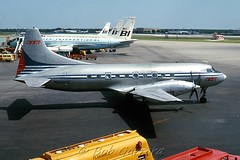
N94205 TTA Trans-Texas Airways
Trans-Texas Airways (TTa) Convair 600 at Dallas Love Field

I had posted previously how in a similar financial situation, New York-based Mohawk Airlines had turned to the services of a small consulting firm called Jet Capital that was headed by a young and quite brash individual named Frank Lorenzo. Lorenzo and his primary business partner, Bob Carney, a fellow Harvard Business School classmate, had become a bit of an upstart darling on Wall Street for their financial wizardry in creating Jet Capital. In their stock offering, Lorenzo and Carney sold shares to the public at 10 cents each, but before the IPO for Jet Capital, they sold shares to friends at $3.50 each but more importantly, they sold shares to each other for 12 cents each. Investing only $44,000 of their money, the Jet Capital IPO netted them $1.5 million yet they controlled 75% of Jet Capital's shares. It was that seed money that Lorenzo used in his failed bid to takeover Mohawk Airlines. At the time of his Mohawk venture, Lorenzo had made friends with Don Burr, a mutual fund manager that had made a name for himself on Wall Street with some very astute aviation stock picks. With his clout as a mutual fund manager that held shares in Texas International, Burr convinced the airline to engage the consulting services of Jet Capital to effect a turnaround. Lorenzo arranged to have the airline's debt refinanced with Burr offering the injection of $5 million from his mutual fund. The result, of course, like their proposed Mohawk deal, was to take control of the airline, and like the Mohawk board several years earlier, the Texas International board was suspicious of Lorenzo and they might have scrapped the deal had it not been for two individuals that entered the ring to try to acquire Texas International themselves- Howard Hughes and Herb Kelleher. 

Ever since Hughes relinquished control of TWA in the late 1960s, he had been craving to get back into the airline business and got that chance with his acquisition of the local service carrier AirWest in 1970, immediately rebranding the airline has Hughes Airwest. But Hughes wanted something on the scope of TWA and his new airline only gave him the West Coast. Acquiring Texas International would get him 2/3 of the way across the country on his goal of recreating a transcontinental airline. For Herb Kelleher, getting Texas International would not only knock out a competitor who only recently tried to put Southwest out of business through legal action, it would also give Southwest the operating certificate of Texas International which permitted flights beyond the states of Texas, something Southwest wasn't able to do at the time. Faced with someone known to be eccentric and someone who they felt was bent on revenge for their failed bid to quash Southwest, the Texas International board sold the airline to Lorenzo in 1972. Like his structuring of Jet Capital, even though he controlled only 24% of the shares in Texas International, Lorenzo structured the deal to give him majority voting control of the airline. At only 32 years of age, Frank Lorenzo became the youngest airline chief since Juan Trippe at Pan Am. And he did it by defeating Herb Kelleher *and* Howard Hughes. Who wouldn't be on top of the world in those shoes?

Frank Lorenzo at the time he took control of Texas International
Don Burr left Wall Street in 1973 to work with Lorenzo in Houston running Texas International. At the time Southwest was adding its fifth and sixth Boeing 737-200 to its nascent fleet and even though Texas International had routes outside of the state of Texas, it was beginning to lose market share within Texas to Herb Kelleher's operation. It was at Texas International that Lorenzo began to earn his reputation as a union-buster- in order to better compete against Southwest, Lorenzo began making deep cuts in labor costs that sowed discord among the employees at Texas International. With labor contracts up for negotiation, the atmosphere became contentious at Texas International. In a pattern that set Lorenzo's pattern for negotiations with both unions and investors, he would often add or change at the last minute agreed-upon terms for the contract. This angered the unions at Texas International and they struck, the very first strike in the history of the small airline. The airline was grounded for four months, but back then in the days before deregulation, there was a mutual aid pact in place where other airlines gave financial support to airlines that were grounded by labor actions. As a result (and much to the other airline's chagrin who felt Lorenzo could have prevented the strike), Texas International got millions under the pact and the strike eventually ended. 
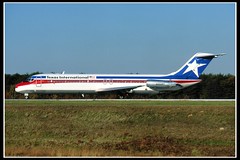
N3508T Texas International Airlines
Texas International Douglas DC-9 Series 30, the airline's largest aircraft

Having got his labor concessions the way he wanted, Lorenzo could now turn his attention to competing with Southwest. At the time, Southwest operated within the "Texas Triangle" of Dallas, Houston, and San Antonio, the state's three largest cities. Kelleher had engaged the services of a seasoned airline executive, Lamar Muse, to guide Southwest's growth. Muse picked the agricultural town of Harlingen in the Rio Grande Valley as Southwest's next destination. The city was ripe for the picking- being at least a seven hour drive from the nearest large city, Harlingen was dependent upon air services from Texas International and the four month strike at the airline had hurt the city economically. Muse had also astutely noted that Harlingen was a short drive from South Padre Island which was at the cusp of starting its tourist boom as a Gulf Coast beach destination. While Texas International would have charged a one way fare of $40 for Harlingen, Southwest charged only $25 and traffic soon boomed with thousands of passengers filling Southwest flights whereas the year prior, Texas International would have only had a few hundred a month. Before long, residents from northern Mexico were crossing the border to also take Southwest flights. Texas International tried various approaches, but it was painfully clear to Lorenzo that he wasn't able to compete head-to-head with Southwest. 

In the days before deregulation, airline fares were set by the Civil Aeronautics Board (CAB) in Washington. Any airline that operated beyond a single state was an interstate carrier and would fall under CAB regulation as was the case with Texas International. Southwest, however, only operated in Texas and therefore was free to set its fares whatever it wished as long as the state authorities in Austin had no objections, which was rarely the case. In November 1976, Lorenzo petitioned the CAB to be allowed to cut its fares- and not just to match Southwest, but to undercut Southwest with a 50% discount- what Lorenzo called "Peanuts Fares" since you could "fly for peanuts". For years airlines had been allowed to implement fare discounts by the CAB, but these were usually for charter flights, holiday flights and red-eye flights and were rarely ever long-term and only applied to a few flights. What Lorenzo was petitioning the CAB to be allowed to do was unprecedented in the airline industry- he was asking for individual authority to set his own ticket prices across the board based on market conditions. This had never been done in forty years, but there were already deregulation forces at work in Washington on the heels of Jimmy Carter's election to the White House. The CAB approved Lorenzo's petition and the Peanuts Fare" were introduced not just to Harlingen, but across Texas International's route system. By the end of the first week, passenger loads on the airline had shot up an astounding 600 percent. 

Peanuts Fares didn't just apply to routes where TI competed with Southwest
Peanuts Fares were a success for the airline and Frank Lorenzo was hailed as a hero by consumer advocate groups. But there was a catch that gnawed at him despite being flush with success at such a young age with such a small airline- the fare experiment suggested strongly that airlines were more than able to manage their own fares without the bureaucracy of the CAB. To the advocates of deregulation, it was ammunition in the battle to eliminate the CAB and deregulate the US airline industry. Just a few years earlier an airline executive could face criminal charges for setting fares without the approval of the CAB, now here was Texas International doing just that and making a huge pile of money in the process and stimulating a boom in passenger traffic. Lorenzo didn't want deregulation, though. Texas International at the time was only the 20th largest airline in the United States. He knew he could be crushed instantly by the Dallas-based giant Braniff International should deregulation happen. Even bigger American Airlines was growing its presence at the new DFW Airport as well, and American had resources and deep pockets that would make Texas International a quick snack in a fully free-market environment. During press interviews at the time, Lorenzo was quick to point out the experimental and temporary nature of the Peanuts Fares. For the time being, the CAB's bureaucracy did shelter him from being crushed by larger airlines for the time being, giving him time to plan his next move. 

But that'll be a blog post for a later date..........

Source: Hard Landing: The Epic Contest for Power and Profits That Plunged the Airlines into Chaos by Thomas Petzinger. Times Business/Random House, 1996, pp 38-50. Grounded: Frank Lorenzo and the Destruction of Eastern Airlines by Aaron Bernstein. Beard Books, 1999, pp 11-15 Photos: Wikipedia, Flickr/Bob Garrard Collection


11 July 2012

The Birth of Indian Commercial Aviation and Its Father


The pre-war network of Tata Air Lines.
Rather curiously amongst Britain's possessions in the interwar years of the 1920s and 1930s, commercial aviation remained neglected in India in comparison to what was taking place elsewhere in the Empire. Some of this was due to perceived stereotypes of the day that the vast majority of India was made up of illiterate peasants and that the British government through New Delhi conducted business with select members of the Indian aristocracy. Some of this was also due to the perception that India already had an extensive rail network that made airlines superfluous. And for many in the main British overseas airline of the day, Imperial Airways, the priority interest in the region was the development of a route connecting the United Kingdom with Australia with India being more of a refueling stop along the way. Whatever the misconceptions and prejudices of the day, development of commercial aviation in India prior to the Second World War became the purview of the country's growing merchant class who saw commercial aviation not just as a tool for business, but also as a business opportunity in a modernizing nation. Foremost amongst these individuals was J.R.D. Tata, the youthful head of the Tata Sons conglomerate which by the 1930s was already the largest business enterprise in India with holdings in manufacturing, textile mills, iron works, and even hydroelectric plants. J.R.D. Tata was so enamored with aviation that he himself learned to fly, earning the first pilot's license to be given to an Indian. 

Unlike Europe, the New Delhi government expected any airline established to be self-funded without any subsidy or assistance. This proved to be significant barrier for any sort of entry into the market, but given that Tata Sons Limited was the largest business in India, funding would be no issue at the start. In July 1932 J.R.D. Tata established an aviation department in the company as private enterprise and on 15 October 1932 launched services connecting Karachi (Imperial Airways' main gateway to India at the time) to the southern city of Madras via Ahmedabad, Bombay and Bellary with a very modest fleet of two De Havilland Puss Moths which could carry two passengers plus the pilot. Tata himself flew the inaugural flight. It was quite an investment for Tata Sons Limited- the New Delhi government didn't just refuse to provide any subsidies, any investment in landing fields and navigational aids was non-existent as well. However, Tata's early success resulted in a ten-year air mail contract that did help offset the investment costs. Over the next several years Tata embarked on route expansions within India along with progressively larger aircraft like the De Havilland Dragon. By 1938 Tata Air Lines served every major city in southern India with connections to Karachi, New Delhi, and Colombo.

Disembarking from a Tata Air Lines DC-3.
During the Second World War, Tata Air Lines proved vital to supporting the war effort and with more contracts in hand, aircraft as large as the Douglas DC-2 were acquired along with further investment in the airport facilities at each of the cities it served, all under J.R.D. Tata's guiding hand. By the end of the war in 1945 not only had Tata expanded services to include every major Indian city, but had earned a position of prominence and reputation that would enhance India's aviation status in the world. The experience of running a scheduled airline to meet the exacting demands of the Allied war effort gave not just Tata valuable experience, but a whole host of other Indian carriers as well, the most prominent of which after Tata Air Lines was Indian National Airlines. By the time of India's independence in 1947 with the subsequent formation of Pakistan, Burma and Sri Lanka, Tata Air Lines found itself not just India's largest domestic airline, but also India's primary international airline as well. Tata Air Lines was on sound financial ground with surplus Douglas DC-3s now filling its fleet needs. On 29 July 1946 J.R.D. Tata took his airline public, raising a significant amount of capital for modernization of the airline's fleet. As part of the airline becoming a publicly-traded corporation, the name was changed to Air India with Tata himself at the helm. One of his first acts as head of the new Air India was an agreement with Howard Hughes' TWA whereby Air India acted as TWA's agent in India in exchange for technical assistance and training and an interchange link to the United States via TWA's own route network. In April of that year, Air India received its first postwar aircraft, the Vickers Viking. Given Air India's status as India's premier airline, Prime Minister Jawaharlal Nehru asked Tata for Air India to be the nation's "chosen instrument" for international expansion (the fact that Tata had already ordered Lockheed Constellations undoubtedly helped). In March 1948 Air India was organized as a joint corporation split between J.R.D. Tata and the Indian government and the first two Lockheed Constellations were delivered to what was now branded as Air India International. On 8 June of that year, "Rajput Princess" and "Malabar Princess" would inaugurate Air India International's first Constellation services to London. 

Air India's early fleet were former Tata Air Lines DC-3s.
Significantly behind the new Air India International were a motley group of domestic carriers, of which the most prominent was Indian National Airways. The other seven airlines were of varying fiscal health and some even were still operating pre-war aircraft. Seeking rationalization in the airline industry of the nation, the Air Corporations Act of 1953 was passed which, in essence, nationalized the airline industry of India. J.R.D. Tata's Air India International obviously shoed-in for the all international services and the remaining seven airlines were merged into one entity named Indian Airlines which would have responsibility for all domestic services- the model being that of BOAC and BEA in the Great Britain. The nationalization of Air India International took place in June 1953 and it was allowed to keep two domestic trunk routes, Bombay-Calcutta and Bombay-New Delhi, in a complex pool agreement with Indian Airlines. The infusion of government capital allowed Air India to order not just Lockheed Super Constellations, but also the new De Havilland Comet as well in order to compete on a more even footing with BOAC's Comet services to the region. Ultimately the Comet order was canceled following the Comet tragedies that struck BOAC, but Air India's Super Constellations stretched its network throughout Asia to Africa and even to Moscow and the rest of Europe. By this time Air India had the clout to join the pooling agreement that BOAC and QANTAS had on the London-Sydney route. Beginning in December 1959, revenues between London and Sydney were split with BOAC getting 51%, QANTAS getting 28% and Air India getting 21%. But the most important aspect of the agreement was Air India getting Fifth Freedom rights from London- in the early 1960s this allowed Air India to launch Boeing 707 services to New York JFK via London Heathrow. 

For over forty years J.R.D. Tata remained at the helm of Air India from its first incarnation as a private company in his business conglomerate to its rise as an international carrier operating Boeing 747s across the globe (South America excepted). He would retire from Air India in 1980 and in 1982 at the age of 82 he re-enacted his inaugural Tata Air Lines flight from Madras to Karachi in a restored De Havilland Leopard Moth- and he did it solo. 

J.R.D. Tata
As an interesting footnote to the story, a few years before J.R.D. Tata retired, he gave a speech to a conference of Pacific area travel agents in New Delhi. After his customary review of the trends in the airline industry, he offered up a few predictions for the future of the airline industry that today are remarkably accurate:

-He anticipated the need for jetliners bigger than the 747, specifically pointing out opportunities for a 750-seat twin-deck jetliner.
-He accurately had predicted the pace of long-term growth in passenger numbers.
-He praised Sir Freddie Laker and his ideas on low-cost fares to stimulate more passenger traffic and was convinced that such budget fares were the wave of the future for the industry.
-He bemoaned the lack of foresight by the Indian government in investing in its aviation infrastructure, predicting that lack of capacity would be the biggest threat to the airline growth in India in the future.
-He questioned the economics of the Concorde and felt that supersonic flight would have little bearing on the future of jetliner development. 

Source: Airlines of Asia Since 1920 by R.E.G. Davies. Palawdr Press, 1997, p6-59.

01 July 2012

The First B-25 Mitchell Executive Transports


General Eisenhower's personal B-25 transport in its later years.
Until the arrival of the Grumman Gulfstream I in 1958, the Lockheed Jetstar in 1960 and the Hawker Siddeley HS.125 in 1962, there weren't any aircraft that were designed specifically as business transports. From the end of the Second World War until the 1960s, most companies had the option of buying up surplus Douglas DC-3 or C-47 aircraft, getting a small piston-engined aircraft from the likes of Cessna, Beech, or Piper, or a refitted surplus bomber- this latter option was clearly the high end as ex-bomber aircraft usually had a speed and range advantage over both the DC-3 and smaller piston aircraft. These executive conversions were the cream of the crop of business aviation in those days, the 1950s and 1950s counterpart to today's Gulfstreams and Global Express bizjets. A whole new industry developed in the postwar era to cater to this high-end market. 

One of the more common executive conversions from any several companies in those days used the North American B-25 Mitchell as the base aircraft- they were inexpensive to acquire, readily amenable to modification, and had a reputation as good-handling aircraft (which was why there were so few B-26 executive conversions after the Second World War). But years before the 1950s boom in the market, North American Aviation itself pioneered the concept of using the B-25 as an executive transport. 

The very first B-25 Mitchell to be converted just so happened to be the very first B-25 Mitchell with the serial number 40-2165. That's right. The prototype production B-25 that made its maiden flight in 1940. It had been modified in several ways as the flight test program proceeded and by 1942 it was deemed to have cost too much to have had it modified to the standard that was being delivered to the USAAF in those days, so it sat in a corner of the North American Aviation's facility at Mines Field (today's LAX). At this point in the B-25 program, North American now had two plants running at full capacity turning out Mitchells- the Fairfax plant in Kansas City, Kansas, and one at Hensley Field in Dallas (which later became NAS Dallas). In addition, North American executives and engineers were regularly moving amongst the suppliers nationwide as well as Washington DC and Wright Field in Dayton, Ohio, where the USAAF's technical division was located. During the war, airline service wasn't dependable as most of the air capacity was used by the military to support the war effort and travel by train was too slow. Dutch Kindelberger, president of North American Aviation, ordered the stored prototype to be converted into an executive transport. Seven passengers seats were installed, two ahead of the bomb bar and five  in the aft fuselage. The bomb bay became a baggage compartment and bunks were installed above it. Four windows were installed in the aft fuselage for the passenger cabin and the glass nose was made solid with a smooth aluminum skin. Carpeting, upholstery and extensive soundproofing were also added as well as a small bar- something not highlighted or admitted to by North American- which got the aircraft the nickname "Whiskey Express". It was used extensively by the North American corporate brass until January 1945 when it had to be scrapped after a runway overrun at Mines Field. 

The second B-25 modified by North American belonged to USAAF General Henry "Hap" Arnold- visiting the Inglewood facility at Mines Field one day, Arnold got to see the Whiskey Express and as the Chief of Staff, he decided he needed one, too. This was 1943 and production was rapidly accelerating in the B-25 program, so it was easy to divert a B-25C from production to be fitted out by North American to a similar standard as Whiskey Express. After the war, General Arnold's personal transport was purchased by Howard Hughes who used for another twenty years before it was retired. 

The same year Arnold got his own B-25, a B-25J was taken off the production line in Kansas City and flown to Inglewood on a "secret" mission. Tail number 43-4030 was fitted out to become the personal transport for General Dwight Eisenhower. Unlike Arnold's B-25 which had olive drab upholstery, Ike's Mitchell had a more stylish blue interior. Clamshell doors were fitted to the nose for easy access to the extra communications and navigation equipment and more floor space in the aft fuselage was created by moving the gunner's aft hatch further back, giving the rear cabin more seating and a drop leaf table. Overhead luggage racks were also fitted and extra fuel tanks were fitted to the bomb bay to give it more range. Officially it was designated an RB-25J to hide its true nature as Ike's personal transport, but as the war in Europe progressed, it was redesignated CB-25J and when Eisenhower moved up to larger aircraft as the Supreme Allied Commander, the CB-25J was passed on for use by lower ranking generals and was used by the USAF postwar until it ended up in the possession of the South Dakota Air and Space Museum where it can be seen today. 

In 1944, General Arnold traded up to a newer Mitchell transport. Maybe it was knowing Ike had a nicer one than him, who really knows, but tail number 44-28945 was taken from the production line and fitted out identically to the Eisenhower's aircraft. Arnold used it until 1946, but it remained in USAF use for a number of years flying colonels around well into the 1960s. 

When the Whiskey Express got scrapped, the North American brass decided a replacement was needed. The same month that the Whiskey Express had its accident, a B-25J was pulled from the production line and fitted out to nearly the same standards as Eisenhower's aircraft and Arnold's second aircraft. But knowing the war was soon over, North American decided to go the extra mile thinking there might be a postwar market for the company in such a conversion (years before any such companies specializing in such conversions were in that business!). Extra navigational equipment as well as a cabin heater were added and it entered service in March 1945. Between flying for North American executives, it was flying a test program to get certification as an executive transport. But on 27 February 1946 during a test flight out of Mines Field over the Pacific, the flight crew radioed a mayday that a wing was on fire before the aircraft tragically exploded. 

N5126N, North American's last shot at a business transport
North American decided it had had enough of the conversion market after that tragic loss, but in 1950 with the rise of aftermarket companies that were doing the very same thing North American had done during the Second World War, they decided to take a second shot at the executive transport market. A surplus B-25J was used and this time a new nose that was 14 inches wider was added which allowed room for four passenger seats ahead of the bomb bay but behind the flight deck in addition to the aft fuselage cabin. The bomb bay was permanently closed and replaced with an baggage door and an electric lift at the front of the former bomb bay. Because of the wider nose, a new windshield was needed and the windshield from the Convair 240 worked perfectly. To reduce noise, a circular exhaust collector was used on the engines instead of having several separate exhaust stacks. Nicknamed the "Bulbous Nose B-25", it had the tail number N5126N. Flight testing began, but ended tragically a second time on 25 March 1950 when N5126N broke up in a thunderstorm over Arizona, killing seven North American flight crew and engineers. With that loss, North American decided to abandon the project. 

Through the 1950s, though, the USAF still had quite a few B-25s flying as transports on strength and contracted the Hayes Aircraft Company in Birmingham, Alabama, and the Tucson, Arizona, branch of Hughes Tool Company to carry out conversion work on the B-25s. While not as extensive as the Bulbous Nose B-25 aircraft, they definitely drew upon North American's work. Many of these converted B-25s became trainer aircraft with the military through the 1960s, not just with the USAF but also the Royal Canadian Air Force. 

Source/Photos: Deadly Duo- The B-25 and B-26 in World War II by Charles A. Mendenhall. Specialty Press, 1981, p101-111.

05 August 2010

The History of the TWA Moonliner

In the fall of 1955 a new Disneyland attraction opened to great fanfare as the centerpiece of Tomorrowland. Designed by Disney imagineer John Hench, the TWA Moonliner stood 76 feet tall as a 1/3 scale replica of what a 1986-era Moonliner was conceptualized to look like. Hench worked with the NASA rocket scientists Werner von Braun and Willy Ley in creating the Moonliner. Early in the design process, Ralph Damon, the president of TWA, was brought in as part of a classic marketing coup by Disney to sponsor the Moonliner attraction. At the time, TWA was the official airline of Disneyland, and TWA's classic red stripes on white would adorn the new Moonliner. The Moonliner stood eight feet taller than Sleeping Beauty's castle that formed the centerpiece of the Disneyland park.

Inside the main attraction housed next to the Moonliner, Disney visitors entered a futuristic ticketing and boarding area complete with flight attendants and gate agents in futuristic TWA uniforms. TWA signage adorned the simulated terminal area and large viewscreens and animated models demonstrated to waiting visitors the workings of the atomic-powered Moonliner and the planned routing to visit the Moon after liftoff. The passenger compartment of the attraction featured one of the first uses of air jackhammers and hydraulics to heighten the sensation and simulation of a rocket launch and spaceflight while two large screens displayed the progress of the flight. The PA system featured a baritone voice announcing himself as "Captain Collins, welcome aboard the TWA Moonliner 'Star of Polaris' for our flight to the Moon."

Once visitors exited the ride, they were ushered through what Disney called "Hobbyland" where they could buy toys and models of the TWA Moonliner and other space-themed attractions at Tomorrowland. Disney inked an exclusive deal with Strombecker Models to create the models and toys to be sold next to the attaction in the first widespread instance of what we now call cross-marketing that features so prominently with today's movies and television shows. At the same time Disney opened the TWA Moonliner, their Sunday evening television program featured a three part series titled "Man in Space" in which one part of the feature used scenes shot at the TWA Moonliner.

One year after the opening of the TWA Moonliner attraction, Howard Hughes had a 22-foot replica of the Moonliner added to the roof of the TWA headquarters building in Kansas City, Missouri at 18th Street and Baltimore. When Howard Hughes sold his stake in TWA in 1962, not only was this replica Moonliner removed and sold to a local company, but TWA also ended its sponsorship of the Moonliner attraction and Disneyland. It became the Douglas Moonliner when Douglas Aircraft Company became the attraction's sponsor and the Moonliner itself was repainted in Douglas' blue and red colors with the company name running down the side. With the merger of St. Louis-based McDonnell Aircraft Company and Douglas Aircraft Company in 1967, sponsorship ended and the Moonliner was taken down. In 1975 the Flight to the Moon attraction itself became the Mission to Mars attraction.

In 1997, a Missouri-based collector of Disney memorabilia purchased the deteriorating Moonliner replica that sat atop the TWA headquarters building. After a long restoration process, it now sits as part of the Airline History Museum's display at Kansas City's Wheeler/Downtown Airport. In 2006, a real estate development group bought the old TWA headquarters building and remodeled it as part of a new arts district. As a tribute to the building's past history as TWA's Kansas City headquarters, a slightly smaller but fully lit TWA Moonliner replica was built atop the building.

Source: From Props to Jets: Commercial Aviation's Transition to the Jet Age 1952-1962 by Craig Kodera, Mike Machat, and Jon Proctor. Specialty Press, 2010, p70-71.