Showing posts with label Polaris. Show all posts

23 January 2016

What Your Kitchen Refrigerator and Ballistic Missiles Have in Common: Freon


While liquid-fueled rocket engines have been the mainstay for the satellite launch industry, the long road of technological development in solid-fuel rockets have also benefited the aerospace industry. Often times unique solutions were needed in the development of solid-fuel rockets. One of the more unusual ones was the use of liquid freon to direct the exhaust flame from solid-fueled rockets. That's right. Liquid. Freon. How? I'll get to that.

Minuteman II test launch
(National Park Service/Minuteman Missile NHS)
In the 1950s the conventional wisdom in ICBM development was that only liquid-fueled engines had the power to lift the heavy nuclear warheads of the day. The two main ICBMs in development, the Atlas and the Titan, used liquid-fueled engines. But the US Navy, seeking to put ICBMs on nuclear submarines as a sea-based strategic deterrent, considered liquid-fuels on a submarine wholly impractical and not just for safety reasons. As a result, the engineers who were developing the Polaris SLBM focused their efforts on solid-fuel rocket motors for the missile. They were storable and could be quickly fired. In addition, with enough right mix of solid propellants, the missile could be much smaller than a comparable liquid-fueled missile.

The advantages of a storable propellant and rapidity of launch made solid-fuel an attractive option for a land-based ICBM as well. In the US Air Force, General Bernard Schriever was in charge of the Air Force's ICBM development effort as the head of the Western Development Division. While he initially believed that liquid-fueled engines were the only way to power an operational ICBM, he was ably convinced by several of his engineers to look at solid-fuels as an alternative. That tangent then took on an important priority equal to that of the Atlas and Titan programs, becoming the Minuteman ICBM which was developed in the same time frame as the Navy's Polaris missile. The two weapons shared many similar characteristics due to their solid-fuel rocket engines. The first variant of the Minuteman, the LGM-30A Minuteman I, became operational at Malmstrom AFB in Montana in 1962. 
First SLBM launch, 23 July 1960.
Polaris A1 from the USS George Washington
(US Navy)
The first solid rockets used tabs that jutted into the exhaust stream to deflect the plume for directional control. It was the simplest system but to provide effective control and deflection, the tabs had to be of a size that inevitably cut into the exhaust stream's total velocity. The next solution was what the Polaris team called "jetevators". The exhaust cone of the solid rocket had an extension at the bottom of the cone that was in effect, a gimbaled extension of the skirt (rather than moving the whole nozzle assembly) and small actuators moved the whole extension. Jetevators were used on the first versions of the Polaris SLBM, the A1 and A2 variants. The main disadvantage of jetevators was they added technical complexity to the solid rocket motor as well as weight. Small jetevators could only provide slight corrections but to provide more significant directional control, larger and heavier jetevators would be needed.

Both the early versions of Polaris and Minuteman used jetevators on each of the three stages of the missiles, with the first and second stages of both missiles having four nozzles that could be differentially vectored to provide control. By 1962, however, the next versions of the missiles were already in development- for Polaris it was the A3 version (third version) and for the Minuteman it was the Minuteman II (second version, obviously). In both missiles a range increase was desired and one way to get it was to lighten the missile itself. For both new versions, the second stage switched from four nozzles with jetevators to a single nozzle that used what was called "liquid injection thrust vectoring control". For both the LGM-30B Minuteman II and the UGM-27C Polaris A3, a bigger second stage with the new liquid injection thrust control got the range increases needed. 

1964 patent diagram for liquid
injection thrust vectoring control.
(Google Patents)
Around the perimeter of the nozzle about 1/2 the way up were a series of four ports that angled slightly upward. Liquid freon was injected into one of the ports and as it did, it created a shockwave in the nozzle that pushed the exhaust stream in a direction up to 7 to 10 degress opposite from the port the freon entered. The freon didn't react with the hot plume, it merely created a thermal shockwave that pushed the plume one direction. By injecting freon into the various ports, directional control could be achieved for a lot less weight than traditional actuator-driven control mechanisms. 

On the Minuteman II, the second stage carried 262 pounds of freon in a rubber bladder to use for thrust vectoring. The Minuteman II and Polaris A3 weren't the first missiles to use this novel method of control. That honor goes to the Lance short-range battlefield missile that was used by the US Army until the 1960s. The knowledge gained from the Minuteman II and Polaris A3 in liquid injection thrust vectoring control would be used to its fullest on the large solid rocket boosters used on the Titan III and Titan IV launchers, long the mainstay of US expendable heavy-lift vehicles. Both boosters on the Titan launchers used liquid injection thrust vectoring control. If you look at a picture of a Titan III/IV at launch, you'll notice a small external tank attached to the core rocket's base, one for each booster. That's the reservoir for the liquids used for the thrust vectoring system of the solid rocket boosters.
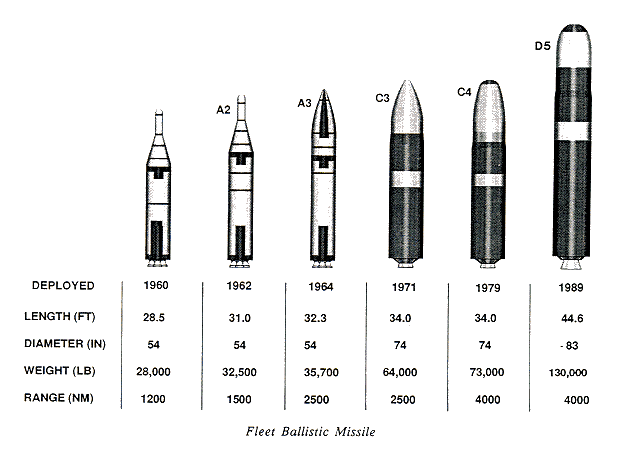
From left to right: Polaris A1, Polaris A2, Polaris A3, Poseidon C3, Poseidon C4, Trident D5
(Federation of American Scientists)
The Polaris was superseded in the Navy's strategic deterrent by the Poseidon, which was followed by  the current missile, the Trident. The Minuteman II was retired from service and the land-based ICBM deterrent for the United States relies on the Minuteman III.

Further reading: 

Martin, the Titan I and the Titan II Ballistic Missiles
One of the Most Important Missions of the Douglas C-133 Cargomaster: Transporting ICBMs


Source: To Reach the High Frontier- A History of US Launch Vehicles, edited by Roger D. Launius and Dennis Jenkins. The University Press of Kentucky, 2002, p262-266.

03 November 2015

Regulus: The US Navy's First Operational Nuclear Missile

Regulus missile on an aircraft carrier deck.
Following the defeat of Germany in May 1945, the US Navy began experimentation with the German V-1 "buzz bomb" as a submarine-launched weapon called the JB-2 Loon. Both the Navy as well as the Army drew up plans to use the JB-2 during the planned invasion of the Japanese Home Islands, but the war in the Pacific ended in August of that year before the plans could be put into place for use of the Loon. This didn't put a stop to development work, though- in March 1946, Secretary of the Navy James Forrestal approved plans to convert two submarines to operate the Loon on an experimental basis. While the Loon was never planned in the postwar period to be an operational missile, it was planned to give the submarine force experience in operating cruise missiles. In 1947 the Navy began development of several supersonic land-attack cruise missiles- one was the Mach 2 Rigel and the other was the Mach 3.5 Triton, both powered by ramjets. At the time, ballistic missile technology was at a point where they weren't practical nor compact enough to be fired from submarines, so the Navy was hitching its submarine nuclear deterrent on the cruise missile. The level of technology required for the Rigel and Triton were far above what was state of the art for the late 1940s, so while development work continued and technology matured, an interim cruise missile for the sub force was needed and this task was given to Vought Aircraft who then developed the Regulus missile- originally planned to carry a 4,000 lb conventional warhead, in 1949 Vought was directed to use a nuclear warhead on the Regulus, making the first US Navy missile to carry a nuclear warhead. 

The Regulus featured folding wings and a tail fin to allow it to be carried aboard a submarine. Powered by an Allison J33 engine (also used on the Lockheed F-80 and T-33 Shooting Star), Regulus was a subsonic missile with an approximately 500 nautical mile range. It was boosted from the missile by two solid rocket boosters that fell away once the J33 engine took over propelling the missile. The missile guidance was by radio command- the system was called "Trounce" and it directed the missiles nearly all the way to the target. Not only were submarines and ships capable of guiding Regulus using Trounce, but the Navy also had specialized Regulus guidance squadrons equipped with the North American FJ Fury that could be embarked aboard fleet carriers as needed. The first Regulus flight took place on 29 March 1951- this early Regulus missile had its own landing gear to take off and land under its own power and was controlled from another aircraft. Test launches were made from surface ships the following year. 

Firing a Regulus from the USS Tunny.
Two diesel-electric submarines were the first to be converted to carry and fire the Regulus. The USS Tunny (SSG 282, the "G" for missile) and the USS Barbero (SSG 317) were fitted with a rather cumbersome hangar aft of the conning tower which itself was modified to carry the Trounce guidance equipment. Converted at the Mare Island shipyards near San Francisco, the Tunny was recommissioned in March 1953 and the Barbero returned to the fleet in October 1955. The first submarine launch of the Regulus took place on the USS Tunny on 15 July 1953. On both ships, the Regulus missile hangar would hold two missiles- to fire the Regulus, the submarine had to surface and the missile had to be manually rolled out of the hangar and manually unfolded to prepare it for launch. 

While the submarine force got ready for the Regulus, the Navy went ahead and deployed it from surface ships (several cruisers and aircraft carriers deployed with the Regulus) with the 50 kiloton Mk 5 warhead starting on May 1954. The first overseas deployment of the Regulus actually took place with surface ships- in 1955 the cruiser USS Los Angeles (three missiles) and the aircraft carrier USS Hancock (four missiles) deployed to the Western Pacific to cover Soviet targets in the Far East. It wasn't until 1958 that the Regulus went to sea aboard a submarine. Joining the USS Tunny and USS Barbero were two purpose-built diesel electric subs that were modifications of an existing design- the USS Grayback (SSG 574) and the USS Growler (SSG 577) were completed in 1958- the Grayback was built at Mare Island and the Growler was built at the Portsmouth shipyards in New Hampshire. There were plans initially to have Regulus capability on the first nuclear submarine, the USS Nautilus, but it was felt to minimize risk, the Nautilus was completed as a non-cruise missile submarine. However, funds were made available for a nuclear-powered Regulus submarine, and in 1960 the USS Halibut (SSGN 587) was commissioned, giving the US Navy five Regulus-armed boats. 

The first submarine nuclear deterrent patrol took place during the 1958 Lebanon crisis when the USS Tunny was ordered to patrol in the North Pacific to make up for the usual aircraft carrier that would have been present to hold Soviet targets in the Far East "at risk". This was more than two years before the first ballistic missile submarine, the USS George Washington, went to see with the Polaris SLBM. The USS Barbero was assigned to the Atlantic fleet and carried out deterrent patrols there from April 1956 to late 1958 before the Navy consolidated its Regulus subs with the Pacific Fleet. From September 1959 to July 1964, the Navy had at least one submarine on deterrent patrol in the North Pacific- the diesel electric boats would refuel at either Adak, Alaska, or Midway Island, before going out on the patrol. The sole nuclear-powered Regulus boat, the USS Halibut, didn't need the refueling stops. During that period, forty-one Regulus patrols were conducted, sometimes two of the subs were on patrol at once. The Regulus missiles during this period were armed with two megaton W27 warhead which replaced the earlier Mk 5 warhead.

Regulus launch from the USS Halibut.
The successor to the Regulus was to have been the supersonic Regulus II with twice the range and a heavier warhead. The development got as far as having a Regulus II fired from the USS Grayback in September 1958, but three months after the sub launch the Regulus II program was canceled as the decision had been made to accelerate and enlarge the Polaris missile program which was shaping up to be a much more practical system than cruise missiles. The Regulus missiles were retired as the Polaris come on line, the last Regulus deterrent patrol taking place in July 1964 which was five months before the Polaris missile patrols commenced in the North Pacific. Both the Barbero and Tunny were scrapped, but the Growler would become a museum boat in New York City at the Intrepid Sea-Air-Space Museum (it has a Regulus missile displayed in launch configuration). The USS Grayback become a special forces transport and served in this role until 1984. The USS Halibut had an impressive second career as an intelligence platform to carry out clandestine ocean operations. It served in this role until 1976. 

The Regulus ended up being an interim placeholder for the US Navy until the arrival of the ground-breaking Polaris missile. For almost five years, the Regulus subs patrolling the North Pacific were the only submarine nuclear deterrent. In fact, the USS Halibut was the second nuclear sub to be built to operate missile armament- the honor of the first actually goes to the USS George Washington with its Polaris missiles. It was launched five days before the USS Halibut in 1960, but it wasn't until late 1964 that it went on an operational deterrent patrol with Polaris.

Source: Cold War Submarines- The Design and Construction of US and Soviet Submarines by Norman Polmar and KJ Moore. Potomac Books, 2004, p86-93. Photos: US Navy Historical Center, Wikipedia.

22 August 2010

The Beriev A-150

During the 1960s a strategic shift was taking place in nuclear deterrent doctrines as the United States Navy began putting to sea increasing numbers of Polaris sea-launched ballistic missiles (SLBMs) aboard nuclear-powered ballistic missile submarines beginning in 1960 with the first deterrent patrols of the George Washington-class. With improvements in the Polaris missile coming rapidly that bestowed even greater range, the Soviet Union, lacking a blue-water navy in the 1960s looked to unique if not creative answers to seek out and destroy the American SSBNs which no longer needed to lurk close to Soviet shores to reach remote ocean areas not normally patrolled by the Soviet Navy.

In 1965 the Beriev OKB was tasked with developing one of the most impressive unbuilt flying boat designs that had as its core mission to seek out and destroy the SSBNs in remote ocean areas. The Beriev A-150 built on the design bureau's already extensive expertise in flying boats that included the jet powered Be-10 that saw limited service with the AV-MF (naval air force) in the 1950s. The A-150 was to have been a multi-role amphibian with a large delta wing that bestowed on it a large internal volume for missions that not only included long range anti-submarine warfare, but also anti-suface vessel warfare, maritime reconnaissance, search and rescue and an inflight tanker. In addition, Beriev developed transport variants that not only had military roles, but could also have been used for resource development in the Soviet Far East where ground networks of roads and rails were near non-existent.

The A-150 would have been 163 feet long with a wingspan of 137 feet. Paired nacelles above the wings would have housed Kuznetsov NK-8 turbofans (used on the Il-62 and Tu-154 jetliners). In addition, twelve Kolesov RD36 lift engines would have been installed in the leading edge roots to help shorten the takeoff run of the A-150. Inside the wing center section on each side of the fuselage were equipment bays that could accommodate interchangeable mission pods depending upon the mission tasking. Each bay and mission pods had standardized connections allowing the A-150 to be retasked in minimal time. Each pod had a volume of just over a thousand cubic feet. Some pods were weapons bays, others included ASW equipment like dunking sonar, sonobuoys and torpedoes. With a crew of 5 and a range of nearly 11,000 miles, the A-150 would have been an impressive machine.

Beriev also developed the A-150DT version which had a larger fuselage and a clamshell "tailgate" that allowed heavy loads to be driven directly into the fuselage cargo deck. The total cargo capacity of the A-150DT was nearly 70,000 lbs and it had 16 instead of 12 RD36 lift engines to handle the increased weight. There was even exploration of a VTOL version with 32 lift engines! The A-150DT was intended as an assault transport but its capabilities also made it useful in Siberian resource development and supporting the Soviet fishing fleet at sea. The assault transport version also had two twin-cannon turrets, one for the tail and one in the nose section.

Ultimately Beriev's ambitious A-150 proved to be too much aircraft for the prevailing technology of the day and the Soviet answer to the American SSBN fleet was to increase its own fleet of nuclear-powered hunter killer subs (SSNs).

Source: Beriev's Jet Flying Boats (Red Star Volume 28) by Yefim Gordon, Andrey Sal'nikov, and Alexandr Zoblotskiy. Ian Allan/Midland Publishing, 2006, p96-97.