Showing posts with label Minuteman. Show all posts

23 January 2016

What Your Kitchen Refrigerator and Ballistic Missiles Have in Common: Freon


While liquid-fueled rocket engines have been the mainstay for the satellite launch industry, the long road of technological development in solid-fuel rockets have also benefited the aerospace industry. Often times unique solutions were needed in the development of solid-fuel rockets. One of the more unusual ones was the use of liquid freon to direct the exhaust flame from solid-fueled rockets. That's right. Liquid. Freon. How? I'll get to that.

Minuteman II test launch
(National Park Service/Minuteman Missile NHS)
In the 1950s the conventional wisdom in ICBM development was that only liquid-fueled engines had the power to lift the heavy nuclear warheads of the day. The two main ICBMs in development, the Atlas and the Titan, used liquid-fueled engines. But the US Navy, seeking to put ICBMs on nuclear submarines as a sea-based strategic deterrent, considered liquid-fuels on a submarine wholly impractical and not just for safety reasons. As a result, the engineers who were developing the Polaris SLBM focused their efforts on solid-fuel rocket motors for the missile. They were storable and could be quickly fired. In addition, with enough right mix of solid propellants, the missile could be much smaller than a comparable liquid-fueled missile.

The advantages of a storable propellant and rapidity of launch made solid-fuel an attractive option for a land-based ICBM as well. In the US Air Force, General Bernard Schriever was in charge of the Air Force's ICBM development effort as the head of the Western Development Division. While he initially believed that liquid-fueled engines were the only way to power an operational ICBM, he was ably convinced by several of his engineers to look at solid-fuels as an alternative. That tangent then took on an important priority equal to that of the Atlas and Titan programs, becoming the Minuteman ICBM which was developed in the same time frame as the Navy's Polaris missile. The two weapons shared many similar characteristics due to their solid-fuel rocket engines. The first variant of the Minuteman, the LGM-30A Minuteman I, became operational at Malmstrom AFB in Montana in 1962. 
First SLBM launch, 23 July 1960.
Polaris A1 from the USS George Washington
(US Navy)
The first solid rockets used tabs that jutted into the exhaust stream to deflect the plume for directional control. It was the simplest system but to provide effective control and deflection, the tabs had to be of a size that inevitably cut into the exhaust stream's total velocity. The next solution was what the Polaris team called "jetevators". The exhaust cone of the solid rocket had an extension at the bottom of the cone that was in effect, a gimbaled extension of the skirt (rather than moving the whole nozzle assembly) and small actuators moved the whole extension. Jetevators were used on the first versions of the Polaris SLBM, the A1 and A2 variants. The main disadvantage of jetevators was they added technical complexity to the solid rocket motor as well as weight. Small jetevators could only provide slight corrections but to provide more significant directional control, larger and heavier jetevators would be needed.

Both the early versions of Polaris and Minuteman used jetevators on each of the three stages of the missiles, with the first and second stages of both missiles having four nozzles that could be differentially vectored to provide control. By 1962, however, the next versions of the missiles were already in development- for Polaris it was the A3 version (third version) and for the Minuteman it was the Minuteman II (second version, obviously). In both missiles a range increase was desired and one way to get it was to lighten the missile itself. For both new versions, the second stage switched from four nozzles with jetevators to a single nozzle that used what was called "liquid injection thrust vectoring control". For both the LGM-30B Minuteman II and the UGM-27C Polaris A3, a bigger second stage with the new liquid injection thrust control got the range increases needed. 

1964 patent diagram for liquid
injection thrust vectoring control.
(Google Patents)
Around the perimeter of the nozzle about 1/2 the way up were a series of four ports that angled slightly upward. Liquid freon was injected into one of the ports and as it did, it created a shockwave in the nozzle that pushed the exhaust stream in a direction up to 7 to 10 degress opposite from the port the freon entered. The freon didn't react with the hot plume, it merely created a thermal shockwave that pushed the plume one direction. By injecting freon into the various ports, directional control could be achieved for a lot less weight than traditional actuator-driven control mechanisms. 

On the Minuteman II, the second stage carried 262 pounds of freon in a rubber bladder to use for thrust vectoring. The Minuteman II and Polaris A3 weren't the first missiles to use this novel method of control. That honor goes to the Lance short-range battlefield missile that was used by the US Army until the 1960s. The knowledge gained from the Minuteman II and Polaris A3 in liquid injection thrust vectoring control would be used to its fullest on the large solid rocket boosters used on the Titan III and Titan IV launchers, long the mainstay of US expendable heavy-lift vehicles. Both boosters on the Titan launchers used liquid injection thrust vectoring control. If you look at a picture of a Titan III/IV at launch, you'll notice a small external tank attached to the core rocket's base, one for each booster. That's the reservoir for the liquids used for the thrust vectoring system of the solid rocket boosters.
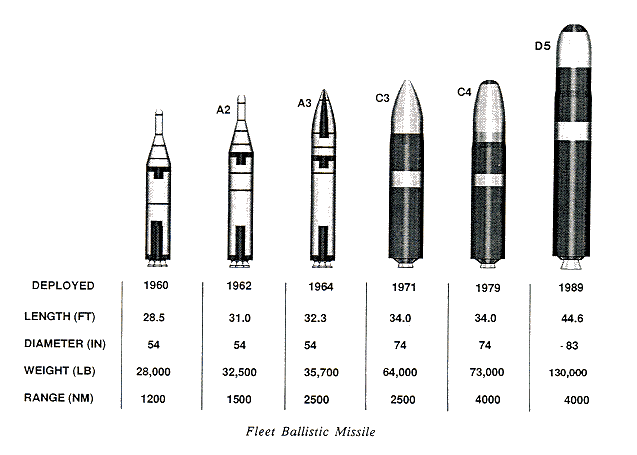
From left to right: Polaris A1, Polaris A2, Polaris A3, Poseidon C3, Poseidon C4, Trident D5
(Federation of American Scientists)
The Polaris was superseded in the Navy's strategic deterrent by the Poseidon, which was followed by  the current missile, the Trident. The Minuteman II was retired from service and the land-based ICBM deterrent for the United States relies on the Minuteman III.

Further reading: 

Martin, the Titan I and the Titan II Ballistic Missiles
One of the Most Important Missions of the Douglas C-133 Cargomaster: Transporting ICBMs


Source: To Reach the High Frontier- A History of US Launch Vehicles, edited by Roger D. Launius and Dennis Jenkins. The University Press of Kentucky, 2002, p262-266.

14 March 2010


A year ago today I created this blog as an extension of my own fascination with aviation history, from the aircraft to the personalities that shaped the development and use of aviation since its earliest days. I've always been an inverterate reader when it comes to aviation books and any given time I'll have several books I'm rotating through covering diverse topics in aviation history. I started this blog last March to share even just a bit of the enjoyment I get out of my trips through the history of flight and that became the subtitle for Aviation Trivia of the Day- "Short Trips on the Long Road of Aviation History".

I thought finding an appropriate bit of aviation trivia for Christmas was challenging, trying to think of something appropriate for the one year anniversary of this blog was even harder. I remembered one time having a discussion on Airlinebuzz with my fellow aviation geeks about heroes and role models in aviation. A lot of what happens now in aviation is shaped by many individuals working for a common goal and less so do we have figures like the Orville and Wilbur Wrights or the Donald Douglases or Scott Crossfields and Neil Armstrongs to even individuals like C.R. Smith or C.E. Woolman. Sure, we have standouts now and then these days like Burt Rutan or Herb Kelleher, but I suspect that kids today don't name the personalities of aviation as their role models and heroes.

Mind you, I was virtually an "avgeek" from the get-go, so growing up I had an natural inclination to want to read as much about these folks as I could, whether it was aces like James Jabara or Robin Olds, designers like Igor Sikorsky or Jack Northrop, test pilots like Al White, or pioneers like Amelia Earhart or Yuri Gagarin.

I'm every bit still an avgeek despite a day job that has nothing to do with aviation. So I figured for today I'd talk a bit about one of these aviation figures that always impressed me and to this day as an adult still do. I'll admit this is an unusual choice, but for me it's a mix of what United States Air Force General Bernard Schriever set out to do and what his legacy today has become.

Born in 1910 in Bremen, German, Bernard Schriever found himself bound for the United States as a young boy when the passenger ship his father served on was interned during the First World War in New York. His family settled in the Texas Hill Country where many German immigrants of the day settled and though his father passed away in an industrial accident in 1918, the young Schriever worked hard in school, graduating with honors from San Antonio High School and would go on to graduate with honors as well with a degree in architectural engineering from Texas A&M in 1931. He excelled in ROTC and this earned him his pilot's wings at Kelly Field in San Antonio in 1933.

But Schriever applied himself to his hobbies as well- he worked as a caddy through school and managed to become quite the golfer himself. During the inter-war period, he even briefly played professional golf in addition to flying with the US Army's air mail service, commanding a Civilian Conservation Corps, and even flew for a while for Northwest Airlines.

But his calling came with World War II, flying 63 combat missions in the Pacific with the USAAF's 19th Bombardment Group. He was one of the key personalities in the postwar independent United States Air Force that shaped the USAF's emphasis on technology as he had come to work with the famed aerodynamicist Theodore Von Karman on emerging technologies that would be of use for the nascent USAF. He became the defacto technical expert in the USAF in this field, often clashing with the pragmatic and often bombastic Curtis LeMay, head of the Strategic Air Command.

In the 1950s, LeMay's emphasis on the manned bomber as the main nuclear deterrent force on the United States was near-unassailable. The Navy had a small carrierborne deterrent, but that was it. Schriever saw the future of nuclear deterrence and the security of his adopted homeland would not be with bombers, but with ballistic missiles as he observed the leaps and bounds made by the Russians in their space program. After all, if they could put in Sputnik into orbit, it wasn't that much more of an effort to put a nuclear warhead in the United States.

Having won the confidence of his superiors with his technical knowledge and unassuming style (Schriever's superiors also happened to be General LeMay's superiors) that enabled him to outpace LeMay, he became the head of what was then called the Western Development Division of the USAF and given nearly free-reign to not just handpick his staff and subordinates, but also to engage a new defense procurement and management style that was radical for the day- the WDD would act as a systems manager and integrator, and subcontract parts of weapons systems to defense companies. He actively promoted competition amongst the contractors to spur technological progress but also divided subprojects amongst deserving companies to reduce risk.

When President Eisenhower declared fielding an operational intercontinental ballistic missile was of the "utmost national priority", General Schriever had all the pieces in place to lead the development and fielding of a nuclear deterrent that would eclipse LeMay's bomber force in strength, technology, and security. This was one of the reasons LeMay saw Schriever as a threat- what Schriever could deliver would make LeMay's massive bomber fleets irrelevant in the nation's nuclear strategy. When Schriever got his fourth star, LeMay remarked "If it were up to me, he'd never have gotten that star."

By the time the Atlas ICBM project was underway, the Western Development Division had along with the contractors over 18,000 scientists, 17 major defense companies, over 200 subcontractors, 3,500 suppliers for a total of approximately 70,000 people in an effort that dwarfed the Manhattan Project. Just before Sputnik's launch in 1957, the Western Development Division became the USAF's Ballistic Missile Division (BMD) and under Schriever's leadership, the USAF not only rapidly fielded the Atlas missile (first flight was in June 1957 and the first missile went on alert in January 1958), but also developed, flight tested and fielded the Thor IRBM, two version of the Titan ICBM (the Titan I and the more advanced Titan II) and three versions of the Minuteman ICBM (Minuteman I and II, and Minuteman III, today still the cornerstone of the United States' missile deterrent). And this all occurred in a seven year period between the first Atlas contractor awards in January 1955 and the first operational Minuteman missiles going on alert in November 1962!

By comparison in the same time period, the Convair F-102 Delta Dagger interceptor took ten years from initial awards to operational deployment. To this day, what General Bernard Schriever accomplished in such a short period of time is still unparalleled. The technological burst that arose from the ICBM programs not only benefited the US space program, but formed the robust seed of the modern American industrial technology from advances in materials science, computing, and production methods.

But General Schriever's name is little known in many historical and business/industrial circles this day, but then I suspect from what I've read of him that was fine by him. In his later years, he always considered what his work brought to the US manned space program and scientific exploration of the solar system to be of greater satisfaction and significance than the creation of the ICBM force.

General Schriever passed away in 2005. He was laid to rest amongst other heroes at Arlington National Cemetery where his head stone reads "Bernard A Schriever General US Air Force, Father of the Air Force's Ballistic Missile and Space Programs". Noted military historian Walter Boyne puts it more succinctly "The Right Man in the Right Place at the Right Time".

Source: Beyond the Wild Blue- A History of the United States Air Force, 1947-2007, Second Edition by Walter J. Boyne. Thomas Dunne Books/St. Martin's Press, 2007, p117-123.

13 November 2009

One of the Most Important Missions of the C-133 Cargomaster: Transporting ICBMs


One of the principal missions planned for the Douglas C-133 Cargomaster was the transport of the ballistic missiles of the Strategic Air Command. With the Atlas ICBM in development and the Thor and Jupiter IRBMs already deployed in Europe, no other aircraft had the performance and capacity to move the missiles to air bases near the launch sites. With the entry into service of the Titan ICBM, the aft cargo doors of the C-133 had to be modified from the original configuration which consisted of the ramp and a single cargo door that hinged upward. As the Titan was a significantly wider missile, the single upward-hinging door was replaced by a three part unit that consisted of two doors than hinged outward to provide more clearance and a small section of the upward-hinging door at the very end of the tail. Not only did this give a wider opening, but it also added an additional 3 feet of space for the longer Titan missile.

The first Atlas missile was transported in 1959 and the first Titan and Minuteman missiles were transported on the Cargomaster in 1962. The thin skin of the Atlas was particularly challenging to protect during loading as the fit was extremely tight. A complex rail loading system was used for the Atlas and it had to be aligned within a tolerance of less than 2 mm with the cargo rails inside the Cargomaster, necessitating use of a surveryor's transit. Fuel load, tire pressure and landing gear strut compression were all closely monitoried and the loading and unloading could easily take a full day.

The solid-fueled Minuteman ICBM was easier to load but required a special cradle that had hydraulic translating jacks to align the cradle with the rails in the C-133's cargo hold. Since there was no integral winch on the Cargomaster, the Minuteman cradle had one of its own to facilitate loading. A portable winch was developed for missile loading, but it wasn't any easier for ground crews as it required a forklift to move and position.

NASA also found value in the ICBM transport capability of the C-133 Cargomaster as it was used to deliver launch vehicles to Cape Canaveral in Florida. Between 1966 and 1969, NASA operated a C-133 as tail number 928 from both Dover AFB and Ellington Field near the Johnson Space Center for over 200 flight hours. It also served in the development of the Apollo spacecraft by air dropping a boilerplate Apollo command module to test the recovery parachutes. The C-133 wasn't approved for air drops, but the cargo ramp and doors were removed and the boilerplate was dropped from a fixture in the opening. Thirty four drops were made at National Parachute Test Range at El Centro, California.

NASA went as far as to do wind tunnel testing on a twin-finned C-133 that could carry Saturn rocket stages on its back similar to what the Russians did years later with Energia rocket components on the Antonov An-225 and Myasishchev M-4 Bison. NASA eventually settled on using the Aero Spacelines Super Guppy as a more economical approach.

Source: Air Enthusiast, March/April 2004. "Forgotten Airlifter- The Short-Lived Douglas C-133 Cargomaster" by Bill Norton, p45-51.