Showing posts with label US Marine Corps. Show all posts

24 November 2015

The Most Decorated Flight Crew in Vietnam: The Story of Cherry Six

The most northerly air base in South Vietnam during the Vietnam War was Da Nang Air Base which was located only 85 miles south of the demilitarized zone (17th Parallel) that demarcated North and South Vietnam. Once a limited airfield inherited from the French, it wasn't until the early 1960s that the South Vietnamese expanded Da Nang into a modern military air base. The first US advisors with the Military Assistance Advisory Group (MAAG) arrived in 1961. Over the next three years as the US military presence ballooned, Da Nang AB became a vital base for close air support for the US Marine Corps operating in I Corps, the military operating area just south of the DMZ that was centered on Da Nang. With it became necessary to increase the USMC aviation presence in I Corps, Da Nang AB was practically over capacity and a second air base had to be built in 1965 about 56 miles to the southeast of Da Nang at a location called Chu Lai. Elements of Marine Air Group 12 (MAG-12) were based at Chu Lai, including Marine Observation Squadron 6 (VMO-6) and their Bell UH-1E Iroquois "Huey" helicopters. During the Korean War, VMO-6 was the first Marine Corps helicopter squadron in history to enter combat, flying observation, reconnaissance, and escort missions at the Pusan Perimeter in 1950. VMO-6 had just converted to the Huey in 1964 and commenced operations at Chu Lai AB in September 1965.
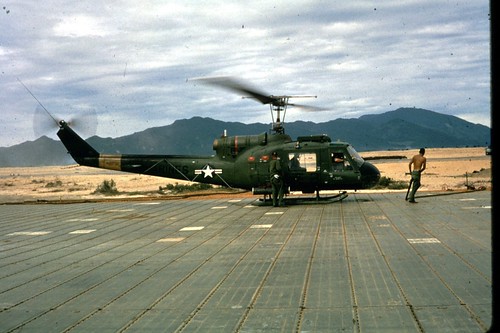
Newly arrived Marine UH-1E ( Huey ) from VMO 6 at Chu Lai, Viet Nam; Sept. 1965
Marine UH-1Es looked like this 1965 example at Chu Lai. By 1967, the yellow warning stripe was removed as well as the US insignia with "Marines" titles in black to reduce their visibility in combat.

It would be a four-man UH-1E flight crew from VMO-6 in 1967 that would become the most decorated flight crew of the Vietnam War. On 19 August 1967, an Army Boeing/Vertol CH-47 Chinook was enroute to Chu Lai AB with a load of injured soldiers. Twenty miles out, the Chinook came under heavy small arms fire from Viet Cong in the area. They set down on a beach where the the Song Tra Khuc River empties into the South China Sea to assess the damage. While several of the crew were outside of the helicopter examining the damage, Viet Cong troops in the area laying in wait opened fire on the helicopter. In a rush, the pilot took off, leaving four crewmen behind on the beach. He radioed immediately on the emergency guard channel that his aircraft was all shot up and he was trying to make for a safer location adding "I still have four men on the ground, the VC are trying to take them prisoner or kill them; God, can somebody help them?"

Captain Stephen Pless was flying an armed UH-1E with the callsign CHERRY SIX on a medevac escort mission when he received the transmission of Americans in immediate danger. Pless discussed the radio call with his copilot, Captain Rupert Fairfield and Pless decided their original mission, escorting the medevac of a single injured Korean Marine, didn't need their escort services and they flew to the location of the trapped men on the beach. Overflying the area, Pless noted that the trapped men were under heavy machine gun and mortar fire. Seeing three jets overhead as well as four Army Hueys orbiting offshore, Pless noted they were all reluctant to move in on account of the heavy fire coming from the VC advancing on the beach. He then asked his crew "How do you feel about going in?" getting a thumbs up from Captain Fairfield and his two crew chiefs, Gunnery Sergeant Leroy Paulson and Lance Corporal John Phelps. 

Stephen Pless was no ordinary Marine officer. He joined the officer corps from the enlisted ranks but he still had great affection for his enlisted men. He frequently socialized with the Marine enlisted at Chu Lai and it's said he spent more time in the enlisted quarters at the base than the officers' quarters. He had several hundred missions under his belt already and some of the Marine crew chiefs had flown secret missions with him into Laos. Pless knew his men would follow him down to that beach with no hesitation and anyone would have done it with Pless as their commanding officer. 

On their initial approach to the trapped men, the first elements of the VC force of about 40 to 50 men were already upon the men, disarming them and hitting them while the rest of the VC moved out from the treeline onto the beach. Since the VC soldiers were too close to use their rockets, Gunnery Sergeant Paulson opened up with M60 machine gun, scattering the VC soldiers. As they ran back for the safety of the treeline, Pless fired white phosphorus-tipped rockets into the mass of fleeing VC. Wheeling the Huey around for several passes, Pless fired more rockets as well his side mounted guns into the treeline, taking heavy small arms fire in the process. On most of his attacks he was less than 50 feet above the ground, in some cases so low that mud thrown up from his own weapons splattered the Huey's windshield. With his rockets nearly expended, Pless then landed his Huey near the trapped men, facing the ocean using his helicopter as a shield between the VC and the trapped men. 

Emblem of VMO-6 "Tomcats"
(Wikipedia)
As several VC tried to approach the helicopter, Lance Corporal Phelps fired his M60 from the left side while Gunnery Sergeant Paulson jumped out and ran to the trapped men- he was able to get the first man aboard as he was still able to walk and Paulson then ran back to the next man while under heavy fire. Captain Fairfield then exited the cockpit to help Paulson with the second man. As he jumped out, Fairfield saw three VC only 10 feet away. He quickly unhooked one of the M60 machine guns and killed all three with a short burst. He then ran to Paulson to help get the second man aboard while Lance Corporal Phelps provided cover fie with his M60. Getting the second man aboard, Fairfield and Paulson then ran for the third man, but he was heavier than the other two- Phelps gave his M60 to the first injured man, Staff Sergeant Lawrence Allen, who was propped up against the back of Pless's seat. He cradled the M60 with his injured arm and continued providing suppressive fire with his good arm. With Fairfield, Paulson, and Phelps carrying the third man to the Huey, a single VC with a hand grenade approached. Phelps dispatched that soldier from ten to fifteen feet away with six shots from his service pistol. Fairfield and Paulson also fired their service pistols as well as they carried the third man to the helicopter. 

With the third man aboard, Fairfield and Paulson ran back for the fourth man but he was already dead. As they jumped back into the Huey, Pless began to takeoff but the three extra men made his helicopter significantly overweight. With the only reasonable avenue of departure being over the ocean as the VC small arms fire intensified, Pless bounced off the waves repeatedly until the helicopter had enough airspeed to climb away from danger. He then had the crew jettison or throw overboard anything that wasn't needed to get to Chu Lai only 20 miles away. Enroute, Paulson and Phelps rendered medical aid to the three injured men. 

Unbeknowst to the crew of CHERRY SIX, one of the Army Hueys Pless observed orbiting offshore made a run in to provide additional covering fire. Flown by Warrant Officer Ronald Redeker, he made multiple strafing runs with his door gunners until their ammunition was exhausted. 

The flight crew of CHERRY SIX: (L-R) Phelps, Pless, Fairfield, and Paulson
(Defense Department/Valor Remembered)
Seven days later, the commanding officer of VMO-6 wrote a letter that passed up through the chain of command to the Secretary of the Navy recommending Captain Stephen Pless for the Congressional Medal of Honor. In the same letter he also recommended Captain Fairfield, Gunnery Sergeant Leroy Paulson, and Lance Corporal John Phelps for the Navy Cross, the second highest award from bravery after the Medal of Honor. The awards were all approved- not only making Captain Stephen Pless the only Marine Corps aviator to earn the Medal of Honor in Vietnam, but also making the entire crew of CHERRY SIX the most decorated flight crew of the Vietnam War. 

Sources: Marine Air: The History of the Flying Leathernecks in Words and Photos by Robert F. Dorr. Penguin Books, 2007. Assault from the Sky: US Marine Corps Helicopter Operations in Vietnam by Dick Camp. Casemate Books, 2013.

26 June 2015

The Daring Rescue of a Downed Pilot at the Battle of A Shau Valley

Major Bernard Fisher, first USAF Medal of Honor recipient of the Vietnam War
In 1961 the CIA, in cooperation with the US Army Special Forces teams, began to set up a network of surveillance camps along the borders of South Vietnam to monitor North Vietnamese infiltration of South Vietnam. Located primarily in the remote highlands of South Vietnam, the special forces camps were manned by a mixture of US Army special forces personnel, South Vietnamese special forces personnel, and paramilitary units recruited from the indigenous populations of the area like the Montagnards. By 1962 the US Army assumed full responsibility for the special forces camps. In 1966, one of these special forces camps was the scene of one of the most daring rescues of downed American pilot in the Vietnam War. High up in a remote area of the northwest corner of South Vietnam just two miles from the Laotian border was the special forces camp in the A Shau Valley. If there was a more remote camp that was nearly inaccessible elsewhere in South Vietnam, the A Shau Valley would have given them a run for the money. With steep jungle covered mountains ascending to over 7,000 feet and constant storms during monsoon season, the aerial resupply of the A Shau Valley camp was challenging even under the best of conditions. It had an approximately half-mile long dirt airstrip that sat astride the triangular-shaped fort that served as the special forces base camp. But the camp lay astride three major infiltration routes off the Ho Chi Minh Trail into South Vietnam- one route ran westward from the valley towards the main axis of the Ho Chi Minh Trail and two routes ran eastward towards the city of Hue and the heavily populated areas of the South Vietnamese coast. In early March of that year, two regiments of the North Vietnamese Army set up positions in the mountains above the camp in preparation of an assault. A flak trap was set up in the heights over the camp with 37mm anti-aircraft cannons. On 9 March at 0400, the assault began with a mortar bombardment on the camp with NVA sappers punching holes in the camp's defensive perimeter. An estimated 2,000 NVA soldiers squared off against 360 South Vietnamese and Montagnard soldiers led by 17 US Army Special Forces troops.

Due to poor weather with only 400-foot ceilings (in a valley surrounded by 7,000 foot mountains), the first air support didn't arrive until mid-morning when a USAF AC-47 Spooky gunship arrived over the area in poor weather conditions. On its third pass at low altitude, the NVA flak trap caught the gunship and it crashed into a mountainside. The crew of six survived, but three were rescued thanks to the heroic actions of two of the crew to defend the crash site until they could be rescued. Captain Willard Collins and 1st Lt. Delbert Peterson posthumously earned the Air Force Cross for defending the survivors before they were killed by NVA troops. Two Cessna O-1 Bird Dogs attempted to land on the dirt strip to fly out some casualties, but the heavy enemy fire only allowed them to fly out one wounded special forces soldier. Later that afternoon, the Marines sent two Sikorsky UH-34Ds into the area to evacuate the wounded. One helicopter was shot down but managed to crash land inside the camp perimeter. Its crew was picked up by the other helicopter before it had to withdraw under the thick overcast. That night under cover of darkness a USAF Sikorsky CH-3E managed to land in the camp and fly out 26 causalities. The following morning the NVA pressed their attack against the camp again, managing the penetrate the defensive perimeter. In the pre-dawn darkness, a Marine A-4 Skyhawk two-ship responded and one of the pilots managed to make a low level bombing pass before coming around to strafe the area with the Skyhawk's 20mm cannon. Lt. Augusto Xavier failed to pull out of his strafing run in the limited visibility conditions and crashed into one of the mountains around the camp. He was posthumously awarded the Silver Star. Nearly 200 close air support sorties were mounted that day despite poor weather to keep the camp from falling into NVA hands.

With the arrival of daylight, USAF Major Bernard Fisher (call sign "HOBO 51") from the 1st Air Commando Squadron led a flight of A-1E Skyraiders in 800-foot overcast ceilings to try and assist the defenders of the A Shau Valley camp. Fisher's wingman took 37mm cannon hits to his engine and had to return to base. A second pair of USAF A-1E Skyraiders arrived on scene, led by Major D.W. "Jump" Myers (call sign "SURF 41") from the 602nd Air Commando Squadron. The Skyraiders pressed their attacks as close to the camp as possible to keep the perimeter from falling. Making strafing passes on the NVA troops pushing on the camp perimeter, Myers was hit on his third pass and his Skyraider caught fire. He elected to crash land on the camp's dirt runway and Major Fisher flew along side to give him steering directions as Myers' windscreen got covered in oil when the engine got hit. Myers successfully crash landed his Skyraider on the dirt strip and immediately got out before his Skyraider exploded and took cover in a ditch next to the runway. A team from the camp tried to get to Myers to bring him inside the camp perimeter, but the NVA fire in the area was too heavy to effect a ground rescue. Orbiting above and dodging enemy fire, Fisher directed the other Skyraider pilots' fire to protect Myers and buy time for the inbound rescue helicopter. When he found out a rescue helicopter would take about 20 minutes to reach the area due to the weather conditions, Major Fisher elected to try and land on the strip to rescue Myers himself. 

With debris from the battle as well as Myers' destroyed Skyraider littering the runway, Fisher had to abort his first landing attempt and swung around to land the other direction on the runway. One of the pilots in the area described the scene as like "Flying into Yankee Stadium with everyone in the bleachers firing at you with machine guns!" Fisher managed to land on the runway and in the midst of the heavy fire, taxied back up the runway searching for Myers. Since his Skyraider was the side-by-side two seat version of the A-1, Fisher spotted Myers who sprinted for the aircraft from his hiding place. Fisher had already unharnessed himself thinking that Myers was wounded and needed help when he found the pilot already scrambling up his wing to the cockpit. Fisher grabbed Myers and quite literally threw him into the cockpit headfirst with Myers yelling "You dumb son-of-a-bitch, now neither of us will get out of here!" With Myers scrambling to get himself seated and harnessed into the cockpit, Fisher wheeled the A-1 around and kept the Skyraider in ground effect until he had the speed climb up through the overcast and over the mountains to safety at their base at Pleiku.

Fisher on the left and Myers on the right after the rescue flight
Remember that group of special forces that got pinned down trying to rescue Major Myers? They were able to escape and get back inside the camp perimeter as all the NVA guns that had them pinned down were focused on trying to shoot down Major Fisher's Skyraider.; When his aircraft landed back at its base, the aircraft had 19 holes from ground fire sustained during the rescue flight. Fisher was unlikely Skyraider pilot- he served in World War II as a sailor and on return to the United States, joined the ROTC while in college. He only finished three years at the University of Utah before he was commissioned to fly for the USAF. He had earned his wings flying Convair F-102 Delta Daggers in Europe and Lockheed F-104 Starfighters for the Air Defense Command stateside. He volunteered for combat duty in Vietnam, getting assigned to fly Skyraiders with the 1st Air Commando Squadron at Pleiku. At the time of his epic rescue flight, he had been flying combat missions in the A-1 for eight months. The day prior to his rescue of Major Myers, he earned a Silver Star flying combat missions over the same special forces camp in the A Shau Valley! 

On 19 January 1967, he was awarded the Congressional Medal of Honor for his rescue of Major Myers. This is the citation: 
For conspicuous gallantry and intrepidity at the risk of his life above and beyond the call of duty. On that date, the special forces camp at A Shau was under attack by 2,000 North Vietnamese Army regulars. Hostile troops had positioned themselves between the airstrip and the camp. Other hostile troops had surrounded the camp and were continuously raking it with automatic weapons fire from the surrounding hills. The tops of the 1,500-foot hills were obscured by an 800 foot ceiling, limiting aircraft maneuverability and forcing pilots to operate within range of hostile gun positions, which often were able to fire down on the attacking aircraft. During the battle, Maj. Fisher observed a fellow airman crash land on the battle-torn airstrip. In the belief that the downed pilot was seriously injured and in imminent danger of capture, Maj. Fisher announced his intention to land on the airstrip to effect a rescue. Although aware of the extreme danger and likely failure of such an attempt, he elected to continue. Directing his own air cover, he landed his aircraft and taxied almost the full length of the runway, which was littered with battle debris and parts of an exploded aircraft. While effecting a successful rescue of the downed pilot, heavy ground fire was observed, with 19 bullets striking his aircraft. In the face of the withering ground fire, he applied power and gained enough speed to lift-off at the overrun of the airstrip. Maj. Fisher's profound concern for his fellow airman, and at the risk of his life above and beyond the call of duty are in the highest traditions of the U.S. Air Force and reflect great credit upon himself and the Armed Forces of his country.
Fisher was the first USAF Medal of Honor recipient of the Vietnam War. He finished his tour in Vietnam on the Skyraider with 200 combat missions. His unit, the 1st Air Commando Squadron, had a 40% casualty rate amongst its pilots as they did a lot of low level close air support flying in support of the special forces camps in some of the most inhospitable parts of South Vietnam. He returned to the Air Defense Command until his retirement as a colonel in 1974, having flown the McDonnell F-101B Voodoo. He took up corn and alfalfa farming with his wife in rural Idaho. Every year since his rescue, each March 10th, D.W. Myers called Bernard Fisher to wish him well until Myers died in 1992. Myers' daughter kept up the ritual for another 22 years, calling Fisher on March 10th herself to wish him well. In 2008, the University of Utah awarded a diploma to Bernard Fisher 57 years after he was last a student there in recognition for his achievements and decorated military career. In 2010, the Boise Rescue Mission was established as a homeless veterans' transitional program with Fisher's help and its motto is Fisher's quote after he rescued Myers: "When a man is down, you don't leave him there." Colonel Bernard Francis Fisher flew west on 16 August 2014.

Fisher's A-1E Skyraider at the USAF Museum
You can see Bernard Fisher's A-1E Skyraider today as it has been restored and wears the colors and markings as it looked on the day of his Medal of Honor Mission at the National Museum of the United States Air Force in Dayton, Ohio.

As for the fate of the special forces camp in the A Shau Valley after Fisher's rescue flight? By late afternoon on 10 March 1966, the decision was made to evacuate and abandon the A Shau Valley camp. Sixteen UH-34D helicopters along with six UH-1Es, all from the Marine units HMM-163 and VMO-2 respectively, flew into the valley with 200-foot overcast for the evacuation. Two helicopters were shot down but their crews managed to lead groups of camp soldiers out of the area on foot, evading the NVA units that were closing in on the camp. The NVA flak trap was so intense that three Marine F-4B Phantoms, two A-4 Skyhawks, two UH-1s and three more UH-34D sustained damage. The following morning a second evacuation flight managed to get the rest of the personnel out of the camp. The Marine helicopter squadron HMM-163 needed to have 21 of its 24 UH-34Ds replaced. Interestingly, one of the UH-1s involved in the evacuation of the rest of the personnel from the special forces camp was flown by Brigadier General Marion Carl of the US Marine Corps. Carl was the Marines' first ace of the Second World War and before Vietnam he was a decorated test pilot. Despite his rank as the commander of the 1st Marine Brigade in Vietnam, he often flew combat missions in both helicopters and jet fighters much to the chagrin of his superiors!

Sources: Above and Beyond: The Aviation Medals of Honor by Barrett Tillman. Smithsonian Institution Press, 2002, pp 218-221. Assault from the Sky: US Marine Corps Helicopter Operations in Vietnam by Dick Camp. Casemate Publishers, 2013, pp 64-79. Photos: USAF Museum

11 June 2015

A Watershed Moment in Close Air Support: The 1927 Battle of Ocotal

Major Ross Rowell, USMC
Less than a year had elapsed in Nicaragua since the last civil war and American intervention (1912-1925) ended when liberal and conservative factions in the unity government broke into open rebellion on 2 May 1926 with conservative factions representing the Managua government. On 24 January 1927, the 400 Marines arrived in-country at the request of the government as events proved beyond Managua's ability to control. Accompanying the initial group of Marines was the Marine Observation Squadron VO-1M, led by Major Ross Rowell. In the years following World War I, Marine aviation was very much a lean force, so much so that Marine aviators like Rowell had to be temporarily assigned to the Army to get flight training. Rowell's tour of duty with the US Army began in 1923 at Kelly Field in San Antonio, Texas. There he was assigned to the 3rd Attack Group, an Army squadron that had been established in 1921 to specialize in ground attack. The unit had experimented with a variety of aircraft during this period which were to have been designed for the role of ground attack (and distinct from long-range bombing) on the battlefield, but most designs were wholly inadequate for the roles envisioned by the Army unit. The unit ended up experimenting with the De Havilland DH-4B for ground attack as the aircraft was plentiful, available, and had been used by the British in the ground attack role in the First World War. Using the DH-4B, the unit experimented with dive bombing, which to be more accurate was more glide bombing- the distinction being that glide bombing involved descents of about 45 degrees while dive bombing was quite a bit steeper, approaching 70 degree or more. British experience in the First World War had shown that steep attacks greater than 45 degrees were needed to attack ground positions and while ground attack in the First World War never proved decisive, the seeds of the idea had been planted and were being sown further by the unit that Major Ross Rowell was assigned to. Their DH-4Bs were modified with underwing racks that could hold 10 small bombs. The aircraft was less than suitable for the role and the unit's work had concluded that attacking aircraft would be exposed to hostile fire during its attack that the mission would be of little use. 

Despite the inadequacy of the DH-4 biplane, Rowell held the opposite view as a result of his time with the Army in San Antonio. Given the number of interventions the Marines were conducting in the 1920s, Rowell was convinced that an aircraft making a steep glide or dive attack would be useful for close air support in the small guerrilla wars that the Marine Corps were being committed to throughout Latin America during the interwar period. Upon his return to the Marines from his tour with the Army, Rowell was given command of Marine Observation Squadron One (VO-1M) based at North Island in San Diego. VO-1M had just returned from the Marine intervention in Santo Domingo and based on their experience there, was designated the aviation asset to accompany Marine expeditionary forces being sent overseas. As such, Rowell instructed the pilots of VO-1M in glide and dive bombing based on his experiences with the Army's 3rd Attack Group in Texas. He relentlessly trained his men against simulated ground targets as well as seaborne targets. In February 1927, VO-1M was given orders to deploy to Nicaragua to support the Marines there that landed the previous month. By the end of February, Rowell had the unit's DH-4B biplanes flying a variety of missions ranging from observation and reconnaissance, shuttling messages amongst the various Marine garrisons in the country, and supporting assaults against the rebels who called themselves Sandinistas after their leader, Augusto Cesar Sandino. Prior to the arrival of VO-1M, most air missions during the civil war were flown by the Nicaraguan Air Service which didn't amount to much- two converted civilian Laird Swallow biplanes flown by mercenary pilots that dropped dynamite on the Sandinistas. Needless to say, it wasn't terribly effective and for the most part, the Sandinistas ignored the aircraft until VO-1M arrived. 

Marine DH-4B. Note the Ace of Spades logo of VO-1M. 
On 17 July 1927, a large Sandinista force of 800 men attacked the small Marine outpost at Ocotal near the Honduran border about 125 miles from the capital, Managua. Defending the outpost were 37 Marines and less than 50 Nicaraguan National Guard. The attack opened at 3:00am and it wasn't until 10:15am in the morning that the Marine HQ in Managua became aware of the attack after a Marine patrol overflew Ocotal and saw the gunfire. Major Rowell mustered five DH-4Bs which were crewed by two and bombed up to fly to Ocotal. Since there was no other Marine force in the area that could be delivered to the area in time on account of distance and Nicaragua's primitive transportation network, it was Marine air or nothing to save the garrison at Ocotal. Arriving over the garrison, Rowell circled the area to assess the situation. At the time, radios were supplied to VO-1M, but their were so heavy given the technology of the time, it was easier to remove the radios and trade that weight for fuel and bombs. The beleaguered Marine garrison laid out colored panels to give Rowell and his pilots indications of where the Sandinistas were located. Being 125 miles from their base in Managua, the fuel situation didn't lend itself to extended loitering by the DH-4Bs and to make matters worse, thunderstorms were approaching the area. Rowell organized his pilots into a bombing column that was single file and he made the first diving attack from 1500 feet, released a some bombs and then pulled out at 600 feet with the other four aircraft in the column following suit against targets he'd marked with his own bombs. Since the Sandinistas' previous exposure to air attacks were minimal, the Marine attacks drew little if any ground fire. In fact, the Sandinistas weren't even taking cover. Rowell astutely realized this fact and had his men fly lower for greater accuracy, diving from only 1000 feet and pulling out at only 300 feet. During their dives, the pilots fired the forward gun to add to the firepower and in the pull out, the observer in the rear seat would strafe as well with their trainable gun, effectively suppressing any potential ground fire. The Sandinista attack on the garrrison was broken as they retreated in the countryside taking approximately 25% casualties from the air attacks. Major Rowell would earn the Distinguished Flying Cross for leading the attack to save the Marine garrison at Ocotal.

It was a watershed moment in the history of military air power and close air support- the 1927 Battle of Ocotal was the first time that an ground unit facing a numerically superior enemy was saved solely by aerial intervention. It was a lesson not lost by the Marines in particular. During the time period and well into the Second World War, Army doctrine manuals discouraged close air support out of a fear of friendly fire casualties while the Marine Corps were quite the opposite in seeing air support as an integral part of ground force operations. It was also the first time that steep diving attacks were used in combat effectively. During his time at North Island in San Diego, Rowell had made friends with a number of naval aviators of the Pacific Fleet would were soon to make their own mark on the history of military aviation with their use of dive bombing. But as always, that will be the subject of a future post on this blog!

Historical aside: VO-1M was formed in 1919 as First Division, Squadron 1. Following the intervention in Santo Domingo, the squadron was redesignated VO-1M. Prior to the Battle of Ocotal, the squadron was redesignated again as VO-8M. In 1934, as part of the reorganization of Marine aviation, the unit was reorganized and was routinely sent to sea aboard aircraft carriers to participate in exercises. In 1941 the unit was moved to Hawaii with their first monoplane, the Vought SB2U Vindicator, along with a redesignation to VMSB-231 (Marine Scout and Bombing Squadron 231) and was embarked on the USS Lexington when Pearl Harbor was attacked. In 1942 the squadron transitioned to the Douglas SBD Dauntless and participated in actions at Guadalcanal and later in the war got the Vought F4U Corsair for the Marshall Islands campaign. They were deactivated in 1962 after long serving as a Marine reserve unit. They were brought back in 1973 to become an AV-8A Harrier unit and fly the AV-8B Harrier II today as VMA-231 "Ace of Spades"- the Ace of Spades logo used on VO-1M's DH-4s in Nicaragua are still the unit emblem today.

Source: Strike From the Sky: The History of Battlefield Air Attack, 1911-1945 by Richard P. Hallion. Smithsonian History of Aviation Series, Smithsonian Institution, 1989, pp 71-75. Photos: USMC, Wikipedia.

26 November 2010

Grumman's Biggest Cat in World War II

In early 1941 the United States Navy issued a requirement to Grumman for development of a large twin-engined fighter powered by twin Pratt & Whitney R-2800 Double Wasp engines of 2,100 horsepower each. The Double Wasp was used on the Navy's other two fighters under development at the time, the Grumman F6F Hellcat and the Vought F4U Corsair- two such engines offered a tremendous leap in performance for what the Navy designated the F7F. The fighter would be heavily armed with four 20mm cannon in the wing roots and four 0.50-caliber machine guns in the nose with provision for carrying a torpedo under the fuselage or two 1,000 lb bombs under the wings. The large fighter would form the nucleus of the air wing of the new 45,000 ton Midway class aircraft carriers then under proposal. On 30 June 1941 the Navy authorized Grumman to begin work on the Tigercat. Two prototypes designated XF7F-1 were ordered on that day. As an interesting historical sidenote, five weeks earlier the US Army Air Force ordered two aircraft as well which were to be designated XP-65 but had lighter Wright R-1820 engines that would have been turbosupercharged to give the XP-65 even better peformance than the F7F. However, the differing specifications of the Navy and the Army were at odds as the USAAF wanted a lighter fighter than what the Navy desired. As a result, what might have been the first American joint-service fighter died quietly when the Army bowed out due to concerns about the design becoming overweight to meet Navy requirements. 

With the first F7F-1 Tigercats rolling off the Grumman production lines in April 1944, the Navy took the unusual step of having the Tigercat only operate with land-based squadrons of the US Marine Corps and skip  what promised to be a lengthy carrier qualification series of tests as the Navy had not previously operated large twin-engined fighters off its flight decks. The aircraft carrier it was intended for, the USS Midway, was still under construction at the time. At that point in the Pacific War the Navy felt that its fighter needs were being satisfied with the F6F Hellcat and the F4U Corsair. The Marines could operate the Tigercat as a fighter bomber which the Navy brass felt was more suited to the aircraft's design. Plans were set in motion to equip twelve Marine Corps fighter squadrons that were operating the Corsair at the time to re-equip with the Tigercat. The Corsairs would then be passed back to the Navy to meet fleet requirements in the Pacific. 

Production of the F7F-1 Tigercat came to sudden halt in December 1944 after only 35 aircraft were built. By this point in the war the Navy's carrier battle groups were gearing up for their first raids on the Japanese Home Islands themselves (Task Force 58 in February 1945) as a diversion for the assault on Iwo Jima. The Navy had a different role in mind for the Tigercat and the third F7F-1 was converted into the prototype XF7F-2N night fighter with an AN/APS-6 radar set in the nose, displacing the four 0.50-caliber machine guns, and a second seat for the radar operator over the wing behind the pilot. More powerful versions of the R-2800 radial were used to compensate for the increased weight of the second crewman and the additional radar equipment. However, changing requirements and technical issues meant that the F7F-2N was only an interim type, with only 65 being produced between December 1944 when F7F-1 production was stopped in favor of the night fighter and August 1945. Several of the -2Ns did go to sea, though, but for a series of comparison tests aboard the USS Antietam and the USS Shangri-La with the North American PBJ-1 Mitchell (the Navy version of the B-25 Mitchell). Both were being evaluated as night fighters by the Navy in April 1945 but it was soon found that both the Tigercat and the Mitchell were too large for the Essex-class fleet carriers and the Navy settled on radar-equipped variants of the F6F Hellcat and F4U Corsair instead. 

Only one Tigercat squadron made it to the Pacific before the end of the war with the Japanese surrender. Marine Corps squadron VMF(N)-533 was one of three Marine Corps night fighter squadrons established in 1943 operating the night fighter version of the Hellcat, the F6F-5N. Based in Okinawa at the time, the squadron was to convert to the night fighter Tigercat in theatre, but their new mounts arrived the day before the Japanese surrender. Patrols were made over China and Japan, but no operational engagements took place in the months following the Japanese surrender. Interestingly, the Royal Navy evaluated two F7F-2N Tigercats in the night fighter role, but decided to adopt the De Havilland Sea Hornet instead for the role. 

The most famous and most-produced version of the Tigercat, the F7F-3 and -3N, didn't arrive until March of 1946, too late for service in the Second World War. This variant was never carrier-qualified as well and by the time the Midway class carriers it was intended for were operational, the Navy's standard fighter was the Grumman F8F Bearcat and jets were just over the horizon. The F7F-4N was fully carrier capable and fully qualified unlike the previous versions, but only 14 of this model were built. In the Korean War, night fighting Tigercats in the hands of the Marine Corps finally drew blood and achieved fame that had eluded it during the Second World War. 

Source: United States Naval Fighters of World War II in Action by Michael O'Leary. Blandford Press, 1980, p136-141.


23 June 2010

ACE- The Aviation Combat Element, the Air Wing of the Amphibious Assault Carrier

The helicopter amphibious assault ships of the US Navy that transport Marine Expeditionary Units (MEUs) are often called the "big deck amphibs" as their size approaches that of the the aircraft carriers of previous generations. In fact, the latest class of assault carriers, the Wasp-class LHDs, are much larger than the Royal Navy's Invincible-class Harrier carriers and closer in size to ships like the old French aircraft carriers FNS Clemenceau and FNS Foch (size comparison here) Like a supercarrier, the assault carriers have their own air wing embarked with the Marine Corps calls an Air Combat Element or Aviation Combat Element (ACE). But there the difference ends. But let's back up a bit and talk about the MEU and how the ACE fits into the MEU.

Think of an MEU as miniature Marine Corps composed of approximately 2,300 personnel. The MEU is the basic deployable unit of a Marine Air Ground Task Force that integrates the soldiers, artillery, tanks, aircraft and logistcal support to conduct anything from combat operations to humanitarian relief efforts worldwide. There are four "elements" in an MEU- the Aviation Combat Element, the Ground Combat Element, the Command Element, and the Logistics Combat Element. The Ground Combat Element or GCE is centered around an 800-man infantry battalion to which are attached armor, artillery and transport to become a Battalion Landing Team. The Logistics Combat Element or LCE is in charge of keeping the MEU supplied while the Command Element or CE is obviously to run the whole show. The USMC has seven MEUs- three on the US East Coast, three on the US West Coast and one forward-deployed in Japan.

Back to the Aviation Combat Element, or ACE. The ACE is the MEU's air wing. The nucleus of the ACE is either a medium helicopter squadron (HMM) operating Boeing Vertol CH-46 Sea Knights or medium tilt-rotor squadron (VMM) operating the Bell/Boeing MV-22 Osprey. The VMM and HMM squadrons are set up so that other units can be attached to them to form the ACE. The VMM and HMM squadrons form the nucleus as they are the largest squadron in the ACE and have the most personnel and equipment. A normal VMM or HMM squadron might have 200 personnel, but when other units are attached to it like AV-8B Harrier IIs or other helicopter assets, it grows to over 500 personnel and becomes a "reinforced squadron". So for example, VMM-263 is a tilt-rotor squadron flying Ospreys. When the squadron goes to sea as part of an ACE, it becomes "reinforced" and is designated VMM-263 (REIN).

But what is unique about a Marine Corps ACE is that the attached units, whether they're fixed wing Harrier IIs, Super Cobra gunships or heavy lift CH-53Es, all take on the VMM or HMM's squadron identity and tail codes when deployed. So you might have six AV-8B Harrier IIs from VMA-223 that take on the identiy of VMM-263 if that's the squadron they get attached to in an ACE.

Unlike a US Navy supercarrier, the ACE units all have one ready room. The diverse units attached to the nucleus VMM or HMM squadron all brief and train together as a team. Everyone even wears the squadron patches of the VMM or HMM squadron they're attached to. And if necessary, an ACE can even have land-based KC-130 Hercules tankers attached to it, but the tankers operate from nearby land bases. This gives the MEU its own mini-air force that can conduct assault support, offensive air support, aerial reconnaissance, command and control, anti-air warfare, and electronic warfare (the six functions of Marine Corps aviation).

Every six to seven months an MEU goes out on deployment approximately one month after another MEU returns. Prior to entering the area of responsibility, the entire MEU, and in particular the ACE, have to train together to prepare for deployment. The first step is to get all the pilots of the ACE up to speed on shipboard operations as part of the reinforced VMM/HMM squadron. Then RUT, Realistic Urban Training, is carried out at the Indiana National Guard's Muscatatuck Urban Center. From there, the MEU goes back to sea for what is called a COMPTUEX, Composite Training Exercise that irons out any kinks between the Marine Corps units and the US Navy vessels of the fleet. The final exercise before deployment is the CERTEX, Certification Exercise which is the culmination of a 6-month long work up period. Once the CERTEX has been passed, the MEU and its associated ACE can go to sea as part of an Amphibious Ready Group composed of three amphibious assault ships, with the ACE based on the big deck amphib.

Source: Combat Aircraft Monthly, June 2010, Vol. 11, No. 6. "USS Nassau Air Combat Element" by Gert Kromhout, p56-59.

19 March 2010


On 18 January 2003 the over 7,000 Marines of Task Force Tarawa set sail from the United States aboard seven amphibious assault ships with 72 aircraft (and more following them) for the Persian Gulf in the run up to Operation Iraqi Freedom. The Bell AH-1W Super Cobras of Marine Light Attack Helicopter Squadron 269 (HMLA-269 "Gunrunners") from MCAS New River, North Carolina were reinforced with additional gunships from sister unit HMLA-167 for a total of 18 AH-1W Super Cobras and nine Bell UH-1N transports. The reinforced squadron embarked on the USS Saipan (LHA-2) and the USS Ponce (LPD-15) for the sea transit to the Middle East. As Task Force Tarawa transited through the choke points of Gibraltar and the Suez Canal, HMLA-269 would have six Super Cobras on flying alert to protect the task force.

Arriving off the coast of Kuwait on 18 March 2003, ten of HMLA-269's Super Cobras were detached to a forward base 23 miles south of the Iraqi border to participate in the squadron's first operational mission, the assault on the Iraqi forward reconnaissance positions at Safwan. The first combat missions by the AH-1Ws of the squadron on 20/21 March were notable, however, for the combat use of what was then-a-classified version of the AGM-114 Hellfire missile, the AGM-114N thermobaric Hellfire.

Thermobaric weapons were first developed in the 1960s by the engineers at the China Lake Naval Weapons Center and were what were then known as fuel-air-explosive weapons. FAEs work by releasing a cloud of volatile vapor which is then detonated, creating a large and destructive pressure wave in the process. A standard blast/fragmentation warhead creates a large pressure spike that decays rapidly. A thermobaric warhead, on the other hand, creates a large sustained pressure wave that propagates through any building or enclosed space, making it ideal for urban warfare. In the late 1990s, the engineers at China Lake had succeeded in creating non-liquid thermobaric explosives using metal particles (such as aluminum or magnesium) instead a liquid. The initial detonation releases the fine particles which then ignite, creating the large and sustained pressure wave. For this the China Lake Naval Weapons Center was awarded a classified US patent.

Marine Corps combat experience prior to OIF had shown that missiles like the TOW or Hellfire with their blast/fragmentation warheads were often unsuitable in urban environments as the pressure spike from the warhead detonation would be attenuated inside enclosed spaces. In addition, the missiles would often pass right through the target building before detonating.

The thermobaric weapons work at China Lake resulted in what was called a metal-augmented charge (MAC) that was the ideal warhead for a new version of the Hellfire missile desired by the Marine Corps. The AGM-114N's thermobaric warhead consists of a layer of fine aluminum powder sandwiched between the warhead casing and the explosive fill in the center. On detonation, the aluminum powder is dispersed and ignites, creating a large and sustained pressure wave. Live fire tests at White Sands and China Lake proved the weapon to be effective.

When HMLA-269 arrived in the Persian Gulf, the squadron's commanding officer, Lt. Col. Jeffrey Hewitt, was one of the few Marine aviators aware of the AGM-114N as his previous posting before taking command of the "Gunrunners" was a senior posting in Marine Corps weapons development working closely on the tests of the thermobaric Hellfire missile. The thermobaric Hellfires used in the development and testing work in the United States prior to OIF were converted from stock AGM-114K Hellfires and Lt. Col. Hewitt knew that there were 60 AGM-114Ns left over from the test program that were in storage. Aware that the Marines of Task Force Tarawa faced many urban threats before even reaching Baghdad, he arranged for those 60 missiles to be shipped out to the squadron. However, the US Navy wouldn't transport them as the missiles were never certified for carriage by ship. Lt. Col. Hewitt then turned to the US Air Force, who were more than happy to fly out the missiles immediately to Kuwait for the squadron.

HMLA-269's original plan was to keep the precious AGM-114Ns until Task Force Tarawa reached Baghdad, but they also wanted to prove that the thermobaric Hellfires worked in actual combat. Several were fired during the assault on Safwan and were highly effective. Interestingly enough, during their use in the assault on Safwan and in HMLA-269's combat missions on the march to Baghdad, the AGM-114N thermobaric Hellfire missiles (called TB Hellfire) were still classified!

Source: International Air Power Review, Volume 12, Spring 2004. "Focus Aircraft: Bell AH-1 Cobra" by Robert Hewson, p56-58.

31 January 2010

When Israeli Aircraft Industries created the Kfir fighter-bomber by replacing the SNECMA Atar turbojet with a more powerful GE J79 engine, the additional modifications required to accommodate the American engine (which was shorter but heavier) along with the avionics needed for the strike role and the heavier undercarriage to increased takeoff weights with heavy bombloads degraded the performance and maneuverability of the the first generation Kfirs. Rather than try increasing the thrust of the J79 engine, IAI engineers decided the solution would have to be an aerodynamic one.

The addition of canards was favored early on and Dassault cautioned IAI about adding canards to the aircraft based on the French experience with the Mirage Milan canard test aircraft. Despite the warnings, no other solution was seen as being viable, so flight testing of the canard proceeded on the Technolog, a two-seat Mirage III that first tested the installation of the J79 engine.

Nose strakes near the tip of the nose were also found (even before the canard solution was reached) to improve high AoA performance but this came at the cost of buffeting at high AoAs, something that would have been unacceptable in air combat. The buffeting was cured on the suggestion of one of the IAI test pilots to add a wing leading edge saw-tooth which helped smooth the local airflow.

These modifications improved the Kfir's performance with the addition of wing area in the form of the canards that shifted the aircraft center of gravity forward, reduced the stability margin enough that the aircraft would be more responsive. The vortices that came off the canard smoothed the airflow over the delta wings which enhanced their lift and performance particularly at high angles of attack. The saw-tooth leading edges also slightly increased wing area and the vortices created by the saw tooth augmented the canard-produced vortices.

The combination of these modifications only added 187 lbs of weight to the new Kfir version designated C2. The side benefit of the structural strengthening of the fuselage for the canards (fuselage Section 10) is that that area was able to also accommodate an additional pair of weapons pylons under the intakes, giving the Kfir a total of five underfuselage pylon stations.

The Kfir C2 entered service with the IDF in 1977. The earlier Kfir C1s only got the nose strakes and a much reduced canard as the structural strengthening and modification to full C2 standards was deemed not worth the effort. Many of those earlier-variant Kfir C1s flew with US Navy and US Marine Corps adversary units in the 1980s as the F-21A Lion.

Source: International Air Power Review, Volume 15. AIRtime Publishing, 2005, "Warplane Classic: IAI Kfir- Israel's Lion Cub" by Shlomo Aloni, p137-139.

01 October 2009

After the end of hostilities in the Korean peninsula in 1953, the Douglas F3D Skyknights of Marine Corps squadron VMF(N)-513 continued to fly night patrols to stop North Korean Polikarpov Po-2 biplanes from crossing the DMZ. On some nights, even North Korean MiG-15 would test the waters by making runs across the DMZ and dashing back north before they could be intercepted by the F3D patrols.

The Marine Corps came up with a joint tactic with the USAF to stop the intruding flights by the MiG-15s which in some cases were too fast for the F3Ds. At South Korean air base K-55, the USAF had some F-86 Sabre units in residence. But the Sabres lacked nocturnal capability as they didn't have an air intercept radar. So in a tactic called "Mad Dog", an F3D would radio K-55 when five miles out with an F-86 at the end of K-55's runway ready to roll. The Skyknight then radio in again when one mile out and that was the F-86's signal to begin its takeoff roll.

As the F3D passed low over the runway, the F-86 pilot would lift off and follow the glow from the twin engine tailpipes of the Skyknight. If the F3D Skyknight couldn't catch up with the MiG-15, they "launched" the F-86 and used their air intercept radar to guide the Sabre pilot to the intercept, much like a miniature AWACS system.

After several Mad Dog sorties, the North Korean MiGs stopped their noctural provocation flights across the DMZ.

Source: Combat Aircraft, October 2009. "US Navy Fighters of the Fifties- Skyknight" by LCDR Rick Burgess USN (Ret), p87.

17 August 2009

During Operation Iraqi Freedom, six Marine Corps AV-8B Harrier II squadrons participated in the initial 26 days of combat flying nearly 2000 sorties from land bases in Kuwait and five of the Navy's big deck amphibious carriers. As the front lines rapidly moved northward towards Baghdad further away from the ships, the Harrier squadrons faced the problem of getting aerial refueling as high demand by other Coalition aircraft made tanking capacity scarce.

An out-of-action Iraqi air base at An Numaniyah was set up as for forward operating base to refuel the Marine Harriers. As the base's runways had been knocked out by Coalition air attacks, only the Harrier could use the base due to its unique V/STOL abilities. On 8 April 2003 a section of AV-8B Harrier IIs from VMA-542 landed at An Numaniyah at night, becoming the first Coalition tactical jets to touch down on Iraqi soil.

Source: Air Forces Monthly, August 2009. "Marine Harriers Over Iraq" by Warren E. Thompson, p80-81.

16 August 2009


During the war in the Pacific, the kamikaze threat required increasing numbers of fighters in the Navy's carrier air groups which in turn displaced bombers like the TBF Avenger. To give the fighters more offensive air-to-ground striking power, unguided rockets became standard for fighter aircraft like the Corsair and Hellcat. One of the ultimate unguided rockets to be used in the Pacific was the Tiny Tim, which was created by adding a 500-lb armor piercing bomb to the front of a standard oil well casing which was filled with rocket propellant. The oil well casing had the same 11.75 inch diameter as the 500-lb bomb. Finished off with a rocket nozzle and fins, the Tiny Tim was 10 feet long and weighed 1300 lbs.

The first firing took place in June 1944 and unlike previously used smaller rockets, it couldn't be fired off the rail due to the blast. As a solution, the rocket was dropped and a lanyard ignited the rocket motor once clear of the aircraft. The first aircraft carrier carrying Tiny Tim, the USS Franklin, was nearly sunk near Okinawa from kamikaze attacks before strikes with the rocket could begin. But the rocket was employed to effect against Japanese shipping by land-based Marine Corps PBJ bombers (B-25 Mitchells).

Source: Strike from the Sea: U.S. Navy Attack Aircraft from Skyraider to Super Hornet, 1948-Present by Tommy H. Thomason. Specialty Press, 2009, p17.

25 July 2009

The US Marine Corps had initially required the Grumman A-6 Intruder to meet an STOL requirement to take off in 1500 feet over a 50 foot obstacle. To accomplish this, the first seven A-6 Intruders had tilting tailpipes in which the exhaust of the twin J52 engines was vectored downward 23 degrees on takeoff and landing. There was a knurled knob on the outboard throttle that the pilot used to activate the feature. During testing, the Navy evaluation team set out to see if the feature worked as advertised and found the tilting tailpipes only marginally effective in meeting the USMC requirements- in fact, in many configurations the approach speeds were actually lower than they had been in propeller-driven aircraft.

The Navy team recommended deleting the feature at a cost savings of $25,000 per aircraft. After some back and forth arguing between the Marines and the Navy, the tailpipes and the associated actuation mechanisms were deleted beginning with aircraft number 8.

Source: Intruder: The Operational History of Grumman's A-6 by Mark Morgan and Rick Morgan. Schiffer Publishing, 2004, p16-17.