Showing posts with label Luftwaffe. Show all posts

27 February 2016

Hans von Seeckt and the Doctrinal Foundations of the Luftwaffe, Part One

With the defeat of Germany in the First World War, probably the harshest restrictions by the provisions of the Versailles Treaty dealt with Germany's military aviation, a reflection of the effectiveness of the Imperial German Air Force, the Luftstreitkräfte, during the latter half of the war. Four articles of the Treaty specifically addressed aviation in the postwar Germany. The Allies required the defeated Germans to surrender large quantities of aviation assets, including 17,000 aircraft and engines. Any sort of air force was strictly forbidden and the Germany aviation industry was shut down for a period of six months following the Treaty going into effect. No aircraft, engines or parts could be imported during that six month period and once that period had expired, Germany could only build aircraft that were of limited range, speed and engine power. Finally, the Germans had to surrender control of their airspace with the Allies having free overflight and landing rights throughout Germany. With the German government accepting the Versailles Treaty on 23 June 1919, the demobilization of the Luftstreitkräfte began with the official disbandment taking place on 8 May 1920. Along with effectively stripping Germany of an air force, the Treaty also placed strict limits on the size of the German Army and Navy, with only a lightly armed 100,000 man army with no tanks or heavy artillery and a 15,000 man Navy with obsolete ships and small patrol craft. The Navy was forbidden to have submarines or aircraft. To ensure compliance with the harsh measures of the Treaty, the Inter-Allied Control Commission was established with broad authority to inspect any military or industrial facility on short notice. 
General Hans von Seeckt
(Bundesarchiv.de)
Leading this diminished military force was probably one of the most under-rated military theorists of the Twentieth Century, General Hans von Seeckt. Descended from a line of noble Prussian military officers, from an early age von Seeckt had shown promise, vitality and vision and he rapidly moved up the ranks into the German general staff (the leadership of the Imperial German Army). He led German forces in the 1915 Serbian campaign and then led a very innovative mobile campaign in 1916 that pushed Romania out of the war. As chief of staff of the Ottoman field armies in Turkey in 1918, he showed a remarkable grasp of the strategic picture of war as he commanded a coalition of armies of varying strengths and weakness, successfully able to use the diverse forces at his disposal to carry out a war of maneuver against the largely static mass armies of Russia. Unlike many German generals, von Seeckt was highly educated outside of military matters, was fluent in English and French and also knew Latin and Greek. Prior to his service in the First World War, he had traveled extensively in Europe and as far as India. As the commander in chief of the interwar Germany army, the Reichswehr, he was even fond of having breakfast with the publishers and editors of several Berlin newspapers. 

What made Hans von Seeckt unique in comparison to his peers in Britain, France and the United States, was his vision that the next war would be a war of mobility and maneuver with smaller, more highly trained agile forces than with large mass armies. Many military thinkers of the day framed future wars through the lens of their recent First World War experience while von Seeckt felt strongly that the paradigm of war would change with technology, transforming the waging of war. As early as 1919 he was already advocating an all-volunteer military, feeling conscription belonged to a past era of slow, lumbering mass armies on the field. Mass armies were only suitable for defense and von Seeckt saw the only use for conscription for a reserve militia force. As many military theorists in France began to think more defensively (hence the Maginot Line), von Seeckt saw a mobile offense as the key in any future conflict. 

Captain Helmuth Wilberg
(Bundesarchiv.de)
Core to his ideas of maneuver warfare was the need for a fully independent air force that did more than just support the army- an idea that was pervasive in the United States at the time in particular given the apathy of the Army Air Corps towards long range bombing. As the head of the postwar Reichswehr in 1919, von Seeckt saw to it that what would be come the Luftwaffe got funding priority. As his air advisor, von Seeckt selected Captain Helmuth Wilberg, one of Germany's first aviators who had commanded over 700 aircraft in the field during the First World War. Wilberg was an unusual choice given that he didn't have the Prussian military background most in the Reichswehr expected. His father was an artist and his mother was Jewish- given that anti-Semitism in Germany had roots that went back well before the rise of the Nazi regime, Wilberg's family enjoyed a privileged status as his father had given art lessons to the daughter of the Kaiser. With the patronage of the Kaiser's family, Wilberg entered the military and began a successful career as a military officer. He even did a two year stint as the military tutor to some of the Kaiser's family members before joining the German general staff. In 1910, Wilberg became the 26th licensed pilot in Germany and became an ardent supporter of aviation development in prewar Germany. During the First World War, Wilberg gained renown as a unit commander for his analytical leadership style. 

With von Seeckt as the head of the Reichswehr (the term was used interchangeably for both the entire inter-war Germany military and for the Germany army of the time), he made Wilberg the senior officer in charge of all air matters- while Germany was forbidden by treaty to have an air force, in effect, Wilberg was the head of what would become the Luftwaffe. With Wilberg in charge of aviation, von Seeckt reorganized the German military with a particular emphasis on aviation. Since the Germany military was restricted in size, this gave von Seeckt a chance to pick the best and brightest of the war veterans who wished to continue serving in the military. The two men set about creating the plans for a future German air force that operated on von Seeckt's ideas on the employment of air power. 

General von Seeckt saw a fully independent air force as an offensive weapon in its own right- it's first task was air superiority- to control the air allowed for unhindered movement of his mobile army forces. Once control of the air was secured, then the air force would move in concert with mobile land forces to disrupt the enemy's ability to mobilize and supply its own forces. His own words still resonate in air power doctrines to this day: 

"The war will begin with a simultaneous attack of the air fleets- the weapon which is the most prepared and fastest means of attacking the enemy. Their enemy is, however, not the major cities or  industrial power, but the enemy air force. Only after its suppression can the offensive arm be directed against other targets."

This contrasts strongly with the strategic bombing doctrines of the same period that were being espoused with growing enthusiasm in Great Britain and the United States. Doctrinal theory that would later influence Allied strategic bombing plans in the Second World War saw the enemy's center of power as the cities and their industries whereas while von Seeckt did see that morale could be affected by attacking the enemy's cities, he saw the primary target of his air force the enemy's military, its air force in particular. Though he never ruled out bombing of enemy cities, he certainly foresaw that any future adversary would target German cities and he vigorously pushed the German government to establish a national system of civil defense. 

"Through aerial attack, one has the possibility of striking the centers of resistance of the enemy state Not a new target, but one more easily reached by air, are the key elements of military strength, whose disruption degrades the land army's powers of endurance. The only difference is that, when before the decision was sought on land and sea, now it is also sought in the air."

Within the newly formed Reichswehr, what was once the general staff (headquarters command) became the "Truppenamt" or "Troops Office", with von Seeckt as the chief of the Truppenamt. There were four sections in the Truppenamt- T-1 (Operations and Planning), T-2 (Army Organization), T-3 (Intelligence), and T-4 (Training). Only sixty officers were selected for the Truppenamt, giving an indication to the draconian restrictions on the Reichswehr. Acting as adjutants to the Truppenamt were what were called Inspectorates which were specialized staffs that established doctrine, training, and requirements for specific army units. These branch inspectorates focused on things like artillery, infantry, communications, medical corps, and so on. In addition, there was a mixed military and civilian staff group called the Waffenamt or Weapons Office. It was the Waffenamt's responsibility to develop, procure, and test weapons for the military. Many other military organizations in other nations had similar groups, but only in Germany were these functions centralized under one command- that of Hans von Seeckt. 

There was a fifth Truppenamt section that was in many ways the most important and it was designated TA(L). This was the air staff office with Helmuth Wilberg in charge. Wilbert made sure there were aviators in every section of the Truppenamt- of the sixty officers that made up the Truppenamt in 1920, six of them were aviators. Of the sixty officers assigned to the Waffenamt, six there as well were aviators. An even larger number former military aviators were employed as civilian staff to the different groups, insuring there was sufficient "air mindedness" in literally every corner of the Reichswehr. To foster an "air mindedness" throughout the rest of Germany within the restrictions of the Versailles Treaty, von Seeckt encouraged the sport of gliding throughout the Germany with the establishment of glider clubs which created a pool of potential pilots for the future Luftwaffe. Glider competitions were hosted by von Seeckt himself would award prizes for proficiency and skill in the air. 

Institutionalizing such "air mindedness" in the German military was unprecedented when compared with the military leadership structures of other nations. But simply having aviators on staff everywhere isn't enough. In the upcoming second part of this article, I'll talk more about what all those aviation staffers did in a systematic way that established the doctrinal foundations of the Second World War Luftwaffe that made it such an effective weapon in the first several years of the war. Stay tuned!

Further reading: 


Source: The Luftwaffe: Creating the Operational Air War, 1918-1940 by James S. Corum. University of Kansas Press, 1997, pp 49-59.

02 May 2015

Franz Josef Strauss: The Bavarian Politician Who Saved Airbus

Franz Josef Strauss in the cockpit of an Airbus
The early history of Airbus Industrie was very rocky indeed and I had posted previously how the failure of the planned Rolls Royce RB.207 engine nearly killed the A300 before it even flew. The breach of trust that opened up between Rolls Royce and Airbus was so large, over twenty years would elapse before a Rolls Royce engine was available on the Airbus aircraft- that was 1989 when Cathay Pacific Airlines specified the new Trent 700 engine for its A330s. Quite literally, the day after the French, British and German governments signed the agreement to create Airbus on 26 July 1968, the governments were getting a case of cold feet. For the French, that was the year the franc collapsed on the world currency markets and the French government began to have reservations about having three airline projects going on at once- Concorde, the Airbus A300, and the Dassault Mercure. It was clear that it was politically unfeasible to pull out of the Concorde program. Many French officials their faith in the 100% French program of the Dassault Mercure despite the protests of Airbus engineers that the Mercure would be a flop. That left Airbus on the cutting block. The redesign of the Airbus to a smaller aircraft to make off-the-shelf engines possible instead of the RB.207 saved the program as it cut the cost of the program and made it more appealing to potential customers- this was enough to give French officials cause to reconsider and not withdraw from Airbus. 

The British, however, were less than open-minded. In short, money had been put up to help with the launch of the BAC Three-Eleven which used two RB.211 engines. The smaller, redesigned A300 designated the A300B could now also use RB.211 engines, but that also put the new A300B square in competition with the BAC Three-Eleven. Lockheed and BAC were even in discussions on collaborating on the Three-Eleven and with the French economic malaise spreading through Europe, some in the British government wanted to put their bets on collaboration with the United States. Believe it or not, there was discussion by British officials about pulling out of Concorde, but again, like the French realized, that was politically unfeasible. That's not often realized that the British and French were considering pulling the plug on Concorde before it even made its first flight! 9 April 1969 was the first flight of the first British-built Concorde; on the day after, British officials met with their French counterparts to inform them the British were pulling out of Airbus. 

Karl Schiller, Federal Minister for Economic Affairs
British withdrawal from Airbus didn't come as a bolt out of the blue- the indications were there for over a year and the RB.207 fiasco made it clear that it was coming sooner rather than later. Earlier that year in 1969, the Germans made it known to the French that they would be willing to fill the gap in the Airbus consortium should the British pull out. At the time, the lion's share of the A300 was split between Great Britain and France with West Germany getting the remaining stake. Even though World War II had ended 25 years earlier, the German aircraft industry was still a hollow shell of its former self despite the consortium of seven German aircraft manufacturers that teamed together to form the West German contribution to Airbus. That the Germans were willing to step in to fill that possible gap is due to the efforts of two politicians. The first one was Karl Schiller, the Federal Minister for Economic Affairs. Schiller was a quiet, bespectacled economist that had made his name in West German politics focusing on rebuilding the economy. The other politician was more well-known, Franz Josef Strauss. Strauss was a boisterous Bavarian who never seemed to be far from scandal in German politics. In 1956, Strauss become the youngest defense minister in German history and was tasked with rebuilding the German military. The procurement of the Lockheed F-104 Starfighter for the Luftwaffe was contentious and a Lockheed lobbyist testified that he had paid $10 million in bribes to Strauss to select the Starfighter. During this time, Lockheed had gotten itself entangled with bribery allegations with several different aircraft procurement programs to gain sales of the Starfighter. Strauss filed a slander suit against the lobbyist, but since the allegations couldn't be corroborated, the issue was dropped. The German magazine Der Spiegel then accused Strauss of taking bribes in the construction of German military facilities. The resulting controversy resulted in Strauss stepping down for having the editor and owner of Der Spiegel arrested and held in retribution. Strauss's political career was all but over had it not been for the 1966 elections that resulted in a coalition government and Strauss being tapped to be Minister of the Treasury to work with Karl Schiller in growing the German economy. 

Both Strauss and Schiller were an interesting pair that had common goals of growing the German economy. Schiller was quiet, Strauss was loud. Schiller was dry and Strauss was animated. Both liked the idea of Airbus as a project to tie Europe together. Strauss in particular had a strong dislike of nationalism as he felt it was counterproductive to economic prosperity- having a central role in Airbus would not only benefit West Germany, it would also economically tie the nation to the rest of Europe for the greater good and keep nationalism from raising its ugly head again. Strauss was a long time supporter of the German aviation industry and he was a private pilot himself. When the Luftwaffe selected the F-104 Starfighter, he was instrumental in getting license production for German industry with Messerschmitt-Bölkow-Blohm (MBB) building 260 F-104Gs for the Luftwaffe. Given Strauss's aviation connections, he was well aware of the British getting cold feet in 1969. Before the British pull out, Schiller and Strauss had sent ministers to France to let them know that if Britain were unwilling to support Airbus, the West German government was prepared to double its investment to as much as 50% of the program provided the French did the same. Given the economic climate of Europe at the time, that was an astoundingly generous offer on the table in the event of a British withdrawal from the consortium. 

An A300 wing set being loaded for delivery to Toulouse from Hawker's facilities.
Increasing German participation in Airbus in the event of a British pullout was part of what the coalition government from the West German 1966 elections wanted from Franz Josef Strauss and Karl Schiller- how to grow the nation's economy and despite the economic downturn of the time, the British pullout from Airbus presented an opportunity for the German economy. Once the British were out, negotiations began in earnest between West Germany and France on a new 50-50 workshare in Airbus. One of the few sticking points in the deal was that there was quite a bit of difference between the state of affairs of the West German aerospace industry and that of the French industry. Clearly the French were more built out and advanced in terms of their industrial capacity for large commercial aircraft production. This particular issue found its resolution via the solving the problem of the A300's wing which was the responsibility of Hawker Siddeley. The company was aghast with the British withdrawal from Airbus, but early on was very clear that it wanted to stay in Airbus even if the British government didn't contribute. Hawker was willing to fund 40% of the wing design and manufacture out of its own internal funds, but it needed the balance of the 60% to continue with Airbus. That majority portion of the funding for the A300's wing was to have come from the British government prior to their withdrawal. If Hawker was out, a new contractor for the wing would have to be secured and that was something the French didn't want as it was hard enough to convince the French government to continue supporting Airbus. Having to get a new wing would almost guarantee the death knell for Airbus and this was similarly the case for West Germany as well. They were on the cusp of getting a 50% stake in Airbus and there was no way for West Germany to go it alone if Hawker had to pull out and the French pulled the plug on their support. 

And that's at the moment Strauss intervened personally. He pressed the coalition government led by Chancellor Kurt Georg Kiesinger to come up with the extra money to keep Hawker Siddeley in the consortium. Strauss sent word to Airbus that he was willing to double West Germany's financial contribution to Airbus from 500 million Deutschmarks to 1 billion Deutschmarks so Hawker's wing could be fully funded. Needless to say, Roger Béteille and his team at Airbus were quick to take up Strauss on his offer. The influx of German funds allowed Hawker to complete the work on the A300 wing with a fixed price contract for four wing sets- two for testing and two for the two prototype aircraft as well as the tooling and machinery to produce four wing sets per month for Airbus. 

Interestingly at the time of Strauss's intervention to save the Hawker wing, two of Germany's elder aircraft designers, Willy Messerschmitt and Ludwig Bölkow, insisted they had a better wing design than the Hawker wing. Both men were over 70 and claimed their wing was lighter and simpler than Hawker's design and pressed the government to abandon the British design. As one German official had put it, "We tried to prevent situations that could have been damaging for the two men, because basically one should not make famous people look ridiculous." Naturally the question became that if Messerschmitt's wing was lighter and simpler, could it still be strong and stand up to the strain of repeated takeoffs and landings in commercial service? The story goes that Messerschmitt took his design to Britain to lobby for it and was told something to the effect "Dr. Messerschmitt, I believe the fatigue life of a Bf 109 was about fifty hours provided it didn't meet a Spitfire!"

Strauss's work was crucial when Airbus was at its most vulnerable following the British withdrawal from the consortium. Strauss become the first head of Airbus's supervisory board in 1970. Increasing German participation in Airbus was also crucial to the rebuilding and expansion of the nation's aerospace industry. In honor of his contributions to supporting German aviation, the Munich Airport is named for Franz Josef Strauss. 

Source: Close to the Sun: How Airbus Challenged America's Domination of the Skies by Stephen Aris. Aurum Press, 2002, pp 35-46. Images: T-Mobile, Abendzeitung-Muenchen, Trucknetuk.com forum.

17 April 2015

The Last Savoia-Marchetti Airliner

Italian aeronautical engineer Alessandro Marchetti
The Italian aircraft manufacturer Savoia had a history dating back to its founding in 1915 by Umberto Savoia and after the end of World War I, it merged with SIAI (Società Idrovolanti Alta Italia), another firm known for its seaplanes. The company became Savoia-Marchetti (sometimes also referred to as SIAI-Marchetti) when the designer Alessandro Marchetti became its chief engineer in 1922 and quickly became famous for his work on the S.55 twin-hull flying boat. Many of Marchetti's designs during the interwar period would set speed and endurance records in flight. Most of what Alessandro Marchetti is best known for, though, was his line of three-engined aircraft that began with the SM.79 Sparviero that first flew in 1934 as a fast eight-passenger transport capable of air racing. With the storm clouds of war fast coming to Europe, the Sparviero became Italy's primary bomber aircraft and one of the few Italian designs produced in significant quantities during the Second World War. The trimotor layout of the Sparviero set the pattern for a whole seriesof aircraft from Savoia-Marchetti, In 1934 the Italian airline Ala Litorria asked Marchetti for a modern long range airliner to which the SM.75 Marsupiale transport resulted. The Marsupiale had its inaugural revenue flights with Ala Littoria in 1938 with the Italian air arm, the Regia Aeronautica, taking interest in the aircraft as a transport. 

With war embroiling Europe in 1941, Marchetti began work on a four-engined derivative of the SM.75 that accommodated 18 passengers on long-range flights. It was a departure from Marchetti's land plane designs which were nearly all trimotors save the obscure SM.74 of which only three were built of this pre-war shoulder-wing airliner. The new aircraft was designated the SM.95 and a prototype and two pre-production examples were built in 1942. In addition, work began on a long-range bomber version designated SM.95B. The original design called for either 14- or 18-cylinder Piaggio radial engines, but wartime availability meant that Marchetti had to settle for a 9-cylinder Alfa Romeo engine producing 780 horsepower. Typical for Marchetti's designs of the period, the SM.95 was of mixed construction with a welded steel tube fuselage with metal alloy skin for the nsoe section and underside and fabric covering for the rest of the fuselage. The wings were plywood-skinned with three wood wing spars. The mixed-material construction likely also made the aircraft much lighter given the fact that lower-powered engines were used instead of what was originally planned. 

The prototype first flew on 8 May 1943 and was immediately impressed into transport service by the Luftwaffe. The fate of the first pre-production aircraft is unknown but is believed to have also been impressed into Luftwaffe service. The second pre-production aircraft was stretched and designed SM.95GA for "Grande Autonomia", featuring increased fuel capacity and revised cockpit instrumentation. Work on the SM.95 was soon hampered by the Italian Armistice in September 1943, but work was completed on the SM.95B bomber prototype with had the wings, engines, and empennage of the transport variant married to a new fuselage that was deepened to allow a bomb bay below the wing spar carry-through structure. A glazed nose accommodated the bombardier with the flight deck moved forward with defensive armament consisting of 12.7mm Breda guns in a turret aft of the flight deck and lateral positions in the aft fuselage and a ventral position forward of the bomb bay. No known photographs of the SM.95B are known to exist though the bomber prototype did fly at least once in 1945. 

Alitalia's SM.95 I-DALL "Marco Polo"
The third SM.95, the SM.95GA, finally made its first flight on 28 July 1945. It and the next aircraft built were put into military service with the Aeronautica Militare. The stretched fuselage of the SM.95GA became the production standard, the nine-foot fuselage stretch allowing for the carriage of 30 passengers in three-abreast seating. The military transports entered operational service starting in May 1946. The new Italian flag airline Alitalia had just been established in September 1946 and orders for six SM.95s were placed. The first two were I-DALJ "Cristoforo Colombo" and I-DALK "Amerigo Vespucci", delivered at the end of 1947 to Alitalia and promptly put into airline service. The production SM.95s had upgraded 9-cylinder Alfa Romeo radials that had increased power output from 780 horsepower on the wartime prototypes to 930 horsepower to accommodate the increased weights of the increased fuel and stretched fuselage. The balance of Alitalia's order, though, was completed with British Bristol Pegasus engines that delivered 1,000 horsepower- these aircraft were I-DALL "Marco Polo", I-DALM, I-DALN "Sebastiano Caboto" and I-DALO "Ugolino Vivaldi". The first two Alitalia SM.95s were subsequently re-engined with the more powerful Bristol Pegasus. It was I-DALN "Sebastiano Caboto" that inaugurated Alitalia's first postwar services to Great Britain on 3 April 1948. 

One of LATI's three SM.95s, I-LATI "San Francesco"
Another Italian airline also ordered the SM.95- Linee Aeree Transcontinentali Italiane (LATI), which had operated air services between Italy and South America prior to the Second World War. LATI had ordered three SM.95s which were all delivered by 1949- I-LAIT "San Antonio", I-LATI "San Francesco" and I-LITA "San Cristoforo". When LATI ceased operations in 1950, their three SM.95s were assumed by Alitalia. Interestingly the only other airline operator of the SM.95 was SAIDE of Egypt, which operated three aircraft to connect Cairo with European capitals. While Alitalia configured its aircraft for 20 passengers, LATI flew shorter routes than Alitalia and configured its aircraft for 26 passengers but SAIDE operated even shorter routes and packed in 38 passengers on their aircraft. Both LATI and SAIDE's aircraft were powered not by the Pegasus radial engine but Pratt & Whitney R-1830 Twin Wasp 14-cylinder engines producing 1,200 horsepower. 

Only a total of 12 production SM.95s operated commercial services out of a total of 20 airframes built including the prototypes. The mixed material construction wasn't terribly robust with the rigors of scheduled passenger services and lacking pressurization also limited their usefulness. Compared to the Douglas DC-4 and the Lockheed L-749 Constellation of the time, the SM.95 was an outdated design. The last passenger flights took place in 1950 less than a year after the last production aircraft was completed. 

Interestingly, there was a plan by the Regia Aeronautica called "Operation S" prior to the 1943 armistice that would have used a modified SM.95GA to fly at very long ranges to bomb New York City. Benito Mussolini, however, would only allow the mission to drop propaganda leaflets as he didn't want to alienate the large population of Italian-Americans in the city. The mission was under preparation when the 1943 armistice occurred. 

Source: Air International "Plane Facts" Volume 10 Number 2, February 1976. Photos: Wikipedia, Alitalia, Air International

25 June 2012

The Luftwaffe Seenotdienst: The First Air Rescue Units

Cover of a German history book on the Seenotdienst.

Since the beginnings of military aviation air rescue operations had taken place, but the operations were quite ad hoc and improvised in most situations. That would change with the rise of the Luftwaffe which would be publicly acknowledged for the first time by Hermann Goering in 1935. As the Luftwaffe needed to expand rapidly as part of Germany's expansionist aims, the air arm could ill afford the loss of a highly trained pilot or flight crew member. Given that most of the Luftwaffe's taskings were in support of the Wehrmacht, it was expected that most crewmen would bail out over land. Despite this, the Luftwaffe did have a small number of seaplanes at bases in Baltic Sea and North Sea, both of which complicated the bail out from an aircraft in trouble. In 1935, Lt. Colonel Konrad Goltz, a supply officer based in Kiel, was tasked with organizing a system for recovering downed aircrew from the inhospitable waters of the surrounding seas. His initial command consisted of a flotilla of second-hand, if not run-down, boats with local commanders given authority to seek assistance from Kriegsmarine aircraft and local German lifeboat rescue societies. By the following year his units were designated the Ships and Boats Group- an unusual situation of a Luftwaffe officer commanding a fleet of ships!

By 1938 it was apparent to Luftwaffe planners that war with Great Britain was on the horizon and that Luftwaffe crews would be routinely traversing the English Channel and North Sea to strike British targets. In the following year the Ships and Boats Group acquired twelve old Heinkel He 59 float planes which were painted white with Red Cross markings. The aircraft were modified with a floor hatch and extendable ladders as well as a hoist to help lift injured crews into the aircraft. Medical gear, respirators and electrically-heated sleeping bags were also fitted to the old biplane aircraft. Renamed the Seenotdienst (Air-Sea Rescue Service), the Heinkels went into action on 18 December 1939 not to rescue Luftwaffe crews, but downed RAF crews from a Vickers Wellington force that was badly mauled after a bombing attack on the port of Wilhemshaven.

The Seenotdienst's first aircraft, the Heinkel He 59.
As the Reich conquered the Low Countries and Denmark and Norway, Seenodienst units were established in those countries for the rescue of downed aircrews. With the fall of France in 1940, captured French aircraft were added to the Seenotdienst fleet along with larger and more capable Dornier Do 24 flying boats. With the massing of Luftwaffe units in France for the anticipated invasion of Britain, German fighter ace and commander Adolf Galland stressed the importance of water survival to his flight crews- even single seat fighters were equipped with a survival raft and Luftwaffe crews were trained to ditch their aircraft and use the rafts as opposed to RAF crews who were trained to bail out and rely on their life vests. In addition, Luftwaffe general Ernst Udet had a series of rescue buoys placed throughout the English Channel- the buoys could hold four men and were stocked with blankets, dry clothes, food, water, and flares. Painted bright yellow and nicknamed "Lobster Pots" by the RAF, through the Battle of Britain both British and German patrol boats would check on the buoys and unusually, kept them stocked as they knew the buoys could save any downed aircrew regardless if they were British or German. The Luftwaffe also pioneered the use of fluorescein green dye to stain the waters around downed aircrew so as to make their positions more visible to rescue aircraft. The Luftwaffe Seenotdienst also pioneered the idea of a rescue task force with Messerschmitt Bf 110 twin engine fighters assigned the task of escorting and protecting the Seenotdienst aircraft.

Between February and August of 1941, of the over 1200 air crews from both sides that went down in the North Sea and English Channel, 444 of them were saved by the Seenotdienst. Of those 444, 78 were RAF crews. With painful awareness that British efforts were severely lacking in air-sea rescue during the Battle of Britain, in 1941 the RAF Coastal Command set about improving its air rescue capability and would use the Seenotdienst as a model. With the expansion of the US Army Air Forces in Britain, the RAF Coastal Command in turn assisted the United States in developing its air sea rescue capabilities.

Source: Search and Rescue in Southeast Asia by Earl H. Tilford, Jr. Center for Air Force History, 1992, p3-6.

08 February 2011

How the USS Wasp Helped Defeat Rommel's Afrika Corps

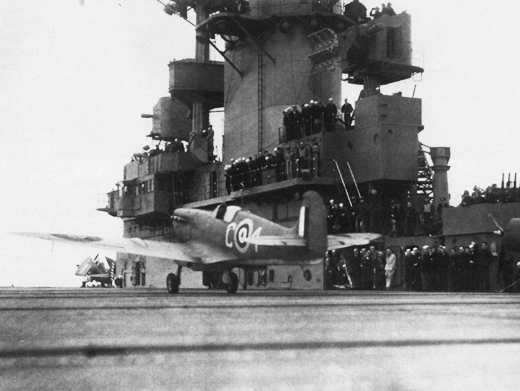
Spitfire Mk.V makes its takeoff run on the USS Wasp
From 1940 to 1942 the Italian Regia Aeronautica and the Luftwaffe mounted over 3,000 sorties against the British fortress island of Malta in the Mediterranean in an effort to secure their supply lines to Field Marshall Erwin Rommel's Afrika Korps in North Africa. Despite repeated attacks, the Allies managed to keep Malta supplied, even with Axis airfields only sixty miles to the north in Sicily. With the coming of the harsh Russian winter in 1941, poor flying conditions put a temporary hold on most air operations over the Eastern Front and Hitler decided once and for all to deal with Malta. Aircraft idled on the Eastern Front were temporarily moved to airfields in Sicily and southern Italy to begin an intensive aerial bombardment as a prelude to an invasion of the outpost. By the end of January 1942, Malta's defenses had been reduced only a few dozen Hawker Hurricanes which were far outclassed by the Messerschmitt Bf 109s that routinely prowled the skies around the British garrisons. The Hurricanes were delivered to Malta by a Royal Navy aircraft carrier- launching from a point 600 miles west of Malta off the coast of Algeria for the long flight to Malta. Now the British planned to send Supermarine Spitfires the same way to bolster the defenses of the island. Supermarine's engineers devised a 90 gallon external belly tank to extend the range of the Spitfire as well as the addition of a dust filter under the nose to keep the carburetor air relatively grit-free.

On 7 March 1942 the HMS Eagle delivered fifteen Spitfire Mk.Vs to the island and by the end of the month, the Eagle made two more deliveries. But the Luftwaffe and the Regia Aeronautica stepped up the pace of their attacks on the beleaguered island fortress and the bombers and torpedo bombers that were based on the island to harass Axis shipping had to be withdrawn, providing a much needed respite for the Afrika Korps who could now be supplied unmolested. The small Spitfire force suffered heavy attrition both in combat and due to air attacks on the island airfields and by the end of the month, the only carrier available to deliver Spitfires to the island, the HMS Eagle, had developed steering problems that would lay her up for four weeks in the dockyard at Gibraltar. As a result, on 1 April 2942 Prime Minster Winston Churchill contacted President Franklin D. Roosevelt for assistance in getting more Spitfires to Malta. No Spitfires were available in Egypt to be spared, and the other two available Royal Navy carriers weren't suitable- the HMS Argus was too small and the HMS Victorious' lifts were too small for Spitfires. The Luftwaffe hoped to knock Malta out before the late spring thaw in on the Eastern Front. 
Spitfires being craned aboard the USS Wasp

On 10 April 1942 President Roosevelt ordered Operation Calendar- on that day the USS Wasp docked in Glasgow and loaded forty-seven Spitfires while retaining twelve Grumman F4F Wildcats for self-defense. Nine days later the Wasp and her escorting force of British warships entered the Mediterranean. On 20 April 1942 at sunrise off the coast of Algeria, the Wasp launched her Wildcat combat air patrol first followed by the twelve Spitfires on the deck and then the thirty-five Spitfires that were brought up from the hangar deck. Alll but one of the Spitfires made it to Malta, greatly bolstering the defenses. Unfortunately the following day the Luftwaffe struck back at the island's airfields and by the end of the day, only seventeen Spitfires were left operational. RAF repair crews labored under constant air attack to cannibalize battle damaged Spitfires that were beyond repair to get the others operational to fight off the next attack. Once again, Churchill contacted Roosevelt and on 29 April the USS Wasp arrived back in Glasgow for Operation Bowery. This time not only did the Wasp take aboard forty-seven Spitfires, but she was joined by the newly-repaired HMS Eagle which took seventeen Spitfires. At dawn on 9 May 1942 a force of sixty-four Spitfires departed; one crashed on takeoff, killing its pilot and a second Spitfire flown by Royal Canadian Air Force pilot Jerry Smith found once airborne that he couldn't draw fuel from the 90-gallon drop tank. Once the deck of the Wasp was clear, he managed to land safely back aboard the carrier despite never having landed on a carrier and his Spitfire not having an arresting hook! No barriers were engaged either, and as result, the US Navy pilots aboard the Wasp "unofficially" awarded him a set of gold Navy pilot's wings. 

Spitfires share the deck with Wildcats with the HMS Eagle following
Of the sixty-two Spitfires that set out for Malta that day, two were lost along the way. As each Spitfire landed, it was immediately refueled and rearmed while a Malta-based pilot replaced the ferry pilot, all while the engine remained running. RAF ground crews had each Spitfire airborne and ready to meet the next Luftwaffe attack in only 15 minutes! Over the next two days, the Spitfires and remaining Hurricanes on Malta exacted a harsh price from the Luftwaffe attackers, but by this point, the weather was improving over the Eastern Front and Hitler ordered the aircraft transferred to the Mediterranean for the Malta operation moved back to Russia. The Regia Aeronautica was given responsibility for knocking out Malta's defenses but never came close to achieving the near-defeat of the fighter defenses of April and May of that year. Between 18 May and 8 June another seventy-six Spitfires were delivered to Malta, this time by Royal Navy carriers, but it never matched the effect of the USS Wasp making just two deliveries, leading Churchill to quip "Who says a wasp can't sting twice?"

The overall effect of having Malta as a base of operations against Axis shipping in the Mediterranean cannot be understated- of the Axis merchant ships that provided the lifeline to Erwin Rommel's Afrika Korps, 70% of Italian merchant shipping was sunk by Malta-based aircraft and 23% of German merchant shipping was sent to the bottom of the Mediterranean by the RAF on Malta. Had the British lost Malta, the outcome of the war in North Africa might have been very different.

Source: Military Aircraft Monthly International, Volume 10, Issue 1. "Air Wars: Spitfires to Malta" by Dr. Alfred Price, p4-11.

04 February 2011

Dr. Hans Multhopp's Raven and Its Legacy

Dr. Hans Multhopp and a model of his Ta 183 fighter
By 1942 both Messerschmitt and Heinkel had flown jet fighter prototypes but other great fighter aircraft manufacturer of Germany at the time, Focke-Wulf, was lagging behind in jet aircraft development with the technical director of the company, Kurt Tank, still working on preliminary ideas for a jet fighter aircraft. Tank's first designs resembled the Heinkel He 162 with a single, dorsal-mounted engine. As Tank refined the design further, the engine moved into the fuselage with a nose intake, then it got lateral intakes, twin fins and finally ended up as a single-engine twin-boom fighter that resembled the De Havilland Vampire and was named the "Flitzer" (Dasher). However, Tank's protege in the company, Hans Multhopp, had been working on something even more spectacular than the Flitzer. Multhopp joined Focke-Wulf in 1938, having been recruited by Tank himself from the University of Gottingen where he worked under the famed aerodynamicist Ludwig Prandtl. By 1940 Multhopp was second-in-charge of the company's aerodynamics department and by 1943 Tank had promoted him to head the company's advanced design bureau. It was here that Multhopp developed what was called Project V. Multhopp had christened his design "Huckebein" after a mischievous raven in a children's cartoon of the day. The Huckebein had sharply swept wings and a raked back T-tail that gave it an appearance that was nothing like any design in the works anywhere at the time. 

Kurt Tank's Flitzer design
Tank was dubious about the features of the Huckebein and had scale models of both the Flitzer and the Huckebein built and tested. Despite the tests not uncovering any flaws with the Huckebein, Tank continued work on his own Flitzer but by 1944 it was quite apparent that it couldn't deliver the performance the Luftwaffe desired, which was for a jet fighter aircraft that could outperform the Messerschmitt Me 262. Even though the Me 262 was quite capable in many respects, the German air ministry, the RLM, had overstated the progress of the Allies in jet fighter aircraft development. In addition, by 1944 it was apparent that the Boeing B-29 Superfortress could outperform the B-17 and B-24 bombers that were hitting the Reich regularly. The main drawback of the Me 262 was that in using two engines, it used up per aircraft twice the scarce materials than a single-engined aircraft. Because of this, the RLM and the Luftwaffe exercised even tighter control over fighter aircraft development that in hindsight, were excessively bureaucratic. 

In 1944 with Tank having to accept that the company would have to focus its development resources on the Huckebein, the RLM issued a specification for a high performance fighter powered by a single Heinkel HeS 011 jet engine. Messerschmitt submitted what was to become the P.1011 fighter. Focke Wulf submitted Multhopp's Huckebein and even seaplane builder Blohm und Voss submitted a fighter design. Through the winter of 1944-1945 RLM officials and Luftwaffe staff endlessly deliberated the merits of each design and even discussed revamping the specification- as Allied armies were approaching the Rhine in the West and the Soviet Red Army was continuing its relentless push on the Eastern Front. Junkers was then invited to submit their design as well. With no progress being made, the Luftwaffe High Command called an emergency meeting in February 1945 to resolve the matter and the Focke Wulf Huckebein was selected as the Ta 183 ("Ta" in reference to Kurt Tank) to be the interim design while the Messerschmitt design was regarded as the optimal design for further development to supplant the Ta 183 in service. Plans were drawn up sixteen test Ta 183 aircraft with a maiden flight planned for May or June 1945 with the first production fighters being delivered to the Luftwaffe in October 1945. 
Ta 183 Design III, this influenced the Saab J29 Tunnan

The Ta 183 was aerodynamically very advanced with a 40 degree, thin, swept wing that had low wing loading for high altitude performance and maneuverability. The sharply raked back vertical fin mounted a T-tail unit that was used only for trimming purposes with pitch and roll to be handled only by the wing surfaces. The cockpit was pressurized and aircraft was armed with hard-hitting 30mm cannon. An alternate variation of the Ta 183 was also envisioned with a less sharply swept wing, a conventional tail unit and longer fuselage- this was the Design III which Tank worked on while Multhopp refined the original Ta 183 which was designated Design II. 

The Ta 183 is a popular subject of "What-If" modeling
Work proceeded quickly after that February meeting, but the following month the Allies crossed the Rhine into Germany and work on the Ta 183 under Hans Multhopp and Kurt Tank ground to a halt when the British Army captured Bad Eilsen, the location of Focke-Wulf's design department. The fall of Nazi Germany left the Allies an impressive treasure trove of aeronautical progress. The British initially failed to realize the technological leap the Ta 183 represented when they sifted through the captured material at Bad Eilsen. The Soviets, however, were quick to realize the Ta 183's potential, having found a complete set of plans on microfilm when they captured the RLM headquarters in Berlin. While the plans were examined by Artyom Mikoyan and Mikhail Gurevich of the MiG design bureau, it would be fallacy to say that the MiG-15 is a copy of the Ta 183 as Mikoyan and Gurevich were talented designers in the their own right. Perhaps their examination of the Ta 183 plans confirmed their own intuitions on how best to proceed with the MiG-15. There is no doubt, though, that Sweden managed to get a hold of the Ta 183 plans and data and that it is believed to have influenced their own design work on the Saab J 29 Tunnan fighter. 

Following the end of the Second World War, Kurt Tank and Hans Multhopp parted ways, with Tank moving on to work on projects in Argentina and India (subject for future blog posts, stay tuned!). Multhopp and a team of his assistants went to work at Farnborough in the UK and developed plans for a transonic research aircraft powered by an Rolls-Royce Avon turbojet with 60-degree swept wings and a T-tail with the pilot sitting prone in the shock cone of the nose intake. However, Britain was economically spent after the war and Multhopp's design never got built. In 1949 he moved to the United States and went to work with the Glenn L. Martin Company where he worked on two designs that also had T-tails- the XB-51 tactical bomber and the P6M Seamaster jet flying boat. He would later become the chief scientist for Martin Aircraft and his career would culminate with Martin's pioneering work on lifting body spaceplane designs like the X-23/PRIME and the X-24 which provided much data for the NASA Space Shuttle program. 

While the Ta 183 was only one of many advanced designs being worked on in Germany during the Second World War, it is probably the most emblematic of Germany's influence on postwar aircraft design. Many designs that were considered ground breaking in the 1940s like the Boeing B-47 Stratojet and the North American F-86 Sabre, originally began as less-than-spectacular straight wing designs that were reworked to incorporate what was being learned from the analysis of captured German aeronautical research.

Source: Aircraft, January 2011, Volume 44, Number 1. "The Luftwaffe's Last Hope" by Bruce Hales-Dutton, p46-50.

09 November 2009


After a prolonged development phase that started in 1934, the Blohm und Voss BV 138 three-engined flying boat first appeared in the skies over the Bay of Biscay in 1940. The first flying boat from Blohm und Voss, the most unique but not seen feature of the BV 138 was its tubular main wing spar which was also sealed to form a large fuel tank in addition to the more conventional fuel tanks in the wings. The flying controls were all hydraulically assisted and the crew of five was housed in the short fuselage/hull which bestowed the BV 138 it's nickname of "Die Fliegende Holzschuh" or "Flying Clog". There were enough provisions in the hull to sustain the crew for a week which allowed deployment of the BV 138 to forward positions to await further orders.

The crew included the pilot and naval observer side by side in the flight deck- in the Luftwaffe, the naval observer was actually the mission commander and only had a rudimentary amount of flight training as most of the flying was entrusted to the pilot who sat on the left. The navigation and radio compartment was located below the central engine while behind the center engine and in the wing midsection was the flight engineer's cabin whose duties included operating the fuel transfer pumps as well as topping off the engine oil in all three engines via hand pumps every 60 to 90 minutes as well as mixing coolant to keep the engines topped off as well. Two gun positions included a 20mm cannon turret in the nose ahead of the flight deck and an aft machine gun mount at the rear.

In the summer of 1943 the deployed provisioning capability of the BV 138 was used to base the flying boats on the Russian island of Novaya Zemlya to prowl on Arctic convoys bound for the port of Murmansk.

But the most unusual use of the BV 138 was that of an aerial minesweeper with a 46.6 foot diameter degaussing loop attached to the aircraft and powered by a generator in the former nose turret. As the war drew to a close, BV 138s were used to land on lakes around Berlin to evacuate wounded soldiers to Denmark.

Source: Air Enthusiast, July/August 1999. "Flugboots from Hamburg- An Outline History of Blohm und Voss Flying Boats" by Ken Wixley, p42-47.

08 November 2009

During the Second World War, aircraft manufacturers Arado and Fieseler were asked to develop a carrier-borne aircraft for the under-construction carrier Graf Zeppelin that could deliver both bombs and torpedoes. The Arado Ar 195 was the less successful of the two- based on the Arado Ar 95 floatplane, it was underpowered with only an 830-horsepower engine. The Fieseler Fi 167, was a better performer as from the start as its engine was the same Daimler-Benz 1,100-horsepower engine that was used on the Messerschmitt Bf 109 and Bf 110 fighters.

Though a biplane design with fixed undercarriage, the Fi 167 was in the same class as the Fairey Swordfish and Albacore torpedo bombers that despite their antiquated appearance, were quite effective in the Second World War. Fieseler's experience in designing the Fi 156 Storch STOL aircraft resulted in the Fi 167 having an astoundingly low stalling speed. Leading edge slats on the wings made it possible to stop the Fi 167 in midair by pulling hard back on the stick and the aircraft would settle in a near vertical drop while still under full control. Such handling characteristics made it ideal for carrier landings.

In addition to folding wings that folded aft in a similar fashion to the wing fold of the Fairey Swordfish, explosive charges could sever the fixed landing gear from the wings in case the aircraft had to be ditched at sea.

At the end of 1938 Fieseler got a contract for the first 12 aircraft which would be pre-production prototypes. Designated Fi 167A-0, the were taken on by an experimental squadron and operated in Holland from 1942 to 1943 in various testing roles which also included camouflage trials. With the eventual cancellation of the Graf Zeppelin, the aircraft were returned to Fieseler and rumored to have been split up between nine being overhauled before being delivered to Romania and the remaining three were kept by the Luftwaffe for test work.

Source: Air Enthusiast, March/April 2001. "Graf Zeppelin Afloat" by Henk van Willigenburg, p59-62.