Showing posts with label USS Wasp. Show all posts

25 April 2016

CHECK SIX: The USS Wasp (CV-7)

The USS Wasp in 1940
(Wikipedia)
The Wasp (CV-7) was a scaled down Yorktown-class carrier and a product of the Washington Naval Treaty. After the Yorktown and Enterprise were built, the US still had 15,000 tons allowed for an additional carrier under the treaty. Since the Navy wanted as big an air wing as possible on the Wasp despite the ship being about 25% smaller than the Yorktown class, a number of torpedo protection features were omitted from the design that would have protected her stores and machinery spaces. The carrier also had less armor protection topside. Her machinery was less powerful than even the Independence-class CVLs. The Wasp's machinery was capable of 75,000 shaft-horsepower. The Yorktown's power plant could do 120,000 shp, the Essex-class had a power plant capable of 150,000 shp and that of the Independence-class CVLs could do 100,000 shp.

The Wasp had the first deck edge elevator- it was a T-shaped platform to accommodate the tailwheel at the top and the mainwheels on the cross part. Though instead of running vertically on side rails, articulated arms moved the elevator in a semicircular path from the hangar deck to the flight deck. 

The deck edge elevator of the USS Wasp with a Vought SB2U Vindicator
(National Museum of Naval Aviation/Wikipedia)
The Wasp was commissioned on 25 April 1940. Her final sea trials took place on 26 September 1940 and was afterwards assigned to the Atlantic Fleet with the homeport at Norfolk, Virginia. One of her earliest assignments were experiments to see if Army aircraft, in this case Curtiss P-40 Warhawks, could be flown off the carrier. Interestingly while on Neutrality Patrol in the summer of 1941, the Wasp participated in the search for the German cruiser Admiral Hipper. With the declaration of war in December 1941, the Wasp's first tasking was in the Caribbean to intercept any French warships which were feared to be under Vichy control and would attempt a breakout to reach France. With carrier losses in the Pacific after the Battle of Coral Sea and the Battle of Midway reducing the US Pacific fleet to only three carriers, the Wasp was urgently transferred from the Atlantic Fleet to the Pacific Fleet. It was participation in the Guadalcanal campaign with the USS Saratoga and the USS Enterprise that the Wasp would be lost. 

The design omissions to meet Washington Treaty stipulations would prove fatal in 1942 when she was torpedoed during the Guadalcanal campaign by the submarine I-19. Early war inexperience with damage control was also a factor in the Wasp's sinking. I-19 fired six torpedoes- three hit the Wasp in the area of its fuel bunkers and magazines with disastrous effect. The fourth torpedo hit the escorting destroyer USS O'Brien, the fifth and six torpedoes missing. Thirty-five minutes after being hit, Captain Forrest P. Sherman gave the order to abandon ship. She later had to be sunk by one of the escorting destroyers. Of her air wing, 45 aircraft went down with her, but of the 26 aircraft that were airborne at the time of the attack, all but one were recovered aboard the USS Hornet. 193 men died with 366 wounded.

The Wasp ablaze shortly after the three torpedo hits
(Wikipedia)
Further reading: 


08 February 2011

How the USS Wasp Helped Defeat Rommel's Afrika Corps

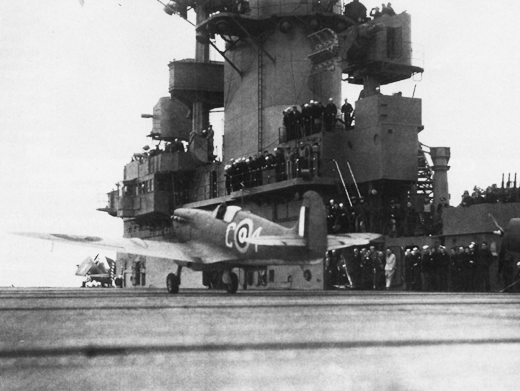
Spitfire Mk.V makes its takeoff run on the USS Wasp
From 1940 to 1942 the Italian Regia Aeronautica and the Luftwaffe mounted over 3,000 sorties against the British fortress island of Malta in the Mediterranean in an effort to secure their supply lines to Field Marshall Erwin Rommel's Afrika Korps in North Africa. Despite repeated attacks, the Allies managed to keep Malta supplied, even with Axis airfields only sixty miles to the north in Sicily. With the coming of the harsh Russian winter in 1941, poor flying conditions put a temporary hold on most air operations over the Eastern Front and Hitler decided once and for all to deal with Malta. Aircraft idled on the Eastern Front were temporarily moved to airfields in Sicily and southern Italy to begin an intensive aerial bombardment as a prelude to an invasion of the outpost. By the end of January 1942, Malta's defenses had been reduced only a few dozen Hawker Hurricanes which were far outclassed by the Messerschmitt Bf 109s that routinely prowled the skies around the British garrisons. The Hurricanes were delivered to Malta by a Royal Navy aircraft carrier- launching from a point 600 miles west of Malta off the coast of Algeria for the long flight to Malta. Now the British planned to send Supermarine Spitfires the same way to bolster the defenses of the island. Supermarine's engineers devised a 90 gallon external belly tank to extend the range of the Spitfire as well as the addition of a dust filter under the nose to keep the carburetor air relatively grit-free.

On 7 March 1942 the HMS Eagle delivered fifteen Spitfire Mk.Vs to the island and by the end of the month, the Eagle made two more deliveries. But the Luftwaffe and the Regia Aeronautica stepped up the pace of their attacks on the beleaguered island fortress and the bombers and torpedo bombers that were based on the island to harass Axis shipping had to be withdrawn, providing a much needed respite for the Afrika Korps who could now be supplied unmolested. The small Spitfire force suffered heavy attrition both in combat and due to air attacks on the island airfields and by the end of the month, the only carrier available to deliver Spitfires to the island, the HMS Eagle, had developed steering problems that would lay her up for four weeks in the dockyard at Gibraltar. As a result, on 1 April 2942 Prime Minster Winston Churchill contacted President Franklin D. Roosevelt for assistance in getting more Spitfires to Malta. No Spitfires were available in Egypt to be spared, and the other two available Royal Navy carriers weren't suitable- the HMS Argus was too small and the HMS Victorious' lifts were too small for Spitfires. The Luftwaffe hoped to knock Malta out before the late spring thaw in on the Eastern Front. 
Spitfires being craned aboard the USS Wasp

On 10 April 1942 President Roosevelt ordered Operation Calendar- on that day the USS Wasp docked in Glasgow and loaded forty-seven Spitfires while retaining twelve Grumman F4F Wildcats for self-defense. Nine days later the Wasp and her escorting force of British warships entered the Mediterranean. On 20 April 1942 at sunrise off the coast of Algeria, the Wasp launched her Wildcat combat air patrol first followed by the twelve Spitfires on the deck and then the thirty-five Spitfires that were brought up from the hangar deck. Alll but one of the Spitfires made it to Malta, greatly bolstering the defenses. Unfortunately the following day the Luftwaffe struck back at the island's airfields and by the end of the day, only seventeen Spitfires were left operational. RAF repair crews labored under constant air attack to cannibalize battle damaged Spitfires that were beyond repair to get the others operational to fight off the next attack. Once again, Churchill contacted Roosevelt and on 29 April the USS Wasp arrived back in Glasgow for Operation Bowery. This time not only did the Wasp take aboard forty-seven Spitfires, but she was joined by the newly-repaired HMS Eagle which took seventeen Spitfires. At dawn on 9 May 1942 a force of sixty-four Spitfires departed; one crashed on takeoff, killing its pilot and a second Spitfire flown by Royal Canadian Air Force pilot Jerry Smith found once airborne that he couldn't draw fuel from the 90-gallon drop tank. Once the deck of the Wasp was clear, he managed to land safely back aboard the carrier despite never having landed on a carrier and his Spitfire not having an arresting hook! No barriers were engaged either, and as result, the US Navy pilots aboard the Wasp "unofficially" awarded him a set of gold Navy pilot's wings. 

Spitfires share the deck with Wildcats with the HMS Eagle following
Of the sixty-two Spitfires that set out for Malta that day, two were lost along the way. As each Spitfire landed, it was immediately refueled and rearmed while a Malta-based pilot replaced the ferry pilot, all while the engine remained running. RAF ground crews had each Spitfire airborne and ready to meet the next Luftwaffe attack in only 15 minutes! Over the next two days, the Spitfires and remaining Hurricanes on Malta exacted a harsh price from the Luftwaffe attackers, but by this point, the weather was improving over the Eastern Front and Hitler ordered the aircraft transferred to the Mediterranean for the Malta operation moved back to Russia. The Regia Aeronautica was given responsibility for knocking out Malta's defenses but never came close to achieving the near-defeat of the fighter defenses of April and May of that year. Between 18 May and 8 June another seventy-six Spitfires were delivered to Malta, this time by Royal Navy carriers, but it never matched the effect of the USS Wasp making just two deliveries, leading Churchill to quip "Who says a wasp can't sting twice?"

The overall effect of having Malta as a base of operations against Axis shipping in the Mediterranean cannot be understated- of the Axis merchant ships that provided the lifeline to Erwin Rommel's Afrika Korps, 70% of Italian merchant shipping was sunk by Malta-based aircraft and 23% of German merchant shipping was sent to the bottom of the Mediterranean by the RAF on Malta. Had the British lost Malta, the outcome of the war in North Africa might have been very different.

Source: Military Aircraft Monthly International, Volume 10, Issue 1. "Air Wars: Spitfires to Malta" by Dr. Alfred Price, p4-11.