Showing posts with label B-47 Stratojet. Show all posts

02 September 2010

The Martin XB-48

In November 1944 the US Army Air Forces looked ahead to the future of jet technology in issuing a specification for a jet-powered bomber with a range of 3,000 miles, a service ceiling of 45,000 feet and a maximum speed of 550 mph. By January of the following year the requirements were increased with the necessary ability to carry specific types of large bombs in the USAAF inventory. Four companies would eventually come to submit designs that would reach the flying hardware stage- the North American XB-45 Tornado, the Convair XB-46, the Boeing XB-47 Stratojet, and the Martin XB-48. With the XB-45 and XB-46 being four-engined bombers, they were paired up to compete with each other for a production contract and the XB-47 and XB-48 both being six-engined bombers, ended up being paired up to compete as well. By December of 1945, the Glenn L. Martin Company in Baltimore signed a contract with the USAAF for its submission, the Model 223 which received the designation XB-48. A newer contract superseded the original contract which called for two XB-48 prototypes with a first flight date no later than the end of September 1947. 

While the general layout of the Martin XB-48 was conventional (straight wings, for instance), there were many features on the XB-48 that were unique and ground-breaking for aircraft technology of the day. Since the wings were too slender to carry the main undercarriage, the XB-48 featured a bicycle undercarriage with outrigger wheels that retracted into the outer sections of the underwing jet nacelles. This landing gear arrangement was first tested on a modified Martin B-26 Marauder nicknamed the "Middle River Stump Jumper" and designated XB-26H. The other significant unique feature of the XB-48 was that in order to keep the wingspan reasonable, the three engine nacelles on each wing were grouped together to form a lifting surface in which the nacelles top surface was faired into the wing and contributed to the overall wing lift. The General Electric J35 engines had their own sub-nacelles with an air duct passing between each nacelle and exhausting out the back of the nacelle. The jetpipes were also adjustable via flaps that deflected the jet exhaust. 
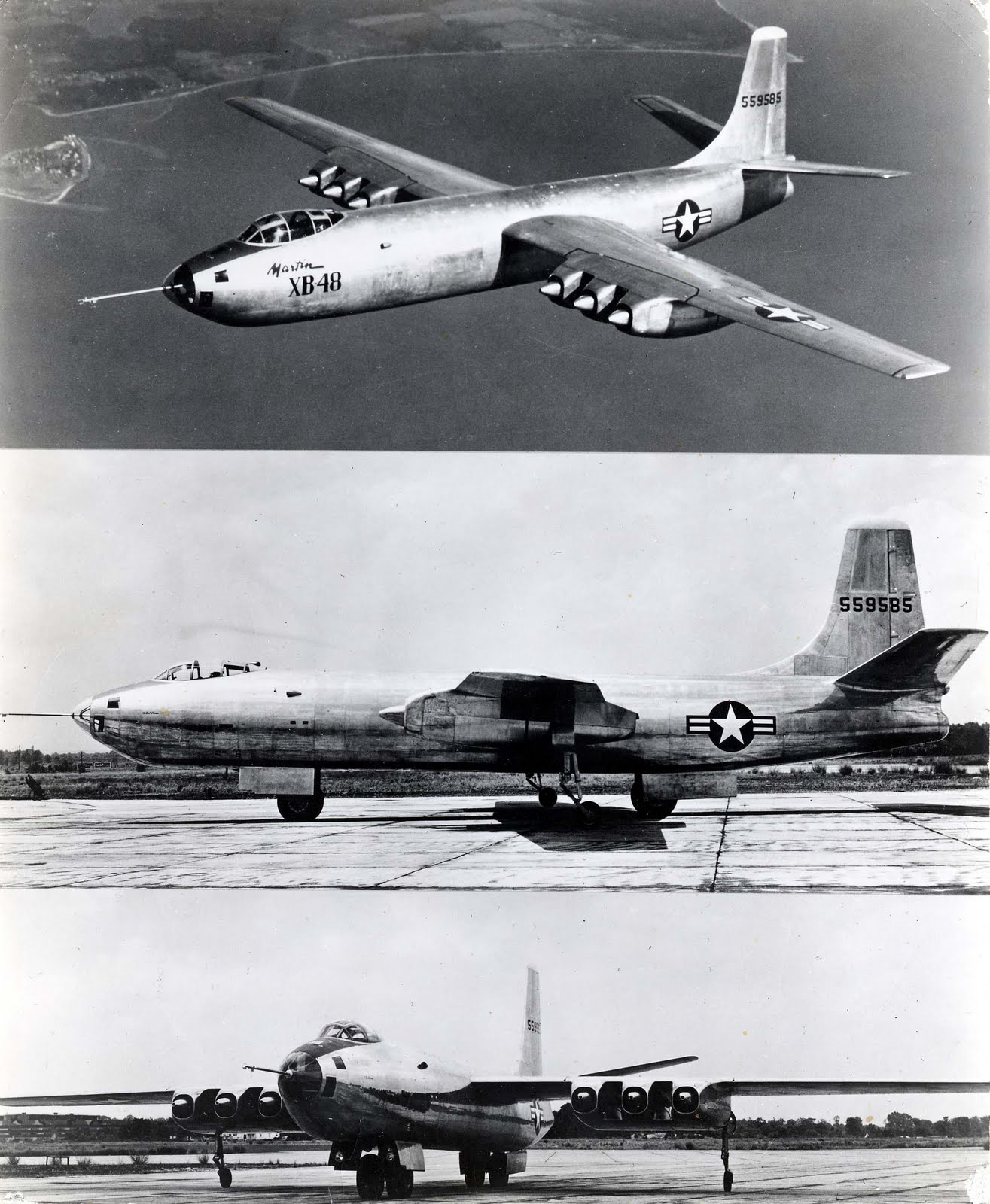
The first XB-48 made its first flight at the Middle River plant's airfield on 22 June 1947 and flew to NAS Patuxent River 80 miles away for more flight testing. The J35 engines proved to be one of the biggest headaches in the flight test program. The first XB-48 aircraft went through fourteen J35s in only 44 test flights! By this time the USAAF was an independent military branch as the United States Air Force and flight testing of both the XB-48 and the Boeing XB-47 showed that the Stratojet was clearly the superior aircraft thanks to its more powerful J47 engines and highly refined aerodynamics with its thin swept wing. Martin's XB-48 ended up being 50mph slower than its original design speed and as a result, the XB-48 program was canceled by the USAF in September 1948 with an order of the first production B-47A Stratojets. 

However, the USAF did make enough funds available for the completion of the second XB-48 prototype and for its flight testing. The second XB-48 first flew on 16 October 1948, three months behind schedule. But the delay was of little significance since the USAF had already terminated the program. Martin then offered to modify the XB-48 design in 1949 with XT40 turboprops which would have been more capable than the B-50 Superfortress, but by this point the USAF was interested only in pure jet bombers, not to mention that the XT40 was a Navy-funded engine and in those days, intraservice rivalries played a significant role in weapons development. In March of that year, Martin was formally notified of the USAF's lack of interest in the XT40-powered version of the XB-48. 

With the formal end of the flight test program in the summer of 1949, Martin elected to keep flying the XB-48 as test beds. The first aircraft would be used as a spares source to keep the second aircraft flying and test schedules were drawn up to test items like autopilot systems, engine cooling technologies and hydraulic equipment. In the end, though, even those tests got canceled and the second XB-48 ended up only flight testing a thermal de-icing system. In September 1951 the sole remaining XB-48 was flown to the Aberdeen Proving Ground in Maryland and static tested to destruction. 

13 March 2010

The First Production ECM Pod for Jet Aircraft: Tee Town


In the late 1950s Soviet defenses against the bombers of the Strategic Air Command were improving by leaps and bounds as more capable fighters, radars and surface-to-air missiles were deployed not just on the periphery of the Soviet Union but also around key cities and industrial centers like Moscow and Leningrad. At the time, SAC's bomber force consisted of 100 Boeing B-52 Stratofortresses, over 1,000 Boeing B-47 Stratojets, and 200 Convair B-36s that were gradually being phased out. As the tip of SAC's spear, the B-52s had a comprehensive electronic countermeasures suite as well as an onboard electronic warfare officer who could constantly reconfigure the jammers to meet the threats.

The B-36s being piston-driven (despite the addition of four jet engines) was soon to be phased out, so there was no need to upgrade to the ECM systems. But the B-47 made up three-quarters of SAC's offensive striking force and unlike the B-52, didn't have the space or power for additional jamming systems to put it on par with the Stratofortresses.

The solution came with a $2.5 million contract code named Tee Town. Carried out in 1958 to 1959 with the assistance of Douglas Aircraft's Tulsa Division, Tee Town consisted of two 14-foot long pods mounted on cantilevered pylons attached to the bomb bay doors. Each pod carried four ALT-6B jammers on the lower half of the pod and covered by a fiberglass dielectric fairing. Ram air was ducted around each of the jammers for cooling and Douglas added upgraded electrical generators on the Tee Town aircraft to handle the increased electrical demand.

Tee Town was planned as an interim measure pending deployment of the specialized Phase V jamming escort version of the B-47 that would accompany strike cells of nuclear-armed Stratojets. Sixty B-47s were modified to carry the Tee Town pods and were assigned to the 303rd Bomb Wing at Davis-Monthan AFB in Arizona and the 509th Bomb Wing at Pease AFB in New Hampshire.

Although only 120 of the Tee Town pods were built, it marked a historical point as the world's first electronic warfare jamming pod designed for high speed aircraft to go into production.

Source: The History of U.S. Electronic Warfare, Volume II- The Renaissance Years, 1946-1964 by Alfred Price. The Association of Old Crows/Port City Press, 1989, p191-192.

07 February 2010


When famed test pilot Alvin "Tex" Johnston came to Boeing just before the first flight of the XB-47 Stratojet prototype, it was on the recommendation of the USAF based on Johnston's prior experience with jet aircraft at Bell and that he had flown just about every aircraft in the Air Force's inventory. He had the nickname "Tex" as he always wore cowboy boots when he flew.

The flight test program of the Stratojet was quite literally exploring uncharted territory as it was the first large jet-powered swept-wing aircraft to fly. It fell to the Boeing test pilots like Tex Johnston to uncover all the aerodynamic pitfalls and report them to the engineers. At times, Johnston could be a constant irritant to the Stratojet engineering team but somehow his observations always seemed on the mark even if he wasn't seeing eye-to-eye with the engineers.

One famous example concerned the discovery that at high speed, the XB-47's nose would start pitching up as the Mach number increased. The oscillations had the potential to throw the Stratojet out of control and into a spin. Many of the test pilots had noted this high-Mach instability, but it took Tex Johnston's larger-than-life personality to get it taken seriously. After a test flight, he informed one of the Boeing engineers, T.A. Wilson (who would later head the B-52 program and eventually lead Boeing through the 70s and 80s), that the vibrations would get severe enough to cause a stall warning. Wilson wanted to know at what point the oscillations began as he wasn't seeing it on the flight data recording equipment printouts.

"I don't see anything that shows me it's a high-Mach stall".
"Goddammit, I felt it!"
"You felt it? Where?"
"Wilson, right in my ass!"

So T.A. Wilson decided to settle it once and for all. He removed the pilot's seat cushion and installed a data recorder right in the seat and had Tex Johnston take the XB-47 back up. Once he landed, Wilson took a look at the data and sure enough, the recorder picked up the signature of the onset of a high-Mach stall.

As the Stratojet approached higher Mach speeds, a forming shockwave from the wing's leading edge disturbed the airflow over the outer wings, causing them to lose lift. The solution was to put a series of vortex generators on the outer wing which energized the airflow over the outer wing and maintained lift at high speeds.

Source: Legend & Legacy: The Story of Boeing and Its People by Robert J. Serling. St. Martin's Press, 1992, p97-98.

23 January 2010


Less than six months separated the first flight of the Boeing 377 Stratocruiser and the first flight of the Boeing B-47 Stratojet in December of 1947. While the Stratocruiser represented in many ways the ultimate development of the B-29 Superfortress, there was a design evolution that connects the B-29 and the B-47 as well.

The genesis of the B-47 came in the midst of the Second World War when the US Army Air Forces (the USAF wasn't an independent branch until 1947) looked to the future and knew that jets were the way to go and decided a jet-powered bomber based on their top of the line aircraft, the B-29 Superfortress was what was needed next. Boeing's design team began with what was essentially a jet-powered development of the B-29 but ran into difficulties meeting the range and performance levels that the USAF desired. When the war ended in August 1945, Boeing's chief aerodynamicist, George Schairer, was already in Germany with a USAAF technical team that was evaluating captured German aeronautical research.

At the Luftwaffe research center at Volkenrode, the technical team was reviewing wind-tunnel research into swept wings. In a dry well Schairer and the team found hastily-dumped papers that showed the performance leap possible by combining jet engines and swept wings.

Schairer wrote a seven page later to the engineering team at Boeing working on what would become the B-47 Stratojet. The design process at the time had a design that had fuselage mounted engines and a straight tapered wing and Schairer detailed in his letter what he had found at Volkenrode and his thoughts at how it might benefit the jet bomber design. As a result, the design was reworked to feature a 35-degress swept wing- at the time designated the Boeing Model 448, it was the first of two major technological breakthroughs in the design of the B-47. At this point the design still had its engines mounted in the fuselage and team found that the thin, swept wing could bend excessively in some flight regimes.

The second technological breakthrough was to relocate the jet engines in pods in the wings. The weight of the engines offset bending in the wings and resulted in a more aerodynamic fuselage. It would set the pattern for all large jet aircraft from then onward.

When the XB-47 made its first flight in December 1947, it was only 44 years to the day of the Wright Brothers' first flight at Kitty Hawk. But there was one other aircraft that beat the XB-47 into the air as the first with swept wings, and that was the XP-86 Sabre from North American Aviation (later redesignated F-86). North American also had representatives on the same technical team in Germany with George Schairer.

Source: 747: Creating the World's First Jumbo Jet and Other Adventures from a Life in Aviation by Joe Sutter with Jay Spenser. Smithsonian Books, 2006, p53-57.

07 January 2010

The first Air Force air-refueling tankers were KB-29 and KB-50s converted from bombers but by the 1950s the Boeing KC-97 became the standard air refueling tanker- this choice, however, was not without its difficulties particularly in refueling the B-47 Stratojet- the KC-97 wasn't able to reach the higher altitudes where the B-47 was most efficient and the B-47 had to descend to lower altitudes where its fuel burn was higher in order to link up with the KC-97. Furthermore, even with the KC-97's throttles "firewalled", the Stratojet had a tendency to stall during the link up and as a result, the refueling operation would have to carried out with the KC-97 in a shallow dive in order to gain speed above the stall speed of the Stratojet.

In 1953, the USAF trialled two B-47Bs outfitted with the British probe-and-drogue system developed by Flight Refueling, Ltd. One aircraft designated YB-47F and nicknamed "Pa" was fitted with nose mounted probe and the other aircraft, designated KB-47G and nicknamed "Ma", reeled out the hose-mounted drogue from its bomb bay. On 1 September 1953 the pair made the world's first all-jet air refueling.

Despite the higher speeds and ease of rendezvous, the fuel transfer rate with the system wasn't fast enough and in certain conditions was actually *less* than the burn rate of the six J47 engines of the receiver Stratojet. Only the flying boom used on the KC-97 was capable of the fuel transfer rates needed to give the Stratojets "legs" to reach distant targets. The interim solution was to fit the KB-50 and KC-97 tankers with auxillary jet engines to provide extra speed during refueling but the long term solution would arrive in the form of the Boeing KC-135 Stratotanker that had the speed and altitude performance to match SAC's bomber fleet.

Source: Boeing's B-47 Stratojet by Alwyn T. Lloyd. Speciality Press, 2005, p202.

05 January 2010


During the development of the hydrogen bomb there were concerns by the USAF that the delivery aircraft wouldn't be able to successfully exit the target area after dropping the weapon. As the development of the Atlas ICBM was still years away, Project Brass Ring was initiated in 1950 to create an unmanned version of the Boeing B-47 Stratojet to carry the H-bomb which would be designated MB-47 which in turn would be controlled by a manned Stratojet designated DB-47.

North American Aviation developed a sophisticated navigation and flight control system for the MB-47- but given the Air Force's requirements that the system be fully automatic, jam-resistant, and be accurate, it pushed the technology of the day and by 1952 it had to be cancelled due to cost overruns. The USAF then turned to Sperry Gyroscope to pick up where North American left off and it eventually cost a then-hefty sum of $2.3 million to complete. The MB-47 made its first flight on 7 May 1952 and by that summer both the MB-47 and the DB-47 controller had made several test flights with encouraging results. However, the cost of Project Brass Ring had nearly doubled from $4.9 million to just over $10 million.

By this point in the program SAC had determined that the Convair B-36 Peacemaker would be able to deliver the first production H-bombs if they were equipped with a parachute-retarding lay-down system. Furthermore, gaining permission from NATO members to forward deploy Stratojets in the UK, Spain, and French Morrocco made Project Brass Ring unnecessary and the program was terminated in April 1953.

Source: Boeing's B-47 Stratojet by Alwyn T. Lloyd. Speciality Press, 2005, p206-207

18 December 2009


With the expansion in the numbers of jet-powered military aircraft in the USAF as well as the other branches of the military in the 1950s, concerns were raised about the flow control of high-performance jet aircraft with slower civilian piston traffic in the airways system. The Strategic Air Command alone in 1955 operated over a thousand jet aircraft. The USAF's Airways & Air Communications Service, in charge of all Air Force navigation and communications facilities, expressed concern that without the development of new control procedures, airways and navaids, it would be like inadequate highways being paired with modern automobiles.

As the Civil Aeronautics Administration (the FAA's predecessor) had no jet aircraft capable of performing the flight check role, the task was assigned the USAF AACS. In what became known as the High Altitude Project, both CAA and USAF navaids and procedures were to be evaluated using Boeing B-47 Stratojets. The objectives of the project were to evaluate ATC procedures, determine the capabilities of navaids at high speeds between 20,000 to 40,000 feet and develop new high altitude control procedures. The Douglas C-47s and C-54s then operated by the CAA would conduct the low altitude flight checks as they had been doing since the Second World War.

Between 1955 and 1962 B-47s based at Tinker AFB, Oklahoma, were fitted out with the necessary flight check equipment for the High Altitude Project. In 1963, Lockheed C-140 Jetstars would replace the Stratojets in the flight check role.

Two sets of navigational charts resulted from the High Altitude Project, an updated set of low-altitude charts and procedures for altitudes up to 18,000 feet and a jet navigation set of charts and procedures for altitudes from 18,000 feet to 40,000 feet. In addition, a new set of airfield approach plates suitable for jet aircraft were developed.

Source: Boeing's B-47 Stratojet by Alwyn T. Lloyd. Speciality Press, 2005, p182-183