Showing posts with label Bell. Show all posts

24 April 2016

The Grand Daddy of the Bell Helicopter Family: The 1942 Model 30

I had posted an article this past November on how a self-taught engineer, Arthur Young, got Bell Aircraft into the helicopter business. Young had demonstrated to Larry Bell himself the stability and controllability of his model helicopter designs. From my November 2015 article: 
On 3 September 1941, Young arrived at Bell's Buffalo plant and was taken to a hangar where P-39s were prepared for delivery. Bell ordered the personnel in the hanger to stop work and move the P-39s outside to give Young room for his demonstration. Not only did Young fly a successful demonstration for Larry Bell, he also reviewed with Bell films showing his previous design efforts and showed him his notes on the design process he had developed to solve the problems of vertical flight. Bell was enthralled by Arthur Young and wanted to hear Young's ideas on a full-size piloted helicopter design. In a matter of weeks they reached an agreement where Young would come to Buffalo and work for Bell in developing a new helicopter based on his designs. Young assigned his patents to Bell Aircraft and Larry Bell funded the development of two full-sized helicopters. Young wanted two aircraft in case one crashed and Bell insisted that the second prototype be a two-seater so he could go on a ride!

Though Bell had established a $250,000 budget for Arthur Young and the design and fabrication of a full-scale flying helicopter prototype, the demands of the war effort meant that just about anyone and everyone who worked at Bell was assigned to one of the three shifts that were running around the clock building aircraft. Larry Bell was under the impression that Young would produce manufacturing drawings while Young was under the impression that he would design *and* build the helicopter prototypes. Young had successfully argued that plans couldn't be drawn until more was known about vertical flight through experimentation and test flying. The original agreement was clarified and amended to provide for the construction of two prototypes which would be designated the Model 30. Larry Bell, however, not understanding the nature of helicopter flight himself, would only agree to the fabrication of flying prototypes if Young could assure him that if the engine quit, the helicopter wouldn't drop out of the sky, killing its pilot. Young took one of his remote controlled models, attached an egg to it, and with Larry Bell watching, turned off the electric motor and the model autorotated smoothly to the ground without breaking the egg!

The Birthplace of Bell Helicopter in Gardenville, New York
(Bell Helicopter)
It was decided that a work space separate from the main Bell plant in Buffalo was needed and a vacant Chrysler car dealership building in Gardenville was secured for Young's use. However, since Young had to agree to not place additional burdens on Bell's engineering staff, Young did most of the engineering work himself with his assistant, Bart Kelley (who had been working for Young even before Young joined Bell). Skilled tradesmen and a few draftsmen were sent to Gardenville from the Bell plant- at any given point during the three year development program, Young only had 24 to 32 workers at his disposal. Using one of Young's flying models as a pattern which was scaled up six times, the first Model 30 helicopter was designed and fabricated in just six months starting in June 1942 and was named "Genevieve"- the name never caught on, as everyone referred to this helicopter as "Ship 1". 

The single-seat fuselage was made of plywood and welded tubing with magnesium sheet covering the tail boom. The rotor blades (32 feet in diameter) were made of a composite sandwich of balsa and fir wood with a stainless steel leading edge for reinforcement. A 165-horsepower Franklin flat-six piston engine was used as the power plant. Franklin engines were light aircraft engines used in a variety of light aircraft at the time. The engine was mounted vertically under the rotor mast. Since no one at Bell knew how to make a helicopter transmission, one of Arthur Young's model's transmission was scaled up for the Model 30. 

Ship 1 with its original "spider legs"
(Airwar.ru)
Ship 1 was rolled out of the Gardenville facility on 18 December 1942. It initially had four long spidery legs for its early flight test program that began with its maiden flight on 29 December 1942. Since the program didn't have the budget for a test pilot, Arthur Young himself made the first flight! When Bell's chief test pilot, Robert Stanley, wanted to have a go at the Model 30, he over controlled it and crash landed it. As a result, Bell assigned the Model 30 its own test pilot to work with Arthur Young and prevent further mishaps. Easily repaired, the Model 30 prototype continued its flight test program and experimentation which allowed Arthur Young and his small team to refine the rotor head and transmission design while work began on the second helicopter, designated Ship 2. 

In September 1943, the project's test pilot, Floyd Carlson, was attempting the first autorotation landings when Ship 1 landed hard and crashed a second time. Despite having sustained more damage than the first crash, Ship 1 was rebuilt as Ship 1A but Ship 2 was quickly finished and picked up the Model 30 flight test program in the fall of 1943. As had been agreed upon initially between Larry Bell and Arthur Young, Ship 2 was a two seater with an enclosed cabin as opposed to the open single seat cockpit of Ship 1. With a two seat flying prototype, Bell formally notified the company's board of directors that they had a flying helicopter prototype in testing and that it would be Bell Aircraft's goal of getting into the helicopter business in the postwar period. It was around the end of 1943 that Larry Bell got his wish to ride in a helicopter when Floyd Carlson took up for a short hop around Gardenville. The expanding flight test program with Ship 2 made it a local celebrity with locals lining the fences to catch sight of it in flight. On 4 July 1944, the rebuilt Ship 1 as Ship 1A gave a flight demonstration to thousands of spectators at Buffalo Civic Stadium. With two helicopters in the flight test program, it was inevitable that Bell would be asked to fly rescue flights with the Model 30. 

The two seat Ship 2
(Toronto Aviation History)
On 5 January 1945, Bell test pilot Jack Woolams was injured bailing out of an early model P-59 Airacomet jet fighter. Though injured, Woolams walked a mile deep snowdrifts to reach a farm house in Lockport, New York. With the roads in the area closed due to the heavy snowfall several days earlier, Floyd Carlson flew a physician in Ship 2 to the farm house where Woolams was treated, preventing the need for amputation of his frost-bitten feet. On 14 March 1945, Floyd Carlson was asked again to assist with a rescue and he flew Ship 2 to save two fishermen who had been stranded on an ice floe in Lake Erie for 21 hours. He flew out, picked up the first fisherman, brought him to shore and then went back for the second one. Amusingly the fishermen had insisted on bringing the fish they caught with them, but Carlson refused on the grounds there was no room and Ship 2 couldn't handle the extra weight!

Ship 3, the unauthorized helicopter
(Aviastar.org)
In January 1945, Arthur Young and his growing Gardenville helicopter development team decided to build a third Model 30. Though not authorized by contract, they had figured out they had the parts and sufficient funding to proceed, though they did it quietly starting in January 1945 since it was an unauthorized project. It was decided that Ship 3 would be a two-seater like Ship 2, but it would incorporate all the lessons learned in the design, fabrication and flight testing of Ship 1A and Ship 2. It was only when Ship 3 made its first flight on 20 April 1945 that its existence was revealed to Larry Bell and the company's management. While most company managers might have been upset with this sort of activity, the Gardenville team explained that Ship 3 would bring Bell Aircraft much closer to its goal of entering the civilian helicopter market as it embodied all the lessons learned from the past three years. 

To say that Ship 3 would bring Bell Aircraft closer to entering the civilian helicopter market would be an understatement- Ship 3, in effect, was the prototype for Bell's first success in the postwar market for any aircraft design in its portfolio- the iconic Bell Model 47 helicopter. 

But that's a story for a future article here at Tails Through Time! 

Further reading: 

Arthur Young Gets Bell into the Helicopter Business

Sources: The Bell Helicopter Textron Story: Changing the Way the World Flies by David A. Brown. Aerofax Publications, 1995, pp 19-39. "Bell Model 30 Ship 1A Genevieve" at the Smithsonian National Air & Space Museum.

24 November 2015

The Most Decorated Flight Crew in Vietnam: The Story of Cherry Six

The most northerly air base in South Vietnam during the Vietnam War was Da Nang Air Base which was located only 85 miles south of the demilitarized zone (17th Parallel) that demarcated North and South Vietnam. Once a limited airfield inherited from the French, it wasn't until the early 1960s that the South Vietnamese expanded Da Nang into a modern military air base. The first US advisors with the Military Assistance Advisory Group (MAAG) arrived in 1961. Over the next three years as the US military presence ballooned, Da Nang AB became a vital base for close air support for the US Marine Corps operating in I Corps, the military operating area just south of the DMZ that was centered on Da Nang. With it became necessary to increase the USMC aviation presence in I Corps, Da Nang AB was practically over capacity and a second air base had to be built in 1965 about 56 miles to the southeast of Da Nang at a location called Chu Lai. Elements of Marine Air Group 12 (MAG-12) were based at Chu Lai, including Marine Observation Squadron 6 (VMO-6) and their Bell UH-1E Iroquois "Huey" helicopters. During the Korean War, VMO-6 was the first Marine Corps helicopter squadron in history to enter combat, flying observation, reconnaissance, and escort missions at the Pusan Perimeter in 1950. VMO-6 had just converted to the Huey in 1964 and commenced operations at Chu Lai AB in September 1965.

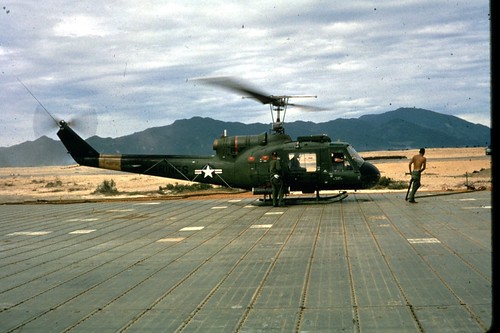
Newly arrived Marine UH-1E ( Huey ) from VMO 6 at Chu Lai, Viet Nam; Sept. 1965
Marine UH-1Es looked like this 1965 example at Chu Lai. By 1967, the yellow warning stripe was removed as well as the US insignia with "Marines" titles in black to reduce their visibility in combat.

It would be a four-man UH-1E flight crew from VMO-6 in 1967 that would become the most decorated flight crew of the Vietnam War. On 19 August 1967, an Army Boeing/Vertol CH-47 Chinook was enroute to Chu Lai AB with a load of injured soldiers. Twenty miles out, the Chinook came under heavy small arms fire from Viet Cong in the area. They set down on a beach where the the Song Tra Khuc River empties into the South China Sea to assess the damage. While several of the crew were outside of the helicopter examining the damage, Viet Cong troops in the area laying in wait opened fire on the helicopter. In a rush, the pilot took off, leaving four crewmen behind on the beach. He radioed immediately on the emergency guard channel that his aircraft was all shot up and he was trying to make for a safer location adding "I still have four men on the ground, the VC are trying to take them prisoner or kill them; God, can somebody help them?"

Captain Stephen Pless was flying an armed UH-1E with the callsign CHERRY SIX on a medevac escort mission when he received the transmission of Americans in immediate danger. Pless discussed the radio call with his copilot, Captain Rupert Fairfield and Pless decided their original mission, escorting the medevac of a single injured Korean Marine, didn't need their escort services and they flew to the location of the trapped men on the beach. Overflying the area, Pless noted that the trapped men were under heavy machine gun and mortar fire. Seeing three jets overhead as well as four Army Hueys orbiting offshore, Pless noted they were all reluctant to move in on account of the heavy fire coming from the VC advancing on the beach. He then asked his crew "How do you feel about going in?" getting a thumbs up from Captain Fairfield and his two crew chiefs, Gunnery Sergeant Leroy Paulson and Lance Corporal John Phelps. 

Stephen Pless was no ordinary Marine officer. He joined the officer corps from the enlisted ranks but he still had great affection for his enlisted men. He frequently socialized with the Marine enlisted at Chu Lai and it's said he spent more time in the enlisted quarters at the base than the officers' quarters. He had several hundred missions under his belt already and some of the Marine crew chiefs had flown secret missions with him into Laos. Pless knew his men would follow him down to that beach with no hesitation and anyone would have done it with Pless as their commanding officer. 

On their initial approach to the trapped men, the first elements of the VC force of about 40 to 50 men were already upon the men, disarming them and hitting them while the rest of the VC moved out from the treeline onto the beach. Since the VC soldiers were too close to use their rockets, Gunnery Sergeant Paulson opened up with M60 machine gun, scattering the VC soldiers. As they ran back for the safety of the treeline, Pless fired white phosphorus-tipped rockets into the mass of fleeing VC. Wheeling the Huey around for several passes, Pless fired more rockets as well his side mounted guns into the treeline, taking heavy small arms fire in the process. On most of his attacks he was less than 50 feet above the ground, in some cases so low that mud thrown up from his own weapons splattered the Huey's windshield. With his rockets nearly expended, Pless then landed his Huey near the trapped men, facing the ocean using his helicopter as a shield between the VC and the trapped men. 

Emblem of VMO-6 "Tomcats"
(Wikipedia)
As several VC tried to approach the helicopter, Lance Corporal Phelps fired his M60 from the left side while Gunnery Sergeant Paulson jumped out and ran to the trapped men- he was able to get the first man aboard as he was still able to walk and Paulson then ran back to the next man while under heavy fire. Captain Fairfield then exited the cockpit to help Paulson with the second man. As he jumped out, Fairfield saw three VC only 10 feet away. He quickly unhooked one of the M60 machine guns and killed all three with a short burst. He then ran to Paulson to help get the second man aboard while Lance Corporal Phelps provided cover fie with his M60. Getting the second man aboard, Fairfield and Paulson then ran for the third man, but he was heavier than the other two- Phelps gave his M60 to the first injured man, Staff Sergeant Lawrence Allen, who was propped up against the back of Pless's seat. He cradled the M60 with his injured arm and continued providing suppressive fire with his good arm. With Fairfield, Paulson, and Phelps carrying the third man to the Huey, a single VC with a hand grenade approached. Phelps dispatched that soldier from ten to fifteen feet away with six shots from his service pistol. Fairfield and Paulson also fired their service pistols as well as they carried the third man to the helicopter. 

With the third man aboard, Fairfield and Paulson ran back for the fourth man but he was already dead. As they jumped back into the Huey, Pless began to takeoff but the three extra men made his helicopter significantly overweight. With the only reasonable avenue of departure being over the ocean as the VC small arms fire intensified, Pless bounced off the waves repeatedly until the helicopter had enough airspeed to climb away from danger. He then had the crew jettison or throw overboard anything that wasn't needed to get to Chu Lai only 20 miles away. Enroute, Paulson and Phelps rendered medical aid to the three injured men. 

Unbeknowst to the crew of CHERRY SIX, one of the Army Hueys Pless observed orbiting offshore made a run in to provide additional covering fire. Flown by Warrant Officer Ronald Redeker, he made multiple strafing runs with his door gunners until their ammunition was exhausted. 

The flight crew of CHERRY SIX: (L-R) Phelps, Pless, Fairfield, and Paulson
(Defense Department/Valor Remembered)
Seven days later, the commanding officer of VMO-6 wrote a letter that passed up through the chain of command to the Secretary of the Navy recommending Captain Stephen Pless for the Congressional Medal of Honor. In the same letter he also recommended Captain Fairfield, Gunnery Sergeant Leroy Paulson, and Lance Corporal John Phelps for the Navy Cross, the second highest award from bravery after the Medal of Honor. The awards were all approved- not only making Captain Stephen Pless the only Marine Corps aviator to earn the Medal of Honor in Vietnam, but also making the entire crew of CHERRY SIX the most decorated flight crew of the Vietnam War. 

Sources: Marine Air: The History of the Flying Leathernecks in Words and Photos by Robert F. Dorr. Penguin Books, 2007. Assault from the Sky: US Marine Corps Helicopter Operations in Vietnam by Dick Camp. Casemate Books, 2013.

08 November 2015

Arthur Young Gets Bell into the Helicopter Business

Lawrence Bell, founder of Bell Aircraft
(Airport Journals.com)
In his book The Bell Helicopter Textron Story, David Brown says of Larry Bell, the founder of Bell Aircraft, "Larry Bell was different. With the visionary's eye, he saw his first helicopter and was impressed. When he saw his second (helicopter), he understood that here was an industry waiting to be born." Larry Bell was one of the early American aviation pioneers- after high school he worked as his older brother Grover's mechanic for several years while his brother conducted barnstorming flights. In 1913, his brother was fatally injured in a crash and Bell resolved to stay away from aviation. It wouldn't last, though. He first went to work for his brother's flight instructor, Glenn L. Martin, as a stockroom clerk in Martin's fledgling aviation company. He advanced quickly through the company and ultimately ended up as the Martin Aircraft vice-president and general manager. It was Bell who hired the first college-educated aeronautical engineer for the company- a young MIT graduate named Donald Douglas. It was Bell who got the Army interested in a heavy bomber called the Martin MB-2 that was one of Douglas' early projects. And it was Bell who convinced a brash Army aviator named Billy Mitchell to use the MB-2 to prove that bombers could sink battleships. In 1925, Bell asked to own stock in Martin but Glenn Martin rebuffed his offer of part ownership of the company. Bell resigned and within three years was hired by Rueben Fleet, the president of Consolidated Aircraft. Fleet allowed Bell to own a sizable portion of Consolidated shares and by 1929 he was promoted by Fleet to be the general manager of Consolidated. In 1935, Fleet wanted to move Consolidated from Buffalo, New York, to southern California to take advantage of the better flying weather. Bell didn't want to move, so he resigned but a group of investors backed him in purchasing Consolidated's facilities in Buffalo for the new Bell Aircraft Company. Interestingly, Bell was the third tenant of the factory- it was originally built in 1916 for Glenn Curtiss and at the time was considered the largest aircraft factory in the world. 

Bell's first aircraft was the YFM-1 Airacuda (Bell Model 1) which was a heavy bomber destroyer twin engined fighter. Only thirteen of the unique pusher twins were built and only a single squadron of Airacudas was activated as it was an aircraft ahead of its time. But the US Army Air Corps liked Bell's innovative thinking and asked him for a heavily-armed single engined fighter and this became the Bell Model 12, better known as the P-39 Airacobra which first flew in 1938. It was a remarkable start for Bell's fledgling company and in 1938, President Franklin D. Roosevelt asked Bell to join a group of American industrialists who had been invited tour Nazi Germany. Roosevelt wanted an expert opinion of Germany industrial capacity from the group and Bell was asked to join to assess the Nazi's aviation capabilities. Bell witnessed a flight demonstration of the Focke-Wulf Fw 61 helicopter flown by Hanna Reitsch and he considered the most impressive thing he'd seen on his tour of Germany. 

That was the first helicopter Larry Bell saw- to get to the second helicopter he saw in 1941, we have to step back a bit to look at the story of a unique inventor named Arthur Young. A native of Pennsylvania, while a student at Princeton University, Young was very interested in philosophy and tried to develop an original line of philosophical thought but was unsuccessful. He decided that he wouldn't be able to do so without some real-world experience solving problems. Graduating from Princeton in 1927 with a mathematics degree, Young searched for a technical challenge. He scoured city libraries in the East Coast and made regular visits to the US Patent Office in Washington in his search. He came across a book in his searches by German helicopter pioneer Anton Flettner who had invented a ship that used the Magnus effect from rotary drums to sail across the Atlantic. Flettner had described improving windmill efficiency by using small propellers at the tips. Young thought Flettner's concept could be applied to aircraft and of course that aircraft would be the helicopter, one of the unique flying machines of the day. He set himself on the task of developing a successful helicopter. 

Arthur Young and one of his late helicopter models
(State Archives of Florida, Steinmetz Collection)
Young set up an experimental workshop in a barn on his wealthy family's large estate in Pennsylvania. He refined his ideas using small models and his first design flew in 1931 using parts he obtained from a local toy shop- using rubber bands, hand-carved wooden blades with propellers at the tips and a balsa structure, his first model had a rotor diameter of six feet and it flew for only ten seconds. For the next nine years he worked at improving the Flettner concept, moving to the use of electric motors. He went through so many crashed models he literally learned how to mass produce his own helicopter blades. One of the problems Young encountered was getting his models into a stable hover. Over time he used his mathematics background to calculate stresses and build his own components based on his stress calculations. In doing so, he developed many of the concepts and tools used to measure rotor lift, propeller efficiency as well as equations to calculate a variety of power requirements for helicopters. 

In 1938, Young attended a conference of helicopter designers and learned of the pioneering work of Igor Sikorsky. Sikorsky himself gave a lecture on the use of a tail rotor to counter the torque of the main rotor. Young was fascinated by Sikorsky's lecture and set about to revise his model testbeds with tail rotors, disposing of the complex gearing that he had been working on to drive tip propellers. Stability in a hover continued to plague his efforts- he had tried a pendulum within the fuselage, but the pendulum arrangement he designed couldn't distinguish between the force of gravity and the force of acceleration. He then came up with the stabilizer bar- a bar with weights on the end that was perpendicular to the rotor. The weighted bar when spinning acted as a gyroscope that stabilized the helicopter in a hover. He used an electrical control system that ran to a box where he controlled the helicopter with extreme precision. He took his models on demonstrations to various aircraft companies where he showed how he could fly his helicopter models indoors and even in and out of doorways. He even gave a demonstration to the Army's aeronautical development center at Wright Field in Dayton, Ohio, but failed to find any financial backers. 

Dr. John Sharp was a physician who had seen one of Arthur Young's demonstrations. Sharp had a unique hobby in that he designed gearing systems in his free time and was working on a new gearing concept for a variable pitch propeller was pitching his ideas to Bell Aircraft. In 1941, Sharp was meeting with a Bell engineer named Jack Strickler and in casual conversation, Sharp spoke highly of Young's helicopter flight demonstrations. Strickler than passed on what Sharp told him to Larry Bell himself. Since Bell was impressed with what he had seen with the Focke-Wulf Fw 61 helicopter in his 1938 tour of Germany, he invited Arthur Young to come to Buffalo to give a demonstration of his helicopter design.

On 3 September 1941, Young arrived at Bell's Buffalo plant and was taken to a hangar where P-39s were prepared for delivery. Bell ordered the personnel in the hanger to stop work and move the P-39s outside to give Young room for his demonstration. Not only did Young fly a successful demonstration for Larry Bell, he also reviewed with Bell films showing his previous design efforts and showed him his notes on the design process he had developed to solve the problems of vertical flight. Bell was enthralled by Arthur Young and wanted to hear Young's ideas on a full-size piloted helicopter design. In a matter of weeks they reached an agreement where Young would come to Buffalo and work for Bell in developing a new helicopter based on his designs. Young assigned his patents to Bell Aircraft and Larry Bell funded the development of two full-sized helicopters. Young wanted two aircraft in case one crashed and Bell insisted that the second prototype be a two-seater so he could go on a ride! 

The rest, as they say, was history! That first helicopter, the Bell Model 30, will be the subject of a future article here at Tails Through Time. Stay tuned!

BONUS: A three part interview with Arthur Young in his later years about his design efforts


Sources: The Bell Helicopter Textron Story: Changing the Way the World Flies by David A. Brown. Aerofax Publications, 1995, pp 1-19. "Arthur Young: Maker of Bell, Part 1" by Robert Tipton, http://www.arthuryoung.com/maker1.html. 

19 October 2015

Mike Grimm, Father of the Night Stalkers

Michael Grimm, Father of the Night Stalkers
Conventional wisdom in aviation history points to the tragic debacle at Desert One in Iran during the hostage rescue mission as the watershed moment that culminated in the formation of the US Special Forces Command (SOCOM). While I do think that the story of the failed 1980 Iranian hostage rescue mission should be held near and dear to every military leader of this nation, there was actually someone else who sounded the warning bells three years before that fateful day in 1980. His name is legendary amongst US special forces personnel to this day, but I'd bet hardly any of us enthusiasts had ever heard of his name- Mike Grimm.

Long before he would make his mark on the history of US special forces, Mike Grimm was already a decorated hero of the Vietnam War when as a second lieutenant in 1968, assumed command of his platoon and managed to fight off through the night two entire companies of Vietcong before they could be extracted by helicopter from the battle zone. He stayed on with the US Army after the end of US participation in the war in 1973, eventually becoming a helicopter pilot and stationed in Hawaii in 1975. But serving in Hawaii was boring for Grimm, when the most serious decision they ever had to make was whether he would fly clockwise or counter-clockwise around Oahu. In 1976, the world was electrified with the stunning Israeli raid at Entebbe, Uganda, to rescue the passengers of a hijacked Air France flight. In less than one hour, Israeli commandos stormed the Entebbe Airport, killed nearly all the terrorists, rescued nearly all the hostages and only losing one commando. And they also manged to destroy most of the MiGs of the Ugandan Air Force in the process.

Mike Grimm realized that the United States lacked the capability to do what the Israelis managed to do- project power over 2,000 miles into hostile territory and effect a hostage rescue with minimal losses. Austerity was the key word in the post-Vietnam defense budget and even training exercises were canceled to save money. Once he had become the Divisional operations officer in 1977, he decided to use the Division's entire budget for training on a single exercise. He called it an Emergency Deployment Readiness Exercise (EDRE) and in the training scenario, his men and pilots would have to fly 200 miles to the island of Hawaii where a select group of soldiers playing terrorists were holding hostages. Grimm's men would have rescue those hostages with minimal losses. The tactics he developed for the exercise would be the blueprint for all future missions to come, even to this day.


Men from the First and Fifth Infantry Battalions at Schoefield Barracks on Oahu were selected to be the "raiders." Their helicopter element consisted of 10 Bell UH-1H Hueys and two Bell AH-1G Cobra gunships from A Company of the 25th Aviation Battalion. After an alert and planning period, the men and their helicopters flew from Schoefield Barracks to Hickam AFB to be loaded aboard USAF Lockheed C-141A Starlifters to simulate strategic deployment. The men were flown to Hilo Airport which would function as the "intermediate staging base" for the exercise. On 14 November they arrived in Hilo where the helicopters were readied for flight and they flew onward to Bradshaw AAF in the Pohaku Trainng Area in the center of Hawaii. This would be their "forward operating base" for the mission exercise.

The "hostages" were being held in the fire station of Waimea-Kohala Airport just 30 miles north of their forward operating base. The raid would be carried out at dawn as no night vision equipment was available. At ten miles from the target, the "terrorists" heard the team coming and "executed" the hostages. When Grimm's raiding force landed, they were wiped out to the last man.

The next day at Bradshaw AAF the After Action Review took place and everyone but Mike Grimm thought their Army careers were over when the Division commander, Lieutenant General Willard Scott arrived. He began the debriefing with the statement "This exercise was a really bad idea." As he continued for several minutes on the inappropriateness of using helicopter-borne infantry on anti-terror operations. "Our Army will never enter into this area. This is NOT our role."

At that moment, Mike Grimm stood up and interrupted his commander.

"Respectfully, sir, that is NOT correct." Here he was, a newly minted major, holding a two-star general to task. "Not only do we need to create this capability, sir, but if we don't, we are going to find ourselves at some point in our history embarrassed as a nation!"
Emblem of the 160th SOAR

Three years later, on the morning of 25 April 1980, in the Iranian desert, that embarrassment took place. The wrecks of five Marine RH-53D Sea Stallions and one USAF C-130 Hercules lay smoldering in the desert with the bodies of eight American servicemen. That year Mike Grimm was the commander of A Company of the 229th Aviation Battalion of the 101st Airborne Division where he was working with a handpicked group of men to transform the Hughes OH-6 "Loach" into what would become the MH-6/AH-6 "Little Bird" for night time special forces missions. On the night of 7 October 1981, Mike Grimm was flying one of the unit's MH-6s at low level over the Cumberland River when he hit the side of a power line tower and was killed instantly. One week later, in memorial to Mike Grimm, the new 160th Aviation Battalion uncased its colors. It was the birth of the Army Special Force's aviation element (Special Operations Aviation Regiment, or SOAR), the "Night Stalkers".

Source: The Night Stalkers: Top Secret Missions of the US Army's Special Operations Aviation Regiment by Michael J. Durant and Steven Hartov. GP Putnam and Sons, 2006, p33-64. Photos: US Army, Wikipedia

19 December 2011

The Bell L-39 Swept-Wing Demonstrator


The Bell L-39 making a simulated carrier approach.
Following the end of the Second World War, captured German aerodynamic research had indicated the high-speed benefits of swept wings and many designs under development in the mid to late 1940s were revised to incorporate swept wings- two such examples being the North American F-86 Sabre and the Boeing B-47 Stratojet. While the USAF might have been enthusiastic about the benefits of swept wings, the US Navy still had its reservations- the Bureau of Aeronautics (BuAer), the Navy organization tasked with the development and support of naval aircraft, had concerns about the low-speed handling characteristics of swept wings as it was this particular flight regime that was critical in flight operations aboard aircraft carriers. While there was no questioning the high-speed benefits, the Navy didn't have the luxury of long runways to land at high speeds. To determine the scope of the problem, BuAer solicited bids from industry for a swept-wing flying demonstrator to explore the low-speed handling qualities of swept wings. Grumman tendered two proposals, one based on a modified F4F Wildcat as well as an all new aircraft that would have allowed wings of differing sweep to attached to the fuselage. Bell submitted a modification of its P-63 Kingcobra which won the contract as it offered lower development costs using two P-63 aircraft. The aircraft would be designated L-39. In those days, the Navy designated its research aircraft with a letter denoting the manufacturer followed by the manufacturer's model number- as exemplified by the more well-known D-558 Skystreak and later Skyrocket- "D" for Douglas, Model 558. In the case of the L-39, "L" was Bell Aircraft's letter designation and the swept wing demonstrator had the company designation Model 39. The design had really only a tangential relationship to the P-39 Airacobra (more on this in a bit). 

The wings were basically P-63 Kingcobra outer wing panels that were modified to be swept to 35 degrees and attached to an unswept center stub section. This was done for aerodynamic balance purposes. The wings were further modified with slats which could be positioned before flight either open or closed. Because of the wing modifications, the landing gear was non-retractable, but since BuAer was more interested in low speed landing, this was of no consequence. Two L-39s were built, differing only in the size of the slats.

The swept outer panels attached to an unswept center section.
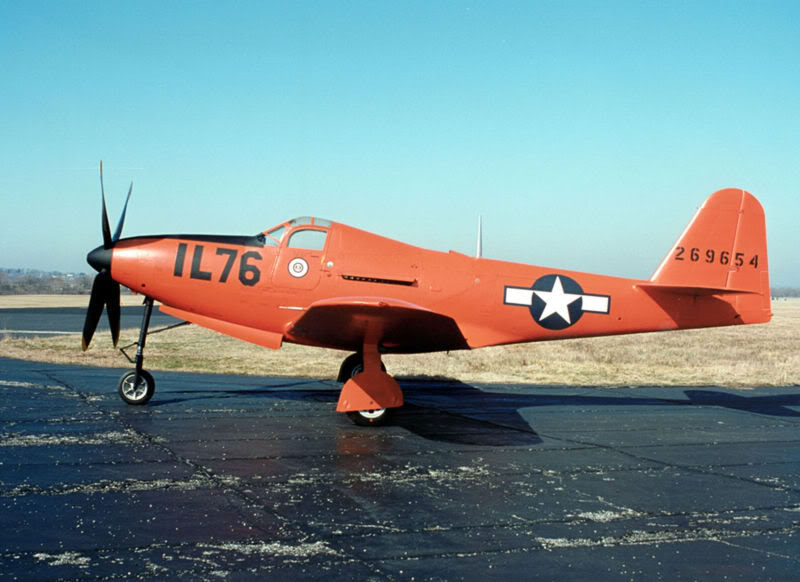
The first L-39 was ready to fly only 10 weeks after the go-ahead from the Navy and made its first flight on 23 April 1946. The initial set of flight tests showed some handling issues that were easily resolved with further modification to the first aircraft- namely a fuselage extension aft of the wing to increase the moment arm of the tailplane to provide more pitch authority, a ventral fin for stability, and to shift the center of gravity rearward more, the original four-bladed P-63 propeller was replaced with a lighter three-bladed unit from a P-39 Airacobra (and thus the only real link between the P-39 and the L-39). The second L-39 demonstrator was completed with the additional modifications and joined the flight test program.

It was quickly determined that the swept wing with the slats closed possessed entirely unacceptable stall characteristics- namely it was abrupt and caused the aircraft to roll to one side. However, if the wing were slatted, then the stall characteristics become acceptable. Simulated carrier approaches and landings were made by both BuAer test pilots and even Corky Meyer, Grumman's chief test pilot (as Grumman was in the process of designing swept wing aircraft for the Navy). Handling and stall characteristics in the low speed regime around the carrier were quickly determined to not be an issue as long as the swept wing were slatted and the L-39 flight test program concluded in August 1946.

Close up of the L-39's wing slats.
One issue that did come up during the L-39 test program was that swept wings needed a responsive power source in the carrier landing pattern. On aircraft there is a relationship between power required for flight and airspeed. As the airspeed decreases, the power needed also decreases, but it then reaches a point due to drag that the power needed starts to go up even as the airspeed decreases. This is called the "back side" of the curve. In carrier aircraft, they are flown on this backside because the approach to the deck must be at as low as a speed is possible. On a propeller-driven aircraft, power can be immediately applied to halt the aircraft from settling in the approach and striking the ramp. But swept wings had a steeper "back side" and early jet engines took time to spool up. And it would be jet engine development that would later dog the Navy's aircraft programs in the 1950s. But more on that in a later post!

Source: U.S. Naval Air Superiority- Development of Shipborne Jet Fighters 1943-1962 by Tommy H. Thompson. Specialty Press, 2008, p69-73.

17 March 2011

The Bell 207 Sioux Scout- Grand Daddy of the Gunship

The Bell D-245 Warrior set the pattern for gunship designs
With the turbine-powered Bell UH-1 Iroquois "Huey" utility helicopter offering a quantum leap in capability for the US Army over previous, cumbersome, piston-driven rotorcraft, it was a natural progression that the UH-1s would be armed for aerial fires support for the growing conflict in Vietnam. But Bell's engineers in Fort Worth were steps ahead of the military with studies as early as 1958 for a tandem-seat purpose-built helicopter gunship that used the transmission and engine systems of what would become the UH-1. Bell's first offering had the in-house designation D-245 and was named "Warrior" which laid down the standard layout of gunships that followed- a slim fuselage with tandem seating for a pilot and gunner, stub wings for weapons, and nose-mounted gun turret. But despite its potential, the Army had yet to determine operational doctrines for the use of attack helicopters and the D-245 Warrior was quietly shelved. 

Despite official disinterest from the US Army, Bell decided to embark on internally-funded development to further refine the D-245 Warrior design. In June 1962 Bell unveiled the D-255 Iroquois Warrior to the Army at its Fort Worth facility. The D-255 was a bit larger than the earlier D-245 but retained the tandem seating for pilot and gunner in stepped layout with the pilot sitting behind and higher than the gunner in the forward seat. Again, the tail boom, rotor transmission and engines were adapted from the UH-1. While the mixed reaction from the US Army was an improvement over the official disinterest that the earlier D-245 design elicited, it still wasn't enough to get a production contract from the Army. Again the D-255 was quietly shelved, but this still wasn't going to discourage the Bell team from staying ahead of the game. In December 1962 a brainstorming session of the engineering team resulted in a decision to build a flying demonstrator to prove the US Army what Bell's gunship concept could accomplish. 

The Sioux Scout was quite small for a two-seat gunship
Designated the Model 207 and named the Sioux Scout, the demonstrator combined the engine, rotor, and drive systems of the proven Bell OH-13 Sioux (the bubble-cockpit helicopter made famous in the introduction to the TV series M*A*S*H) with its civilian counterpart, the Bell 47. The six-cylinder Lycoming 435 engine of the OH-13/Bell 47 was supercharged to deliver 220 horsepower driving the main rotor system from the OH-13 and the tail rotor/tail boom of the Bell 47. An all-new slim fuselage was created that used box beams to create a rigid structure to which were attached the stub wings that could carry external stores on six hardpoints on each side as well as house an additional 43 gallons of fuel which gave the Sioux Scout a range of 200 miles. At high speeds, the stub wings helped offload the main rotor as well. An Emerson Electric TAT-101 gun turret was installed under the nose (the rigid fuselage structure dampened recoil) housing twin 7.62mm machine guns that were adaptations of the M60 gun. With 1,100 rounds of ammunition, the gunner in the forward seat used a pioneering hand controller to operate the gun turret 100 degrees side to side, 15 degress upward, and 45 degrees downward. Under each stub wing were six round, 2.75 inch rocket launchers on each hardpoint. 

The gunner had an outstanding field of view from the front seat
The Sioux Scout made its first flight from Bell's Fort Worth facility in Hurst on 27 June 1963, in the process becoming the first pure gunship in the world to take flight. Since the demonstrator program was somewhat secret, the helicopter was painted red and white to not so blatantly give away its military purpose. After several weeks of testing with Bell that added up to 65 flight hours, the Sioux Scout was repainted in more Army-like olive drab and began a series of weapons tests at Fort Sill, Oklahoma, northwest of Fort Worth. In November of that year, the Sioux Scout was taken on the road, touring Army bases and being flown by both Army and even NASA test pilots with over 300 flight hours that included firing over 83,000 rounds of ammunition from the chin turret. Finally, in 1964, B Troop, 3rd Squadron, 17th Cavalry of the 11th Air Assault Division spent a month flying the Sioux Scout in operational conditions and in field exercises. At the time, the 11th Air Assault Division was tasked by the Army commanders with experimenting and creating operational doctrines in helicopter assault at Fort Benning, Georgia. 

The Model 209 prototype had retractable landing skids
Other than the Sioux Scout being underpowered and the reliability of the experimental gun turret being less than ideal, Army evaluators were overwhelmingly pleased with the outcome of the 11th Air Assault Division's operational evaluation of the demonstrator. The recommendation was issued that a turbine-powered, more capable version be developed as quickly as possible for operational use. In late 1964 the Secretary of the Army created the Advanced Aerial Fire Support System (AAFSS) with invitations to industry to submit designs. With the quick realization that the AAFSS design would take time to field, the Army decided that an interim design was needed that would field the gap until the AAFSS became operational. Bell dusted off its D-255 Iroquois Warrior design and with further refinements based on the Sioux Scout evaluation, designated it the D-262. However, in 1965 the Army rejected the D-262 design. But, as Bell had done before, they quietly went about refining the design further on company funds- within several months of the rejection of the D-262, the situation in Vietnam worsened and the US commander in Vietnam, General William Westmoreland, advised the Pentagon that either the AAFSS needed to fielded quickly or some interim design was needed as soon as possible. In March 1965 Bell just happened to finish the full-scale mockup of its refined gunship designated the Model 209 and "leaked" to Army commanders what it was up to. Before long, the Army issued a formal requirement for an interim design. Beating out submissions from Sikorsky, Kaman, Piasecki and Boeing Vertol, the Model 209 was selected on 11 March 1966 for production as the AH-1 Cobra.

And the AAFSS? That became the Lockheed AH-56 Cheyenne and was a classic case of wanting too much out of a design. It ended up getting cancelled in August 1972. That same month, the Army created the Advanced Attack Helicopter program (AAH) which became the AH-64 Apache. And what become of the Sioux Scout? The grand daddy of gunships can be seen today in the Army Aviation Museum in Fort Rucker, Alabama. And of course, Bell's interim design is still in production today for the US Marine Corps as the AH-1Z Viper.

Source: Helicopter Gunships: Deadly Combat Weapon Systems by Wayne Mutza. Specialty Press, 2010, p56-60. Images from aviatstar.org

14 February 2011

Operation MARHUK: The Combat Debut of the Marine's AH-1J SeaCobra

Marine SeaCobras took a beating operating at sea
The first US Marine Corps AH-1 Cobra gunships in action were actually AH-1Gs which were ordered by the Marines in 1967- having closely watched the Army development of the Cobra gunship, 72 helicopters were requested for one helicopter attack squadron in each of its three Marine Air Wings. Despite having the approval of the Secretary of the Navy, Defense Secretary McNamara overruled the decision and only allowed the Marines to order 38 of the single-engined AH-1G variant. With the first Marine AH-1Gs going into action in Vietnam in April 1969, reports from the field couldn't have been more salutatory in the effectiveness of the Cobra gunship. Based on that initial experience, the Marines wanted a more powerful Cobra- one with twin engines, Marine avionics, a rotor brake for shipboard operations and a harder-hitting gun in the undernose turret. After overcoming the resistance of an obstinate Secretary McNamara, the AH-1J SeaCobra went into production with the first examples undergoing combat evaluation in South Vietnam in February 1971. With the onset of the Easter invasion by North Vietnam of the south and the American response, Operation Linebacker, the first Marine helicopter attack squadron, HMA-369 based in Okinawa, was called upon shortly after its establishment to conduct offensive operations against North Vietnam. 

The USMC had the AH-1J built from the start to operate from ships
At the time, Army Cobra gunship were operating in South Vietnam against the invasion thrusts of the North Vietnamese Army. Despite having just received its new AH-1J SeaCobras, Admiral John McCain, Jr, head of the US Pacific Command, wanted to make sure that the blockade of North Vietnam was complete. Even though carrier aircraft had sown mines closing Haiphong Harbor, the North's main port, the North Vietnamese had resorted to having Chinese and Soviet cargo ships anchor offshore various locations and cargo would be offloaded into smaller sampans for transfer to the shore. This way the mined sea lanes could be avoided. Because fixed wing carrier aircraft were urgently needed for Operation Linebacker attacks on North Vietnam, it was decided that the AH-1J SeaCobra would be ideal for the role of maritime interdiction off the coast of North Vietnam. In the entire Pacific theatre, only HMA-369 in Okinawa had suitable helicopters for the job and Operation MARHUK (Marine Hunter-Killer) was born. It would be the Bell AH-1J SeaCobra's baptism of fire and off the coast of the heavily defended North Vietnamese coast, no less. 

HMA-369's "Marhuker" patch

 HMA-369 originally wanted a helicopter carrier to be based on for Operation MARHUK, but the Navy's LPHs were heavily committed else where and the 18 officers, 99 men and seven AH-1J SeaCobras of HMA-369 that were ready to deploy in June 1972 were shoehorned into the amphibious transport ship USS Denver (LPD-9). Marine brass give the squadron officers a blank check to do what ever was necessary to get HMA-369 to the war zone and the nickname "Marhukers" was given to the officers who improvised and bent and possibly broke many rules to make their SeaCobras combat ready. Even 5-inch Zuni rockets were procured, a weapon that had not yet been cleared for use from the AH-1J. The ship and its escorts would be positioned near the Hong La anchorage further south down the coast from Haiphong. Here Chinese and Soviet merchant ships anchored offshore and North Vietnamese sampans offloaded cargo offshore to bring into Hong La. Since the rules of engagement forbade hitting the merchant ships, the SeaCobras stayed at least 500 yards away from the ships and remained overwater the whole time as the North Vietnamese had heavy AAA guns on  the shoreline. The SeaCobras operated in pairs and would sink the sampans with their Zuni rockets and 20mm undernose cannon. The pilots were also trained to call in naval gunfire and air strikes while the gunners in front seats of the AH-1Js focused on the sampans. After several weeks, the shore-based heavy AAA guns learned not to fire on the SeaCobras thanks to the naval fire support and air strikes the pilots would call in. 

In August 1972 HMA-369 moved to the USS Cleveland (LPD 7) and then again to the USS Dubuque (LPD 8). Over the course of Operation MARHUK, the AH-1J SeaCobras were called on to provide air cover for downed aviators in the North as well as functioning as forward air controllers for Navy strike aircraft. Missions ranged from 80 miles north of the DMZ to as far north as 80 miles south of Hanoi inland! When Operation MARHUK ended on 26 January 1973 with the end of Operation Linebacker II, nearly 1,000 sorties had been flown with 123 sampans sunk, further straining the logistics of North Vietnam that eventually drove them to the bargaining table. It was quite a stunning debut for the AH-1J SeaCobra. 

Source: Helicopter Gunships: Deadly Combat Weapon Systems by Wayne Mutza. Specialty Press, 2010, p72-76.

20 September 2010

The Bell RP-63 Pinball

As the strategic bombing campaign over Germany built up in the spring of 1943, losses over the skies of the Reich began to mount as mission momentum increased over the course of that summer. While the ever-present flak was a significant threat to the B-17 Flying Fortresses and B-24 Liberators of the US Eighth Air Force based in the UK, it was the fighters of the Luftwaffe that were mauling the formations. From June into the autumn, losses were mounting and doubts were starting to be raised on the operational wisdom of daylight strategic bombing. The breaking point came on 14 October 1943 with the second attack on the ball-bearing plants at Schweinfurt, Germany. Already bruised from a vicious mauling at the hands of the Luftwaffe on the first raid on the Scweinfurt (which was attacked along with Regensburg on 17 August 1943 with the loss of 60 bombers), of the 291 B-17s sent on the mission, 77 bombers were lost and 122 were damaged. The day was named "Black Thursday" for having the highest number of crewmen lost on a single USAAF mission- 590 killed, 65 taken prisoner. Deep penetration missions of Germany were suspended until February 1944 when the long-range P-51 Mustangs arrived. 

But warnings were raised as early as 1942 stateside when Major Cameron Fairchild of the USAAF sought ways to improve the aerial gunnery skills of the men who manned the defensive positions on the heavy bombers. The techniques of training at the time were fairly basic, ranging from skeet shooting to firing at towed targets. Fairchild surmised the best aerial gunnery training would consist of being able to fire live ammunition at an actual fighter aircraft. His first task was to develop a bullet that had the same characteristics as a 30- or 50-caliber round but would splinter harmlessly on impact. Working with researchers at Duke University, the University of Michigan, and the Bakelite Corporation (one of the pioneering manufacturers of plastics), Fairchild and his team came up with a frangible bullet that was weighted with powdered lead to give it the proper weight and density. 

Fairchild proved to be willing to circumvent the usual Army bureaucracy to promote his ideas. Instead of working through the usual Army weapons development channels, he teamed up with academics to validate his ideas. Fortunately, the heavy losses of 1943 showed that aerial gunnery skills were lacking and Fairchild's frangible training bullets gained traction with the USAAF. He then selected the Bell P-63 Kingcobra as the target aircraft. As it was a type not used by front-line USAAF units, it was easily available. The P-63, designated RP-63, was given 1-inch thick armored glass with special armor in vulnerable areas. Sensors underneath the RP-63 registered hits and lights on the spinner and on the fuselage would light up, giving rise to the name "Pinball". 

Beginning in early 1945 RP-63 Pinballs would fly attack profiles against bombers with student gunners before they were assigned to a combat unit. A training B-17 might have 12 student gunners each having 2,000 rounds of Fairchild's special frangible ammunition to fire at the Pinballs. The Pinball pilots, flying RP-63s that were painted either dayglo orange or yellow, flew 2-3 missions a day from bases throughout the United States. Minor damage was easily repaired on the flightline but the Achilles heel of the Pinball was the wingroot air ducts that provided cooling air to the mid-fuselage mounted Allison V-1710 liquid-cooled engine. If a frangible bullet got into the duct, the fragments could damage the cooling system, resulting in an overheating engine and a mandatory deadstick landing or a bailout by the RP-63 pilot. 

A total of 300 P-63s were converted to the RP-63 Pinball configuration. Some aircraft also trained B-29 Superfortress gunners, but by 1947, the Pinball program was wound down and the last aircraft retired. Much of the early demise of the program came with the introduction of the centralized gunner control system in the Boeing B-29 Superfortress where analog systems provided the necessary lead and tracking for the gunners which used sights that remotely operated the turrets. Targets could be handed off from one gunner's sight to another and it made aerial gunnery training obsolete. The second factor in the demise of the Pinball program came with the gun-laying radar that was first introduced on the tail cannons of the Convair B-36 Peacemaker. Radar simplified tracking and accurately shooting at target aircraft. But the Pinball program lives on as an unique wartime solution that undoubtedly did its part to hasten the demise of the Axis in the Second World War.

Source: Air & Space Smithsonian, November 2010, Vol. 25, No. 5. "Just Shoot Me: In World War II, P-63 pilots had to learn to take it- and not take it personally" by James Dunaway, p50-53. RP-63 model by Scott Van Aken.

19 March 2010


On 18 January 2003 the over 7,000 Marines of Task Force Tarawa set sail from the United States aboard seven amphibious assault ships with 72 aircraft (and more following them) for the Persian Gulf in the run up to Operation Iraqi Freedom. The Bell AH-1W Super Cobras of Marine Light Attack Helicopter Squadron 269 (HMLA-269 "Gunrunners") from MCAS New River, North Carolina were reinforced with additional gunships from sister unit HMLA-167 for a total of 18 AH-1W Super Cobras and nine Bell UH-1N transports. The reinforced squadron embarked on the USS Saipan (LHA-2) and the USS Ponce (LPD-15) for the sea transit to the Middle East. As Task Force Tarawa transited through the choke points of Gibraltar and the Suez Canal, HMLA-269 would have six Super Cobras on flying alert to protect the task force.

Arriving off the coast of Kuwait on 18 March 2003, ten of HMLA-269's Super Cobras were detached to a forward base 23 miles south of the Iraqi border to participate in the squadron's first operational mission, the assault on the Iraqi forward reconnaissance positions at Safwan. The first combat missions by the AH-1Ws of the squadron on 20/21 March were notable, however, for the combat use of what was then-a-classified version of the AGM-114 Hellfire missile, the AGM-114N thermobaric Hellfire.

Thermobaric weapons were first developed in the 1960s by the engineers at the China Lake Naval Weapons Center and were what were then known as fuel-air-explosive weapons. FAEs work by releasing a cloud of volatile vapor which is then detonated, creating a large and destructive pressure wave in the process. A standard blast/fragmentation warhead creates a large pressure spike that decays rapidly. A thermobaric warhead, on the other hand, creates a large sustained pressure wave that propagates through any building or enclosed space, making it ideal for urban warfare. In the late 1990s, the engineers at China Lake had succeeded in creating non-liquid thermobaric explosives using metal particles (such as aluminum or magnesium) instead a liquid. The initial detonation releases the fine particles which then ignite, creating the large and sustained pressure wave. For this the China Lake Naval Weapons Center was awarded a classified US patent.

Marine Corps combat experience prior to OIF had shown that missiles like the TOW or Hellfire with their blast/fragmentation warheads were often unsuitable in urban environments as the pressure spike from the warhead detonation would be attenuated inside enclosed spaces. In addition, the missiles would often pass right through the target building before detonating.

The thermobaric weapons work at China Lake resulted in what was called a metal-augmented charge (MAC) that was the ideal warhead for a new version of the Hellfire missile desired by the Marine Corps. The AGM-114N's thermobaric warhead consists of a layer of fine aluminum powder sandwiched between the warhead casing and the explosive fill in the center. On detonation, the aluminum powder is dispersed and ignites, creating a large and sustained pressure wave. Live fire tests at White Sands and China Lake proved the weapon to be effective.

When HMLA-269 arrived in the Persian Gulf, the squadron's commanding officer, Lt. Col. Jeffrey Hewitt, was one of the few Marine aviators aware of the AGM-114N as his previous posting before taking command of the "Gunrunners" was a senior posting in Marine Corps weapons development working closely on the tests of the thermobaric Hellfire missile. The thermobaric Hellfires used in the development and testing work in the United States prior to OIF were converted from stock AGM-114K Hellfires and Lt. Col. Hewitt knew that there were 60 AGM-114Ns left over from the test program that were in storage. Aware that the Marines of Task Force Tarawa faced many urban threats before even reaching Baghdad, he arranged for those 60 missiles to be shipped out to the squadron. However, the US Navy wouldn't transport them as the missiles were never certified for carriage by ship. Lt. Col. Hewitt then turned to the US Air Force, who were more than happy to fly out the missiles immediately to Kuwait for the squadron.

HMLA-269's original plan was to keep the precious AGM-114Ns until Task Force Tarawa reached Baghdad, but they also wanted to prove that the thermobaric Hellfires worked in actual combat. Several were fired during the assault on Safwan and were highly effective. Interestingly enough, during their use in the assault on Safwan and in HMLA-269's combat missions on the march to Baghdad, the AGM-114N thermobaric Hellfire missiles (called TB Hellfire) were still classified!

Source: International Air Power Review, Volume 12, Spring 2004. "Focus Aircraft: Bell AH-1 Cobra" by Robert Hewson, p56-58.

19 July 2009

In 1945 there wasn't a large body of technical knowledge on supersonic flight when the design of the Bell X-1 was formulated. Many engineering and design decisions had to be made based on the best possible estimates of the aircraft's performance. The fusleage's shape was the end product of the study of the .50 caliber bullet, as it was known to be stable at supersonic velocities. Bell's engineers tried to fill in the data gaps on supersonic flight by observing objects known to fly at supersonic speeds- in this case, the .50 caliber round. Discussions with ballistics experts concluded that little was known about the aerodynamics of the round after it was fired, but since there was no question that it was stable at high speeds, its shape formed the basis for the X-1's fuselage.

Source: Bell X-1 Variants, Aerofax Datagraph 3 by Ben Guenther and Jay Miller. Aerofax, 1988, p6.

29 May 2009

The Air Force Space Command was formed in September 1982 initially responsible for space monitoring and space-related activities connected with the defense of the United States and Canada. In 1993 the ICBM force passed from the Air Combat Command to the Space Command and since then AFSPC has been responsible for the ICBM nuclear deterrent force, the early warning of ballistic missile launches, the launch and operation of military satellites (including the GPS constellation) and worldwide space surveillance.

But the only manned aircraft assigned to the Air Force Space Command are approximately 26 Bell UH-1Ns assigned to three Flights to fly launch crews to ICBM missile silos and transport security teams to ICBM sites. The three Flights are based at three Air Force bases of the 20th Air Force, the operating AF for the ICBM force- Francis E. Warren AFB, Wyoming (tail code "FE"), Minot AFB, North Dakota ("MT"), and Malmstrom AFB, Montana ("MT"). A fourth Flight of UH-1s is based at Vandenberg AFB ("HV") to support missile and space launch activities.

Source: US Air Force: The New Century by Bob Archer. Midland Publishing, 2000, p29.

07 May 2009

In terms of revenue, the current helicopter industry leader is Eurocopter with over $6 billion in revenue in 2008. The number two spot is surprising given their past labor and financial problems- Sikorsky with over $5 billion in revenue. The remaining three spots in descending order based on revenue for 2008:

#3: AgustaWestland (previously the #2 leader until passed by Sikorsky in 2006)- over $4 billion.

#4: Boeing - over $3 billion in revenue.

#5: Bell Helicopter - just under $3 billion.

Since 2003 all of the above companies have experienced a growth in revenue. The companies' rankings in 2003 in descending order were Eurocopter, AgustaWestland, Boeing, Sikorsky, and Bell.

Source: Aviation Week and Space Technology, May 4, 2009. "Worst to First" by Joseph Anselmo, p49.

29 April 2009

When the Bell AH-1 Cobra gunship was being developed, the Army's intent was to name the aircraft after an American Indian tribe as had been its long tradition. However, at the time of the development of the Cobra gunship, the Department of Defense was in a legal battle with Piper Aircraft who also named their aircraft after American Indian tribes.

In Vietnam, UH-1 "Hueys" were called "Slicks" if they were operating unarmed, "Hogs" if they were armed with rockets, and "Cobras" if they were armed with guns. As Bell's main pitch for the procurement for the AH-1 was that it was a low-risk development of the UH-1 Iroquois (to some degree true given that the original gunship proposal was called the Iroquois Warrior and had more in common with the UH-1 than the final AH-1 design), the AH-1 got named "Huey Cobra".

Source: New Vanguard: Huey Cobra Gunships by Chris Bishop. Osprey Publishing, 2006, p6-7.