Showing posts with label Medal of Honor. Show all posts

24 November 2015

The Most Decorated Flight Crew in Vietnam: The Story of Cherry Six

The most northerly air base in South Vietnam during the Vietnam War was Da Nang Air Base which was located only 85 miles south of the demilitarized zone (17th Parallel) that demarcated North and South Vietnam. Once a limited airfield inherited from the French, it wasn't until the early 1960s that the South Vietnamese expanded Da Nang into a modern military air base. The first US advisors with the Military Assistance Advisory Group (MAAG) arrived in 1961. Over the next three years as the US military presence ballooned, Da Nang AB became a vital base for close air support for the US Marine Corps operating in I Corps, the military operating area just south of the DMZ that was centered on Da Nang. With it became necessary to increase the USMC aviation presence in I Corps, Da Nang AB was practically over capacity and a second air base had to be built in 1965 about 56 miles to the southeast of Da Nang at a location called Chu Lai. Elements of Marine Air Group 12 (MAG-12) were based at Chu Lai, including Marine Observation Squadron 6 (VMO-6) and their Bell UH-1E Iroquois "Huey" helicopters. During the Korean War, VMO-6 was the first Marine Corps helicopter squadron in history to enter combat, flying observation, reconnaissance, and escort missions at the Pusan Perimeter in 1950. VMO-6 had just converted to the Huey in 1964 and commenced operations at Chu Lai AB in September 1965.
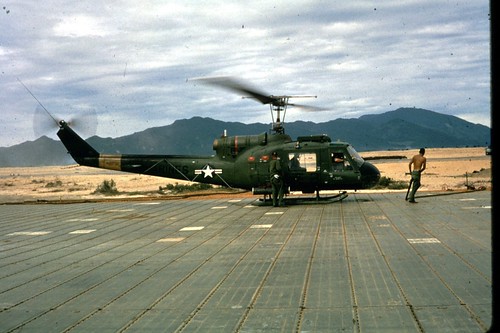
Newly arrived Marine UH-1E ( Huey ) from VMO 6 at Chu Lai, Viet Nam; Sept. 1965
Marine UH-1Es looked like this 1965 example at Chu Lai. By 1967, the yellow warning stripe was removed as well as the US insignia with "Marines" titles in black to reduce their visibility in combat.

It would be a four-man UH-1E flight crew from VMO-6 in 1967 that would become the most decorated flight crew of the Vietnam War. On 19 August 1967, an Army Boeing/Vertol CH-47 Chinook was enroute to Chu Lai AB with a load of injured soldiers. Twenty miles out, the Chinook came under heavy small arms fire from Viet Cong in the area. They set down on a beach where the the Song Tra Khuc River empties into the South China Sea to assess the damage. While several of the crew were outside of the helicopter examining the damage, Viet Cong troops in the area laying in wait opened fire on the helicopter. In a rush, the pilot took off, leaving four crewmen behind on the beach. He radioed immediately on the emergency guard channel that his aircraft was all shot up and he was trying to make for a safer location adding "I still have four men on the ground, the VC are trying to take them prisoner or kill them; God, can somebody help them?"

Captain Stephen Pless was flying an armed UH-1E with the callsign CHERRY SIX on a medevac escort mission when he received the transmission of Americans in immediate danger. Pless discussed the radio call with his copilot, Captain Rupert Fairfield and Pless decided their original mission, escorting the medevac of a single injured Korean Marine, didn't need their escort services and they flew to the location of the trapped men on the beach. Overflying the area, Pless noted that the trapped men were under heavy machine gun and mortar fire. Seeing three jets overhead as well as four Army Hueys orbiting offshore, Pless noted they were all reluctant to move in on account of the heavy fire coming from the VC advancing on the beach. He then asked his crew "How do you feel about going in?" getting a thumbs up from Captain Fairfield and his two crew chiefs, Gunnery Sergeant Leroy Paulson and Lance Corporal John Phelps. 

Stephen Pless was no ordinary Marine officer. He joined the officer corps from the enlisted ranks but he still had great affection for his enlisted men. He frequently socialized with the Marine enlisted at Chu Lai and it's said he spent more time in the enlisted quarters at the base than the officers' quarters. He had several hundred missions under his belt already and some of the Marine crew chiefs had flown secret missions with him into Laos. Pless knew his men would follow him down to that beach with no hesitation and anyone would have done it with Pless as their commanding officer. 

On their initial approach to the trapped men, the first elements of the VC force of about 40 to 50 men were already upon the men, disarming them and hitting them while the rest of the VC moved out from the treeline onto the beach. Since the VC soldiers were too close to use their rockets, Gunnery Sergeant Paulson opened up with M60 machine gun, scattering the VC soldiers. As they ran back for the safety of the treeline, Pless fired white phosphorus-tipped rockets into the mass of fleeing VC. Wheeling the Huey around for several passes, Pless fired more rockets as well his side mounted guns into the treeline, taking heavy small arms fire in the process. On most of his attacks he was less than 50 feet above the ground, in some cases so low that mud thrown up from his own weapons splattered the Huey's windshield. With his rockets nearly expended, Pless then landed his Huey near the trapped men, facing the ocean using his helicopter as a shield between the VC and the trapped men. 

Emblem of VMO-6 "Tomcats"
(Wikipedia)
As several VC tried to approach the helicopter, Lance Corporal Phelps fired his M60 from the left side while Gunnery Sergeant Paulson jumped out and ran to the trapped men- he was able to get the first man aboard as he was still able to walk and Paulson then ran back to the next man while under heavy fire. Captain Fairfield then exited the cockpit to help Paulson with the second man. As he jumped out, Fairfield saw three VC only 10 feet away. He quickly unhooked one of the M60 machine guns and killed all three with a short burst. He then ran to Paulson to help get the second man aboard while Lance Corporal Phelps provided cover fie with his M60. Getting the second man aboard, Fairfield and Paulson then ran for the third man, but he was heavier than the other two- Phelps gave his M60 to the first injured man, Staff Sergeant Lawrence Allen, who was propped up against the back of Pless's seat. He cradled the M60 with his injured arm and continued providing suppressive fire with his good arm. With Fairfield, Paulson, and Phelps carrying the third man to the Huey, a single VC with a hand grenade approached. Phelps dispatched that soldier from ten to fifteen feet away with six shots from his service pistol. Fairfield and Paulson also fired their service pistols as well as they carried the third man to the helicopter. 

With the third man aboard, Fairfield and Paulson ran back for the fourth man but he was already dead. As they jumped back into the Huey, Pless began to takeoff but the three extra men made his helicopter significantly overweight. With the only reasonable avenue of departure being over the ocean as the VC small arms fire intensified, Pless bounced off the waves repeatedly until the helicopter had enough airspeed to climb away from danger. He then had the crew jettison or throw overboard anything that wasn't needed to get to Chu Lai only 20 miles away. Enroute, Paulson and Phelps rendered medical aid to the three injured men. 

Unbeknowst to the crew of CHERRY SIX, one of the Army Hueys Pless observed orbiting offshore made a run in to provide additional covering fire. Flown by Warrant Officer Ronald Redeker, he made multiple strafing runs with his door gunners until their ammunition was exhausted. 

The flight crew of CHERRY SIX: (L-R) Phelps, Pless, Fairfield, and Paulson
(Defense Department/Valor Remembered)
Seven days later, the commanding officer of VMO-6 wrote a letter that passed up through the chain of command to the Secretary of the Navy recommending Captain Stephen Pless for the Congressional Medal of Honor. In the same letter he also recommended Captain Fairfield, Gunnery Sergeant Leroy Paulson, and Lance Corporal John Phelps for the Navy Cross, the second highest award from bravery after the Medal of Honor. The awards were all approved- not only making Captain Stephen Pless the only Marine Corps aviator to earn the Medal of Honor in Vietnam, but also making the entire crew of CHERRY SIX the most decorated flight crew of the Vietnam War. 

Sources: Marine Air: The History of the Flying Leathernecks in Words and Photos by Robert F. Dorr. Penguin Books, 2007. Assault from the Sky: US Marine Corps Helicopter Operations in Vietnam by Dick Camp. Casemate Books, 2013.

26 June 2015

The Daring Rescue of a Downed Pilot at the Battle of A Shau Valley

Major Bernard Fisher, first USAF Medal of Honor recipient of the Vietnam War
In 1961 the CIA, in cooperation with the US Army Special Forces teams, began to set up a network of surveillance camps along the borders of South Vietnam to monitor North Vietnamese infiltration of South Vietnam. Located primarily in the remote highlands of South Vietnam, the special forces camps were manned by a mixture of US Army special forces personnel, South Vietnamese special forces personnel, and paramilitary units recruited from the indigenous populations of the area like the Montagnards. By 1962 the US Army assumed full responsibility for the special forces camps. In 1966, one of these special forces camps was the scene of one of the most daring rescues of downed American pilot in the Vietnam War. High up in a remote area of the northwest corner of South Vietnam just two miles from the Laotian border was the special forces camp in the A Shau Valley. If there was a more remote camp that was nearly inaccessible elsewhere in South Vietnam, the A Shau Valley would have given them a run for the money. With steep jungle covered mountains ascending to over 7,000 feet and constant storms during monsoon season, the aerial resupply of the A Shau Valley camp was challenging even under the best of conditions. It had an approximately half-mile long dirt airstrip that sat astride the triangular-shaped fort that served as the special forces base camp. But the camp lay astride three major infiltration routes off the Ho Chi Minh Trail into South Vietnam- one route ran westward from the valley towards the main axis of the Ho Chi Minh Trail and two routes ran eastward towards the city of Hue and the heavily populated areas of the South Vietnamese coast. In early March of that year, two regiments of the North Vietnamese Army set up positions in the mountains above the camp in preparation of an assault. A flak trap was set up in the heights over the camp with 37mm anti-aircraft cannons. On 9 March at 0400, the assault began with a mortar bombardment on the camp with NVA sappers punching holes in the camp's defensive perimeter. An estimated 2,000 NVA soldiers squared off against 360 South Vietnamese and Montagnard soldiers led by 17 US Army Special Forces troops.

Due to poor weather with only 400-foot ceilings (in a valley surrounded by 7,000 foot mountains), the first air support didn't arrive until mid-morning when a USAF AC-47 Spooky gunship arrived over the area in poor weather conditions. On its third pass at low altitude, the NVA flak trap caught the gunship and it crashed into a mountainside. The crew of six survived, but three were rescued thanks to the heroic actions of two of the crew to defend the crash site until they could be rescued. Captain Willard Collins and 1st Lt. Delbert Peterson posthumously earned the Air Force Cross for defending the survivors before they were killed by NVA troops. Two Cessna O-1 Bird Dogs attempted to land on the dirt strip to fly out some casualties, but the heavy enemy fire only allowed them to fly out one wounded special forces soldier. Later that afternoon, the Marines sent two Sikorsky UH-34Ds into the area to evacuate the wounded. One helicopter was shot down but managed to crash land inside the camp perimeter. Its crew was picked up by the other helicopter before it had to withdraw under the thick overcast. That night under cover of darkness a USAF Sikorsky CH-3E managed to land in the camp and fly out 26 causalities. The following morning the NVA pressed their attack against the camp again, managing the penetrate the defensive perimeter. In the pre-dawn darkness, a Marine A-4 Skyhawk two-ship responded and one of the pilots managed to make a low level bombing pass before coming around to strafe the area with the Skyhawk's 20mm cannon. Lt. Augusto Xavier failed to pull out of his strafing run in the limited visibility conditions and crashed into one of the mountains around the camp. He was posthumously awarded the Silver Star. Nearly 200 close air support sorties were mounted that day despite poor weather to keep the camp from falling into NVA hands.

With the arrival of daylight, USAF Major Bernard Fisher (call sign "HOBO 51") from the 1st Air Commando Squadron led a flight of A-1E Skyraiders in 800-foot overcast ceilings to try and assist the defenders of the A Shau Valley camp. Fisher's wingman took 37mm cannon hits to his engine and had to return to base. A second pair of USAF A-1E Skyraiders arrived on scene, led by Major D.W. "Jump" Myers (call sign "SURF 41") from the 602nd Air Commando Squadron. The Skyraiders pressed their attacks as close to the camp as possible to keep the perimeter from falling. Making strafing passes on the NVA troops pushing on the camp perimeter, Myers was hit on his third pass and his Skyraider caught fire. He elected to crash land on the camp's dirt runway and Major Fisher flew along side to give him steering directions as Myers' windscreen got covered in oil when the engine got hit. Myers successfully crash landed his Skyraider on the dirt strip and immediately got out before his Skyraider exploded and took cover in a ditch next to the runway. A team from the camp tried to get to Myers to bring him inside the camp perimeter, but the NVA fire in the area was too heavy to effect a ground rescue. Orbiting above and dodging enemy fire, Fisher directed the other Skyraider pilots' fire to protect Myers and buy time for the inbound rescue helicopter. When he found out a rescue helicopter would take about 20 minutes to reach the area due to the weather conditions, Major Fisher elected to try and land on the strip to rescue Myers himself. 

With debris from the battle as well as Myers' destroyed Skyraider littering the runway, Fisher had to abort his first landing attempt and swung around to land the other direction on the runway. One of the pilots in the area described the scene as like "Flying into Yankee Stadium with everyone in the bleachers firing at you with machine guns!" Fisher managed to land on the runway and in the midst of the heavy fire, taxied back up the runway searching for Myers. Since his Skyraider was the side-by-side two seat version of the A-1, Fisher spotted Myers who sprinted for the aircraft from his hiding place. Fisher had already unharnessed himself thinking that Myers was wounded and needed help when he found the pilot already scrambling up his wing to the cockpit. Fisher grabbed Myers and quite literally threw him into the cockpit headfirst with Myers yelling "You dumb son-of-a-bitch, now neither of us will get out of here!" With Myers scrambling to get himself seated and harnessed into the cockpit, Fisher wheeled the A-1 around and kept the Skyraider in ground effect until he had the speed climb up through the overcast and over the mountains to safety at their base at Pleiku.

Fisher on the left and Myers on the right after the rescue flight
Remember that group of special forces that got pinned down trying to rescue Major Myers? They were able to escape and get back inside the camp perimeter as all the NVA guns that had them pinned down were focused on trying to shoot down Major Fisher's Skyraider.; When his aircraft landed back at its base, the aircraft had 19 holes from ground fire sustained during the rescue flight. Fisher was unlikely Skyraider pilot- he served in World War II as a sailor and on return to the United States, joined the ROTC while in college. He only finished three years at the University of Utah before he was commissioned to fly for the USAF. He had earned his wings flying Convair F-102 Delta Daggers in Europe and Lockheed F-104 Starfighters for the Air Defense Command stateside. He volunteered for combat duty in Vietnam, getting assigned to fly Skyraiders with the 1st Air Commando Squadron at Pleiku. At the time of his epic rescue flight, he had been flying combat missions in the A-1 for eight months. The day prior to his rescue of Major Myers, he earned a Silver Star flying combat missions over the same special forces camp in the A Shau Valley! 

On 19 January 1967, he was awarded the Congressional Medal of Honor for his rescue of Major Myers. This is the citation: 
For conspicuous gallantry and intrepidity at the risk of his life above and beyond the call of duty. On that date, the special forces camp at A Shau was under attack by 2,000 North Vietnamese Army regulars. Hostile troops had positioned themselves between the airstrip and the camp. Other hostile troops had surrounded the camp and were continuously raking it with automatic weapons fire from the surrounding hills. The tops of the 1,500-foot hills were obscured by an 800 foot ceiling, limiting aircraft maneuverability and forcing pilots to operate within range of hostile gun positions, which often were able to fire down on the attacking aircraft. During the battle, Maj. Fisher observed a fellow airman crash land on the battle-torn airstrip. In the belief that the downed pilot was seriously injured and in imminent danger of capture, Maj. Fisher announced his intention to land on the airstrip to effect a rescue. Although aware of the extreme danger and likely failure of such an attempt, he elected to continue. Directing his own air cover, he landed his aircraft and taxied almost the full length of the runway, which was littered with battle debris and parts of an exploded aircraft. While effecting a successful rescue of the downed pilot, heavy ground fire was observed, with 19 bullets striking his aircraft. In the face of the withering ground fire, he applied power and gained enough speed to lift-off at the overrun of the airstrip. Maj. Fisher's profound concern for his fellow airman, and at the risk of his life above and beyond the call of duty are in the highest traditions of the U.S. Air Force and reflect great credit upon himself and the Armed Forces of his country.
Fisher was the first USAF Medal of Honor recipient of the Vietnam War. He finished his tour in Vietnam on the Skyraider with 200 combat missions. His unit, the 1st Air Commando Squadron, had a 40% casualty rate amongst its pilots as they did a lot of low level close air support flying in support of the special forces camps in some of the most inhospitable parts of South Vietnam. He returned to the Air Defense Command until his retirement as a colonel in 1974, having flown the McDonnell F-101B Voodoo. He took up corn and alfalfa farming with his wife in rural Idaho. Every year since his rescue, each March 10th, D.W. Myers called Bernard Fisher to wish him well until Myers died in 1992. Myers' daughter kept up the ritual for another 22 years, calling Fisher on March 10th herself to wish him well. In 2008, the University of Utah awarded a diploma to Bernard Fisher 57 years after he was last a student there in recognition for his achievements and decorated military career. In 2010, the Boise Rescue Mission was established as a homeless veterans' transitional program with Fisher's help and its motto is Fisher's quote after he rescued Myers: "When a man is down, you don't leave him there." Colonel Bernard Francis Fisher flew west on 16 August 2014.

Fisher's A-1E Skyraider at the USAF Museum
You can see Bernard Fisher's A-1E Skyraider today as it has been restored and wears the colors and markings as it looked on the day of his Medal of Honor Mission at the National Museum of the United States Air Force in Dayton, Ohio.

As for the fate of the special forces camp in the A Shau Valley after Fisher's rescue flight? By late afternoon on 10 March 1966, the decision was made to evacuate and abandon the A Shau Valley camp. Sixteen UH-34D helicopters along with six UH-1Es, all from the Marine units HMM-163 and VMO-2 respectively, flew into the valley with 200-foot overcast for the evacuation. Two helicopters were shot down but their crews managed to lead groups of camp soldiers out of the area on foot, evading the NVA units that were closing in on the camp. The NVA flak trap was so intense that three Marine F-4B Phantoms, two A-4 Skyhawks, two UH-1s and three more UH-34D sustained damage. The following morning a second evacuation flight managed to get the rest of the personnel out of the camp. The Marine helicopter squadron HMM-163 needed to have 21 of its 24 UH-34Ds replaced. Interestingly, one of the UH-1s involved in the evacuation of the rest of the personnel from the special forces camp was flown by Brigadier General Marion Carl of the US Marine Corps. Carl was the Marines' first ace of the Second World War and before Vietnam he was a decorated test pilot. Despite his rank as the commander of the 1st Marine Brigade in Vietnam, he often flew combat missions in both helicopters and jet fighters much to the chagrin of his superiors!

Sources: Above and Beyond: The Aviation Medals of Honor by Barrett Tillman. Smithsonian Institution Press, 2002, pp 218-221. Assault from the Sky: US Marine Corps Helicopter Operations in Vietnam by Dick Camp. Casemate Publishers, 2013, pp 64-79. Photos: USAF Museum

12 May 2015

Major Merlyn Dethlefsen and the Medal of Honor Wild Weasel Mission of Lincoln 03

Major Merlyn H. Dethlefsen
By March 1967, Operation Rolling Thunder had been going on for two years with no signs of North Vietnam backing down. The United States and North Vietnam engaged in a gradual escalation of the conflict. As US air strikes increased, the Hanoi regime increased its anti-air defenses from AAA to the more deadly SA-2 surface-to-air missiles as well as MiG fighters. The skies over North Vietnam would be the most dangerous and difficult skies for American pilots to operate in since World War 2. At the start of Rolling Thunder, defense suppression was assigned to two-seat F-100F Super Sabres known as the Wild Weasels. The F-100 was in interim solution for the Wild Weasel role, though, as it had a limited payload and wasn't fast enough to keep up with the F-105 Thunderchiefs that were shouldering the burden of strike missions at the time for the USAF. In June 1966 the first Thunderchief Wild Weasels arrived in Southeast Asia. One of the Wild Weasel units at the time was the 354th Tactical Fighter Squadron at Royal Thai Air Force Base (RTAFB) Takhli which was home to the F-105s of the 355th Tactical Fighter Wing. The 355th TFW had been operating the Thunderchief since 1962 at McConnell AFB in Kansas before being deployed for Rolling Thunder. Like the F-100Fs, the Wild Weasel F-105Fs had two crew, the pilot and the electronic warfare officer in the back, the EWO or "Bear". 

Dethlefsen and Gilroy in their Wild Weasel F-105F
On 10 March 1967, the target portfolio was finally expanded to include the large Thai Nguyen steel works. The area was the center of North Vietnam's heavy industry and the only steel mill (it actually was the first steel mill in Indochina, having started production in 1959) and for most of the first two years of Operation Rolling Thunder, it remained off the target list for political reasons. A large Thunderchief strike package made up of single-seat F-105Ds and Wild Weasel F-105Fs for defense suppression was sortied against the steelworks by the 355th TFW from RTAFB Takhli. One flight of four Wild Weasels with the call sign "Lincoln" was part of this strike package on this day. As the flight approached Thai Nguyen, Lincoln Lead's Bear locked up a SAM site and an AGM-45 Shrike missile was fired, but it missed. The SAM site, however, did not, and in short order Lincoln Lead along with two F-4 Phantoms flying escort were shot down. Lincoln 02 took flak damage and had to withdraw and limp back to Takhli. That left only two Wild Weasels in the area, Lincoln 03 piloted by Major Merlyn Dethlefsen and his Bear, Captain Kevin Gilroy, and their wingman, Major Ken Bell in Lincoln 04. As Dethlefsen and Gilroy targeted the SAM site, two VNAF MiG-21s entered the fight, closing in on Dethlefsen from behind. Lincoln 03 fired their Shrike missile and immediately hauled the heavily laden F-105F into a hard turn, causing the missiles from the attacking MiG-21s to go wide and miss. Gambling that the MiGs wouldn't follow him into the flak zone that protected the SAM site, Dethlefsen pressed on instead of jettisoning his bombs as was the practice when jumped by MiGs- for the VNAF, getting a Thunderchief to jettison its bombload was as good as shooting it down since it wouldn't be able to press its attack. Sure enough, the MiGs didn't follow him to the deck and at low altitude, Dethlefsen hit the afterburner to regain altitude. Just as he had reached position to hit the SAM site, another pair of MiGs closed in and opened fire on Lincoln 03 and Lincoln 04. Both took 37mm cannon hits but were still flying. 

With the last of the strike F-105Ds and their Phantom escorts egressing the area, Dethlefsen knew the weather forecast was good for the next several days and that the Thai Nguyen steel plant was long on the wish list for the pilots to hit. Though he would have been in his right by USAF procedure to follow the rest of the aircraft and leave the area for Takhli, Dethlefsen elected to take another crack at the SAM site as he knew more of his fellow pilots would be returning over the next several days. Leading his wingman, Dethlefsen scanned the flak pattern from a safe altitude while Kevin Gilroy acting as his Bear got a bead on the SAM site with the Wild Weasel's electronics. Once Gilroy pinpointed the site, they fired their Shrike missile to knock out the guidance radar. Dethlefsen then led his wingman down into the flak zone to put the SAM site out of business. Getting a visual on the site, Dethlefsen unleashed his bomb load across the site and then pulled out. For added insurance, he rolled his damaged Thud into a reverse flip, switched to guns and hosed the site down with his 20mm Vulcan cannon. He then nursed his F-105F out of the target zone and hooked up with a KC-135A tanker on the way back to Takhli. 

Merlyn Dethlefsen and his EWO, Kevin Gilroy
It was a Medal of Honor performance, but what did Dethlefsen do that was so brave? First of all, by USAF procedure he was to have exited the area as the strike package left- one of the mottos of the Wild Weasels was "First in, last out". Instead, he decided to take another crack at a SAM site. Dethlefsen wasn't naive. On the day of this mission he already had 72 Wild Weasel combat missions under his belt. He knew if the site wasn't knocked out, it would more than likely shoot down more crews in the coming days. And this wasn't just any target- this was a prized asset of the North Vietnamese and it was heavily defended. More American aircraft were shot down in 1967 than any other year of the Vietnam War. The skies over Thai Nguyen were not a good place to be for an American pilot that day, month, and year. Add to that the Wild Weasel mission profile that exposed their crews to hostile fire longer than most pilots. 

Merlyn Dethlefsen was born in 1934 on a farm in Iowa and he joined the USAF in 1954 through the Aviation Cadet Program. From 1957 to 1959 he served as a navigator on the Douglas C-124 Globemaster II out of Dover AFB before reporting to undergraduate flight training. His first operational assignment after getting his wings was flying F-100 Super Sabres in Germany before transitioning to the F-105 Thunderchief in 1965. After his Medal of Honor mission (his Bear, Kevin Gilroy, earned the Air Force Cross for that mission), he went on to complete his 100 mission tour in Vietnam. He would later go on to serve as an operations director for the SR-71 wing at Beale AFB in California and for the B-52 wing at Dyess AFB in Texas. Dethlefsen flew west in 1987 and was laid to rest at Arlington National Cemetery. 

Source: Above and Beyond: The Aviation Medals of Honor by Barrett Tillman. Smithsonian Institution Press, 2002, pp 225-227. F-105 Thunderchief Units of the Vietnam War by Peter Davies. Osprey Publishing, 2012. Photos: USAF Museum, Wikipedia.

30 May 2011

Master Sgt Red Erwin, One of Many Heroes

In coming up with a suitable blog post for Memorial Day, I had scoured my aviation library for a historical event- given that I've long been interested in military aviation history, there's no shortage of material in that department, believe me. However, I'm currently reading Barrett Tillman's outstanding book Whirlwind: The Air War Against Japan 1942-1945 and came across the story of a red-headed Alabaman, Master Sgt. Henry "Red" Erwin. In April 1945, the massive arsenal of democracy that was American industry had already started the systematic destruction of the Japanese war machine the previous month as Boeing B-29 Superfortresses of the XXI Bomber Command based in the Marianas Islands under the command of General Curtis LeMay began to deliver destruction to the cities of Japan. The first fire-bombing raids had already visited untold disaster on Tokyo and other urban areas of the Home Islands. Superfortress attacks on the kamikaze bases on Kyushu had helped ensure victory on Okinawa. And by this month, the XXI Bomber Command finally had enough Superfortresses to wage a round-the-clock strategic bombing campaign on the Japanese homeland. On 12 April 1945 news reached the bases in the Marianas about the death of President Franklin D. Roosevelt- for many of the fighting men in the Pacific, Roosevelt was the only leader they had known. But there was war to fight, and every bomb dropped meant getting home sooner. 

Erwin is 2nd from the right, front row, with his B-29 crewmates
On that day, 250 Superfortresses set out in three airborne task forces to attack industrial centers near Tokyo. Half of the force belonged to the 29th Bomb Group and were tasked to hit the Koriyama chemical complex north of Tokyo. Off the coast of Japan, the lead pilot of the Koriyama-bound force was Captain George Simeral flying The City of Los Angeles. His crew excelled at their jobs and earned The City of Los Angeles the lead position of the task force. His crew had been together since June 1944 and had already flown ten missions over Japan. As Simeral neared the coast. he ordered his radioman, Master Sgt. Red Erwin, to drop a phosphorous flare to mark the assembly point for his own squadron. Erwin left his station in the forward compartment, picked up the large flare canister and pulled the arming pin before dropping it as was the standard procedure- only this time the flare prematurely fired and a 1,300-degree Fahrenheit blast hit him in the face, blinding him and instantly burning off his nose and one ear. The forward compartment of the B-29 filled with white smoke and Simeral and his co-pilot quickly lost view of their instruments and the outside world. 
Erwin realized that the hot burning flare could burn through the compartment like a big blowtorch into the bomb bay and set off the bomb load. Griping around the compartment, he somehow managed to find the flare and pick it up. He stumbled his way forward, planning to throw it out the co-pilot's window but found his way obstructed by the navigator's table- the navigator at the time was in the astrodome taking a sighting when the flare fired. As the table could be unlocked and hinged downward, Erwin tucked the hot flare between one arm and his side and managed to fold the table so he could continue his way forward through the compartment. Though blinded, he somehow managed to get to the co-pilot's window, open it, and throw the burning flare overboard. He immediately collapsed on the bomber's throttle console. 

In the short time it took for Red Erwin to throw the flare overboard, the crew had lost control of the B-29 and Simeral managed to regain control with the bomber only 300 feet above the sea as the crew opened every hatch and window possible to vent the forward compartment. Everyone else did what they could to easy Erwin's suffering and Captain Simeral set course for Iwo Jima. The doctors there could do little for him and he was flown to Guam where a fleet hospital was located. General LeMay had been informed of the situation and when doctors advised him that Erwin would likely die from his burns, LeMay was determined to get him the Medal of Honor irrespective of the regulations. 

To understand what happened next, you have to realize that LeMay was already well-known in the USAAF as being very results-oriented. When he was tapped by the head of the USAAF, General Henry "Hap" Arnold, to head the XXI Bomber Command, the B-29 was not performing well as a combat machine, being constantly plagued by rushed training and poor maintenance practices. Arnold wanted results as he was one of the most staunch defenders of the B-29 program and the massive funding it required- not to mention a successful air campaign over Japan strengthened his case for an independent United States Air Force. LeMay was given his orders- and unusually for a combat command, the XXI Bomber Command was run right out of Arnold's office at the Pentagon so theater commanders couldn't appropriate the prized Superfortress for tactical missions. It was LeMay who had to deliver and the way Arnold entrusted LeMay, so did LeMay entrust his subordinates- "Get me the results I want and I won't ask questions." As a result, his subordinates became well-known in the Pacific Theater for circumventing rules and red tape to get their boss results. 

It usually took several months to get a Medal of Honor awarded as it passed via several levels of review. That didn't suit LeMay. His first act was to order an aircraft and its crew to Hawaii to get a Medal of Honor that could be presented to Erwin before he died. The crew took this task to heart and having found one in a display case, were unable to locate who had the keys to open the case. So they broke into the case and returned to Guam with the medal in hand. With the medal secured, LeMay then cabled General Arnold at the Pentagon and insisted that Erwin's award be approved immediately as he was on his deathbed. Luckily for LeMay, Arnold agreed with him and quickly got the orders and citation approved and the papers were on President Harry S Truman's desk in just days. In fact, one of Truman's first acts as President after FDR died was to sign the papers for the awarding of the Medal of Honor to Red Erwin!

Red Erwin's widow with the painting of him at Maxwell AFB
At a hastily arranged ceremony at Erwin's bedside at the fleet hospital in Guam, LeMay presented him with the Medal of Honor six days after the mission took place. The general order that announced the award took three months to be processed and formally announced! But the tough Alabaman surprised everyone by surviving his wounds. Over the next two and a half years he underwent over 40 reconstructive surgeries and managed to regain his vision. Discharged from the now-independent United States Air Force in 1947, he went to work for the Veterans' Administration hospital in Birmingham, Alabama, working closely with burn patients for the next forty years. Master Sgt. Henry "Red" Erwin passed away in 2002 at the age of eighty. 

After his death, the U.S. Air Force established the Red Erwin award for the outstanding enlisted airman of the year in the Air National Guard and Reserves. More recently, the library at the Air University at Maxwell AFB in Alabama was named the Red Erwin Library in his honor with a specially-commissioned painting of him and the B-29 Superfortress. Always the modest man, Erwin told everyone that he didn't wear the Medal of Honor for what he did on that fateful mission in 1945- he wore the medal for everyone who served.

Source: Whirlwind: The Air War Against Japan, 1942-1945 by Barrett Tillman. Simon and Schuster, 2010, p164-167. Photos: United States Air Force.

01 December 2010

When America Needed a Hero, Butch O'Hare Stepped Up

Following the attack on Pearl Harbor, the first six months of 1942 were dark days for the American public. The Japanese war machine seemed unstoppable with the fall of the Philippines, Burma and Singapore. The Dutch East Indies and the Solomons would also fall. Japanese air attacks had already taken place on Darwin, Australia. A Japanese sub even managed to surface off the coast of California and shell targets on the coastline. Rommel's Afrika Corps were pushing steadily eastward towards the Suez Canal. The German U-boat offensive in the Atlantic was taking a tremendous toll on shipping.

The Japanese had landed on New Guinea and with the establishment of a major base in Rabaul in the Solomon Islands, Australia's populous east coast could fall under striking range. Already the carriers Enterprise and Yorktown had conducted a diversionary raid in the Marshall Islands and it was left to the carrier Lexington to make a diversionary raid several weeks later against Rabaul. On 20 February 1942 the Lexington was steaming 400 miles northeast of Rabaul when the Grumman F4F Wildcat fighter squadron VF-3 led by Lt. Commander John Thach was scrambled to intercept a Kawanshi H6K "Mavis" flying boat that had spotted the carrier strike force. Despite shooting down the flying boat, the position of the Lexington had been given away and later that afternoon, a formation of nine Mitsubishi G4M "Betty" bombers approached the carrier at 11,000 feet. Despite the shootdown of four of the bombers by the Lexington's combat air patrols, five of the bombers made a level bombing run against the carrier. Waiting until the bombs had been released before making sharp turns, the Lexington escaped damage. Unfortunately, a second flight of nine G4M bombers approached and this time only two of the Lexington's F4F Wildcat fighters were in a position to intercept the incoming Bettys. One of those Wildcats was flown by Lt. Edward H. "Butch" O'Hare. 


O'Hare firewalled his Wildcat and made directly for the bomber formation that was only minutes away from their bomb run on the Lexington. The Betty had a 20mm cannon tail gun and four machine gun defensive positions. Well-known for his marksmanship, on O'Hare's first pass of the V-shaped formation, two bombers fell to his guns. He then pulled the Wildcat into a tight turn for another pass at the formation and downed three more bombers, all of this action taking place in sight of the sailors onboard the Lexington. O'Hare's commanding officer, John Thach, joined the fight and downed several more bombers before scattering the formation as it beat a hasty retreat from the vicinity of the Lexington. In the space of only four minutes, Butch O'Hare become the first US Navy ace, saving the Lexington in the process. According to Thach, O'Hare had expended only sixty rounds of 0.50-caliber ammunition in the process! The captain of the Lexington, Frederick Sherman, recommended O'Hare for the Congressional Medal of Honor for his actions that day- O'Hare had refused, insisting to his captain that any one of his squadron mates would have done the same thing. But with the raid on Rabaul called off due to the loss of the element of surprise and the constant stream of bad news arriving from the Pacific and Europe, O'Hare became an instant hero- he was young, dashing, and was the recruiting poster boy for naval aviation. He was summoned to the White House in April 1942 by President Franklin D. Roosevelt to receive the Medal of Honor. 

In June 1942 O'Hare relieved Thach as the skipper of VF-3 and the following spring the squadron swapped designations with VF-6 as O'Hare converted to the more powerful Grumman F6F Hellcat. Embarked on the USS Independence with future ace Alexander Vraicu as his wingman, O'Hare would add to his score with several more victories during operations against Wake Island. Following action over Wake Island, O'Hare was promoted to be the new CAG (commander air group) for Air Group 6 aboard the USS Enterprise. At the time the Navy was concerned about single or dual aircraft attacks at night when the carrier battle group's defenses were at their most vulnerable. O'Hare had come up with an innovative idea to use a radar-equipped Grumman TBF Avenger orbiting over the carrier at night. On each wing of the Avenger would be Grumman F6F Hellcats who would be cued into the night intruders by the crew of the Avenger. 

On 26 November 1943 O'Hare took up one of the Hellcats along with the radar-equipped Avenger and a second Hellcat to patrol the dark skies over the Enterprise. With some initial difficulties getting the formation coordinated with incoming bombers detected on radar, Butch O'Hare's Hellcat would slide out of the formation that night and disappear. It had been thought for years that he had gotten caught in the crossfire between the Avenger's gunner and Betty bomber and was hit inadvertently by the Avenger's gunner. However, later research that involved interviews with the surviving crew members of that formation indicate that O'Hare most likely had been downed by a lucky shot from a Betty gunner. Though declared missing in action, he was declared dead a year later. In his honor in 1947, Orchard Depot Airport in Chicago was renamed O'Hare Airport and its prior name is the reason why O'Hare's three letter code is ORD. In Terminal 2 of Chicago O'Hare is a restored Grumman F4F Wildcat painted in the colors of Butch O'Hare's aircraft during his Medal of Honor mission. 

As an interesting historical side note, O'Hare's father "Easy Eddie" O'Hare was known as Al Capone's lawyer in the 1920s. Urban legend has it that a crisis of conscience in teaching his son Butch about right and wrong led the elder O'Hare to turn informant on Capone that led to the gangster's imprisonment on tax evasion charges. However, it may have been more a matter of survival for the elder O'Hare as he had offered to meet with the IRS after the 1929 St. Valentine's Day massacre in which rival gang members were brutally executed. O'Hare turned over extensive records that helped convict Al Capone in 1933. In November 1939, Eddie O'Hare was on his way home from the dog track when he was gunned down and killed in his car in a murder that to this day remains unsolved. 

The following is from Butch O'Hare's Medal of Honor citation: 
"For conspicuous gallantry and intrepidity in aerial combat, at grave risk of his life above and beyond the call of duty, as section leader and pilot of Fighting Squadron 3 on February 20, 1942. Having lost the assistance of his teammates, Lieutenant O'Hare interposed his fighter between his ship and an advancing enemy formation of 9 attacking twin-engine heavy bombers. Without hesitation, alone and unaided, he repeatedly attacked this enemy formation, at close range in the face of intense combined machine gun and cannon fire. Despite this concentrated opposition, Lieutenant O'Hare, by his gallant and courageous action, his extremely skillful marksmanship in making the most of every shot of his limited amount of ammunition, shot down 5 enemy bombers and severely damaged a sixth before they reached the bomb release point. As a result of his gallant action—one of the most daring, if not the most daring, single action in the history of combat aviation—he undoubtedly saved his carrier from serious damage."
Source: United States Naval Fighters of World War II in Action by Michael O'Leary. Blandford Press, 1980, p58-62.