Showing posts with label US Navy. Show all posts

28 May 2016

CHECK SIX: The F-4 Phantom's F3H Demon Roots

With yesterday being the 58th anniversary of the F-4 Phantom II's maiden flight, here's some interesting trivia. There is actually a continuous line of evolution from the McDonnell F3H Demon to the F-4 Phantom (which was designated F4H when it first flew). This photo is of the full scale mock up of the main missing link that connects the F3H Demon to the F4H Phantom. In 1953, the McDonnell team headed by Herman Barkey was looking at ways of extending the Demon's viability and expanding its versatility. McDonnell had the in house designation F3H-X for the design as it was considered an evolution of the Demon. 

F3H-C "Super Demon": This design was first, it was powered by a single J67 engine. The J67 was to be have been a license-built version of the Rolls Royce Olympus. No J67s were ever built in the US and the Navy wasn't keen on an unproven engine. 

F3H-E: This was different enough from the Demon that it was given the Model 98A designator. It was also powered by the J67 but had a bigger wing than the Demon and had a level stance on the ground instead of the nose-high stance of the Demon.

Full scale mock up of the F3H-G design
(Wikipedia)

F3H-G (Model 98B): This one had twin J65 engines, a license built British Sapphire engine like that used on the Hawker Hunter. It had lateral intakes that looked more like the Phantoms and exhausts that looked also more like the eventual Phantom design. The Navy was attracted to twin engines for safety. The wing was also further enlarged from the F3H-E. It had four 20mm cannon and had an impressive external stores capability. 

F3H-H: This was was the F3H-G but with two of the then-new and promising GE J79 engines. 

Model 98C: Delta winged version of the F3H-G/98B with J65 engines. 

Model 98D: Delta winged version of the F3H-G/98B with J79 engines. 

F3H-J (Model 98E): Similar to the 98C/D, but with an even larger delta wing. 

Model 98F: Recon version of the 98C. 

Tail section of the F3H-G mockup showing the two different engine sizes-
The J79 was on the right side, the J65 was on the left side.
(Wikipedia)
Barkey's team decided the F3H-G/98B was the most promising of the designs and built a full scale mockup, but one side was sized for the J65 engine and the other side sized for the J79 engine. On 19 September 1953 McDonnell submitted the design as an unsolicited proposal to the Navy. Though impressed with the design, the Navy had already ordered the Grumman F11F Tiger and Vought F8U Crusader for its supersonic fighter needs. The Navy, however, encouraged Herman Barkley's team to refine the design to meet an all-weather attack requirement. This design was submitted to the Navy in 1954 and two prototypes were ordered as the AH-1 which had four 20mm cannon and eleven weapons stations. 

F4H full scale mock up showing the originally
planned trapeze launchers for the Sparrow missiles.
(Wikipedia)
The following year the all-weather attack program was canceled and McDonnell was asked to redesign the AH-1 into a two-seat interceptor with a single centerline station for a 600-gallon fuel tank and AIM-7 Sparrow capability. The J65 engine was dropped from contention when the Chief of Naval Operations selected the J79 engine for the new aircraft which would be designated F4H Phantom II. 

And the rest is history! 

Further reading: 


10 May 2016

CHECK SIX: The Vought V-173 "Flying Pancake"


In the 1930s while at Vought, aeronautical engineer Charles Zimmerman advocated a unique discoid aircraft layout that was a form of a lifting body that became known as a “flying pancake”- such an aircraft would have low drag and high structural strength. The Vought V-173 was built as a proof of concept aircraft that first flew 23 November 1942. The large 16-foot props turned opposite each other, driven by Continental A-80 four-cylinder 80-horsepower engines on each side of the cockpit. The props turned in the opposite direction of the wing vortices, in effect nearly canceling them out which resulted in a significant drag reduction. The low aspect ratio wing-fuselage was rigid and generated a lot of lift that made the V-173 very maneuverable and gave it excellent low speed handling characteristics. High-speed, maneuverability and good low speed handling got the US Navy’s attention and Vought got the contract for a fighter version called the XF5U. Though the XF5U never flew (it was five times the weight of the V-173 and would have been an impressive carrier fighter), the V-173 made 190 test flights with its last flight on 31 March 1947. It resided in long term storage with the Smithsonian before it was restored by Vought volunteers here in North Texas and is now on display at the Frontiers of Flight Museum at Love Field. 

Further reading: 


Photo: JP Santiago

04 May 2016

A Giant Ahead of Its Time: The Lockheed R6V Constitution

Before the start of the Second World War, Pan American Airways was the world's biggest operator of large ocean-going flying boats with the Boeing 314, Martin M-130 and Sikorsky S-42 in the fleet that spanned Pan American's worldwide network. However, the airline recognized that the pace of development in aviation technology meant that landplanes would be the dominant airline aircraft of the future. Pan Am worked with Boeing to bring the Boeing 307 Stratoliner to fruition (the world's first pressurized airliner). But with the start of the war for the United States in 1941, Pan American's operations were shifted to support the war effort and in this capacity the airline solicited the US Navy for the construction of a true heavy-lift landplane transport. This was finalized with the US Navy, Lockheed, and Pan American in November 1942 with what became the Lockheed Model 49 Constitution. 


The R6V Constitution on final approach at Moffett Field in California
(Wikipedia/US Navy)
The requirements issued by the Navy as suggested by Pan American were for a range of 5,000 miles, 17,500 lb payload at 255 mph at 25,000 feet cruising altitude. A year later on 1 November 1943 the contract was formally issued to Lockheed. Pan American's engineers led by their head engineer, Andre Priester, worked alongside Lockheed's engineers and their head, Willis Hawkins (he also designed the Constellation and later on would work on the F-80 Shooting Star, F-104 Starfighter, and the C-130 Hercules). The fuselage of the Constitution was a double deck, double lobed cross-section design with the large wing passing through the mid-fuselage between decks. With a fully-pressurized double-deck, the Constitution could carry up to 204 military passengers but the normal complement would be 168 passengers. Pan American's plans were for 51 passengers on the lower deck and 58 passengers on the top deck. Cargo doors were installed on the lower deck and the wings were deep enough to allow mechanics to access the four radial engines in flight for maintenance. The Constitution was also the first large transport aircraft to have multi wheel main landing gear bogies (four wheels to each main landing gear). 

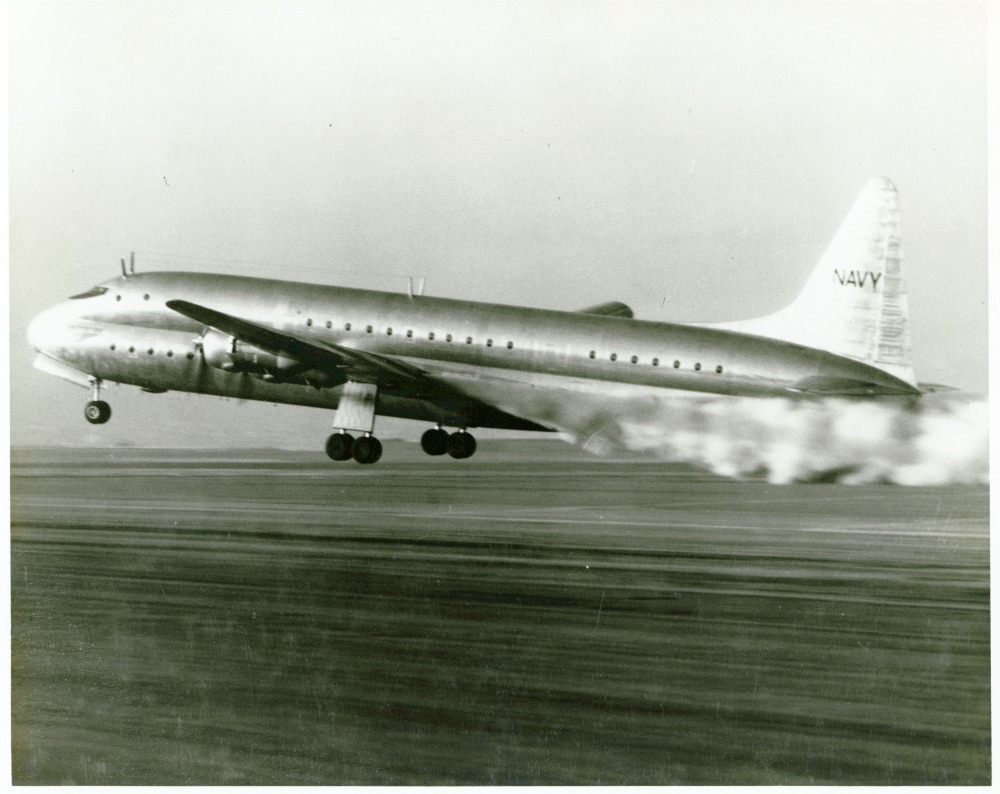
The wing itself was based on the layout and structure of the wings used on the Constellation and the P-38 Lightning. Four 3,000 horsepower Pratt & Whitney R-4360 28-cylinder Wasp Major engines drove four bladed props. Unusually, the upper surface trailing edge root of the wings could hold RATO units to shorten takeoff runs. There were three units in each wing- they were fired when the landing gear retraction sequence started. As the landing gears took 14 seconds to retract, the RATO units burned for 15 seconds.

Takeoff using the overwing integral RATO units
(San Diego Air & Space Museum)
Since the Constitution was a low-priority project during the war, it wasn't until well after the war ended in August 1945 that the aircraft was completed. Though standard for today's design work on modern airliners, Lockheed used a full-scale hydraulic and electrical systems test rig that today would be known as an "iron bird". The system was loaded so the hydraulics and flight control systems would "experience" loads similar to what would be found inflight and were invaluable in letting the Constitution's test pilots get familiar with the large aircraft. The first flight came on 9 November 1946 and after the first 44 flight hours of testing the Constitution was found to be significantly underpowered. More powerful versions of the R-4360 Wasp Major were installed that theoretically produced 3,500 horsepower, but in practice even these engines could only garner 2,900 to 3,300 horsepower and that was with water injection and bypassing the superchargers on takeoff. As a result, use of the integral RATO units was commonplace. 

To keep Pan American interested in the project, Lockheed proposed the civilian version of the Constitution be powered by Wright 5,500 horsepower Typhoon turboprop under development, but by this point Pan American had thrown its lot with the Boeing Stratocruiser and bowed out of the Constitution program. Designated XR6O-1 by the US Navy, the first Constitution underwent a full year of flight testing at NAS Patuxent River, Maryland. The second XR6O-1 made its first flight on 9 June 1948 and unlike the first aircraft, the upper deck was fitted out for VIP passenger service with 92 seats while the lower deck was fitted out to carry as much as 40,000 lbs of cargo. Dual spiral staircases at each end of the cabin provided access to the upper deck from the lower deck and passenger entry was via the nose gear well which was large enough to allow airstairs to be pulled up just in front of the nose gear. 

The Constitution on static display during an open house at San Francisco Airport
(San Francisco International Airport/FlySFO.com)
In February 1949 the second R6O (the X prefix was dropped) was commissioned into service at NAS Moffett Field, California, with the fleet logistics support squadron VR-44. Soon joined by the first R6O, the Navy embarked on a series of publicity flights across the country, using the Constitution to not only transport personnel and materiel, but also to stimulate interest in naval aviation. The R6O carried one and a half times more cargo than the next biggest Navy transport, the Douglas R5D (C-54 Skymaster/DC-4). In 1950, the two R6Os were redesigned R6V; in the Navy's aircraft designation system used prior to 1962, "V" stood for the Vega Division of Lockheed that had built the PV-1 Ventura and PV-2 Harpoon in the Second World War- the "O" of Lockheed was dropped as it could be confused with the number zero and "V" took it's place as the Lockheed designator code. They were reassigned to VR-5 for expanded operational duties that included flights to Hawaii and Alaska. With a total of 3,760 flight hours between the two aircraft, in 1953 the R6O Constitutions were retired and placed in storage at NAF Lichtfield Park, Arizona. The aircraft were offered to the airlines on a proposed five-year lease, but no interest came about. 

The first Constitution ended up in Las Vegas as a promotional billboard for Alamo Airways at McCarran Airport and plans were floated to move the aircraft to the Strip to be part of a casino. However, the plans were never materialized and when Howard Hughes acquired the property that the aircraft sat on, he also gained ownership of the aircraft and had it scrapped in 1970. The second Constitution ended up in Opa Locka, Florida, where it was to be sold to a German businessman who wanted to use it for a restaurant in Barcelona, Spain. The deal fell through and the aircraft mysteriously caught fire which gutted the interior but spared the exterior. After several years of legal wrangling, the aircraft was scrapped in 1979.

Further reading: 

The Convair Model 6: A Jumbo Jet Before Its Time
Pan American and the Boeing 314 Toilet Scandal
The Cadillac of the Constellation Line

Source: Lockheed R6O/R6V Constitution (Naval Fighers No. 83) by Steve Ginter. Ginter Books, 2009.

29 April 2016

The American V-1 Program 1944-1950

Beginning in 1942, Allied intelligence began a systematic analysis of the Fiesler Fi 103 flying bomb better known as the V-1. Analysis of crashed test articles combined with photoreconnaissance and intelligence collected by agents within occupied Europe led the United States in particular to restart its flying bomb programs in 1943 that had laid dormant for the most of the Second World War on account of what was felt to be beyond the current state of the art. In 1944, Northrop was contracted to begin development of the first US flying bomb, designated the JB-1. Running parallel to the Northrop effort was the reverse-engineering of the V-1 using 2,500 lbs of salvaged V-1 parts that had been provided by Great Britain. The parts arrived at Wright-Patterson Field in Dayton, Ohio, on 13 July 1944 and the US Army Air Forces directed the engineering staff there to build 13 copies of the V-1. Quite remarkably, the USAAF technical staff completed the first copy in just three weeks! To put the scope of the success of the Allied intelligence effort and the work the Wright-Patterson Field team into perspective, the first German V-1s struck Britain on 12-13 June 1944. By the end of the following month, the USAAF had its first copy of the V-1 and they had test fired the reverse-engineered pulse jet engine. A memo from the technical team responsible to General Henry Arnold, head of the USAAF, recommended mass production at the earliest opportunity- however, General Arnold and his advisors were well aware of the V-1's inaccuracy and despite reservations that production of an American V-1 would divert crucial wartime resources and manpower from battle-proven weapons, it was felt that if the guidance of the V-1 could be improved, an American version might be useful. 

The Republic-Ford JB-2 differed from the V-1 in minor details
(USAF/Wikipedia)
Republic Aviation was tasked with producing the American V-1 which was designated JB-2 with the first of the thirteen USAAF copies arriving on 8 September 1944 from Wright-Patterson Field. The USAAF ordered 1,000 JB-2s from Republic. The Ford Motor Company was tasked with producing the JB-2's pulse jet engine which was designated the PJ31. With Republic's resources nearly all committed to the production of the P-47 Thunderbolt, the company subcontracted the airframe assembly to Willys-Overland, the same company that built the Jeep. With Ford responsible for engine production, the Jack & Heintz Company of Cleveland which had been building aircraft electrical components and autopilots as a subcontractor was given responsibility for the JB-2's control system. Alloy Products of Wisconsin was given responsibility for the fuel tanks and pressure vessels used in the JB-2 while the Northrop was contracted for the JB-2's launch sled. The booster rockets that actually propelled the JB-2 off the ground were contracted to Monsanto. 

By the end of September 1944, the USAAF revised its initial order for 1,000 JB-2s to 1,000 JB-2s *per* month with a target goal to reach that rate by April 1945. The first JB-2 launch took place at Eglin Airfield in Florida on 12 October 1944- just three months had elapsed since start of the German V-1 campaign against London and the first American copy had made its first flight! Flight testing was also carried out at Wendover Field in Utah at the same time that the B-29 Superfortress unit that dropped the atomic bombs, the 509th Composite Group, was a tenant at Wendover training for their special mission. The flight tests didn't go too smoothy- by the first week of December, there were two successful flights out of ten launches. 

JB-2 air launch from a B-17 at Eglin Army Air Field in 1944
(USAF/Wikipedia)
Northrop's own flying bomb design, the JB-1, made its first launch in December 1944 but crashed after launch. (The JB-1 will be the subject of its own later article here at Tails Through Time.) With the the early failures of the JB-1 and problems with its jet powerplant, the USAAF decided to continue with the development of the Northrop design but production and operational priority went to the JB-2. Despite issues with accuracy in the flight tests at Eglin and Wendover, the USAAF leadership pushed for an increased production rate for the JB-2 to at least 3,000 per month. On 14 January 1945, General Arnold ordered another 75,000 JB-2s with the ability to launch 100 per day by September and 500 per day by January 1946 in anticipate of the invasion of Japan. On the next day, the JB-2 program got the same priority that was given to the B-29 Superfortress program. 

Despite the enthusiasm from the USAAF leadership, theater and operational commanders were skeptical of the JB-2. The generally poor European weather that was interfering with the strategic bombing campaign, however, offered perhaps some utility for the JB-2 as it wasn't dependent on clear weather- a view supported by Sir Trafford Leigh-Mallory, the head of the Royal Air Force and commander-in-chief of Allied air forces for the Normandy invasion as well as General Carl Spaatz, head of US Strategic Air Forces Europe. Spaatz, however, was a bit more measured in his support for the employment of the JB-2. He felt that it was more a harassment weapon that could be used when bad weather precluded a strategic bombing mission and outlined his planned use at 300 JB-2s per day only 10 days out of the month. But General Spaatz was very specific that operational employment of the JB-2 could not interfere with heavy bomber operations and he personally expressed concerns to General Arnold regarding the JB-2's cost-effectiveness given its inaccuracy. 

The JB-2 flight test program centered primarily on improving the weapon's accuracy. The first successful flights in the fall of 1944 showed an average error of eight miles at a range of just over 120 miles, not much better than what the Germans were averaging in their own V-1 campaign. The next step by the USAAF was to install radio guidance control in the JB-2. Using a radar beacon and remote control, it was thought the JB-2's accuracy could be improved. However, continued flight tests showed in 20 flight tests with the new guidance system, the JB-2's average error was no better than it was before with preset controls. Things did get better though- by war's end, the JB-2 with preset controls was averaging 5 miles error over a range of 150 miles and 1/4 mile error over a range of 100 miles with radio guidance. 

The biggest stumbling block to the operational deployment of the JB-2 in Europe in 1945, believe it or not, was logistical. The sheer numbers of JB-2s needed competed with other munitions production and it was estimated by some in the War Department that just transporting the JB-2 and its associated equipment to Europe would take up nearly 25% of Allied shipping capacity in the Atlantic. Brief consideration was given to moving JB-2 production to Europe, but there simply wasn't the production capacity anywhere else but the United States to produce the numbers of JB-2s planners envisioned using. 

With the end of the war in Europe, JB-2 production numbers remained in flux as planners debated what was needed for the planned invasion of Japan. By this point, however, the production and logistical concerns for the mass deployment of the JB-2 had exhausted the initial enthusiasm for the weapon. Production was halted initially at the end of January 1945 but then reinstated at a lower rate. By the time of the Japanese surrender, 1,385 JB-2s had been built when production was terminated.

Concurrent with the USAAF testing, the US Navy worked on a navalized version of the JB-2 that would have been launched from specially-modified LSTs and escort carriers during the invasion of Japan. Fifty-one JB-2s were requested by the Navy for its own testing program in September 1944 when production was launched. While airborne launches from B-17 Flying Fortresses were done during testing at Eglin Field, the Navy planned to launch JB-2s from Consolidated PB4Y Privateers as well. Navy planners, however, didn't expect operational capability with the JB-2 (which was called the Loon by the Navy) until August or September 1946. The first Navy Loon launch was on 7 January 1946 with the Secretary of the Navy approving the conversion of two submarines for Loon operations in March 1946. Conversion of the USS Cusk (SS-348) began in January 1947. The Cusk entered the history books on 18 February 1947 as the world's first missile submarine when it made its first Loon launch...which ended in failure after only 3.5 miles of flight. The Cusk finally had its first successful launch on 7 March 1947 after five tries. Submarine launch had become the Navy's focus for the Loon program with the USS Carbonero (SS-337) also modified for the program and by 1949 finally carried out a firing from a surface ship, the test ship USS Norton Sound. In March 1950, the Navy terminated in the Loon in favor of the more promising Regulus cruise missile. 

The USS Cusk fires a JB-2 Loon
(US Navy/Wikipedia)
With the US Air Force becoming independent in 1947, the JB-2 program was reactivated in March 1948 at Holloman AFB in New Mexico as part of a program for the development of missile guidance systems and seeker technology. Work using the JB-2 benefitted the later Matador cruise missile program with the JB-2 program winding down by 1949 with test airframes successfully being flown remotely and skid landed for recovery. A joint effort with Eglin AFB also used the JB-2 as a target drone for the development of gunsights. Interestingly "Flakzielgerät 76" was the German cover name for the V-1 during its development which loosely translates as anti-aircraft target device.

Further reading:

British Defenses Against the Summer 1944 V-1 Bombardment
Regulus: The US Navy's First Operational Nuclear Missile
CHECK SIX: Ships Damaged or Sunk by the Yokosuka MXY7 Ohka

Sources: The Evolution of the Cruise Missile: Comprehensive History from the V-1 and V-2 to the Tomahawk and Snark by Kenneth P. Werrell. Air University Press/USAF, 1983, pp 79-85. V-1 Flying Bomb 1942-1952: Hitler's Infamous Doodlebug (New Vanguard No. 106) by Steven J. Zaloga. Osprey Publishing, 2005, pp 39-41.


25 April 2016

CHECK SIX: The USS Wasp (CV-7)

The USS Wasp in 1940
(Wikipedia)
The Wasp (CV-7) was a scaled down Yorktown-class carrier and a product of the Washington Naval Treaty. After the Yorktown and Enterprise were built, the US still had 15,000 tons allowed for an additional carrier under the treaty. Since the Navy wanted as big an air wing as possible on the Wasp despite the ship being about 25% smaller than the Yorktown class, a number of torpedo protection features were omitted from the design that would have protected her stores and machinery spaces. The carrier also had less armor protection topside. Her machinery was less powerful than even the Independence-class CVLs. The Wasp's machinery was capable of 75,000 shaft-horsepower. The Yorktown's power plant could do 120,000 shp, the Essex-class had a power plant capable of 150,000 shp and that of the Independence-class CVLs could do 100,000 shp.

The Wasp had the first deck edge elevator- it was a T-shaped platform to accommodate the tailwheel at the top and the mainwheels on the cross part. Though instead of running vertically on side rails, articulated arms moved the elevator in a semicircular path from the hangar deck to the flight deck. 

The deck edge elevator of the USS Wasp with a Vought SB2U Vindicator
(National Museum of Naval Aviation/Wikipedia)
The Wasp was commissioned on 25 April 1940. Her final sea trials took place on 26 September 1940 and was afterwards assigned to the Atlantic Fleet with the homeport at Norfolk, Virginia. One of her earliest assignments were experiments to see if Army aircraft, in this case Curtiss P-40 Warhawks, could be flown off the carrier. Interestingly while on Neutrality Patrol in the summer of 1941, the Wasp participated in the search for the German cruiser Admiral Hipper. With the declaration of war in December 1941, the Wasp's first tasking was in the Caribbean to intercept any French warships which were feared to be under Vichy control and would attempt a breakout to reach France. With carrier losses in the Pacific after the Battle of Coral Sea and the Battle of Midway reducing the US Pacific fleet to only three carriers, the Wasp was urgently transferred from the Atlantic Fleet to the Pacific Fleet. It was participation in the Guadalcanal campaign with the USS Saratoga and the USS Enterprise that the Wasp would be lost. 

The design omissions to meet Washington Treaty stipulations would prove fatal in 1942 when she was torpedoed during the Guadalcanal campaign by the submarine I-19. Early war inexperience with damage control was also a factor in the Wasp's sinking. I-19 fired six torpedoes- three hit the Wasp in the area of its fuel bunkers and magazines with disastrous effect. The fourth torpedo hit the escorting destroyer USS O'Brien, the fifth and six torpedoes missing. Thirty-five minutes after being hit, Captain Forrest P. Sherman gave the order to abandon ship. She later had to be sunk by one of the escorting destroyers. Of her air wing, 45 aircraft went down with her, but of the 26 aircraft that were airborne at the time of the attack, all but one were recovered aboard the USS Hornet. 193 men died with 366 wounded.

The Wasp ablaze shortly after the three torpedo hits
(Wikipedia)
Further reading: 


14 April 2016

VFP-62 "Eyes of the Fleet" and the Bay of Pigs Invasion

Over the course of the Second World War, photoreconnaissance in the US Navy progressed from rudimentary handheld photography from whatever aircraft was available to reconnaissance variants of carrier fighters equipped with cameras in fuselage bays. The reconnaissance mission was carried out usually by the fighter squadrons in the carrier air wing (which were still called carrier air groups back then) and in the years after the war, small groups of combat-seasoned photo recon pilots were usually attached to carrier air groups but no standard training, syllabus or even squadron existed for the reconnaissance mission. That all began to change in 1948 when Fleet Air Service Squadron THEE formed a photographic detachment at NAS Norfolk, Virginia. On 8 January 1949, 13 officers and 88 enlisted personnel gathered to form Composite Squadron SIXTY-TWO (VC-62) at Norfolk, with a sister squadron, VC-61, formed on the West Coast at NAS Miramar, California, to serve the Pacific Fleet. The squadrons were tasked to train and perform the photo reconnaissance mission. The first aircraft of the units were photo variants of the Bearcat and Corsair- the Grumman F8F-2P (the P suffix designating a recon variant) and the Vought F4U-4P and -5P. Though specialized for the recon mission, that's a loosely used term since the aircraft carried a single camera in a fuselage bay and the pilots were still considered fighter pilots and VC-61 and VC-62's training regimen still required proficiency in gunnery, rocketry and bombing missions with extra emphasis on navigation. 

A VFP-62 F2H-2P Banshee aboard the USS Franklin D. Roosevelt
(Wikipedia)
Of the two squadrons, VC-62 would soon become famous. The unit was transferred from Norfolk to NAS Jacksonville and converted to the McDonnell F2H-2P Banshee which was a quantum leap in performance over the Bearcats and Corsairs as not only was the Banshee jet powered, but its extended nose bay housed multiple cameras that could photograph targets from over 40,000 feet. In 1953, VC-62 added the swept wing Grumman F9F-6P Cougar to its existing fleet of Banshees. Camera technology also progressed in this time to allow sharper and better quality photos from aircraft moving at much higher speeds than piston-engined aircraft. The arrival of the jets also meant that the pilots no longer had guns to shoot back- the recon variants of the jets were unarmed, requiring the use of speed, maneuverability and sharp mission planning to get home with the photos. On 2 July 1956, VC-62 was redesigned VFP-62 and VC-61 became VFP-63. Two years later, VFP-62 got one of the finest naval photo reconnaissance aircraft in the form of the Vought F8U-1P Crusader. 
A VFP-62 F9F-6P Cougar overflies the USS Essex
(Wikipedia)
The Crusader wasn't just fast, it also had the latest in state of the art camera technology in the -1P recon variant. At the speed of the Crusader, especially at low levels, the images would have been blurred, but the four cameras of the -1P Crusader had what was called IMC (Image Motion Compensation). A set of avionics boxes with controls in the cockpit coordinated the aircraft's speed and altitude with the camera equipment. During a photo run, a vacuum sucked the film frame against a moving shuttle- when the shutter opened, the shuttle would move the film frame in the opposite direction of flight at a speed that canceled out the forward speed of the Crusader for that brief moment. When the shutter closed, the vacuum released the film frame and the next frame entered the shuttle. This process took place with each of the Crusader's four cameras multiple times in a second depending upon the target, the aircraft's speed and altitude, and ambient lighting conditions. The IMC electronics also made sure the frames overlapped the ground to insure a required level of coverage of of the target. 

In 1958, the same year as the conversion to the F8U-1P Crusader, VFP-62 moved to NAS Cecil Field outside of Jacksonville as it had outgrown its Jacksonville base. It was an unusually large squadron compared to most Crusader fighter squadrons on account that it sent detachments of carrier air wings- a typical photo detachment might be three aircraft with 35 officers and enlisted men. The squadron could have multiple detachments deployed worldwide at any given moment. 

A VFP-62 F8U-1P Crusader tanks from an A4D-2 Skyhawk
(Wikipedia)
On 1 January 1959, the revolutionary forces of Fidel Castro defeated Fulgencio Batista's regime in Cuba, putting the island nation square in the communist sphere of influence. Needless to say, having a Soviet client state just 90 miles from American shores would greatly influence the foreign and defense policy of both the Eisenhower and Kennedy administrations. John F. Kennedy won the 1960 presidential elections against Richard Nixon on a strong anti-Castro platform, campaigning that Nixon, as Eisenhower's vice-president, was weak on Cuba. Unfortunately for Kennedy, this put him in a position after entering office of accepting the plan for the invasion of Cuba by US-trained Cuban exiles at a location called the Bay of Pigs. On 18 April 1961, a force of 1,400 Cuban exiles landed ashore at the Bay of Pigs as the Cuban Expeditionary Force (CEF) with plans to start a counter-revolution against Castro. Kennedy was keen to limit the appearance and extent of American involvement and the CIA-trained CEF force had its fleet of Douglas B-26 Invader aircraft cut in half as part of that effort. The young president wanted the CEF to look like a home grown force than a US-backed force to prevent a superpower confrontation. The operation was doomed from the start and when it became clear that the CEF was in over its head against Castro's forces the following day, Kennedy ordered a secret photo assessment of the situation on the ground at the Bay of Pigs. 

VFP-62 had three F8U-1Ps as part of Detachment 41 assigned to the USS Independence which was in the area for contingency operations should US air support be needed (which it was but was never authorized). Det 41's commander was ordered to paint over any military markings and even the maintenance stencils were overpainted in gray. Roman numerals I, II, and III, were painted inside the wheel wells to tell the aircraft apart as they were completely sanitized of any exterior markings. The Crusaders were identified as "Gray Ghost" and then "One", "Two", or "Three" during flight operations. They conducted a series of flights over the Bay of Pigs which confirmed that the CEF was about to be overrun by Castro's forces. It was hoped that the low level overflights of the area might give Castro's forces pause that the CEF might be defended by US airstrikes and give the beleaguered exiles time to regroup, but this wasn't to be the case and the CEF was roundly defeated with those not killed taken prisoner. 
A VFP-62 F8U-1P Crusader prepares to launch from the USS Independence
(Wikipedia)
The USS Independence and its carrier air wing were awarded the Armed Forces Expeditionary Medal for its clandestine operation, but even after the disaster at the Bay of Pigs had passed, VFP-62 was requested to remain in the area to keep an eye on Cuba. Up until the Cuban Missile Crisis in October 1962, the squadron would make periodic flights to Cuba, mostly staging out of NAS Cecil Field. Flights of two aircraft would then "pretend" to making practice approaches to NAS Key West and dash to Cuba at low level. Other missions had two Crusaders appear as a flight transiting to Guantanamo Bay and then dash down at low level before recovering at Homestead AFB in Florida. 

VFP-62's missions would soon take on added urgency as October 1962 approached. But that's a subject for a future article here at Tails Through Time! 

Further reading: 


Source: Blue Moon Over Cuba: Aerial Reconnaissance during the Cuban Missile Crisis by Capt. William B. Ecker USN and Kenneth V. Jack. Osprey Publishing, 2012, pp 33-50.

09 April 2016

The WW1 French Fighter That Got More Fame Than It Deserved: The Nieuport 28

Aviation author Peter Bowers once said of the Nieuport 28 biplane fighter of the First World War "The French Nieuport 28....is unique in aviation history for having achieved a considerable degree of fame that it didn't really deserve." The penultimate Nieuport biplane fighter design was rejected by the French for front line service and that might well have been the end of the story for not just the aircraft but the Nieuport company as well had it not been for the American Expeditionary Force's need for a fighter aircraft as the better SPAD biplane's production was devoted to filling the needs of the French Air Service. Since it was available, it would be the Nieuport 28's claim to fame to be the first combat aircraft to wear American colors into the First World War. 
This N.28 wears the "kicking mule" emblem of the 95th Aero Squadron. The kicking mule is still used by the 95th Reconnaissance Squadron that flies the Rivet Joint.
(USAF Museum)
The story of the Nieuport 28 (N.28C-1 was its company designation, but for brevity reasons I'll just refer to it here on out as the N.28) begins with the formation of an aircraft company by Edouard and Charles Nieuport in 1909, at first devoted to producing aircraft components like engine ignition systems. Both brothers were pilots and began working on their own monoplane designs which were contemporaries of the more famous Blériot XI design that made the first air crossing of the English Channel on 25 July 1909. After a series of prototype designs, the Nieuport brothers reorganized the company in 1911 to focus more on their own aircraft designs as Nieuport et Deplante. Edouard was killed while flying that year and with the help of aviation-minded investors, the company was renamed Société Anonyme des Établissements Nieuport with the remaining brother, Charles, heading the company before his untimely demise also while flying later that year. Swiss engineer Franz Schneider, who would become more famous for his German designs in the First World War, briefly held the post of chief designer at Nieuport until he left for Germany in 1913. French engineer Gustave Delage took over in January 1914 and began work on a sesquiplane racer- not a true biplane as the lower wing was much narrower than the top wing. For lightness, Delage used only a single spar in each wing and used a "V" brace for the wing struts, the apex of the "V" being on the lower "half" wing. By the time the First World War had broken out, Delage's racing aircraft design became the Nieuport 10 fighter which in turn was developed into the faster Nieuport 12 fighter. The V-strut and sesquiplane layout would be the pattern of a series of further developments of the Nieuport fighter over the course of the war. By 1917, the current design was the Nieuport 17- though light and maneuverable, it couldn't deal with the latest crop of German fighters as it was underarmed (it only had a single machine gun when twin guns were pretty much the air combat standard by that point) and the single spar sesquiplane structure wasn't strong enough for extended air combat with the latest German designs. It was painfully obvious that Gustave Delage's design layout had reached its limits. 

With the French Air Service considering the SPAD S.VII fighter, Delage set about to create a better Nieuport fighter and broke with his long-standing design tradition by adopting a true biplane layout with conventional two spar wings and a twin machine gun armament with the Nieuport 28. With a longer fuselage but keeping the same cross section, the N.28 looked sleeker than previous Nieuport designs. Both the upper and lower wings now had two spars for strength and the chord of the lower wing was slightly less than that of the upper wing with Delage abandoning his favored sesquiplane layout. In contrast to the angular wing tips of his previous designs, the N.28 had rounded elliptical wingtips with conventional two strut wing braces attached to the spars, again, breaking with the V-strut configuration of his past designs (which were sometimes referred to as "V-Strutters"). Because of the narrowness of the fuselage, the twin Vickers 0.303 machine guns were offset- one left of center ahead of the pilot and the other nearly on left fuselage side. This was the result of the original N.28 prototype having only a single gun offset to the left ahead of the pilot. The need for a second gun meant that the fuselage was too narrow for two guns side by side ahead of the pilot, the second gun was offset to the left and below of first gun. 

Eddie Rickenbacker and his N.28. Note the offset guns and the Hat-in-the-Ring emblem
still used to this day by the 94th Fighter Squadron which flies F-22s from Langley AFB.
(Wikipedia)
In keeping with past Nieuport designs, a rotary engine was used from either the Gnome or Le Rhone engine manufacturer. To keep the engines lightweight, they lacked carburetors and could not be throttled down- as a result, the N.28 had what was called a "blip switch" on the control stick that would briefly turn off the engine when power needed to be reduced, such as landing. The Le Rhone rotary engines were a bit more flexible and could be throttled between 900 to 1250 rpm, but even at the lowest setting it was still too much power for the N.28, so the "blip switch" was still necessary regardless of the engine type installed. Later engines would feature additional switches that could cut out certain cylinders on the engines to reduce power, but these systems would prove to be continual maintenance headaches. The late model Gnome engines boasted 100 hp which for the N.28 was a lot of power, but to keep engine weight down, the engine cylinders had only a single valve instead of the traditional two valves and as such, were referred to as "Monosoupape" engines which worked not unlike a two stroke engine. Unfortunately this was very wasteful when it come to fuel consumption and incompletely burned fuel posted a constant engine fire hazard for N.28 pilots. 

While the engine issues alone might have been enough cause for the French Air Service to reject the N.28, the performance gains offered were eclipsed by the SPAD S.XIII which became the standard French fighter of the period. That might have been the end of the Nieuport story at that point had it not been for the arrival of the American Expeditionary Force in France. Lacking a suitable fighter aircraft of their own, the Americans turned to the French for the SPAD S.XIII, but all of SPAD's production was committed to French needs and none were available for the AEF. The French offered the N.28 which wasn't ideal but it was better than nothing and Nieuport would build 297 N.28s for the AEF. 

The introduction into service was lackluster at best. The First Pursuit Group assigned the N.28 to four of its squadrons- the 27th, 94th, 95th, and 147th Aero Squadrons. The 95th AS arrived first to the front in February 1918, but the N.28s were delivered without guns! To boost morale and show that that the Americans were ready for action, Major Raoul Lufbery, a veteran of the Lafayette Escadrille of American volunteers, led unarmed patrols over the front lines the following month. It was an inauspicious start to American air combat operations that the first fighters in action lacked armament. On 14 April 1918, the 94th's sister squadron, the 95th Aero Squadron, made its first armed patrol with three N.28s- with the flight lead aborting due to weather, the other two pilots, Lt. Reed Chambers and Lt. Eddie Rickenbacker, decided to press on with their patrol. Returning to the airfield, two German fighters were overhead, apparently lost above the fog. The second patrol launched with Lt. Alan Winslow and Lt. Douglas Campbell and they downed the two Germans, Winslow scoring the first victory for the AEF and Campbell (soon to become the first American ace) getting credit for the second German by forcing it to crash land.

In the weeks of air combat that followed, the Americans found the N.28 had other short comings besides its troublesome rotary engine. During extended dives, the upper wings tended to shed their fabric covering, often taking the wing ribs forward of the forward wing spar with it. Several American pilots were lost due to the wing failures. Even Eddie Rickenbacker nursed home a crippled N.28 when he lost most of his upper wing's fabric. By the time Nieuport had a fix for the problem, adequate SPAD S.XIIIs became available and the Americans quickly converted to the superior SPAD fighter in July 1918. After the last N.28s were built for the AEF squadrons, Nieuport switched over to license production of SPAD fighters in an ironic twist. By August 1918, the last N.28s were phased out from the AEF in favor of the SPAD. 

Despite the shortcomings of the N.28, the Americans maintained a favorable win-to-loss ratio, the most appreciated quality of the N.28 being its maneuverability. The kill ratio was about 3:1, respectable given the shortcomings of the N.28 and the relative inexperience of the American pilots early on. By the time the four squadrons had converted to the SPAD, the kill ratio had slipped to 1:1 on account of there being more veteran German pilots in combat than earlier in the N.28's combat career. 
An N.28 flies off the turret platform of either the USS Oklahoma or USS Pennsylvania
(US Navy)
Following the First World War, about 50 N.28s that did not see combat service over France were shipped to the United States and used by the US Navy as gunnery observation aircraft. Small fly-off platforms were built atop some battleship turrets and the light weight and rapid acceleration of the N.28 allowed them to be operated off these platforms. Flotation gear and hydrovanes were fitted that allowed the N.28s to be recovered from water landings. 

Further reading: 


Sources: Profile Publications No. 79: The Nieuport N.28C-1 by Peter Bowers. Profile Publications, 1966. National Museum of the US Air Force, Wikipedia. 

08 March 2016

The Ryan FR-1 Fireball and F2R Dark Shark: An Evolutionary Dead-End

When the US Navy initiated the development of its first jet fighter, the McDonnell FD-1/FH-1 Phantom, in 1942, not only did it hedge its bets on McDonnell's design by carrier testing the Lockheed P-80 Shooting Star, but it also initiated a back up program at the insistence of the Navy's Bureau of Aeronautics (BuAer) for a mixed-powerplant fighter that combined a conventional piston radial engine with a jet engine. There were still a lot of unknowns about the operation of jet aircraft from fleet carriers and the concept of a mixed powerplant fighter would combine what was known- that a conventional radial engine had the performance for a carrier takeoff and a wave-off from landing and that a jet engine could provide a boost for high speed performance. At the same time as the start of the FD-1/FH-1 program, BuAer held a competition for a mixed-powerplant fighter which was won by San Diego-based Ryan Aeronautical Corporation which started work in 1943 on the prototype for the FR-1 Fireball.

Ryan FR-1 Fireball
(Wikipedia)
The Fireball's radial engine was a Wright R-1820 Cyclone 9-cylinder radial engine generating 1,425 horsepower. The R-1820 was used on a variety of World War 2 aircraft from the Boeing B-17 Flying Fortress to the Douglas SBD Dauntless and Curtiss SB2C Helldiver. This was a surprising choice given that the standard engine of the Navy fighters of the day was the 2,000 horsepower Pratt & Whitney R-2800 18-cylinder Double Wasp. The jet engine in the rear fuselage, fed by wing root intakes, was a General Electric I-16 (later redesignated J31) developing approximately 1,600 lbs of thrust. The I-16/J31 was a GE production version of the Whittle W.1 centrifugal flow turbojet and was the first production jet engine built in the United States. Outside of the Fireball, two of the same jet engine were used on the Bell P-59 Airacomet. Development of the three prototype XFR-1 airframes proceeded along remarkably smoothly and the prototype made its first flight on 25 June 1944 powered only by its piston engine. On the third flight, the I-16 engine was fitted to the prototype and used successfully.

The Fireball boasted excellent cockpit visibility but one of its other unique features was it was the first production carrier-borne aircraft to have a tricycle landing gear. This was done primarily out of necessity to elevate the jet engine exhaust up and away from the wooden decks of the Navy's fleet carriers. Despite the loss of the three prototypes, the Navy was anxious to field the FR-1 Fireball and had already ordered 100 aircraft a year before the first flight of the prototype. With satisfactory flight testing and excellent performance, another 600 aircraft were added to the order in 1944. The Navy wanted the Fireballs in the Pacific as a Kamikaze interceptor- Fireballs were planned to be used in combat air patrols, loitering on their radial engines. When inbound Kamikazes were detected on radar, the Fireballs would light up the jet engine and speed off to intercept the enemy. At the end of 1944, the Navy ordered 600 of a faster variant, the FR-2, that had a more powerful R-1820 engine that developed 1,500 horsepower. 

VF-66 Fireballs in formation flight
(San Diego Air & Space Museum Archives)
Navy fighter squadron VF-66 stood up at NAS North Island where the Ryan plant was located to speed the introduction into service of the Fireball. Instead of the usual operational evaluations and demonstrations, VF-66 was tasked to get the Fireball into action as soon as possible. Unusual for a Navy squadron of the day, VF-66 was made up of senior officers and experienced pilots. Five days after VF-66 stood up on New Year's Day 1945, the first FR-1s were making their initial carrier qualifications aboard the USS Ranger in preparation for combat deployment. The squadron pilots enjoyed flying the FR-1 for its speed and maneuverability. Pilots often would make low passes at area airfields with the front prop feathered to confuse tower and airport personnel. By July 1945 VF-66 was in final preparations to take the FR-1 into combat but it was all for naught when the Pacific War ended the following month with surrender of Japan after the atomic bombings of Hiroshima and Nagasaki. The Fireball was officially unveiled to the public in September 1945 but only 66 FR-1s were produced and delivered before the war ended, the balance of orders for the FR-1 and FR-2 being canceled. After the war in November 1945 a Fireball that suffered a radial engine failure landed on the USS Wake Island to be come the first jet landing on an aircraft carrier, but obviously not intentionally!

Looking to improve the Fireball's performance, Ryan proposed the FR-3 that would have taken the faster FR-2 design and swapped out the I-16 engine for a more powerful GE I-20 engine that offered 2,000 lbs of thrust. The FR-3 never got built, but Ryan did a contract for a prototype of the FR-4, which used a 3,400-lb thrust Westinghouse J34 engine in the rear fuselage. The XFR-4 did fly, and the main external difference was the relocation of the jet intakes from the wing roots to the lower sides of the nose just aft of the radial engine. Doors could close off the NACA-style flush intakes to keep the jet engine from windmilling and producing drag and small eyelid doors could increase the area of the intake as well. The XFR-4 added 100 mph to the top speed of the Fireball, but only one prototype was built. The small number of FR-1s, however, were withdrawn from service when in 1947 they were found to have significant structural fatigue in the aft fuselage just behind the wings. The last flyable FR-1 arrived at the Naval Air Technical Training Center in Memphis, Tennessee, to be used as a maintenance trainer.

Ryan F2R Dark Shark configuration
(San Diego Air & Space Museum Archives)
It wasn't the end of the road for the Fireball just yet, though. The Powerplant Division of BuAer still remained skeptical of the performance of jets in the carrier landing pattern. Ryan was asked to further develop the FR-1design by replacing the radial engine with a General Electric 1,700-horsepower XT31 turboprop engine. The XT31 was the first turboprop engine designed and built in the United States and was also used on the Air Force's Convair XP-81 turboprop/jet fighter. The new Ryan fighter was designated the F2R Dark Shark and though it retained the wing root intakes and the I-16/J31 engine of the FR-1, it had an impressive climb rate but lacking the drag-reducing jet intakes of the FR-4, it was actually slower than the XFR-4 in level flight. With the large 8-foot prop, the Dark Shark demonstrated improved performance in the carrier landing pattern over the FR-1, but by the time of its first flight in November 1946 McDonnell had proven the practicality of pure-jet carrier operations with the FD-1/FH-1 Phantom and the last resistance within BuAer to pure jets had ended as the Navy decreed that all future fighters after the Grumman F8F Bearcat would be pure jets.

The Dark Shark in flight
(San Diego Air & Space Museum Archives)
The Air Force (then still the USAAF) was impressed with the performance of the XF2R-1 Dark Shark prototype and asked Ryan to make some modifications to evaluate it in competition against the Convair XP-81. What was designated the XF2R-2 featured the NACA flush intakes on the nose of the XFR-4 feeding a Westinghouse J34 engine. The XF2R-2 was ultimately never built other than as a mockup, as the Air Force decided, like the Navy, that mixed powerplant fighters were an evolutionary dead end and the future lay with pure jets.

I should also mention the Curtiss XF15C which was also planned as a Navy mixed-propulsion fighter. But that aircraft will be getting its own article at a later date here at Tails Through Time!

Further reading: 

The Coming Kamikaze Threat in World War II We Never Faced
Refining Anti-Submarine Warfare: The Grumman AF Guardian
The Ground-Breaking Gun Turret of the Grumman TBF Avenger
The Boeing PBB Sea Ranger: The Best Flying Boat at the Worst Possible Time

Source: U.S. Naval Air Superiority- Developement of Shipborne Jet Fighters 1943-1962 by Tommy H. Thompson. Specialty Press, 2008, p28-30.

23 January 2016

What Your Kitchen Refrigerator and Ballistic Missiles Have in Common: Freon


While liquid-fueled rocket engines have been the mainstay for the satellite launch industry, the long road of technological development in solid-fuel rockets have also benefited the aerospace industry. Often times unique solutions were needed in the development of solid-fuel rockets. One of the more unusual ones was the use of liquid freon to direct the exhaust flame from solid-fueled rockets. That's right. Liquid. Freon. How? I'll get to that.

Minuteman II test launch
(National Park Service/Minuteman Missile NHS)
In the 1950s the conventional wisdom in ICBM development was that only liquid-fueled engines had the power to lift the heavy nuclear warheads of the day. The two main ICBMs in development, the Atlas and the Titan, used liquid-fueled engines. But the US Navy, seeking to put ICBMs on nuclear submarines as a sea-based strategic deterrent, considered liquid-fuels on a submarine wholly impractical and not just for safety reasons. As a result, the engineers who were developing the Polaris SLBM focused their efforts on solid-fuel rocket motors for the missile. They were storable and could be quickly fired. In addition, with enough right mix of solid propellants, the missile could be much smaller than a comparable liquid-fueled missile.

The advantages of a storable propellant and rapidity of launch made solid-fuel an attractive option for a land-based ICBM as well. In the US Air Force, General Bernard Schriever was in charge of the Air Force's ICBM development effort as the head of the Western Development Division. While he initially believed that liquid-fueled engines were the only way to power an operational ICBM, he was ably convinced by several of his engineers to look at solid-fuels as an alternative. That tangent then took on an important priority equal to that of the Atlas and Titan programs, becoming the Minuteman ICBM which was developed in the same time frame as the Navy's Polaris missile. The two weapons shared many similar characteristics due to their solid-fuel rocket engines. The first variant of the Minuteman, the LGM-30A Minuteman I, became operational at Malmstrom AFB in Montana in 1962. 
First SLBM launch, 23 July 1960.
Polaris A1 from the USS George Washington
(US Navy)
The first solid rockets used tabs that jutted into the exhaust stream to deflect the plume for directional control. It was the simplest system but to provide effective control and deflection, the tabs had to be of a size that inevitably cut into the exhaust stream's total velocity. The next solution was what the Polaris team called "jetevators". The exhaust cone of the solid rocket had an extension at the bottom of the cone that was in effect, a gimbaled extension of the skirt (rather than moving the whole nozzle assembly) and small actuators moved the whole extension. Jetevators were used on the first versions of the Polaris SLBM, the A1 and A2 variants. The main disadvantage of jetevators was they added technical complexity to the solid rocket motor as well as weight. Small jetevators could only provide slight corrections but to provide more significant directional control, larger and heavier jetevators would be needed.

Both the early versions of Polaris and Minuteman used jetevators on each of the three stages of the missiles, with the first and second stages of both missiles having four nozzles that could be differentially vectored to provide control. By 1962, however, the next versions of the missiles were already in development- for Polaris it was the A3 version (third version) and for the Minuteman it was the Minuteman II (second version, obviously). In both missiles a range increase was desired and one way to get it was to lighten the missile itself. For both new versions, the second stage switched from four nozzles with jetevators to a single nozzle that used what was called "liquid injection thrust vectoring control". For both the LGM-30B Minuteman II and the UGM-27C Polaris A3, a bigger second stage with the new liquid injection thrust control got the range increases needed. 

1964 patent diagram for liquid
injection thrust vectoring control.
(Google Patents)
Around the perimeter of the nozzle about 1/2 the way up were a series of four ports that angled slightly upward. Liquid freon was injected into one of the ports and as it did, it created a shockwave in the nozzle that pushed the exhaust stream in a direction up to 7 to 10 degress opposite from the port the freon entered. The freon didn't react with the hot plume, it merely created a thermal shockwave that pushed the plume one direction. By injecting freon into the various ports, directional control could be achieved for a lot less weight than traditional actuator-driven control mechanisms. 

On the Minuteman II, the second stage carried 262 pounds of freon in a rubber bladder to use for thrust vectoring. The Minuteman II and Polaris A3 weren't the first missiles to use this novel method of control. That honor goes to the Lance short-range battlefield missile that was used by the US Army until the 1960s. The knowledge gained from the Minuteman II and Polaris A3 in liquid injection thrust vectoring control would be used to its fullest on the large solid rocket boosters used on the Titan III and Titan IV launchers, long the mainstay of US expendable heavy-lift vehicles. Both boosters on the Titan launchers used liquid injection thrust vectoring control. If you look at a picture of a Titan III/IV at launch, you'll notice a small external tank attached to the core rocket's base, one for each booster. That's the reservoir for the liquids used for the thrust vectoring system of the solid rocket boosters.
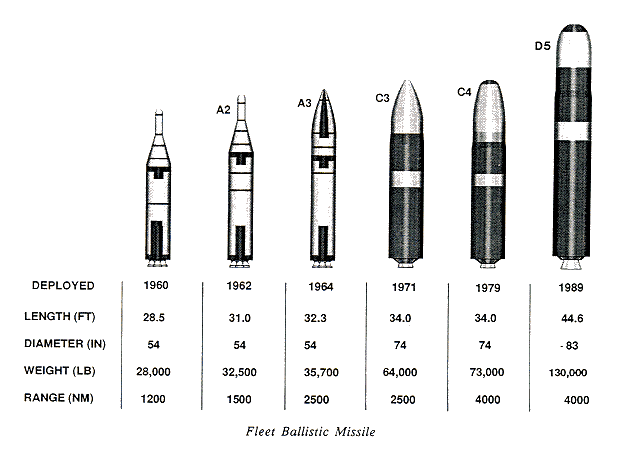
From left to right: Polaris A1, Polaris A2, Polaris A3, Poseidon C3, Poseidon C4, Trident D5
(Federation of American Scientists)
The Polaris was superseded in the Navy's strategic deterrent by the Poseidon, which was followed by  the current missile, the Trident. The Minuteman II was retired from service and the land-based ICBM deterrent for the United States relies on the Minuteman III.

Further reading: 

Martin, the Titan I and the Titan II Ballistic Missiles
One of the Most Important Missions of the Douglas C-133 Cargomaster: Transporting ICBMs


Source: To Reach the High Frontier- A History of US Launch Vehicles, edited by Roger D. Launius and Dennis Jenkins. The University Press of Kentucky, 2002, p262-266.

18 January 2016

The Bomber Career of the Douglas A-3 Skywarrior, 1955-1968

Douglas ad for the A-3 Skywarrior
The origins of the Douglas A-3 Skywarrior lay in a 1948 Navy requirement for a jet-powered, carrier-based, nuclear attack bomber. Even though at the time, the Navy's first purpose-built carrier bomber capable of nuclear attack, the North American AJ Savage, was in the midst of flight testing, the Navy had set its eyes on a more capable successor aircraft that could carry a 10,000 lb nuclear bomb over a combat radius of 2,000 miles. The planned operating weights of the new jet bomber would limit its use to the new 61,000-ton super carrier USS United States as it was too large to operate off the Essex-class carriers and even the much larger Midway class carriers. The program was seen as the most challenging of the Navy's postwar aircraft programs and the VAX(H) Program only received two formal submissions- one from Douglas and the other from Curtiss-Wright. Headed by the legendary designer Ed Heinemann who was already widely regarded for his work on the SBD Dauntless and the AD Skyraider, the Douglas team emphasized that a smaller aircraft was possible that could meet the stringent requirements of the VAX(H) specification. Heinemann championed a smaller aircraft that could also operate safely from the 45,000-ton Midway class carriers as well as even the smaller 29,000-ton Essex class carriers and still accommodate a notional 10,000 lb nuclear weapon. 

The preliminary Douglas designs were for a twin jet aircraft that was less than half the planned operating weight limit set by the Navy's Bureau of Aeronautics. BuAer felt that the nuclear attack mission required an aircraft of 200,000 lbs weight but Ed Heinemann felt that he could meet the mission requirements with an aircraft only 70,000 lbs at maximum operating weight. Naturally his design was met with considerable skepticism within the Navy but Heinemann's planning for a more flexible design not limited to super carriers was validated with the 1949 cancellation of the USS United States. Given that the Douglas submission could also operate off smaller carriers made it the winner of the VAX(H) competition. 

VAH-4 Skywarrior pilot. Note the set back B/N console.
(Wikipedia)
The prototype A3D Skywarrior took the air for the first time on 16 September 1953. Initially low-powered with the troublesome Westinghouse J40 turbojet, the Navy wisely switched the more powerful and widely used Pratt & Whitney J57 engine. A three year flight test program ensued and proved the Skywarrior able to safely operate not just off the super carrier decks of the United States' replacement, the Forrestal class, but also the Midway and Essex classes as well that had been duly upgraded with angled decks and steam catapults. The crew of three consisted of the pilot on the left side, the bombardier/navigator (B/N) on the right side and slightly more aft than the pilot, and the plane captain/navigator who sat behind them facing aft who controlled the twin 20mm cannon in the tail. The cannons proved to be a maintenance nightmare and were all removed from the Skywarrior flight between 1960 and 1961 and replaced with a dovetail or "duck butt" fairing that contained electronic warfare gear. 

The first production Skywarriors weighed in at 43,000 lbs empty, the maximum weight for a catapult launch was 73,000 lbs, and the maximum landing weight was 50,000 lbs. In 1959 an A3D-2 was catapulted from the USS Saratoga with a weight of 84,000 lbs, setting a record that still stands for the heaviest aircraft to be catapulted from an aircraft carrier. 

The first Skywarrior squadron was Heavy Attack Squadron ONE (VAH-1) established on 1 November 1955 a NAS Jacksonville, followed by VAH-3 on 1 June 1956. "Heavy One" went to sea first aboard the USS Forrestal in October 1956, followed by a Mediterranean deployment in January 1957. "Heavy Three" went to sea next, embarked aboard the USS Franklin D. Roosevelt for a Mediterranean cruise in July 1957. Getting used to operating the A3D took a lot of work given it's size which gave it its nickname "Whale". In the first full year of fleet deployments, there were seven flight deck accidents that cost the lives of nine crew. One of the main issues with the high accident rate was that many A3D crew came from the land-based patrol community as it was assumed they were most experienced at handling large aircraft. Turns out, it was carrier experience that was needed as well as more standardized training. As new Skywarrior squadrons were established, they were assigned to NAS Jacksonville to pool experience and training. Eventually Heavy Attack Wing ONE moved to NAS Sanford north of Orlando. By 1958, the accident rate was dropping significantly with the influx of personnel experienced in carrier jet operations. Previously the Navy preferred to keep its carrier air wings united at a single base, but the Skywarrior community set the pattern for the future, for the first time the Navy based all of one aircraft type together at a single base at NAS Sanford. 

With the new A3D-2 variant entering service to replace the earlier A3D-1, a second Skywarrior base for the Pacific Fleet was established at NAS Whidbey Island in Washington. Heavy Attack Wing TWO was set up in Washington, having previously been based at NAS North Island when its heavy attack squadrons flew the AJ Savage. Even numbered VAH squadrons were with the Pacific Fleet, odd numbered VAH squadrons were with the Atlantic Fleet in Florida. The first Pacific Fleet deployment was carried out by VAH-2 aboard the USS Bon Homme Richard in July 1957. Interestingly at the time, there were no Forrestal class carriers assigned to the Pacific Fleet, so nearly all of the Pacific Fleet Skywarrior cruises at the time were done aboard the small Essex-class carriers.

Special nuclear storage facilities were set up on the carriers where the nuclear weapons were stored, guarded by special Marine detachments. Alert aircraft on the carrier deck were also guarded by Marines. Essex class carriers carried three A3D-2s, nine to eleven A3D-2s were embarked on the Midway class and full twelve-aircraft squadrons were sent aboard the Forrestal class decks when they were finally assigned to the Pacific Fleet.  While tanking and conventional bombing were routinely practiced, they were considered secondary to the nuclear deterrent mission. At any given time, a carrier with Skywarriors aboard had at least one or two aircraft armed and on alert for immediate launch. Alert Skywarriors were sometimes kept in the hangar deck near an elevator for immediate movement to the flight deck. The Skywarrior's preferred nuclear attack profile was to make the run into the target at low level at 520 knots. Once the B/N had the target on his radar, the A3D would pull up at 2.5Gs at full throttle, pitching up to 60 degrees climb to release the weapon. After release, the Skywarrior would roll 120 degrees, still pulling 2.5Gs, and hit the deck to egress the target area to escape the nuclear blast. 

By 1960, NAS Whidbey Island was home to five A3D Skywarrior squadrons- four operational squadrons and one training squadron. The last of the Skywarriors were delivered in January 1961, from a production run of 283 aircraft. The zenith of Skywarrior operations was in mid-1961 when there were 227 aircraft in service. With the entry into service of the Polaris sea-launched ballistic missile (SLBM) in 1961, the nuclear deterrent mission of the Skywarrior and its replacement, the supersonic North American A3J (designated A-5 after 1962) Vigilante, was soon to end. The Skywarrior units with the Atlantic Fleet based at NAS Sanford transitioned to the Vigilante, the first fleet deployment taking place in 1963 aboard the USS Independence. By 1965-1966, there were no more Skywarriors with the Atlantic Fleet as all the squadrons in Florida had converted to the Vigilante, leaving NAS Whidbey Island in Washington as the center of the Skywarrior's world with four operational squadrons, VAH-2, -4, -8, and -10, with VAH-123 acting as the training squadron. 

VAH-4 Skywarrior in a shallow dive bombing run
(Skywarrior Association)
On the night of the Tonkin Gulf incident on 2 August 1964 that set in motion the long US involvement in the Vietnam War, VAH-4 had three A-3B Skywarriors embarked on the USS Ticonderoga and twelve A-3Bs with VAH-10 aboard the USS Constellation. The A-3B (as the A3D-2 was redesigned after 1962) could carry up to 8,000 lbs of conventional bombs. Usually the high drag box fin Korea-era bombs were carried as most could fit in the A-3B's bomb bay. The low drag Mark 82 series bombs were reserved for aircraft that had to carry their bomb loads externally. The first bombing missions by Skywarriors in Vietnam were carried out by VAH-2 in 1964 which was uniquely split between two aircraft carriers, the USS Ranger and the USS Coral Sea. Many Skywarrior missions going into 1965 were level bombing runs at night using radar. Most Skywarriors did dual roles, both tanking and bombing. During VAH-2's marathon 331-day deployment 1964-1965, the unit's A-3Bs flew 4900 hours, dropped over 400,000 lbs of bombs, and offloaded over 4 million pounds of fuel. 

During 1966-1967, many of the targets in the North weren't good radar targets for the Skywarrior. Driven as well by concerns about the A-3B's survivability in the increasingly lethal air defenses of North Vietnam, Skywarrior squadrons shifted Viet Cong targets in South Vietnam as well as missions against the Ho Chi Minh Trail in Laos. But there was a problem. If the juicy targets in North Vietnam weren't very good radar targets, how much better was a target somewhere in the jungles of South Vietnam and Laos? The Skywarrior crews adopted dive bombing, attacking in 30-degree dives. While it wasn't anything new as it had been done in exercises in the past, the A-3B lacked an optical sight for dive bombing. Skywarrior pilots resorted to grease pencil marks on the windscreen, some used the refueling probe as an improvised aim point in their dive attacks. The pilots began their attack runs at 8,000 to 10,000 feet, pulling out at 3,000 feet to avoid light caliber anti-aircraft guns and to avoid over stressing the aircraft. More enterprising units resorted to bolting gunsights from A-1 Skyraiders to the glare panel and one unit even got its hands on some gunsights from A-4 Skyhawks. Some Skywarrior missions involved leading groups of A-4 Skyhawks on level bombing runs, the Skyhawks dropping on command from the A-3B's B/N. 

A steeper bombing attack by the Skywarrior over Vietnam
(Skywarrior Association)
A usual A-3B bombing mission involved both bombing and tanking. A Skywarrior would launch, refuel aircraft in the departing strike package, then go on its own bombing mission. On return to the carrier, it would refuel the next outgoing strike package before recovering. When not loaded with bombs or a tanker package, the bomb bay could carry critical spare parts, mail and other high priority items. It was common for a spare A-3B to be sent to NAS Cubi Point in the Philippines for critical aircraft spare parts or get sent to Japan to pick up combat pay for the ship's crew. 

The Skywarrior's role in Vietnam as a bomber began to wind down in late 1967 as it was deemed that its air refueling role was a more vital mission and that more capable, more survivable attack aircraft like the Grumman A-6 Intruder and Vought A-7 Corsair were available. The last bombing missions were carried out in 1968. But there is an oft-repeated apocryphal story amongst Skywarrior veterans of Vietnam that General William Westmoreland, commander of US forces in Vietnam, himself ordered an end of A-3 bombing missions. The story goes that he was shocked when visiting an aircraft carrier that Skywarriors were providing close air support to Army troops "without the benefit of a proper gunsight". 

Nearly every aircraft carrier that participated in Vietnam had A-3 Skywarriors aboard, mostly as tankers, bombers until 1968, and later in the war, in reconnaissance and electronic warfare roles. Just in the bomber/tanker roles, Skywarrior squadrons made 62 combat cruises in Southeast Asia, ranging from three-aircraft detachments on the Essex class to full twelve-aircraft squadron deployments on the larger super carriers. Sixteen different aircraft carriers operated Skywarriors in Vietnam, only the USS Intrepid and USS Saratoga never operated Skywarriors during the war. Six Skywarriors were lost in combat, twelve were lost to operational accidents in the theater, and 35 crew were lost. 

Related reading:


Sources: A-3 Skywarrior Units of the Vietnam War by Rick Morgan. Osprey Combat Aircraft No. 108, Osprey Publishing, 2015, pp8-30. Strike From the Sea: US Navy Attack Aircraft from Skyraider to Super Hornet 1948-Present by Tommy Thomason. Specialty Press, 2009, p75-87.