Showing posts with label UH-1. Show all posts

24 November 2015

The Most Decorated Flight Crew in Vietnam: The Story of Cherry Six

The most northerly air base in South Vietnam during the Vietnam War was Da Nang Air Base which was located only 85 miles south of the demilitarized zone (17th Parallel) that demarcated North and South Vietnam. Once a limited airfield inherited from the French, it wasn't until the early 1960s that the South Vietnamese expanded Da Nang into a modern military air base. The first US advisors with the Military Assistance Advisory Group (MAAG) arrived in 1961. Over the next three years as the US military presence ballooned, Da Nang AB became a vital base for close air support for the US Marine Corps operating in I Corps, the military operating area just south of the DMZ that was centered on Da Nang. With it became necessary to increase the USMC aviation presence in I Corps, Da Nang AB was practically over capacity and a second air base had to be built in 1965 about 56 miles to the southeast of Da Nang at a location called Chu Lai. Elements of Marine Air Group 12 (MAG-12) were based at Chu Lai, including Marine Observation Squadron 6 (VMO-6) and their Bell UH-1E Iroquois "Huey" helicopters. During the Korean War, VMO-6 was the first Marine Corps helicopter squadron in history to enter combat, flying observation, reconnaissance, and escort missions at the Pusan Perimeter in 1950. VMO-6 had just converted to the Huey in 1964 and commenced operations at Chu Lai AB in September 1965.
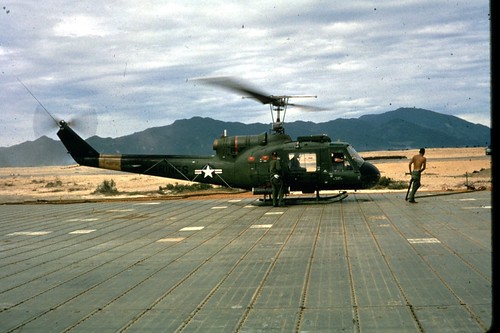
Newly arrived Marine UH-1E ( Huey ) from VMO 6 at Chu Lai, Viet Nam; Sept. 1965
Marine UH-1Es looked like this 1965 example at Chu Lai. By 1967, the yellow warning stripe was removed as well as the US insignia with "Marines" titles in black to reduce their visibility in combat.

It would be a four-man UH-1E flight crew from VMO-6 in 1967 that would become the most decorated flight crew of the Vietnam War. On 19 August 1967, an Army Boeing/Vertol CH-47 Chinook was enroute to Chu Lai AB with a load of injured soldiers. Twenty miles out, the Chinook came under heavy small arms fire from Viet Cong in the area. They set down on a beach where the the Song Tra Khuc River empties into the South China Sea to assess the damage. While several of the crew were outside of the helicopter examining the damage, Viet Cong troops in the area laying in wait opened fire on the helicopter. In a rush, the pilot took off, leaving four crewmen behind on the beach. He radioed immediately on the emergency guard channel that his aircraft was all shot up and he was trying to make for a safer location adding "I still have four men on the ground, the VC are trying to take them prisoner or kill them; God, can somebody help them?"

Captain Stephen Pless was flying an armed UH-1E with the callsign CHERRY SIX on a medevac escort mission when he received the transmission of Americans in immediate danger. Pless discussed the radio call with his copilot, Captain Rupert Fairfield and Pless decided their original mission, escorting the medevac of a single injured Korean Marine, didn't need their escort services and they flew to the location of the trapped men on the beach. Overflying the area, Pless noted that the trapped men were under heavy machine gun and mortar fire. Seeing three jets overhead as well as four Army Hueys orbiting offshore, Pless noted they were all reluctant to move in on account of the heavy fire coming from the VC advancing on the beach. He then asked his crew "How do you feel about going in?" getting a thumbs up from Captain Fairfield and his two crew chiefs, Gunnery Sergeant Leroy Paulson and Lance Corporal John Phelps. 

Stephen Pless was no ordinary Marine officer. He joined the officer corps from the enlisted ranks but he still had great affection for his enlisted men. He frequently socialized with the Marine enlisted at Chu Lai and it's said he spent more time in the enlisted quarters at the base than the officers' quarters. He had several hundred missions under his belt already and some of the Marine crew chiefs had flown secret missions with him into Laos. Pless knew his men would follow him down to that beach with no hesitation and anyone would have done it with Pless as their commanding officer. 

On their initial approach to the trapped men, the first elements of the VC force of about 40 to 50 men were already upon the men, disarming them and hitting them while the rest of the VC moved out from the treeline onto the beach. Since the VC soldiers were too close to use their rockets, Gunnery Sergeant Paulson opened up with M60 machine gun, scattering the VC soldiers. As they ran back for the safety of the treeline, Pless fired white phosphorus-tipped rockets into the mass of fleeing VC. Wheeling the Huey around for several passes, Pless fired more rockets as well his side mounted guns into the treeline, taking heavy small arms fire in the process. On most of his attacks he was less than 50 feet above the ground, in some cases so low that mud thrown up from his own weapons splattered the Huey's windshield. With his rockets nearly expended, Pless then landed his Huey near the trapped men, facing the ocean using his helicopter as a shield between the VC and the trapped men. 

Emblem of VMO-6 "Tomcats"
(Wikipedia)
As several VC tried to approach the helicopter, Lance Corporal Phelps fired his M60 from the left side while Gunnery Sergeant Paulson jumped out and ran to the trapped men- he was able to get the first man aboard as he was still able to walk and Paulson then ran back to the next man while under heavy fire. Captain Fairfield then exited the cockpit to help Paulson with the second man. As he jumped out, Fairfield saw three VC only 10 feet away. He quickly unhooked one of the M60 machine guns and killed all three with a short burst. He then ran to Paulson to help get the second man aboard while Lance Corporal Phelps provided cover fie with his M60. Getting the second man aboard, Fairfield and Paulson then ran for the third man, but he was heavier than the other two- Phelps gave his M60 to the first injured man, Staff Sergeant Lawrence Allen, who was propped up against the back of Pless's seat. He cradled the M60 with his injured arm and continued providing suppressive fire with his good arm. With Fairfield, Paulson, and Phelps carrying the third man to the Huey, a single VC with a hand grenade approached. Phelps dispatched that soldier from ten to fifteen feet away with six shots from his service pistol. Fairfield and Paulson also fired their service pistols as well as they carried the third man to the helicopter. 

With the third man aboard, Fairfield and Paulson ran back for the fourth man but he was already dead. As they jumped back into the Huey, Pless began to takeoff but the three extra men made his helicopter significantly overweight. With the only reasonable avenue of departure being over the ocean as the VC small arms fire intensified, Pless bounced off the waves repeatedly until the helicopter had enough airspeed to climb away from danger. He then had the crew jettison or throw overboard anything that wasn't needed to get to Chu Lai only 20 miles away. Enroute, Paulson and Phelps rendered medical aid to the three injured men. 

Unbeknowst to the crew of CHERRY SIX, one of the Army Hueys Pless observed orbiting offshore made a run in to provide additional covering fire. Flown by Warrant Officer Ronald Redeker, he made multiple strafing runs with his door gunners until their ammunition was exhausted. 

The flight crew of CHERRY SIX: (L-R) Phelps, Pless, Fairfield, and Paulson
(Defense Department/Valor Remembered)
Seven days later, the commanding officer of VMO-6 wrote a letter that passed up through the chain of command to the Secretary of the Navy recommending Captain Stephen Pless for the Congressional Medal of Honor. In the same letter he also recommended Captain Fairfield, Gunnery Sergeant Leroy Paulson, and Lance Corporal John Phelps for the Navy Cross, the second highest award from bravery after the Medal of Honor. The awards were all approved- not only making Captain Stephen Pless the only Marine Corps aviator to earn the Medal of Honor in Vietnam, but also making the entire crew of CHERRY SIX the most decorated flight crew of the Vietnam War. 

Sources: Marine Air: The History of the Flying Leathernecks in Words and Photos by Robert F. Dorr. Penguin Books, 2007. Assault from the Sky: US Marine Corps Helicopter Operations in Vietnam by Dick Camp. Casemate Books, 2013.

19 October 2015

Mike Grimm, Father of the Night Stalkers

Michael Grimm, Father of the Night Stalkers
Conventional wisdom in aviation history points to the tragic debacle at Desert One in Iran during the hostage rescue mission as the watershed moment that culminated in the formation of the US Special Forces Command (SOCOM). While I do think that the story of the failed 1980 Iranian hostage rescue mission should be held near and dear to every military leader of this nation, there was actually someone else who sounded the warning bells three years before that fateful day in 1980. His name is legendary amongst US special forces personnel to this day, but I'd bet hardly any of us enthusiasts had ever heard of his name- Mike Grimm.

Long before he would make his mark on the history of US special forces, Mike Grimm was already a decorated hero of the Vietnam War when as a second lieutenant in 1968, assumed command of his platoon and managed to fight off through the night two entire companies of Vietcong before they could be extracted by helicopter from the battle zone. He stayed on with the US Army after the end of US participation in the war in 1973, eventually becoming a helicopter pilot and stationed in Hawaii in 1975. But serving in Hawaii was boring for Grimm, when the most serious decision they ever had to make was whether he would fly clockwise or counter-clockwise around Oahu. In 1976, the world was electrified with the stunning Israeli raid at Entebbe, Uganda, to rescue the passengers of a hijacked Air France flight. In less than one hour, Israeli commandos stormed the Entebbe Airport, killed nearly all the terrorists, rescued nearly all the hostages and only losing one commando. And they also manged to destroy most of the MiGs of the Ugandan Air Force in the process.

Mike Grimm realized that the United States lacked the capability to do what the Israelis managed to do- project power over 2,000 miles into hostile territory and effect a hostage rescue with minimal losses. Austerity was the key word in the post-Vietnam defense budget and even training exercises were canceled to save money. Once he had become the Divisional operations officer in 1977, he decided to use the Division's entire budget for training on a single exercise. He called it an Emergency Deployment Readiness Exercise (EDRE) and in the training scenario, his men and pilots would have to fly 200 miles to the island of Hawaii where a select group of soldiers playing terrorists were holding hostages. Grimm's men would have rescue those hostages with minimal losses. The tactics he developed for the exercise would be the blueprint for all future missions to come, even to this day.


Men from the First and Fifth Infantry Battalions at Schoefield Barracks on Oahu were selected to be the "raiders." Their helicopter element consisted of 10 Bell UH-1H Hueys and two Bell AH-1G Cobra gunships from A Company of the 25th Aviation Battalion. After an alert and planning period, the men and their helicopters flew from Schoefield Barracks to Hickam AFB to be loaded aboard USAF Lockheed C-141A Starlifters to simulate strategic deployment. The men were flown to Hilo Airport which would function as the "intermediate staging base" for the exercise. On 14 November they arrived in Hilo where the helicopters were readied for flight and they flew onward to Bradshaw AAF in the Pohaku Trainng Area in the center of Hawaii. This would be their "forward operating base" for the mission exercise.

The "hostages" were being held in the fire station of Waimea-Kohala Airport just 30 miles north of their forward operating base. The raid would be carried out at dawn as no night vision equipment was available. At ten miles from the target, the "terrorists" heard the team coming and "executed" the hostages. When Grimm's raiding force landed, they were wiped out to the last man.

The next day at Bradshaw AAF the After Action Review took place and everyone but Mike Grimm thought their Army careers were over when the Division commander, Lieutenant General Willard Scott arrived. He began the debriefing with the statement "This exercise was a really bad idea." As he continued for several minutes on the inappropriateness of using helicopter-borne infantry on anti-terror operations. "Our Army will never enter into this area. This is NOT our role."

At that moment, Mike Grimm stood up and interrupted his commander.

"Respectfully, sir, that is NOT correct." Here he was, a newly minted major, holding a two-star general to task. "Not only do we need to create this capability, sir, but if we don't, we are going to find ourselves at some point in our history embarrassed as a nation!"
Emblem of the 160th SOAR

Three years later, on the morning of 25 April 1980, in the Iranian desert, that embarrassment took place. The wrecks of five Marine RH-53D Sea Stallions and one USAF C-130 Hercules lay smoldering in the desert with the bodies of eight American servicemen. That year Mike Grimm was the commander of A Company of the 229th Aviation Battalion of the 101st Airborne Division where he was working with a handpicked group of men to transform the Hughes OH-6 "Loach" into what would become the MH-6/AH-6 "Little Bird" for night time special forces missions. On the night of 7 October 1981, Mike Grimm was flying one of the unit's MH-6s at low level over the Cumberland River when he hit the side of a power line tower and was killed instantly. One week later, in memorial to Mike Grimm, the new 160th Aviation Battalion uncased its colors. It was the birth of the Army Special Force's aviation element (Special Operations Aviation Regiment, or SOAR), the "Night Stalkers".

Source: The Night Stalkers: Top Secret Missions of the US Army's Special Operations Aviation Regiment by Michael J. Durant and Steven Hartov. GP Putnam and Sons, 2006, p33-64. Photos: US Army, Wikipedia

26 June 2015

The Daring Rescue of a Downed Pilot at the Battle of A Shau Valley

Major Bernard Fisher, first USAF Medal of Honor recipient of the Vietnam War
In 1961 the CIA, in cooperation with the US Army Special Forces teams, began to set up a network of surveillance camps along the borders of South Vietnam to monitor North Vietnamese infiltration of South Vietnam. Located primarily in the remote highlands of South Vietnam, the special forces camps were manned by a mixture of US Army special forces personnel, South Vietnamese special forces personnel, and paramilitary units recruited from the indigenous populations of the area like the Montagnards. By 1962 the US Army assumed full responsibility for the special forces camps. In 1966, one of these special forces camps was the scene of one of the most daring rescues of downed American pilot in the Vietnam War. High up in a remote area of the northwest corner of South Vietnam just two miles from the Laotian border was the special forces camp in the A Shau Valley. If there was a more remote camp that was nearly inaccessible elsewhere in South Vietnam, the A Shau Valley would have given them a run for the money. With steep jungle covered mountains ascending to over 7,000 feet and constant storms during monsoon season, the aerial resupply of the A Shau Valley camp was challenging even under the best of conditions. It had an approximately half-mile long dirt airstrip that sat astride the triangular-shaped fort that served as the special forces base camp. But the camp lay astride three major infiltration routes off the Ho Chi Minh Trail into South Vietnam- one route ran westward from the valley towards the main axis of the Ho Chi Minh Trail and two routes ran eastward towards the city of Hue and the heavily populated areas of the South Vietnamese coast. In early March of that year, two regiments of the North Vietnamese Army set up positions in the mountains above the camp in preparation of an assault. A flak trap was set up in the heights over the camp with 37mm anti-aircraft cannons. On 9 March at 0400, the assault began with a mortar bombardment on the camp with NVA sappers punching holes in the camp's defensive perimeter. An estimated 2,000 NVA soldiers squared off against 360 South Vietnamese and Montagnard soldiers led by 17 US Army Special Forces troops.

Due to poor weather with only 400-foot ceilings (in a valley surrounded by 7,000 foot mountains), the first air support didn't arrive until mid-morning when a USAF AC-47 Spooky gunship arrived over the area in poor weather conditions. On its third pass at low altitude, the NVA flak trap caught the gunship and it crashed into a mountainside. The crew of six survived, but three were rescued thanks to the heroic actions of two of the crew to defend the crash site until they could be rescued. Captain Willard Collins and 1st Lt. Delbert Peterson posthumously earned the Air Force Cross for defending the survivors before they were killed by NVA troops. Two Cessna O-1 Bird Dogs attempted to land on the dirt strip to fly out some casualties, but the heavy enemy fire only allowed them to fly out one wounded special forces soldier. Later that afternoon, the Marines sent two Sikorsky UH-34Ds into the area to evacuate the wounded. One helicopter was shot down but managed to crash land inside the camp perimeter. Its crew was picked up by the other helicopter before it had to withdraw under the thick overcast. That night under cover of darkness a USAF Sikorsky CH-3E managed to land in the camp and fly out 26 causalities. The following morning the NVA pressed their attack against the camp again, managing the penetrate the defensive perimeter. In the pre-dawn darkness, a Marine A-4 Skyhawk two-ship responded and one of the pilots managed to make a low level bombing pass before coming around to strafe the area with the Skyhawk's 20mm cannon. Lt. Augusto Xavier failed to pull out of his strafing run in the limited visibility conditions and crashed into one of the mountains around the camp. He was posthumously awarded the Silver Star. Nearly 200 close air support sorties were mounted that day despite poor weather to keep the camp from falling into NVA hands.

With the arrival of daylight, USAF Major Bernard Fisher (call sign "HOBO 51") from the 1st Air Commando Squadron led a flight of A-1E Skyraiders in 800-foot overcast ceilings to try and assist the defenders of the A Shau Valley camp. Fisher's wingman took 37mm cannon hits to his engine and had to return to base. A second pair of USAF A-1E Skyraiders arrived on scene, led by Major D.W. "Jump" Myers (call sign "SURF 41") from the 602nd Air Commando Squadron. The Skyraiders pressed their attacks as close to the camp as possible to keep the perimeter from falling. Making strafing passes on the NVA troops pushing on the camp perimeter, Myers was hit on his third pass and his Skyraider caught fire. He elected to crash land on the camp's dirt runway and Major Fisher flew along side to give him steering directions as Myers' windscreen got covered in oil when the engine got hit. Myers successfully crash landed his Skyraider on the dirt strip and immediately got out before his Skyraider exploded and took cover in a ditch next to the runway. A team from the camp tried to get to Myers to bring him inside the camp perimeter, but the NVA fire in the area was too heavy to effect a ground rescue. Orbiting above and dodging enemy fire, Fisher directed the other Skyraider pilots' fire to protect Myers and buy time for the inbound rescue helicopter. When he found out a rescue helicopter would take about 20 minutes to reach the area due to the weather conditions, Major Fisher elected to try and land on the strip to rescue Myers himself. 

With debris from the battle as well as Myers' destroyed Skyraider littering the runway, Fisher had to abort his first landing attempt and swung around to land the other direction on the runway. One of the pilots in the area described the scene as like "Flying into Yankee Stadium with everyone in the bleachers firing at you with machine guns!" Fisher managed to land on the runway and in the midst of the heavy fire, taxied back up the runway searching for Myers. Since his Skyraider was the side-by-side two seat version of the A-1, Fisher spotted Myers who sprinted for the aircraft from his hiding place. Fisher had already unharnessed himself thinking that Myers was wounded and needed help when he found the pilot already scrambling up his wing to the cockpit. Fisher grabbed Myers and quite literally threw him into the cockpit headfirst with Myers yelling "You dumb son-of-a-bitch, now neither of us will get out of here!" With Myers scrambling to get himself seated and harnessed into the cockpit, Fisher wheeled the A-1 around and kept the Skyraider in ground effect until he had the speed climb up through the overcast and over the mountains to safety at their base at Pleiku.

Fisher on the left and Myers on the right after the rescue flight
Remember that group of special forces that got pinned down trying to rescue Major Myers? They were able to escape and get back inside the camp perimeter as all the NVA guns that had them pinned down were focused on trying to shoot down Major Fisher's Skyraider.; When his aircraft landed back at its base, the aircraft had 19 holes from ground fire sustained during the rescue flight. Fisher was unlikely Skyraider pilot- he served in World War II as a sailor and on return to the United States, joined the ROTC while in college. He only finished three years at the University of Utah before he was commissioned to fly for the USAF. He had earned his wings flying Convair F-102 Delta Daggers in Europe and Lockheed F-104 Starfighters for the Air Defense Command stateside. He volunteered for combat duty in Vietnam, getting assigned to fly Skyraiders with the 1st Air Commando Squadron at Pleiku. At the time of his epic rescue flight, he had been flying combat missions in the A-1 for eight months. The day prior to his rescue of Major Myers, he earned a Silver Star flying combat missions over the same special forces camp in the A Shau Valley! 

On 19 January 1967, he was awarded the Congressional Medal of Honor for his rescue of Major Myers. This is the citation: 
For conspicuous gallantry and intrepidity at the risk of his life above and beyond the call of duty. On that date, the special forces camp at A Shau was under attack by 2,000 North Vietnamese Army regulars. Hostile troops had positioned themselves between the airstrip and the camp. Other hostile troops had surrounded the camp and were continuously raking it with automatic weapons fire from the surrounding hills. The tops of the 1,500-foot hills were obscured by an 800 foot ceiling, limiting aircraft maneuverability and forcing pilots to operate within range of hostile gun positions, which often were able to fire down on the attacking aircraft. During the battle, Maj. Fisher observed a fellow airman crash land on the battle-torn airstrip. In the belief that the downed pilot was seriously injured and in imminent danger of capture, Maj. Fisher announced his intention to land on the airstrip to effect a rescue. Although aware of the extreme danger and likely failure of such an attempt, he elected to continue. Directing his own air cover, he landed his aircraft and taxied almost the full length of the runway, which was littered with battle debris and parts of an exploded aircraft. While effecting a successful rescue of the downed pilot, heavy ground fire was observed, with 19 bullets striking his aircraft. In the face of the withering ground fire, he applied power and gained enough speed to lift-off at the overrun of the airstrip. Maj. Fisher's profound concern for his fellow airman, and at the risk of his life above and beyond the call of duty are in the highest traditions of the U.S. Air Force and reflect great credit upon himself and the Armed Forces of his country.
Fisher was the first USAF Medal of Honor recipient of the Vietnam War. He finished his tour in Vietnam on the Skyraider with 200 combat missions. His unit, the 1st Air Commando Squadron, had a 40% casualty rate amongst its pilots as they did a lot of low level close air support flying in support of the special forces camps in some of the most inhospitable parts of South Vietnam. He returned to the Air Defense Command until his retirement as a colonel in 1974, having flown the McDonnell F-101B Voodoo. He took up corn and alfalfa farming with his wife in rural Idaho. Every year since his rescue, each March 10th, D.W. Myers called Bernard Fisher to wish him well until Myers died in 1992. Myers' daughter kept up the ritual for another 22 years, calling Fisher on March 10th herself to wish him well. In 2008, the University of Utah awarded a diploma to Bernard Fisher 57 years after he was last a student there in recognition for his achievements and decorated military career. In 2010, the Boise Rescue Mission was established as a homeless veterans' transitional program with Fisher's help and its motto is Fisher's quote after he rescued Myers: "When a man is down, you don't leave him there." Colonel Bernard Francis Fisher flew west on 16 August 2014.

Fisher's A-1E Skyraider at the USAF Museum
You can see Bernard Fisher's A-1E Skyraider today as it has been restored and wears the colors and markings as it looked on the day of his Medal of Honor Mission at the National Museum of the United States Air Force in Dayton, Ohio.

As for the fate of the special forces camp in the A Shau Valley after Fisher's rescue flight? By late afternoon on 10 March 1966, the decision was made to evacuate and abandon the A Shau Valley camp. Sixteen UH-34D helicopters along with six UH-1Es, all from the Marine units HMM-163 and VMO-2 respectively, flew into the valley with 200-foot overcast for the evacuation. Two helicopters were shot down but their crews managed to lead groups of camp soldiers out of the area on foot, evading the NVA units that were closing in on the camp. The NVA flak trap was so intense that three Marine F-4B Phantoms, two A-4 Skyhawks, two UH-1s and three more UH-34D sustained damage. The following morning a second evacuation flight managed to get the rest of the personnel out of the camp. The Marine helicopter squadron HMM-163 needed to have 21 of its 24 UH-34Ds replaced. Interestingly, one of the UH-1s involved in the evacuation of the rest of the personnel from the special forces camp was flown by Brigadier General Marion Carl of the US Marine Corps. Carl was the Marines' first ace of the Second World War and before Vietnam he was a decorated test pilot. Despite his rank as the commander of the 1st Marine Brigade in Vietnam, he often flew combat missions in both helicopters and jet fighters much to the chagrin of his superiors!

Sources: Above and Beyond: The Aviation Medals of Honor by Barrett Tillman. Smithsonian Institution Press, 2002, pp 218-221. Assault from the Sky: US Marine Corps Helicopter Operations in Vietnam by Dick Camp. Casemate Publishers, 2013, pp 64-79. Photos: USAF Museum

17 March 2011

The Bell 207 Sioux Scout- Grand Daddy of the Gunship

The Bell D-245 Warrior set the pattern for gunship designs
With the turbine-powered Bell UH-1 Iroquois "Huey" utility helicopter offering a quantum leap in capability for the US Army over previous, cumbersome, piston-driven rotorcraft, it was a natural progression that the UH-1s would be armed for aerial fires support for the growing conflict in Vietnam. But Bell's engineers in Fort Worth were steps ahead of the military with studies as early as 1958 for a tandem-seat purpose-built helicopter gunship that used the transmission and engine systems of what would become the UH-1. Bell's first offering had the in-house designation D-245 and was named "Warrior" which laid down the standard layout of gunships that followed- a slim fuselage with tandem seating for a pilot and gunner, stub wings for weapons, and nose-mounted gun turret. But despite its potential, the Army had yet to determine operational doctrines for the use of attack helicopters and the D-245 Warrior was quietly shelved. 

Despite official disinterest from the US Army, Bell decided to embark on internally-funded development to further refine the D-245 Warrior design. In June 1962 Bell unveiled the D-255 Iroquois Warrior to the Army at its Fort Worth facility. The D-255 was a bit larger than the earlier D-245 but retained the tandem seating for pilot and gunner in stepped layout with the pilot sitting behind and higher than the gunner in the forward seat. Again, the tail boom, rotor transmission and engines were adapted from the UH-1. While the mixed reaction from the US Army was an improvement over the official disinterest that the earlier D-245 design elicited, it still wasn't enough to get a production contract from the Army. Again the D-255 was quietly shelved, but this still wasn't going to discourage the Bell team from staying ahead of the game. In December 1962 a brainstorming session of the engineering team resulted in a decision to build a flying demonstrator to prove the US Army what Bell's gunship concept could accomplish. 

The Sioux Scout was quite small for a two-seat gunship
Designated the Model 207 and named the Sioux Scout, the demonstrator combined the engine, rotor, and drive systems of the proven Bell OH-13 Sioux (the bubble-cockpit helicopter made famous in the introduction to the TV series M*A*S*H) with its civilian counterpart, the Bell 47. The six-cylinder Lycoming 435 engine of the OH-13/Bell 47 was supercharged to deliver 220 horsepower driving the main rotor system from the OH-13 and the tail rotor/tail boom of the Bell 47. An all-new slim fuselage was created that used box beams to create a rigid structure to which were attached the stub wings that could carry external stores on six hardpoints on each side as well as house an additional 43 gallons of fuel which gave the Sioux Scout a range of 200 miles. At high speeds, the stub wings helped offload the main rotor as well. An Emerson Electric TAT-101 gun turret was installed under the nose (the rigid fuselage structure dampened recoil) housing twin 7.62mm machine guns that were adaptations of the M60 gun. With 1,100 rounds of ammunition, the gunner in the forward seat used a pioneering hand controller to operate the gun turret 100 degrees side to side, 15 degress upward, and 45 degrees downward. Under each stub wing were six round, 2.75 inch rocket launchers on each hardpoint. 

The gunner had an outstanding field of view from the front seat
The Sioux Scout made its first flight from Bell's Fort Worth facility in Hurst on 27 June 1963, in the process becoming the first pure gunship in the world to take flight. Since the demonstrator program was somewhat secret, the helicopter was painted red and white to not so blatantly give away its military purpose. After several weeks of testing with Bell that added up to 65 flight hours, the Sioux Scout was repainted in more Army-like olive drab and began a series of weapons tests at Fort Sill, Oklahoma, northwest of Fort Worth. In November of that year, the Sioux Scout was taken on the road, touring Army bases and being flown by both Army and even NASA test pilots with over 300 flight hours that included firing over 83,000 rounds of ammunition from the chin turret. Finally, in 1964, B Troop, 3rd Squadron, 17th Cavalry of the 11th Air Assault Division spent a month flying the Sioux Scout in operational conditions and in field exercises. At the time, the 11th Air Assault Division was tasked by the Army commanders with experimenting and creating operational doctrines in helicopter assault at Fort Benning, Georgia. 

The Model 209 prototype had retractable landing skids
Other than the Sioux Scout being underpowered and the reliability of the experimental gun turret being less than ideal, Army evaluators were overwhelmingly pleased with the outcome of the 11th Air Assault Division's operational evaluation of the demonstrator. The recommendation was issued that a turbine-powered, more capable version be developed as quickly as possible for operational use. In late 1964 the Secretary of the Army created the Advanced Aerial Fire Support System (AAFSS) with invitations to industry to submit designs. With the quick realization that the AAFSS design would take time to field, the Army decided that an interim design was needed that would field the gap until the AAFSS became operational. Bell dusted off its D-255 Iroquois Warrior design and with further refinements based on the Sioux Scout evaluation, designated it the D-262. However, in 1965 the Army rejected the D-262 design. But, as Bell had done before, they quietly went about refining the design further on company funds- within several months of the rejection of the D-262, the situation in Vietnam worsened and the US commander in Vietnam, General William Westmoreland, advised the Pentagon that either the AAFSS needed to fielded quickly or some interim design was needed as soon as possible. In March 1965 Bell just happened to finish the full-scale mockup of its refined gunship designated the Model 209 and "leaked" to Army commanders what it was up to. Before long, the Army issued a formal requirement for an interim design. Beating out submissions from Sikorsky, Kaman, Piasecki and Boeing Vertol, the Model 209 was selected on 11 March 1966 for production as the AH-1 Cobra.

And the AAFSS? That became the Lockheed AH-56 Cheyenne and was a classic case of wanting too much out of a design. It ended up getting cancelled in August 1972. That same month, the Army created the Advanced Attack Helicopter program (AAH) which became the AH-64 Apache. And what become of the Sioux Scout? The grand daddy of gunships can be seen today in the Army Aviation Museum in Fort Rucker, Alabama. And of course, Bell's interim design is still in production today for the US Marine Corps as the AH-1Z Viper.

Source: Helicopter Gunships: Deadly Combat Weapon Systems by Wayne Mutza. Specialty Press, 2010, p56-60. Images from aviatstar.org

29 May 2009

The Air Force Space Command was formed in September 1982 initially responsible for space monitoring and space-related activities connected with the defense of the United States and Canada. In 1993 the ICBM force passed from the Air Combat Command to the Space Command and since then AFSPC has been responsible for the ICBM nuclear deterrent force, the early warning of ballistic missile launches, the launch and operation of military satellites (including the GPS constellation) and worldwide space surveillance.

But the only manned aircraft assigned to the Air Force Space Command are approximately 26 Bell UH-1Ns assigned to three Flights to fly launch crews to ICBM missile silos and transport security teams to ICBM sites. The three Flights are based at three Air Force bases of the 20th Air Force, the operating AF for the ICBM force- Francis E. Warren AFB, Wyoming (tail code "FE"), Minot AFB, North Dakota ("MT"), and Malmstrom AFB, Montana ("MT"). A fourth Flight of UH-1s is based at Vandenberg AFB ("HV") to support missile and space launch activities.

Source: US Air Force: The New Century by Bob Archer. Midland Publishing, 2000, p29.

29 April 2009

When the Bell AH-1 Cobra gunship was being developed, the Army's intent was to name the aircraft after an American Indian tribe as had been its long tradition. However, at the time of the development of the Cobra gunship, the Department of Defense was in a legal battle with Piper Aircraft who also named their aircraft after American Indian tribes.

In Vietnam, UH-1 "Hueys" were called "Slicks" if they were operating unarmed, "Hogs" if they were armed with rockets, and "Cobras" if they were armed with guns. As Bell's main pitch for the procurement for the AH-1 was that it was a low-risk development of the UH-1 Iroquois (to some degree true given that the original gunship proposal was called the Iroquois Warrior and had more in common with the UH-1 than the final AH-1 design), the AH-1 got named "Huey Cobra".

Source: New Vanguard: Huey Cobra Gunships by Chris Bishop. Osprey Publishing, 2006, p6-7.