Showing posts with label Glenn Martin. Show all posts

03 January 2016

Martin, the Titan I, and the Titan II Ballistic Missiles

Titan I ICBM elevated out of its silo for laugh
(USAF Museum)
When George M. Bunker took over the reins of Martin Aircraft from Glenn Martin in 1952, Bunker wanted to diversify Martin which up to that point had produced only aircraft. With an able group of lead engineers that Glenn Martin had literally hand picked in the years prior to his retirement from his company, Bunker moved some of Martin's engineering and research efforts into the rocket and missile arena that bore first fruit with the Viking research rocket and the Vanguard light satellite launcher built for the Navy. While many in the growing rocket and missile division were focusing their efforts on the Vanguard program, it was Jess Sweetser, Martin's VP for Sales and Requirements, who pushed the company to bid for the second USAF ICBM contract. At the time, General Bernard Schriever was heading the Western Development Division (WDD) in Los Angeles which directed the ICBM effort that started off with the Atlas ICBM built by Convair. Schriever wanted a second ICBM system fielded as a backup to the Atlas and the WDD issued a requirement that spelled out the range, guidance and throw weight (the payload of the missile, which was the nuclear warhead). Left up to the contractors would be the missile configuration, liquid vs. solid propellants, staging and number of engines.

Sweetser got to know General Schriever so well they became golfing buddies* in their free time and as a result, he was able to anticipate the need for a second ICBM program from his conversations with the general. As a result, when the WDD issued the requirement, Martin's team of engineers was already doing preliminary work in addition to their work on the Vanguard launcher for the Navy. It became clear from further directions from the Western Development Division as well as the operator of the ICBMs, the Strategic Air Command, that not just a backup ICBM was wanted, but one that was a true alternative to the Atlas ICBM and if possible, more advanced. With both Boeing and Lockheed in the competition for the alternative ICBM contract, George Bunker split the rocket and missiles team into two parts- one group stayed on the East Coast and worked on the Vanguard launcher, the other group set up shop in Los Angeles next to the WDD to work on their ICBM design. Martin's design was based on work that had been already done for the Vanguard launcher- instead of the thin, pressurized balloon skin arrangement used on the Atlas, the Martin proposal used two liquid propellant stages made of a rigid framework of copper-aluminum alloy with the tank wall integral to the rocket walls for weight savings as had been done on the Vanguard. The first stage would use two powerful 150,000 lb thrust engines and the second stage used a single 80,000 lb thrust engine that would be ignited in zero-gravity in near-space, a first for such a large engine. The Vanguard had proved that near-space ignition of the second stage was possible, but this would be the first large-scale application. 

In addition, Martin's ICBM design would be modular, allowing the design to be enlarged over time for heavier payloads. The sweetener of the proposal that would win the USAF contract for Martin in December 1955 was the creation of an all-new development, testing, and production facility in one location at the base of the Rocky Mountains in Littleton, Colorado. This was chosen for two reasons- first, the valleys in some of the mountains could house engine test stands with the mountains acting as natural sound insulators for the surrounding area, and secondly, Martin pointed out that a mid-continent facility was furthest away from the coasts which could be vulnerable to Soviet submarine missile launches and bomber attacks. Ground was broken on the Littleton facility outside of Denver in February 1956 for the missile that the USAF christened the Titan. As a result of the USAF's requirement that everything that went into the Titan missile be thoroughly tested, the first facilities built were the test stands, some of which replicated full size launch pads were complete Titan missiles could be tested. 

Just three years after the start of construction on the facility itself, the first Titan I missile was flight tested from Cape Canaveral on 6 February 1959. The second, third, and fourth test flight were a success, unprecedented in a new rocket or missile program. The fifth and sixth flights were failures with explosions on the launch pad, but the seventh flight was a success and by 1960 Martin had 11 more successful Titan I test flights. Out of 18 test flights, only two Titan I test flights failed, a success rate that was stunning and groundbreaking given the technology of the time. 

Titan I 3x3 ICBM base layout
(USAF Museum)
The first Titan I silos were built in 1959 in the Lowry AFB gunnery range just east of Denver. The first Titan I ICBMs went on nuclear alert on schedule in August 1962 at Lowry AFB. As the Titan I used liquid oxygen as an oxidizer, the missiles were kept the silos until the launch order was given. At this point a massive elevator lifted the Titan I out its silo to an above ground position where it was fueled for launch. All of the necessary facilities were deep underground, even the propellant storage tanks. Each ICBM squadron had nine Titan Is in groups of three. Each group of three missiles were part of a single launch complex. Once the missiles were fueled, the radio guidance domes also were elevated from their own silos. The radio guidance system tracked the missiles after launch and fed the necessary course corrections, much like the guidance system used on the Atlas ICBMs. 

With advances in Soviet ICBMs, though, while the Titan I flight test program was taking place, Martin's engineers were already working on a successor, Titan II. Titan II had an even bigger warhead and the modularity of the Titan design paid off as the engineers merely had to fatten the second stage to the same diameter as the first stage and then lengthened both stages for a bigger missile. To replace the radio guidance system on the Titan I, AC Delco and MIT created a new inertial guidance system that set the standard for ICBMs. No longer would radio signals from the launch site be necessary, minimizing the Titan II's vulnerability to a counterstrike. The liquid oxygen was also replaced as the oxidizer and Titan II now had non-cryogenic storable liquid propellants- Aerozine-50, which was a mix of hydrazine and unsymmetrical dimethylhydrazine (UDMH) and dinitrogen tetroxide as the oxidizer. As a result, no fueling process was needed. 

Titan II silo "hot launch"
(USAF Museum)
The simplification of the Titan II launch complexes compared to the Titan I was dramatic. Major underground structures dropped from 42 to just 18 structures, 6,000 feet of service tunnels were reduced to just 945 feet, the power requirements dropped from 12,000 kilowatts per squadron to just 2,700 kilowatts. Only half the wiring connections were needed and the need for periodic checkout of missile systems dropped by an astounding 90%.  As a result, the silos could be more widely dispersed. With a formal contract awarded in 1960, the Titan II flight test program went smoothly- of 33 test launches, 25 were successful- in fact, the last 13 test launches were so successful and reliable, the Titan II was selected by NASA to be the launcher for Project Gemini. 

With this reliability came the need to solve the basing issue. The Titan I was housed in silos, but it was lifted out of the silo for launch. Martin's engineers argued that it was possible to launch the Titan II right out of its silo, dramatically reducing its response time. Significant debate ensued about the feasibility let alone the safety of launching the 110-foot Titan II with its 430,000 lbs of first stage thrust right out of a silo. On 19 February 1963, a test Titan I was successfully launched from a Titan II test silo at Vandenberg AFB in California, validating the concept so clearly that the USAF had Boeing incorporate silo-launch on its Minuteman ICBM. The first Titan II missiles went on nuclear alert in 1963 just one year after the first Titan I missiles went on alert! 

The Titan I missile squadrons were operational from 1962 to 1965 at Lowry AFB in Colorado, Ellsworth AFB in South Dakota, Beale AFB in California, Larson AFB in Washington, and Mountain Home AFB in Idaho. Only Lowry AFB was home to two Titan I missile squadrons while the other bases only hosted a single squadrons. The Titan II missile squadrons were grouped three squadrons to a missile wing and were operational from 1963 to 1987 at McConnell AFB in Kansas, Little Rock AFB in Arkansas, and Davis-Monthan AFB in Arizona. The modularity of the Titan design, though, made it a versatile heavy-lift space launcher. Not only did the Titan II launch the manned Gemini missions, but it was also used as a satellite launcher until 2003. Titan III and Titan IV were exclusively space launchers, with the last Titan IV launch in 2005. In 1995, when Lockheed merged with Martin Marietta, the Colorado facility became part of the Lockheed Space and Missiles Division. Since the retirement of the Titan IV launcher, the Littleton facility is now the headquarters of United Launch Alliance, the joint venture of Lockheed Martin and Boeing for the Delta and Atlas launch vehicles. Although no production takes place there any longer, ULA still has its mission control, testing and engineering facilities at the same location that was the birthplace of the Titan missile when ground was broken over fifty years ago.

Historical tangent: 

I had mentioned above how Martin Aircraft's VP for Sales and Requirements Jess Sweetser, had become a golfing buddy of USAF General Bernard Schriever. Before he came to work for Martin Aircraft, Jess Sweetser was a championship golfer in the 1920s. While a student at Yale, Sweetser had won the National Intercollegiate Championship in 1920, placed 11th at the US Open the following year despite his youth, and won the Metropolitan Championship  in 1922 in his junior year at Yale. He then won the US Amateur Championship that same year and then became the first American to win the British Amateur Championship in 1926 despite having the flu. He played on the first Walker Cup team (a trophy for amateur golfers in the United States, Great Britain and Ireland) in 1922 and five more teams in years following. After graduation from Yale, he worked as a stockbroker and played golf on weekends. His first job in aviation was with Curtiss-Wright before he came to Martin Aircraft. 

Source: Raise Heaven and Earth: The Story of Martin Marietta People and Their Pioneering Achievements by William B. Harwood. Simon and Schuster, 1993, p299-325

08 November 2015

Arthur Young Gets Bell into the Helicopter Business

Lawrence Bell, founder of Bell Aircraft
(Airport Journals.com)
In his book The Bell Helicopter Textron Story, David Brown says of Larry Bell, the founder of Bell Aircraft, "Larry Bell was different. With the visionary's eye, he saw his first helicopter and was impressed. When he saw his second (helicopter), he understood that here was an industry waiting to be born." Larry Bell was one of the early American aviation pioneers- after high school he worked as his older brother Grover's mechanic for several years while his brother conducted barnstorming flights. In 1913, his brother was fatally injured in a crash and Bell resolved to stay away from aviation. It wouldn't last, though. He first went to work for his brother's flight instructor, Glenn L. Martin, as a stockroom clerk in Martin's fledgling aviation company. He advanced quickly through the company and ultimately ended up as the Martin Aircraft vice-president and general manager. It was Bell who hired the first college-educated aeronautical engineer for the company- a young MIT graduate named Donald Douglas. It was Bell who got the Army interested in a heavy bomber called the Martin MB-2 that was one of Douglas' early projects. And it was Bell who convinced a brash Army aviator named Billy Mitchell to use the MB-2 to prove that bombers could sink battleships. In 1925, Bell asked to own stock in Martin but Glenn Martin rebuffed his offer of part ownership of the company. Bell resigned and within three years was hired by Rueben Fleet, the president of Consolidated Aircraft. Fleet allowed Bell to own a sizable portion of Consolidated shares and by 1929 he was promoted by Fleet to be the general manager of Consolidated. In 1935, Fleet wanted to move Consolidated from Buffalo, New York, to southern California to take advantage of the better flying weather. Bell didn't want to move, so he resigned but a group of investors backed him in purchasing Consolidated's facilities in Buffalo for the new Bell Aircraft Company. Interestingly, Bell was the third tenant of the factory- it was originally built in 1916 for Glenn Curtiss and at the time was considered the largest aircraft factory in the world. 

Bell's first aircraft was the YFM-1 Airacuda (Bell Model 1) which was a heavy bomber destroyer twin engined fighter. Only thirteen of the unique pusher twins were built and only a single squadron of Airacudas was activated as it was an aircraft ahead of its time. But the US Army Air Corps liked Bell's innovative thinking and asked him for a heavily-armed single engined fighter and this became the Bell Model 12, better known as the P-39 Airacobra which first flew in 1938. It was a remarkable start for Bell's fledgling company and in 1938, President Franklin D. Roosevelt asked Bell to join a group of American industrialists who had been invited tour Nazi Germany. Roosevelt wanted an expert opinion of Germany industrial capacity from the group and Bell was asked to join to assess the Nazi's aviation capabilities. Bell witnessed a flight demonstration of the Focke-Wulf Fw 61 helicopter flown by Hanna Reitsch and he considered the most impressive thing he'd seen on his tour of Germany. 

That was the first helicopter Larry Bell saw- to get to the second helicopter he saw in 1941, we have to step back a bit to look at the story of a unique inventor named Arthur Young. A native of Pennsylvania, while a student at Princeton University, Young was very interested in philosophy and tried to develop an original line of philosophical thought but was unsuccessful. He decided that he wouldn't be able to do so without some real-world experience solving problems. Graduating from Princeton in 1927 with a mathematics degree, Young searched for a technical challenge. He scoured city libraries in the East Coast and made regular visits to the US Patent Office in Washington in his search. He came across a book in his searches by German helicopter pioneer Anton Flettner who had invented a ship that used the Magnus effect from rotary drums to sail across the Atlantic. Flettner had described improving windmill efficiency by using small propellers at the tips. Young thought Flettner's concept could be applied to aircraft and of course that aircraft would be the helicopter, one of the unique flying machines of the day. He set himself on the task of developing a successful helicopter. 

Arthur Young and one of his late helicopter models
(State Archives of Florida, Steinmetz Collection)
Young set up an experimental workshop in a barn on his wealthy family's large estate in Pennsylvania. He refined his ideas using small models and his first design flew in 1931 using parts he obtained from a local toy shop- using rubber bands, hand-carved wooden blades with propellers at the tips and a balsa structure, his first model had a rotor diameter of six feet and it flew for only ten seconds. For the next nine years he worked at improving the Flettner concept, moving to the use of electric motors. He went through so many crashed models he literally learned how to mass produce his own helicopter blades. One of the problems Young encountered was getting his models into a stable hover. Over time he used his mathematics background to calculate stresses and build his own components based on his stress calculations. In doing so, he developed many of the concepts and tools used to measure rotor lift, propeller efficiency as well as equations to calculate a variety of power requirements for helicopters. 

In 1938, Young attended a conference of helicopter designers and learned of the pioneering work of Igor Sikorsky. Sikorsky himself gave a lecture on the use of a tail rotor to counter the torque of the main rotor. Young was fascinated by Sikorsky's lecture and set about to revise his model testbeds with tail rotors, disposing of the complex gearing that he had been working on to drive tip propellers. Stability in a hover continued to plague his efforts- he had tried a pendulum within the fuselage, but the pendulum arrangement he designed couldn't distinguish between the force of gravity and the force of acceleration. He then came up with the stabilizer bar- a bar with weights on the end that was perpendicular to the rotor. The weighted bar when spinning acted as a gyroscope that stabilized the helicopter in a hover. He used an electrical control system that ran to a box where he controlled the helicopter with extreme precision. He took his models on demonstrations to various aircraft companies where he showed how he could fly his helicopter models indoors and even in and out of doorways. He even gave a demonstration to the Army's aeronautical development center at Wright Field in Dayton, Ohio, but failed to find any financial backers. 

Dr. John Sharp was a physician who had seen one of Arthur Young's demonstrations. Sharp had a unique hobby in that he designed gearing systems in his free time and was working on a new gearing concept for a variable pitch propeller was pitching his ideas to Bell Aircraft. In 1941, Sharp was meeting with a Bell engineer named Jack Strickler and in casual conversation, Sharp spoke highly of Young's helicopter flight demonstrations. Strickler than passed on what Sharp told him to Larry Bell himself. Since Bell was impressed with what he had seen with the Focke-Wulf Fw 61 helicopter in his 1938 tour of Germany, he invited Arthur Young to come to Buffalo to give a demonstration of his helicopter design.

On 3 September 1941, Young arrived at Bell's Buffalo plant and was taken to a hangar where P-39s were prepared for delivery. Bell ordered the personnel in the hanger to stop work and move the P-39s outside to give Young room for his demonstration. Not only did Young fly a successful demonstration for Larry Bell, he also reviewed with Bell films showing his previous design efforts and showed him his notes on the design process he had developed to solve the problems of vertical flight. Bell was enthralled by Arthur Young and wanted to hear Young's ideas on a full-size piloted helicopter design. In a matter of weeks they reached an agreement where Young would come to Buffalo and work for Bell in developing a new helicopter based on his designs. Young assigned his patents to Bell Aircraft and Larry Bell funded the development of two full-sized helicopters. Young wanted two aircraft in case one crashed and Bell insisted that the second prototype be a two-seater so he could go on a ride! 

The rest, as they say, was history! That first helicopter, the Bell Model 30, will be the subject of a future article here at Tails Through Time. Stay tuned!

BONUS: A three part interview with Arthur Young in his later years about his design efforts


Sources: The Bell Helicopter Textron Story: Changing the Way the World Flies by David A. Brown. Aerofax Publications, 1995, pp 1-19. "Arthur Young: Maker of Bell, Part 1" by Robert Tipton, http://www.arthuryoung.com/maker1.html. 

04 October 2015

Birth of a Breed: The Development of the Douglas DC-1

The Douglas DC-1 at its 1933 handover to TWA
(San Diego Air and Space Museum Archives)
The crash of a TWA (Transcontinental & Western Air) Flight 599 on 31 March 1931 served as a major catalyst in the airline industry for adoption of all-metal aircraft. The Fokker F.10 was on a scheduled flight from Kansas City to Los Angeles when it encountered turbulence on its first leg between Kansas City and Wichita. As the Fokker F.10 airline had wings of wood laminate, accumulated moisture had caused a weakening of the glue used which led to delamination and structural failure. Aboard Flight 599 was the famed Notre Dame head football coach Knute Rockne, who along with five other passengers and two crew, were lost in the crash when the aircraft went down between the rural Kansas towns of Bazaar and Matfield Green. As a result of the crash, the Bureau of Air Commerce required operators of aircraft with wood wing structures to undergo frequent inspections- as this was economically unfeasible for most operators, all-metal designs were procured as soon as possible. TWA nearly shut down for good while its Fokker fleet was grounded for  inspections. Most of the types that were procured were interim types- but in 8 February 1933, a new airliner made its first flight that was a quantum leap over anything that had proceeded it, and that was the Boeing 247 which entered service with United Air Lines just fifty days later. All metal with a retractable undercarriage, the Boeing 247 was sleek and much faster than anything that had flown passenger services up to that point. Even the most current designs were instantly obsolete- for example, the Curtiss Condor biplane airliner had entered service with Eastern Air Lines and American Airlines just five weeks before United put its Boeing 247s into service. 

United's main rival on the transcontinental market was TWA- the Boeing 247 could now make the east to west transcontinental run in only 21 hours 30 minutes including technical stops. By comparison, TWA's Fokkers took 28 hours 43 minutes to fly from New York to Los Angeles. When TWA learned of United's order for the Boeing 247, he contacted Boeing about ordering the aircraft for TWA, but at the time, United and Boeing were part of the same holding company, United Aircraft and Transport Corporation and Boeing was contractually bound to deliver 60 Boeing 247s to United before it could supply airframes to other customers. TWA's vice president for operations, Jack Frye, wasted little time in sending a letter to other aircraft manufacturers soliciting interest in building at least 60 three-engined airliners for the airline. That letter went to Consolidated Aircraft, Curtiss-Wright, Douglas Aircraft, General Aviation Manufacturing, Stout (Ford) Aircraft, and Glenn Martin Aircraft. The letter included general performance specifications that any design had to meet: 

Jack Frye of TWA
(FindAGrave.com)

1. All metal, trimotor preferred, combination structures and biplane would be considered, but the internal structure had to be metal. 
2. Thee engines of 500-550 hp. 
3. Maximum gross weight of 14,200 lbs. 
4. Weight allowance for radio and mail carriage of 350 lbs. 
5. Weight allowance for full instrumentation, including night flying, fuel to fly 1,080 miles at 150 mph, crew of two, at least 12 passengers in comfort. Payload had to be at least 2,500 lbs with full equipment and fuel for maximum range. 
6. Minimum top speed of 185 mph, cruising speed at least 146 mph. Landing speed not to exceed 65 mph, rate of climb at least 1,200 feet/min, minimum service ceiling of 21,000 feet and a minimum service ceiling with one engine out of 10,000 feet. 


The specifications page also emphasized that any design, fully loaded, "must make satisfactory take-offs under good control at any TWA airport on any combination of two engines." This landmark letter from Jack Frye is considered the "birth certificate" of the DC-1. When Donald Douglas received the letter in Santa Monica, he immediately convened a meeting with his top heads- James "Dutch" Kindelberger (of P-51 Mustang fame) who was his chief engineer, Arthur Raymond who was the deputy to Kindelberger, and Harry Wetzel, the Douglas Santa Monica plant director. With the United States in the midst of the Great Depression, it didn't take long for them to decide this was a tremendous business opportunity for the company. Just ten days after Jack Frye sent his letter of proposal, Douglas dispatched Arthur Raymond and Harry Wetzel with a ten-person team by transcontinental train to New York to meet with TWA. The Douglas team by this point had moved quickly and concluded that even though TWA was leaning towards a three engined design, they would offer a twin engined design that would be equal if not superior to TWA's specifications. The design would be an all-metal monoplane with a retractable undercarriage that would have passenger comfort as a priority. With Kindelberger supervising the design work in California and telephoning design details to Raymond and Wetzel as they were enroute to New York, the design was refined as the team prepared for its presentation to the TWA evaluation team which consisted of Jack Frye, Richard Robbins, president of TWA, and Charles Lindbergh, the airline's technical consultant. Also present were the teams from four other aircraft manufacturers, all of whom tendered three-engined designs. 

Having prior flying experience with other Douglas designs, Frye was favorable to the Douglas proposal, but Lindbergh had his doubts that a twin engined design could meet the airline's stringent specifications. Lindbergh in particular was concerned about single-engined performance at TWA's hot and high airports in the southwestern United States. The Douglas team in consultation with the engineerings staff in California rechecked their calculations repeatedly to be sure that their design could take off with a single engine from any of TWA's airports. With considerable trepidation, Douglas instructed his team meeting with TWA that he would agree to a contract provision guaranteeing this particular specification to satisfy Lindbergh's concerns. On 20 September 1932, TWA signed a contract for the first Douglas DC-1 for $125,000 (about $2 million of today's dollars) with options for 60 more aircraft based on the flight tests and performance of the DC-1. As an insurance policy against a possible failure of the DC-1, General Motors, which owned TWA, had its General Aviation Manufacturing subsidiary work on the GA-38X which was a three-engined larger derivative of the smaller single engined GA-43 airliner. Construction had started on the prototype, but work ceased early on when it became clear the DC-1 would be successful. 

Arthur E. Raymond, chief designer for the Douglas DC-1
(General Aviation News)
With a signed contract in hand, Donald Douglas assigned Arthur Raymond as the DC-1 project manager. Assisting him would be the legendary Jack Northrop, who was at the time managing the Douglas El Segundo division and would be managing the structural design of the DC-1. Other able Douglas engineers were put in charge of various systems and components for the DC-1. In addition and a first for a transport aircraft, extensive wind tunnel testing at Cal Tech's facilities in Pasadena, California, would be an integral part of the design and development process. Cal Tech's aeronautical faculty would head this effort to uncover as many issues as possible before any metal got cut for the prototype- it was wind tunnel testing that found the planned wing design was unstable and further wind tunnel testing at Cal Tech showed that sweeping the wing leading edge back addressed the stability issue. This was how the DC-1 and later DC-2 and DC-3 got their unique wing shape. 

With passenger comfort a priority, it was decided that the benchmark would be the interior noise of a Pullman rail car. The DC-1 cabin had to have the same level of noise or less. As the design effort proceeded, the early specifications for the Boeing 247 were published in Popular Mechanics and Arthur Raymond had copies of the article posted everywhere with the admonition "Do Better than Boeing!" It was vital at every step of the design process that the DC-1 be more comfortable than the Boeing 247 and an important design step was Northrop's wing design that would fit at the bottom of the fuselage without intruding into the cabin as was the case with the Boeing 247. Northrop's wing center section was relatively flat with the engine nacelles at the ends, outboard of which the outer wing panels were attached with the needed dihedral for stability. In a unique feature of the day, the passenger seats could also be reclined. Heating, ventilation, and the aforementioned soundproofing efforts were as considerable as any aircraft system to meet Douglas's desire for the DC-1 to be comfortable. The aisle width was a then-generous 16 inches (Americans in those days were nowhere near as obese as they are now) with a cabin height of 6 feet 4 inches. This would lay down the reputation of Douglas aircraft for years to come to be considered passenger-friendly.

Note the faired struts ahead of the wings on the DC-1
(San Diego Air and Space Museum Archives)
Both the Pratt and Whitney 9-cylinder R-1690 Hornet radial engine and the Wright 9-cylinder R-1820 Cyclone radial engine were evaluated with the Douglas team selecting the Hornet as the DC-1's power plant. Fixed pitch metal propellers were to be used for the prototype. Developments of both engines would figure prominently in American aircraft of the Second World War- the Cyclone would be progressively developed into larger versions that would power the B-17 Flying Fortress, the TBF Avenger, the B-25 Mitchell and in its ultimate development, the B-29 Superfortress and Lockheed Constellation. The Pratt and Whitney Hornet radial engine was a modest success but was developed into a twin row radial as the Twin Wasp which would be used on the DC-3 which in turn was developed into the outstanding Double Wasp and Wasp Major engines. The engine development is of course a future topic here at Tails Through Time! The engines of the DC-1 were one of the first transport aircraft to use the NACA cowling which streamlined radial engines by as much as 60%. When the prototype was rolled out in the summer of 1933, there were also faired struts that connected the forward fuselage with the engine nacelles ahead of the wings- in the prototype these carried sensor cables from the engines for test instrumentation but were later removed. 

On 9 April 1934, Dutch Kingleberger and Arthur Raymond filed for Patent No. 94,427 "Design for an Airplane" which described the layout and configuration of the DC-1 and later DC-2 development. Despite the patent's rather sparse documentation, it was issued by the US Patent Office in the following year. 

On 1 July 1933, the DC-1 would make its first flight as the birth of the Douglas breed of airliners. The story of the flight test program and service history of the DC-1 will be the subject of a subsequent article here, but it should be noted that in 1918, a very young Donald Douglas was working for Glenn L. Martin where he designed bombers for Martin but it was a transport derivative of his bomber designs that fascinated Douglas- the GMT or Glenn Martin Transport was a 15 seat aircraft that had a fully enclosed cockpit. Only one was built and it was destroyed in an accident in March 1920. The GMT was the first Douglas-designed transport and it was where Donald Douglas resolved that his dream was to design and build an aircraft that whose sole purpose was to carry passengers in comfort. That was in 1919-1920, the DC-1 when it made its maiden flight in 1933 was just the start of Donald Douglas's dreams coming true. 

Source: Douglas Propliners: Skyleaders, DC-1 to DC-7 by Rene J. Francillon. Haynes Publishing, 2011, pp 9-11, 46-53. 


07 June 2010

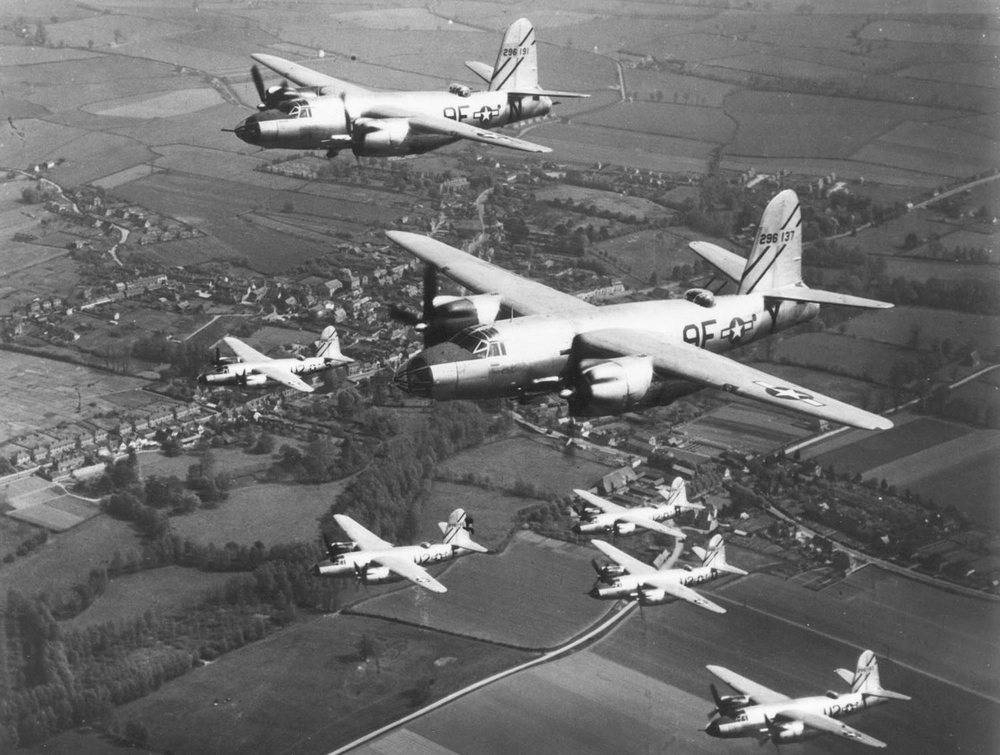
The Martin B-26 Marauder medium bomber was built in two locations in the United States during the Second World War- at the main Martin plant at Middle River outside of Baltimore, Maryland, built 3,681 B-26s and the Omaha, Nebraska, plant, built 1,585 Marauders. Designed by Peyton Magruder, who at the time he was placed in charge of the B-26 program by Glenn Martin he was only 26, the B-26 Marauder started once it won the Army competition for a medium bomber in July 1939. The prototype rolled out at the Middle River plant on 25 November 1940 and made its first flight that day. The first production Marauders were already flowing to USAAF combat units in February 1941.

Marauders were blighted early on by numerous crashes caused by pilot inexperience but would go on to fly over 110,000 missions in the Second World War with a combat loss rate of only 0.5%, the lowest of any Allied bomber of the war.

But there were a lot more things that made the B-26 Marauder a milestone in aviation history that aren't as well known to the annals of history:

-It was the first Allied bomber type in Europe to complete 100 missions, a B-26 named "Mild and Bitter" with a mission against the Luftwaffe airfield at Evreaux, France on 9 May 1944.

-It was also the first Allied bomber type to complete 200 missions, a famous B-26 named "Flak Bait" that completed its 202nd mission in May 1945 before the German surrender.

-It was the first US Army Air Forces bomber to use aerial torpedoes during the war- a two-thousand pound naval torpedo could be slung under the fuselage from an external rack (most torpedo missions were flown in the Pacific).

-It was the first twin engine medium bomber to be able to carry a greater bomb payload than the Boeing B-17 Flying Fortress, the heavyweight of the day.

-It was the first US Army Air Forces aircraft to use external gun pods- two self-contained 50-caliber machine guns were mounted two to each side of the forward fuselage for ground strafing.

-It was the first bomber to have an all-plexiglass nose which happened to be a Martin innovation in shaping plexiglass into the necessary aerodynamic curves.

-It was the first combat aircraft to use butt seams for the skin rather than overlapping seams. This improved the aerodynamics of the bomber by reducing drag.

-It was the fist bomber to use an all-electric bomb release mechanism.

-It was the first US combat aircraft with self-sealing fuel tanks, another Martin innovation which was called "Mareng Cells"- short for Martin Engineering.

-It was the first bomber to use flexible tracks to bring ammunition from its storage boxes in the mid-fuselage bomb bay to the tail gunner's position. And the maker of those flexible tracks? Lionel. Of Lionel trains fame.

-It was the first combat aircraft to substitute plastic for metal in over 400 components for weight savings.

Source: Raise Heaven and Earth: The Story of Martin Marietta People and Their Pioneering Achievements by William Harwood. Simon & Schuster, 1993, p193-212.