24 January 2011

The 747 Shuttle Carrier Aircraft (SCA)

The Boeing 747 was one of two choices for the SCA
During the design and development of the Shuttle Orbiter, air breathing jet engines were a part of the design for some time until cost and technical considerations in early 1974 led to their deletion from the concept. No longer able to "self-ferry", NASA now faced the problem of how to get the Orbiter from the remote landing sites to the launch locations. At the time NASA Langley had a study ongoing on a large aircraft design called VIRTUS that would have carried the Orbiter under the center wing flanked by twin fuselages and a twin boom tail with power coming from four Pratt & Whitney JT9D turbofans. Design work had proceeded on VIRTUS as far as wind tunnel tests with a 1/34 scale model, but sheer size, long development time and costs involved for an aircraft that would be built in very small numbers resulted in end of the VIRTUS project. At the time, Jack Conroy, the developer of the Super Guppy concept that NASA was using to transport rocket stages, had suggested using a jumbo-class aircraft to carry the Orbiter on its back. Proposals were issued to the industry and Lockheed offered up a twin-fuselage aircraft based on the C-5 Galaxy with the Orbiter suspended underneath a new center wing section- but, like the earlier VIRTUS program, it was eliminated from consideration due to cost, development time and that the design was so wide, no runway available could accommodate the design. Boeing offered a modified version of the 747 that carried the Orbiter on its back that presented a much lower risk approach. Boeing at the time even suggested that the large external tanks could be carried on the back of a 747, but wind tunnel studies showed the idea to be less practical than initially thought. Lockheed had subsequently reworked its design to a simple modification of a C-5 Galaxy to carry the Orbiter on its back much like Boeing's proposal. 

By mid-1974 Boeing's 747-based proposal and Lockheed's simpler C-5 Galaxy-based proposal were the only serious contenders to become the new Shuttle Carrier Aircraft (SCA). On 24 April 1974 NASA selected the C-5 Galaxy proposal from Lockheed based on it having the least acquisition expense and a C-5 Galaxy would need less structural modification than a Boeing 747. Accordingly, NASA approached the United States Air Force with the proposal and a request to make three to five C-5s available. The USAF was very receptive to the idea and the Lockheed proposal only added 400 to 600 pounds of modifications to the Galaxy without adversely affecting its cargo carrying capacity when not being used to transport the Orbiter. An arrangement was set up whereby NASA would pay for the modifications and then lease the modified C-5s as needed from the Military Airlift Command. One Galaxy was agreed to be bailed to NASA full-time for development into the SCA and for use in the atmospheric flight tests with the planned first Orbiter (which would become the Shuttle Enterprise). Despite some lingering concerns about the effects of the Orbiter's wake on the C-5's T-tail, both NASA and the USAF had worked out an acceptable arrangement for both parties.

N905NA conducted the atmospheric landing tests with Enterprise
The downturn in the American economy in the early 1970s led numerous US airlines to release their 747 aircraft which were too large for the market at the time. As a result, the acquisition cost of the Boeing 747 as the SCA dropped much lower than that of the Lockheed proposal. With the ready availability of low-time 747s on the market, NASA abandoned plans for using the Galaxy as it was decided it was much easier in the end to have complete control of the SCA than to have to compromise with military priorities for use of the C-5 Galaxy. On 18 July 1974 NASA purchased a used Boeing 747-123 (N9668, msn 20107) from American Airlines. It was the 86th 747 off the production line at Everett and was delivered to American on 29 October 1970. By the time of the NASA purchase, it had only logged 8,999 flight hours and 2,985 cycles flying primarily transcontinental services between New York JFK and LAX. NASA re-registered the aircraft as N905NA. Before modification into the SCA configuration, N905NA was used for in-house studies with NASA Ames on wake vortices. Following conclusion of the wake vortex research program, Boeing initiated the $30 million conversion program on N905NA on 2 August 1976. 

Not often seen is the sense of humor NASA has with the SCA
Boeing installed new bulkheads to strengthen the fuselage with skin reinforcement at critical stress areas. The horizontal stabilizer structure was also beefed up along with the addition of telemetry and transponder test equipment, fittings for the Orbiter support struts, and the installation of a 747-200 rudder actuator system. Boeing also developed a set of removable modifications for the SCA- the first one was a telescopic forward support assembly that was used only during the atmospheric flight tests with the Shuttle Enterprise. This support would hold the Enterprise at a six-degree angle of attack to facilitate release during the flight tests. A fixed assembly was also developed for use during SCA ferry missions that held the Orbiter at a three-degree angle of attack, which induced less drag during the ferry flights. The aft support assemblies (there were two) were common to both the atmospheric flight tests and ferry flights and finally 10 foot by 20 foot vertical endplates were added to the end of the horizontal stabilizer to provide additional stability when carrying the Orbiter- in practice, though, NASA never removed the endplates. 

The 747's trim system was also modified to allow a greater range of trim in pitch to counteract the downwash off the Orbiter's wing on to the horizontal stabilizer. Most of the main deck interior was stripped out, but some seats were retained for support personnel during the ferry flights. The JT9D engines were also converted to allow a thrust increase from 43,500 pounds to 46,950 pounds of thrust. The current JT9D engines on the current incarnation of the 747 SCA are rated at 50,000 pounds of thrust. Since each Orbiter has a different empty weight, an adjustable ballast system using standard cargo containers in the forward underfuselage cargo compartment had to be developed to maintain the center of gravity. On 14 January 1977 Boeing finished the modification work and after a period of flight testing, it was delivered to NASA. 

Concerns about flight crew safety during the atmospheric flight tests with the Shuttle Enterprise led NASA to incorporate an escape system on N905NA since the flight crew of the Enterprise had ejection seats. The escape system was based on what was used on the 747 prototype during Boeing's 1969 flight tests- in the event of an emergency, a handle was pulled that blew out thirty fuselage windows to facilitate rapid decompression of the aircraft. Three seconds later an emergency egress hatch on the lower forward fuselage was blown out with extendable spoiler being deployed. The crew would make their way back from the flight deck to the middle of the upper deck lounge area where a hole leading to a 16 foot escape slide would lead them out the blown hatch and clear of the aircraft. Testing showed the flight crew could bail out of the 747 within 11 seconds. The atmospheric flight tests will be the subject of a future blog post, so stay tuned. 

N905NA has three upper deck windows, N911NA has five
In 1988 NASA acquired a second 747 to act as a back up to N905NA. Part of this was driven by the recommendations following the Challenger accident that a significant portion of Shuttle flights would still be landing at Edwards AFB. The first 747-100SR was purchased from Japan Air Lines where it had flown as JA8117, msn 20781. Boeing purchased the aircraft from JAL on behalf of NASA and conducted the necessary modification work to bring it up to SCA standards with the new tail number N911NA. On 20 November 1990 it was delivered to NASA and in 1995-1996 both of the 747 SCAs were repainted in NASA's new colors. 


During a ferry mission the SCA' smaximum speed it 250 KIAS (Mach 0.6) at an altitude of 13,000-15,000 feet with a range of approximately 1,150 miles. Without the Orbiter, the SCA cruises at 24,000-26,000 feet with a range of 6,300 miles. During ferry flights the usual crew is two pilots and two flight engineers, but only one flight engineer is needed on non-ferry flights. At one point NASA looked at inflight refueling of the SCA as the equipment was readily available as it was installed on a handful of the USAF's 747s- the E-4 airborne command posts and the two VC-25A presidential transport aircraft. Proximity flight tests were even carried out with N905NA and a KC-135 tanker minus the Orbiter, but the discovery of cracks at the base of N905NA led to the termination of the studies as it was feared that wake turbulence from the tanker may have been possible. Plans were in motion to fly the proximity tests with an Orbiter, but the costs involved and wake turbulence concerns led to the quiet abandonment of the idea. 

Source: Space Shuttle: The History of the National Space Transportation System- The First 100 Missions by Dennis R. Jenkins. Specialty Press, 2001, p195-202.

23 January 2011

Operational Improvisation: Over-the-Shoulder Nuclear Bombing

F-84Gs of the 20th FBW had lightning markings, each squadron had its own color
In 1952 the Republic F-84Gs of the 20th Fighter-Bomber Wing crossed the Atlantic supported by aerial refueling to set up shop at their new base, RAF Wethersfield, in order to provide tactical nuclear strike capability for the first time to NATO forces in Europe. Just a year earlier, scientists and engineers at Sandia, one of the development centers in the United States for nuclear weapons, had developed the Mark 7 nuclear bomb, the first tactical nuclear weapon with an explosive yield of 20 kilotons. While the Mark 7 weapon would be carried operationally by many USAF and US Navy tactical attack aircraft, the first aircraft to carry the Mark 7 operationally also happened to be the first production tactical fighter to have not just nuclear capability, but also air-refueling capability. That was specifically the G variant of the Republic F-84 Thunderjet, which had an air refueling receptacle for a flying boom in the left wing root, a more powerful jet engine, and provisions for the Mark 7's special pylon that had the necessary circuitry for nuclear weapons delivery. 

The Mark 7 was the first American tactical nuclear weapon
The 20th FBW had been given six months to prepare for the move to Great Britain as well as to become the first tactical nuclear fighter-bomber unit in military history. At the time of the deployment, the F-84Gs and pilots of the 20th FBW were only versed in clear-weather weapons delivery more suited to the bombing ranges in the predominantly sunny southwestern United States, drops being made starting at 20,000 feet in altitude. The weather in Europe, however, was far from ideal for this sort of weapons delivery mode, with a predominantly cloudy maritime climate in the areas that the 20th FBW was expected to operate. I had posted this past September about the nuclear delivery role assigned to the McDonnell F-101 Voodoos of the 81st Tactical Fighter Wing based in RAF Bentwaters/Woodbridge in the late-1950s and early 1960s. Not unlike the conditions facing the pilots several years later that flew the Voodoo, the pilots of the 20th FBW were expected to navigate visually and by dead reckoning to their targets with only the most basic of navigational aids. By the time the 20th FBW had set up shop at RAF Wethersfield, a different form of nuclear delivery was needed and the wing commander, Colonel John Dunning, had sent some of his best pilots to Kirtland AFB in Albuquerque, New Mexico near Sandia, to find out more about a new weapons delivery tactic called LABS- Low Altitude Bombing System. Developed at Kirtland by Major Jack Ryan, it hadn't yet received much attention as most nuclear delivery tactics of the day concerned use by strategic bombers. Col. Dunning wanted his pilots in Europe to have every advantage possible and LABS offered that prospect. 

In a LABS run, an IP (initial point) is chosen that is a known distance and direction from the target and was most ideally located three miles away. The LABS equipment was quite basic- it was a timer with a gyro that was free to move about the pitch axis of the delivery aircraft. Having previously set the time from the IP to the pull up point near the target and the calculated angle of release beforehand, an aircraft on a LABS run headed towards the target at 500 mph at low level with the IP in between the aircraft and the target. Once the IP was reached. the pilot pushed the "pickle" button on the control stick which started the timer and a flashing red light on the gunsight was connected to both the timer and the LABS gyro. The pilot pulled into a steady 4G climb and at a precise point and angle (usually 25 to 30 degrees), LABS released the nuclear weapon which continued onward on a precalculated ballistic trajectory towards the target while the pilot pulled his aircraft into an Immelman loop and exited the area as fast as possible. In effect, LABS "tossed" the bomb towards the target. 

Diagram showing the over-the-shoulder bomb toss
On return to Europe, the pilots that trained in the LABS technique for the 20th FBW found that finding an IP near the target was challenging. It was noted that as the distance between the IP and target decreased, the ideal release angle of the Mark 7 bomb increased. If the IP was very close to the target itself, then the optimum release angle was 90 degrees. Pushing the idea further, the pilots of the 20th FBW worked out that if the IP was the target itself, then the optimum LABS release angle was 110 degrees and the bomb would impact right at the point where the pull-up maneuver was initiated. No IP was needed- the target itself was the IP. The bomb was released "over the shoulder" and would arc upward to 10,000 feet and more than a minute elapsed before it detonated, allowing time for the F-84G to rollout and accelerate out of the area in a dive. The USAF and the specialists at Kirtland AFB doubted if the average USAF pilot could carry out such a complex maneuver as the wings had to be absolutely level in the pull up or the bomb's impact point would stray away from the target. The operations officer of one of the 20th FBW's constituent squadrons had noted that the F-84G didn't even need a LABS gyro- the aircraft's own gyro started to "tumble" right past vertical and by complete coincidence, right at 110 degrees! Major John J, Kropenick, the ops officer who made this observation, came up with his own solution, the "Kropenick Autopilot" that was taught to all the pilots of the 20th FBW- two large rubber bands were hooked to the control stick on the run in, each one then looped over a cockpit light on the sidewall on each side. The tension of the rubber bands kept the stick precisely centered during the pull up and once the Thunderjet's own gyro tumbled, the bomb would be released. Pilots taught the method with the "Kropenick Autopilot" had bomb scores acceptable to the USAF given the 20-kiloton yield of the Mark 7 bomb.

By the time the LABS equipment had been fitted to the 20th FBW's Thunderjets, the pilots of the wing had gotten quite proficient at using the "Kropenick Autopilot" and made the transition to using the LABS equipment for "over the shoulder" toss bombing with a minimum of delay and fuss. 

Source: Aviation History, March 2011, Volume 21, Number 4. "Over-the-Shoulder A-Bombing; Cold War F-84G pilots improvised a surprising twist on bomb delivery" by David Rust, p54-57.

19 January 2011

The Achilles Heel of the Douglas B-66 Destroyer

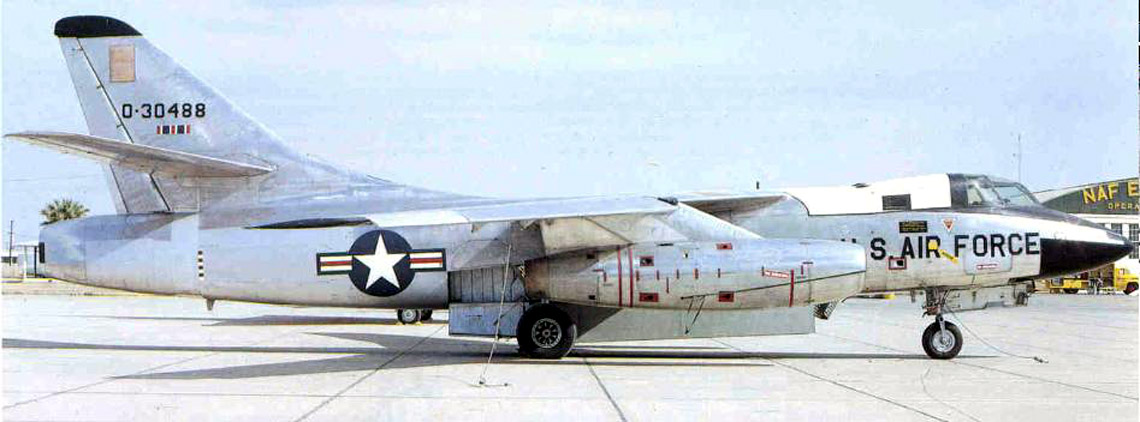
The B-66 Destroyer ended up only resembling the A-3 Skywarrior
In January 1952 when the US Air Force issued its official General Operational Requirement (GOR) for a tactical bomber and reconnaissance jet aircraft to replace the Douglas B-26 Invader and the "interim" Martin B-57 Canberra, the selection of a minimum change version of the Douglas A3D Skywarrior as the B-66 Destroyer made sense. Douglas's proposed changes weren't all that major- deletion of the folding wings, catapult gear and arresting gear, addition of ejection seats and anti-icing, strengthening the airframe for the stresses of low altitude flight and an enlarged search radar antenna. Since the aircraft was "off the shelf", no prototypes were ordered. Eventually the USAF's GOR evolved to cover four distinct versions- the B-66B, a nuclear capable bomber version to replace the North American B-45 Tornado, the RB-66B, an all-weather day/night reconnaissance version, the RB-66C, a tactical electronic reconnaissance aircraft, and the WB-66D weather reconnaissance aircraft. Douglas agreed to an ambitious timetable to get the B-66 in production and operational, but the USAF kept requesting changes that ended up making the B-66 Destroyer a totally different aircraft that literally shared nothing in common with the Skywarrior. It's a testament to Douglas's abilities that the schedule slipped only two years as a result of constant changes being requested by the USAF! The B-66 ended up weighing just over 10,000 lbs more than the A3D Skywarrior as a result of all the changes. 

Had it gotten the J57 engine, the B-66 might have had a longer career
But being overweight wasn't the biggest flaw in the B-66 design. Ed Heinemann and his Douglas team recommended the Pratt & Whitney J57 turbojet for the B-66 after the A3D was switched from the anemic Westinghouse J40 turbojet to the more powerful J57 (the first production turbojet in the world to exceed 10,000 lbs of thrust). However, the Air Force held a competition for the engine to power the B-66- in addition to the recommended J57 engine, the Allison J71, General Electric J73 and surprisingly the Westinghouse J40 were submitted. Not surprisingly the J40 was dropped early on and the J73 soon followed for technical reasons. To the surprise of Douglas, the USAF then selected the J71 for the Destroyer, not only an engine that had yet to fly but it was also less powerful than the J57 by nearly 2,000 lbs of thrust! The official reasoning was that the Allison J71 was readily available (a bit of a stretch here on the part of the USAF) and the B-66 had lower priority than other USAF programs that used J57 engines- namely, the Boeing B-52 Stratofortress, the Boeing KC-135 Stratotanker, the North American F-100 Super Sabre, the McDonnell F-101 Voodoo, and the Convair F-102 Delta Dagger. At the time the Voodoo was under development as a long range penetration fighter for SAC, so it became obvious to many that SAC dominated the USAF budget and would receive any and all J57 engines possible. The main reason the F-100 got any J57s at all was that the F-100 was central to the Tactical Air Command's desire to have its own tactical nuclear attack force built around the F-100. 

Ordinarily those assigned to the B-66 Program Office at Wright Patterson AFB would have pushed for the J57, but politically the B-66 was seen as primarily a reconnaissance aircraft and only in interim bomber. Those with fighter experience in TAC wanted the F-100, those with tactical bomber experience in TAC wanted the Martin XB-51. And SAC was determined to preserve its budgetary allocation at all costs. In the end, no one really fought for the B-66 Destroyer when it was given the clearly less-powerful Allison J71 engine. Allison had trouble getting the J71 prototypes bench tested to at least 50 hours without any problems and only barely made the cut which exacerbated the schedule slippage of the first operational Destroyers. And even at that, the test pilots at Edwards AFB flying the first B-66s hated the J71- it was slow to spool up for more power, it surged often, and even would flame out and stall while taxiing. On 8 October 1955 the pilots of the AFTC (Air Force Flight Test Center) filed an extremely unsatisfactory report on the J71. The test force concluded that the J71 engine was accepted by the USAF only partially developed and a replacement engine was needed, the preference being for the J57 used by the Skywarrior. It was alleged that on a hot summer day in Denver with a typical combat load, the B-66 Destroyer couldn't even get airborne!

The tail guns were soon removed and replaced with ECM tailcone
Unfortunately for the B-66 program, the Secretary of Defense at the time, Charles Wilson, came to the Defense Department as the CEO of General Motors, of which Allison was one of its divisions. Wilson's 1953 confirmation hearings before the Senate were highly controversial because of his reluctance to sell his GM holdings and comments that alluded to him possibly favoring GM as Secretary of Defense. The loss of the J71 contract would have been a severe blow to Allison at the time. As a result, the Destroyer kept the J71 engines and Allison tweaked the engine further to bring the engine up to 9,700 lbs of thrust. While this satisfied the USAF given the mission profiles of the Destroyer in the 1950s, the addition of heavy electronic warfare equipment to the Destroyer to created the EB-66, the only tactical electronic warfare aircraft available in Vietnam, strained the limits of the J71 in the hot tropical environment of Vietnam. Destroyer crews nicknamed the aircraft "The Airplane with One-Way Engines" in reference to the fact that outside of the lackluster McDonnell F3H Demon, the other design to use the J71 was the Northrop Snark cruise missile. However, in 1956, Northrop switched the Snark's engine from the J71 to the- you guessed it- J57. 

Source: Glory Days: The Untold Story of the Men Who Flew the B-66 Destroyer into the Face of Fear by Wolfgang W.E. Samuel. Schiffer Military History, 2008, p24-38.

18 January 2011

Flight Testing on the Cheap: The Ground-Breaking M2F1 Lifting Body

In the early 1960s NASA's research work into lifting body designs was in full swing with the X-23/PRIME program testing lifting bodies in the re-entry regime from orbit. I had previously blogged about the PRIME program and the data that it provided the aerospace industry. But while the unmanned X-23 program answered the question of a lifting body's flight characteristics at the high speeds encountered during re-entry, questions still remained about the suitability of a lifting body in subsonic flight- would a lifting body design be controllable and stable in the low speed flight regime upon return to Earth of a reusable space vehicle? At the time, Dale Reed, an engineer at NASA's Flight Research Center (FRC) at Edwards AFB, had been following the lifting body research in his free time. Being an avid remote-control aircraft model builder, Reed built a 24-inch flying model of what was designated the M2 shape- the M1 shape was the product of research at NASA Ames which started out as a 13-degree half cone with a rounded nose. The M1 shape was refined into the M2 shape which added twin vertical fins, a canopy for a pilot, and horizontal control surfaces. This M2 shape was what Dale Reed modeled in his free time and dropped it from a 60-inch remote control "mothership" while his wife Donna would film the M2 model flight with an 8mm camera. He later showed the films to the director of the FRC, Paul Bikle, and Alfred Eggers, one of the pioneering researchers on lifting body work. They were suitably impressed with Reed's work that in November 1962 Bikle authorized a six-month program paid out of the FRC's discretionary fund to build a manned glider version of Reed's M2 model. 

The M2 glider had a steel tubular frame to which was attached the pilot's seat and landing gear (taken from a Cessna 150)- the exterior would be a light wooden shell this way different shapes could be tested. As it was, work on the lifting bodies within NASA would eventually settle on the M2 shape as the most ideal and the glider was designated the M2-F1. Space was set aside in the main hangar at the FRC which was cordoned off and nicknamed "Wright's Bicycle Shop". A local glider builder was contracted to help construct the outer shell while NASA engineers and technicians, many of whom were members of the Experimental Aircraft Association (EAA), lent their time and talents to the construction of the M2-F1. As many of them did it in the free time, it ended up costing NASA only $30,000 to build the M2-F1 when it was finished in early 1963! One of the reasons Paul Bikle funded the program out of FRC's discretionary fund was that he feared NASA headquarters in Washington would disapprove, or worse, take control of the project and make it excessively complex and expensive. 

The finished M2-F1 was 20 feet long, 10 feet high, and 14 feet wide. At the aft ends of the blunt half cone it had twin fins that mounted horizontal control surfaces nicknamed "elephant ears". The main body itself had two flaps at the end that were for trimming the glider in flight. Complete with the pilot, the M2-F1 weighed only 1,138 pounds. Later in the flight test program a Weber zero-zero ejection seat was fitted, but for the first set of flights, no ejection seat was used. By March 1963 the full scale wind tunnel tests at NASA Ames were completed with encouraging results and back at Edwards AFB tow runs were made with various vehicles pulling the M2-F1, the first captive flight taking place 5 April 1963. For these initial flights, the M2-F1 was suspended below a Rogallo wing as the vehicles weren't fast enough to pull the M2-F1 to its rotation speed. 

The engineers wanted to a faster vehicle to get the M2-F1 airborne before pulling it aloft behind a tow aircraft to higher altitudes. A 1963 Pontiac Catalina convertible was procured and stripped down. It had a 455-cubic inch engine, four barrel carburetor, and was a five speed stick shift. The engineers enlisted the help of famed California hot-rodder Bill Straup in Long Beach to replace the street tires with racing tires and to tune and tweak the engine for maximum performance. Rollbars and radio equipment were installed and the right hand front passenger seat was turned around to face aft. Adorned with the suitable high visibility markings and NASA logos, the FRC's hot rod pulled the M2-F1 for the first time airborne in June 1963. Satisfied with the near-ground/low altitude peformance, a Douglas R4D (Navy version of the DC-3/C-47) pulled the M2-F1 glider aloft for the world's first piloted lifting body free flight on 16 August 1963 when NASA test pilot Milt Thompson cast off from the tow plane at 10,000 feet and landed smoothly onto Rogers Dry Lake below. Six other test pilots flew the M2-F1 glider after casting off from the R4D towplane- Bill Dana, Capt. Jerauld Gentry, Don Mallick, Bruce Peterson, Donald Sorlie, and Col. Chuck Yeager. Bruce Peterson and Milt Thompson flew the majority of the M2-F1 flights. The M2-F1 eventually got a proper ejection seat and a small rocket was added which was fired before landing to assist with the pre-landing flare. Eventually modifications and test equipment required the M2-F1 to trade in its Cessna 150 landing gear for the gear of a Cessna 180. 

The last M2-F1 flight took place on 16 August 1966 after just over 100 flights and 400 ground tows. It was donated to the Smithsonian Institution and was restored years later and returned to NASA Dryden (what the FRC is today known as) for display. Proving that a lifting body shape could be safely flown at subsonic speeds, NASA proceeded to develop the M2-F2, a heavier, alumimum, rocket powered version that was dropped from the NB-52A and was capable of supersonic flight. Plans were to build two M2-F2s, but eventually one M2-F2 was built to supersede the M2-F1 and a competing lifting body design was built by Northrop as the HL-10. As an interesting bit of television trivia, the crash depicted in the opening of the "Six Million Dollar Man" is Bruce Peterson crashing in the M2-F2 on 10 May 1967, which he did survive. 

16 January 2011

The Short and Deadly Career of the De Havilland Swallow

Evolution of the Comet from mailplane to jetliner
The Allies reaped a technological windfall with the unconditional surrender of Nazi Germany in May 1945. Both the United States and Great Britain in particular found that their wartime studies of future jet aircraft experienced quantum leaps in performance with the incorporation of the aeronautical knowledge of the personnel technical documents, and aircraft of the Third Reich. During the final half of the Second World War, Britain grappled with the future of passenger flight with the Brabazon Committee's deliberations on the future of commercial aviation. Of the five designs put forth by the Committee, the most advanced was the Type IV design for a jet-powered 100-passenger design. This aircraft would become the De Havilland DH.106 Comet- but the DH.106 started out as a very small, modest adaptation of the Vampire jet fighter as jet-powered mailplane with a six-seat passenger compartment. But with the input of the Brabazon Committee, the DH.106 evolved into a substantially larger aircraft that at one point was a tailless design before taking on the shape now familiar as the Comet. 

TG283, the low-speed DH.108 aircraft
The British were particularly interested in the Messerschmitt Me 163 Komet rocket-powered point interceptor- it was fast, had modestly swept wings, was tailless and was known to have good flying characteristics. As a result of their evaluation of the Komet, the government issued the E.18/45 requirement which was awarded to De Havilland for the construction of two small jet-powered research aircraft to study swept wings and the tailless configuration. Designed by De Havilland engineer Ronald Bishop, what was designated the DH.108 used the fuselage of the De Havilland Vampire jet fighter which was stretched and streamlined combined with a new swept vertical fin and new swept wings. This served to save time and effort and like the Vampire jet fighter, the DH.108 had wing root intakes. Unofficially named "Swallow", the two prototypes received the RAF serials TG283 and TG306. TG283 had a 43-degree swept wing and was intended for low speed testing while TG306 had a 45-degree wing and was assigned to high-speed transonic testing. Initial wind tunnel studies suggested that the Swallow would have lousy stall characteristics, so the first of the two to fly, the low-speed assigned TG283, had fixed wing slats and anti-spin parachutes in fairings on the wingtips. It made its first flight on 15 May 1946 and TG306, the high-speed Swallow, made its first flight a month later and had automatic wing slats but no anti-spin parachutes.

VW120, the third DH.108 Swallow that broke the sound barrier in 1948
The test pilot for the DH.108 was the chief test pilot for the company, Geoffrey De Havilland, Jr, the son of the company's founder. After several problem-free test flights it was found that both aircraft lacked the predicted poor stall characteristics and the high speed aircraft, TG306, joined the formal research program on 23 August 1946. By the time De Havilland had safely taken it to 630 mph at altitude with no problems, it was decided he would take TG306 to break the world speed record. On a practice run over the Thames Estuary on 27 September 1946, the aircraft exceeded its structural limits at high speed and broke up, killing Geoffrey De Havilland, Jr, as the aircraft had no ejection seat. John Cunningham succeeded De Havilland as chief test pilot and took over flying the DH.108. To replace the lost aircraft, a third DH.108 was ordered and received the RAF serial VW120. It featured a more pointed nose, revised canopy and cockpit including a Martin-Baker ejection seat, and a higher thrust Goblin engine than what had powered the first two aircraft. Cunningham took VW120 up on its maiden flight  on 24 July 1947. With Cunningham and fellow test pilot John Derry flying VW120, a series of new speed records were set in 1948 and on 9 September of that year, Derry took VW120 past Mach 1 in a dive from 40,000 feet, making the DH.108 Swallow the first British aircraft to break the sound barrier- though it must be pointed out that Derry had for the most part lost control of VW120 during the supersonic portion of the flight but had safely recovered and landed. 

After flying demonstrations at the 1948 Farnborough SBAC air show, VW120 was handed over to the Royal Aircraft Establishment to join TG283 (the first Swallow) in the research program. On 15 February 1950 RAE test pilot Stuart Muller-Rowland was killed when VW120 broke up due to structural failure during a high speed test run. Three months later TG283 was lost and killed its test pilot, RAF Squadron Leader G.E. Genders, when it stalled at low speed and low altitude. 

Despite the loss of all three DH.108s with the loss of life, the data from the Swallow flight test program and the research program at the Royal Aircraft Establishment benefited not just the design of the DH.106 Comet jetliner, but also that of the DH.110 Sea Vixen naval fighter as well.

Source: Military Aircraft Monthly International, Volume 9, Issue 12. "A Deadly Swallow: The short sharp story of De Havilland's DH.108" by Nico Braas, p28-32.

12 January 2011

The British Knock Out the Italian Fleet with Biplanes

The Fairey Swordfish as marked/painted for the Taranto attack
The planning for the attack on the Italian fleet at the harbor of Taranto began in earnest in 1938 during the Munich Crisis when it seemed that Europe was headed for war. Though boasting a force of six battleships, five cruisers and twenty destroyers at the start of the conflict that could have caused significant headaches for the Royal Navy in the Mediterranean, Mussolini rarely ordered the fleet to sail far from the home port of Taranto and they would return at the earliest opportunity, failing to engage the British Mediterranean fleet. With the threat of war looming, captain of the HMS Glorious, Capt. Lumley Lyster, was asked to draw up an attack plan to knock out the Italian fleet while it sat in harbor. Essential to any attack given the strength of the defenses of the harbor would be surprise, necessitating a night attack. By the time 1940 had come around and maintaining the sea links with the British forces in North Africa took added importance, the need to proceed with the attack, codenamed "Operation Judgement", the trained Fairey Swordfish aircrews that trained aboard the HMS Glorious were now serving aboard the HMS Illustrious and under strict secrecy, the attack was planned for 12 October 1940 on Trafalgar Day. Unfortunately, a fire in the hangar deck of the Illustrious resulted in the Swordfish aircraft being drenched in saltwater, necessitating their clean up and repair. Also, the original attack plan called for the HMS Eagle to accompany the Illustrious on the attack, but Eagle had suffered damage from an accidental bomb explosion earlier in the year. As a result, some of Eagle's Swordfish and aircrew were transferred to the Illustrious. The attack was rescheduled for the night of 11/12 November 1940. 

Given the nature of the defenses based on the latest British reconnaissance, the first wave to attack Taranto would consist of twelve Swordfish, only six of which would carry torpedoes while the balance of aircraft carried bombs and flares. At the time, the conventional naval wisdom was that torpedoes were only usable in deep water, but the Royal Navy had modified their torpedoes to run in the shallow water of Taranto Harbor. The photos showed that the battleships were protected by torpedo nets, but they were standard keel-depth nets. The torpedoes used were configured to magnetically detonate below the ships' keels. 

Diagram of the attack on the Italian fleet
At 8:30pm the first wave took off from the HMS Illustrious. The gunners weren't carried, their place being taken by a supplemental fuel tank to allow a two-man crew to fly the 340-mile roundtrip mission. By 9:00pm the twelve aircraft were all airborne and they set off for Taranto. Several of the Swordfish became separated from the main formation and had to make their own way to the target- one pilot arrived at Taranto ahead of the main force and had to await the rest of the aircraft- some references indicate that this may have alerted the Italians. Arriving over the harbor at 11:00pm, the strike force immediately came under fire. One of the Swordfish peeled off from the group and dropped a series of flares at 7,500 feet along the eastern perimeter of Mar Grande, the outer harbor. A second Swordfish followed suit, illuminating the area for the rest of the strike force. Lt. Commander K. Williamson, the CO of No. 815 Squadron, made the first torpedo run against the battleship Conte di Cavour, blowing a hole in the side of the ship but getting shot down in the process. Two more Swordfish that accompanied Williamson then pressed their attack against the battleship Andrea Doria, which was unsuccessful. The last group of the first wave attacked two cruisers and four destroyers as well in Mar Piccolo, the inner harbor. The Swordfish's agility paid dividends as the seemingly archaic aircraft managed to weave around the barrage balloons and jink hard to throw off the anti-aircraft fire. 

HMS Illustrious with a Swordfish on the deck
With the first wave turning back for the Illustrious, the only aircraft shot down was that of their CO, Lt. Commander Williamson, who was taken prisoner along with his crewman. The second wave, under the lead of Lt. Commander J.W. Hale, the CO of No. 819 Squadron, had left the Illustrious thirty minutes after the first wave took off. Of the twelve Swordfish in the second wave, only eleven arrived at Taranto due to technical problem with the twelfth aircraft that forced it to return to the carrier. Arriving over the harbor at midnight, again the flare-dropping Swordfish lit up the area while the bomb and torpedo-armed aircraft set to work on the rest of the Italian battle fleet. Two aircraft attacked the battleship Littorio, but only one scored a hit. Another aircraft despite taking damage pressed an unsuccessful attack against the battleship Vittorio Veneto. The battleship Caio Duilio was also hit, and only one aircraft from the second wave was shot down, the two aircrew being killed. By 240am, the last of the Swordfish landed on the Illustrious. A third wave was planned the following night, but bad weather prevented a final blow to the Italian fleet. 

The attack was a stunning success by an aircraft that was older and slower than many of its contemporaries. Just 11 torpedoes and 48 bombs managed to knock out half of the Italian battle fleet at Taranto and while the defenders fired off over 22,000 rounds, only two aircraft were shot down, quite an impressive feat! The attack followed by the Battle of Cape Spartivento two weeks later and the Battle of Cape Matapan in March 1941 consolidated the Royal Navy's control of the Mediterranean, hastening the defeat of the Axis. The planning staff of the Imperial Japanese Navy, at the time putting together the plans for the attack on Pearl Harbor, studied the British attack at Taranto carefully and managed on 7 December 1941 to knock out more battleships in the process, but unlike the Mediterranean, the attack failed to shift the balance of power in the Pacific as the US Navy had shifted its fleet emphasis to the aircraft carrier as the new capital ship. 

Source: International Air Power Review, Volume 27, Winter 2010/11. "Warplane Classic- Fairey Swordfish- the Fleet Air Arm's enigmatic warrior" by Allan Laws, p125-129.


10 January 2011

British Defenses Against the Summer 1944 V-1 Bombardment

Cutaway view of the Fiesler Fi 103, or V-1 "Buzz Bomb"
Within a week of the Allied landings on Normandy on 6 June 1944, the Germans initiated a new form of bombardment against London, launching ten of Hitler's "Revenge Weapon No.1" or Vergeltungswaffe 1- V-1 for short. Of the V-1s launched in the early morning darkness of 13 June, six suffered failures that prevented them from even reaching the English coast from launch sites at Pas de Calais. Four bombs made it into British airspace, three of them hit in open land causing no casualties. One of those four V-1s, though, hit Bethnal Green, 2 miles from the famous Tower Bridge (which was used as the nominal aiming point) where it killed six people and injured nine more. British intelligence had predicted history's first cruise missile bombardment for a year, but the opening salvoes were far smaller than what was feared. It took three days to resume the launches and by 16 June 244 V-1s had been fired at the British capital. Of those missiles, 153 crossed into British airspace and of those V-1s, 73 hit the London area causing widespread damage and civilian casualties. 

German launcher crew prepare a V-1 on its firing ramp in France
In the three day lull following the first attack, the Royal Air Force and British Army swiftly deployed its defenses to southeast England. The first line of defense consisted of nine squadrons of Supermarine Spitfire and Hawker Tempest fighters as well as two squadrons of De Havilland Mosquito night fighters. The aircraft three lines of standing patrols, the first line 20 miles off the coast, the second line at the coast, and the third line 15 miles inland. Behind the fighter patrols came the gun zone made up of 192 heavy caliber AA guns and nearly 200 light-caliber guns in an area 20 miles deep. If a fighter pursued a V-1 into the gun zone, gunners were ordered to hold their fire to allow the fighter to complete its pursuit. Behind the gun zone on the southeast suburbs of London was the balloon zone made up of 480 barrage balloons. Over a quarter million mothers and children were evacuated out of London itself during the bombardment. Up to the end of June 1944, an average of 153 V-1s were fired at London. One-third failed or were shot down before crossing the English coast. Another one-third crashed or were shot down over southeastern England before reaching London. But that left a significant amount that managed to hit the London area. 


By mid-July, the defenses were revised based on the experience so far. This time each defensive measure was given a predefined zone for unrestricted engagement of any flying targets. The British Army's AA gun batteries were increased to 412 heavy guns and nearly 600 light guns in a 65-mile long strip along the coast that allowed the gun-laying radars of the batteries a clear view over the English Channel. Fighter pilots were prohibited from crossing the new gun zone, knowing that the gun batteries had unrestricted rules of engagement. The fighter zones were now split into two, with an outer zone over the English Channel that stopped five miles from the coast where the gun zone began. The inner zone began at the rear of the gun zone along the coast and extended back to the barrage balloon zone in London. In less than a month the number of barrage balloons increased to over 2,000. With the new defensive layout, over one-half of incoming V-1s were stopped from reaching the capital. 2 August would be the heaviest bombardment day, with 316 V-1s launched from 38 launchers in Pas de Calais. Of that number, 107 would impact in London. On that day, the nominal aiming point for the V-1 batteries in France, the Tower Bridge, took a direct hit from a V-1. 

A Spitfire pursues a V-1 at treetop height
By early August, the first Gloster Meteor jet fighter units were becoming operational and were tasked with V-1 interception. However, there were three developments that would vastly improve the British defenses, all technological wizardry courtesy of the United States. First was the SCR-584 gun laying radar that was the state of the art in 1940s radar technology and could lock onto targets instead of having to be manually directed by operators. A new device called the the Number 10 Predictor was the second device, it could exploit the improved fidelity from the SCR-584 to direct the AA fire more accurately. And the third bit of wizardry would also save many US Navy carriers and warships in the Pacific- proximity-fuzed AA shells that no longer needed a direct hit to bring down a target. With these three advances, the average V-1 engagement by a British Army gun battery only used a mere 156 rounds to bring down a V-1. 

The last V-1 launched from Pas de Calais came on 1 September, by which point the launch sites were all overrun by British Army units on the breakout from the Normandy beaches. From that point on, the V-1s that hit London were delivered by air-launching which was less effective and more prone to interception. During the first phase of the bombardment from June to September 1944, until the British defenses received new radars and proximity-fuzed AA shells, the most effective defense was actually the Allied air attacks on the French rail system. V-1 launch sites often had to wait days before receiving new missiles to fire due to attacks on supply trains and the rail network itself. Throughout this first V-1 bombardment phase, the launchers at Pas de Calais never launched V-1s at their intended capacity. 

The V-1's magnetic compass in the nose was enclosed in a wooden sphere
By far the most interesting defense that nearly got fielded in the summer of 1944 also came from the United States. Dr. Don Hare and his team at the Airborne Instruments Laboratory in New York were working on radio countermeasures systems when they were asked by the US government to assist in developing a counter to the V-1 attacks on London. Since the V-1 required no outside cues, it was invulnerable to jamming. Its direction guidance came via a magnetic compass in the nose that cued the master gyroscope that controlled the rudder. As the V-1 had to be simple to produce, it lacked any ailerons and its straight wing lacked any dihedral to provide stability. RAF pilots had already discovered a V-1 could be thrown off course and downed by forcing the bomb into a steep bank by tipping one wing. Dr. Hare's team reasoned that if a suitably strong magnetic field could be created, the magnetic compass could be tricked into cueing the master gyroscope to put the V-1 into a tight turn, thereby downing it. The American team's idea was to use existing railway lines that formed a loop around London 60 miles in circumference as a giant magnetic loop. By connecting specific rail lines in a giant circuit, it would take 1,000 amps of DC power to create a magnetic field over London that could confuse the V-1's autopilot. It was determined that 20 to 30 megawatts were needed which was within the capacity of a large commercial power station. Design work began on the needed equipment, but the "Mightiest Magnet" program ended when the launch sites in Pas de Calais were overrun by Allied forces. 

Source: International Air Power Review, Volume 27, Winter 2010/11. "Pioneers & Prototypes- Vergeltungswaffe 1- Adolf Hitler's revenge weapon" by Dr. Alfred Price and P.G. Cooksley, p150-159.

05 January 2011

Flying for Less: The Birth of PeoplExpress

Don Burr was seen as taking full advantage of dergulation
For years Don Burr, a former mutual fund manager, and Frank Lorenzo had been inseparable since their early days as airline management consultants, long before they'd taken helm at Texas International. In the turnaround of Texas International, Don Burr was the brains and Frank Lorenzo provided the schmooze factor, demonstrating a remarkable talent in getting creditors off their back. They were the best man at each other's wedding and Frank Lorenzo was the godfather to one of Burr's children. Their families even vacationed together. Given their closeness, what was soon to transpire was earth-shaking in the industry.

In 1978 deregulation was right around the corner and suddenly the US airline industry would have to deal with an open and free market for the first time in its history. Even Lorenzo knew that Texas International wasn't the right vehicle for prosperity in the post-deregulatory market. He once remarked at a conference that there were only two kinds of airlines after deregulation- very small ones and very large ones and with Texas International only the sixteenth largest airline, it was neither. It could be crushed by the juggernaut that was American at DFW or nibbled to death by Southwest Airlines which had already cut deeply into Texas International's intrastate business. Lorenzo's solution was to look for a takeover target and get bigger by acquisition. Burr's solution was different. Markedly different, to say the least- while Lorenzo absorbed himself in a stock market race with Pan Am for control of National Airlines' stock, Burr decided the culture of the company had to change- it had transform to face the new market reality.

Frank Lorenzo's rise to fame began at Texas International.

In his younger days Burr read a book called The Greatest Thing in the World in which a 19th century Scottish minister named Henry Drummond extolled the virtues of establishing love at the foundation of every activity of daily life. Burr adored the book and still kept it within reach for moments of comfort and inspiration. Burr figured that he could apply the same principles to Texas International- trusting employees, eliminating time clocks, minimizing supervision and giving the employee the freedom and latitude to do the best job possible. Burr tapped Texas International's chief of service, Edwin Cathell, and they analyzed everything from Abraham Maslow's hierachy of needs to the corporate policies of other companies known in those days for progressive employee relations.

The result of this research was Don Burr's "People's Program"- a set of black three-ring binders distributed to all the officers of company. He then called a meeting to go over how he planned to transform the corporate culture of the airline to make it a better player after deregulation. Of course, Frank Lorenzo was invited. He hadn't read the binders, of course. That wasn't his style With Lorenzo at a glittering hi-rise office building in downtown Houston, Burr remained at the "Blue Barn", Texas International's headquarters at Houston Hobby Airport.

As the meeting began, Burr noted that while financial considerations were always vital to a company's performance once deregulation took place, the expected universality of low fares meant that Texas International would have to leverage customer service to survive and his "People's Program" would be the cornerstone of that transformation. Burr showed how the binders he distributed established a program of "Leadership and Love" throughout the company through psychological indoctrination, specialized training sessions, open work spaces, jogging trails and a shift from the "Blue Barn" to new campus-like corporate headquarters in the wooded suburbs north of Houston. Employees would work in an environment where they were not only cared for, but trusted. It would cost money, but the investment in improving productivity added to the airline's bottom line. 

Texas International operated primarily DC-9-10s/30s.


Ten minutes into his presentation, Lorenzo interrupted the presentation and told Burr to follow him to his office. And that's when Lorenzo told Don Burr what he thought of his People Program."This is complete bullshit!" Burr was crushed. Over the years of dealing with Frank Lorenzo, Burr would often storm out threatening to quit but like some battered wife, Burr always came back and never carried out his threats to leave Texas International for good. This time was different, though. Burr knew Lorenzo was trying to get control of National Airlines and it would be up to him to pick up the pieces and make it work while Lorenzo moved on to his next target. After several months of soul-searching, he called Lorenzo and told him "I resign". "Fine", Lorenzo sneered back, "it's about damn time!" while he laughed. Lorenzo had heard this from Burr a hundred times before and hung up on him. Burr then called Melrose Dawsey, Lorenzo's personal secretary (she was literally Lorenzo's organizer), invited her to resign and join him a new business venture. She walked out that day. Burr next called Gerry Gitner, Lorenzo's numbers man who was one of the most important gears in Lorenzo's machine. Gitner walked out that day was well. 

PeoplExpress started out with second-hand Boeing 737s.


It was a bad time go strike it out. There was a second oil recession on the heels of the Iranian Revolution, the Fed was jacking up interest rates to sky high levels to rein in inflation, the airline industry was stagnating, and Burr, Dawsey, and Gitner had just angered the most vindictive man in the history of the airline industry. Leasing a small office in the northwest suburbs of Houston, they put out word that they were available ready to fix any struggling airline. But it occurred to Burr, why fix one when we can start our own? Burr had already seen Southwest as a young upstart compete ably against Texas International, American, and Braniff in Texas. So it was possible if they leveraged customer service like Southwest had so successfully done in Texas. The three of them scraped together as much money as they could, selling their cars, homes, vacation condos, stock options, and depleting their savings to pull together about $500,000. 

Don Burr at his office at Newark's North Terminal


Burr figured they needed to start up someplace that was vulnerable to a low-cost competitor. And that would be the Northeast- airlines were pulling planes out of the region to more robust markets in the West and South. They would combine Southwest's high-frequency low-cost service with Burr's People Program. With the regional economy in the Northeast depressed, the area was ripe for a low-cost carrier to set up shop as the only airline not cutting back in the region was USAir, which was already saddled with the highest labor costs in the industry. JFK and La Guardia were too expensive for Burr's proposed airline and settled on Newark's abandoned North Terminal- the ceiling was falling in, it was infested with rats, garbage was strewn everywhere. But it was available for pennies from the Port Authority and Burr snapped it up. 

By Februray 1980 Burr along with Dawsey and Gitner met with a venture capitalist in Boston. When asked what the airline would be named, Burr replied that "the name will flow from the design." He was sure the name would come to him as things got rolling. The potential investor strongly advised them to think hard about the name as it should as closely as possible describe their business.

"We're people with a People Program, working to move people. We'll call it PeoplExpress."

And the rest, is history.

03 January 2011

Project Palladium: Testing Soviet Radars

The A-12 Cygnus flew mostly in bare titanium with few markings
When the Lockheed U-2 made its first overflight of the Soviet Union on 4 July 1956, it was common knowledge that its apparent invulnerability was time-limited as advances in Soviet air defense systems were sure to eventually bring one down. In fact, USAF analysts were in the planning stages of a replacement to the U-2 long before it even made its first flight. The first such study was for an exotic liquid hydrogen powered aircraft called Suntan from Lockheed which ended up getting canceled in 1959 at the urgings of its designer, the legendary Kelly Johnson. Running parallel to the Suntan which was an Air Force project, the CIA had two studies going for a U-2 replacement- one was a subsonic design code named Gusto and the other was a supersonic design that ultimately became Oxcart. That program's flying hardware was the Lockheed A-12 Cygnus, a single-seat predecessor to the two-seat SR-71 Blackbird. The A-12 made its maiden flight at Groom Lake/Area 51 on 26 April 1962, two years after Francis Gary Powers had been shot down over the Soviet Union in his U-2. 

A-12 landing at Groom Lake; note the single seat cockpit
The design of the A-12 was the first to take into consideration a reduction in radar cross section (RCS) to limit the detection range by an adversary's radar systems. On the Lockheed A-12, the leading edges of the wings and chines had pie-shaped wedges that were filled with a composite material that would theoretically reduce the RCS of the aircraft. With three A-12s in flight testing by October 1962 at Groom Lake/Area 51, the Cuban Missile Crisis took place- with the shoot-down of Major Rudolph Anderson and his U-2 by an SA-2 missile on 27 October 1962 in the midst of the crisis, the Oxcart project took added urgency and the need for operational Mach 3 strategic reconnaissance capability as soon as possible was deemed an urgent national priority. While the intensity of flight testing at Groom Lake picked up, a program was established to determine the A-12's detectability to Soviet radar systems. Two radar systems in particular were of interest to the CIA, the P-12 "Spoon Rest" radar which was used as a search radar for the SA-2 surface-to-air missile batteries and had a range of 100 miles, and the even more powerful P-14 "Tall King" radar which had double the power and range of the P-12 system. 

Soviet P-12 "Spoon Rest" radar
As part of a broad reaching program of electronic intelligence to support the A-12 Cygnus, a highly-classified program called Palladium was established to test the sensitivity of Soviet radars. Palladium was a special electronic transmitter that could project a false target into the "Tall King" and "Spoon Rest" radar systems. Technicians could adjust the Palladium signal to present varying targets of RCS values and with National Security Agency (NSA) technicians eavesdropping on communications channels, it became possible to find out what size RCS target the Soviet radar systems could acquire. During the 1962 Cuban Missile Crisis, nineteen SA-2 missile sites were constructed on the island supported by P-14 "Tall King" radars. Oxcart planners realized they had a unique opportunity to test the sensitivity of the latest in Soviet defense radars during the Crisis. 

Soviet P-12 "Tall King" radar
One night during the crisis a US Navy destroyer carrying the Palladium transmitter positioned itself north of Havana and used the CIA's special transmitter to project the signal of an aircraft racing south from NAS Key West towards the Cuban capital. At a predetermined time with a P-14 radar tracking the Palladium ghost target, a US Navy submarine surfaced just offshore of Havana and released a series of balloons, each carrying a radar reflector corresponding to a specific RCS value. The sudden appearance of multiple targets offshore then triggered the SA-2 operators to activate their fire control radars as well. With the NSA listening to Cuban and Soviet communications, it was possible to determine the smallest size RCS reflector that could be detected by both the P-14 search radar and the SA-2 batteries' fire control radars. Cuban MiGs were scrambled that night and it must have made for an interesting post-flight debrief when CIA technicians aboard the destroyer switched off the Palladium set, causing the targets to suddenly disappear. As a result of this unique test, it was determined that the RCS-reducing features of the A-12 Cygnus still made it detectable by not only the long range search radars, but also the fire control radars of the SA-2 missile batteries. Despite the findings of this unique and risky test given the tensions present during the crisis, the flight testing and operational deployment of the A-12 Cygnus continued. Its first operational recon missions over hostile territory took place in 1967 over North Vietnam. 

Source: Lockheed Blackbird: Beyond the Secret Missions by Paul Crickmore. Osprey Publishing, 2010, p16-45.


02 January 2011

The Spitfire Floatplane That Reginald Mitchell Would Have Loved

During the 1940 Norwegian campaign, the RAF found itself at a disadvantage with relatively few airfields to operate from during the German invasion of Norway and Denmark, Operation Weserübung. In fact, on the day of the invasion, 9 April, German paratrooper units seized three main airfields in the southern part of the country near the capital, Oslo. The British Air Staff issued a priority requirement for floatplane versions of both the Supermarine Spitfire and Hawker Hurricane that could operate out of the many fjords of the Norwegian coast. Folland Aircraft began work on a Spitfire Mk.I using floats from a Blackburn Roc, but within 24 hours of the invasion, major cities as far north as Narvik had already been seized by German forces. As result, the requirement faded away and the aircraft was demodified and returned to normal configuration. However, the idea of a Spitfire floatplane resurfaced in 1942 following some low-priority work on the concept at Folland that had continued even after the fall of Norway. This time a Spitfire Mk.V was used and this time, specially designed floats were used that were the brainchild of Arthur Shirvall, who had designed the high speed floats that were used in the 1920s and 1930s on the Supermarine family of racing floatplanes that the Spitfire claimed its ancestry. Additional modifications to the Mk.V Spitfire included a four-bladed propeller to replace the stock three-bladed unit and an extended ventral fin below the tail to counteract the reduced directional stability caused by the twin floats.

On 12 October 1942 the Spitfire floatplane made its maiden flight from Southampton harbor and initial test flights showed the need for a larger ventral fin. After more modifications, the Spitfire floatplane prototype flew again in January 1943 from Glasgow, Scotland, on its first RAF service trials. Fully loaded, the Spitfire floatplane only weighed 1,100 lbs more and only suffered a 40mph reduction in maximum speed, being capable of 324 mph at 19,200 feet. With a rate of climb of 400 feet/minute, it was less than a stock Mk.V Spitfire, but acceptable to the RAF. Surprisingly, there was only a modest reduction in maneuverability and test pilots found the Spitfire floatplane more maneuverable than any other floatplane. Handing both in the air and on the water was found to relatively easy during the service trials. Other than having to compensate for the torque of the engine on the takeoff run by applying 1/3 to 1/2 rudder, the RAF test pilots felt that the Spitfire floatplane could be easily flown by line pilots.

In the summer of 1943, the RAF began planning for an operation that would utilize the Spitfire floatplane against the German garrisons on the Dodecanese Islands in the eastern Mediterranean off the coast of Turkey. Transport aircraft supplied the various garrisons and the plan was to use Spitfire floatplanes hiding at a small, uninhabited island in the area to attack the transport aircraft. A submarine would be used as a base and house the crews and between missions the Spitfire floatplanes would rest at their moorings next to the submarine under camouflage netting. Folland Aircraft was issued a contract to convert two more Spitfire Mk.Vs to floatplane configuration and after the flight testing of the two newer aircraft, all three three were partially disassembled and shipped to the RAF seaplane base at Fanara, Egypt, on the shores of the Great Bitter Lake. The prototype was found to have serious corrosion in the empannage and was set aside until Folland could ship a new tail to the base. The other two Spitfire floatplanes were assembled and test flown with the work finishing up in November 1943. Operational pilots were recruited from Spitfire crews assigned to the Middle East and they received brief seaplane conversion training on a Supermarine Walrus before converting to the Spitfire floatplanes. Four pilots underwent conversion training for the Dodecanese operation. 

During training on the Egyptian lake, the pilots found that the floats leaked more than hoped and the aircraft had to be hauled out of the water to allow the floats to drain. Not an issue at a seaplane base, but at a submarine mooring on a small island in the Dodecanese Islands, it would be an issue. Pilots also found that the Spitfire floatplane only handling vice was trying to take off in crosswinds over 15 mph which was near impossible. Questions arose as to whether a suitable "secret" location could be found in the Dodecanese chain that would allow more flexible takeoffs. Discussions on the matter eventually proved to be moot as the Luftwaffe reinforced the area just a few weeks prior to the planned start of the operation. The four pilots were released back to their original Spitfire units and the three Spitfire Mk.V floatplanes were put in storage. 

It wasn't quite the end of the story yet as during the spring of 1944 the idea of the Spitfire floatplane was re-examined for operations in the Pacific. Once again, the RAF asked Folland to convert a Spitfire and this time a powerful Mk.IX was chosen, making its first flight on 18 June 1944. With a more powerful engine, this version of the Spitfire floatplane could even outperform a standard land-based Hawker Hurricane. However, the pace of the war intervened again as the operational need faded and the Spitfire Mk.IX floatplane joined the other three Mk.V float planes in storage. Eventually all were scrapped, ending the story of a unique Spitfire variant that hearkened back to its roots as one of Reginald Mitchell's inspired Schneider Cup racing floatplanes. 

Source: Model Aircraft Monthly International, Volume 9, Issue 12. "Airwars 16: Spitfires on Floats" by Dr. Alfred Price, p4-9.