Showing posts with label B-57 Canberra. Show all posts

25 August 2010

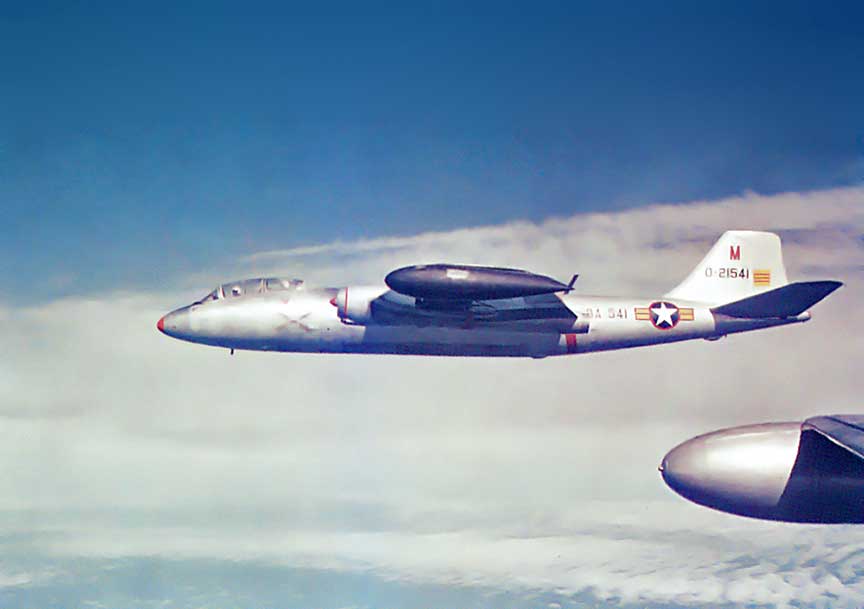
The U-2's Antecedent: The Martin RB-57D Canberra

In the early 1950s the Strategic Air Command asked Martin, the American license builder of the English Electric Canberra as the B-57, if a modified version of the B-57 could be built that would operate at altitudes in excess of 60,000 as a reconnaissance aircraft. Though not as radically modified as the better-known RB-57F (which were stock B-57s modified by General Dynamics), the RB-57D was unique in its own right and set the stage for high-altitude reconnaissance operations by its successor, the Lockheed U-2. To operate in the rarefied air of the stratosphere, the most noticeable change in the RB-57D was its enlarged wing which resulted in an increase in wingspan from 64 feet in the standard B-57 Canberra to 106 feet. Special lightening measures were taken from skinning over the bomb bay doors to reduce weight and the bomb bay was used to house the reconnaissance equipment. In addition, enlarged nacelles replaced the B-57's Wright J65 engines with Pratt & Whitney J57s (as were used on the KC-135) which offered a 6,000 lb thrust increase and better high altitude performance. 

Despite the massively enlarged wing, an empty RB-57D weight not much more than an empty B-57 due to the lightening measures taken. The most extreme measures were taken with the wings which were thin metal honeycomb sections that formed a full wet wing (even in the leading edges). To avoid the weight of rivets, the wings were assembled with a special glue and the wing skin was waxed for aerodynamic smoothness. With a surface skin of only 0.010 inch thick, even dropping a small tool on the wing could damage the skin. Even deicing fluid used on the aircraft could potentially cause the glue used to lose strength!

Only twenty RB-57Ds were built, but they were built in four groups, each group had a unique set of mission equipment and capabilities that were practically custom-made for missions in specific parts of the world. The first group of RB-57Ds were called "Group A" and "Group B" and only differed in the Group A aircraft being capable of inflight refueling. Four optical cameras were carried in the forward fuselage and a large optical viewfinder was installed in the cockpit for the pilot to use for both navigation and as a viewsight for the cameras. Thirteen aircraft (seven and six respectively) were built to Group A and Group B standards.

The next version was the single Group D RB-57D built which was also single seat and designed for electronic reconnaissance with a nose mounted radar and SLAR built into the lower sides of the fuselage. Capable of inflight refueling, the sole Group C aircraft flew most of its missions over Europe, using its powerful SLAR to peek deep into the Soviet bloc. 

The final variant were the six Group C RB-57Ds which were two seaters with a pilot and electronic warfare officer. These RB-57D were designed as electronic ferrets to collect enemy radar emissions for later analysis in the development of electronic countermeasures. These aircraft were also capable of inflight refueling. 

In 1956 the newly-formed 4028th Strategic Reconnaissance Squadron was assigned to the 4080th Strategic Reconnaissance Wing to operate the unique RB-57Ds. In the space of a year the 4028th SRS would be moved from Lockbourne AFB in Ohio, to Turner AFB in Georgia, and finally settled down at Laughlin AFB in Del Rio, Texas. Despite being moved three times, the squadron would become fully operational with its first six RB-57Ds only 120 days from the delivery of its first RB-57D. Those first six aircraft, all Group A RB-57Ds, deployed to Japan in late 1956 for reconnaissance missions over what is presumed to be China, North Korea and the Soviet Union. A year after the Japan deployment, three of the Group A RB-57Ds were sent to Taiwan wearing Republic of China markings for further missions over China during the Taiwan Straits Crisis. Flown by USAF pilots, two Taiwanese pilots were preparing to fly RB-57D missions after only 30 days of training, but the plans came to end when both the People's Republic of China and Taiwan began dogfighting each other over the Taiwan Straits. 

In  1958 the first atmospheric samplings missions were flown by RB-57Ds in support of nuclear testing in the Marshall Islands, the high flying capability of the RB-57Ds allowed them to get particle samples from high in the atmosphere as part of the post-detonation analysis. At the same time, Several Group B and the sole Group D aircraft were deployed to Europe for missions over Eastern Europe. 


The pace of missions put a strain on the delicate wings of the RB-57D and the first aircraft were put into storage by SAC following two incidents when the wings outboard of the engine nacelles cracked and fell off during landing. Martin had designed the wings for only 500 flight hours and many of them had already exceeded that limit but strategic necessity resulted in the RB-57Ds still flying missions. At this point the USAF was planning for the arrival of the Lockheed U-2 and the Air Defense Command took over the remaining RB-57Ds to act as high altitude targets for the supersonic interceptor force. Fitted out with electronic countermeasures, the 4677th Defense Systems Evaluation Squadron at Hill AFB, Utah, was formed to operate 12 of the 20 RB-57Ds. Martin modified the wings to extend their surface life. However, the high flying capabilities of the RB-57Ds meant that the 4677th DSES was always asked to send aircraft in support of nuclear testing. 

By 1963 wing structural problems cropped up again when one of the RB-57Ds lost its wing at 50,000 feet. But the ADC still needed a high altitude target aircraft and since the last US atmospheric nuclear test had taken place in 1962, Martin agreed to modify the remaining RB-57Ds for another 3,000 flight hours. Upgrades to the electronic countermeasures to challenge the ADC interceptor crews resulted in these aircraft being designated EB-57Ds and they served in this role along with other testing roles until the mid-1970s. 

The big wing and engine power of the RB-57Ds in many ways prepared pilots for what it would be like to fly the Lockheed U-2. On takeoff, only 50% engine power was necessary for takeoff which only needed a ground roll of about 2,000 feet. Climbing at 25-30 degrees, the RB-57Ds could reach 50,000 feet in only 15 minutes. Maximum cruise altitude was 65,000 feet and the pilots wore full pressure suits that were improved for the U-2 and SR-71 programs. With over 200 gallons less than a stock B-57, the RB-57D could fly twice the duration, approximately seven hours compared to four hours for a B-57. Landing was challenging as the big wing didn't lose lift easily. Even with the engines at idle, it was still too much power for landing. Even with the spoilers out and landing gear extended, the plane still had a very low sink rate and pilots resorted to actually holding the RB-57Ds into a series of slight stalls to get the aircraft down to the runway!

Source: Martin B-57 Canberra: The Complete Record by Robert C. Mikesh. Schiffer Military History Press, 1995, p132-141.


16 August 2010

The Very Brief Career of the B-57 with the VNAF

In April 1964 the 8th Bomb Squadron and the 13th Bomb Squadron arrived at Clark AB in the Philippines as tensions in Indochina began to escalate. The Gulf of Tonkin incident was still four months away when the Martin B-57 Canberra jet bombers of the two squadrons took up residence at Clark. In the following month, it was decided that a select group of three South Vietnamese Air Force (VNAF) officers led by Major N. N. Bien would begin introductory training on the B-57 with the two USAF squadrons at Clark. At the time there was a great deal of hesitation on the part of the administration of President Lyndon B. Johnson on supplying the B-57 to the VNAF as it was thought that it would unnecessarily escalate tensions in the area. Despite the prejudicial stereotypes of many USAF personnel of the day on the quality of the pilots of the VNAF, this first group of three pilots turned out to be remarkably proficient and experienced in combat operations as they had all flown combat missions in A-1 Skyraiders and had jet experience from their flight training in France. 

As this first group of VNAF pilots were winding up their training at Clark AB, the Gulf of Tonkin incident took place in August 1964 that would bring American combat forces into direct confrontation with the North Vietnamese for the first time. The 8th BS and 13th BS alternated rotations to Bien Hoa AB outside of Saigon and the presence of the B-57s was thought might offset the presumed presence of North Vietnamese Ilyushin Il-28 light jet bombers. The next group of three VNAF pilots were then slated to take "Familiarization Training" with whichever USAF B-57 unit was on rotation at Bien Hoa who would fly their B-57s to Tan Son Nhut Airport in Saigon. Unlike the first three VNAF officers who were proved to be highly competent, this next group of three pilots were more for show than anything else as they were the flamboyant General Nguyen Cao Ky, head of the VNAF (and later Premier of South Vietnam), and two officers that were subordinates of General Ky, one in charge of Ky's security and the other in charge of the VNAF command post in Saigon. Their training was considerably abbreviated and consisted of only three days of ground school, a day and a half of aircraft familiarization on the ramp at Tan Son Nhut, and another three to four days of flying with an American pilot in the back seat of the B-57. As as typical for General Ky, on the the completion of their "training" he took the USAF instructors tiger hunting on elephants in the Central Highlands of South Vietnam!

It wasn't until August 1965 that the formal announcement was made that the B-57 was going to be operated by the VNAF. At a formal ceremony on 9 August 1965 at Tan Son Nhut, a USAF B-57 was flown in and repainted with VNAF insignia and a prominent South Vietnamese flag on the tail. The "U.S. Air Force" titles were removed but were obvious from the shiny areas left behind where the lettering had been buffed off. This B-57 was displayed with all the various armament stores it could carry, including one inadvertently armed 500-lb bomb! Before the ceremony, three dual trainer B-57Cs were flown in from Clark AB in the Philippines and repainted with VNAF markings. General Ky, who by now was the Premier of South Vietnam, and the previously trained pilots were given quick familiarization training to perform a fly-by during the ceremony. Having taken off before the ceremony, each pilot had an American instructor in the back seat. During the formation fly-by, Ky himself had to relinquish control of "his" B-57 to his instructor as he had not been present during all of the previous day's familiarization training. After a spirited fly by and landing, once the B-57Cs landed and were at the far end of the runway and out of sight of the assembled guests, the USAF instructor pilots climbed out of their back seats and the three jets were taxied to the ceremony area by their VNAF pilots and Premier Ky, which of course had the desired propaganda effect. As soon as the ceremony ended, the three B-57s had their USAF markings reapplied and were flown back to Clark AB. 

Major Bien of the VNAF, officially in charge of the VNAF portion of the B-57 training, brought another group of 12 pilots and 12 navigators to Clark to begin actual bona fide training in the B-57. Of historical interest, there were also two Philippine Air Force navigators in the group as well as a "gesture of thanks" to the Philippine government for allowing their country to serve as a vital rear logistics area for the war effort. As each VNAF pilot and navigator completed their training at Clark, they were then sent to Bien Hoa with either the USAF 8th Bomb Squardon or the 13th Bomb Squadron (whoever was on rotation at the time) and were paired up with either experienced USAF pilots or navigators to fly combat missions. There were VNAF-marked B-57s based at Bien Hoa AB, but they were few in number and always flown under USAF command.
At this point Premier Ky felt that the VNAF B-57 program was not getting the visibility he desired and wanted in order to boost the morale of the South Vietnamese military. On 29 October 1965, the Armed Forces Day for South Vietnam, five B-57s were flown in from Clark and repainted in VNAF markings. Fully armed and fueled and crewed entirely by USAF personnel, the five Canberras took off from Da Nang, struck a suspected Viet Cong base and then flew 300 feet at nearly 300 knots up the main boulevard in Saigon and over the Presidential residence. This gave Premier Ky his propaganda coup even though not one crewman on that mission was a VNAF officer!

Despite this, morale amongst the VNAF contingent in the Philippines was low and USAF instructors were constantly being frustrated by the lack of discipline of the second group which included frequent claims of illness and even complaints about the extreme maneuvers needed in exploiting the B-57's strengths. Matters came to a head when one VNAF pilot crash landed his B-57 at NAS Cubi Point while doing touch-and-gos. But before the issue of morale and discipline could be sorted out, the charismatic leader of the VNAF contingent, Major Bien, was killed in a freak accident when his B-57 diverted to Pleiku AB. Unable to restart his engines due to the inexperienced VNAF ground crew installing the engine starter cartridges incorrectly, the ground crew elected to manually push his B-57 to another area of the ramp for further attention. Unfortunately, the engines powered the hydraulic system and the brakes were inoperable. The ground crew lost control of the B-57 and in an effort to avoid getting injured, Major Bien jumped from the open cockpit only to be run over by one of the main wheels. 

With Major Bien's death, the rest of the VNAF contingent at Clark refused to continue with the B-57 program and the USAF closed down the VNAF B-57 program on 20 April 1966, only seven months after the program was publicly announced. The remaining VNAF B-57s were repainted in USAF markings and returned to service with the 8th and 13th Bomb Squadrons in USAF markings and American crews. The most potent aircraft that the VNAF had been given had been an utter failure, a victim of political grandstanding by the South Vietnamese government. 

Source: Martin B-57 Canberra: The Complete Record by Robert C. Mikesh. Schiffer Military History Press, 1995, p99-104.