Showing posts with label B-26 Marauder. Show all posts

07 May 2015

The North American XB-28: Too Much, Too Late

The sole XB-28 prototype. Note the remotely operated turrets.
With the North American B-25 Mitchell prototype (internal company designation NA-40B) already in the hands of the US Army Air Corps for flight testing in 1939, the promise of cabin pressurization offered a leap in bomber performance by being able to fly higher and faster. Accordingly, in August 1939, the Army issued the XC-214 specification which called for a pressurized medium bomber to supplant the medium bomber types that were soon to become operational. Only Martin and North American responded to XC-214. Martin's submission was for the XB-27 but the USAAC felt Martin didn't have a full grasp of the challenges of high altitude pressurization in their design and North American's submission, the XB-28 won the development contract. This took place on 15 November 1939 just three months after the Army issued its specification with North American inking a contract to begin formal design work on the XB-28. To give you an idea of the pace of development and the pressure of the looming clouds of war, the contract for the development of the XB-28 was signed around the same time that the Army ordered the B-25 Mitchell into production! The XB-28 had started out as a pressurized version of the B-25 Mitchell with a circular fuselage and Pratt & Whitney R-2800 Double Wasp engines with GE Type-C turbosuperchargers replacing the Wright R-2600 Twin Cyclone radials used on the B-25. Design work proceeded rapidly since the company was already at work on a pressurized successor to the B-25 at the time of the release of the XC-214 specification in August 1939. As design work progressed, changes were made stating with abandoning the Mitchell's twin fins for a single fin. Eventually the XB-28 as designed bore little resemblance to the Mitchell. The contract for three prototypes was signed on 13 February 1940. 

The five crew all sat in a pressurized compartment in the forward fuselage. 
Besides the change to more powerful R-2800 Double Wasp engines with GE turbosuperchargers, a third supercharger was also fitted to provide cabin pressurization. Heaters powered by gasoline warmed the air in the pressurization ducting for the pressure cabin located in the the forward fuselage. The elongated nacelles had an opening in the rear for the turbo-supercharger exhaust which added some forward propulsive power. The four bladed propellers were counter-rotating to cancel each other's torque to ease handling. Integral self-sealing fuel tanks took up most of the wings. Relatively unique for the day nose wheel steering was fitted and controlled by a lever in the cockpit similar to modern nose wheel tillers. Another unique feature was the use of fluorescent paint on the instrument panel and instruments that would glow at night from overhead UV lamps as an aid to night flying.

Overall configuration of the XB-28.
To simply the structure of a pressurized aircraft, the pressure cabin only occupied the forward fuselage. All the joints were sealed during assembly and the interior sprayed with a plastic sealant before installation of the cabin items. The cabin atmosphere was maintained at the equivalent of 8,000 feet up to an operating altitude of 33,000 feet. The crew of five was crammed into this space- with the pilot and co-pilot sitting side by side, behind them sat the primary gunner and the radio operator/secondary gunner. The bombardier/navigator sat in the nose compartment but could access the cramped flight deck via a floor panel by the co-pilot's feet. The bomb bay could carry up to 4,000 lbs of bombs and the three defensive turrets consisted of twin 50-caliber guns in dorsal, ventral and tail turrets that were operated remotely by the primary gunner and the radio operator/secondary gunner. Each gunner had a hemispheric observation window next to them and sighted the guns via a periscope system that protruded from streamlined twin fairings above and below the fuselage just aft of the flight deck. Initial plans for were for North American-designed turrets tied to a Sperry fire control system, but Sperry's resources were tied up with current production aircraft. It was decided to switch to General Electric for the remote fire control system and to have them be responsible for the turrets as well well. This imposed delays in the development as changes needed to be made to accommodate GE's equipment and systems. There was also a prevailing opinion at North American that Sperry's system was more advanced. A compromise was reached with the XB-28 defensive systems to use GE turrets and the Sperry sighting system. It's worth noting at this point that when the work on the remote turret fire control system on the XB-28 was under development, both Sperry and GE were working on getting the contract for the remote turret fire control system on the Boeing B-29 Superfortress- ironing out the kinks in the XB-28 gave GE valuable experience that helped the B-29 and made its system the production standard on the Superfortress.

Engine run up test at Mines Field in the summer of 1942.
The US entry into the Second World War slowed development of the XB-28 as priority shifted to production types and much of North American's resources were devoted to the production of the B-25 Mitchell and the P-51 Mustang. The maiden flight of the first prototype took place on 24 April 1942 at Mines Field (the site of today's Los Angeles International Airport/LAX) and the flight test program showed the XB-28 to be quite fast at high altitude, capable of 372 mph at 25,000 feet. Following the conclusion of North American's flight test program, the USAAF portion of the flight test program took place with the XB-28 operating out of Wright Field outside of Dayton, Ohio, for service trials. It was decided during the service trials that the third XB-28 prototype would be completed as a reconnaissance and photo-mapping aircraft designated XB-28A. North American was instructed to set aside work on the second XB-28 to get the XB-28A variant flying. The speed and altitude performance of the XB-28A was increased by reducing weight as well as installing more powerful versions of the R-2800 engines. The XB-28A made its maiden flight on 24 April 1943 (exactly one year after the first XB-28) but was unfortunately lost in flutter incident during dive testing on 4 August 1943 with the crew able to parachute to safety. At the time of the accident, design work on the production B-28 was underway with the most significant change being some extra scanning windows on the nose compartment for the bombardier/navigator.

By this point, however, it was realized that despite the outstanding performance of the XB-28, the realities of war showed that medium bombers already in service like the B-25 Mitchell and the Martin B-26 Marauder were most effective at low to medium altitudes flying interdiction missions where pressurization wasn't necessary. In the Pacific, B-25s equipped with extra forward firing machine guns were becoming very effective low level anti-shipping weapons while in the European theater, B-25s and B-26s operated most effectively at medium altitude (though some low level anti-shipping missions were flown in the Mediterranean against Axis vessels along the French and Italian coasts). The final nail in the XB-28's coffin was the Douglas product that was also first flown at Mines Field just a few months after the XB-28's maiden flight. The prototype Douglas XA-26 Invader first flew on 10 July 1942. It used the same engines as the XB-28, carried the same bomb load, but lacked pressurization which made it simpler to build and it only had a crew of three versus the crew of five on the XB-28. The sole XB-28 prototype was still at Wright Field at the time of the program's cancellation- it had its outer wings removed and sat out the war as a ground test article for pressurization tests before being scrapped.

Anigrand released a 1/72 resin kit of the XB-28 and this page has a great series of photos of a completed model that show the overall configuration of the XB-28. Take note of the hemispheric scanning bubbles on the upper lateral fuselage ahead of the wing for the gunners as well as the streamlined twin fairings above and below the forward fuselage for the sighting system to control the remote turrets.

Source: American Bomber Aircraft Development in World War 2 by Bill Norton. Midland Publishing, 2012, pp 66-69. Photos: USAF Museum, Anigrand


07 June 2010

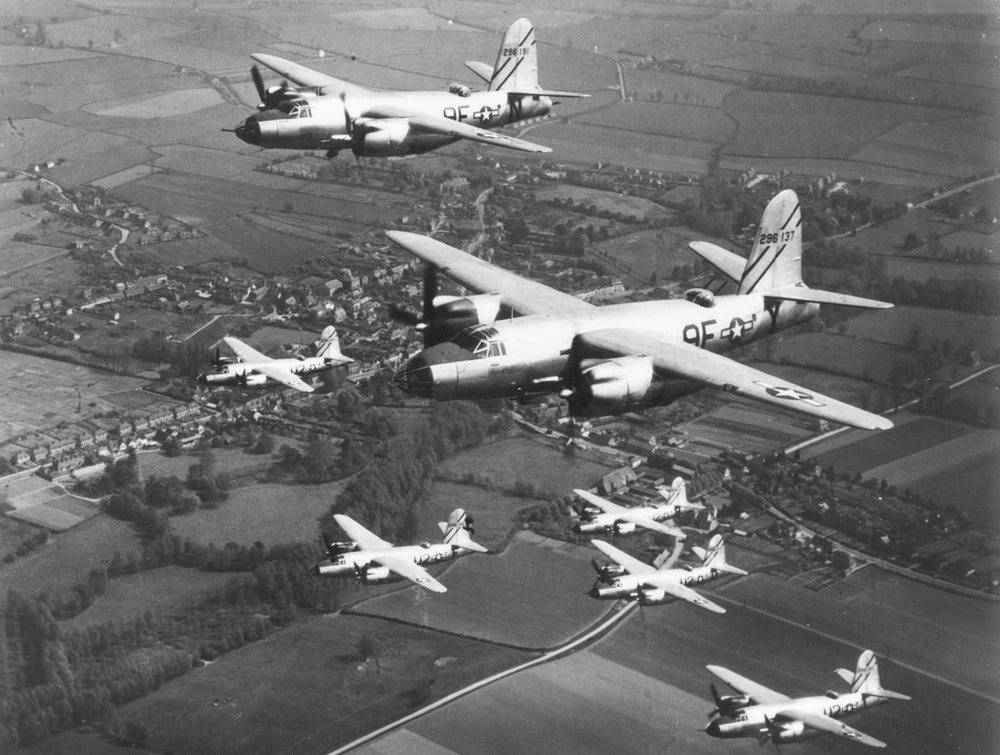
The Martin B-26 Marauder medium bomber was built in two locations in the United States during the Second World War- at the main Martin plant at Middle River outside of Baltimore, Maryland, built 3,681 B-26s and the Omaha, Nebraska, plant, built 1,585 Marauders. Designed by Peyton Magruder, who at the time he was placed in charge of the B-26 program by Glenn Martin he was only 26, the B-26 Marauder started once it won the Army competition for a medium bomber in July 1939. The prototype rolled out at the Middle River plant on 25 November 1940 and made its first flight that day. The first production Marauders were already flowing to USAAF combat units in February 1941.

Marauders were blighted early on by numerous crashes caused by pilot inexperience but would go on to fly over 110,000 missions in the Second World War with a combat loss rate of only 0.5%, the lowest of any Allied bomber of the war.

But there were a lot more things that made the B-26 Marauder a milestone in aviation history that aren't as well known to the annals of history:

-It was the first Allied bomber type in Europe to complete 100 missions, a B-26 named "Mild and Bitter" with a mission against the Luftwaffe airfield at Evreaux, France on 9 May 1944.

-It was also the first Allied bomber type to complete 200 missions, a famous B-26 named "Flak Bait" that completed its 202nd mission in May 1945 before the German surrender.

-It was the first US Army Air Forces bomber to use aerial torpedoes during the war- a two-thousand pound naval torpedo could be slung under the fuselage from an external rack (most torpedo missions were flown in the Pacific).

-It was the first twin engine medium bomber to be able to carry a greater bomb payload than the Boeing B-17 Flying Fortress, the heavyweight of the day.

-It was the first US Army Air Forces aircraft to use external gun pods- two self-contained 50-caliber machine guns were mounted two to each side of the forward fuselage for ground strafing.

-It was the first bomber to have an all-plexiglass nose which happened to be a Martin innovation in shaping plexiglass into the necessary aerodynamic curves.

-It was the first combat aircraft to use butt seams for the skin rather than overlapping seams. This improved the aerodynamics of the bomber by reducing drag.

-It was the fist bomber to use an all-electric bomb release mechanism.

-It was the first US combat aircraft with self-sealing fuel tanks, another Martin innovation which was called "Mareng Cells"- short for Martin Engineering.

-It was the first bomber to use flexible tracks to bring ammunition from its storage boxes in the mid-fuselage bomb bay to the tail gunner's position. And the maker of those flexible tracks? Lionel. Of Lionel trains fame.

-It was the first combat aircraft to substitute plastic for metal in over 400 components for weight savings.

Source: Raise Heaven and Earth: The Story of Martin Marietta People and Their Pioneering Achievements by William Harwood. Simon & Schuster, 1993, p193-212.

16 November 2009


In the summer of 1944 the German forces in Italy were holding a defensive position called the Gothic Line that ran across the Italian peninsula across the Apennine Mountains south of Bologna. Most of the Allied sorties of the MATAF (Mediterranean Allied Tactical Air Force) were focused on the Gothic Line itself but on July 11, a combined offensive headed by Martin B-26 Marauders of the MATAF codenamed Operation Mallory Major sought to break the logistical support of the Germans.

Named for Major William N. Mallory of the Twelfth Air Force who conceived of the plan, Operation Mallory Major was one of the first applications of what today war planners might call "shock and awe". The Germans had massive supply dumps north of the Po River and OSS agents had determined that 22 major bridges across the Po River were virtually undefended and it was across these road and rail bridges that the Germans were supplying the Gothic Line.

The genius of Mallory's plan was to hit all 22 bridges in short span of time before the Germans would realize what was going on and deploy anti-air assets to protect the bridges. With good weather, two B-26 Marauder bomb wings flew 300 missions a day and in the first two days, 11 of the 22 bridges were destroyed and four days after the start of the operation, all 22 bridges were knocked out, cutting off the Gothic Line from their supply bases north of the Po River. For another 12 days, the medium bomber force of the MATAF revisted several bridges to insure that they weren't repaired and put back into use. Although the Germans reinforced the bridge defenses, it was too late as the volume of traffic that could cross the Po had slowed to a trickle, hastening the defeat of the Germans in northern Italy.

Major William Mallory would be awarded the Legion of Merit for his plan but tragically he died when the plane returning him to the United States crashed.

Source: Aviation History, November 2009. "Operation Mallory Major- A Twelfth Air Force intelligence officer came up with a daring plan to cripple Axis supply lines in northern Italy" by Joseph Connaughton, p40-43.