Showing posts with label Vietnam. Show all posts

18 January 2016

The Bomber Career of the Douglas A-3 Skywarrior, 1955-1968

Douglas ad for the A-3 Skywarrior
The origins of the Douglas A-3 Skywarrior lay in a 1948 Navy requirement for a jet-powered, carrier-based, nuclear attack bomber. Even though at the time, the Navy's first purpose-built carrier bomber capable of nuclear attack, the North American AJ Savage, was in the midst of flight testing, the Navy had set its eyes on a more capable successor aircraft that could carry a 10,000 lb nuclear bomb over a combat radius of 2,000 miles. The planned operating weights of the new jet bomber would limit its use to the new 61,000-ton super carrier USS United States as it was too large to operate off the Essex-class carriers and even the much larger Midway class carriers. The program was seen as the most challenging of the Navy's postwar aircraft programs and the VAX(H) Program only received two formal submissions- one from Douglas and the other from Curtiss-Wright. Headed by the legendary designer Ed Heinemann who was already widely regarded for his work on the SBD Dauntless and the AD Skyraider, the Douglas team emphasized that a smaller aircraft was possible that could meet the stringent requirements of the VAX(H) specification. Heinemann championed a smaller aircraft that could also operate safely from the 45,000-ton Midway class carriers as well as even the smaller 29,000-ton Essex class carriers and still accommodate a notional 10,000 lb nuclear weapon. 

The preliminary Douglas designs were for a twin jet aircraft that was less than half the planned operating weight limit set by the Navy's Bureau of Aeronautics. BuAer felt that the nuclear attack mission required an aircraft of 200,000 lbs weight but Ed Heinemann felt that he could meet the mission requirements with an aircraft only 70,000 lbs at maximum operating weight. Naturally his design was met with considerable skepticism within the Navy but Heinemann's planning for a more flexible design not limited to super carriers was validated with the 1949 cancellation of the USS United States. Given that the Douglas submission could also operate off smaller carriers made it the winner of the VAX(H) competition. 

VAH-4 Skywarrior pilot. Note the set back B/N console.
(Wikipedia)
The prototype A3D Skywarrior took the air for the first time on 16 September 1953. Initially low-powered with the troublesome Westinghouse J40 turbojet, the Navy wisely switched the more powerful and widely used Pratt & Whitney J57 engine. A three year flight test program ensued and proved the Skywarrior able to safely operate not just off the super carrier decks of the United States' replacement, the Forrestal class, but also the Midway and Essex classes as well that had been duly upgraded with angled decks and steam catapults. The crew of three consisted of the pilot on the left side, the bombardier/navigator (B/N) on the right side and slightly more aft than the pilot, and the plane captain/navigator who sat behind them facing aft who controlled the twin 20mm cannon in the tail. The cannons proved to be a maintenance nightmare and were all removed from the Skywarrior flight between 1960 and 1961 and replaced with a dovetail or "duck butt" fairing that contained electronic warfare gear. 

The first production Skywarriors weighed in at 43,000 lbs empty, the maximum weight for a catapult launch was 73,000 lbs, and the maximum landing weight was 50,000 lbs. In 1959 an A3D-2 was catapulted from the USS Saratoga with a weight of 84,000 lbs, setting a record that still stands for the heaviest aircraft to be catapulted from an aircraft carrier. 

The first Skywarrior squadron was Heavy Attack Squadron ONE (VAH-1) established on 1 November 1955 a NAS Jacksonville, followed by VAH-3 on 1 June 1956. "Heavy One" went to sea first aboard the USS Forrestal in October 1956, followed by a Mediterranean deployment in January 1957. "Heavy Three" went to sea next, embarked aboard the USS Franklin D. Roosevelt for a Mediterranean cruise in July 1957. Getting used to operating the A3D took a lot of work given it's size which gave it its nickname "Whale". In the first full year of fleet deployments, there were seven flight deck accidents that cost the lives of nine crew. One of the main issues with the high accident rate was that many A3D crew came from the land-based patrol community as it was assumed they were most experienced at handling large aircraft. Turns out, it was carrier experience that was needed as well as more standardized training. As new Skywarrior squadrons were established, they were assigned to NAS Jacksonville to pool experience and training. Eventually Heavy Attack Wing ONE moved to NAS Sanford north of Orlando. By 1958, the accident rate was dropping significantly with the influx of personnel experienced in carrier jet operations. Previously the Navy preferred to keep its carrier air wings united at a single base, but the Skywarrior community set the pattern for the future, for the first time the Navy based all of one aircraft type together at a single base at NAS Sanford. 

With the new A3D-2 variant entering service to replace the earlier A3D-1, a second Skywarrior base for the Pacific Fleet was established at NAS Whidbey Island in Washington. Heavy Attack Wing TWO was set up in Washington, having previously been based at NAS North Island when its heavy attack squadrons flew the AJ Savage. Even numbered VAH squadrons were with the Pacific Fleet, odd numbered VAH squadrons were with the Atlantic Fleet in Florida. The first Pacific Fleet deployment was carried out by VAH-2 aboard the USS Bon Homme Richard in July 1957. Interestingly at the time, there were no Forrestal class carriers assigned to the Pacific Fleet, so nearly all of the Pacific Fleet Skywarrior cruises at the time were done aboard the small Essex-class carriers.

Special nuclear storage facilities were set up on the carriers where the nuclear weapons were stored, guarded by special Marine detachments. Alert aircraft on the carrier deck were also guarded by Marines. Essex class carriers carried three A3D-2s, nine to eleven A3D-2s were embarked on the Midway class and full twelve-aircraft squadrons were sent aboard the Forrestal class decks when they were finally assigned to the Pacific Fleet.  While tanking and conventional bombing were routinely practiced, they were considered secondary to the nuclear deterrent mission. At any given time, a carrier with Skywarriors aboard had at least one or two aircraft armed and on alert for immediate launch. Alert Skywarriors were sometimes kept in the hangar deck near an elevator for immediate movement to the flight deck. The Skywarrior's preferred nuclear attack profile was to make the run into the target at low level at 520 knots. Once the B/N had the target on his radar, the A3D would pull up at 2.5Gs at full throttle, pitching up to 60 degrees climb to release the weapon. After release, the Skywarrior would roll 120 degrees, still pulling 2.5Gs, and hit the deck to egress the target area to escape the nuclear blast. 

By 1960, NAS Whidbey Island was home to five A3D Skywarrior squadrons- four operational squadrons and one training squadron. The last of the Skywarriors were delivered in January 1961, from a production run of 283 aircraft. The zenith of Skywarrior operations was in mid-1961 when there were 227 aircraft in service. With the entry into service of the Polaris sea-launched ballistic missile (SLBM) in 1961, the nuclear deterrent mission of the Skywarrior and its replacement, the supersonic North American A3J (designated A-5 after 1962) Vigilante, was soon to end. The Skywarrior units with the Atlantic Fleet based at NAS Sanford transitioned to the Vigilante, the first fleet deployment taking place in 1963 aboard the USS Independence. By 1965-1966, there were no more Skywarriors with the Atlantic Fleet as all the squadrons in Florida had converted to the Vigilante, leaving NAS Whidbey Island in Washington as the center of the Skywarrior's world with four operational squadrons, VAH-2, -4, -8, and -10, with VAH-123 acting as the training squadron. 

VAH-4 Skywarrior in a shallow dive bombing run
(Skywarrior Association)
On the night of the Tonkin Gulf incident on 2 August 1964 that set in motion the long US involvement in the Vietnam War, VAH-4 had three A-3B Skywarriors embarked on the USS Ticonderoga and twelve A-3Bs with VAH-10 aboard the USS Constellation. The A-3B (as the A3D-2 was redesigned after 1962) could carry up to 8,000 lbs of conventional bombs. Usually the high drag box fin Korea-era bombs were carried as most could fit in the A-3B's bomb bay. The low drag Mark 82 series bombs were reserved for aircraft that had to carry their bomb loads externally. The first bombing missions by Skywarriors in Vietnam were carried out by VAH-2 in 1964 which was uniquely split between two aircraft carriers, the USS Ranger and the USS Coral Sea. Many Skywarrior missions going into 1965 were level bombing runs at night using radar. Most Skywarriors did dual roles, both tanking and bombing. During VAH-2's marathon 331-day deployment 1964-1965, the unit's A-3Bs flew 4900 hours, dropped over 400,000 lbs of bombs, and offloaded over 4 million pounds of fuel. 

During 1966-1967, many of the targets in the North weren't good radar targets for the Skywarrior. Driven as well by concerns about the A-3B's survivability in the increasingly lethal air defenses of North Vietnam, Skywarrior squadrons shifted Viet Cong targets in South Vietnam as well as missions against the Ho Chi Minh Trail in Laos. But there was a problem. If the juicy targets in North Vietnam weren't very good radar targets, how much better was a target somewhere in the jungles of South Vietnam and Laos? The Skywarrior crews adopted dive bombing, attacking in 30-degree dives. While it wasn't anything new as it had been done in exercises in the past, the A-3B lacked an optical sight for dive bombing. Skywarrior pilots resorted to grease pencil marks on the windscreen, some used the refueling probe as an improvised aim point in their dive attacks. The pilots began their attack runs at 8,000 to 10,000 feet, pulling out at 3,000 feet to avoid light caliber anti-aircraft guns and to avoid over stressing the aircraft. More enterprising units resorted to bolting gunsights from A-1 Skyraiders to the glare panel and one unit even got its hands on some gunsights from A-4 Skyhawks. Some Skywarrior missions involved leading groups of A-4 Skyhawks on level bombing runs, the Skyhawks dropping on command from the A-3B's B/N. 

A steeper bombing attack by the Skywarrior over Vietnam
(Skywarrior Association)
A usual A-3B bombing mission involved both bombing and tanking. A Skywarrior would launch, refuel aircraft in the departing strike package, then go on its own bombing mission. On return to the carrier, it would refuel the next outgoing strike package before recovering. When not loaded with bombs or a tanker package, the bomb bay could carry critical spare parts, mail and other high priority items. It was common for a spare A-3B to be sent to NAS Cubi Point in the Philippines for critical aircraft spare parts or get sent to Japan to pick up combat pay for the ship's crew. 

The Skywarrior's role in Vietnam as a bomber began to wind down in late 1967 as it was deemed that its air refueling role was a more vital mission and that more capable, more survivable attack aircraft like the Grumman A-6 Intruder and Vought A-7 Corsair were available. The last bombing missions were carried out in 1968. But there is an oft-repeated apocryphal story amongst Skywarrior veterans of Vietnam that General William Westmoreland, commander of US forces in Vietnam, himself ordered an end of A-3 bombing missions. The story goes that he was shocked when visiting an aircraft carrier that Skywarriors were providing close air support to Army troops "without the benefit of a proper gunsight". 

Nearly every aircraft carrier that participated in Vietnam had A-3 Skywarriors aboard, mostly as tankers, bombers until 1968, and later in the war, in reconnaissance and electronic warfare roles. Just in the bomber/tanker roles, Skywarrior squadrons made 62 combat cruises in Southeast Asia, ranging from three-aircraft detachments on the Essex class to full twelve-aircraft squadron deployments on the larger super carriers. Sixteen different aircraft carriers operated Skywarriors in Vietnam, only the USS Intrepid and USS Saratoga never operated Skywarriors during the war. Six Skywarriors were lost in combat, twelve were lost to operational accidents in the theater, and 35 crew were lost. 

Related reading:


Sources: A-3 Skywarrior Units of the Vietnam War by Rick Morgan. Osprey Combat Aircraft No. 108, Osprey Publishing, 2015, pp8-30. Strike From the Sea: US Navy Attack Aircraft from Skyraider to Super Hornet 1948-Present by Tommy Thomason. Specialty Press, 2009, p75-87.

05 February 2011

One Powerful Helicopter Gunship- the ACH-47A "Guns A-Go-Go"

The weapons loadout of the ACH-47A Chinook gunship
After years of experimentation with armed helicopters, the US Army finally sent armed Bell UH-1B Huey gunships into combat in October 1962 with the rocket/gun armed Hueys acting as escort for Piasecki CH-21 Shawnee transports out of Tan Son Nhut Air Base in Saigon. Despite the growing success of the armed Hueys in the growing conflict in Vietnam, the Army sought a helicopter that offered even more firepower to replace the Huey gunships. Initial evaluations began in 1964 and even despite the selection of the Bell AH-1 Cobra (the world's first dedicated helicopter gunship design) in 1966, the general staff wanted something with even more firepower than the Cobra gunship as it was felt to only be an interim design pending what the Army felt was the ultimate gunship, the Lockheed AH-56 Cheyenne. While the Army pushed for a large gunship based on experiences in Vietnam, it found itself running into opposition from the USAF which felt its traditional domain of fixed wing close-air support being infringed upon by more capable helicopter gunships. Regardless, combat experience proved to be a powerful argument and the existing Hueys were felt in certain situations lacking in firepower. With the Army due to deploy the Boeing Vertol CH-47 Chinook transport helicopter to Southeast Asia in November 1965, Boeing Vertol submitted a formal proposal to the Army to modify eleven Chinooks into heavy gunships and on 2 July 1965 the first test Chinook was diverted from the production line in Philadelphia for conversion into the prototype ACH-47A. 

The heavy lift capability offered by the twin turbine-powered Chinook allowed for many choices of possible armament systems, weapons loads, and self-protection. No concept was considered too outlandish as even manned turrets and stub wings for mounting weapons were considered. The eventual weapons fit of the ACH-47A became the XM5 40mm grenade launcher in a turret in the nose fed by a flexible belt that ran through the cockpit to the forward cabin where a container holding 500 rounds was located; a 30-inch stub wing on each side of the forward sponsons that at the end mounted an M24A1 20mm cannon, each fed by an 800-round container in the middle cabin; under each stub wing was a pylon that could mount either a 19-round 2.75-inch rocket launcher or a pod-mounted 7.62mm rotary Minigun. In addition to these permanently mounted systems, there were five crew-operated 50-caliber gun stations- forward right side, forward left side, right and left waist, and cargo ramp. The waist and forward stations had enlarged openings to allow a wider field of fire and the top half of the cargo ramp was removed to expand the rearward field of fire. Each 50-caliber gun had its own 1,000 round supply. With the five gunner stations, the ACH-47A would be the only helicopter gunship to fly into combat with a full 360-degree field of fire. 

Two ACH-47As during the flight test program. Note the gloss paint scheme.
Despite the removal of items not needed for the gunship mission (items like the troop seats, cargo handling gear, even soundproofing), over 2,500 lbs went back into the ACH-47A for armor plating for the crew, rotor pylons, and vital systems. The standard Lycoming T55 turboshaft engines were uprated to 2,850 hp each compared to 2,200 hp for the standard CH-47A transport. This meant that a fully-loaded ACH-47A had the same performance as a operationally-loaded CH-47A. The first ACH-47A made its maiden flight at the Boeing Vertol plant in Philadelphia on 6 November 1965, only four months after the work began! After flight testing, the first ACH-47A was delivered to the Army for weapons trials at Aberdeen Proving Ground in Maryland and then to Fort Benning, Georgia for operational training in March 1966. At Fort Benning, the 53rd Aviation Detachment, Field Evaluation (Provisional) was formed for the training and operation of the ACH-47A and in April 1966 three more ACH-47As arrived, but due to budgetary constraints, only four ACH-47As could be built and delivered. The first one, 64-13145, was initially named "Crazy 8" but was renamed "Cost of Living". 64-12149 became "Easy Money", 64-13151 was named "Stump Jumper" and the last one, 64-13154, was named "Birth Control". The last three shipped out to Vietnam in May 1966 while "Cost of Living" remained at Edwards AFB for more testing. 

"Easy Money" resting between missions at An Khe
The six-month period of operational testing would be split between Vung Tau in the southern coast one hour downriver from Saigon and at An Khe in the centeral highlands of South Vietnam. At Vung Tau the ACH-47As would operate not just with American units fighting the Viet Cong but also the Royal Australian Task Force. At An Khe, the ACH-47As operated with the 1st Cavalry Division. At both locations the 53rd Aviation Detachment remained the operator and acquired the nickname "Guns A-Go-Go" as a result of the heavy firepower of the Chinook gunships. Troops in contact with enemy forces favored the ACH-47As for their firepower and 360-degree field of fire. On 5 August 1966, "Stump Jumper" was destroyed in a freak accident at Vung Tau when it collided while taxiing with a transport CH-47A. The ACH-47A that was still at Edwards AFB "Cost of Living" conducting advanced testing was then prepared for deployment to replace the destroyed "Stump Jumper". One of the missions assigned exclusively to the ACH-47As was to go into an area that had just been carpet bombed by a B-52 Arc Light strike and finish off any enemy positions that survived the bombing. It was considered heavily armed enough and heavily protected enough to be able to finish off the job left by an Arc Light strike!

At the end of the test period in December 1966, "Cost of Living" arrived in Vietnam and the 53rd was redesignated the 1st Aviation Detachment (Provisional) attached to the 1st Cavalry Division at An Khe. Enemy forces became reluctant to fire upon any Chinook after a while because at a distance, the ACH-47A was hard to distinguish from a standard CH-47A transport Chinook. On 5 May 1967 while on an attack run, a retention pin on the stub wing of "Cost of Living" came loose and allowed the gun to elevate and fire into the forward rotors, causing the gunship to crash with the loss of all onboard. The two remaining ACH-47As, "Easy Money" and "Birth Control", however, kept flying as the need for their firepower was highly desired by troops in contact. The end of the Chinook gunship program came during the 1968 Tet Offensive at the Battle of Hue. On 22 February 1968, "Birth Control" was forced down due to multiple hits after an attack run in low ceiling conditions. Autorotating into a rice paddy near the walls of the Citadel in the ancient city of Hue, the crew started taking heavy fire from the Citadel area. "Easy Money" made several attempts to land and rescue the crew of "Birth Control", but the ground fire was too intense. "Easy Money" finally landed, but overshot and found itself between the Citadel and "Birth Control". Two UH-1 Huey gunships unleashed 76 2.75-inch rockets into the source of the enemy fire, allowing "Easy Money" to struggle airborne with the crew from "Birth Control". Before the downed ACH-47A could be recovered, it was destroyed by enemy mortars. Since the tactics called for the ACH-47As to operate in pairs, "Easy Money" never flew into combat again as no Chinooks were available for conversion as every one was needed for transport duties in Vietnam. With the number of Bell AH-1 Cobra gunships increasing in Vietnam, "Easy Money" sat out the rest of the war as a maintenance trainer at Vung Tau.

The logo of "Guns A-Go-Go
"Easy Money" ended up in the boneyard at Savannah Army Depot. Boeing had evaluated the airframe for possible conversion to the prototype CH-47D, but it was found to be too corroded to be of any use. It was moved to Fort Eustis where it was used as a sheet metal trainer before it was moved to the base scrapyard. It's historical identity was discovered in 1997 when the "Easy Money" name was uncovered under layers of paint. The aircraft was duly restored and is now on display at Redstone Arsenal, in Alabama. In 2006, the 160th Special Operations Aviation Regiment "Nightstalkers" at Fort Campbell, Kentucky, set up a new battalion at Fort Lewis, Washington, to serve special operations units based on the West Coast for operations in the Pacific. Equipped with the advanced MH-47G Chinook, the unit approached the veterans of the 53rd "Guns A-Go-Go" for permission to resurrect the unit designation, patch, and "Guns A-Go-Go" call sign- which of course was agreed to with enthusiasm!

I highly recommend you visit a tribute website to the ACH-47A and "Guns A-Go-Go"!

Source: Helicopter Gunships: Deadly Combat Weapon Systems by Wayne Mutza. Specialty Press, 2010, p41-55.


29 January 2011

The First Operational Helicopter UAV: DASH and the Gyrodyne QH-50

The Kaman HTK-1, forerunner of the DASH
In the years following the end of the Second World War, the Soviet Navy expanded its submarine force considerably to offset the powerful surface fleet of the United States Navy. In response to this growing threat, the Chief of Naval Operations at the time, Admiral Arleigh Burke, envisioned a two-layer stand-off system to knock out Soviet subs. The innermost layer of defense consisted of the ASROC weapons system. ASROC (Anti-Submarine ROCket) consisted of a solid rocket motor booster that lofted a Mk 44 torpedo on a ballistic trajectory to the suspected location of the enemy submarine. Later versions of ASROC could deliver a nuclear depth charge or the Mk 46 torpedo. However, ASROC only had a range of five miles and the launch and control system couldn't be readily added to the existing fleet of World War II-era destroyers. As a result, the second outer layer of defense became the DASH system- Drone Anti-Submarine Helicopter. At the time, funding was hard to come by given the limits of the technology of the day until aeronautical engineer Charles Kaman proved that a remotely-controlled drone helicopter could be stably operated with his own HTK-1 test drone, based on the HTK helicopter trainer. The transition to turbine power improved the capability of Kaman's tests when a QH-43G Huskie was successfully tested from the USS Wright (CVL-49) and the USS Mitscher (DL-2), proving that a drone helicopter could be operated from warships. Secret tests at the time with the QH-43G showed that not only could a warload be carried and delivered, but dunking sonar could be used as well as communication to friendly subs. Kaman's tests proved that DASH would work as the outer defense layer against the Soviet threat. As a result, in 1958, the Navy invited submissions from industry for the DASH contract. 

The final round in the competition left Bell, Kaman, and Gyrodyne standing- and to the surprise of many who expected Kaman to win, Gyrodyne was selected the winner in December 1958. Gyrodyne already had a contract with the Navy dating from 1951 to study the co-axial rotor arrangement which the Navy felt offered promise as it was compact compared to conventional helicopter designs (the same reason that the Russians went with Kamov co-axial designs for their shipboard helicopters). The founder of Gyrodyne, Peter Papadakos, started the company in 1946 when he acquired the assets of the Bendix Helicopter Company which included an unfinished design for a one-man helicopter which he finished and perfected as the Rotorcycle. At one point, the US Marine Corps was considering acquiring the Rotorcycle as a one-man reconnaissance vehicle- and this undoubtedly won Gyrodyne the DASH competition as the company's design was based on the Rotorcycle- and having flying hardware that was more compact that Kaman's designs won the contest for Papadakos and Gyrodyne. 

DASH QH-50 recovering aboard the USS Allen M. Sumner
To make the Gyrodyne design as compact and light as possible, many safety and redundancy systems used on manned helicopters were dispensed with and the first versions of what would become the QH-50 weighed only 1,200 lbs and used a Volkswagen automobile engine. The initial plans were for the QH-50 to be essentially disposable in delivering a nuclear depth charge to the target. However, the need for extensive security and safety measures made storing nuclear depth charges on the modernized destroyers impractical, so a single Mk 44 torpedo became the DASH weapons load. The first shipboard landing was made on 1 July 1960 aboard the USS Mitscher with a safety pilot cumbersomely strapped to a bicycle seat behind the rotors! The first unmanned landing was made in 7 December 1960 aboard the USS Hazelwood (DD-531). Following development testing off the coast of Key West, Florida, the QH-50 was upgraded  in 1962 to use a more powerful Boeing T50 turbine engine which increased the warload to two Mk 44 torpedoes. After having been impressed by a DASH demonstration, in 1963 President John F. Kennedy authorized deployment of the system to provide two helicopters and associated equipment (hangar, control center, transmitting/receiving antennas) for the 240 destroyers upgraded to FRAM I and FRAM II standards (Fleet Rehabilitation And Modernization).

Project Snoopy QH-50 showing the underslung tray of equipment
The simplicity of the QH-50 and the DASH system (lack of redundancy) proved to be its weakness- without feedback from the QH-50, the ship's radar had to be used to track its location. If there was an equipment failure in any of the electronics, the drone would be lost. As a result, of the 746 QH-50s produced for the US Navy, fully 80% were lost due to electronics failures! By 1966, Secretary of Defense Robert McNamara pushed for a reduction in DASH funding as the growing conflict in Vietnam was consuming a significant portion of the US defense budget. Given that the submarine threat was nil during Vietnam, the Navy and Gyrodyne were eager to show that the QH-50 could perform other roles. Under Project Snoopy in 1967, QH-50s were modified with telemetry and transmission systems in a tray underslung where the torpedoes were usually carried. A television camera was also mounted in the tray and the Project Snoopy drone were used in Vietnam operationally to spot the fall of naval gunfire on enemy targets. Under a series of DARPA programs code named "Blow Low", "Night Panther", and "Night Gazelle", armed QH-50s were flown operationally in Vietnam. Some of the helicopters carried bombs to attack enemy river shipping and some QH-50s also flew with a TV-camera-aimed 40mm grenade launcher. Another operational test program fielded in Vietnam had QH-50s carrying underslung cargo loads to resupply Special Forces units deep in enemy territory. Of all the QH-50s produced for the US Navy, 5% were lost in combat action in Vietnam. 

The last QH-50 was delivered to the US Navy in August 1969 and the only foreign operator of the DASH system was Japan, which took delivery of 18 helicopter drones for service from seven destroyers in their fleet. The last Project Snoopy missions in Vietnam were flown in 1970, after which most DASH systems had been phased out from the fleet with the introduction of Kaman SH-2 Seasprite as LAMPS- Light Airborne Multi Purpose System- that offered greater manned capability from ships too small to operate the larger Sikorsky SH-3 Sea King. The US Army at White Sands Missile Range and the US Navy at the Naval Air Weapons Station at China Lake gave the QH-50 a new lease on life flying test and research missions and ending their days as targets in anti-helicopter trials. The last QH-50 mission was flown in 2006 by the US Army at White Sands, New Mexico. As a result, Gyrodyne has claim to first and so far only production and operationally-deployed helicopter UAV until the deployment of the Northrop Grumman MQ-8 Firescout in 2009. 

Source: Helicopter Gunships: Deadly Combat Weapon Systems by Wayne Mutza. Specialty Press, 2010, p97-101.

16 September 2010

The First USAF Recon Missions in SE Asia

Following the partition of Vietnam in 1954, North Vietnam increased its support of not just the Viet Cong insurgency in the south but also provided support to the Pathet Lao insurgency in Laos. With the increase in activity of the Pathet Lao in the latter half of the 1950s, the Laotian government in Vientiane needed more information on the disposition and activities of the insurgents but the air arm of the nation lacked any sort of reconnaissance capability. As a result, the Vientiane government turned to the United States for assistance. At the time, the international commission (the ICC) that was overseeing the partition and planned reunification of Vietnam had strict rules about the activity of combat aircraft over Laos. So the first efforts consisted of a camera-equipped Douglas C-47 that was "assigned" to the US air attache in Saigon and Vientiane. As the C-47 flew between the two cities it was "assigned" to, it would fly over suspect Pathet Lao enclaves. This continued until February 1961 when the aircraft got shot down in the highlands in the northern part of Laos. 

As a result, President John F. Kennedy asked for more effective measures to be put in place to keep an eye on Pathet Lao activities. In April of that year, the Pacific Air Forces (PACAF) asked for volunteers from the two McDonnell F-101 Voodoo squadrons in the area, the 15th TRS at Kadena AB and the 45th TRS at Misawa AB. The recon pilots had to have recent Lockheed T-33 experience. Two pilots, Captain Bob Caudry and Lieutenant Fred Muesegaes, volunteered and were flown to Clark AB, Philippines, the headquarters of PACAF, to begin briefings of their top secret mission code named "Operation Field Goal". 

Operation Field Goal was made up initially of the two Voodoo pilots, five enlisted men, a crew chielf, and an additional officer to command the operation. A single Lockheed RT-33 was assigned to the project. The RT-33 was a hybrid of the T-33 trainer with the camera nose of the RF-80 Shooting Star. With an uprated jet engine and an additional fuel tank in place of the rear seat, Operation Field Goal was then moved from Clark AB to RTAFB (Royal Thai Air Force Base) Udorn in the northern part of Thailand, a short hop from the Laotian capital of Vientiane. Udorn would later in the Vietnam War become and important USAF base that would become home to several F-4 Phantom squadrons, but in 1961, Udorn hadn't changed much from its days as a Japanese Army Air Force base in World War 2. The only navaid at Udorn was a low-powered radio beacon with a range of about 25 miles, and on arrival, the RT-33 had to buzz the main runway to drive water buffalo away. 

A Marine detachment provided fuel and also built a tent city at Udorn (the first US presence at this base aside from the irregular operations of CIA-run Air America). Both Caudry and Muesegaes developed their own procedures for operating the RT-33 from the primitive base, right down to their own approach procedures for use in bad weather. A US Military Advisory Group in Vientiane tasked the RT-33 missions and at the end of each flight, the film was flown by an Air America helicopter to Vientiane for development and analysis. The pilot on that mission often accompanied to film to assist the photo-interpreters. 

Captain Bob Caudry flew the first Operation Field Goal mission on 24 April 1961, first overflying the Plain of Jars at 20,000 feet before making a low level run at 200 feet of a major road in an insurgent-held area of Laos. A total of sixteen missions with good intelligence were flown until 10 May 1961 when the ICC demanded the flights over Laos stop. Given the primitive nature of the RTAFB Udorn at the time and the grueling nature of the recon missions, Operation Field Goal moved to Don Muang Airport in Bangkok with plans of resuming the missions from there once the ICC lifted its ban. The ban did get lifted finally on 9 October 1961 and the Field Goal missions resumed, this time flying from Bangkok northward to Laos. Upon return to Bangkok, the RT-33 was then flown by non-recon pilots to deliver the aircraft and its film to the photo-analysts who were no longer in Vientiane but moved to RTAFB Udorn. On 5 November 1961 the last Field Goal recon mission was flown and all subsequent reconnaissance missions were now assigned to a detachment of four McDonnell RF-101C Voodoos that were assigned to Tan Son Nhut Airport in Saigon under Operation Pipe Stem. 

Subsequent reconnaissance efforts were now flown by regular USAF units, but the work done with that RT-33 resulted in the RT-33 being marketed by Lockheed to foreign air forces needing an inexpensive jet reconnaissance capability. 

Source: Voodoo Warriors: The Story of the McDonnell Voodoo Fast Jets by Nigel Walpole. Pen and Sword, 2007, p159-165.

18 August 2010

The Australian Canberra in Vietnam

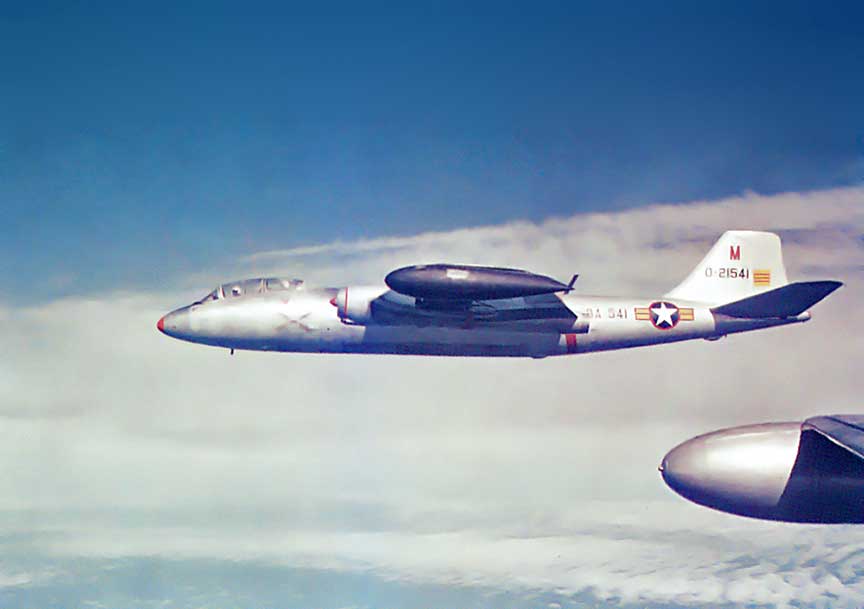
Monday I'd posted about the South Vietnamese Air Force's brief, if not flawed, operation of the Martin B-57 Canberra during the Vietnam War. They weren't the only nation outside of the United States to operate the Canberra in Southeast Asia. In 1967, the English Electric Canberra Mk.20s of the Royal Australian Air Force's No. 2 Squadron arrived at Phan Rang AB, which at the time was home to the USAF Martin B-57 operation under the aegis of the 35th Tactical Fighter Wing (an F-100 Super Sabre outfit). At the start of combat operations, the eight Canberras were assigned to night attack missions where they made bomb drops from 20,000 feet under direction of the Combat Sky Spot ground radars that would direct the bombers when to make their drop. While the strikes were very accurate and effective, a better role was soon found for the Australians. 

By mutual agreement with the Seventh Air Force and No. 2 Squadron, the RAAF Canberras would mount eight sorties a day against up to 16 targets, seven days a week. All the targets were within South Vietnam to minimize the anti-air threat and make best use of the Canberra's visual bombing equipment. Their radio call sign in Vietnam was "MAGPIE" from the squadron's crest. As the Australians were trained exhaustively on visual bombing, most of the targets assigned to No. 2 Squadron were in the Mekong Delta region. Often the targets were shifted to targets of opportunity spotted by airborne forward air controllers and with the Canberras at altitude, little to no warning proceeded the bombing runs as the bombardiers used Second World War-vintage precision visual bomb sights to hit targets from 20,000 feet that were normally hit at lower altitudes by USAF crews. The Australian crews quickly developed a reputation for pinpoint bombing and were the only combat aircraft in the entire Vietnam theater for the entire duration of the war that employed level bombing with visual bombsights from altitude. 

By 1969 approximately 70% of No. 2 Squadron's targets were in the Mekong Delta where the level visual bombing technique was best suited. With most of the Delta region flat and at sea level, it made the job on the Canberra's bombardier easier. Since the English Electric Canberra Mk.20 didn't have underwing hardpoints like the USAF B-57s, the wing tip tanks were removed and replaced with bomb racks to supplement the bomb bay load. Since most of the targets weren't far from Phan Rang AB, the extra fuel in the tip tanks wasn't needed. 

On 3 November 1970, after three and a half years of combat operations without a single loss, the first RAAF Canberra was lost on a Combat Sky Spot radar bombing mission near Da Nang. MAGPIE 91, flown by Flight Officer Michael Herbert with Pilot Officer Robert Carver as bombardier, executed a near perfect bomb drop from 22,000 feet at night and were lost without a trace after their run. On 14 March 1971 another RAAF Canberra was lost to a SAM missile while on a mission to the northwest corner of South Vietnam. Although the crew were rescued the following day, the Seventh Air Force directed that no aircraft should operate near known SAM zones without adequate electronic countermeasures equipment. By 1971 nearly all of the northern quarter of South Vietnam had been infiltrated by NVA units with portable surface-to-air missiles. By this point in the war, the USAF B-57 operation was winding down and with the 35th Tactical Fighter Wing leaving Phan Rang as part of the "Vietnamization" of the war, there was no point in No. 2 Squadron remaining behind. 

No. 2 Squadron flew its last combat mission in Vietnam on 31 May 1971, making it the 11,963 mission flown by the Australian Canberras in Southeast Asia. Within a week the Canberras were refitted with their wing tip tanks and returned to RAAF Amberly via Darwin to become a reconnaissance and target towing squadron that would eventually be disbanded in 1982. In 2000, the RAAF reformed No. 2 Squadron to operate the Boeing 737 AEW&C Wedgetail. 

Source: Martin B-57 Canberra: The Complete Record by Robert C. Mikesh. Schiffer Military History Press, 1995, p116-119.


16 August 2010

The Very Brief Career of the B-57 with the VNAF

In April 1964 the 8th Bomb Squadron and the 13th Bomb Squadron arrived at Clark AB in the Philippines as tensions in Indochina began to escalate. The Gulf of Tonkin incident was still four months away when the Martin B-57 Canberra jet bombers of the two squadrons took up residence at Clark. In the following month, it was decided that a select group of three South Vietnamese Air Force (VNAF) officers led by Major N. N. Bien would begin introductory training on the B-57 with the two USAF squadrons at Clark. At the time there was a great deal of hesitation on the part of the administration of President Lyndon B. Johnson on supplying the B-57 to the VNAF as it was thought that it would unnecessarily escalate tensions in the area. Despite the prejudicial stereotypes of many USAF personnel of the day on the quality of the pilots of the VNAF, this first group of three pilots turned out to be remarkably proficient and experienced in combat operations as they had all flown combat missions in A-1 Skyraiders and had jet experience from their flight training in France. 

As this first group of VNAF pilots were winding up their training at Clark AB, the Gulf of Tonkin incident took place in August 1964 that would bring American combat forces into direct confrontation with the North Vietnamese for the first time. The 8th BS and 13th BS alternated rotations to Bien Hoa AB outside of Saigon and the presence of the B-57s was thought might offset the presumed presence of North Vietnamese Ilyushin Il-28 light jet bombers. The next group of three VNAF pilots were then slated to take "Familiarization Training" with whichever USAF B-57 unit was on rotation at Bien Hoa who would fly their B-57s to Tan Son Nhut Airport in Saigon. Unlike the first three VNAF officers who were proved to be highly competent, this next group of three pilots were more for show than anything else as they were the flamboyant General Nguyen Cao Ky, head of the VNAF (and later Premier of South Vietnam), and two officers that were subordinates of General Ky, one in charge of Ky's security and the other in charge of the VNAF command post in Saigon. Their training was considerably abbreviated and consisted of only three days of ground school, a day and a half of aircraft familiarization on the ramp at Tan Son Nhut, and another three to four days of flying with an American pilot in the back seat of the B-57. As as typical for General Ky, on the the completion of their "training" he took the USAF instructors tiger hunting on elephants in the Central Highlands of South Vietnam!

It wasn't until August 1965 that the formal announcement was made that the B-57 was going to be operated by the VNAF. At a formal ceremony on 9 August 1965 at Tan Son Nhut, a USAF B-57 was flown in and repainted with VNAF insignia and a prominent South Vietnamese flag on the tail. The "U.S. Air Force" titles were removed but were obvious from the shiny areas left behind where the lettering had been buffed off. This B-57 was displayed with all the various armament stores it could carry, including one inadvertently armed 500-lb bomb! Before the ceremony, three dual trainer B-57Cs were flown in from Clark AB in the Philippines and repainted with VNAF markings. General Ky, who by now was the Premier of South Vietnam, and the previously trained pilots were given quick familiarization training to perform a fly-by during the ceremony. Having taken off before the ceremony, each pilot had an American instructor in the back seat. During the formation fly-by, Ky himself had to relinquish control of "his" B-57 to his instructor as he had not been present during all of the previous day's familiarization training. After a spirited fly by and landing, once the B-57Cs landed and were at the far end of the runway and out of sight of the assembled guests, the USAF instructor pilots climbed out of their back seats and the three jets were taxied to the ceremony area by their VNAF pilots and Premier Ky, which of course had the desired propaganda effect. As soon as the ceremony ended, the three B-57s had their USAF markings reapplied and were flown back to Clark AB. 

Major Bien of the VNAF, officially in charge of the VNAF portion of the B-57 training, brought another group of 12 pilots and 12 navigators to Clark to begin actual bona fide training in the B-57. Of historical interest, there were also two Philippine Air Force navigators in the group as well as a "gesture of thanks" to the Philippine government for allowing their country to serve as a vital rear logistics area for the war effort. As each VNAF pilot and navigator completed their training at Clark, they were then sent to Bien Hoa with either the USAF 8th Bomb Squardon or the 13th Bomb Squadron (whoever was on rotation at the time) and were paired up with either experienced USAF pilots or navigators to fly combat missions. There were VNAF-marked B-57s based at Bien Hoa AB, but they were few in number and always flown under USAF command.
At this point Premier Ky felt that the VNAF B-57 program was not getting the visibility he desired and wanted in order to boost the morale of the South Vietnamese military. On 29 October 1965, the Armed Forces Day for South Vietnam, five B-57s were flown in from Clark and repainted in VNAF markings. Fully armed and fueled and crewed entirely by USAF personnel, the five Canberras took off from Da Nang, struck a suspected Viet Cong base and then flew 300 feet at nearly 300 knots up the main boulevard in Saigon and over the Presidential residence. This gave Premier Ky his propaganda coup even though not one crewman on that mission was a VNAF officer!

Despite this, morale amongst the VNAF contingent in the Philippines was low and USAF instructors were constantly being frustrated by the lack of discipline of the second group which included frequent claims of illness and even complaints about the extreme maneuvers needed in exploiting the B-57's strengths. Matters came to a head when one VNAF pilot crash landed his B-57 at NAS Cubi Point while doing touch-and-gos. But before the issue of morale and discipline could be sorted out, the charismatic leader of the VNAF contingent, Major Bien, was killed in a freak accident when his B-57 diverted to Pleiku AB. Unable to restart his engines due to the inexperienced VNAF ground crew installing the engine starter cartridges incorrectly, the ground crew elected to manually push his B-57 to another area of the ramp for further attention. Unfortunately, the engines powered the hydraulic system and the brakes were inoperable. The ground crew lost control of the B-57 and in an effort to avoid getting injured, Major Bien jumped from the open cockpit only to be run over by one of the main wheels. 

With Major Bien's death, the rest of the VNAF contingent at Clark refused to continue with the B-57 program and the USAF closed down the VNAF B-57 program on 20 April 1966, only seven months after the program was publicly announced. The remaining VNAF B-57s were repainted in USAF markings and returned to service with the 8th and 13th Bomb Squadrons in USAF markings and American crews. The most potent aircraft that the VNAF had been given had been an utter failure, a victim of political grandstanding by the South Vietnamese government. 

Source: Martin B-57 Canberra: The Complete Record by Robert C. Mikesh. Schiffer Military History Press, 1995, p99-104.

06 July 2010

The Navy Diversion for the Son Tay Prison Raid

My blog posting yesterday about the Son Tay prison raid made mention of a Navy diversionary strike that allowed the raiders to sneak into North Vietnam nearly unopposed. One month before the Son Tay raid in November 1970, the main architects of the raid, Colonel Arthur "Bull" Simons and USAF Brigadier General Leroy Manor, visited Vice Admiral Frederic A. Bardshar. Admiral Bardshar was the commander of Task Force 77, the main aircraft carrier group of the Navy's Seventh Fleet and responsible for combat operations in Southeast Asia. Together the three men developed an ingenious deception plan to be carried out by Navy aircraft the night of the Son Tay raid.

President Lyndon B. Johnson declared a bombing halt on 31 October 1968 on all targets north of the 17th Parallel (the DMZ between North and South Vietnam). The purpose was two-fold, to tempt the North Vietnamese to the negotiating table at the peace talks in Paris and to help support the presidential campaign of Vice President Hubert Humphrey who was running against Richard Nixon in the 1968 elections. While neither plan worked for Johnson, Richard Nixon left the bombing halt in place as part of his plan to draw down US forces in Vietnam. By the time of the Son Tay raid in November 1970, a major Navy air strike had not taken place on North Vietnam (though there were numerous reconnaissance flights and reactionary attacks to protect those missions) for two years. With the Son Tay raiders entering North Vietnam via the "back door" through Laos, the US Navy's plan was to create as much havoc and panic amongst the North Vietnamese air defense system as possible to divert their attention to the east.

On the night of the raid, the three aircraft carriers Oriskany, Ranger, and Hancock launched a total of seven Grumman A-6 Intruders, twenty Vought A-7 Corsair IIs, eight McDonnell Douglas F-4 Phantom IIs, four Vought F-8 Crusaders, six ECM jamming aircraft and another fourteen support aircraft. The Crusaders and Phantoms were armed with air-to-air missiles to deal with any MiGs that rose up that night but the only offensive weapons carried by the rest of the Navy diversion force were AGM-45 Shrike anti-radar missiles. Instead of bombs, they also carried photoflash bombs and long-duration flares. The force crossed the beach "feet dry", creating a massive set of radar tracks that caused near-panic amongst the North Vietnamese as such a large force hadn't entered the area for two years.

This way, the Son Tay raiding force entering from Laos, were it to be detected that night, would have looked like a combat search-and-rescue force operating in support of what the North thought was a major strike against targets in the previously forbidden zone. Many of the Navy pilots found the mission bizzare but at the time of their preparations, launch, and execution of their vital mission, they were all on a "need to know basis" and it was only upon their return to the carriers of Task Force 77 in the Tonkin Gulf that they were informed of the role they played in supporting the Son Tay raid.

Source: Beyond Hell and Back: How American's Special Operations Forces Became the World's Greatest Fighting Unit by Dwight Jon Zimmerman and John D. Gresham. St. Martin's Griffin Press, 2007, p21-60.

05 July 2010

Operation Kingpin: The Son Tay Prison Raid

Operation Kingpin, the raid on the Son Tay prison in North Vietnam, was the largest and most complex special operations mission of the Vietnam War. It would be a joint operation with the Army, Navy, and Air Force with 59 men led by the legendary Col. Arthur "Bull" Simons in the actual ground team that would enter Son Tay. One-hundred sixteen aircraft from the USAF and the US Navy participated, with the Navy aircraft flying from three aircraft carriers to conduct diversionary operations to allow the Son Tay raiders to sneak into North Vietnam from Laos.

On the night of 20 November 1970, the Kingpin force had departed RTAFB Takhli in Thailand just north of Bangkok. After a rendezvous over Laos for aerial refueling, the raiding force itself consisted of the following elements:
  • Cherry 1: Lockheed C-130E (Raid force mission leader)
  • Cherry 2: Lockheed C-130E (Mission leader for the Douglas A-1 Skyraiders flying close air support as Peach flight)
  • Banana 1: Sikorsky HH-3E Jolly Green Giant (Assault team, they would intentionally crash land in Son Tay's courtyard)
  • Apple 1, 2, and 3: Sikorsky HH-53 Super Jolly (Assault team)
  • Apple 4 and 5: Sikorsky HH-53 Super Jolly (POW transport)
  • Peach 1-5: Douglas A-1 Skyraider (Close air support)
  • Falcon 1-10: McDonnell Douglas F-4 Phantom II (MiGCAP)
  • Firebird 1-5: Republic F-105G Thunderchief (Wild Weasel SAM suppression)
In addition to the raiding force, a multitude of other tankers, early warning aircraft and Navy combat aircraft were assigned vital supporting roles to make Operation Kingpin possible. For at least a year up to the actual raid on Son Tay, the prison complex was a high-priority reconnaissance target imaged by both spy satellites and Lockheed SR-71 Blackbird flights as analysts and planners set about determining the forces defending Son Tay as well as the routines of the personnel and prisoners of the complex. Something as simple as laundry hanging out in the prison courtyard offered valuable clues. In the last few months before the raid took place, reconnaissance had shown that the North Vietnamese had added two SA-2 "Guideline" SAM battalions to the area. Each SAM battalion was self-contained with its own radars, command and control equipment and four SA-2 missile sites, each site with six launchers and 12 missiles. With two of these battalions in the area, that meant eight SAM sites would be defending the prison complex. And these SAM sites were often protected by a large number of mobile antiaircraft guns.

To meet this dangerous threat to the aircraft of the Kingpin raiding force, the 6010th Wild Weasel Squadron flying the SAM-site killing F-105G Thunderchief were added to the raiding force to knock out the missile sites. Firebird 1 through 3 would accompany the raiders all the way to Son Tay and orbit the area, knocking out the SAM sites as their radars went active. Firebird 4 and 5 were to act as spare aircraft in case anything happened to either Firebird 1, 2 or 3 during the mission.

As the assault teams hit the ground, the SAM site radars went active and the first of 18 SA-2 missiles were fired during the raid- but only two of them targeted (and missed) the helicopters, A-1 Skyraiders or the C-130s acting as mission command posts. The rest of those SAMs bored in on the F-105s of Firebird flight. Firebird 3 took a hit but was able to disengage and its crew were able to nurse the damaged aircraft to RTAFB Udorn in Thailand. As Firebird 3 disengaged, Captain Don Kilgus and his back seat electronic warfare officer (EWO, or "Bear"), Captain Clarence Lowery in Firebird 5 were called into action to duel with the SAM sites. One missile managed to detonate close to Firebird 5, but Capt. Kilgus felt their F-105G wasn't damaged seriously and he and his EWO pressed their attack, knocking out the site that had fired the offending missile.

Unbeknown to the raiders, the POWs at Son Tay had been moved the previous August to a new facility 12 miles away called Camp Faith. The POWs there were awakened by the sounds of the SAM launches trying to down the raiding force. Some weren't able to see out their barred windows but the prisoners on the west side of the building could see the flares, the SAM detonations in the sky, and the explosions by Peach flight's close air support strikes. Word spread amongst the POWs "They're raiding Son Tay!"

Disappointed having not found and rescued any POWs at Son Tay, the raiding force withdrew from the area in less than 26 minutes. Not a single man was killed and only two were wounded. The 59 men and their support aircraft had managed to kill 200-300 enemy troops.

As Firebird 5 withdrew with the rest of the F-105Gs from the raiding force, Capt. Kilgus realized their were losing fuel. And they were losing it fast. The near-miss by the SA-2 detonation had showered their aircraft with shrapnel and punctured nearly all the aircraft's fuel tanks. With the fuel loss too great to be offset by tanking from an orbiting KC-135, Kilgus and Lowery were forced to eject over the mountains of Laos. They had managed to eject near each other and met up on the ground and began to radio their location to await rescue. As it turned out, the nearest rescue helicopters to their position were two of the returning HH-53 Super Jollies from Son Tay, Apple 4 and Apple 5. After a midair refueling from C-130 Hercules tankers, the two helicopters diverted and plucked Kilgus and Lowery from the jungle, making them the only two pilots rescued in the Son Tay prison raid.

Dejected by their failure to rescue any POWs, what wasn't immediately apparent to the men of Operation Kingpin was that their historic raid scared the Hanoi government about the strength of the resolve of the United States when it came to the POWs. Within two days POWs that were scattered across camps in North Vietnam in small groups were crowded together at the infamous "Hanoi Hilton" where the lethal air defense umbrella around the capital would prevent any future rescue attempts. Prior to Son Tay, many POWs were in isolated groups and this isolation was used as a psychological weapon by their captors. With all the POWs now in one facility, the "Hanoi Hilton" was simply too crowded for isolation to be used and the morale of the prisoners skyrocketed as they were housed together in large groups, getting moral support from each other. The men from Camp Faith shared their stories of what they had seen that November night in the skies over Son Tay and all former POWs to this day mark their time in captivity by either "before Son Tay" and "after Son Tay".

Source: Beyond Hell and Back: How American's Special Operations Forces Became the World's Greatest Fighting Unit by Dwight Jon Zimmerman and John D. Gresham. St. Martin's Griffin Press, 2007, p21-60.

30 June 2010

The X-28A Osprey, the Most Unlikely X-Plane

In 1969 homebuilt aircraft builder and boat designer George Pereira of Sacramento, California, started work on the Osprey I homebuilt flying boat. Using his technical background in powerboat design and construction, Pereira designed the Osprey I as a high-performance STOL sea plane intended for the growing homebuilt aircraft market. With folding wings, a single-seat open cockpit and able to be transported by a boat trailer, the Osprey I was made of wood, fiberglass, and styrofoam with a Continental C90 four-cylinder 90-hp piston engine mounted on a dorsal pylon driving a fixed-pitch two-bladed propeller. With one pilot and a full load of fuel, the aircraft weighed only 900 lbs and had a top speed of 135 mph. After finishing the design and construction, Pereira had to demonstrate that the Osprey I could safely be flown during an FAA mandatory 50-flight hour restricted flying period to be completed in less than six months.

Having duly met the FAA's requirements for a kitbuilt aircraft, Pereira was approached in 1971 by three Navy officials about seeing a demonstration of the Osprey and having one of their pilots checked out in the sole prototype. Pereira and later the Navy pilot operated the aircraft successfully over a three day period from the Sacramento River at which point the Naval Air Development Center informed Pereira that they were interested in the Osprey for Project Air Skimmer, a plan to deploy a simple single engine seaplane to Southeast Asia for air policing duties. The NADC's requirement called for not just an easy to build and fly aircraft but it also had to have a reasonable performance over existing kitplanes and be able to operate from the many rivers and lakes in South Vietnam's Mekong Delta region. Plans were for local manufacturer of the Air Skimmer aircraft by the South Vietnamese and that it be easy to train pilots to fly the aircraft in VFR conditions, operate from canals as little as 25 feet wide and be transportable by trailer with a maximum weight under 1,000 lbs.

Funded as the X-28A Osprey, the single prototype and its trailer were purchased by the US Navy on 27 July 1971 to be test flown from the Delaware River at the NADC's Philadelphia Naval Base. Since the test site sat under the Class B airspace of Philadelphia International Airport and the X-28A had only minimal instrumentation, it was restricted to 300 feet maximum altitude but it was felt that this wouldn't adversely affect the evaluation process. Flight tests took place between 16 September 1971 to 22 October 1971 and the X-28A was found to be easy to fly and easy to master by pilots of limited experience.

However, with the winding down of the Vietnam War, Project Air Skimmer quietly ended with no further plans for use in Southeast Asia. Pereira, however, refined the design with a two-seat enclosed cockpit and retractable landing gear as the Osprey II. First offered in kit form in 1974, nearly 600 have been built and flown. Not only will the X-plane be one of the smallest of the X-planes, it's the only homebuilt one, not to mention the only one that can still be built today by any homebuilt enthusiast of reasonable skill.

Source: The X-Planes- X-1 to X-45 by Jay Miller. Midland Publishing, 2001, p291-293.

04 June 2010

As the Vietnam War escalated in the 1960s and air crew losses began to mount to increasingly sophisticated air defenses, thoughts began to circulate in the USAF if there was a way to provide downed air crew with a better means of descent than just the winds and parachute. What if downed aircrew could have a better choice in where to land? And better yet, what if they could fly away to friendly territory? The USAF began to discuss with aircraft manufacturers and designers if there wasn't a way to package an ultralight aircraft or glider into part of the ejection seat and cockpit that would give shot-down air crew more options on bail out. Proposals were issued to the industry in 1967 and Bensen Aircraft Corporation, a well-known builder of homebuilt autogyro aircraft, submitted an unpowered version of one of their autogyros to be used as an autogyro glider. Bensen's proposals easily won the USAF over and contracts were issued in 1968 and the program received the X-plane designation of X-25A (a powered version) and X-25B (unpowered glider version). A third version called the DDV (Discretionary Descent Vehicle) was an even lighter and simpler version of the X-25B designed for one time use with automatic blade deployment to become a rotor chute even from a supersonic ejection.

The USAF took delivery of the X-25A and X-25B on 16 February 1968 and immediately embarked on a series of flights to determine the length of a pilot training cycle necessary to master the autogyro controls. The X-25A was used to power itself to an assigned altitude and then shut down its engine and autorotate. This was to determine the glide performance of the aircraft. Twenty pilots all with fixed wing experience and no rotary wing time were then checked out in the X-25B to see how easy it was to operate. All 20 pilots were able to master the X-25B within 30 minutes. The DDV was then used with anthropomorphic test dummies to measure G-loads and glide performance with an incapacitated pilot.

The winding down of the Vietnam War ended interest in the autogyro solution and it was felt that such an aircraft could be packaged to be accommodated in most combat aircraft cockpits with the current technology of the day. The X-25A is currently on display at the National Museum of the US Air Force in Dayton, Ohio, while the X-25B is at the Museum of Aviation at Warner Robbins, Georgia. The final disposition of the DDV is unknown but the X-25 will always be known as the smallest of the X-planes if not one of the most obscure.

Source: The X-Planes- X-1 to X-45 by Jay Miller. Midland Publishing, 2001, p272-275.

20 May 2010

The Flamboyant Markings of VF-51's Phantoms in Vietnam


During Operation Linebacker over Vietnam in 1972, the two McDonnell Douglas F-4 Phantom II squadrons aboard the USS Coral Sea, VF-111 "Sundowners" and VF-51 "Screaming Eagles" each had their own obstacles to overcome to become some of the premier Phantom units in Southeast Asia. VF-51, in particular, had a double uphill climb as the squadron had just transitioned from the Vought F-8H Crusader AND their new Phantoms weren't so new- they were old F-4B models that had been rejected by the Marines as unairworthy and had been left in storage at MCAS El Toro in California for years.

Many of the senior cadre of pilots at VF-51 were ex-Crusader jocks who lamented the loss of their 20mm cannon and what they perceived the hassle of having a RIO (radar intercept officer) in the back seat. "I'd rather have 500 lbs of fuel than babysit an NFO (naval flight officer, the category of flight crew that were assigned as Phantom RIOs)." The pilots resented their transition training to the Phantom with VF-121 at NAS Miramar where they had veteran RIO instructors in the back seat. "About as fun as having your mother with you on a date" complained one pilot. VF-51's commander, Tom Tucker, ordered his pilots to "dummy up" and play nice with the RIOs to make the transition as smooth as possible.

Soon the ex-Crusader jocks fell in love with their new mounts. Having more power and a better radar than the Crusader was well-appreciated and a few of the former single-seat pilots also started to like having the extra set of eyeballs afforded by the RIOs. Before long, the pilots started to have preferences for certain RIOs but the RIOs themselves were an independent minded bunch. There's an anecdotal story of one RIO teaching his pilot a lesson on crew coordination when during a training mission the RIO shut down all the key radar and avionic systems and told his pilot "Okay, badass, see how well you can fly and fight now." Since the RIO had the switches for those systems, the pilot was left with little to do but keep from crashing. So an unspoken rule developed at VF-51 that RIOs also had say in which pilots they flew with. Many of the Phantom crews ended up flying with the same pilots and RIOs through much of the Coral Sea's 1972 combat cruise.

Having to get the elderly F-4Bs up and running proved to be VF-51's other difficulty in the run up to the 1972 combat cruise. The latest production model was the F-4J which rectified many of the problems with the F-4B, but as the rapid build-up of forces under President Nixon accelerated, any and all Phantoms that could be spared were snapped up by deploying squadrons. In VF-51's case, that meant a motley assortment of hangar queens from MCAS El Toro that hadn't flown since 1968. VF-51 was given free reign to press into service any maintenance crew from any squadron at NAS Miramar to form "Tiger Teams" that worked day and night to get the F-4Bs ready for combat.

With the pilots transitioned and finally working well with their RIOs and the F-4Bs ready to head to war, the only thing left was the come up with new squadron markings for VF-51's mounts. One of the squadron ensigns was sent to a corrosion control and painting course at NAS North Island and he had figured out which panels were opened up the most during routine combat operations. Squadron markings were devised that avoided these panels so they scheme stayed intact and it was one of the most flamboyant Phantom markings to go to sea- what rival squadrons called the "Supersonic Can Opener" was a bright eagle marking with tail feathers that splayed out on the rear fuselage. Even the main landing gear doors were painted with full color eagle talons.

Some of the Miramar command staff told VF-51 that the only thing their Phantoms were missing now were mudflaps and a raccoon tail attached to an aerial! One of the future MiG-killers of VF-51, CDR Jerry "Devil" Houston, recounted in an interview that while other squadrons were looking at ways to tone down their markings and even conceal their aircraft, for morale they wanted VF-51's markings "to be audacious; we wanted to be a magnet for MiGs...intruders in our airspace didn't have to speculate about who just whipped their ass."

Sister squadron VF-111 on the Coral Sea in response adopted an equally flamboyant sunburst tail marking for their 1972 combat cruise as well.

Source: Gray Ghosts: US Navy and Marine Corps F-4 Phantoms by Peter E. Davies. Schiffer Publishing, 2000, p151-153.

08 April 2010

Operation Carolina Moon: Bridge Busting with the C-130


One of the toughest targets in North Vietnam during the long war there was the Thanh Hoa Bridge over the Song Ma River. The bridge was a massive steel truss and concrete structure that carried a railroad down the center and a two lane road way on each side and was a major supply choke point from Hanoi and the harbor of Haiphong. Crossing the river at its narrowest point, sharp limestone ridges on each side gave it the nickname Ham Rong, or "Dragon's Jaw" as the American pilots referred to it. Because of its strategic nature on the supply route to the battlefields along the DMZ and to the Viet Cong in South Vietnam, the Thanh Hoa Bridge was a significant target and was recognized as such by the North Vietnamese who protected the area with some of the densest antiaircraft defenses outside of Hanoi and Haiphong.

Despite the initial attacks by F-105s from bases in Thailand, the bridge which was over-engineered, refused to drop. One USAF attack had 79 aircraft of varying times involved at the same time and yet the bridge still stood. Late that year the Armaments Development Laboratory at Eglin AFB in Florida had been doing research on using high-explosive weapons that focused their energy- similar to a scaled up version of a shaped charge used in anti-tank warfare. The command staff of the Pacific Air Forces running the USAF air campaign in Vietnam was notified of the possible destructive power of these new weapons, but they could only be carried by cargo aircraft and the only suitable would be the Lockheed C-130 Hercules. Since the AA defenses of the Thanh Hoa Bridge were so intense, a plan was formulated to have C-130s drop the weapons up river and let them float down to the bridge and detonate. The opeation was given the code name Carolina Moon.

Two experienced crews were chosen from the 314th Troop Carrier Wing at Sewart AFB, Tennessee. One crew was led by Major Richard Remers and the other crew was led by Major Thomas Case, both crews from the 61st Troop Carrier Squadron.

On 30 May 1966, Remer's crew took off first in a C-130E from Da Nang AB just after midnight local time. With a crew of seven, they flow at 100 feet above the South China Sea and then turned in towards the target area, remaining at 100 feet. There were two navigators aboard Remer's Hercules and there were two drop zones upstream from the Thanh Hoa Bridge selected. The first one was 2 miles up river and the second one was just a mile up river. Upon reaching the first point and meeting no resistance, Remer pressed on the the next drop point. Soon anti-aircraft gunfire opened up across the river valley but the successfully dropped their five Carolina Moon weapons in the river and flew all the way back to Da Nang on the deck, rarely exceeding 100 feet.

The following day reconnaissance photos showed the bridge still standing so that night, the second mission led by Major Case took off just over a hour after midnight from Da Nang. As with the previous night's mission with Major Remer, USAF F-4s conducted diversion strikes in the area and one of the pilots reported heavy anti-aircraft fire and large ground flash about 2 minutes before the drop zone for the weapons. Major Case's crew was never heard from again and it wasn't until well after the war ended into the present day that the crash site for the Hercules was finally identified with excavations under way.

It was later found that the special bombs did in fact detonate under the bridge as designed, but they simply lacked enough force to bring down the spans of the Thanh Hoa Bridge. It wasn't until 1972 during the Linebacker missions that F-4 Phantoms dropping brand-new laser-guided bombs (LGBs) managed to finally put the Dragon's Jaw out of commission.

Source: C-130 Hercules: Tactical Airlift Missions, 1956-1975 by Sam McGowan. Aero Publishers, 1988, p122-124.