Showing posts with label J57. Show all posts

18 January 2016

The Bomber Career of the Douglas A-3 Skywarrior, 1955-1968

Douglas ad for the A-3 Skywarrior
The origins of the Douglas A-3 Skywarrior lay in a 1948 Navy requirement for a jet-powered, carrier-based, nuclear attack bomber. Even though at the time, the Navy's first purpose-built carrier bomber capable of nuclear attack, the North American AJ Savage, was in the midst of flight testing, the Navy had set its eyes on a more capable successor aircraft that could carry a 10,000 lb nuclear bomb over a combat radius of 2,000 miles. The planned operating weights of the new jet bomber would limit its use to the new 61,000-ton super carrier USS United States as it was too large to operate off the Essex-class carriers and even the much larger Midway class carriers. The program was seen as the most challenging of the Navy's postwar aircraft programs and the VAX(H) Program only received two formal submissions- one from Douglas and the other from Curtiss-Wright. Headed by the legendary designer Ed Heinemann who was already widely regarded for his work on the SBD Dauntless and the AD Skyraider, the Douglas team emphasized that a smaller aircraft was possible that could meet the stringent requirements of the VAX(H) specification. Heinemann championed a smaller aircraft that could also operate safely from the 45,000-ton Midway class carriers as well as even the smaller 29,000-ton Essex class carriers and still accommodate a notional 10,000 lb nuclear weapon. 

The preliminary Douglas designs were for a twin jet aircraft that was less than half the planned operating weight limit set by the Navy's Bureau of Aeronautics. BuAer felt that the nuclear attack mission required an aircraft of 200,000 lbs weight but Ed Heinemann felt that he could meet the mission requirements with an aircraft only 70,000 lbs at maximum operating weight. Naturally his design was met with considerable skepticism within the Navy but Heinemann's planning for a more flexible design not limited to super carriers was validated with the 1949 cancellation of the USS United States. Given that the Douglas submission could also operate off smaller carriers made it the winner of the VAX(H) competition. 

VAH-4 Skywarrior pilot. Note the set back B/N console.
(Wikipedia)
The prototype A3D Skywarrior took the air for the first time on 16 September 1953. Initially low-powered with the troublesome Westinghouse J40 turbojet, the Navy wisely switched the more powerful and widely used Pratt & Whitney J57 engine. A three year flight test program ensued and proved the Skywarrior able to safely operate not just off the super carrier decks of the United States' replacement, the Forrestal class, but also the Midway and Essex classes as well that had been duly upgraded with angled decks and steam catapults. The crew of three consisted of the pilot on the left side, the bombardier/navigator (B/N) on the right side and slightly more aft than the pilot, and the plane captain/navigator who sat behind them facing aft who controlled the twin 20mm cannon in the tail. The cannons proved to be a maintenance nightmare and were all removed from the Skywarrior flight between 1960 and 1961 and replaced with a dovetail or "duck butt" fairing that contained electronic warfare gear. 

The first production Skywarriors weighed in at 43,000 lbs empty, the maximum weight for a catapult launch was 73,000 lbs, and the maximum landing weight was 50,000 lbs. In 1959 an A3D-2 was catapulted from the USS Saratoga with a weight of 84,000 lbs, setting a record that still stands for the heaviest aircraft to be catapulted from an aircraft carrier. 

The first Skywarrior squadron was Heavy Attack Squadron ONE (VAH-1) established on 1 November 1955 a NAS Jacksonville, followed by VAH-3 on 1 June 1956. "Heavy One" went to sea first aboard the USS Forrestal in October 1956, followed by a Mediterranean deployment in January 1957. "Heavy Three" went to sea next, embarked aboard the USS Franklin D. Roosevelt for a Mediterranean cruise in July 1957. Getting used to operating the A3D took a lot of work given it's size which gave it its nickname "Whale". In the first full year of fleet deployments, there were seven flight deck accidents that cost the lives of nine crew. One of the main issues with the high accident rate was that many A3D crew came from the land-based patrol community as it was assumed they were most experienced at handling large aircraft. Turns out, it was carrier experience that was needed as well as more standardized training. As new Skywarrior squadrons were established, they were assigned to NAS Jacksonville to pool experience and training. Eventually Heavy Attack Wing ONE moved to NAS Sanford north of Orlando. By 1958, the accident rate was dropping significantly with the influx of personnel experienced in carrier jet operations. Previously the Navy preferred to keep its carrier air wings united at a single base, but the Skywarrior community set the pattern for the future, for the first time the Navy based all of one aircraft type together at a single base at NAS Sanford. 

With the new A3D-2 variant entering service to replace the earlier A3D-1, a second Skywarrior base for the Pacific Fleet was established at NAS Whidbey Island in Washington. Heavy Attack Wing TWO was set up in Washington, having previously been based at NAS North Island when its heavy attack squadrons flew the AJ Savage. Even numbered VAH squadrons were with the Pacific Fleet, odd numbered VAH squadrons were with the Atlantic Fleet in Florida. The first Pacific Fleet deployment was carried out by VAH-2 aboard the USS Bon Homme Richard in July 1957. Interestingly at the time, there were no Forrestal class carriers assigned to the Pacific Fleet, so nearly all of the Pacific Fleet Skywarrior cruises at the time were done aboard the small Essex-class carriers.

Special nuclear storage facilities were set up on the carriers where the nuclear weapons were stored, guarded by special Marine detachments. Alert aircraft on the carrier deck were also guarded by Marines. Essex class carriers carried three A3D-2s, nine to eleven A3D-2s were embarked on the Midway class and full twelve-aircraft squadrons were sent aboard the Forrestal class decks when they were finally assigned to the Pacific Fleet.  While tanking and conventional bombing were routinely practiced, they were considered secondary to the nuclear deterrent mission. At any given time, a carrier with Skywarriors aboard had at least one or two aircraft armed and on alert for immediate launch. Alert Skywarriors were sometimes kept in the hangar deck near an elevator for immediate movement to the flight deck. The Skywarrior's preferred nuclear attack profile was to make the run into the target at low level at 520 knots. Once the B/N had the target on his radar, the A3D would pull up at 2.5Gs at full throttle, pitching up to 60 degrees climb to release the weapon. After release, the Skywarrior would roll 120 degrees, still pulling 2.5Gs, and hit the deck to egress the target area to escape the nuclear blast. 

By 1960, NAS Whidbey Island was home to five A3D Skywarrior squadrons- four operational squadrons and one training squadron. The last of the Skywarriors were delivered in January 1961, from a production run of 283 aircraft. The zenith of Skywarrior operations was in mid-1961 when there were 227 aircraft in service. With the entry into service of the Polaris sea-launched ballistic missile (SLBM) in 1961, the nuclear deterrent mission of the Skywarrior and its replacement, the supersonic North American A3J (designated A-5 after 1962) Vigilante, was soon to end. The Skywarrior units with the Atlantic Fleet based at NAS Sanford transitioned to the Vigilante, the first fleet deployment taking place in 1963 aboard the USS Independence. By 1965-1966, there were no more Skywarriors with the Atlantic Fleet as all the squadrons in Florida had converted to the Vigilante, leaving NAS Whidbey Island in Washington as the center of the Skywarrior's world with four operational squadrons, VAH-2, -4, -8, and -10, with VAH-123 acting as the training squadron. 

VAH-4 Skywarrior in a shallow dive bombing run
(Skywarrior Association)
On the night of the Tonkin Gulf incident on 2 August 1964 that set in motion the long US involvement in the Vietnam War, VAH-4 had three A-3B Skywarriors embarked on the USS Ticonderoga and twelve A-3Bs with VAH-10 aboard the USS Constellation. The A-3B (as the A3D-2 was redesigned after 1962) could carry up to 8,000 lbs of conventional bombs. Usually the high drag box fin Korea-era bombs were carried as most could fit in the A-3B's bomb bay. The low drag Mark 82 series bombs were reserved for aircraft that had to carry their bomb loads externally. The first bombing missions by Skywarriors in Vietnam were carried out by VAH-2 in 1964 which was uniquely split between two aircraft carriers, the USS Ranger and the USS Coral Sea. Many Skywarrior missions going into 1965 were level bombing runs at night using radar. Most Skywarriors did dual roles, both tanking and bombing. During VAH-2's marathon 331-day deployment 1964-1965, the unit's A-3Bs flew 4900 hours, dropped over 400,000 lbs of bombs, and offloaded over 4 million pounds of fuel. 

During 1966-1967, many of the targets in the North weren't good radar targets for the Skywarrior. Driven as well by concerns about the A-3B's survivability in the increasingly lethal air defenses of North Vietnam, Skywarrior squadrons shifted Viet Cong targets in South Vietnam as well as missions against the Ho Chi Minh Trail in Laos. But there was a problem. If the juicy targets in North Vietnam weren't very good radar targets, how much better was a target somewhere in the jungles of South Vietnam and Laos? The Skywarrior crews adopted dive bombing, attacking in 30-degree dives. While it wasn't anything new as it had been done in exercises in the past, the A-3B lacked an optical sight for dive bombing. Skywarrior pilots resorted to grease pencil marks on the windscreen, some used the refueling probe as an improvised aim point in their dive attacks. The pilots began their attack runs at 8,000 to 10,000 feet, pulling out at 3,000 feet to avoid light caliber anti-aircraft guns and to avoid over stressing the aircraft. More enterprising units resorted to bolting gunsights from A-1 Skyraiders to the glare panel and one unit even got its hands on some gunsights from A-4 Skyhawks. Some Skywarrior missions involved leading groups of A-4 Skyhawks on level bombing runs, the Skyhawks dropping on command from the A-3B's B/N. 

A steeper bombing attack by the Skywarrior over Vietnam
(Skywarrior Association)
A usual A-3B bombing mission involved both bombing and tanking. A Skywarrior would launch, refuel aircraft in the departing strike package, then go on its own bombing mission. On return to the carrier, it would refuel the next outgoing strike package before recovering. When not loaded with bombs or a tanker package, the bomb bay could carry critical spare parts, mail and other high priority items. It was common for a spare A-3B to be sent to NAS Cubi Point in the Philippines for critical aircraft spare parts or get sent to Japan to pick up combat pay for the ship's crew. 

The Skywarrior's role in Vietnam as a bomber began to wind down in late 1967 as it was deemed that its air refueling role was a more vital mission and that more capable, more survivable attack aircraft like the Grumman A-6 Intruder and Vought A-7 Corsair were available. The last bombing missions were carried out in 1968. But there is an oft-repeated apocryphal story amongst Skywarrior veterans of Vietnam that General William Westmoreland, commander of US forces in Vietnam, himself ordered an end of A-3 bombing missions. The story goes that he was shocked when visiting an aircraft carrier that Skywarriors were providing close air support to Army troops "without the benefit of a proper gunsight". 

Nearly every aircraft carrier that participated in Vietnam had A-3 Skywarriors aboard, mostly as tankers, bombers until 1968, and later in the war, in reconnaissance and electronic warfare roles. Just in the bomber/tanker roles, Skywarrior squadrons made 62 combat cruises in Southeast Asia, ranging from three-aircraft detachments on the Essex class to full twelve-aircraft squadron deployments on the larger super carriers. Sixteen different aircraft carriers operated Skywarriors in Vietnam, only the USS Intrepid and USS Saratoga never operated Skywarriors during the war. Six Skywarriors were lost in combat, twelve were lost to operational accidents in the theater, and 35 crew were lost. 

Related reading:


Sources: A-3 Skywarrior Units of the Vietnam War by Rick Morgan. Osprey Combat Aircraft No. 108, Osprey Publishing, 2015, pp8-30. Strike From the Sea: US Navy Attack Aircraft from Skyraider to Super Hornet 1948-Present by Tommy Thomason. Specialty Press, 2009, p75-87.

01 February 2015

The PT1: Pratt & Whitney's First Turbine Engine

Animation showing the operation of a free piston turbine engine
Most airborne turbine development during the Second World War wasn't focused at first on jet engines but on superchargers that were driven mechanically by the engine to compress the thinner air of higher operating altitudes so that aircraft engines operated as if they were in the richer air of lower altitudes. Turbochargers operated on the same principle and tended to be more complex do the exhaust ducting used to drive the turbines that compressed the air for the engines. During the war, General Electric was one of the top firms in supercharger and turbocharger development. However, as early as the late 1930s, Pratt & Whitney had been sponsoring small research programs at the Massachusetts Institute of Technology (MIT) to forward its own efforts in supercharger development. In early 1941, one of the MIT engineers, Andrew Kalitinsky, along with his Pratt & Whitney liason, John Marchant, began discussing a new sort of propulsion system based on a free piston engine- basically two opposing pistons would compress air in a combustion chamber between them with the exhaust being ducted to drive a turbine which in turn drove a propeller. Turbochargers already were in use that collected exhaust gases and drove the turbine for the supercharger- aircraft like the P-47 Thunderbolt used this method. The difference in a free piston engine is that the pistons aren't connected to a crankshaft, hence being "free" but are used to compress air for combustion to drive a turbine which is what provides the rotational power to a propeller. 

Free piston engines were already in use as air compressors. On German U-boats, for example, a four pairs of free pistons in series were used to generate compressed air for launching torpedoes. Kalitinsky and Marchant's idea for an aircraft free piston turbine engine went up their respective chains of command at both MIT and Pratt & Whitney with all involved interested in the concept. On 6 September 1941 a formal report based on MIT's studies was submitted to Pratt & Whitney titled "Free Piston Gas Turbine Power Plant for Aircraft". The proposed engine had eight pairs of free pistons (eight stages) as a gas generator that drove a turbine that in turn drove a propeller through reduction gear. The exhaust gases after spinning the turbine were discharged through a variable area nozzle for additional propulsive thrust. In addition, the duct work incorporated a burner for extra power like an internal afterburner. The report suggested that such an engine could drive a fighter aircraft to Mach 0.75 at 40,000 feet or power a four-engine bomber at Mach 0.6 at 40,000 feet. 

The proposed fighter engine at low altitudes had nearly all the propulsive power coming from the propeller, but the proportion from the turbine exhaust increased as altitude increased. At the operating altitude of 40,000 feet. 2/3 of the propulsion would come from the prop and 1/3 of the propulsion could come from the turbine exhaust. In the bomber engine at operating altitudes 3/4 of the propulsion came from the prop and 1/4 of the propulsion came from the turbine exhaust. For comparison, consider the widely-used PT6 turboprop engine- about 85% of its propulsion comes from the prop and 15% comes from the exhaust gases. The specific fuel consumption of the proposed free piston turbine was 0.36 lbs/hr/HP for the bomber engine and 0.41 lbs/hr/HP for the fighter engine. This represented about a 30% reduction in fuel consumption over the piston engines of the day. Again, for comparison to a modern turboprop, the PT6 engine has an SFC that ranges between 0.64 to 0.59 depending upon the variant. 

The report summarized the potential advantages of the free piston turbine over the piston engines of the day: 
  • 1. Improved fuel economy.
  • 2. Reduced weight.
  • 3. Reduced cooling requirements. 
  • 4. Flexibility in installation due to the smaller size. 
  • 5. Since the turbine exhaust contributed to propulsion, the propeller could be smaller.
  • 6. Less fatigue stress since the engine torque would be minimal.
  • 7. Use of alternate fuels than avgas. 

The PT1 test article at the Pratt & Whitney Museum
A new engine designation system would be needed since the free piston turbine was a departure from Pratt & Whitney's established business. "P" would stand for propeller and "T" would be for turbine. The free piston turbine was launched as a company-funded program on 27 October 1941 as the PT1. The PT1's pistons were the same as that used on the R-1830 radial engine. The initial test engine was built out of cast iron since it wasn't going to be a flight-worthy engine. The main challenge for the small PT1 team was getting the two pistons to oscillate symmetrically at high frequency. First run was in August 1942, but again, the technical challenge was getting just two opposing pistons to synchronize. Imagine getting eight for the proposed engine! By March 1943 the PT1 test article was running as intended. In parallel to the free piston work were two other efforts- work on the turbine and work on the burner. Two types of burners were tested, one before the turbine that could boost power to the prop and a second one that was in the turbine exhaust as a rudimentary afterburner. 

Cross section model of the PT1, showing the opposing cylinders
It's important to realize at this time, the PT1 was a low priority program despite the potential advantages. The US military didn't want resources to be diverted from established radial engine programs that were crucial to the war effort. In 1943 there were only 74 personnel assigned to the PT1 program but the engine had run for 400 hours and 280 hours were run with the turbine. Considering the modest budget, small staff and that the PT1 pushed Pratt & Whitney's metallurgical techniques and limited turbine experience, that run time is quite an accomplishment for the technology of the day. Based on the testing so far, the PT1 team concluded the bomber application was most promising and should be the focus of the team's efforts. A comparison was done with a B-29 compared with a B-29 powered by the PT1. For the same bomb load, the range was better with PT1 engines going from 5200 miles to 8900 miles. On a long distance 2900-mile mission, the bomb load was also heavier, going from 7600 lbs to 25,600 lbs! In March 1945 Pratt & Whitney proposed developing the PT1 further to a 4500 hp demonstrator engine with the military designation T32. By this point, though, jet engines were a better-known quantity and offered even more power for relative simplicity compared to a production PT1 engine. 

At war's end the PT1 program was canceled but it wasn't for nothing. Many of the engineers who worked on the turbine section of the PT1 would go on to have great influence in the design of Pratt & Whitney's jet engines like the J57/JT3 turbojet and much of what was learned in the PT1 went to the the company's first true turboprop, the PT2 program which was started at the end of the war. The PT2 became the T34 turboprop engine that powered the Douglas C-133 Cargomaster and was flown prior to the Cargomaster on a Boeing C-97 Stratofreighter, a Lockheed Constellation, and a Douglas C-124 Globemaster. The PT2/T34 was Pratt & Whitney's first axial flow gas turbine engine that set the stage for later engine designs. 

Source: The Engines of Pratt & Whitney: A Technical History by Jack Connors. American Institute of Aeronautics and Astronautics, Lockheed Martin Library of Flight, 2010, pp161-172. Photos: Wikipedia, www.enginehistory.org (Kimble D. McCutcheon)

19 January 2011

The Achilles Heel of the Douglas B-66 Destroyer

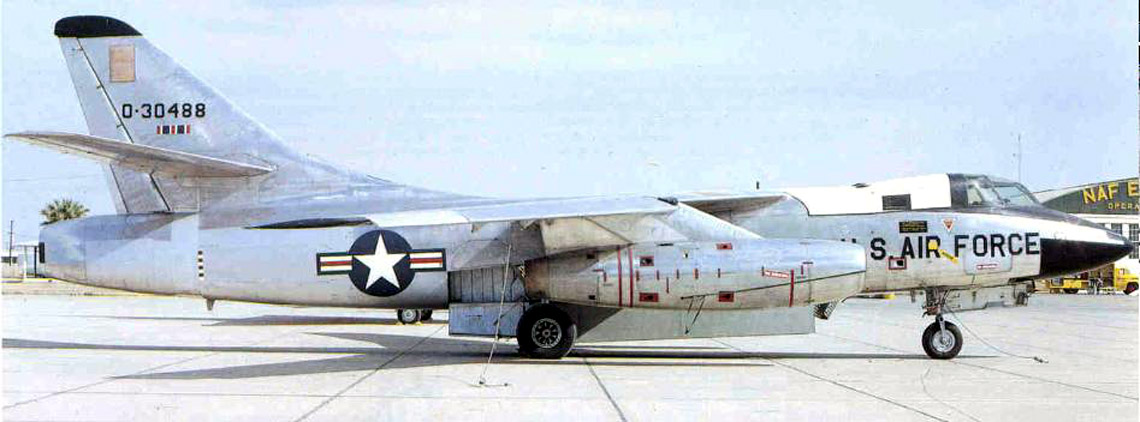
The B-66 Destroyer ended up only resembling the A-3 Skywarrior
In January 1952 when the US Air Force issued its official General Operational Requirement (GOR) for a tactical bomber and reconnaissance jet aircraft to replace the Douglas B-26 Invader and the "interim" Martin B-57 Canberra, the selection of a minimum change version of the Douglas A3D Skywarrior as the B-66 Destroyer made sense. Douglas's proposed changes weren't all that major- deletion of the folding wings, catapult gear and arresting gear, addition of ejection seats and anti-icing, strengthening the airframe for the stresses of low altitude flight and an enlarged search radar antenna. Since the aircraft was "off the shelf", no prototypes were ordered. Eventually the USAF's GOR evolved to cover four distinct versions- the B-66B, a nuclear capable bomber version to replace the North American B-45 Tornado, the RB-66B, an all-weather day/night reconnaissance version, the RB-66C, a tactical electronic reconnaissance aircraft, and the WB-66D weather reconnaissance aircraft. Douglas agreed to an ambitious timetable to get the B-66 in production and operational, but the USAF kept requesting changes that ended up making the B-66 Destroyer a totally different aircraft that literally shared nothing in common with the Skywarrior. It's a testament to Douglas's abilities that the schedule slipped only two years as a result of constant changes being requested by the USAF! The B-66 ended up weighing just over 10,000 lbs more than the A3D Skywarrior as a result of all the changes. 

Had it gotten the J57 engine, the B-66 might have had a longer career
But being overweight wasn't the biggest flaw in the B-66 design. Ed Heinemann and his Douglas team recommended the Pratt & Whitney J57 turbojet for the B-66 after the A3D was switched from the anemic Westinghouse J40 turbojet to the more powerful J57 (the first production turbojet in the world to exceed 10,000 lbs of thrust). However, the Air Force held a competition for the engine to power the B-66- in addition to the recommended J57 engine, the Allison J71, General Electric J73 and surprisingly the Westinghouse J40 were submitted. Not surprisingly the J40 was dropped early on and the J73 soon followed for technical reasons. To the surprise of Douglas, the USAF then selected the J71 for the Destroyer, not only an engine that had yet to fly but it was also less powerful than the J57 by nearly 2,000 lbs of thrust! The official reasoning was that the Allison J71 was readily available (a bit of a stretch here on the part of the USAF) and the B-66 had lower priority than other USAF programs that used J57 engines- namely, the Boeing B-52 Stratofortress, the Boeing KC-135 Stratotanker, the North American F-100 Super Sabre, the McDonnell F-101 Voodoo, and the Convair F-102 Delta Dagger. At the time the Voodoo was under development as a long range penetration fighter for SAC, so it became obvious to many that SAC dominated the USAF budget and would receive any and all J57 engines possible. The main reason the F-100 got any J57s at all was that the F-100 was central to the Tactical Air Command's desire to have its own tactical nuclear attack force built around the F-100. 

Ordinarily those assigned to the B-66 Program Office at Wright Patterson AFB would have pushed for the J57, but politically the B-66 was seen as primarily a reconnaissance aircraft and only in interim bomber. Those with fighter experience in TAC wanted the F-100, those with tactical bomber experience in TAC wanted the Martin XB-51. And SAC was determined to preserve its budgetary allocation at all costs. In the end, no one really fought for the B-66 Destroyer when it was given the clearly less-powerful Allison J71 engine. Allison had trouble getting the J71 prototypes bench tested to at least 50 hours without any problems and only barely made the cut which exacerbated the schedule slippage of the first operational Destroyers. And even at that, the test pilots at Edwards AFB flying the first B-66s hated the J71- it was slow to spool up for more power, it surged often, and even would flame out and stall while taxiing. On 8 October 1955 the pilots of the AFTC (Air Force Flight Test Center) filed an extremely unsatisfactory report on the J71. The test force concluded that the J71 engine was accepted by the USAF only partially developed and a replacement engine was needed, the preference being for the J57 used by the Skywarrior. It was alleged that on a hot summer day in Denver with a typical combat load, the B-66 Destroyer couldn't even get airborne!

The tail guns were soon removed and replaced with ECM tailcone
Unfortunately for the B-66 program, the Secretary of Defense at the time, Charles Wilson, came to the Defense Department as the CEO of General Motors, of which Allison was one of its divisions. Wilson's 1953 confirmation hearings before the Senate were highly controversial because of his reluctance to sell his GM holdings and comments that alluded to him possibly favoring GM as Secretary of Defense. The loss of the J71 contract would have been a severe blow to Allison at the time. As a result, the Destroyer kept the J71 engines and Allison tweaked the engine further to bring the engine up to 9,700 lbs of thrust. While this satisfied the USAF given the mission profiles of the Destroyer in the 1950s, the addition of heavy electronic warfare equipment to the Destroyer to created the EB-66, the only tactical electronic warfare aircraft available in Vietnam, strained the limits of the J71 in the hot tropical environment of Vietnam. Destroyer crews nicknamed the aircraft "The Airplane with One-Way Engines" in reference to the fact that outside of the lackluster McDonnell F3H Demon, the other design to use the J71 was the Northrop Snark cruise missile. However, in 1956, Northrop switched the Snark's engine from the J71 to the- you guessed it- J57. 

Source: Glory Days: The Untold Story of the Men Who Flew the B-66 Destroyer into the Face of Fear by Wolfgang W.E. Samuel. Schiffer Military History, 2008, p24-38.

09 December 2009

Following the Second World War, engine maker Pratt and Whitney found itself lagging behind in jet engine development as the wartime and immediate postwar demand for its piston engines was an all-time high. Nearly 50% of all engines built for US aircraft during World War II were Pratt and Whitney engines. The company's head, the legendary Frederick Rentschler (who quite literally built Pratt and Whitney into the dominant engine company it had become during World War II after leaving Wright Aeronautical in 1924), directed his head of engineering, Leonard Hobbs, to begin efforts to catch up in jet engine development.

Rentschler's goal was to catch up with the competition like General Electric, Westinghouse, and Allision by 1950 and become the dominant jet engine maker. Hobbs and his boss, however, had trouble finding an aircraft design tailored to their proposed engine designs. Gaining valuable experience by license-building the Rolls-Royce Nene turbojet for the Grumman F9F Panther as the J42, they found the USAF was in the midst of deciding between a turboprop and a turbojet for its new long range bomber that would become the Boeing B-52 Stratofortress.

Hobbs' initial design was for a larger turboprop than the Wright T35 being considered. Designated the T45, it combined the gearbox of a turboprop with the compressor/turbine core of one of their own jet engine designs. To achieve the necessary specific fuel consumption, Hobbs increased the pressure ratio to an unheard of 8:1. However, this would make the engine difficult to start and sluggish in acceleration. Hobbs' technological leap was to make the engine dual-spooled, with the front of the engine running at a slower speed than the back of the engine which ran at a faster speed. By optimizing the speeds of the different sections of the engine core, the engine would run not only more efficiently, but could generate more thrust than single spool engines of the day could ever create.

When Boeing's bomber design grew in size, the USAF decided only a turbojet could meet the needs of the design and Pratt and Whitney abandoned the T45 and the jet engine core of the turboprop became the J57 engine. With its compressor ratio increased to 12:1 (which was over double the industry standard of the day), the engine ran for the first time in January 1950 and would become the first jet engine to produce more the 10,000 lbs of thrust.

The J57 would be used in many fighter aircraft including the North American F-100 Super Sabre, Vought F8U Crusader, Douglas F4D Skyray, Convair F-102 Delta Dagger and McDonnell F-101 Voodoo. It also powered the Boeing B-52 Stratofortress and the KC-135 Stratotanker. The civilian JT3 version would be used on the Boeing 707 and Douglas DC-8 jetliners. The J57 and the JT3, would become the dominant large aircraft engine as well as fighter engine for a good part of the 1950s and 1960s, realizing Frederick Rentschler's goal set in 1945.

Source: US Naval Air Superiority: Development of Shipborne Jet Fighters 1943-1962 by Tommy H. Thomason. Specialty Press, 2007, 151-152.

05 September 2009

Braniff International Airways would be the only customer for the Series 200 of the Boeing 707 jetliner. While the original 707 production version was designated the 707-120, Braniff's aircraft were 707-200s (actually 707-227s using Braniff's customer number). The -120 used the JT3C turbojet which provided 13,200 lbs of thrust and was the civilian version of the military J57 engine. The -227, on the other hand, used the more powerful JT4A engine with 15,800 lbs of thrust and was the civilian version of the J75 engine that was used on the F-105 Thunderchief, F-106 Delta Dart and the U-2. The JT4A (which was also used on the Douglas DC-8-20) gave Braniff plenty of extra power at some of the hot-and-high airports of the US Southwest and Latin America and did not require water injection for a takeoff boost.

Only five 707-227s were built- the first one was lost on a pre-delivery test flight on 19 October 1959. The remaining four were flown by Braniff until 1971 when they were traded to BWIA (British West Indies Airlines).

Source: Airways, October 2009. "Braniff's 'El Dorado Super Jet' 707s" by Ed Davies, p41, 44.