Showing posts with label SAC. Show all posts

23 January 2016

What Your Kitchen Refrigerator and Ballistic Missiles Have in Common: Freon


While liquid-fueled rocket engines have been the mainstay for the satellite launch industry, the long road of technological development in solid-fuel rockets have also benefited the aerospace industry. Often times unique solutions were needed in the development of solid-fuel rockets. One of the more unusual ones was the use of liquid freon to direct the exhaust flame from solid-fueled rockets. That's right. Liquid. Freon. How? I'll get to that.

Minuteman II test launch
(National Park Service/Minuteman Missile NHS)
In the 1950s the conventional wisdom in ICBM development was that only liquid-fueled engines had the power to lift the heavy nuclear warheads of the day. The two main ICBMs in development, the Atlas and the Titan, used liquid-fueled engines. But the US Navy, seeking to put ICBMs on nuclear submarines as a sea-based strategic deterrent, considered liquid-fuels on a submarine wholly impractical and not just for safety reasons. As a result, the engineers who were developing the Polaris SLBM focused their efforts on solid-fuel rocket motors for the missile. They were storable and could be quickly fired. In addition, with enough right mix of solid propellants, the missile could be much smaller than a comparable liquid-fueled missile.

The advantages of a storable propellant and rapidity of launch made solid-fuel an attractive option for a land-based ICBM as well. In the US Air Force, General Bernard Schriever was in charge of the Air Force's ICBM development effort as the head of the Western Development Division. While he initially believed that liquid-fueled engines were the only way to power an operational ICBM, he was ably convinced by several of his engineers to look at solid-fuels as an alternative. That tangent then took on an important priority equal to that of the Atlas and Titan programs, becoming the Minuteman ICBM which was developed in the same time frame as the Navy's Polaris missile. The two weapons shared many similar characteristics due to their solid-fuel rocket engines. The first variant of the Minuteman, the LGM-30A Minuteman I, became operational at Malmstrom AFB in Montana in 1962. 
First SLBM launch, 23 July 1960.
Polaris A1 from the USS George Washington
(US Navy)
The first solid rockets used tabs that jutted into the exhaust stream to deflect the plume for directional control. It was the simplest system but to provide effective control and deflection, the tabs had to be of a size that inevitably cut into the exhaust stream's total velocity. The next solution was what the Polaris team called "jetevators". The exhaust cone of the solid rocket had an extension at the bottom of the cone that was in effect, a gimbaled extension of the skirt (rather than moving the whole nozzle assembly) and small actuators moved the whole extension. Jetevators were used on the first versions of the Polaris SLBM, the A1 and A2 variants. The main disadvantage of jetevators was they added technical complexity to the solid rocket motor as well as weight. Small jetevators could only provide slight corrections but to provide more significant directional control, larger and heavier jetevators would be needed.

Both the early versions of Polaris and Minuteman used jetevators on each of the three stages of the missiles, with the first and second stages of both missiles having four nozzles that could be differentially vectored to provide control. By 1962, however, the next versions of the missiles were already in development- for Polaris it was the A3 version (third version) and for the Minuteman it was the Minuteman II (second version, obviously). In both missiles a range increase was desired and one way to get it was to lighten the missile itself. For both new versions, the second stage switched from four nozzles with jetevators to a single nozzle that used what was called "liquid injection thrust vectoring control". For both the LGM-30B Minuteman II and the UGM-27C Polaris A3, a bigger second stage with the new liquid injection thrust control got the range increases needed. 

1964 patent diagram for liquid
injection thrust vectoring control.
(Google Patents)
Around the perimeter of the nozzle about 1/2 the way up were a series of four ports that angled slightly upward. Liquid freon was injected into one of the ports and as it did, it created a shockwave in the nozzle that pushed the exhaust stream in a direction up to 7 to 10 degress opposite from the port the freon entered. The freon didn't react with the hot plume, it merely created a thermal shockwave that pushed the plume one direction. By injecting freon into the various ports, directional control could be achieved for a lot less weight than traditional actuator-driven control mechanisms. 

On the Minuteman II, the second stage carried 262 pounds of freon in a rubber bladder to use for thrust vectoring. The Minuteman II and Polaris A3 weren't the first missiles to use this novel method of control. That honor goes to the Lance short-range battlefield missile that was used by the US Army until the 1960s. The knowledge gained from the Minuteman II and Polaris A3 in liquid injection thrust vectoring control would be used to its fullest on the large solid rocket boosters used on the Titan III and Titan IV launchers, long the mainstay of US expendable heavy-lift vehicles. Both boosters on the Titan launchers used liquid injection thrust vectoring control. If you look at a picture of a Titan III/IV at launch, you'll notice a small external tank attached to the core rocket's base, one for each booster. That's the reservoir for the liquids used for the thrust vectoring system of the solid rocket boosters.
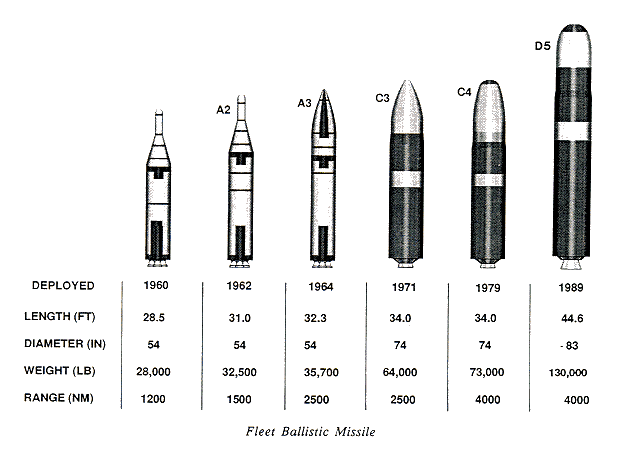
From left to right: Polaris A1, Polaris A2, Polaris A3, Poseidon C3, Poseidon C4, Trident D5
(Federation of American Scientists)
The Polaris was superseded in the Navy's strategic deterrent by the Poseidon, which was followed by  the current missile, the Trident. The Minuteman II was retired from service and the land-based ICBM deterrent for the United States relies on the Minuteman III.

Further reading: 

Martin, the Titan I and the Titan II Ballistic Missiles
One of the Most Important Missions of the Douglas C-133 Cargomaster: Transporting ICBMs


Source: To Reach the High Frontier- A History of US Launch Vehicles, edited by Roger D. Launius and Dennis Jenkins. The University Press of Kentucky, 2002, p262-266.

03 January 2016

Martin, the Titan I, and the Titan II Ballistic Missiles

Titan I ICBM elevated out of its silo for laugh
(USAF Museum)
When George M. Bunker took over the reins of Martin Aircraft from Glenn Martin in 1952, Bunker wanted to diversify Martin which up to that point had produced only aircraft. With an able group of lead engineers that Glenn Martin had literally hand picked in the years prior to his retirement from his company, Bunker moved some of Martin's engineering and research efforts into the rocket and missile arena that bore first fruit with the Viking research rocket and the Vanguard light satellite launcher built for the Navy. While many in the growing rocket and missile division were focusing their efforts on the Vanguard program, it was Jess Sweetser, Martin's VP for Sales and Requirements, who pushed the company to bid for the second USAF ICBM contract. At the time, General Bernard Schriever was heading the Western Development Division (WDD) in Los Angeles which directed the ICBM effort that started off with the Atlas ICBM built by Convair. Schriever wanted a second ICBM system fielded as a backup to the Atlas and the WDD issued a requirement that spelled out the range, guidance and throw weight (the payload of the missile, which was the nuclear warhead). Left up to the contractors would be the missile configuration, liquid vs. solid propellants, staging and number of engines.

Sweetser got to know General Schriever so well they became golfing buddies* in their free time and as a result, he was able to anticipate the need for a second ICBM program from his conversations with the general. As a result, when the WDD issued the requirement, Martin's team of engineers was already doing preliminary work in addition to their work on the Vanguard launcher for the Navy. It became clear from further directions from the Western Development Division as well as the operator of the ICBMs, the Strategic Air Command, that not just a backup ICBM was wanted, but one that was a true alternative to the Atlas ICBM and if possible, more advanced. With both Boeing and Lockheed in the competition for the alternative ICBM contract, George Bunker split the rocket and missiles team into two parts- one group stayed on the East Coast and worked on the Vanguard launcher, the other group set up shop in Los Angeles next to the WDD to work on their ICBM design. Martin's design was based on work that had been already done for the Vanguard launcher- instead of the thin, pressurized balloon skin arrangement used on the Atlas, the Martin proposal used two liquid propellant stages made of a rigid framework of copper-aluminum alloy with the tank wall integral to the rocket walls for weight savings as had been done on the Vanguard. The first stage would use two powerful 150,000 lb thrust engines and the second stage used a single 80,000 lb thrust engine that would be ignited in zero-gravity in near-space, a first for such a large engine. The Vanguard had proved that near-space ignition of the second stage was possible, but this would be the first large-scale application. 

In addition, Martin's ICBM design would be modular, allowing the design to be enlarged over time for heavier payloads. The sweetener of the proposal that would win the USAF contract for Martin in December 1955 was the creation of an all-new development, testing, and production facility in one location at the base of the Rocky Mountains in Littleton, Colorado. This was chosen for two reasons- first, the valleys in some of the mountains could house engine test stands with the mountains acting as natural sound insulators for the surrounding area, and secondly, Martin pointed out that a mid-continent facility was furthest away from the coasts which could be vulnerable to Soviet submarine missile launches and bomber attacks. Ground was broken on the Littleton facility outside of Denver in February 1956 for the missile that the USAF christened the Titan. As a result of the USAF's requirement that everything that went into the Titan missile be thoroughly tested, the first facilities built were the test stands, some of which replicated full size launch pads were complete Titan missiles could be tested. 

Just three years after the start of construction on the facility itself, the first Titan I missile was flight tested from Cape Canaveral on 6 February 1959. The second, third, and fourth test flight were a success, unprecedented in a new rocket or missile program. The fifth and sixth flights were failures with explosions on the launch pad, but the seventh flight was a success and by 1960 Martin had 11 more successful Titan I test flights. Out of 18 test flights, only two Titan I test flights failed, a success rate that was stunning and groundbreaking given the technology of the time. 

Titan I 3x3 ICBM base layout
(USAF Museum)
The first Titan I silos were built in 1959 in the Lowry AFB gunnery range just east of Denver. The first Titan I ICBMs went on nuclear alert on schedule in August 1962 at Lowry AFB. As the Titan I used liquid oxygen as an oxidizer, the missiles were kept the silos until the launch order was given. At this point a massive elevator lifted the Titan I out its silo to an above ground position where it was fueled for launch. All of the necessary facilities were deep underground, even the propellant storage tanks. Each ICBM squadron had nine Titan Is in groups of three. Each group of three missiles were part of a single launch complex. Once the missiles were fueled, the radio guidance domes also were elevated from their own silos. The radio guidance system tracked the missiles after launch and fed the necessary course corrections, much like the guidance system used on the Atlas ICBMs. 

With advances in Soviet ICBMs, though, while the Titan I flight test program was taking place, Martin's engineers were already working on a successor, Titan II. Titan II had an even bigger warhead and the modularity of the Titan design paid off as the engineers merely had to fatten the second stage to the same diameter as the first stage and then lengthened both stages for a bigger missile. To replace the radio guidance system on the Titan I, AC Delco and MIT created a new inertial guidance system that set the standard for ICBMs. No longer would radio signals from the launch site be necessary, minimizing the Titan II's vulnerability to a counterstrike. The liquid oxygen was also replaced as the oxidizer and Titan II now had non-cryogenic storable liquid propellants- Aerozine-50, which was a mix of hydrazine and unsymmetrical dimethylhydrazine (UDMH) and dinitrogen tetroxide as the oxidizer. As a result, no fueling process was needed. 

Titan II silo "hot launch"
(USAF Museum)
The simplification of the Titan II launch complexes compared to the Titan I was dramatic. Major underground structures dropped from 42 to just 18 structures, 6,000 feet of service tunnels were reduced to just 945 feet, the power requirements dropped from 12,000 kilowatts per squadron to just 2,700 kilowatts. Only half the wiring connections were needed and the need for periodic checkout of missile systems dropped by an astounding 90%.  As a result, the silos could be more widely dispersed. With a formal contract awarded in 1960, the Titan II flight test program went smoothly- of 33 test launches, 25 were successful- in fact, the last 13 test launches were so successful and reliable, the Titan II was selected by NASA to be the launcher for Project Gemini. 

With this reliability came the need to solve the basing issue. The Titan I was housed in silos, but it was lifted out of the silo for launch. Martin's engineers argued that it was possible to launch the Titan II right out of its silo, dramatically reducing its response time. Significant debate ensued about the feasibility let alone the safety of launching the 110-foot Titan II with its 430,000 lbs of first stage thrust right out of a silo. On 19 February 1963, a test Titan I was successfully launched from a Titan II test silo at Vandenberg AFB in California, validating the concept so clearly that the USAF had Boeing incorporate silo-launch on its Minuteman ICBM. The first Titan II missiles went on nuclear alert in 1963 just one year after the first Titan I missiles went on alert! 

The Titan I missile squadrons were operational from 1962 to 1965 at Lowry AFB in Colorado, Ellsworth AFB in South Dakota, Beale AFB in California, Larson AFB in Washington, and Mountain Home AFB in Idaho. Only Lowry AFB was home to two Titan I missile squadrons while the other bases only hosted a single squadrons. The Titan II missile squadrons were grouped three squadrons to a missile wing and were operational from 1963 to 1987 at McConnell AFB in Kansas, Little Rock AFB in Arkansas, and Davis-Monthan AFB in Arizona. The modularity of the Titan design, though, made it a versatile heavy-lift space launcher. Not only did the Titan II launch the manned Gemini missions, but it was also used as a satellite launcher until 2003. Titan III and Titan IV were exclusively space launchers, with the last Titan IV launch in 2005. In 1995, when Lockheed merged with Martin Marietta, the Colorado facility became part of the Lockheed Space and Missiles Division. Since the retirement of the Titan IV launcher, the Littleton facility is now the headquarters of United Launch Alliance, the joint venture of Lockheed Martin and Boeing for the Delta and Atlas launch vehicles. Although no production takes place there any longer, ULA still has its mission control, testing and engineering facilities at the same location that was the birthplace of the Titan missile when ground was broken over fifty years ago.

Historical tangent: 

I had mentioned above how Martin Aircraft's VP for Sales and Requirements Jess Sweetser, had become a golfing buddy of USAF General Bernard Schriever. Before he came to work for Martin Aircraft, Jess Sweetser was a championship golfer in the 1920s. While a student at Yale, Sweetser had won the National Intercollegiate Championship in 1920, placed 11th at the US Open the following year despite his youth, and won the Metropolitan Championship  in 1922 in his junior year at Yale. He then won the US Amateur Championship that same year and then became the first American to win the British Amateur Championship in 1926 despite having the flu. He played on the first Walker Cup team (a trophy for amateur golfers in the United States, Great Britain and Ireland) in 1922 and five more teams in years following. After graduation from Yale, he worked as a stockbroker and played golf on weekends. His first job in aviation was with Curtiss-Wright before he came to Martin Aircraft. 

Source: Raise Heaven and Earth: The Story of Martin Marietta People and Their Pioneering Achievements by William B. Harwood. Simon and Schuster, 1993, p299-325

24 September 2015

The Ultimate Superfortress: The B/RB-54A

Concept art of the B/RB-54A in flight
(Boeing Historical Archives)
During the Second World War Boeing worked extensively on further improvements to the B-29 Superfortress. The most important of these improved variants was the B-29D that involved swapping out the Wright R-3350 radial engines with the more powerful Pratt & Whitney R-4360 Wasp Major radial engine. In July 1945 the USAAF signed a contract for 200 B-29Ds, but with the end of the war and the rapid postwar demobilization, the B-29D contract was canceled. With the creation of an independent United States Air Force in 1947, there was a need for interim bombers pending the arrival of more advanced jet bombers. The USAF was already getting the Convair B-36 which took on the mantle of the heavy bomber, but the USAF also wanted the B-29D which would be redesignated as a medium bomber. The USAF had the B-29D redesignated as the B-50 to avoid the appearance of ordering a "wartime" bomber. Making its maiden flight on 25 June 1947, the B-50 Superfortress would eventually result in 320 examples of all variants produced.

Boeing, however, was working on an even more powerful and longer-ranged development of the B-50. Designated the B-50C, this evolution into the ultimate Superfortress was designed to extract as much speed and performance as was possible using a new version of the Pratt & Whitney R-4360 Wasp Major engine that added what was called a "variable discharge turbine" (VDT) to the engine. The standard Wasp Major used on the B-50 developed approximately 3,500 horsepower and a Wasp Major with a VDT could easily produce 4,000 horsepower, making it one of the most powerful production piston engines in the world.

The Wasp Major VDT
(from the Engine History website)
The VDT consisted of two General Electric CHM-2 turbosuperchargers that collected the hot exhaust gases from the 28 cylinders of the Wasp Major. A portion of the hot gases were diverted through an intercooler to provide turbosupercharging at high altitudes. The bulk of the hot gases went through the CHM-2 turbines and were exhausted out a variable area nozzle that resembled a set of eyelids. By adjusting the size of the nozzle, jet thrust could be achieved that had the potential to add as much as 15% to the speed of the B-50C over the production standard B-50. The Wasp Major VDT was already flying at this point on the Republic XF-12/XR-12 Rainbow long range reconnaissance aircraft. 

The scope of the changes needed to for the B/RB-54 resulted in a redesignation to B-54 with the planned reconnaissance variant being the RB-54. The jump in power output from the use of the Wasp Major VDT resulted in a redesign of the wings that resulted in a wingspan that was over 20 feet longer than that of the B-50 with a chord increase as well- an additional six feet of chord at the wing root and an additional four feet of chord at the wing tip. This provided additional fuel capacity along with external fuel tanks which were three times the capacity of the external tanks used on the B-50A on the outboard wings. The wingspan increase was so much that outrigger gears were needed under the outermost engine nacelles. Wind tunnel testing had shown that the new wing and powerful engine output also required a longer fuselage and the B/RB-54's fuselage was stretched 10 feet. Instead of the plexiglass domes used by the gunners on the B-29/B-50, low drag hemispheric sights were used. These used a fish eye hemispheric optical element that the gunner sighted through. Glenn's Computer Museum has some great pictures of the R/RB-54 hemispheric gunsight. The tail gunner also had a hemispheric gunsight but also had a radar to direct the four-gun turret as well which was mounted in fairing above the gun turret but below the hemispheric gunsight. Fairings were also present on the nose and under the forward fuselage for bombing and navigation radars. 

As a comparison, the B-29 weighed 120,000 lbs fully loaded and the B/RB-54 would weighed in at 207,000 lbs at takeoff. The Wright R-3350 engines of the B-29 developed 2,200 horsepower and the bomber had a range of approximately 3,250 miles. The B/RB-54 would have been able to push 8,000 miles of range. The mockups were completed in 1948 and the contract was signed for 43 bombers as an initial production lot. While the Secretary of the Air Force Stuart Symington and the USAF Chief of Staff General Hoyt Vandenberg were supportive of the B/RB-54 project, General Curtis LeMay, the head of the Strategic Air Command, felt that the B/RB-54 was inferior to the Convair B-36 Peacemaker particularly the B-36D that added four J47 jet engines under the outer wings. Pending the arrival of the B-52 Stratofortress, LeMay felt deterrence was better served by the B-36 which could fly faster, farther, higher, and carry a significantly larger bomb load. In the postwar atmosphere of austerity, more B-36s couldn't be accommodated in the Air Force budget and Secretary Symington offered LeMay more B-50s instead of increased numbers of B-36s. This was even more unsatisfactory to the outspoken SAC commander who then argued that if he couldn't get more B-36s, then the funding set aside for the B/RB-54 should be shifted over to get more of the Boeing B-47 Stratojet which made its first flight in December 1947. This was agreeable to all involved, even for Boeing as it meant more funding for the Stratojet program. The B/RB-54 project was cancelled with the prototype approximately 75% complete (it was converted from a B-50A) at Boeing's Seattle facilities. In addition, the addition of the outrigger gears wasn't popular with SAC as many of its bases would need widened taxiways and runways to accommodate the B/RB-54. 

The B-29 lineage would live on, though, in the C/KC-97 Stratofreighter (the last examples being retired in 1978) and in the commercial Boeing 377 Stratocruiser. But neither would have matched the leap in performance of the B/RB-54, the "ultimate" Superfortress.

The Retromechanix page has a series of superb photos via the National Archives that show the B/RB-54A mockup in detail as well as some schematic drawings. It's well worth the time to browse them!

Source: Boeing B-29 Superfortress (Crowood Aviation Series) by Steve Pace. The Crowood Press Ltd, 2003, p166-168. Boeing B-50 (Air Force Legends Number 215 by Geoffrey Hays. Ginter Books, 2012, pp 118-121.

07 April 2015

The Development of the Boeing Flying Boom

World War II USAAF tests with B-24 tankers and B-17 receivers
Though the United States had explored using air refueling to extend the reach of strategic bombing missions during the Second World War, nothing operational had come of the work by the time the war ended in 1945. In the immediate post war years, the newly independent United States Air Force and its nuclear deterrent arm, the Strategic Air Command, had both the weapons and the aircraft to carry out nuclear strikes, but what was lacking given the technology and geopolitical climate of the day was overseas bases that would allow SAC's bombers to reach the Soviet Union. As it was, the Boeing B-29 Superfortresses that were the main strike force of SAC lacked the range to hit Soviet targets nonstop from bases in the United States. While the US government placed priority on securing overseas bases for SAC, the USAF made inquiries to the leading experts of air refueling of the day, Flight Refueling Limited in Great Britain. It was Flight Refueling that consulted with the US Army Air Forces during the Second World War and assisted with several trials using B-24 Liberators as tankers and B-17 Flying Fortresses as receivers. Several sets of air refueling equipment were procured from Flight Limited and installed on a very limited basis on several B-29 Superfortresses to get crews trained on the procedure. However, the USAF was dissatisfied with the system as it took time to rendezvous and get into the proper position, change positions, and then transfer fuel. Using Flight Refueling's method, the receiver trailed a hauling line with a weight and hook at the end. The tanker approached from the side and below and deployed a contact line that crossed over the hauling line of the receiver and engaged the hook. The tanker then moved above the receiver, pulling in the hauling line with the contact line. The refueling hose was then attached to the hauling line and it was then pulled down to the receiver which had a refueling receptacle in the tail gunner's position and refueling commenced. The lines and refueling hoses used created tremendous drag that imposed air speed restrictions that may have been acceptable for a piston-engined bomber but wholly impractical for a future jet-powered bomber. 

The USAF contacted Boeing in November 1947 if they would be willing to look at the air-refueling problem within the purview of the company's ongoing research programs. In the following month, the Preliminary Design Group and the Experimental Manufacturing Division at Boeing formally signed a contract with the Air Force to work on improving air refueling. Boeing's first step was to determine what formation can two Superfortresses operate most closely for an extended period of time safely to conduct air refueling. Boeing's engineers figured the refueling solution would be easier the closer the aircraft could fly to each other and not have to do the position changes that the Flight Refueling method entailed. To this end, in May 1948, the USAF ran a series of tests out of Wright-Patterson AFB in Dayton, Ohio, using B-29s flown in every possible formation and relationship to each other. Escorting aircraft photographed the formations from every angle and Boeing's team would then analyze the photographs to determine their three-dimensional relationship to each other. For every possible formation, the flight crews involved were also queried on things like workload and visibility in maintaining the formation. As a result of these test flights, it was determined the optimum position that provided a relatively low workload with good visibility was to put the aircraft in trail formation with the trailing aircraft vertically displaced 25 feet and longitudinally displaced 10 feet. This gave the flight crew in the trailing aircraft the best view of the lead aircraft with the closest possible distance. Pilots in the trailing aircraft found that if they flew less than 25 feet vertically displaced below the lead aircraft, they got buffeting from the wake of the lead aircraft which gave the formation an inherent safety feature. 

After determining the most optimal close formation, the next step for the Boeing team was to figure out the best fuel transfer method. Five different refueling systems were explored. The first three systems were probe-and-drogue applications with the tanker trailing a hose with a drogue at the end with the receiver flying a probe into the drogue to make the connection. Though this method is used today by the US Navy and US Marine Corps as well as a large number of air arms like the RAF, the Boeing team felt that the hose movement could be unpredictable in rough air and required too much maneuvering by the trailing aircraft to make hose contact. Such maneuvering might be fine for a smaller tactical aircraft, but Boeing was less than thrilled about the prospect of a large receiver aircraft having to maneuver frequently before contact so close to the tanker. 

The imaginative fourth proposed system involved a gun-turret like assembly on the tanker's forward dorsal fuselage. The tanker would take the trailing position and the turret would deploy a rigid boom up and forward to engage a receptacle on the underside of the tail of the receiver. The boom would be maneuvered like a gun turret by an operator aboard the tanker and when not in use, the boom would slew 180 degrees and stow atop the dorsal fuselage of the tanker. While imaginative, it was soon realized the aerodynamic loads on the boom would be significant. But what if their positions were reversed? What if the tanker lowered the boom aft and down to the receiver who had a receptacle on the top of the fuselage? This way the operator did all the work from the tanker and the receiver flight crew could focus on holding the prescribed position in trail behind the tanker. Flight test personnel with experience with the flight refueling systems of the day were consulted and all agreed that a boom lowered from the lower aft fuselage of the tanker to the top of the fuselage of the receiver would be the most ideal. A rigid boom would allow fuel transfer rates much higher than a hose system and small aerodynamic surfaces would be used on the end of the boom to maneuver it to the receptacle of the receiver- which is how Boeing came to call it the "flying boom". 

B-50 "Lucky Lady II" taking on fuel from a KB-29 hose tanker
While Boeing's engineers in Seattle worked on the flying boom concept, the Air Force's first secretary after its creation, Stuart Symington, had testified before the Senate Armed Services Committee in March 1948 that the latest air refueling systems would allow the new Boeing B-50 Superfortress to reach any part of the Soviet Union, but the reality of it was that all the USAF had were the first Flight Refueling hose units on a handful of B-29s and that the flying boom was still a paper project. Quite literally on the following day, the USAF instructed Boeing's Wichita division to get as many hose units onto KB-29 tankers as possible and get the new B-50s up to speed as receivers with an interim system until the flying boom was operational. The first operational installation was ready in less than 30 days and by the end of 1948. On 26 February 1949, the B-50 Superfortress "Lucky Lady II" took off from Carswell AFB in Fort Worth, Texas, and flew around the world nonstop in 94 hours, taking fuel from hose-equipped KB-29s four times during the record-breaking flight. 

The flying boom equipped KB-29P Superfortress tanker
Despite this very public success, Boeing continued to develop the flying boom and interestingly, had funded the development internally without outside USAF funds. Two dry booms were built for KB-29s as proof of concept. Though not able to transfer fuel (hence the term "dry booms"), the dry booms were actually installed on KB-29s in June 1948, a full seven months before the circumnavigation flight of "Lucky Lady II". Dry receptacles for the purposes of flight test were installed on a B-47 Stratojet and an F-86 Sabre. Flight tests using the dry boom were conducted through the summer of 1948 out of Seattle, Wichita, and Wright-Patterson AFB in Ohio. The tests were successful and the USAF requested Boeing transfer the flying boom work to Curtiss Aircraft. As the company had an absence of work postwar, the USAF wanted to keep Curtiss in business, but quite obviously, Boeing wasn't happy with that request, particularly since development had so far involved company funds without any USAF funding. By April 1949, Boeing was already constructing wet booms (flying booms able to transfer fuel) and was resisting USAF pressure to transfer the program to Curtiss Aircraft. Boeing won the dispute with the USAF by insisting its flying boom work was proprietary and would have commercial applications in refueling jet airliners. Since no USAF funds had been used in development so far, the USAF found it didn't exactly have financial clout to compel Boeing to transfer the program to Curtiss. Up to this point, the flying boom program was classified and the USAF had insinuated that the program's classified status meant that it couldn't be used for commercial applications. But the flight test program had already been publicly revealed by the USAF itself in an October 1949 press release! Boeing did finally get its contract for the flying boom. From 1950 to 1951, the Boeing Renton plant converted over 100 B-29 Superfortresses into KB-29P flying boom tankers with the first tanker delivered to SAC in March 1950. A fixed cradle structure supported the flying boom when it was raised. A hemispheric plexiglass dome replaced the tail turret and laying in a prone position, the boom operated "flew" the boom to the receiver. Boeing had always considered the KB-29P an interim tanker and soon enough was working on a tanker version of the C-97 Stratofreighter- not only did a tanker version of the C-97 offer more fuel carrying capability, it could also carry cargo when not being used for air refueling, offering mission flexibility for the USAF. The first flying boom-equipped C-97 was flight tested by Boeing in September 1950 and so impressed the USAF that all remaining orders for the C-97 were to be completed as KC-97s. In fact, the first KC-97 was delivered to the USAF only eight months after the KC-97 contract was signed with the first units operational in July 1951. Boeing then suggested a turboprop-powered KC-97 to the USAF, but the military was ambivalent to the idea, but by that point, Boeing was already working on a new breed of transport that would eclipse even the turboprop powered KC-97. But I'm pretty sure you know how that story ends! 

Source: Passing Gas: The History of Inflight Refueling by Vernon B. Byrd. Byrd Publishing, 1994, pp 123-136. Photos: National Museum of the United States Air Force.

19 January 2011

The Achilles Heel of the Douglas B-66 Destroyer

The B-66 Destroyer ended up only resembling the A-3 Skywarrior
In January 1952 when the US Air Force issued its official General Operational Requirement (GOR) for a tactical bomber and reconnaissance jet aircraft to replace the Douglas B-26 Invader and the "interim" Martin B-57 Canberra, the selection of a minimum change version of the Douglas A3D Skywarrior as the B-66 Destroyer made sense. Douglas's proposed changes weren't all that major- deletion of the folding wings, catapult gear and arresting gear, addition of ejection seats and anti-icing, strengthening the airframe for the stresses of low altitude flight and an enlarged search radar antenna. Since the aircraft was "off the shelf", no prototypes were ordered. Eventually the USAF's GOR evolved to cover four distinct versions- the B-66B, a nuclear capable bomber version to replace the North American B-45 Tornado, the RB-66B, an all-weather day/night reconnaissance version, the RB-66C, a tactical electronic reconnaissance aircraft, and the WB-66D weather reconnaissance aircraft. Douglas agreed to an ambitious timetable to get the B-66 in production and operational, but the USAF kept requesting changes that ended up making the B-66 Destroyer a totally different aircraft that literally shared nothing in common with the Skywarrior. It's a testament to Douglas's abilities that the schedule slipped only two years as a result of constant changes being requested by the USAF! The B-66 ended up weighing just over 10,000 lbs more than the A3D Skywarrior as a result of all the changes. 

Had it gotten the J57 engine, the B-66 might have had a longer career
But being overweight wasn't the biggest flaw in the B-66 design. Ed Heinemann and his Douglas team recommended the Pratt & Whitney J57 turbojet for the B-66 after the A3D was switched from the anemic Westinghouse J40 turbojet to the more powerful J57 (the first production turbojet in the world to exceed 10,000 lbs of thrust). However, the Air Force held a competition for the engine to power the B-66- in addition to the recommended J57 engine, the Allison J71, General Electric J73 and surprisingly the Westinghouse J40 were submitted. Not surprisingly the J40 was dropped early on and the J73 soon followed for technical reasons. To the surprise of Douglas, the USAF then selected the J71 for the Destroyer, not only an engine that had yet to fly but it was also less powerful than the J57 by nearly 2,000 lbs of thrust! The official reasoning was that the Allison J71 was readily available (a bit of a stretch here on the part of the USAF) and the B-66 had lower priority than other USAF programs that used J57 engines- namely, the Boeing B-52 Stratofortress, the Boeing KC-135 Stratotanker, the North American F-100 Super Sabre, the McDonnell F-101 Voodoo, and the Convair F-102 Delta Dagger. At the time the Voodoo was under development as a long range penetration fighter for SAC, so it became obvious to many that SAC dominated the USAF budget and would receive any and all J57 engines possible. The main reason the F-100 got any J57s at all was that the F-100 was central to the Tactical Air Command's desire to have its own tactical nuclear attack force built around the F-100. 

Ordinarily those assigned to the B-66 Program Office at Wright Patterson AFB would have pushed for the J57, but politically the B-66 was seen as primarily a reconnaissance aircraft and only in interim bomber. Those with fighter experience in TAC wanted the F-100, those with tactical bomber experience in TAC wanted the Martin XB-51. And SAC was determined to preserve its budgetary allocation at all costs. In the end, no one really fought for the B-66 Destroyer when it was given the clearly less-powerful Allison J71 engine. Allison had trouble getting the J71 prototypes bench tested to at least 50 hours without any problems and only barely made the cut which exacerbated the schedule slippage of the first operational Destroyers. And even at that, the test pilots at Edwards AFB flying the first B-66s hated the J71- it was slow to spool up for more power, it surged often, and even would flame out and stall while taxiing. On 8 October 1955 the pilots of the AFTC (Air Force Flight Test Center) filed an extremely unsatisfactory report on the J71. The test force concluded that the J71 engine was accepted by the USAF only partially developed and a replacement engine was needed, the preference being for the J57 used by the Skywarrior. It was alleged that on a hot summer day in Denver with a typical combat load, the B-66 Destroyer couldn't even get airborne!

The tail guns were soon removed and replaced with ECM tailcone
Unfortunately for the B-66 program, the Secretary of Defense at the time, Charles Wilson, came to the Defense Department as the CEO of General Motors, of which Allison was one of its divisions. Wilson's 1953 confirmation hearings before the Senate were highly controversial because of his reluctance to sell his GM holdings and comments that alluded to him possibly favoring GM as Secretary of Defense. The loss of the J71 contract would have been a severe blow to Allison at the time. As a result, the Destroyer kept the J71 engines and Allison tweaked the engine further to bring the engine up to 9,700 lbs of thrust. While this satisfied the USAF given the mission profiles of the Destroyer in the 1950s, the addition of heavy electronic warfare equipment to the Destroyer to created the EB-66, the only tactical electronic warfare aircraft available in Vietnam, strained the limits of the J71 in the hot tropical environment of Vietnam. Destroyer crews nicknamed the aircraft "The Airplane with One-Way Engines" in reference to the fact that outside of the lackluster McDonnell F3H Demon, the other design to use the J71 was the Northrop Snark cruise missile. However, in 1956, Northrop switched the Snark's engine from the J71 to the- you guessed it- J57. 

Source: Glory Days: The Untold Story of the Men Who Flew the B-66 Destroyer into the Face of Fear by Wolfgang W.E. Samuel. Schiffer Military History, 2008, p24-38.

04 September 2010

Boron-based High Energy Jet Fuels

In 1910, German chemist Alfred Stock began to experiment with taking hydrocarbon-based compounds (all fossil-fuels are hydrocarbon-based) and using boron as a substitute for carbon. Given that boron's nearest neighbor on the periodic table of the elements is carbon, Stock was intrigued by the possibility of using boron-based compounds. While successful in making small quantities of boron-based compounds, the process needed was tremendously expensive and yielded little product which at the time had no practical applications. However, in the 1930s, boron's potential began to emerge when it was found that boron-based materials produced a very high heat than the corresponding carbon-based compounds, making boron-based fuel worth studying. Prior to the Second World War, pentaborane and other boron-based compounds were synthesized, but again, practical applications were still lacking despite the promise as a high-energy fuel. At the end of the war, the U.S. Army organized a pilot program to produce boron hydrides (the boron counterpart to hydrocarbon compounds) in more significant quantities as a possible rocket fuel. The boron hydrides created could produce up to 30,000 BTUs/lb, compared to 18,000 BTUs/lb for comparable hydrocarbon fuel. 

General Electric opened a boron hydride research facility in Malta, New York in the early 1950s to continue the work started by Alfred Stock forty years earlier and managed to several hundred pounds of boron hydride compounds for research use. A plant in Muskogee, Oklahoma, also operated under a government contract to synthesize more boron hydride compounds and managed to produce 300,000 lbs of boron fuel. By the early 1950s the possibilities of boron fuels got the attention of jet engine manufacturers. Various high-energy fuels (HEFs) were studied like liquid hydrogen, for example, but boron fuels offered the most promise as they weighed the same and occupied the same volume as conventional jet fuels. For a given quantity of boron fuel versus conventional jet fuels, as much as 40% more energy could be produced. Because boron HEFs had such similar properties to jet fuels, they could be handled and used similarly, unlike liquid hydrogen fuels. 

GE led the way in boron HEF research in jet engines, operating a modified J79 turbojet engine at NASA's Lewis Flight Propulsion Laboratory to run on boron HEF. Calculations showed that if boron HEF were used only in the afterburners along with regular JP-class fuels, a range increase of 16% was possible. If the same aircraft were to use boron HEF exclusively, an range increase of 30% was possible. From the viewpoint of the United States Air Force, aircraft using boron HEF would have longer range and be less reliant on air refueling. In addition, 95% of the world's boron oxide was located outside of Soviet-controlled areas, with the vast majority of those boron deposits in the desert regions of California and Utah. Despite the promise it held, by 1955 the USAF had still to set up any organized study of boron HEF. 

Despite official disinterest, the US Navy's Bureau of Aeronautics did fund boron HEF studies starting in 1952 under Project ZIP in which two chemical companies were contracted to produce boron HEFs. As a result of the Navy's funding, boron HEFs began to be known as "zip fuels". One of the contractors produced a 10-boron compound called decaborane which showed the most promise. The Navy's work got the USAF's attention and decaborane would be designated HEF-3 and all research efforts focused on the use of HEF-3 with the USAF taking over direction of GE's boron fuel work. By 1957, GE reported to the USAF that HEF-3 was a feasible, but that significant technical hurdles remained given the high toxic nature of HEF-3 and the fact that boron oxide deposits were left on engine components which accelerated wear and tear of the powerplants. 

About this time both Boeing and North American were working on the WS-110A (Weapons System 110A) project which would ultimately result in the North American XB-70 Valkyrie. The stringent specifications of WS-110A called for Mach 3 speed but intercontinental range for a new supersonic bomber to replace the Boeing B-52 Stratofortress. HEF-3 became an attractive fuel option for both companies even though the USAF and the Strategic Air Command never specifically directed the use of HEF-3 as a requirement. In December 1957, North American was selected by the USAF's B-70 Program Office as the winning contractor in the WS-110A competition. The Program Office suggested that use of HEF-3 on the XB-70 would be the most economical means of getting the required 6,500 mile range. While still not requiring HEF-3 for the design, funding was made available for the modification of the intended powerplant of the XB-70 Valkyrie, the GE J93 engine, to run on HEF-3. Design work on the XB-70 at North American proceeded on the assumption that the aircraft be able to operate on both conventional JP-class fuels and HEF-3. 

Requiring the use of HEF-3 on the XB-70, however, was withheld by the Pentagon pending further evaluation of the operational advantages and disadvantages of HEF-3. While the refining of JP-class fuels was relatively simple, the production of HEF-3 required several extra steps beginning with simpler boron compounds. These extra steps added considerable cost to the price per gallon of HEF-3. Estimated of an HEF-3 facility built and operated to support one combat wing of operational B-70As resulted in a $10/gallon of HEF-3; adjusting for inflation, a gallon of HEF-3 today would cost just over $75!

Compared to the JP-4 fuel that was to be used on the XB-70 prototypes, HEF-3 produced 25,000 BTUs/lb compared to 18,000 BTUs/lb for JP-4. The spontaneous ignition temperature for HEF-3 was 2,600 degrees Fahrenheit compared to 4,550 degrees F for JP-4. While HEF-3 presented on issues when in contact with metals, there were considerable concerns about it coming into contact with non-metal parts of the Valkyrie's fuel system. In addition, HEF-3 was more toxic than cyanide, which complicated storage and handling at SAC bases. The lower flashpoint of HEF-3 meant that nitrogen inerting of the fuel tanks was a required necessity and even the smallest leaks were unacceptable. In 1958, NASA, North American, the USAF and several chemical contractors formed an HEF Guidance Committee to provide more direction to research efforts and to keep those efforts in line with the development of the B-70. At this point, the intent at North American was to create a dual-fuel bomber that used JP-4 and HEF-3, but it began to add a significant cost to the unit cost of the Valkyrie, particularly when GE's own work on the HEF-3-powered J93 engine began to fall behind schedule. Despite this, in the summer of 1959 the Strategic Air Command began making its initial budget outlays for FY1960 for HEF-3 production to support the production Valkyrie bomber. 

Dissatisfied with the progress, though, just weeks later the Pentagon canceled the HEF-3-powered J93 engine program and limited the Valkyrie program to the use of JP-4 fuel only. Testimony by USAF scientists before Congressional committees revealed that the technical hurdles and the operating cost of using HEF-3 as a jet fuel were prohibitive given the defense budget of the day. With the winding down of the HEF-3 program, the only research that remained on boron fuels lasted in the early 1960s at Edwards AFB as an additive to rocket propellant. There was, however, small consolation to the engineers and scientists involved that Soviet research efforts proved to be equally frustrating in making boron-based fuels practical. The hazardous nature of boron fuels for the most part proved to the final nail in the coffin of the research work. 

Source: Valkyrie: North American's Mach 3 Superbomber by Dennis R. Jenkins and Tony R. Landis. Specialty Press, 2008, p77-82.

25 August 2010

The U-2's Antecedent: The Martin RB-57D Canberra

In the early 1950s the Strategic Air Command asked Martin, the American license builder of the English Electric Canberra as the B-57, if a modified version of the B-57 could be built that would operate at altitudes in excess of 60,000 as a reconnaissance aircraft. Though not as radically modified as the better-known RB-57F (which were stock B-57s modified by General Dynamics), the RB-57D was unique in its own right and set the stage for high-altitude reconnaissance operations by its successor, the Lockheed U-2. To operate in the rarefied air of the stratosphere, the most noticeable change in the RB-57D was its enlarged wing which resulted in an increase in wingspan from 64 feet in the standard B-57 Canberra to 106 feet. Special lightening measures were taken from skinning over the bomb bay doors to reduce weight and the bomb bay was used to house the reconnaissance equipment. In addition, enlarged nacelles replaced the B-57's Wright J65 engines with Pratt & Whitney J57s (as were used on the KC-135) which offered a 6,000 lb thrust increase and better high altitude performance. 

Despite the massively enlarged wing, an empty RB-57D weight not much more than an empty B-57 due to the lightening measures taken. The most extreme measures were taken with the wings which were thin metal honeycomb sections that formed a full wet wing (even in the leading edges). To avoid the weight of rivets, the wings were assembled with a special glue and the wing skin was waxed for aerodynamic smoothness. With a surface skin of only 0.010 inch thick, even dropping a small tool on the wing could damage the skin. Even deicing fluid used on the aircraft could potentially cause the glue used to lose strength!

Only twenty RB-57Ds were built, but they were built in four groups, each group had a unique set of mission equipment and capabilities that were practically custom-made for missions in specific parts of the world. The first group of RB-57Ds were called "Group A" and "Group B" and only differed in the Group A aircraft being capable of inflight refueling. Four optical cameras were carried in the forward fuselage and a large optical viewfinder was installed in the cockpit for the pilot to use for both navigation and as a viewsight for the cameras. Thirteen aircraft (seven and six respectively) were built to Group A and Group B standards.

The next version was the single Group D RB-57D built which was also single seat and designed for electronic reconnaissance with a nose mounted radar and SLAR built into the lower sides of the fuselage. Capable of inflight refueling, the sole Group C aircraft flew most of its missions over Europe, using its powerful SLAR to peek deep into the Soviet bloc. 

The final variant were the six Group C RB-57Ds which were two seaters with a pilot and electronic warfare officer. These RB-57D were designed as electronic ferrets to collect enemy radar emissions for later analysis in the development of electronic countermeasures. These aircraft were also capable of inflight refueling. 

In 1956 the newly-formed 4028th Strategic Reconnaissance Squadron was assigned to the 4080th Strategic Reconnaissance Wing to operate the unique RB-57Ds. In the space of a year the 4028th SRS would be moved from Lockbourne AFB in Ohio, to Turner AFB in Georgia, and finally settled down at Laughlin AFB in Del Rio, Texas. Despite being moved three times, the squadron would become fully operational with its first six RB-57Ds only 120 days from the delivery of its first RB-57D. Those first six aircraft, all Group A RB-57Ds, deployed to Japan in late 1956 for reconnaissance missions over what is presumed to be China, North Korea and the Soviet Union. A year after the Japan deployment, three of the Group A RB-57Ds were sent to Taiwan wearing Republic of China markings for further missions over China during the Taiwan Straits Crisis. Flown by USAF pilots, two Taiwanese pilots were preparing to fly RB-57D missions after only 30 days of training, but the plans came to end when both the People's Republic of China and Taiwan began dogfighting each other over the Taiwan Straits. 

In  1958 the first atmospheric samplings missions were flown by RB-57Ds in support of nuclear testing in the Marshall Islands, the high flying capability of the RB-57Ds allowed them to get particle samples from high in the atmosphere as part of the post-detonation analysis. At the same time, Several Group B and the sole Group D aircraft were deployed to Europe for missions over Eastern Europe. 


The pace of missions put a strain on the delicate wings of the RB-57D and the first aircraft were put into storage by SAC following two incidents when the wings outboard of the engine nacelles cracked and fell off during landing. Martin had designed the wings for only 500 flight hours and many of them had already exceeded that limit but strategic necessity resulted in the RB-57Ds still flying missions. At this point the USAF was planning for the arrival of the Lockheed U-2 and the Air Defense Command took over the remaining RB-57Ds to act as high altitude targets for the supersonic interceptor force. Fitted out with electronic countermeasures, the 4677th Defense Systems Evaluation Squadron at Hill AFB, Utah, was formed to operate 12 of the 20 RB-57Ds. Martin modified the wings to extend their surface life. However, the high flying capabilities of the RB-57Ds meant that the 4677th DSES was always asked to send aircraft in support of nuclear testing. 

By 1963 wing structural problems cropped up again when one of the RB-57Ds lost its wing at 50,000 feet. But the ADC still needed a high altitude target aircraft and since the last US atmospheric nuclear test had taken place in 1962, Martin agreed to modify the remaining RB-57Ds for another 3,000 flight hours. Upgrades to the electronic countermeasures to challenge the ADC interceptor crews resulted in these aircraft being designated EB-57Ds and they served in this role along with other testing roles until the mid-1970s. 

The big wing and engine power of the RB-57Ds in many ways prepared pilots for what it would be like to fly the Lockheed U-2. On takeoff, only 50% engine power was necessary for takeoff which only needed a ground roll of about 2,000 feet. Climbing at 25-30 degrees, the RB-57Ds could reach 50,000 feet in only 15 minutes. Maximum cruise altitude was 65,000 feet and the pilots wore full pressure suits that were improved for the U-2 and SR-71 programs. With over 200 gallons less than a stock B-57, the RB-57D could fly twice the duration, approximately seven hours compared to four hours for a B-57. Landing was challenging as the big wing didn't lose lift easily. Even with the engines at idle, it was still too much power for landing. Even with the spoilers out and landing gear extended, the plane still had a very low sink rate and pilots resorted to actually holding the RB-57Ds into a series of slight stalls to get the aircraft down to the runway!

Source: Martin B-57 Canberra: The Complete Record by Robert C. Mikesh. Schiffer Military History Press, 1995, p132-141.


09 June 2010

The 1952 Carswell AFB Tornado

Prior to the arrival of the Boeing B-52 Stratofortress, the responsibility for the long-range strategic deterrent of the United States rested with the Convair B-36 Peacemaker in the 1950s. The Atlas ICBMs were still years away from becoming operations and the first Polaris submarine-launched ballistic missiles were still on the drawing boards. The other bombers of the USAF's Strategic Air Command, the Boeing B-50 Superfortress and the Boeing B-47 Stratojet, were medium range bombers that could not strike Soviet targets from the United States. Only the B-36 had the range to reach the Soviet Union and the capacity to carry any of the nuclear bombs in the US stockpile.

As the B-36 was built and flight tested in Fort Worth at Convair's mile-long plant at Carswell AFB, the first of SAC's bomb wings to receive the Peacemaker were based at Carswell. The 7th Bomb Wing was the first to put the Convair's "big stick" into service, followed by the co-located 11th Bomb Wing. With Convair right across the runway at the base, any technical problems could be readily addressed. As a result, the majority of the United States' long range striking power was concentrated in Fort Worth.

On Labor Day, 1 September 1952, many of the base personnel and flight crews had the long weekend off. Weather forecasters had predicted severe thunderstorms for North Central Texas that afternoon with estimated winds of 60mph. As few personnel were on duty, few precautions were taken other than securing the B-36 aircraft with 3/8 inch steel cables. At 6:42pm, a tornado touched down on the base perimeter and struck the B-36 flightline directly. Maintenance docks used to work on the large bombers outdoors were thrown about and the steel cables tying down the bombers snapped as the planes were thrown about by the tornado like toys. Ruptured fuel tanks spilled thousands of gallons of high octane avgas all over the ramps. The anemometer on the Carswell control tower registered sustained winds over 90mph before being torn away by the storm. As the storm subsided, operations had to be transferred to nearby Meacham Field and other bases in the Southwest.

Two-thirds of the entire B-36 Peacemaker force was either damaged or destroyed in the tornado. One aircraft was completely shattered and would have to be written off while 72 bombers on the flightline and adjoining aprons were damaged and unflyable. Fortunately there were no fatalities given the long holiday weekend. Another 10 B-36s parked at the Convair plant were also damaged. Some of the bombers were shoved on top of each other and many had lost wings, empannages, or large fuselage sections. Because of the national priority placed on the B-36 fleet, by 5:30 the next morning a repair plan was underway with 1/3 of the repairs to be carried out by SAC, 1/3 of the repair work to be done by repair teams dispatched from Kelly AFB in San Antonio (the site of one of the USAF's heavy logistics centers), and remaining 1/3 would be carried out by Convair. So urgent was the matter than a 1-page typed letter was the basis of a multi-million dollar contract for Convair for its share of the repair work. Project FIXIT returned one bomber to operational service the first week, and nine more B-36s in the second week after the tornado. In less than a month, the 7th Bomb Wing was back at full operational strength of only one B-36 had to be written off out of the 83 damaged. By the end of the month, the round-the-clock effort had the 11th Bomb Wing operational and by the first week of October, 51 more aircraft were returned to service. The last repaired B-36 returned to duty on 11 May 1953.

Having 2/3 of the B-36 force knocked out in less than 30 minutes taught SAC a lesson. Each time severe weather threatened Carswell AFB, as many B-36s as possible were flown out to other bases and would return the next day. 

Senator Lyndon B. Johnson of Texas and his Military Preparedness Committee conducted an investigation that concluded the base commanders had taken all the adequate measures proscribed at the time with an approaching storm. The investigations called for improved weather forecasting and an increase in the research of tornadic thunderstorms which over the years would not only benefit the USAF, but the general public as well.

Source: Cold War Peacemaker: The Story of Cowtown and the Convair B-36 by Dennis R. Jenkins and Don Pyeatt. Speciality Press, 2010, p149-151.

13 March 2010

The First Production ECM Pod for Jet Aircraft: Tee Town


In the late 1950s Soviet defenses against the bombers of the Strategic Air Command were improving by leaps and bounds as more capable fighters, radars and surface-to-air missiles were deployed not just on the periphery of the Soviet Union but also around key cities and industrial centers like Moscow and Leningrad. At the time, SAC's bomber force consisted of 100 Boeing B-52 Stratofortresses, over 1,000 Boeing B-47 Stratojets, and 200 Convair B-36s that were gradually being phased out. As the tip of SAC's spear, the B-52s had a comprehensive electronic countermeasures suite as well as an onboard electronic warfare officer who could constantly reconfigure the jammers to meet the threats.

The B-36s being piston-driven (despite the addition of four jet engines) was soon to be phased out, so there was no need to upgrade to the ECM systems. But the B-47 made up three-quarters of SAC's offensive striking force and unlike the B-52, didn't have the space or power for additional jamming systems to put it on par with the Stratofortresses.

The solution came with a $2.5 million contract code named Tee Town. Carried out in 1958 to 1959 with the assistance of Douglas Aircraft's Tulsa Division, Tee Town consisted of two 14-foot long pods mounted on cantilevered pylons attached to the bomb bay doors. Each pod carried four ALT-6B jammers on the lower half of the pod and covered by a fiberglass dielectric fairing. Ram air was ducted around each of the jammers for cooling and Douglas added upgraded electrical generators on the Tee Town aircraft to handle the increased electrical demand.

Tee Town was planned as an interim measure pending deployment of the specialized Phase V jamming escort version of the B-47 that would accompany strike cells of nuclear-armed Stratojets. Sixty B-47s were modified to carry the Tee Town pods and were assigned to the 303rd Bomb Wing at Davis-Monthan AFB in Arizona and the 509th Bomb Wing at Pease AFB in New Hampshire.

Although only 120 of the Tee Town pods were built, it marked a historical point as the world's first electronic warfare jamming pod designed for high speed aircraft to go into production.

Source: The History of U.S. Electronic Warfare, Volume II- The Renaissance Years, 1946-1964 by Alfred Price. The Association of Old Crows/Port City Press, 1989, p191-192.

02 March 2010


As the Cold War entered its most heightened period in the 1960s, the United States shifted its nuclear deterrent strategy from massive retaliation to that of what was called "flexible response"- instead of one all-out retaliatory launch, flexible response meant that the President and the National Command Authority (NCA) would have the ability to conduct a more limited nuclear exchange against specific targets. Implicit in the shift to flexible response was the need to have a secure and survivable link to all of the elements of the nuclear forces even after an initial nuclear strike on the United States.

Even though a 15-minute ground alert for the bombers of the Strategic Air Command and alternate underground command centers (in addition to SAC Headquarters at Offutt AFB in Nebraska, there were alternate command posts at Barksdale AFB, Louisiana, March AFB, California, and Westover AFB in Massachusetts) improved the survivability of SAC's nuclear assets, improvements in the Soviet ICBM force meant that only an airborne platform would be the most survivable command post and in 1960, that meant basing such a command post on the Boeing KC-135 Stratotanker.

In July 1960 not only had SAC managed to put one-third of its bomber forces on a 15-minute ground alert, but it began a six-month experiment on using KC-135s converted into airborne command posts in the event that the ground command posts were knocked out by a Soviet missile strike. Five KC-135s were put on ground alert at Offutt AFB and tested on their ability to not only takeoff within 15 minutes, but also their ability to perform as an alternate command post and assume control of the nation's bomber and missile deterrent in the event of the loss of the primary command posts. On board each KC-135 was an AEAO- Airborne Emergency Action Office- at first a SAC colonel, but later a general, who would assume command in the event communications were lost with the SAC HQ and the National Command Authority. After six months of testing, the program was a success and the head of SAC, General Thomas Power, ordered more KC-135s converted into emergency command posts.

By July 1961 50% of SAC's bomber forces were now on 15-minute ground alert in addition to Chrome Dome, having a portion of SAC's B-52 Stratofortresses on airborne alert as well. The Titan II and Minuteman ICBMs were quickly replacing the more cumbersome Atlas ICBM as well.

To control these growing forces, SAC relied on what was called PACCS- Post-Attack Command and Control System that used the airborne command post KC-135s along with specially-equipped EB-47 Stratojets that orbited near ICBM missile fields to act as radio relays between the airbone command posts and the ICBM silos. In 1965 the Stratojet relays were phased out and replaced with specially-equipped EC-135s as the airborne command post KC-135s had been redesignated.

The first operational Looking Glass airborne command post mission flew on 3 February 1961. The name Looking Glass indicated that the entire PACCS network "mirrored" the functions of SAC's underground command posts. The primary Looking Glass EC-135 maintained the airborne alert with other EC-135s that functioned as auxiliary command posts and relay aircraft sitting on 15-minute ground alert. On 17 April 1967 the battle staff aboard a Looking Glass aircraft demonstrated the ability to launch a Minuteman ICBM from Vandenberg AFB in California. In addition, a command post dedicated to the President sat alert at Andrews AFB under the code name Night Watch. In 1974, the Night Watch aircraft were upgraded to the larger and more capable E-4A Advanced Airborne National Command Posts (AABNCP).

In the event of a national emergency, the Looking Glass EC-135 would orbit over the central USA along with two auxiliary EC-135 command posts (called AUXCAPS). Three more EC-135s would scramble and these were designated ALCCs (Airborne Launch Control Centers) and they would orbit over the ICBM missile fields in Wyoming, Montana, and the Dakotas. Two more EC-135s would act as radio relay platforms to connect the President aboard the E-4 command post to the Looking Glass aircraft and the AUXCAPS aircraft.

Should contact be lost with the National Command Authority or SAC HQ in Omaha, after satisfying a strict set of guidelines, the battle staff aboard the Looking Glass would assume control of the US nuclear forces and "assess battle damage, communications, radioactive fallout and the location and strength of surviving forces". Once responsible for executing the SIOP (Single Integrated Operations Plan, the nation's nuclear battle plan), four officers on the Looking Glass all had to validate the intent to launch and simultaneously turn their launch keys. The four officers were the AEAO, the communications officer, the operations officer, and the aircraft commander.

The final Looking Glass mission landed at 2:28PM EDT on 24 July 1990, ending what had been a continuous airborne alert by Looking Glass command posts since the first flight in February 1961. Only twice did the airborne alert get interrupted, both times to drop off an critically ill crew member and relaunching within 20 minutes. Today the role of Looking Glass has been assumed by the Navy's E-6B Mercury TACAMO force which for the first time allows airborne control of all three elements of the nuclear triad- bombers, ICBMs and the SLBMs aboard the Navy's Ohio-class ballistic missile submarines.

Source: Boeing KC-135 Stratotanker- More Than Just A Tanker by Robert S. Hopkins III. Aerofax, 1997, p113-118.

10 January 2010


From the outset in the design of the Convair B-58 Hustler, the unique fuel/weapons pod carried underneath the sleek bomber was to be only one of a family of systems that were to be pod mounted as well- rather than have to develop different versions for different roles, different pods for different roles would be carried by "stock" B-58s. Some proposals were for air-launched ballistic missiles, others were for reconnaissance systems with cameras housed in the pod. There was even a proposal for a passenger-carrying pod. But many of these ideas never came to be.

But one system that did get flight tested was for an airborne side-looking radar that would allow a B-58 to get detailed radar imagery from stand-off distances. The first system to be built was the pod-mounted Hughes AN/APQ-69 radar system which first flew on a B-58 on 24 December 1959. The AN/APQ-69 was one of the largest airborne radar antennas ever flown with a 50-foot long antenna that took up all of a long square-section pod carried by the Hustler. Twenty-five test flights were made with the radar and it had a 10 foot resolution from 50 miles which was quite good for the technology of the day. However, the size and weight of the pod restricted the B-58 to subsonic flight and as the radar took up the entire pod, it couldn't be used to carry additional fuel as the fuel/weapons pods used by the SAC alert Hustlers. As such, the B-58 carrying the AN/APQ-69 was limited to only 3 hours' flying time, making it of limited usefulness. In addition, the bow wave from the blunt nosed pod hampered nose gear retraction and a 0.5G pushover after takeoff was necessary to "help" the nose gear retract.

A more advanced radar pod flew in 1961, this time it was a Goodyear AN/APS-73 radar- this time it was a SAR (synthetic aperture radar) which allowed for a smaller antenna but a more detailed radar picture and it was used in a pod that had the same cross-section as the MB-1 fuel/weapons pod already in use- this allowed the B-58 to use nearly all of its performance envelope and the pod could also carry a sizeable amount of fuel.

The AN/APS-73 was housed in a black fiberglass nose section of the pod with the aft 2/3 of the pod carrying fuel. There were two X-band rotating antennas in the pod nose that rotated on an axis that ran longitudinally the length of the pod. The radar range was about 80 miles and was flight tested under the code name Project Quick Check. While the system never went into production, it was used operationally on one flight during the Cuban Missile Crisis- a single B-58 flight carrying the AN/APS-73 was made to survey targets of interest on the island, making it the first and only flight of a B-58 Hustler into hostile airspace.

That particular aircraft, 55-0668, also was the same aircraft that flight tested the earlier Hughes radar pod. It survived the scrapping of the Hustler fleet in 1970 and is now on display at the Lone Star Flight Museum in Galveston, Texas.

Source: Convair B-58 Hustler: The World's First Supersonic Bomber by Jay Miller. Midland Publishing/Aerofax, 1997, p81-86.