
When the three Short brothers Eustace, Oswald, and Horace established the Short Brothers company to design and build aircraft in 1908, there was a difference of opinion in the early days of the company's history about getting into the flying boat business. Oswald and Eustace were keen to get into flying boats which were becoming popular during the First World War, but Horace, the eldest of the three, thought flying boats were "nonsense". When Horace passed away in 1917, the other two Short brothers wasted no time in securing a contract from the Admiralty to license build flying boats to gain experience before flying their own design, the Short N.3 Comarty in 1921. Over the next 15 years, Short Brothers designed and built progressively larger flying boats for both the Royal Navy and Imperial Airways for its far-flung routes throughout the British Empire. By 1932, Eustace had passed away, leaving Oswald Short in charge of the whole enterprise. Imperial Airways flying boat requirements called for progressively larger and more capable designs as the passenger demand as well as mail and freight shipments on the Empire routes continued to grow. In a bid to regain world leadership in aviation, the Empire Air Mail Scheme was established in 1934 that essentially shifted all first-class mail to air mail aboard Imperial Airways' flying boats. As a result of the EAMS, Imperial Airways needed more capable flying boats particularly on its trunk routes to South Africa, the Middle East, and Australia.
In 1935, Imperial Airways approached Oswald Short for a vastly more capable flying boat than the previous large biplane designs Short had produced for the airline. The specification called for the transport of 24 passengers in comfort with 1 1/2 tons of mail and freight over a distance of 800 miles. but as far as 2,000 miles with a smaller payload. Short placed his chief designer, Arthur Gouge on the project. After seeing the entrants to the 1934 MacRobertson Air Race the prior year, particularly KLM's Douglas DC-2, Gouge had been considering a monoplane layout for his next flying boat design and the Imperial Airways requirement was the perfect opportunity. Designated the S.23, the preliminary design was shown to Imperial Airways who decided to skip the construction of two prototypes that had been originally planned and proceed with a production order of fourteen S.23 flying boats. Shortly afterwards, Imperial Airways upped their order to an unprecedented 28 aircraft- prior Short production runs for the airline had been in small numbers as low as three aircraft.
Oswald Short was rightly apprehensive about the new terms despite the company's long pedigree of solid designs. He insisted on at least a single prototype, but Imperial Airways, seeing the growing competition from the Americans across the Atlantic, felt time was of the essence and duly reminded Oswald Short this was the biggest contract yet for Short Brothers. He ultimately relented and put Arthur Gouge in charge to bring the S.23 or "C-Class" flying boats to production. The leap in performance and technology the new aircraft promised resulted in their more common name "Empire Boats" in reference to their importance the Empire Air Mail Scheme.
 |
| Canopus G-ADHL, the first Short Empire flying boat (Profile Publications) |
Using as his staring point the specified cubic capacity per passenger laid down by Imperial Airways to insure comfortable accommodations and space for mail and freight, Gouge adopted a two deck layout that faired the wing neatly into the fuselage for drag reduction. In addition, the fuselage for the first time on a production Short design didn't flare out at the planing bottom of the hull like older designs. Instead, the fuselage sides were near vertical to the waterline which gave the Empire Boat a large internal volume. The new planing bottom developed for the hull cut down on water drag and gave the large aircraft a relatively short water run at takeoff. To further improve the takeoff and landing performance of what was one of the largest production aircraft of the day, Gouge invented a new type of flap called the Gouge flap. Similar to a Fowler flap that translates aft before pivoting down, the Gouge flap used a curved track to curve downward while translating aft that was mechanically simpler than a Fowler flap. A Short Scion Senior aircraft was converted to a near half-scale prototype for the Empire Boat to prove the water characteristics of the new hull design.
No aircraft the size of the Empire Boat had ever been built by the British aircraft industry at the time. The wing spar had to be machined in sections that were then joined. Short engineers had to design many of their own tools and jigs to build the aircraft. The slab sided fuselage not only provided more internal volume, it also proved easier to produce than earlier Short designs that used more complex hull shapes. The fuselage interior was 17-feet deep and allowed for two decks- behind the cockpit (called the "bridge" by Short) was a long upper deck compartment that could carry as much as 3,000 lbs of mail and freight. Below the cockpit on the lower deck was the marine compartment that carried all the necessary water and mooring equipment. Behind the marine compartment was the forward passenger compartment followed by a long hallway to the middle passenger compartment. On one side of the lower deck hallway were the toilets and on the other side was the galley. Behind the middle passenger compartment was a spacious promenade cabin followed by the aft passenger compartment. Behind the aft compartment was another cargo space that extended nearly to the tail.
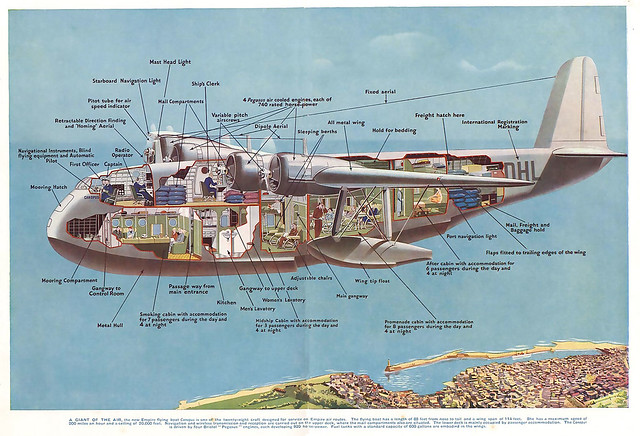
Interior configuration of the Short Empire flying boat
(Flickr)
The first Empire Boat to fly was Canopus G-ADHL on 4 July 1936. The flight test program revealed few issues with test pilots from Short and Imperial Airways pleased with the design. Canopus was delivered to Imperial Airways later that summer with the first commercial taking place 22-25 October (longer due to bad weather) on the London-Marseilles route. The second Empire Boat was Caledonia G-ADHM, first flying on 15 September 1936 and delivered to Imperial Airways on 4 December 1936. She had increased fuel tankage that allowed her to become the first Empire Boat to cross the Atlantic on 5 July 1937, beating the time of a Pan American Sikorsky Clipper by 34 minutes. From September 1936 onward, Short completed the Empire Boats at the rate of one a month. Such was the need to put them into service that subsequent aircraft were delivered to Imperial Airways after each airframe's maiden flight! The last Empire Boat of the original 28-aircraft order was Coorong G-AEVI, delivered on 26 February 1938. With the two Empire Boats that preceded it on the production line, Coogee G-AEUG and Corio G-AEUH, those last three aircraft were delivered to QANTAS for operation on the Australian portion of the Empire Air Mail Scheme.
 |
| The predecessor to Air New Zealand, Tasman Airways had three Empire boats (Air New Zealand) |
Imperial Airways was so pleased with the Empire Boats that in 1937 another eleven aircraft were ordered from Short. The 39 aircraft total was the largest single order for British commercial aircraft at the time. The first three of the second order were built to the same production standard as the original 28-aircraft order- those three aircraft, Carpenteria, Coolangatta, and Cooee, were delivered to QANTAS to bring their fleet of Empire Boats up to six. The rest of the second production block were built to S.30 standard which involved a change to the Bristol Perseus engine (890 hp) versus the Bristol Pegasus (920 hp) used on the S.23 version. Though lower in horsepower and an increased weight from structural beef up in the hull, the S.30 versions had near-identical performance thanks to drag reduction. Champion G-AFCT was the first S.30 boat laid down, but it was Cabot G-AFCU that flew first as it was needed by Shorts for flight testing. The last three Empire Boats from this second order were delivered to Tasman Airways for use on the Sydney-Auckland portion of the Empire Air Mail Scheme.
A single S.30 Empire Boat was ordered in 1939, Cathay G-AFKZ was delivered to Imperial Airways in March 1940 just before the airline was renamed British Overseas Airways Corporation or BOAC. Three more Empire Boats were ordered after Cathay was ordered, but those three aircraft reverted back to the original Bristol Pegasus engine and were designated S.33. Only two of those aircraft were completed and delivered in April and May 1940, Clifton G-AFPZ and Cleopatra G-AFRA. The third planned S.33 aircraft was never built.
 |
| S.26/G-Class Empire Boat Golden Hind (Profile Publications) |
As the S.30/S.33 production began to wind down as most of the British aircraft industry turned its attention to wartime production and Short devoted more resources to the Sunderland program, a final development of the Empire Boats was ordered. The G-Class or S.26, was a scaled up variant of the original S.23/S.30/S.33 design that incorporated some of the Sunderland's design features. First to fly was Golden Hind G-AFCI on 14 July 1939 followed by Golden Fleece G-AFCJ on 8 July 1940 and finally the last Empire Boat built, Golden Horn G-AFCK on 21 January 1940. The larger size of these three G-Class aircraft would have allowed nonstop trans-Atlantic services to Canada and the United States, but wartime demands had all three of these aircraft put into RAF service as VIP transports armed with defensive turrets. Only Golden Hind survived the Second World War. Used by the Ministry of Aviation postwar, she was returned to BOAC in 1948 but the airline wasn't in too much of a hurry to put her back in service as she was damaged during a 1954 storm and scrapped soon afterwards.
No discussion of the Short Empire Boats would be complete without taking a look at the Short-Mayo Mercury/Maia composite piggyback aircraft, but that will be the subject of a future article!
There's a common misconception that the Short Sunderland was a military derivative of the Empire Boat. The aircraft were developed in parallel to two different but broadly similar specifications that allowed Short to share some design elements between the two designs. The Short Sunderland was the result of Air Ministry Specification R.2/33 issued on 23 September 1933 for a large four-engined flying boat for the Royal Air Force to use in the maritime patrol and anti-submarine role. Imperial Airways had started its discussions with Short but had not formalized anything until the 1934 passage the Empire Air Mail Scheme. This accounts for why work on the first Empire Boat went so smoothly and quickly from the 1935 to the first flight of Canopus the following year- Short had done plenty of *similar* engineering work on the Sunderland program already. While there was no Empire Boat prototype, much of the work already done on the Sunderland undoubtedly helped. The first Sunderland prototype flew 16 October 1937, about 15 months after the first flight of the Empire Boat Canopus.
Sources: Sunderland: The RAF's Legendary Protector of the Sea Lanes, Aeroplane Icons, February 2012. "Sunderland Story" by Martyn Chorlton, pp 6-17. "The Short Empire Boats" by Geoffrey Norris. Profile Publications, No. 84, 1966.


