Showing posts with label Aiguillon. Show all posts

22 March 2015

Flying High This Past Week 16 March-22 March

First a bit of housekeeping. This week I switched this blog over to have its own domain name at www.tailsthroughtime.com. The previous address of aviationtrivia.blogspot.com still works and you'll get a redirect notice if you use the old link that will take you to the new URL. Now, without further ado, here's what's been getting a lot of page views this past week here at TAILS THROUGH TIME:
  • Two's Company and Three's a Crowd: The Boeing 737-200 Flight Crew Controversy: Quite naturally the latest post to the blog would be the most popular in the past week! The question of whether the 737-200 required two flight crew or three created quite a bit of acrimony in the late 1960s when the aircraft was introduced. Nowhere else was the dispute more pronounced than at United Air Lines, one of Boeing's key customers for the new jet.
  • The Crazy Cats: The Lockheed Neptunes of the US Army: Yes, you read that right. The *Army*. In Vietnam, the Army found that it needed a bigger and longer ranged aircraft for the SIGINT/COMINT role that today's Guardrail aircraft perform. Intraservice rivalries being what they were then, the Navy stepped up to help the Army and offered some P-2 Neptunes from stateside Reserve squadrons for modification so the Army wouldn't have to deal with what was then a very prickly USAF. The AP-2Es (a spurious designation to avoid antagonizing the USAF) were the heaviest and most complex Neptune variant to take to the skies. Many of the SIGINT/COMINT equipment used on the Army Neptunes would influence the development of the Guardrail system used today by the Army. 
  • The N-20 Program: Switzerland's First Indigenous Jet Aircraft: The Federal Aircraft Factory (FAF) N-20 Aiguillon was an attractive flying wing fighter design that only got as far as taxi tests and some very short hops short of a true first flight before being canceled. The Aiguillon had two flying forebears, though, that contributed to the flight test program and development of this aborted fighter design.
  • Tupolev's Own Tristar Design: It's not unusual for the Russian design bureaus (called OKBs) to reuse designations. The Tu-204 that flies today is actually the third use of that designation. The first use was for an enlarged T-tailed jet development of the Tu-134/Tu-154 and the second use of the designation was for a widebody trijet that looked very much like the Lockheed L-1011 Tristar. 
  • The Rocket-Boosted P-51 Mustang: In 1945 the USAAF's Mustangs were besting the Messerschmitt Me 262 jets over their German bases where the jets were most vulnerable. As a result of augmented airfield defenses, work turned to a rocket-boosted P-51 that would have the speed to catch the Me 262 at altitude and not have to run the gauntlet of airfield defenses.
  • The Legend of Half-Moon Bay: In this day and age when most of us are jaded to air travel and complaints about airlines are the norm, from the 1962 Christmas season is a unparalleled story of ingenuity and a can-do spirit by airline employees to go the extra mile. I won't spoil it here, but let's just say we'd all be hard pressed to come up with anything that equals what a small California airline pulled off that year, creating the "Legend of Half Moon Bay"!
The next TAILS THROUGH TIME article goes up tomorrow night, 23 March. Stay tuned! 

13 March 2015

The N-20 Program: Switzerland's First Indigenous Jet Aircraft

In May 1948 the Swiss government issued a contract with the Federal Aircraft Factory in Emmen for a single-seat, multirole jet fighter called the N-20 Aiguillon ("Stinger") which was a moderately swept delta flying wing powered by four jet engines. The FAF staff had been working on a jet fighter design since the end of the Second World War and it was this work that spurred on the Swiss government to give the go-ahead for a production design based on the FAF's work. The original N-20 design called for indigenous Sulzer D45 engines of 1,600 lbs thrust buried in the wings, two on each side with its own intake on the wing leading edge. The engine air flow and wing design was unique in that bypass air could be ducted direct to the afterburner or deflected through large slots in the upper and lower wings to act as ailerons to enhance the aircraft's maneuverability or even be used as thrust reversers to operated off short runways in the mountainous valleys of Switzerland. The use of bypass air in this manner was novel for the time and was called "durchströmte flügel" which literally means "flowing through wing". Two of the engines could be shut down to increase range and weapons were to be carried in an underfuselage pack that could be swapped out depending upon the mission. 

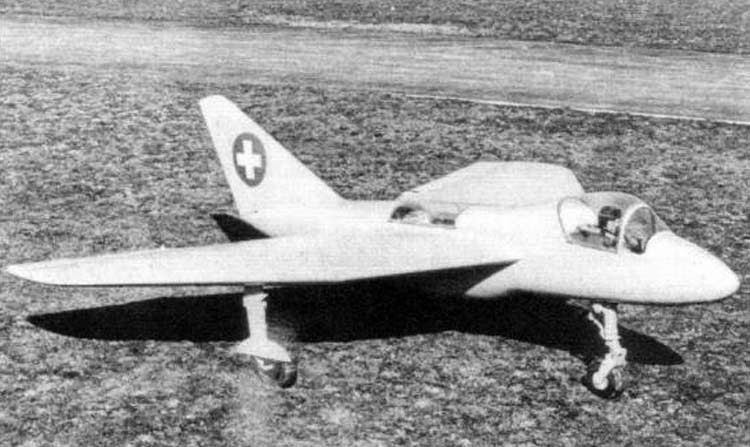
The N-20-1 glider
Given the complexity of the design and that nothing of this scope had ever been tackled in Switzerland, it was decided to approach the project in stages with two research aircraft. The first aircraft was a 3/5 scale glider to study the aerodynamics which was designated N-20-1. The glider was made out of wood with fabric covered control surfaces and had a retractable undercarriage using the nose gear from a De Havilland Vampire and the main gears from a Messerschmitt Bf 109. It had provision for a JATO rocket to boost it for takeoff, though in practice the N-20-1 was usually towed to altitude for its flight test program. On 17 April 1948, the N-20-1 made its first flight at Emmen with the chief test pilot of the Swiss Military Technical Branch at the controls. Sixty-nine flights were made to validate the N-20 aerodynamics before the glider was heavily damaged in a landing accident on 1 July 1949. 

The N-20-2 Arbalète in front of the N-20 Aiguillon
The N-20-1 was then replaced by a similarly-sized test aircraft called the N-20-2 Arbalète ("Crossbow"). The Arbalète had its own jet power, though, in the form of four French Turbomeca Piméné turbojets, each pair mounted above each other at the trailing edge of the wing. The upper engine's intake was above the wing and the lower engine of the pair had its intake below the wing. The Piméné engine was a very small powerplant, developing only 220 lbs of thrust with a fan diameter of only about 15 inches. The Arbalète made its first flight on 16 November 1951 in a 16-minute test hop, become the first jet aircraft to be designed, built, and flown in Switzerland. Despite the low power of the engines, the N-20-2 reached a top speed in level flight of 345 mph at 13,000 feet and in a dive, reached a maximum speed of 447 mph. The generous lift from the broad wing of the Arbalète gave it a stalling speed of only 87 mph, remarkably low for jet aircraft of the day. With a fuel capacity of 52.8 gallons, the aircraft had a range of 155 miles or endurance of 40 minutes.  

The sole N-20 Aiguillon prototype on musuem display
Parallel to the flight test programs of the N-20-1 and N-20-2 Arbalète, work on the definitive N-20 Aiguillon fighter progressed. The Swiss firm Sulzer which was developing the D45 engines for the Aiguillon had numerous technical obstacles with only two prototype engines for bench testing having been built by 1948. Since the design needed slim jet engines to fit in the wings, a change was made to using a modified Armstrong Siddeley Mamba turboprop. Two Mamba engines coupled together to make the Double Mamba powered the Fairey Gannet ASW/AEW aircraft for the Royal Navy. The Swiss Federal Aircraft Factory modified the Mamba engine by replacing the propeller gearbox with a new low pressure fan to become the SM-1 engine (for Swiss Mamba) with 1,400 lbs of thrust. With its low pressure fan, the SM-1 was first flight tested on a De Havilland Mosquito in 1948, becoming one of the earliest turbofan designs to fly. The N-20 Aiguillon prototype began taxi trials on 8 April 1952 and it was soon realized the SM-1 engines didn't provide enough thrust despite being able to make a few short hops just shy of an official first flight. The SM-1 engines would need rework to a two shaft design designated SM-5 which would have generated 3,300 lbs of thrust, but the funding for the engine upgrade wasn't forthcoming from the Swiss government. The FAF tried to salvage the N-20 program with a redesign to what was called the N-20.20 Harpon which used a much more powerful Rolls Royce Avon turbojet in each wing root and dispensed with the novel air ducting in the wings. Wind tunnel models were tested before the Swiss government canceled the N-20 program, the Aiguillon prototype never having taken to the air. 

Despite the cancellation of the Aiguillon fighter, the N-20-2 Arbalète continued to make research flights until 1954, having completed a total of ninety-one flights. It was retired to join the Aiguillon prototype in the Swiss Transport Museum where they can be seen today along with both the Sulzer D45 jet engines and the Swiss Mamba powerplants. 

Source: X-Planes of Europe: Secret Research Aircraft from the Golden Age 1946-1974 by Tony Buttler and Jean-Louis Delezenne. Hikoki Publications, 2012, pp 92-97. Photos: Wikipedia