Showing posts with label Tupolev. Show all posts

11 July 2015

The Rocky History of Ariana Afghan Airlines

Ariana's logo- note the use of the Pan Am font
Prior to the Second World War, air services to Afghanistan were adventurous to say the least, given the inhospitable terrain of the area. Most air links to South Asia of the day that connected the region to Europe passed via India and were controlled by primarily the British. The first air links to Afghanistan, however, came by way of the Soviet Union starting on 14 September 1926 when the Russian airline Dobrolyot connected Kabul to the other Central Asian cities under Soviet control with Junkers F13 monoplanes. Dobrolyot was founded in 1923 to develop air services in the Soviet Union and in 1932 it was Dobrolyot that formed the nucleus of a new airline, Aeroflot. Dobrolyot's air services to Kabul continued until the outbreak of the Second World War. Interestingly enough, Dobrolyot was not the only foreign airline active in Afghanistan in the interwar period- DLH (Deutsche Luft Hansa, predecessor to today's Lufthansa) also opened air services to Afghanistan. At the time, DLH was looking to extend its route network to China where there were substantial German business interests. However, remaining bitterness from the First World War stymied DLH's attempts to open routes to China via India, so going through Afghanistan was seen as a short cut around British influence in the area. DLH extended its network eastward from Istanbul to Baghdad in October 1937 and then extended again from Iraq to the Iranian capital of Teheran in April 1938. Two weeks later, DLH extended its network again, this time connecting the Afghan cities of Kabul and Herat via Teheran and at the time, it was the furthest corner of DLH's airline network. Services ended abruptly, though, in August 1939 on the eve of the outbreak of the Second World War. 

Air services to Afghanistan were spotty at best and ad hoc for the duration of the Second World War  and aside from a small air mail service using Hawker Hart biplanes, it would be an American businessman in India who would forge new air links into Afghanistan again at the end of the war. New York native Peter Baldwin had served with the US Army Air Force in India during the war and returned in 1945 leading a US government mission to oversee the disposal of surplus USAAF aircraft in the region. His job finished, he elected to stay in India and in 1947 formed a company in Bombay (Mumbai today) for the sales of light aircraft and airport equipment. By 1950, he had his own fleet of thirteen Douglas DC-3s that he was flying all over the region on charter flights all over India, the Middle East and as far as Africa. His small charter operation even operated Hajj flights to Mecca. It was in this capacity that he came into partnership with the Afghan government. 

The DC-3 services were a boon to a country without railroads.
In 1951, the Kabul government established a branch of the Royal Afghan Air Force that was tasked with civil aviation development with Colonel Gulbar Khan as the head of what was called the "Hawabazi Mulki". Colonel Khan worked out a partnership with Peter Baldwin to form a new Afghan airline which was established on 27 January 1955 as Aryana Afghan Airlines in Kabul with Peter Baldwin holding 49% ownership of the airline and the Kabul government owning 51%. I haven't been able to determine if the airline's first three DC-3 aircraft were from Baldwin's charter operation, but it would make sense given his signifcant ownership in the new venture. The first services were launched at the end of 1955 connecting Kabul to Mazar-i-Sharif in the north near the Soviet border via the city of Kunduz. What had taken a week on the region's poor roads now only took three hours. 

During the Pan Am years, the Ariana chief pilot was a Pan Am pilot
On 27 June 1956, the Kabul government signed an air transport and development agreement with the United States. At the time, both the Soviet Union and the United States were eager to get Kabul's business and the Afghans astutely played both sides off each other to get economic development agreements. The air agreement with the United States included Pan American buying out Peter Baldwin's interest in Aryana. As a result, Pan Am become responsible for all operational and technical matters and also changed the spelling of the airline's name to Ariana, ostensibly to eliminate any possible references to the word "Aryan" that had been corrupted by the Nazi regime during the Second World War. On 3 June 1956, an Ariana Douglas DC-4 with an all-Afghan crew trained by Pan Am departed New York for Kabul to begin Hajj flights to Mecca. The DC-3s were used for internal domestic services that connected Kabul to Herat, Kandahar, Kunduz, Mazar-i-Sharif, and Maimana. New Delhi was connected to Kabul via the Indian city of Armistar and Karachi, the Pakistani port city, was connected via Kandahar. The DC-4 was used to connect Kabul to Teheran, Beirut and Damascus via Kandahar where American economic development funds were used to build a modern airport and terminal facility. 

Ariana launched services to Europe on 11 September 1959 on what they called the "Marco Polo Route" which used the DC-4 on services to the Turkish capital of Ankara via Beirut. The flight then continued on to Prague and then terminated in Frankfurt. The airline had to replace its DC-4 with a larger DC-6B as adventurous European tourists began to fly the "Marco Polo Route" to Kabul. The airline soon found that it was more profitable for the DC-6B services to bypass Kabul and instead fly Kandahar to New Delhi. Political instability in the region in the 1960s resulted in the termination of services to Karachi and the services that connected Frankfurt to New Delhi could only be flown twice a month- soon after, European services were cut altogether with Ariana's westernmost destination being Beirut by 1962.

Ariana Afghan 727-200
Ariana was near dormant when American development funds arrived again in 1963. This was a time of superpower rivalry and Afghanistan was no different than any other non-aligned nation of the time that had both American and Soviet interests competing for influence. Ariana got an extremely low-interest loan (it was pretty much a gift) that included a second Douglas DC-6 and two ex-Pan American Convair CV-340s to replace the DC-3 on the domestic services. A third CV-340 was purchased from Allegheny Airlines and this allowed a return to Karachi via Kandahar as diplomatic relations between Pakistan and Afghanistan improved. In July 1965, Ariana opened DC-6 services to the Uzbek capital of Tashkent in a pooling agreement with Aeroflot and in the following month, services to Europe resumed with DC-6 services from both Kabul and Kandahar to London Gatwick, stopping only in Beirut and Frankfurt. In April 1968, Ariana got its first jet equipment with a Boeing 727-100 which replaced the DC-6s on the European services. The route to London was reconfigured to route via Teheran, Istanbul and Frankfurt, but as Ariana had no fifth freedom rights, only Kabul/Kandahar-bound passengers could be boarded at London Gatwick. That first 727 crashed in dense fog on approach to London on 5 January 1969, but two more 727s were added- the first a lease from World Airways that was bought outright and a second purchase from Executive Jet Aviation, arriving in 1971. 

Ariana Afghan Airlines Tu-154- note the continued use of the Pan Am font!
The domestic routes of Ariana were spun off under a subsidiary airline called Bakhtar Afghan Airlines. This was a political move more than anything else as some Afghan officials wanted to limit US influence in the northern tier of cities along the Soviet frontier- this was accomplished by cutting Pan Am out of Bakhtar's operations. In 1973, Bakhtar took delivery of three Yakovlev Yak-40 trijets, becoming one of the few non-Soviet client state customers for the 28-seat feeder jet. Pan Am was still needed in the Ariana international operation, though, as Pan Am sold Ariana a Boeing 720B on very generous terms (again, it was pretty much a gift) in May 1973. That year, though, on the heels of a severe drought 1971-1972, Prime Minister Mohammed Daoud Khan seized power in a non-violent coup, deposing King Zahir Shah and ending the Afghan monarchy. A republic was proclaimed to institute economic reforms but only political instability was established as various Afghan leaders relying on tribal loyalties began to vie for control of the country. A series of coups followed starting in 1978, but despite this, Ariana launched Douglas DC-10 Series 30 services with a single aircraft in October 1979 on its services to London which could now be served nonstop. On 24 December 1979, the Soviet Union invaded Afghanistan which for all intents and purposes ended Ariana's operations. The two 727s and DC-10 were parked and eventually sold off under Soviet pressure by 1985. Its regional subsidiary, Bakhtar, took over Ariana's operations with two Tupolev Tu-154M aircraft starting in 1987, but the following year the Ariana name was resurrected and Bakhtar's domestic routes and operations folded into Ariana. 

Ariana's sole Douglas DC-10
The country descended into outright civil war following the Soviet withdrawal in 1989. Communist President Najibullah's regime only lasted to 1992 and with the Taliban takeover in 1996, worldwide sanctions crippled what was left of Ariana's operation. Pakistan set up a temporary maintenance base for the airline in Karachi, and only Dubai remained as the airline's only international destination. During the Taliaban's regime, Al-Qaeda operatives were given Ariana identification to allow them to move arms, personnel and opium shipments between Dubai and Pakistan. There were indications that Russian arms dealers were operating Ariana during this period. By November 2001, only a month before US-led forces toppled the Taliban regime, Ariana was finally grounded for good. Ariana would be resurrected in the post-Taliban era, but that's a subject for another blog posting in the future!

Source: Airlines of Asia Since 1920 by R.E.G. Davies. Palawdr Press, 1997, pp 84-88. Photos: Marc Riboud/Magnum Photos, Wikipedia, National Archives


22 March 2015

Flying High This Past Week 16 March-22 March

First a bit of housekeeping. This week I switched this blog over to have its own domain name at www.tailsthroughtime.com. The previous address of aviationtrivia.blogspot.com still works and you'll get a redirect notice if you use the old link that will take you to the new URL. Now, without further ado, here's what's been getting a lot of page views this past week here at TAILS THROUGH TIME:
  • Two's Company and Three's a Crowd: The Boeing 737-200 Flight Crew Controversy: Quite naturally the latest post to the blog would be the most popular in the past week! The question of whether the 737-200 required two flight crew or three created quite a bit of acrimony in the late 1960s when the aircraft was introduced. Nowhere else was the dispute more pronounced than at United Air Lines, one of Boeing's key customers for the new jet.
  • The Crazy Cats: The Lockheed Neptunes of the US Army: Yes, you read that right. The *Army*. In Vietnam, the Army found that it needed a bigger and longer ranged aircraft for the SIGINT/COMINT role that today's Guardrail aircraft perform. Intraservice rivalries being what they were then, the Navy stepped up to help the Army and offered some P-2 Neptunes from stateside Reserve squadrons for modification so the Army wouldn't have to deal with what was then a very prickly USAF. The AP-2Es (a spurious designation to avoid antagonizing the USAF) were the heaviest and most complex Neptune variant to take to the skies. Many of the SIGINT/COMINT equipment used on the Army Neptunes would influence the development of the Guardrail system used today by the Army. 
  • The N-20 Program: Switzerland's First Indigenous Jet Aircraft: The Federal Aircraft Factory (FAF) N-20 Aiguillon was an attractive flying wing fighter design that only got as far as taxi tests and some very short hops short of a true first flight before being canceled. The Aiguillon had two flying forebears, though, that contributed to the flight test program and development of this aborted fighter design.
  • Tupolev's Own Tristar Design: It's not unusual for the Russian design bureaus (called OKBs) to reuse designations. The Tu-204 that flies today is actually the third use of that designation. The first use was for an enlarged T-tailed jet development of the Tu-134/Tu-154 and the second use of the designation was for a widebody trijet that looked very much like the Lockheed L-1011 Tristar. 
  • The Rocket-Boosted P-51 Mustang: In 1945 the USAAF's Mustangs were besting the Messerschmitt Me 262 jets over their German bases where the jets were most vulnerable. As a result of augmented airfield defenses, work turned to a rocket-boosted P-51 that would have the speed to catch the Me 262 at altitude and not have to run the gauntlet of airfield defenses.
  • The Legend of Half-Moon Bay: In this day and age when most of us are jaded to air travel and complaints about airlines are the norm, from the 1962 Christmas season is a unparalleled story of ingenuity and a can-do spirit by airline employees to go the extra mile. I won't spoil it here, but let's just say we'd all be hard pressed to come up with anything that equals what a small California airline pulled off that year, creating the "Legend of Half Moon Bay"!
The next TAILS THROUGH TIME article goes up tomorrow night, 23 March. Stay tuned! 

17 July 2010

The First Russian Jet Bomber

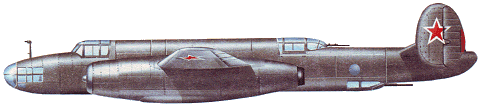
Starting in January 1947 OKB Tupolev began design work on a twin jet tactical bomber powered by two Rolls-Royce Nene centrifugal-flow turbojets. With a few months of the start of the work, it became apparent that the Nene engines produced less thrust than anticipated which delayed development work. Although this jet bomber design carried the official designation Tu-14, it had the Tupolev in-house designation of "73", a continuation of the ANT number series that was discontinued as the official designation during the Second World War. The Politburo wanted the Tu-14 ready for the annual Aviation Day flypast at Moscow-Tushino. But the need to redesign the Tu-14 meant that the prototype would not be ready and Andrei Tupolev himself suggested re-engining a number of piston radial-powered Tu-2 bombers with Nene engines as a temporary measure.

The interim project was given the OKB designation "77" (ANT-77) but would have the official designation Tu-12. Work began in April 1947 even before an official decision was reached authorizing the Tu-12/"77" project. By May of that year the Soviet Air Force reviewed Tupolev's full-scale mockup. Even before the Air Force review of the mockup, Tupolev ordered work to begin in the OKB's workshops converting standard Tu-2S bombers to the Nene-powered configuration. At the end of the month the Air Force authorized conversion work to begin based on their mockup review.

For the sake of expediency, the changes to the Tu-2 bomber were kept to as few as possible. The main differences between the Tu-12 and the Tu-2 were as follows:
  • The Shvetsov ASh-82FN radial engines and nacelles were replaced by longer nacelles housing the Rolls-Royce Nene turbojets. 
  • The wing dihedral was reduced from 6 degress to 3 degrees.
  • The fuselage was stretched with a nose extension allowing the bombardier/navigator to sit ahead of the pilot and a rear fuselage stretch to balance the change in the cockpit.  The height of the midfuselage was increased with the top of the pilot's cockpit even with the top of the aft gunner's canopy. 
  • A tricycle undercarriage was fitted with the mainwheels rotating 90 degrees to lie flat at the bottom of the nacelles. 
  • Additional fuel tanks were added to compensate for the increased fuel consumption of the jet engines. 
  • Adjustments were made to the control system to compensate for higher speeds. 
  • The tail structure was reinforced as well to handle the increase in speeds. 
In July 1947 the prototype Tu-12/"77" was rolled out and on 27 July 1947 the first flight was made in the Soviet Union of a pure jet bomber with none other than Andrei Tupolev himself aboard for the maiden flight- to which he exclaimed "Well, now we've seen for ourselves that youc an fly without an airscrew!" After a handful of successful test flights, the Tu-12 participated in the Aviation Day flypast at Moscow-Tushino and then resumed its flight test program in September of that year. The aircraft was then handed over to the Soviet Air Force to begin state acceptance trials and even though the Tu-12 was only an interim type built from converted Tu-2 bombers, it gave both Tupolev and the Soviet Air Force valuable experience in operating jet bombers. Mock combat sessions were even conducted between the small batch of Tu-12s and the MiG-9 and Yak-23 jet fighters, allowing new tactics to be devised.

Six Tu-12s were made by converting Tu-2s. One aircraft was used as an engine testbed, another was used as part of jet drone development and the remaining four were used by the Soviet Air Force for crew training and familiarization for aircrews bound for the definitive Tu-14. The experience in developing the systems for the first Soviet jet bomber would serve Tupolev well during the development of the Tu-16 "Badger" and Tu-95 "Bear" bombers.

Source: OKB Tupolev: A History of the Design Bureau and its Aircraft by Yefim Gordon and Vladimir Rigmant. Midland/Ian Allan Publishing, 2006, p117-121.

10 July 2010

Tupolev's Own Tristar Design

Amongst the Russian aircraft design bureaus (called OKBs), it's common practice to reuse designations for aircraft projects that have been previously used for aircraft that never made it past the design stage. The Tupolev Tu-204 twin jetliner, for example, is the third design to use the Tu-204 designation. Work on the first Tu-204 project began in 1973, at which time OKB Tupolev was studying the concept of a family of related aircraft designs that shared common features, powerplants and systems. At the time the Tu-134 and Tu-154 were the main domestic jetliners in the Aeroflot fleet as well as in the Soviet client states. The first Tu-204 project was for a short-haul transport carrying up to 180 passengers with two Kuznetsov NK-8 low-bypass turbofan engines (the same powerplant used on the Tu-154) mounted under a T-tail on the aft fuselage. In keeping with Tupolev's ideas for a family of related airliners, this first Tu-204 design would have shared many features of the Tu-134.

By the mid-1970s, though, the design bureau's work and moved towards a medium range airliner with comparable performance to the Airbus A300, the Lockheed L-1011 Tristar, and the McDonnell Douglas DC-10. The expected growth in air travel made a larger-capacity aircraft a more attractive proposition and efforts were made for this new, second Tu-204 project to embody many of the same cabin comforts of the Western wide-bodies. Work began in 1975 on this newer and larger Tu-204 project.

The second Tu-204 project would have had a large fuselage on par with that of the DC-10 and Tristar and underfuselage cargo holds that could accommodate LD-1 and LD-3 containers. A 28-degree sweptback wing with a supercritical airfoil combined with an extensive array of high-lift devices offered good field performance and efficient cruising speeds. A significant amount of time was spent on determining the ideal number of engines, location of the engines, and the type of engines to be used. Again returning to the idea of a family of airliners, Tupolev's designers created to variants of the Tu-204- a twin-engined version and a three-engined version. Both designs used the Soloviev D-30 turbofan (also used on the Il-76 airlifter). The trijet version had a longer fuselage and had its third engine mounted in the end of the aft fuselage and fed by a curved S-duct with its intake ahead of the vertical fin. For all intents and purposes, it strongly resembled the Lockheed Tristar.

Interestingly enough, in 1974 British charter operator Court Line flew one of its Tristars to Moscow along with cadre of Rolls-Royce engineers for a series of demonstrations for Aeroflot that took place over three days. While debatable about how serious Aeroflot's interest in the Tristar was, Aeroflot's engineers were given full access to the aircraft for close examination. This would have been just a year before the launch of the second Tu-204 project.

In the late 1970s the Soviet Council of Ministers issued a directive for a more comfortable and technologically-advanced jetliner that had efficiency as its key selling point. It had to be on par with what was seen as the most advanced jetliner of the day, the Boeing 757/767 series that were under development in the late 1970s (the 767's first flight was in 1981, the 757's was in 1982). As a result, in 1979, the Tu-204 family were redesigned with the more advanced Soloviev D-90 turbofan. Work on the two versions was done in parallel, but Tupolev's designers were steadily starting to favor the twin-engined design as the D-90 was showing promise and growth potential as a powerplant. By 1981 disputes emerged between differing design viewpoints at OKB Tupolev. One group felt that the twin-engined design was just as safe as the three-engined version and that design work should focus on a wide-body twin. Another group wanted to pursue the three-engined design for safety reasons and that the power of three engines offered more growth potential. And a third group emerged that favored a twin-engined design, but felt that the only way to match the 757/767's fuel economy was to use a narrow-body design.


In 1986 the third group won out the internal battle over the Tu-204's design. After a shuffling of design and engineering heads on the project, the Soviet Council of Ministers gave its approval for the Tu-204 to be a twin-jet narrow-body design that strongly resembled the Boeing 757 in layout. That marked the third use of the Tu-204 designation and that is the aircraft that made its first flight on 2 January 1989.


Source: OKB Tupolev: A History of the Design Bureau and Its Aircraft by Yefim Gordon and Vladimir Rigmant. Midland Publishing/Ian Allan, 2006, p267-273.

13 June 2010

The Tupolev Tu-114's First Visit to America

At the 1955 superpower summit in Geneva, Soviet premier Khrushchev found himself embarrassed when President Eisenhower and the American delegation arrived in four-engined propliners and he arrived in a small twin-engine Ilyushin Il-14 transport. Always the showman on the international stage and determined not to be shown up again by the Americans, Khrushchev decided to fly to the United States for his historic 1959 visit in the large Tupolev Tu-114.

Soviet planners, however, were not thrilled at the prospect as 80% of the trip between Moscow and Washington would be overwater and as Aeroflot, the operator of the Tu-114, had rarely conducted trans-oceanic flights at the time, lacked training with ditching techniques, survival at sea and use of life rafts and life jackets. The politburo of the Communist Party as well as the KGB urged Khrushchev to reconsider but he was resolute in making a "grand entrance" on the first visit of a Soviet leader to the United States. The Soviet Navy stationed ships every 200 miles along the route should the airliner have to ditch and the KGB even built a mockup fuselage and tested it in a large swimming pool in Moscow to test out water evacuation scenarios.

The flight went off without a hitch and the aircraft itself was quite the superstar when it landed at Andrews AFB. Eisenhower had offered Khrushchev a helicopter tour of the capital, but he refused as he feared a plot to throw him to his death from the helicopter. It was only after Eisenhower assured him he would be on the same helicopter than he agreed.

After his landmark tour of the United States, on the return flight to Moscow, the Aeroflot Tu-114 encountered a storm near Greenland and St. Elmo's fire danced all over the airframe as the plane temporarily lost contact with Moscow. Khrushchev was sleeping and not awoken during the storm, but the crew feared that loss of contact might cause anxiety in Moscow and fears of a US plot. Fortunately, the large airliner landed safely in Moscow and another unreported tense moment in the Cold War passed into history.


Source: Air Force One: The Aircraft that Shaped the Modern Presidency by Von Hardesty. Northwood/Tehabi, 2005, p60-65.

10 April 2010


As the pace of technological improvements in aviation march forward, sometimes promising aircraft designs get shafted by rival designs that offer more of something- more speed, more payload, more range or just plain more of everything. The lucky ones amongst the short-shrifted go into limited production like the Bristol Britannia or the Convair 990. Some only fly as prototypes like the Avro Canada C102 Jetliner. And most never make it off the drawing boards like the Douglas C-132. Most of the ones that go into even limited production are noted by history- but there are some aircraft designs that despite that, are nearly forgotten to aviation history.

One of those aircraft was the ANT-35 from Andrei Tupolev's design bureau in the interwar period of the 1930s. The beginnings of the ANT-35 started out rather unusually in a contest held in May 1934 in the magazine "Za Roolyom" (At The Wheel) and chaired by the Aviation Research Technical Society (Avia-NITO). The contest called for a high-speed airliner in both single- and twin-engine categories that were to have a speed of 400-450 kilometers per hour, a range of 1,250-1,500 kilometers, a cruising altitude of 7,500 meters and able to carry five to twelve passengers with their baggage. Several dozen designs were submitted to the magazine and while none were actually built, the contest influenced the design of future Soviet airliners.

Andrei Tupolev didn't participate in the contest but he had been watching it from the sidelines and decided to go ahead in August 1935 and build an aircraft to the outlined specifications. To save time and get his design into production as soon as possible, a new passenger-carrying fuselage was mated with the wings, tail, and undercarriage of the Tupolev SB (ANT-40) light bomber. To insure a high speed, special attention was paid to the fit and finish of the components to insure a smooth external line (in contrast to most Soviet designs of the day which were decidedly "rougher") for drag reduction. Two license-built French Gnome-Rhone 860-horsepower Mistral radials were used for the engines. The cabin was heated and fully-soundproofed with ten reclining passenger seats as well as individual ventilation and lighting for each seat- keep in mind that was something that wasn't standard in airliners until the start of the jet age in the 1950s- and this is 1935- in the Soviet Union, no less! Compared to other contemporary Soviet aircraft, the ANT-35 was also lavishly-equipped with a full avionics fit including autopilot, radio equipment and navigation gear.

Tupolev made sure all of the latest in aviation technology was included in the ANT-35- from close-fitting NACA cowlings on engines, oil coolers submerged in the wing roots, hydraulically-operated flaps, even rubber shock-absorbers on the engine mounts. He had every intent on making the ANT-35 not just the fastest airliner, but also the most comfortable and advanced airliner flying.

The first flight of the prototype ANT-35 was made on 20 August 1936 and at normal gross weight it easily cruised at 390 kilometers per hour, making it one of the fastest airliners of the day. The main deficiency noted on the prototype was the lack of headroom in the cabin but it was otherwise an extremely satisfactory design in the opinion of the test crews. The second prototyp,e designated the ANT-35bis, incorporated a cabin with 15 centimeters of more headroom and more powerful license-built American 1,000-horsepower Wright Cyclone radial engines. The improved version flew in late 1937 and served also as a pattern for production of what was to be designated the PS-35 airliner.

Large scale production eluded the ANT-35/PS-35, though. At the same time, the Soviet Union obtained a license to produce the Douglas DC-3 as the Lisunov Li-2 (also designated PS-84) with the same engines as the ANT-35. Although Tupolev's design was much faster, the DC-3/Li-2 could carry more passengers and cargo over a longer range and as a result, Aeroflot and the Soviet Air Force only took delivery of 9 ANT-35 airliners total. Before the outbreak of the Second World War, the ANT-35 was used on the Moscow-Prague and Moscow-Stockholm routes but in 1941 were shifted to high-priority express flights between Moscow and the cities of Lvov and Odessa. During the war the dwindling number of ANT-35s capitalized on their high speed to deliver supplies to partisans in the German rear flanks as well as medical and food supplies to encircled Red Army units. The last aircraft was retired from service in 1944 to fade into obscurity, eclipsed by the Douglas DC-3 and the many variants Lisunov built that were unique to Soviet service.

Source: OKB Tupolev: A History of the Design Bureau and its Aircraft by Yefim Gordon and Vladimir Rigmant. Midland Publishing, 2005, p64-66.

21 December 2009


Similar to the trends in the 1950s in the United States, when the first Russian air-to-air missiles were deployed, the Soviet defense industry shifted towards the development of weapons systems that comprised of not just the interceptor aircraft but also beam-riding radar-guided missiles and the fire control radar. While several design bureaus (OKBs) in the 1950s were working on weapon systems, it was OKB Lavochkin that was the first to propose the weapons system concept with what became the La-250 "Anaconda" in 1953.

The idea behind a weapons system was the each component would be optimized for each other, resulting in a more effective supersonic interceptor. Lavochkin proposed what would be designated the K-15 system which comprised of the La-250 aircraft, the K-15U radar system, the izdeliye ("article") 275 semi-active radar homing air-to-air missile as well as associated GCI equipment. The K-15 weapons system involved 11 manufacturing divisions of the Soviet aerospace industry, six other OKBs, and the Central Aerodynamics and Hydrodynamics Institute (TsAGI), all supervised and integrated by OKB Lavochkin.

Another of the Lavochkin La-250's firsts was the use of an analogue "iron bird" simulator to test the flight control system on the ground before the first flights of the aircraft. The simulator would prove to be instrumental in determining that the loss of the prototype aircraft could have been prevented with a better flight control system. Ultimately, the loss of the first La-250 prototype was only the beginning of problems with the K-15 weapons system that ultimately led to the cancellation of the entire program in July 1959 as the requirements proved to not match the technology of the day.

The La-250 was the last aircraft to be produced by OKB Lavochkin but the effort wasn't in vain- it was the first time in the Soviet Union that research institutes like the legendary TsAGI worked in close cooperation with the design bureaus and manufacturing complexes and it proved the feasibility of such a comprehensive approach. Lavochkin's expertise benefitted OKB Tupolev which introduced the large Tu-128 "Fiddler" interceptor in 1961 which remained in operational service for many years.

Source: Wings of Fame, Volume 19. AIRtime Publishing, 2000, "Beyond the Frontiers: The Lavochkin La-250 Anaconda" by Yefim Gordon, p150-157.

12 November 2009

With the shortest routes to attack American targets laying across the North Pole, Russian research efforts in the Arctic which began in the 1930s took on strategic urgency with the start of the Cold War. Work began in earnest on 23 April 1948 when the first Soviet expedition, designated SP-2, was airlifted to the North Pole. An even larger expedition followed using assets of the Soviet Polar Aviation (a civil aviation agency in the USSR that supported Arctic research) and that of Long-Range Aviation (DA, or Dalyniya Aviatsiya, the Russian version of the Strategic Air Command). Two Tupolev Tu-4 "Bull" bombers from the DA were seconded to Polar Aviation and used as cargo transports with supplies carried in the bomber's spacious bomb bays. Other aircraft were part of the early expeditions and even used at one point an ex-Luftwaffe Focke-Wulf Fw 200 Condor. Also accompanying the bombers and transports were Lavochkin fighters to assess the feasibility of fighter operations in the Arctic.

By the early 1950s a network of deployment airfields large enough to take heavy bombers of the DA like the Tu-95 "Bear" and the Myasishchev M-4 "Bison" had been built across the Russian Arctic along with a chain of radio navigation beacons. However, the DA general staff recognized the vulnerability of these forward bomber bases and in 1956 began investigating operating jet bombers off the polar ice pack itself. By 1958 a special unit of DA Tupolev Tu-16 "Badger" twin jet bombers was created to test the feasibility of operating off ice runways on the polar ice pack.

On 26 April 1958 Colonel Anton Alekhnovich landed a Tu-16 bomber at the SP-6 research station's ice runway. However, on takeoff, the port main gear hit an area of ice that wasn't fully frozen and the bomber veered off the runway and hit an Ilyushin Il-14 transport. Attempts to repair the bomber were unsuccesful and due to fears that the SP-6 ice floe was moving too close to the United States, the Tu-16 was destroyed. Due to the variable nature of ice stability on the polar ice pack, further DA bomber operations were conducted from land bases built in the tundra.

Source: Soviet Strategic Aviation in the Cold War by Yefim Gordon. Hikoki Publications, 2009, p75-82.