
Houston-based Texas International Airlines began in 1944 as Aviation Enterprises and in 1947 with a fleet of surplus Douglas DC-3s, renamed itself Trans-Texas Airways. As Trans-Texas grew as a local service carrier (what we would today call a regional airline only without the affiliation to a major airline like today), Trans-Texas expanded services beyond the state as it added Convair 240 piston twins. The Convairs were later re-engined with Rolls Royce Dart turboprops to become Convair 600s. By the start of the Sixties, the airline flew as far west as Albuquerque and El Paso and Memphis, Jackson, and New Orleans in the east. To maintain its competitive edge with the other Texas-based airline of the day, Braniff International, Trans-Texas added the Douglas DC-9 Series 10 to its fleet starting in 1967. Route expansion continued steadily and with the addition of a small handful of destinations in northern Mexico, the airline re-branded as Texas International in 1970, later unveiling a patriotic Lone Star livery in 1973 prior to the opening of the new DFW Airport. Unfortunately, Texas International's upgrades to jet equipment had saddled the airline with quite a bit of debt, not unlike what had happened to Mohawk Airlines just a few years earlier. Through the 1960s, Texas International and its larger rival Dallas-based Braniff International had more or less comfortably existed in a duopoly in the Texas airline market. That secure operating climate was upended in 1971 with the arrival of Southwest Airlines. Texas International had joined Braniff in the legal battle to quash the nascent upstart and lost, putting Texas International in the new position of having to compete to a degree it had not had to in its history. Combined with its mounting debts from the expansion in the 1960s and the upgrade to a jet fleet, the Houston-based operation was in need of help.
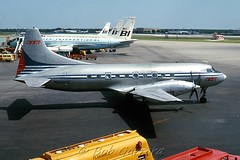
Trans-Texas Airways (TTa) Convair 600 at Dallas Love Field
I had posted previously how in a similar financial situation, New York-based Mohawk Airlines had turned to the services of a small consulting firm called Jet Capital that was headed by a young and quite brash individual named Frank Lorenzo. Lorenzo and his primary business partner, Bob Carney, a fellow Harvard Business School classmate, had become a bit of an upstart darling on Wall Street for their financial wizardry in creating Jet Capital. In their stock offering, Lorenzo and Carney sold shares to the public at 10 cents each, but before the IPO for Jet Capital, they sold shares to friends at $3.50 each but more importantly, they sold shares to each other for 12 cents each. Investing only $44,000 of their money, the Jet Capital IPO netted them $1.5 million yet they controlled 75% of Jet Capital's shares. It was that seed money that Lorenzo used in his failed bid to takeover Mohawk Airlines. At the time of his Mohawk venture, Lorenzo had made friends with Don Burr, a mutual fund manager that had made a name for himself on Wall Street with some very astute aviation stock picks. With his clout as a mutual fund manager that held shares in Texas International, Burr convinced the airline to engage the consulting services of Jet Capital to effect a turnaround. Lorenzo arranged to have the airline's debt refinanced with Burr offering the injection of $5 million from his mutual fund. The result, of course, like their proposed Mohawk deal, was to take control of the airline, and like the Mohawk board several years earlier, the Texas International board was suspicious of Lorenzo and they might have scrapped the deal had it not been for two individuals that entered the ring to try to acquire Texas International themselves- Howard Hughes and Herb Kelleher.
Ever since Hughes relinquished control of TWA in the late 1960s, he had been craving to get back into the airline business and got that chance with his acquisition of the local service carrier AirWest in 1970, immediately rebranding the airline has Hughes Airwest. But Hughes wanted something on the scope of TWA and his new airline only gave him the West Coast. Acquiring Texas International would get him 2/3 of the way across the country on his goal of recreating a transcontinental airline. For Herb Kelleher, getting Texas International would not only knock out a competitor who only recently tried to put Southwest out of business through legal action, it would also give Southwest the operating certificate of Texas International which permitted flights beyond the states of Texas, something Southwest wasn't able to do at the time. Faced with someone known to be eccentric and someone who they felt was bent on revenge for their failed bid to quash Southwest, the Texas International board sold the airline to Lorenzo in 1972. Like his structuring of Jet Capital, even though he controlled only 24% of the shares in Texas International, Lorenzo structured the deal to give him majority voting control of the airline. At only 32 years of age, Frank Lorenzo became the youngest airline chief since Juan Trippe at Pan Am. And he did it by defeating Herb Kelleher *and* Howard Hughes. Who wouldn't be on top of the world in those shoes?
 |
| Frank Lorenzo at the time he took control of Texas International |
Don Burr left Wall Street in 1973 to work with Lorenzo in Houston running Texas International. At the time Southwest was adding its fifth and sixth Boeing 737-200 to its nascent fleet and even though Texas International had routes outside of the state of Texas, it was beginning to lose market share within Texas to Herb Kelleher's operation. It was at Texas International that Lorenzo began to earn his reputation as a union-buster- in order to better compete against Southwest, Lorenzo began making deep cuts in labor costs that sowed discord among the employees at Texas International. With labor contracts up for negotiation, the atmosphere became contentious at Texas International. In a pattern that set Lorenzo's pattern for negotiations with both unions and investors, he would often add or change at the last minute agreed-upon terms for the contract. This angered the unions at Texas International and they struck, the very first strike in the history of the small airline. The airline was grounded for four months, but back then in the days before deregulation, there was a mutual aid pact in place where other airlines gave financial support to airlines that were grounded by labor actions. As a result (and much to the other airline's chagrin who felt Lorenzo could have prevented the strike), Texas International got millions under the pact and the strike eventually ended.
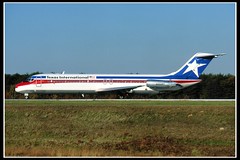
Texas International Douglas DC-9 Series 30, the airline's largest aircraft
Having got his labor concessions the way he wanted, Lorenzo could now turn his attention to competing with Southwest. At the time, Southwest operated within the "Texas Triangle" of Dallas, Houston, and San Antonio, the state's three largest cities. Kelleher had engaged the services of a seasoned airline executive, Lamar Muse, to guide Southwest's growth. Muse picked the agricultural town of Harlingen in the Rio Grande Valley as Southwest's next destination. The city was ripe for the picking- being at least a seven hour drive from the nearest large city, Harlingen was dependent upon air services from Texas International and the four month strike at the airline had hurt the city economically. Muse had also astutely noted that Harlingen was a short drive from South Padre Island which was at the cusp of starting its tourist boom as a Gulf Coast beach destination. While Texas International would have charged a one way fare of $40 for Harlingen, Southwest charged only $25 and traffic soon boomed with thousands of passengers filling Southwest flights whereas the year prior, Texas International would have only had a few hundred a month. Before long, residents from northern Mexico were crossing the border to also take Southwest flights. Texas International tried various approaches, but it was painfully clear to Lorenzo that he wasn't able to compete head-to-head with Southwest.
In the days before deregulation, airline fares were set by the Civil Aeronautics Board (CAB) in Washington. Any airline that operated beyond a single state was an interstate carrier and would fall under CAB regulation as was the case with Texas International. Southwest, however, only operated in Texas and therefore was free to set its fares whatever it wished as long as the state authorities in Austin had no objections, which was rarely the case. In November 1976, Lorenzo petitioned the CAB to be allowed to cut its fares- and not just to match Southwest, but to undercut Southwest with a 50% discount- what Lorenzo called "Peanuts Fares" since you could "fly for peanuts". For years airlines had been allowed to implement fare discounts by the CAB, but these were usually for charter flights, holiday flights and red-eye flights and were rarely ever long-term and only applied to a few flights. What Lorenzo was petitioning the CAB to be allowed to do was unprecedented in the airline industry- he was asking for individual authority to set his own ticket prices across the board based on market conditions. This had never been done in forty years, but there were already deregulation forces at work in Washington on the heels of Jimmy Carter's election to the White House. The CAB approved Lorenzo's petition and the Peanuts Fare" were introduced not just to Harlingen, but across Texas International's route system. By the end of the first week, passenger loads on the airline had shot up an astounding 600 percent.
 |
| Peanuts Fares didn't just apply to routes where TI competed with Southwest |
Peanuts Fares were a success for the airline and Frank Lorenzo was hailed as a hero by consumer advocate groups. But there was a catch that gnawed at him despite being flush with success at such a young age with such a small airline- the fare experiment suggested strongly that airlines were more than able to manage their own fares without the bureaucracy of the CAB. To the advocates of deregulation, it was ammunition in the battle to eliminate the CAB and deregulate the US airline industry. Just a few years earlier an airline executive could face criminal charges for setting fares without the approval of the CAB, now here was Texas International doing just that and making a huge pile of money in the process and stimulating a boom in passenger traffic. Lorenzo didn't want deregulation, though. Texas International at the time was only the 20th largest airline in the United States. He knew he could be crushed instantly by the Dallas-based giant Braniff International should deregulation happen. Even bigger American Airlines was growing its presence at the new DFW Airport as well, and American had resources and deep pockets that would make Texas International a quick snack in a fully free-market environment. During press interviews at the time, Lorenzo was quick to point out the experimental and temporary nature of the Peanuts Fares. For the time being, the CAB's bureaucracy did shelter him from being crushed by larger airlines for the time being, giving him time to plan his next move.
But that'll be a blog post for a later date..........
Source: Hard Landing: The Epic Contest for Power and Profits That Plunged the Airlines into Chaos by Thomas Petzinger. Times Business/Random House, 1996, pp 38-50. Grounded: Frank Lorenzo and the Destruction of Eastern Airlines by Aaron Bernstein. Beard Books, 1999, pp 11-15 Photos: Wikipedia, Flickr/Bob Garrard Collection


