Showing posts with label Regia Aeronautica. Show all posts

06 June 2015

The Macchi-Castoldi Line of Italian Fighter Aircraft

Mario Castoldi, one of the great unheralded designers of WW2
In a lot of ways the development and history of the Macchi-Castoldi series of fighter aircraft used by the Regia Aeronautica during the Second World War parallels that of the Supermarine Spitfire. Unlike many other contemporary fighter aircraft, both lines of fighters weren't derived from earlier fighter designs but sprang from the design work of the elegant racing seaplanes of the 1920s and 1930s and both fighter lines were developed and refined continuously during the course of the war to improve their performance. The Spitfire was born from the Supermarine Schneider series of racing seaplanes designed by Reginald Mitchell. The Macchi-Castoldi series of fighters were the products of Italian engineer Mario Castoldi and his work on the Macchi racing seaplanes that were Schneider Trophy winners as well. Castoldi joined Macchi in 1922 with his first winning racing seaplane design being the Macchi M.39 that won the 1926 Schneider Trophy. Castoldi spent three years working on his ultimate racer, the Macchi M.C.72 that was planned to retake the Schneider from a series of British wins with Reginald Mitchell's designs. Though the M.C.72 didn't complete in a race due to not being ready in time, in 1934 it set a world speed record of 440 mph that still stands to this day for piston-engined seaplanes. For comparison, the world speed record at the time for landplanes was held by the Hughes H-1 with a speed of 352 mph. Castoldi began work on his first fighter aircraft based on his racing seaplane designs when the Hawker Hurricane and Supermarine Spitfire started their flight test programs. Castoldi, however, was handicapped from the start with a lack of a suitable engine like the Rolls-Royce Merlin that wasn't just only a powerful engine but being a liquid cooled inline engine, could be installed in a low drag nose cowling. The only engine that had the power Castoldi wanted was the Fiat A.74 twin-row fourteen cylinder radial developing 870 hp. In addition, the Regia Aeronautica had very stringent visibility demands from the cockpit and this required a hump-backed fuselage which along with the Fiat radial engine, eliminated any of the clean lines that would have belied its racing aircraft origins. The design was entered into the "Program R" competition for a fighter aircraft that had two hours' endurance and twin 12.7mm machine guns. Designated the M.C.200 Saetta (Arrow), it first flew on 24 December 1937. 
M.C.200 Saetta
Proving to be a highly maneuverable aircraft with good ground handling due its wide spaced landing gear (something that always bedeviled both the Spitfire and Bf 109 on account of their narrow track landing gear), the M.C.200 lacked the elegance of the Spitfire but was an impressive performer capable of 500mph in a dive and a quantum leap over the current Regia Aeronautica fighter aicraft, the Fiat C.R.42 Falco biplane. The M.C.200 was declared the winner against the other entrants in 1938 and ordered into production with deliveries beginning in 1939. Thoroughly conventional in its design and construction, the M.C.200 was unique in having its ailerons interconnected with the wing flaps so that they drooped slightly during takeoff and landing to improve field performance. When the first M.C.200s were delivered to the pilots of 4 Stormo (Wing), the pilots were resistant to giving up their Falco biplanes and felt that the enclosed cockpit would delay their egress in an emergency. Castoldi switched to a partially open cockpit design as a result of pilot demands. The pilots of 1 Stormo were more accommodating of the new monoplane fighter, though, as those pilots had participated in the Spanish Civil War and took little convincing that monoplane fighters were the wave of the future. Initial operations had uncovered some unpleasant spin characteristics that had to be rectified with a modified wing and this delayed operational capability further. Only 29 Saettas were in service by the time World War 2 broke out in September 1939 as a result. Interestingly, Italy did solicit export orders for the Saetta and did get a contract for 12 aircraft from Denmark! They were ordered for the Danish Naval Air Service but the order was never finalized after the German invasion of Denmark on 9 April 1940. Two months later when Italy entered the war there were 156 Saettas on strength with the Regia Aeronautica. The M.C.200 Saetta was to have participated in the invasion of France, but another unpleasant quirk was found with high speed stalls. Again the wing required modification and the Saettas went into action over Malta against the Hawker Hurricane. Though slightly slower, the Saetta could hold its own against the Hurricane and proved just as sturdy. Saettas would see extensive service flying escort missions on strikes against Allied shipping in the Mediterranean and were also sent to the Balkans, North Africa, and even participated in Operation Barbarossa on the Eastern Front. 
M.C.201 prototype

M.C.202 Folgore in North Africa

As the development of the M.C.200 Saetta proceeded in 1938, Castoldi was asked to work on a modified Saetta that would use the new Fiat A.76 radial that produced 1,000 horsepower. Castoldi refined the M.C.200 design with an aerodynamic clean up that dropped the hump-backed fuselage and featured an enclosed cockpit for drag reduction. Designated M.C.201, it wasn't enough of an improvement over the production M.C.200 to warrant changing production. Contributing to the termination of the M.C.201 program was Castoldi's next design which was much more promising, the M.C.202 Folgore (Lightning). The Folgore was more of what Castoldi wanted in a fighter design as it featured the German Daimler-Benz DB 601 liquid cooled inline engine that also powered the Messerschmitt Bf 109. With the slimmed down airframe of the M.C.201 and its enclosed cockpit combined with the powerful and low drag DB 601 engine, the M.C.202 Folgore was an instant winner from the time it made its first flight on 10 August 1940. It evoked the lean lines of Castoldi's pre-war racing seaplanes and much of the Saetta production jigs and tooling could be used with sped its introduction into service. Early Folgores used imported DB 601 engines before Alfa Romeo was license-building the DB 601 as the R.A.1000 developing 1,175 hp. The Folgore's empennage was identical to the Saetta and the wings were also identical apart from the installation of fuel tanks in the inboard sections. Armament was basically the same and rather light compared to contemporary aircraft, but some Folgore variants also included an additional pair of wing mounted machine guns and one production batch had underwing fairings for 20mm cannons. The first Folgores went into action with 1 Stormo on 25 November 1941 in Libya. In battles over North Africa, the Folgore gave good account of itself being more maneuverable than both the Hurricane and Spitfire. The M.C.200 Saettas were soon relegated to ground attack missions as the Folgore became the Regia Aeronautica's primary fighter aircraft. Despite this, however, the Saetta remained in production due to production issues with Alfa Romeo on the DB 601 engines. Like the Saetta-equipped units, Folgore squadrons were sent to the Eastern Front but in smaller numbers than the Saetta. 
M.C.205 Veltro in RSI markings
Castoldi wasn't resting on his laurels with the Folgore, though, as he continued to refine the design further and on 19 April 1942 the M.C.205V Veltro (Greyhound) first took flight. While looking very similar to the M.C.202 Folgore, the Veltro used the more powerful Daimler Benz DB 605 engine that produced 1,475 hp. In fact, the Veltro prototype was a Folgore that had been modified to take the DB 605 engine. Like the transition from the Saetta to the Folgore, the transition from the Folgore to the Veltro was relatively easy as much of the same production equipment could be used. Early M.C.205V Veltro aircraft had the same armament as the Folgore before the production standard became two wing-mounted 20mm cannons and the 12.7mm twin guns on the top of the nose. The M.C.205V Veltro went into action for the first time in June 1943 during the Battle of Pantelleria- with the surrender of Axis forces in Tunisia, the Allies prepared for the invasion of Sicily but first had to secure the small island of Pantelleria as well as the rest of the Pelagie Islands of Lampedusa, Linosa, and Lampione. The Veltro then went into action defending Sicily during Operation Husky in July 1943. Despite the fact that the Veltro could easily hold its own against the P-51 Mustang, they were overwhelmed by the sheer size of the Allied invasion force. When the Italian government capitulated on 8 September 1943, the Regia Aeronautica was a shell of its former self with only 33 M.C.200 Saettas, 53 M.C.202 Folgores, and 35 M.C.205V Veltro fighters in serviceable condition along with a variety of other aircraft. But the Macchi-Castoldi fighters were the crown jewels of the Regia Aeronautica and the Germans had no intention of respecting the Italian Armistice. Only 23 Saettas and 6 each of the Folgores and Veltros were able to make it to Allied airfields to become part of the Allied-supported Co-Belligerent Air Force. Most of the fighters were either destroyed by their Italian crews or taken in by the Repubblica Sociale Italiana (RSI) that held out in northern Italy determined to continue fighting with the Germans. 
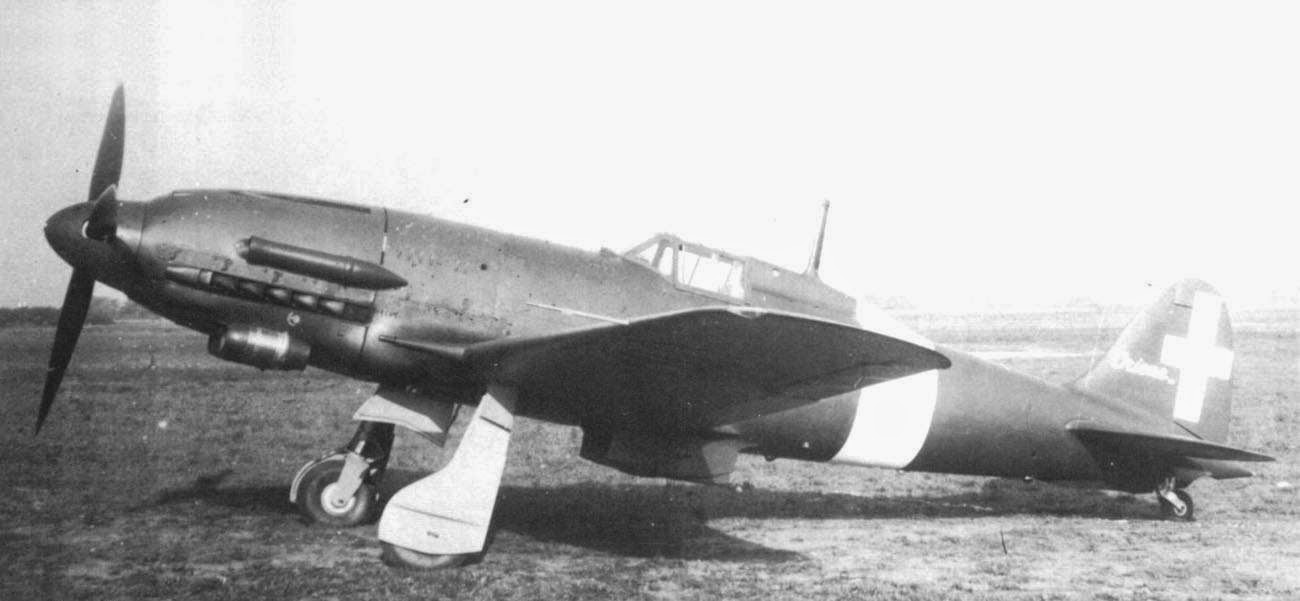
M.C.205N Orione
Castoldi had always considered the Veltro an interim design, though, as he again refined the design further to make full use of the performance of the DB 605 engine. The new design was the M.C.205N Orione (Orion) and while it used the same empennage that was used on the Saetta, Folgore and Veltro, the fuselage was slimmed down for drag reduction and the wing span increased. Four 12.7mm guns were mounted in the forward fuselage- two on the upper nose just like on the prior Macchi-Castoldi fighters but a second set were mounted in fairings on the fuselage sides above the wing roots. Like the Bf 109, the Orione featured a nose-mounted 20mm cannon. The second Orione prototype replaced the 12.7mm guns near the wing roots with a 20mm cannon in each wing. The first Orione made its first flight on 1 November 1942 and the second Orione flew on 19 May 1943. The Italian government afforded production priority to the Veltro as it could use existing jigs and tooling while the Orione would need new tooling. It had also been decided at this point that the successor to the Veltro would be the Fiat G.55 Centauro as it showed more promise at high altitudes where American bomber aircraft operated.

M.C.206. Only one prototype built, but destroyed before flown
This wasn't quite the end of the Macchi-Castoldi line, though. Always refining his designs with several parallel concepts in the works, the successor to the M.C.205N Orione was the M.C.206. Being the consummate engineer, Castoldi set out to improve upon the deficiencies of the M.C.205V Veltro and the M.C.205N Orione. Still using the DB 605 engine, a single M.C.206 was nearly complete when it was destroyed in an Allied bombing attack in the spring of 1944. The more powerful DB 603 engine that was used on the Focke Wulf Ta 152 spurred Castoldi to revise the design again with the M.C.207 which had it been built would have been the ultimate Macchi-Castoldi fighter. With 1.700 hp available, the M.C.207 was a larger aircraft with four 20mm wing cannon. Work began on the M.C.207 prototype, but it was never finished before the war ended in 1945. 

The ultimate Macchi-Castoldi, the M.C.207. Prototype started, never completed
While the quantities of the Macchi-Castoldi fighters were modest compared to other fighter aircraft of the Second World War, the fighters were well-regarded by the Allies as adversaries. The Italian aircraft industry was never fully mobilized on war footing and this was one factor that was detrimental to Italian fortunes in the war. Germany proved to be a less than ideal ally through it all, often holding up deliveries of Daimler Benz engines, failing to provide requested assistance to the Italian aircraft industry. In addition, many skilled Italian workers in the industry were forcibly moved to work in German aircraft factories. Mario Castoldi retired from aviation with the end of the war in 1945, passing away in 1968. 

Source: Famous Fighters of the Second World War by William Green. Doubleday and Co, 1975, pp 71-83. Images: Wings Palette, Wikipedia, World of Warplanes forum.

17 April 2015

The Last Savoia-Marchetti Airliner

Italian aeronautical engineer Alessandro Marchetti
The Italian aircraft manufacturer Savoia had a history dating back to its founding in 1915 by Umberto Savoia and after the end of World War I, it merged with SIAI (Società Idrovolanti Alta Italia), another firm known for its seaplanes. The company became Savoia-Marchetti (sometimes also referred to as SIAI-Marchetti) when the designer Alessandro Marchetti became its chief engineer in 1922 and quickly became famous for his work on the S.55 twin-hull flying boat. Many of Marchetti's designs during the interwar period would set speed and endurance records in flight. Most of what Alessandro Marchetti is best known for, though, was his line of three-engined aircraft that began with the SM.79 Sparviero that first flew in 1934 as a fast eight-passenger transport capable of air racing. With the storm clouds of war fast coming to Europe, the Sparviero became Italy's primary bomber aircraft and one of the few Italian designs produced in significant quantities during the Second World War. The trimotor layout of the Sparviero set the pattern for a whole seriesof aircraft from Savoia-Marchetti, In 1934 the Italian airline Ala Litorria asked Marchetti for a modern long range airliner to which the SM.75 Marsupiale transport resulted. The Marsupiale had its inaugural revenue flights with Ala Littoria in 1938 with the Italian air arm, the Regia Aeronautica, taking interest in the aircraft as a transport. 

With war embroiling Europe in 1941, Marchetti began work on a four-engined derivative of the SM.75 that accommodated 18 passengers on long-range flights. It was a departure from Marchetti's land plane designs which were nearly all trimotors save the obscure SM.74 of which only three were built of this pre-war shoulder-wing airliner. The new aircraft was designated the SM.95 and a prototype and two pre-production examples were built in 1942. In addition, work began on a long-range bomber version designated SM.95B. The original design called for either 14- or 18-cylinder Piaggio radial engines, but wartime availability meant that Marchetti had to settle for a 9-cylinder Alfa Romeo engine producing 780 horsepower. Typical for Marchetti's designs of the period, the SM.95 was of mixed construction with a welded steel tube fuselage with metal alloy skin for the nsoe section and underside and fabric covering for the rest of the fuselage. The wings were plywood-skinned with three wood wing spars. The mixed-material construction likely also made the aircraft much lighter given the fact that lower-powered engines were used instead of what was originally planned. 

The prototype first flew on 8 May 1943 and was immediately impressed into transport service by the Luftwaffe. The fate of the first pre-production aircraft is unknown but is believed to have also been impressed into Luftwaffe service. The second pre-production aircraft was stretched and designed SM.95GA for "Grande Autonomia", featuring increased fuel capacity and revised cockpit instrumentation. Work on the SM.95 was soon hampered by the Italian Armistice in September 1943, but work was completed on the SM.95B bomber prototype with had the wings, engines, and empennage of the transport variant married to a new fuselage that was deepened to allow a bomb bay below the wing spar carry-through structure. A glazed nose accommodated the bombardier with the flight deck moved forward with defensive armament consisting of 12.7mm Breda guns in a turret aft of the flight deck and lateral positions in the aft fuselage and a ventral position forward of the bomb bay. No known photographs of the SM.95B are known to exist though the bomber prototype did fly at least once in 1945. 

Alitalia's SM.95 I-DALL "Marco Polo"
The third SM.95, the SM.95GA, finally made its first flight on 28 July 1945. It and the next aircraft built were put into military service with the Aeronautica Militare. The stretched fuselage of the SM.95GA became the production standard, the nine-foot fuselage stretch allowing for the carriage of 30 passengers in three-abreast seating. The military transports entered operational service starting in May 1946. The new Italian flag airline Alitalia had just been established in September 1946 and orders for six SM.95s were placed. The first two were I-DALJ "Cristoforo Colombo" and I-DALK "Amerigo Vespucci", delivered at the end of 1947 to Alitalia and promptly put into airline service. The production SM.95s had upgraded 9-cylinder Alfa Romeo radials that had increased power output from 780 horsepower on the wartime prototypes to 930 horsepower to accommodate the increased weights of the increased fuel and stretched fuselage. The balance of Alitalia's order, though, was completed with British Bristol Pegasus engines that delivered 1,000 horsepower- these aircraft were I-DALL "Marco Polo", I-DALM, I-DALN "Sebastiano Caboto" and I-DALO "Ugolino Vivaldi". The first two Alitalia SM.95s were subsequently re-engined with the more powerful Bristol Pegasus. It was I-DALN "Sebastiano Caboto" that inaugurated Alitalia's first postwar services to Great Britain on 3 April 1948. 

One of LATI's three SM.95s, I-LATI "San Francesco"
Another Italian airline also ordered the SM.95- Linee Aeree Transcontinentali Italiane (LATI), which had operated air services between Italy and South America prior to the Second World War. LATI had ordered three SM.95s which were all delivered by 1949- I-LAIT "San Antonio", I-LATI "San Francesco" and I-LITA "San Cristoforo". When LATI ceased operations in 1950, their three SM.95s were assumed by Alitalia. Interestingly the only other airline operator of the SM.95 was SAIDE of Egypt, which operated three aircraft to connect Cairo with European capitals. While Alitalia configured its aircraft for 20 passengers, LATI flew shorter routes than Alitalia and configured its aircraft for 26 passengers but SAIDE operated even shorter routes and packed in 38 passengers on their aircraft. Both LATI and SAIDE's aircraft were powered not by the Pegasus radial engine but Pratt & Whitney R-1830 Twin Wasp 14-cylinder engines producing 1,200 horsepower. 

Only a total of 12 production SM.95s operated commercial services out of a total of 20 airframes built including the prototypes. The mixed material construction wasn't terribly robust with the rigors of scheduled passenger services and lacking pressurization also limited their usefulness. Compared to the Douglas DC-4 and the Lockheed L-749 Constellation of the time, the SM.95 was an outdated design. The last passenger flights took place in 1950 less than a year after the last production aircraft was completed. 

Interestingly, there was a plan by the Regia Aeronautica called "Operation S" prior to the 1943 armistice that would have used a modified SM.95GA to fly at very long ranges to bomb New York City. Benito Mussolini, however, would only allow the mission to drop propaganda leaflets as he didn't want to alienate the large population of Italian-Americans in the city. The mission was under preparation when the 1943 armistice occurred. 

Source: Air International "Plane Facts" Volume 10 Number 2, February 1976. Photos: Wikipedia, Alitalia, Air International

08 February 2011

How the USS Wasp Helped Defeat Rommel's Afrika Corps

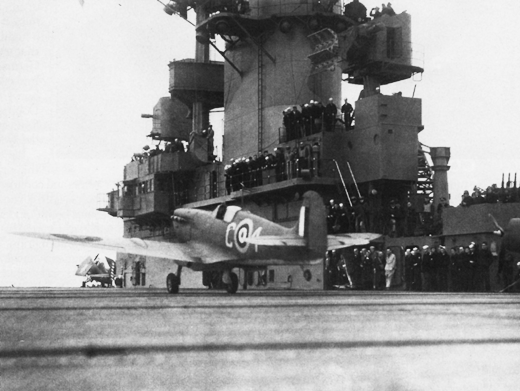
Spitfire Mk.V makes its takeoff run on the USS Wasp
From 1940 to 1942 the Italian Regia Aeronautica and the Luftwaffe mounted over 3,000 sorties against the British fortress island of Malta in the Mediterranean in an effort to secure their supply lines to Field Marshall Erwin Rommel's Afrika Korps in North Africa. Despite repeated attacks, the Allies managed to keep Malta supplied, even with Axis airfields only sixty miles to the north in Sicily. With the coming of the harsh Russian winter in 1941, poor flying conditions put a temporary hold on most air operations over the Eastern Front and Hitler decided once and for all to deal with Malta. Aircraft idled on the Eastern Front were temporarily moved to airfields in Sicily and southern Italy to begin an intensive aerial bombardment as a prelude to an invasion of the outpost. By the end of January 1942, Malta's defenses had been reduced only a few dozen Hawker Hurricanes which were far outclassed by the Messerschmitt Bf 109s that routinely prowled the skies around the British garrisons. The Hurricanes were delivered to Malta by a Royal Navy aircraft carrier- launching from a point 600 miles west of Malta off the coast of Algeria for the long flight to Malta. Now the British planned to send Supermarine Spitfires the same way to bolster the defenses of the island. Supermarine's engineers devised a 90 gallon external belly tank to extend the range of the Spitfire as well as the addition of a dust filter under the nose to keep the carburetor air relatively grit-free.

On 7 March 1942 the HMS Eagle delivered fifteen Spitfire Mk.Vs to the island and by the end of the month, the Eagle made two more deliveries. But the Luftwaffe and the Regia Aeronautica stepped up the pace of their attacks on the beleaguered island fortress and the bombers and torpedo bombers that were based on the island to harass Axis shipping had to be withdrawn, providing a much needed respite for the Afrika Korps who could now be supplied unmolested. The small Spitfire force suffered heavy attrition both in combat and due to air attacks on the island airfields and by the end of the month, the only carrier available to deliver Spitfires to the island, the HMS Eagle, had developed steering problems that would lay her up for four weeks in the dockyard at Gibraltar. As a result, on 1 April 2942 Prime Minster Winston Churchill contacted President Franklin D. Roosevelt for assistance in getting more Spitfires to Malta. No Spitfires were available in Egypt to be spared, and the other two available Royal Navy carriers weren't suitable- the HMS Argus was too small and the HMS Victorious' lifts were too small for Spitfires. The Luftwaffe hoped to knock Malta out before the late spring thaw in on the Eastern Front. 
Spitfires being craned aboard the USS Wasp

On 10 April 1942 President Roosevelt ordered Operation Calendar- on that day the USS Wasp docked in Glasgow and loaded forty-seven Spitfires while retaining twelve Grumman F4F Wildcats for self-defense. Nine days later the Wasp and her escorting force of British warships entered the Mediterranean. On 20 April 1942 at sunrise off the coast of Algeria, the Wasp launched her Wildcat combat air patrol first followed by the twelve Spitfires on the deck and then the thirty-five Spitfires that were brought up from the hangar deck. Alll but one of the Spitfires made it to Malta, greatly bolstering the defenses. Unfortunately the following day the Luftwaffe struck back at the island's airfields and by the end of the day, only seventeen Spitfires were left operational. RAF repair crews labored under constant air attack to cannibalize battle damaged Spitfires that were beyond repair to get the others operational to fight off the next attack. Once again, Churchill contacted Roosevelt and on 29 April the USS Wasp arrived back in Glasgow for Operation Bowery. This time not only did the Wasp take aboard forty-seven Spitfires, but she was joined by the newly-repaired HMS Eagle which took seventeen Spitfires. At dawn on 9 May 1942 a force of sixty-four Spitfires departed; one crashed on takeoff, killing its pilot and a second Spitfire flown by Royal Canadian Air Force pilot Jerry Smith found once airborne that he couldn't draw fuel from the 90-gallon drop tank. Once the deck of the Wasp was clear, he managed to land safely back aboard the carrier despite never having landed on a carrier and his Spitfire not having an arresting hook! No barriers were engaged either, and as result, the US Navy pilots aboard the Wasp "unofficially" awarded him a set of gold Navy pilot's wings. 

Spitfires share the deck with Wildcats with the HMS Eagle following
Of the sixty-two Spitfires that set out for Malta that day, two were lost along the way. As each Spitfire landed, it was immediately refueled and rearmed while a Malta-based pilot replaced the ferry pilot, all while the engine remained running. RAF ground crews had each Spitfire airborne and ready to meet the next Luftwaffe attack in only 15 minutes! Over the next two days, the Spitfires and remaining Hurricanes on Malta exacted a harsh price from the Luftwaffe attackers, but by this point, the weather was improving over the Eastern Front and Hitler ordered the aircraft transferred to the Mediterranean for the Malta operation moved back to Russia. The Regia Aeronautica was given responsibility for knocking out Malta's defenses but never came close to achieving the near-defeat of the fighter defenses of April and May of that year. Between 18 May and 8 June another seventy-six Spitfires were delivered to Malta, this time by Royal Navy carriers, but it never matched the effect of the USS Wasp making just two deliveries, leading Churchill to quip "Who says a wasp can't sting twice?"

The overall effect of having Malta as a base of operations against Axis shipping in the Mediterranean cannot be understated- of the Axis merchant ships that provided the lifeline to Erwin Rommel's Afrika Korps, 70% of Italian merchant shipping was sunk by Malta-based aircraft and 23% of German merchant shipping was sent to the bottom of the Mediterranean by the RAF on Malta. Had the British lost Malta, the outcome of the war in North Africa might have been very different.

Source: Military Aircraft Monthly International, Volume 10, Issue 1. "Air Wars: Spitfires to Malta" by Dr. Alfred Price, p4-11.