Showing posts with label BAC One-Eleven. Show all posts

28 March 2015

The Rise and Fall of Mohawk Airlines and Opening the Door for Frank Lorenzo

Robinson DC-3 crew with Robert Peach on the far right
In the days following Pearl Harbor, the US Civil Aeronautics Board suspended all awards for new air services given the wartime situation. However, the CAB soon realized that air services would need to expand the support the growing production effort for the war. On 11 July 1944 the CAB issued an judgement that created a new category of airline called a feeder or local service airline that would funnel passengers and goods from smaller communities to larger cities for connections to the large established trunk airlines of the day like the "Big Four" of United, Eastern, American, and TWA. One of the early pioneers to take advantage of the CAB's decision was an aerial photographer and inventor named C.S. Robinson in Ithaca, New York. His work with aerial photography before the war led him to developed a metal spring like shock mount for his cameras that was superior to the rubber mounts of the day that became hard at high altitude. Robinson's factory to support the war effort was in Teterboro, New Jersey and he commuted between Teterboro and Ithaca in his Fairchild 24. Finding a constant stream of people who wanted to hitch a ride with him to New Jersey, he decided to start his own airline to connect upstate New York to the New York/New Jersey area and on 6 April 1945 Robinson Airlines began airline services from Ithaca and New York City using three Fairchild 24s. With traffic growing, Robinson expanded to larger aircraft and hired pilots as fast as he could to meet demand. One of his new hires was a former Navy patrol pilot and lawyer named Robert Peach. 

Peach was decorated Navy pilot in the Pacific with two Distinguished Flying Crosses and at the time he joined Robinson Airlines, he was finishing law school at Cornell and wanted to get back into flying part-time. With the rapid growth of demand out of Ithaca, Robinson's laid back management style wasn't conducive to a growing airline and the finances according suffered in the immediate years after the end of the Second World War. Edwin Link, the developer of the Link Simulator that was vital to training pilots, had a factory in Binghamton, New York and was willing to invest in Robinson if there was a change of leadership to assure a return on his investment. Link provided the seed money to allow Robinson to upgrade to Douglas DC-3s and by 1952 Robert Peach had risen through the ranks to Robinson to gain the attention of outside investors. He ended up buying Robinson Airlines outright which assured Link's continued investment in the airline. One of his first acts as head of the airline was to hold a contest to rename the airline and that's how it became Mohawk Airlines. 

Robert Peach at the christening of Mohawk's first One-Eleven
Link's investments weren't enough for Mohawk as Peach pushed for an increase in the usual subsidy the CAB gave to local service airlines. It was a role that raised Peach's prominence in the airline community as he advocated for more support for the smaller airlines. In those days, the CAB had a subsidy given to airlines for routes they flew and Peach pushed for the CAB to treat local service airlines like Mohawk on the same basis as the large established trunk airlines. At the time the Eisenhower Administration wasn't too keen on the idea of increasing subsidies to local service carriers, but Peach and the other local service carrier heads had two important allies- one was Donald Nyrop, the head of the CAB at the time (who later became the head of Northwest Airlines) and Texas Democrat Representative Lloyd Bentsen. When the CAB opened up for applications for local service carriers in 1945, certification was provisional. Bentsen's proposed legislation would make certification of the local service carriers permanent, placing them on better footing with the established trunk carriers and opening the door to increased subsidies from the CAB. President Eisenhower signed the bill after it was unanimously passed by both houses of Congress in 1955. 

Mohawk's BAC One-Elevens increased its stature in the industry
Beginning 1962 Mohawk under Peach's leadership grew tremendously. I had previously written about Mohawk's fight to acquire jet equipment in the form of the BAC One-Eleven that culminated in Peach winning the fight and the first Mohawk BAC One-Eleven, christened "Ohio" flew its first revenue services on 25 June 1965. In addition, Fairchild-Hiller FH-227 turboprops were also put into service to replace the piston twins with Mohawk reaching its zenith in 1967 with route awards from the CAB to Detroit, Cleveland and Boston. The floor fell out from underneath Robert Peach and Mohawk Airlines in 1968. On 23 June that year, the BAC One-Eleven "Discover America" crashed on a flight from Elmira, New York, to Washington, DC. The cause was a valve failure in the APU that resulted in an inflight fire that compromised the tail structure. Two weeks later, a new air traffic controllers union called Professional Air Traffic Controllers Organization (PATCO) that started in New York City staged a slowdown to protest inadequate staffing and excessive overtime. Working to the letter of the rules, air traffic back up around numerous chokepoints that led into the New York City area. From July to August, the PATCO action proved disastrous to many airlines, but more so to Mohawk given its route structure. Peach even tendered a bill to the FAA for costs incurred during the PATCO slowdown as a protest. In the following year, a general downturn in the economy then hit Mohawk's passenger numbers. By 1970, the nation was in recession and every airline was losing money and this further added to Mohawk's woes. To save costs, many local service carriers were handing off services to smaller cities to commuter airlines with the CAB subsidy "flowing through" from the local service carrier to the commuter airline. Mohawk's rival, Allegheny Airlines, was already doing this with their "Allegheny Commuter" brand. The CAB permitted this as long as the local service airline would step back in should the commuter airline cease services to any of the communities. 

Frank Lorenzo at the time of his takeover of Texas International
At Mohawk, the pilots saw the outsourcing to commuter airlines as a threat to their jobs (some things in the airline industry never change and this is still a contentious issue in airlines today). One minute before midnight on 12 November 1970, the pilots went on strike after the failure of negotiations and Mohawk was essentially shut down as an airline. The debts that Mohawk incurred upgrading to the BAC One-Eleven and FH-227 aircraft were piling up against declining traffic. The pilot's strike was a nail in Mohawk's coffin as the management turned to a small New York City aviation consulting firm to assist with a turnaround. This small firm was Jet Capital, founded in August 1966 by two Harvard business school graduates, Frank Lorenzo and Bob Carney. With a small office in the prestigious Pan Am building in Manhattan, Lorenzo and Carney had a stock offering in January 1970 that netted them $1.5 million in "seed money". They had earlier provided financial consulting to Detroit-based cargo airline Zantop  that got their name out in the industry. Lorenzo met with Robert Peach on numerous occasions and Jet Capital offered Mohawk a restructuring plan that essentially resulted in Lorenzo controlling Mohawk Airlines. At the time, Lorenzo was only 30 years old- and his plan to take over Mohawk was a bit much for the Robert Peach and the board to swallow. With the airlines' fortunes waning quickly, Peach instead allowed his long time rival Allegheny Airlines to purchase Mohawk. By this time the slow slide of Mohawk meant that Peach had less control over Mohawk than what was the case in 1967. On 20 April 1970, he had lunch with Frank Lorenzo thanking him for his services and offer but that the board had decided to sell to Allegheny. After lunch, Robert Peach went home to prepare for a speech he was to give that night, but instead shot himself in the head, the loss of Mohawk too much to bear for him. 

Robert Peach wasn't only airline boss to kill himself after dealing with Lorenzo. That will be the subject of a future post on this blog as we track Frank Lorenzo's rise to prominence in the airline industry. The sale of Mohawk to Allegheny left Jet Capital with its seed money from its stock offering burning a hole in their pockets. Lorenzo came tantalizingly close to getting control of an airline, something he had long wanted since he was a teenager. In 1971, Mohawk wasn't the only airline in need of a financial turnaround. Based in Houston was Texas International and it wasn't long before they engaged Frank Lorenzo's services that year. But you'll have to wait for another blog article to find out how that went.....

Source: Airline Executives and Federal Regulation: Case Studies in American Enterprise from the Air Mail Era to the Dawn of the Jet Age by Walter David Lewis. Ohio State University Press, 2000, pp 295-318. Hard Landing: The Epic Contest for Power and Profits That Plunged the Airlines into Chaos by Thomas Petzinger. Times Business/Random House, 1996, pp 38-43. Photos: Historical Images (historicalimages03 on eBay), Wikipedia, PostcardPost.com

18 March 2015

Two's Company and Three's A Crowd: The Boeing 737-200 Flight Crew Controversy

In the late 1950s and early 1960s propliners still served a lot of the shorter routes in the US domestic market as jets were becoming the fashionable on the longer routes where the time savings of the jets over propliners was most apparent. However, the travelling public was irreversibly enamored with jet aircraft for travel and soon shorter domestic routes would be singing with jet noise- the first designs for the medium-range domestic routes, the Convair 880 and the Boeing 720, were too large and uneconomical to operate on short-range routes. Boeing responded with the 727 which would prove to be one of its outstanding commercial successes, but airlines were looking for an even smaller jet. By the early 1960s the Douglas DC-9, BAC 1-11, and the Sud-Aviation Caravelle were established in the market and Boeing's smallest offering, the 727-100, was too big for most short-range routes. When long-time Boeing customer American Airlines turned to Great Britain for the BAC 1-11 for a short-range jet to complement its 727 services, the engineers at Renton got yet another kick in the pants to produce an offering to compete with the twin-jets. 

With the first generation of twin-jets disproving the skeptics that thought short-range routes would too uneconomical for jets, Boeing designers aimed for a small twin jet that was more flexible than the existing competition that could not only fly into smaller communities and smaller airports, but would blend seamlessly with larger jet operations at major airports. Key in making this possible was the decision by 737 lead engineer John Steiner to make the new 737 the same cross-section as the 707 and the 727. This would give the 737 the lead in comfort by offering 3-3 seating whereas the competition could only offer 3-2 seating. For the first time, big jet comfort was possible on shorter sectors. 

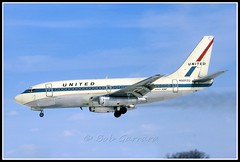
N9052U United Airlines
A United Boeing 737-200 in its delivery livery, the Mainliner scheme.

But the design decision had an unforeseen consequence that would result in considerable controversy between the pilots, the airlines, and the FAA who would be certifying the aircraft. At the time, the FAA had imposed a limit on the size of aircraft that could be operated by a two-man flight crew- it was set at 80,000 pounds maximum takeoff weight (MTOW). This limit dictated the size of the first DC-9s and as the BAC 1-11s were below the limit, Braniff and American who had ordered One-Elevens operated them with two-man crews. Aircraft over the 80,000 pound limit required three crew in the cockpit. Boeing's original 737 proposals weighed in at 79,000 pounds, but potential customers found the design too small. Eastern and United in particular wanted a larger aircraft. Even despite a rule change by the FAA raising the two-man crew limit to 90,000 pounds, the revised 737 design needed a three-man crew as it tipped the scales at 93,000 pounds. 

In April 1965 the FAA announced that it was abolishing the weight limit criteria and from then on, aircraft would be certified for two-crew operation on an individual basis. This followed two years of deliberation and consultations with the pilots' unions, airline managers, airframe manufacturers and human factors studies. 

Of the four major airlines in the US at the time ("The Big Four"), three had already made their choices in the short-range jet category. Eastern and TWA ordered the DC-9 and American ordered the BAC 1-11. That left United as the only major interested in the 737. Of the early orders for the 737, only United's order was sizable (40 -200s ordered in 1965). Lufthansa also had a significant order, but they weren't encumbered by the FAA-mandated weight restrictions on two-man crew operations. However, United's managers found the 737 to have a political disadvantage since the pilots' unions at the time felt that as the largest of the twin jets available, it should be operated with a crew of three. While expensive for the airlines in terms of labor costs, the 737 design from the outset was intended for a two-man crew. Only a small jumpseat was available on the flight deck.

Now the third crew issue had already been visited previously before the introduction of aircraft like the 737. In the late 1950s the Lockheed Electra sparked considerable debate among its customer airlines. However, in each of the three cases, the issue was deferred- Eastern's dispute revolved around whether or not the third crew should be a pilot or a flight engineer. In the cases involving National and Western, ALPA used the two-crew issue as a test case to set a precedent (even though the Electra was never intended to be used by two pilots). National put the issue in arbitration that deferred the issue. Western's management was more inflexible and for four months a pilots' strike nearly grounded Western until it was agreed by both parties to defer the issue. So from a precedent standpoint, the impending dispute over the 737 flight deck had no prior rulings or standards to build upon for either side involved. 

In late 1965 Boeing showed a mockup of the 737 cockpit to representatives from United's ALPA union, the FAA, and airline managers. While the FAA felt that the mockup was inconclusive from a certification standpoint, the pilots' union disapproved of the two-man cockpit. A year later, a working mockup that was "functional" and more detailed to test workloads was presented and again the United pilots balked at the layout for two-crew. Not long afterward, ALPA's leadership made it the union's official recommendation that the 737 be operated with a three-man crew at all times. During this same time, the pilots' contract at United was up for negotiation and the 737 crew issue became a major stumbling block in the discussions for a new contract. To further complicate the picture, the FAA at the same time also tentatively approved two-man operation of the 737 pending the start of flight testing in 1967. 

By 1967 the dispute at United still had not been settled and a presidential mediation board was convened to help in reaching a compromise between ALPA and United's management. That summer the board failed in reconciling both sides and a strike vote taken showed 92% of United's pilots in favor of striking if the 737 couldn't be operated by a three-man crew. As an effort to reach out for a compromise, ALPA proposed to the FAA that the 737 as well as the BAC 1-11 and DC-9 be operated with a three-man crew. This proposal provoked the ire of the airlines that already had the One-Eleven and the DC-9 in service and the proposal was quietly shelved with the assent of ALPA members at those other airlines. By this point the dispute was discouraging further US sales of the 737 and indirectly helped Douglas with it's DC-9 which now offered increased capacity versions to regional airlines since it had already set the precedent for two crew operations with the first DC-9 Series 10 models. 

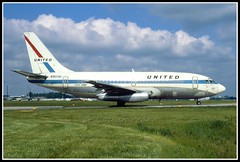
N9013U United Airlines "Mainliner City of Charlotte"
N9013U "Mainliner City of Charlotte"

The 737 made its maiden flight in April 1967 and over the Thanksgiving holiday week of that year, the FAA decided to run a series of tests to put the crew number issue to rest. One of the 737s was borrowed from Boeing and two-crew operations would be tested in the busy Boston-New York-Washington corridor. One pilot was from Boeing, the other pilot from the FAA. Two round-trips were made each day that week in both day and night conditions, both VFR and IFR weather conditions, as well as operations below minimum landing conditions, diversion operations, simulated instrument failures and even simulated crew incapacitation (could one pilot fly the 737 to safety). As a result of these tests, the FAA issued the following statement:

"The far-reaching evaluation of the Boeing 737 was started in September 1965, with the evaluation of the cockpit mock-up. Continuous evaluations over the past two years included regular operations of the aircraft in a high-density air traffic environment to determine workload, complexity, and safety of operations in a fail-safe concept. These flights were part of a very extensive flight-testing programme accomplished by the FAA and Boeing personnel. The technical findings coming out of these evaluations are that the aircraft can be safely flown with a minimum of two pilots."

Certification by the FAA of both the 737-100 and 737-200 followed in December 1967 for full airline operations. 
The third flight deck crew sat on the jumpseat on United 737-200s
Despite the issue being settled by the FAA, several airline pilot unions continued the crew issue as a bargaining chip in labor negotiations with airline management. Anxious to avert a strike in 1967, United reached an agreement with ALPA as part of a broader contract agreement to crew the 737-200 with a crew of three. Western Airlines, Frontier Airlines, and Wien Air Alaska were the only other US airlines bound by contract agreements with the pilots' union to use three crew in the flight deck. Frontier and Wien switched to a two-crew flight deck in 1976 and 1979 respectively. It wasn't until 1981 (ostensibly due to the impending introduction of the 737-300) that United finally went to a two-crew operation on the 737-200. At United, the third crewman sat in the jumpseat which is sited immediately in front of the cockpit door. Duties of the third crewman included preflight, performing the checklists, performance calculations (weight, balance, takeoff and landing distances, etc.) and company communications. All the relevant controls such as radio, electrical, hydraulic and other functions necessary were reachable from the jumpseat. Once United reverted to a two-crew flight deck in 1981, no modifications were necessary to the -200 cockpits.

Source: Boeing 737 (Crowood Aviation Series) by Malcolm L. Hill. Crowood Publishing, 2002, pp 23-31. Photos: Bob Garrard Collection/Flickr, JP Santiago