02 August 2010

Francis Gary Powers: After the Return

On May 1, 1960 a lone CIA U-2 spyplane took off from a forward operating base in Peshawar, Pakistan for what would be one of the most fateful flights of the Cold War era. After over 5 years of uneventful US overflights of the Soviet Union, this mission, piloted by Francis Gary Powers, would change the strategic balance of the Cold War. Powers' mission was to take him on a marathon mission over several reconnaissance targets of interest, from the Baikonur missile test facility, the Sverdlosk industrial center, the ICBM bases at Plesetsk, the submarine construction yards at Severodvinsk, and the Soviet Northern Fleet base at Murmansk before recovering at the NATO base at Bodo, Norway. Halfway through his flight before reaching Sverdlosk at an altitude of 70,500 feet, an SA-2 surface-to-air missile exploded aft of his aircraft, sending it spiraling downward. Powers survived and was promptly apprehended by Soviet authorities and in one of the dramatic moments of the Cold War, was tried in the Hall of Columns at the Kremlin in a highly-publicized proceeding that began on August 17, 1960. He was sentenced to 10 years in prison for espionage.

For the next 18 months Powers was in prison, the US government negotiated for his release and settled upon a trade for convicted Soviet spy Rudolf Abel. Interestingly, the idea for the trade originated with Powers' father, Oliver. In November 1961 acting Director of Central Intelligence (DCI) Charles Cabell notified Secretary of State Dean Rusk of the CIA's support of a trade. On February 1962 following President Kennedy's final approval, at a bridge in Berlin that connected East and West sides of the city, Francis Gary Powers was traded for the spy Rudolf Abel. Powers was immediately flown back to the United States for a comprehensive debriefing, convening what the agency called a "damage assessment team" to determine what damage Powers' shootdown and subsequent interrogation/imprisonment had done to US airborne intelligence efforts. Considering that Powers was extensively involved with the U-2 program from its beginnings, it was assumed that he had revealed everything to the Soviets- instructions to U-2 pilots of what to do in case of capture was scant at best. They were advised to "tell everything since they're going to get it out of you anyway". Some pilots flew on Soviet overflights with cyanide capsules and Powers was given a poison-tipped needle to inject himself with in the event of capture, but it was seized from him when he was apprehended after bailing out. At any rate, after a two week debrief, the damage assessment team concluded that the damage was minimal and were very satisfied with Powers' efforts to reveal as little classified information on the U-2 program as possible.

This wasn't sufficient for the newly-appointed DCI, John A. McCone (the previous appointed DCI was Allen Dulles who resigned in November 1961 in the wake of the shootdown and the failed Bay of Pigs invasion) demanded a further examination of Powers' actions while in Soviet custody despite a letter of support from the previous DCI, Allen Dulles. A new board of inquiry headed by federal judge Barrett Prettyman was convened to investigate the matter further. Testimony from the agency experts who debriefed him was taken, a thorough examination of Powers' background from his doctors to his fellow pilots and commanders from his former Air Force units was performed as well as a voluntary polygraph examination of Powers himself. Soviet photographs taken of the U-2 wreckage were reviewed by Lockheed Skunk Works engineer Kelly Johnson (who designed the U-2) and he found them consistent with Powers' story. DCI McCone was unconvinced and ordered the Air Force to have its own panel of experts review the evidence. The US Air Force echoed the Prettyman Board's findings as well with DCI McCone having only a possible procedural error by Powers in maintaining his course/altitude as the only bit of information contrary to Powers' testimony.

DCI McCone ordered the Prettyman Board reconvened to re-examine the evidence but their second report remained essentially unchanged from their original findings. In March 1962 Powers himself testified before the Senate Armed Services Committee who commended his actions and conduct during the mission and his subsequent capture. Despite all this, any findings that exonerated Powers weren't released to the public and the sensationalized press of the day resulted in a very negative portrayal of Francis Gary Powers. With no public statements from government officials commending Powers for his efforts to withhold classified information from the Soviets during his 18 month internment, in the public eye his motives and loyalties were questioned. His 1962 divorce from his wife further stained his reputation in the press. Powers was snubbed by President Kennedy who had already warmly received other pilots who had been shot down and captured by the Soviets and in 1963 DCI McCone awarded the CIA Intelligence Star to all the Soviet overflight U-2 pilots except Powers (It wasn't until 1965 that Powers got the Intelligence Star from McCone's successor).

CIA U-2 pilots were all drawn from USAF units with the agreement that they would temporarily be on leave from the Air Force for their tour of duty with the CIA, after which they could return to the USAF unit and active duty. Though there was significant initial opposition to his reinstatement with the Air Force, it was approved pending the conclusion of all the investigative proceedings. In the interim time, Kelly Johnson hired him as a U-2 test pilot at Lockheed in support of upgrades and developments being worked on for future U-2 versions. In late 1963 he was offered a chance to return to the Air Force, but Powers elected to remain at Lockheed working for Kelly Johnson. In 1969, with the end of U-2 production work, Kelly Johnson reluctantly had to furlough Powers as Lockheed was unable to place Powers in any other programs. Kelly Johnson would write in his test logs "I must let Gary Powers go. I have protected him for about seven years..."

Powers subsequently found work flying for a Los Angeles radio station as a traffic reporter and subsequently went to work for KNBC as a helicopter pilot. On August 1, 1977, Powers and his cameraman, George Spears were flying back to the KNBC heliport in Burbank in a Bell Jet Ranger 206 after covering a brush fire in Santa Barbara, when for reasons unknown, the helicopter ran out of fuel and crashed near the Sepulveda Dam in the San Fernando Valley community of Encino. Powers and Spears were killed instantly. Powers was laid to rest with honors at Arlington National Cemetery. On May 1, 2000, on the 40th Anniversary of his shootdown, USAF and CIA officials posthumously awarded Francis Gary Powers the Prisoner-of-War Medal, the Distinguished Flying Cross and the National Defense Service Medal. The ceremony with Powers' family took place at Beale AFB, home of the 9th Reconnaissance Wing which today still operates the U-2. At the conclusion of the ceremony, a lone U-2 made a low-level flyby.

Powers' shootdown in 1960 marked the first time a surface-to-air missile successfully brought down a hostile aircraft and his overflight would be last US overflight of the Soviet Union. The Soviet Union would go on to develop one the most comprehensive air-defense systems in the world and that would dictate US strategic planning well into the 1990s with a shift towards low-level penetration bombers, stealth, and most importantly, the technological shift to relying on satellites to provided imagery of Soviet installations and activities.

Source: Spyplane: The U-2 History by Norman Palomar. Zenith Press, 2001.

01 August 2010

The Short but Colorful Life of Western Pacific Airlines

Western Pacific Airlines was founded at under-utilized Colorado Springs Municipal Airport by a team led by one of the founders of America West Airlines, Ed Beauvais. His airline background stretched back all the way to Bonanza Airlines before its merger into Air West and ultimately led to him serving as head of America West until 1992. Western Pacific commenced operations out of Colorado Springs in April 1995 using eight 737-300s with flights to Los Angeles, Las Vegas, and Oklahoma City. With the new trouble-ridden Denver International Airport 40 miles from the Denver city center to the northeast, residents living in the southern areas of the Denver metropolitan area quickly found the short one hour drive to Colorado Springs to catch a WestPac flight more convenient.

While Western Pacific did have a simple red/blue billboard livery, it was their "LogoJet" program that made the airline well-known amongst travellers and enthusiasts. For the first time, the entire exterior of an airliner was put up for rent as a flying billboard. The first customer to sign up for what WestPac called the "AirLogo Program" was the five-star Colorado Springs hotel, the Broadmoor, which was incidentally owned by one of the major investors in WestPac. But the most famous and most-photographed of the LogoJets was the Simpsons Jet. In May 1995 FOX Television needed an advertising coup for that month's Nielsen ratings sweeps for their long-running animated sitcom, The Simpsons. After a meeting with WestPac's marketing staff, FOX paid the airline $1 million to wear a scheme designed by FOX's ad department to bring attention to the TV show during the sweeps week and beyond.

As more 737-300s became available, more destinations were added to the WestPac network and the LogoJets made up a significant portion of the fleet, with customers ranging from the City of Colorado Springs and insurance companies to ski resorts and casinos. At its peak, WestPac was operating 18 737-300s out of Colorado Springs. The dramatic jump in passenger numbers brought increased attention to Colorado Springs which in 1994 had just completed a modern terminal facility to replace the dated and inadequate terminal building on the west side of the field near the FBO hangars. In no time the established majors were attracted back to the airport, much in the same way that Southwest brought traffic from other airlines back to Houston Hobby and how both Southwest and Midway revitalized Chicago Midway Airport.

The honeymoon ended after 18 months and at the end of 1996 investors who were impatient for profits ousted the management team including Ed Beauvais and a new team led by Robert Peiser moved in to reorganize the airline. The management shakeup revealed WestPac's financial health was worse than most in the industry realized. While Beauvais remained on the board of directors of WestPac, Peiser took the airline in a different direction in an effort to attract the business (thus higher revenue) passenger rather than the flocks of leisure travellers who were driving south from Denver to fly to vacation destinations in the WestPac network. One of his first moves was to scrap the LogoJet program and secondly, he moved WestPac to Denver International in an effort to attract more passengers. Some would later say that Peiser already had bankruptcy reorganization in mind and moved the airline to Denver to secure more attractive post-bankruptcy financing. After an abortive codeshare and proposed merger with Frontier Airlines, WestPac ceased operations and was eventually liquidated in February 1998.

WestPac's failure, wasn't just due to the move to Denver. The majors at Denver noticed WestPac's growing operation at Colorado Springs and lowered their fares. This, in combination with service improvements at Denver International, slowly eroded WestPac's advantages at Colorado Springs and made a move to Denver almost a necessity. Also, the Valujet crash in 1996 adversely affected customer perceptions of low-fare airlines. In the eight months preceding the shutdown, airline management made frantic moves to shift the airline from its original low-fare focus to business travel which would only deepen the debts- moving the hub to Denver, unveiling a new corporate logo and livery, converting to SABRE for reservations, and dropping several leisure markets. The merger of Frontier figured heavily in the survival plans for the airline, but wisely so as the more financially healthy airline, Frontier not only called off the merger, but also the codeshare as well. Western Pacific's demise couldn't have been prevented by staying at Colorado Springs as many former employees and city residents still believe- it was a simple case of declining yields in the face of stiff competition from the majors at Denver. And that would have been the case whether or not the airline was still at Colorado Springs or at it's final resting place at DEN.

In the end though, it's going to be the LogoJet program that will be Western Pacific's legacy to the airline industry as airlines all over the world have picked up on the idea (such as Ireland's Ryanair, for example). And of all the LogoJets, be they Western Pacific's or anyone elses to this day, the Simpsons Jet will always be the most famous.

Source: Boeing 737 (Crowood Aviation Series) by Malcom L. Hill. Crowood Press Ltd, 2002.

31 July 2010

The First Helicopter Medevac Missions

For a six-week period in the summer of 1945 as fighting raged between American and Japanese forces on the island of Luzon in the Philippines, six helicopter pilots flew the first rotary-wing medical evacuations under enemy fire in history. Although the helicopter had been used in combat in the Burmese theater of operations in April 1944, the Luzon airlift was first to take place under enemy fire. And here's the really crazy part of the story- the six American pilots were there not for medevac flights, but for repair and supply work! Project Ivory Soap began as concept to use Army-owned supply ships as floating repair depots that could move with the US forces during the Pacific island-hopping campaign. Early in the campaign, it could take weeks, even months, for replacement parts to arrive at front-line units from the United States. Under Project Ivory Soap, USAAF aircraft could be turned around more quickly with the floating depot ships nearby. By December 1943, the program had evolved into using six Liberty ships and eighteen smaller vessels. The ships had helipads constructed on them so that Sikorsky R-4s could shuttle between the ships and airfields ashore with critical parts.

In June 1945 the campaign to liberate the Philippines from Japanese occupation was underway and three of the Liberty ships were deployed to Luzon with the Fifth Air Force while the other three Liberty ships were deployed to the Marianas to support B-29 Superfortress operations with the Twentieth Air Force. On 15 June, R-4 pilot Louis Carle received a request to pick up two soldiers with head injuries 35 miles east of Manila. With only 25 hours of helicopter time and no medical training, Carle arrived at the designated spot but they couldn't locate the two soldiers needing evacuation. Men at the scene who greeted Carle had him fly out a platoon leader with a hip injury instead but they couldn't fit the stretcher into the R-4. Carle ended up removing the other seat and laying the injured soldier on the floor.

News traveled throughout the area of the successful helicopter evacuation and soon Carle and the other pilots of the repair ships were getting requests for additional medevac flights. Given the primitive state of helicopter technology of the day, the flights into combat zones were grueling and often the six pilots were flying as many as six to seven medevac missions a day. Often the pick up points were near front line areas and the helicopters were attractive targets to Japanese units. Mortar and artillery rounds often impacted near the landing zones as well, and adding to the stresses, the pilots were the only crew aboard and they had to load the injured, make sure they were secured, and then fly their flimsy machines out of the combat zone to a field hospital near Manila. As the American forces pushed into the highlands of Luzon, performance of the R-4 and later R-6 helicopters suffered and often Carle and his men had to overspeed the piston engines to get enough rotor lift to get airborne, all while avoiding enemy gunfire.

Carle and another pilot survived crashes of their respective R-4s after ten days. Both men were escorted out of the jungle highlands by appreciative Army units. With his repair ship heading to Okinawa to support the combat effort there, Carle would be officially credited with 12 saved soldiers though the actual numbers were likely quite higher. To replace the departing ship, another repair depot anchored in Manila Bay on 25 June and the four pilots aboard managed to medevac 40 injured soldiers in just four days. To make the medevac flights more comfortable for the wounded soldiers, the helicopter mechanics welded Stokes litters (steel tube and wire mesh baskets for carrying wounded) to the steel frames of the R-4 helicopters.

Of all the injured servicemen flown out of harm's way by helicopter in the Pacific Theater, 60 percent of those medevac flights took place on Luzon in that six week period. One-hundred fifty men are estimated to have been flown out and while this small number is nearly insignificant compared to the 40,000 saved by medevac flights in Korea and 1 million saved in Vietnam, the history making flights of Louis Carle and his fellow pilots in their flimsy Sikorsky R-4s convinced a skeptical military command of the value of the helicopter.


Source: Air & Space Smithsonian, July 2010, Vol. 25, No.2. "Medevac From Luzon" by Roger Connor, p62-67.

30 July 2010

The 1938 Hurricane Relief Flights That Led to the Air Transport Command

The relief efforts following natural disasters have often reminded me of the first humanitarian airlift in the United States after a natural disaster. It was September of 1938 and one of the few Category 5 storms to strike the US mainland had just come ashore with unprecedented destructiveness in New England, causing widespread devastation throughout Long Island, Connecticut, Rhode Island, and Massachusetts.

While the forecasting technology of the day paled in comparison with what we have today, there are sufficient meteorological records from 1938 that give an impressive picture of what historians call "The Long Island Express". The storm formed off the coast of West Africa and tracked westward. Lacking offshore weather buoys, the US Weather Bureau (the National Weather Service's predecessor) relied on reports from ships at sea to track the progress of the storm. From a climatological standpoint, most hurricanes in the late part of the hurricane season that form in the Eastern Atlantic usually track to the west and curve back to the northeast, remaining out to sea and having little effect on the US East Coast.

However, on the morning of 21 September 1938 as the storm was off the coast of Norfolk, Virginia, it made a sudden veer due north instead of continuing out to sea on a northeast heading. Not only did this storm head due north for New England, it also picked up speed with a storm motion of 70mph, making the "Long Island Express" one of the fastest moving hurricanes in recorded history.

The sudden change in direction caught most of New England unprepared and when the hurricane made landfall that night, wind speeds gusting to as high as 185mph were recorded along the coast of New England. The extreme forward speed of the storm made the right quadrant winds 70mph faster than they were and this put Long Island, Rhode Island, and eastern Massachusetts square in the crosshairs of this monster. A 12+ foot storm surge slammed into Providence, Rhode Island and all throughout the area, lines of communication were cut- roads, railroads, phone and telegraph lines. Not until Hurricane Andrew hit Florida in 1992 would there be a storm that caused as much damage as "The Long Island Express". The Boston area found itself cut off from the rest of the nation as thousands were made homeless and the local infrastructure of the area was destroyed.

Enter C.R. Smith. Two years earlier Jack Frye of TWA decided the US airline industry needed a common voice to work with the government in improving air safety and efficiency. He managed to convince C.R. Smith of American, Eddie Rickenbacker of Eastern, and Pat Patterson of United to form the ATA- Air Transport Association. Headed by a former military aviator of unqualified technical experience, Edgar Gorrell, one of the ATA's first acts under Gorrell was to propose that the airlines form a plan to organize their resources in the event of a national emergency to form what Gorrell called a "civil reserve air fleet".

Now keep in mind that this was a time when the airlines were run by rugged individualists like Rickenbacker or Smith. Just the fact that four disparate personalities of the magnitude of Smith, Frye, Rickenbacker, and Patterson even agreed to form the ATA was a miracle in and of itself. But to form a unified plan in case of national emergency? The other member airlines of the ATA balked at the idea despite Gorrell's pleadings- "If we don't have our own plan, the government will shove one down our throats!" But only one airline president backed the ATA proposal and that was C.R. Smith of American Airlines. The ATA proposal languished for two years until that dark night that the "Long Island Express" came ashore.

The only airline that operated on the New York-Boston route was American Airlines and C.R. Smith immediately assigned every available DC-3 the airline had to fly humanitarian missions to Boston Logan Airport which was pretty much the only functioning airport in the area in the hurricane aftermath. Flights were cancelled throughout American's system as DC-3s were pulled for the airlift. Within 24 hours, C.R. Smith realized the job couldn't be done alone- usually American carried 200 passengers a day between Boston and New York and on the first flight out of Boston, over 1000 people were looking for seats on American's mercy flights. With the local authorities also wanting to deploy medical personnel as well as rescue and construction crews to New England, American needed help.

C.R. Smith phoned Edgar Gorrell for an urgent request for help- Gorrell in turn telephoned Jack Frye at TWA, Eddie Rickenbacker at Eastern and Pat Patterson at United. Each of these airlines had the most capable airliner of the day, the DC-3, and Gorrell asked them to pull their DC-3s out of service to fly the humanitarian airlift. Without question, without argument, the three airline presidents had DC-3s streaming into Newark within hours of Gorrell's call. He then secured temporary route authority for them to fly the New York-Boston route from Washington (the nation's airlines had their route structures regulated by the federal government in those days).

For the seven days following the hurricane's landfall, the four airlines operated 24 hours a day, flying over 60,000 tons of medical supplies into Boston, carrying over 1000 rescue workers into the area, and flying out over 1500 refugees out of the area. Those numbers pale in comparison to the airlift that took place after Hurricane Katrina in 2005, but keep in mind that the DC-3 only carried 21 passengers and was the state of the art in 1938. American and TWA even added their older DC-2s to the airlift. Newark, as the bridgehead of the airlift, was the scene of unprecedented cooperation by the rival airlines. American's crews often led formations of other aircraft to Boston as some of TWA and United's pilots had never flown on the East Coast. Airlines shared spare parts, even mechanics to keep the airlift running.

By the time the airlift ended and the airlines and their personnel returned to normal operations, Gorrell as well as the presidents of the four airlines realized the potential of the US airline industry to step up to the plate in times of crisis. When the first bombs dropped on Pearl Harbor just three years later, Edgar Gorrell already had a template in place to organize the US airline industry to provide airlift for the war effort- during the Second World War, the Air Transport Command (ATC) was formed by the US airline industry with government backing. And to head this massive undertaking, Edgar Gorrell turned to C.R. Smith. Not only did C.R. Smith demonstrate initiative in organizing the 1938 airlift, in 1940, a full year before Pearl Harbor, C.R. Smith had already had his own experts formulating an emergency war mobilization plan involving all of the US airline industry.

On 13 December 1941 President Franklin D. Roosevelt was prepared to sign an executive order to nationalize the US airline industry. Sitting in the Oval Office with FDR on that day were Edgar Gorrell and the chief of the US Army Air Corps, General Henry "Hap" Arnold. Both of them convinced FDR to tear up the executive order as Gorrell showed the President C.R. Smith's war plan to mobilize the airlines. In his postwar autobiography Global Mission, General Arnold noted that air power was useless without air transport.

Source: When the Airlines Went to War: The Dramatic, Never-Before-Told Story of America's Civilian Air Warriors by Robert J. Serling. Kensington Press, 1997.

24 July 2010

Alaska Airlines' First Jet, "Seventy-Seven Hotel"

Throughout the 1950s, Alaska Airlines' propliners wore a very elegant blue scheme with a golden eagle logo on the tail. The services from the lower 48 states to Alaska as well as on internal Alaska routes were advertised as "Golden Nugget" service in reference to Alaska's rich prospecting history. But despite popular services, Alaska in the 1950s was financially strapped and woefully unable to finance new equipment. At one point, Howard Hughes even offered to lease Alaska up to six Convair 880s to get into the jet age at very reasonable prices that unfortunately, were still too stiff for Alaska's austere budget.

But jets were what were needed and Alaska's competitor, Pacific Northern Airlines, had just ordered the Boeing 720 for delivery in 1962. There was simply no way for Alaska's DC-6s to compete with PNA's 720s on the Anchorage-Seattle run.

Charlie Willis, then Alaska's president, approached Convair to plead for very favorable financial terms to get jet equipment as Alaska saw the greater speed of the CV-880 as one way to meet the threat to market share posed by PNA's Boeing jets. Fortunately for him, Convair's sales team was desperately looking for a sale as the Convair jet was facing tough competition from the larger Boeing 707s and Douglas DC-8s. Willis returned to Anchorage with a contract for one Convair 880M, which boasted a whole range of improvements over the first baseline 880 model.

Of course, Convair was more than happy to be able to place one of their jets right in Boeing's hometown of Seattle where Alaska had a large presence in the late 1950s and early 1960s. N8477H (often called Seventy-Seven Hotel by Alaska crews) inaugurated Golden Nugget Jet services between Seattle, Anchorage and Fairbanks on 30 August 1961 and the service was cleverly pitched as "Four Jets Daily to Alaska".

Alaska's single CV-800 had high utilization as it was Alaska's only jet until the first Boeing 727s arrived in 1966 and Seventy-Seven Hotel was sold to Cathay Pacific. At one point, Alaska's sole 880 even carried cargo in the lounge area of the aircraft when demand was down in the winter months. The livery Alaska used on the CV-880 was based on the stylized eagle logo used on the DC-6s, but instead of blue, a very attractive red/gold scheme was used that was unique to Seventy-Seven Hotel and was not used on the rest of Alaska's fleet. The 727s that replaced the 880M had a Golden Nugget "meatball" style logo on the tail instead of the eagle on a red field. So not only was Alaska's 880 unique, it also wore a livery unique to it as well.

Source: Convair 880 & 990 (Great Airliners Series, Volume 1) by John Proctor. World Transport Press, 1996, p27.

22 July 2010

The Drug-Busting Night Wolves of VAW-77

I had earlier featured US Navy E-2 Hawkeye squadron VAW-77 "Night Wolves" and the crucial role they played during the rescue efforts in New Orleans during Hurricane Katrina. It turns out that VAW-77 is a very unique squadron within the US Navy on several counts. Though a Reserve unit no different than many of the reserve air units of the different branches of the US military, VAW-77's primary mission is Counter-Illicit Trafficking (CIT) and as such, they are not required to operate from aircraft carriers and therefore its pilots do not have to go through carrier qualifications.

Eighty percent of the squadron's flight hours are devoted to CIT operations and when operating from several locations in the Caribbean and Latin America, fall under the jurisdiction of US Naval Forces Southern Command as part of the Joint Inter-Agency Task Force South (JIATF SOUTH). Deployments depend upon intelligence received from a variety of sources. During CIT missions, the E-2 is paired up with another air asset that acts as the "low bird" while the Hawkeye operates as the "high bird" cueing the "low bird" to targets of interest. In most circumstances, the "low bird" is a Navy P-3 Orion or a US Coast Guard HC-130 Hercules. Other times the "low bird" role may be filled by aircraft of cooperating nations in the Caribbean and Latin America. At times, the E-2 has to act in both roles, dropping down to low altitude to make visual contact, but this is done as little as possible as it's a less than ideal tactical arrangement.

In 2009, VAW-77 flew over 2,000 hours of CIT missions that aided in the seizure of 17.2 metric tons of cocaine and also assisted in the rescue of 15 individuals.

The other 20% of the squadron's flying time is devoted to Fleet Support and Homeland Defense. The Fleet Support mission usually entails area surveillance for the missile ranges of the Gulf of Mexico while Homeland Defense missions can include border surveillance and airborne control of air defense assets. In addition, VAW-77's E-2 Hawkeyes have been tasked with providing surveillance for Air Force One and range control during Space Shuttle and rocket launches from Kennedy Space Center/Cape Canaveral. When other E-2 squadrons have downtime between deployments, junior personnel are often sent to VAW-77 to gain experience and flight hours.

Source: Combat Aircraft Monthly, July 2010, Vol. 11, No. 7. "Drug Busting Night Wolves" by Ted Carlson, p26-31. 

19 July 2010

DC-X, the Delta Clipper

One of the holy grails of aerospace technology not yet achieved has been true reusable single stage-to-orbit (SSTO) capability- a launch vehicle that is fully reusable and completely able to reach orbit in a single structure and return to Earth for reuse. No hardware or components would be shed on the ascent (or descent, for that matter). Some approaches to SSTO have looked at air-breathing vehicles while the other approaches using rocket power face the challenge of having a high enough propellant to mass ratio to reach orbit while still carrying a useful payload.

In 1989, three diverse individuals pooled their talents to pitch a rocket-powered SSTO vehicle to Vice-President Dan Quayle. Max Hunter began his work in aerospace engineering with Douglas Aircraft, having become their chief engineer for astronautics after heading the Thor IRBM program. He later came to Lockheed to work on various aspects of the Strategic Defense Initiative (SDI). Retired Army general Daniel Graham had a background in intelligence and was one of the biggest proponents of the SDI program in the Reagan Administration. And the third individual was Jerry Pournelle, a noted science fiction author, journalist, and, like Graham, a proponent of SDI. The three men met with Quayle that year to pitch their SSTO idea as a means of lowering the cost of access to space, a necessary requirement to make SDI feasible.

With Quayle's backing and funding from the SDIO (Strategic Defense Initiative Organization), in August 1990 a request for proposals to industry was issued for an SSTO vehicle. Of the six designs submitted, four were vertical takeoff and landing designs. SDIO issued $12 million contracts to McDonnell Douglas, Rockwell, Boeing and General Dynamics for further development of their VTOL SSTO designs. The second phase of the program consisted of building an "X" subscale demonstrator to prove VTOL capability and the building of a "Y" prototype vehicle. McDonnell Douglas won this phase of the competition with their "X" subscale demonstrator being 1/3 of the size of the prototype and designated DC-X or "Delta Clipper".

Powered by four Pratt and Whitney RL10 liquid fuel rocket engines, the DC-X wasn't meant to reach orbit but to validate the technologies for VTOL, rapid prototyping, and the ability to be operated with as small a ground crew as possible to reduce costs. On 18 August 1993 at White Sands Missile Range in New Mexico, the DC-X made its maiden flight with a support crew of seven (including astronaut Pete Conrad) housed in a converted trailer. The Delta Clipper flew for 59 seconds, reaching a very modest altitude of 46 meters. Later test flights going into 1995 showed the DC-X's ability to translate side to side and land, reaching a maximum altitude of 2500 meters before a hard landing on 7 July 1995 cracked the aeroshell of the Delta Clipper.

But with the end of the Cold War, SDIO's budget had been cut and the Delta Clipper was becoming a political hot potato in Washington. The program was then transferred to NASA's Reusable Launch Vehicle program. McDonnell Douglas took the opportunity to further lighten the DC-X, including a Russian-built aluminum-lithium liquid oxygen tank from Energia. With a significant weight reduction, the vehicle was redesignated DC-XA "Clipper Graham" in honor of Daniel Graham who had passed away in 1995. The DC-XA returned to White Sands for its resumed test program and made four flights in the summer of 1996. Between the second and third flights, the rocket was turned around in only 26 hours, a first for any rocket vehicle in history. On the fourth flight, one of the landing legs failed to deploy and the DC-XA tipped over and was destroyed in a fire.

NASA refused to release money to repair the DC-XA as it preferred from the beginning its own reusable SSTO idea, the Lockheed X-33 VentureStar. However, the VentureStar program was cancelled in 2001 amidst technical difficulties, but the DC-X may yet have the last laugh. Many of the DC-X engineers are now working with commercial space startup Blue Origin, started and led by Amazon.com founder Jeff Bezos. Blue Origin's spacecraft design, New Shepard, was tested in subscale format for the first time successfully in November 2006.

Source: Air & Space Smithsonian, August 2010, Vol. 25, No. 3. "Black Day at White Sands" by Preston Lerner, p66.

17 July 2010

The First Russian Jet Bomber

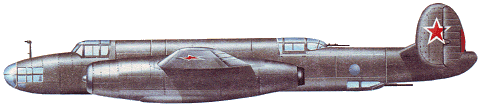
Starting in January 1947 OKB Tupolev began design work on a twin jet tactical bomber powered by two Rolls-Royce Nene centrifugal-flow turbojets. With a few months of the start of the work, it became apparent that the Nene engines produced less thrust than anticipated which delayed development work. Although this jet bomber design carried the official designation Tu-14, it had the Tupolev in-house designation of "73", a continuation of the ANT number series that was discontinued as the official designation during the Second World War. The Politburo wanted the Tu-14 ready for the annual Aviation Day flypast at Moscow-Tushino. But the need to redesign the Tu-14 meant that the prototype would not be ready and Andrei Tupolev himself suggested re-engining a number of piston radial-powered Tu-2 bombers with Nene engines as a temporary measure.

The interim project was given the OKB designation "77" (ANT-77) but would have the official designation Tu-12. Work began in April 1947 even before an official decision was reached authorizing the Tu-12/"77" project. By May of that year the Soviet Air Force reviewed Tupolev's full-scale mockup. Even before the Air Force review of the mockup, Tupolev ordered work to begin in the OKB's workshops converting standard Tu-2S bombers to the Nene-powered configuration. At the end of the month the Air Force authorized conversion work to begin based on their mockup review.

For the sake of expediency, the changes to the Tu-2 bomber were kept to as few as possible. The main differences between the Tu-12 and the Tu-2 were as follows:
  • The Shvetsov ASh-82FN radial engines and nacelles were replaced by longer nacelles housing the Rolls-Royce Nene turbojets. 
  • The wing dihedral was reduced from 6 degress to 3 degrees.
  • The fuselage was stretched with a nose extension allowing the bombardier/navigator to sit ahead of the pilot and a rear fuselage stretch to balance the change in the cockpit.  The height of the midfuselage was increased with the top of the pilot's cockpit even with the top of the aft gunner's canopy. 
  • A tricycle undercarriage was fitted with the mainwheels rotating 90 degrees to lie flat at the bottom of the nacelles. 
  • Additional fuel tanks were added to compensate for the increased fuel consumption of the jet engines. 
  • Adjustments were made to the control system to compensate for higher speeds. 
  • The tail structure was reinforced as well to handle the increase in speeds. 
In July 1947 the prototype Tu-12/"77" was rolled out and on 27 July 1947 the first flight was made in the Soviet Union of a pure jet bomber with none other than Andrei Tupolev himself aboard for the maiden flight- to which he exclaimed "Well, now we've seen for ourselves that youc an fly without an airscrew!" After a handful of successful test flights, the Tu-12 participated in the Aviation Day flypast at Moscow-Tushino and then resumed its flight test program in September of that year. The aircraft was then handed over to the Soviet Air Force to begin state acceptance trials and even though the Tu-12 was only an interim type built from converted Tu-2 bombers, it gave both Tupolev and the Soviet Air Force valuable experience in operating jet bombers. Mock combat sessions were even conducted between the small batch of Tu-12s and the MiG-9 and Yak-23 jet fighters, allowing new tactics to be devised.

Six Tu-12s were made by converting Tu-2s. One aircraft was used as an engine testbed, another was used as part of jet drone development and the remaining four were used by the Soviet Air Force for crew training and familiarization for aircrews bound for the definitive Tu-14. The experience in developing the systems for the first Soviet jet bomber would serve Tupolev well during the development of the Tu-16 "Badger" and Tu-95 "Bear" bombers.

Source: OKB Tupolev: A History of the Design Bureau and its Aircraft by Yefim Gordon and Vladimir Rigmant. Midland/Ian Allan Publishing, 2006, p117-121.

15 July 2010

The Droopsnoot Lightning

One of the more unusual experiments in bombing tactics by the Allies in the Second World War was the Lockheed P-38 Droopsnoot version of the Lightning twin-engine fighter. The idea behind Droopsnoot was that a bombardier-equipped P-38 acting as a formation leader for standard P-38s carrying bombs could carry out missions on smaller targets with an economy that reserved the heavy bombers for larger targets. A formation of P-38s was seen as less likely to draw the attention of the German air defenses that were on the lookout for heavy bomber formations and the performance of the P-38 as a fighter made it "self-defending".

In 1944 the Eighth and Fifteenth Air Forces in England modified a number of P-38 Lightnings into Droopsnoots. The usual modification involved removal of the guns and the replacement of the nose cone with a Plexiglass nose piece with a flat window for aiming a Norden bombsight. Additional windows were added to the sides of the nose to provide light for the bombardier who entered via a hatch on top of the nose but also had an escape hatch on the ventral side as well. The bombardier also had panels for arming the bombs as well as flight instruments and an interphone connection to the pilot. Provisions for oxygen and heating were also installed in the Droopsnoot nose.

Most Droopsnoot missions were carried out between 10,000 to 20,000 feet with a formation of standard Lightnings dropping their bombs on command by the Droopsnoot's bombardier who would call out a 10-second pre-release countdown. Some missions were even flown with the standard Lightning's bomb release switches hooked to the VHF radio equipment to allow the Droopsnoot bombardier to drop all the bombs in the formation by radio command.

By 1945, the Eighth Air Force's initial enthusiasm for the Droopsnoot dampened following operational experience. P-38 pilots weren't trained in tight formation keeping like bomber pilots were and less-than-optimal formation flying led to dispersion of the formation's bomb load, lessening the destructiveness on small targets. It was also found that the Droopsnoot missions were no substitute for individual ground attack aircraft making shallow to medium dive angle attacks on ground targets. After the first Droopsnoot missions were flown, the German air defenses were on the lookout for large formations of P-38s which acted differently than escort fighter formations and fighter sweep formations. Given that many of the Luftwaffe's fighters had been driven away from the coastal areas of continental Europe, most Droopsnoot missions encountered little air opposition, but those that were attacked by the Luftwaffe found that the lack of rear-facing armament was a disadvantage. Escort fighters ended up having to be assigned to Droopsnoot missions, rendering the "self-defending formation" argument irrelevant.

The final nail in the coffin for the Droopsnoot with the Eighth Air Force was an analysis showing that medium bombers like the B-25 Mitchell and B-26 Marauder could carry more bombs to the target than a Droopsnoot-led formation and better defend itself with the multiple gun positions on the medium bombers.

The Fifteenth Air Force was a bit more positive in their evaluation of the Droopsnoot missions. Targets were more closely selected for light flak and the formations were much smaller than the Eighth Air Force's formations with only 8 Lightnings being led by a Droopsnoot. Tactics were more along the lines of that used by the medium bomber force than the heavy bomber force, but that still didn't change the fact that, like the Eighth Air Force, the Droopsnoot missions still needed fighter escort and were actually less economical than a comparable mission flown with either B-25s or B-26s. The Droopsnoot Lightnings did find a niche with the Fifteenth Air Force as radar-equipped pathfinders (with a radar replacing the Norden bombsight) and weather reconnaissance aircraft dispatched ahead of heavy bomber missions to scout out the weather over the planned targets. In the summer of 1944, for instance, the Fifteenth Air Force used Droopsnoots as weather scouts over the oil refineries of Ploesti, Romania, before their attack by B-24 Liberators. The orbiting Droopsnoots relayed the positioning of German smokescreens so the attacking heavy bombers could adjust their inbound routes for maximum visibility of the targets.


Source: Lockheed P-38 Lightning (Warbird Tech Volume 2) by Frederick Johnsen. Specialty Press, 1996, p86-94.

14 July 2010

The Boeing Model 306 Flying Wing Bomber

While Boeing was working on the XB-15 in the 1930s that would ultimately lead to the smaller but more advanced B-17 Flying Fortress and B-29 Superfortress, the company was engaged in a secret parallel project to develop a flying wing bomber that used some of the XB-15 features but was expected to exceed the performance of the XB-15 in every aspect. Boeing has never been previously associated with flying wing research with its current efforts in BWB (blended-wing-body) designs and the X-48 research program the legacy of the merger with McDonnell Douglas. Conventional wisdom of the day at Boeing regarded flying wings as less stable and having less than ideal handling issues than aircraft of conventional layout. Despite the prevailing attitudes of the company at the time, it did engage in flying wing research in 1935, developing a whole series of flying wing aircraft from the XB-15-derived flying bomber to fighters, airliners and even flying boats.

The Boeing Model 306 was the biggest and most impressive of the designs, aiming to capitalize on the aerodynamic advantages of the flying wing to improve upon the design work started with the XB-15. Having a crew of 10, the Model 306 had a swept wing of 140 feet in wingspan with a fuselage 60 feet in length. Four forward-mounted engines on the wings used 850-horsepower Allison V-1710 12-cylinder liquid cooled engines. Having a fully-retractable taildragger landing gear layout, the Model 306 bomber would have had a range of 5,000 miles with a 2,500 bomb load. Defensive armament consisted of a mix of 50-caliber and 30-caliber guns.

One of the more interesting features of the Model 306 had its elevons supported behind the wing trailing edge on long struts. Wind tunnel testing showed this arrangement more efficient as the pivoting and use of the elevons wouldn't interfere with the aerodynamic performance of the swept-wing.

It was only in 2006 that this series of designs came to light. It appears that all of the flying wing designs were collectively designated in-house as Model 306. Considering the state of the art in aircraft design in the 1930s, the Boeing Model 306 flying wing bomber stands out as quite futuristic!

Source: Secret Projects: Flying Wings and Tailless Aircraft by Bill Rose. Midland/Ian Allan Publishing, 2010, p71-71.