Showing posts with label Texas Instruments. Show all posts

11 February 2015

The Corvus Missile- Laying the Foundation for US Anti-Radiation Missiles


Wind tunnel model of the Corvus missile
In the Second World War, the Radioplane Company had built thousands of remote controlled drones for target practice. In the late 1940s, Radioplane was asked by the USAF for a jet-powered drone for target practice and in 1950 first flew the YQ-1 which was powered by a pulse jet. The drone only had a flight time of about 60 minutes which wasn't terribly useful for the USAF's needs. One drone was converted to use a small Continental J69 turbojet but by the time this version had flown in 1953, the USAF had settled on the Ryan Firebee series of drones for its needs. Radioplane's work transferred over to GAM-67 Crossbow missile program that started in 1953 to meet a USAF need for an anti-radiation missile for the Boeing B-50 Superfortress and B-47 Stratojet bombers. The Crossbow would have been the world's first missile designed to kill radars and was to have had a lightweight 10-kiloton nuclear warhead. A Stratojet could carry four Crossbows under its wings. The first successful guided flight took place in 1957 but the program was soon canceled due to technical difficulties. At the same time the Crossbow flight test program was gearing up, the Navy decided they wanted their own anti-radiation missile and in 1955 issued a requirement for a rocket-powered stand-off missile for its carrier attack aircraft. That missile was designated the ASM-N-8 Raven, but a parallel project going on at the time with the Navy duplicated the Raven's role, so the Raven program was canceled early on and efforts shifted (along with the ASM-N-8 designation) to what was called the Corvus missile. 

In January 1957, development of the Corvus missile was awarded to Dallas-based Temco Aircraft. Temco (Texas Engineering and Manufacturing) was founded in 1952 by Robert McCullough who was the plant manager of North American Aviation's plant in Grand Prairie next to NAS Dallas. McCullough and his group took over the plant from North American under the Temco name and kept it open doing subcontracting work for other aircraft manufacturers. Soon Temco got into electronics and missile guidance systems and by the time of the Corvus contract, nearly half of Temco's revenue came from their missile guidance work. The Corvus award was a boost to the company that they were experienced enough to take on a complete weapons system like the Corvus on their own.

XLR-48 engine on display at the Smithsonian
The Corvus was a big missile. It was 16 feet in length and weighed about 1750 lbs. It had delta wings to extend its range and cruciform tail surfaces set at 45 degrees from the delta wing. Instead of a jet engine as was used on the Crossbow, the Reaction Motors subsidiary of the Thiokol Corporation developed the XLR-48 Patriot pre-packaged liquid fuel rocket motor. Reaction Motors was already well established making rocket engines for the X-plane programs and to overcome the Navy's hesitation about having to store liquid rocket fuels aboard the carrier, the XLR-48 was pre-packaged with storable propellants so the missiles would never have to be fueled. This was a Reaction Motors innovation and for the Corvus, the XLR-48 offered greater thrust over a longer period of time than a solid rocket motor sized for the Corvus airframe. The propellants were hypergolic, meaning they ignited on contact which resulted in a surprisingly simple rocket motor. 

Drawing of an A4D Skyhawk with two Corvus missiles
The Corvus could be armed with either a conventional warhead or a 10-kiloton nuclear warhead very similar to what was planned for the Crossbow missile. Being rocket-powered, the Corvus was a lot faster than the jet-powered Crossbow, flying out at Mach 3 on a ballistic trajectory to 85,000 feet. The seeker head was designed by another Dallas-based electronics firm that would itself soon become famous in electronics, Texas Instruments. The seeker would lock onto an enemy radar emitter. In this mode, the Corvus had a range of 170 miles. It also could lock onto a target that was illuminated by the launch aircraft in a semi-active homing mode against non-emitting targets, but in this attack mode the range was shorter at around 100 miles. A data link would have been used to guide the Corvus in semi-active homing mode until it picked up the radar returns from the target. 

Corvus missile being launched from an A3D Skywarrior
The first airborne launches of the Corvus took place from a Douglas A4D Skyhawk in July 1959 from NAS Point Mugu in California. About twenty missiles were built and the program had progressed to fully guided flights when it was abruptly canceled in August 1960. The Navy had decided that nuclear-tipped air-to-surface missiles didn't quite fit with its operational doctrines and the program was transferred to the USAF. Finding the Corvus redundant to its own AGM-28 Hound Dog missile program that had been awarded already to North American Aviation in 1957, the program was canceled in late 1960 despite the Corvus being significantly lighter than the Hound Dog.

The work wasn't all for naught, though. Texas Instruments, who designed and was tapped to produce the Corvus radar seeker guidance head, gained significant experience from the program and would go on to work with the US Navy on the AGM-45 Shrike became the first American anti-radiation missile to be fielded and was used in combat for the first time in the skies over Vietnam against SAM sites. Texas Instruments would then go on in 1974 to develop the successor to the Shrike that is still in use to day, the AGM-88 HARM (High Speed Anti-Radiation Missile). 

As for Temco, their work on the Corvus made them an attractive merger target. Just prior to the Corvus cancellation in 1960, Dallas businessman Richard Ling, head of Ling-Altec Electronics acquired Temco to form Ling-Temco and shortly thereafter gained controlling interest in Chance Vought Aircraft, the new company becoming Ling-Temco-Vought, or LTV. 

Source: Scooter: The Douglas A-4 Skyhawk Story by Tommy Thomason. Crecy Publishing, 2011, p79. Pushing the Envelope: The American Aircraft Industry by Donald M. Pattillo. University of Michigan Press, 2001, pp 241-242. Detecting and Classifying Low-Probability of Intercept Radar by Phillip E. Pace. Artech House, 2008, pp 554-555. DesignationSystems.Net. Photos: Wikipedia, National Air & Space Museum, NASA.

25 February 2012

The Grumman A-6E TRAM: Making the Intruder More Lethal


The patch worn by A-6 Intruder crews. Note the radar and TRAM sensor symbolism
The main variant of the Grumman A-6 Intruder to fight in the Vietnam War was the first production version, the A-6A. The next two variants, the defense-suppression A-6B and the night attack-optimized A-6C, were just modifications of the basic A-6A variant and both the B and C versions served in only small numbers given their specialized roles. The next variant was actually the tanker version, the KA-6D. With the experience of combat, the Navy went ahead with the A-6E variant in 1968 which improved upon the deficiencies of the A-6A and replaced many of the 1950s-era systems with more modern equipment. With combat experience in the skies of Southeast Asia and over ten years of technological advancements, the A-6E was a major upgrade in capability, reliability and maintainability over the A-6A, with newer engines, a digital nav/attack system, a single multi-mode radar (the A-6A had two radars, which is why the Intruder had such a portly nose), and built-in test equipment that allowed the bombardier/navigator (B/N) to test the avionics before takeoff. On 22 September 1972, VA-85 "Black Falcons" embarked aboard the USS Forrestal were the first unit to take the new A-6E on an operational cruise. 

However, the navigation system of the new A-6E proved to be a weak spot and a few short years after the A-6E deployed with the fleet, CAINS (Carrier Airborne Inertial Navigation System) was added to the Intruder. Using the Litton AN/ASN-92 which was the same INS system used on the Grumman F-14 Tomcat and Lockheed S-3 Viking, an Intruder B/N literally plugged the aircraft's INS into the aircraft carrier's navigation systems to get a quick and very accurate initial fix before departing on a mission. But the most dramatic improvement to the capabilities of the Intruder came about at the same time as CAINS. At the time, there were a number of Intruder combat veterans assigned to the Office of the Chief of Naval Operations (OpNav) and with the Naval Air Systems Command. They spent their time getting upgrades and improvements pushed out to the Intruder fleet like CAINS.

A-6C TRIM. Note the prominent ventral gondola for the sensor.
One of the officers, Lieutenant Commander Lyle Bull, was working in the Aircraft Requirements Directorate of OpNav and decided to see what he could do to make the Intruder a full-capability all-weather/night attack aircraft that they had always dreamed about in Vietnam. During the war twelve A-6As were converted into the A-6C which had a large ventral gondola that housed the TRIM (Trails/Roads Interdiction Multi-Sensor) unit that had a FLIR and low-light TV (LLTV) unit for night attack missions over the Ho Chi Minh Trail. Large and aerodynamically bulky, TRIM also suffered from the relatively primitive state of the art in sensor technology at the time. Bull decided that TRIM was a good starting point for an improved system for the A-6E. This improved system became TRAM- Target Recognition Attack Multi-Sensor. In his position with OpNav, Bull had seen the state of the art in infrared technology and made the astute observation that there was space in the Intruder for an internal installation- because, as he put it, "Pods and sailors are not compatible". In the A-6A there was a separate search radar and a track radar in the portly nose- with the A-6E, a new Norden unit combined the functions into one radar and there was now space where the track radar used to be in the lower portion of the nose section. Bull had figured out that a 400-pound installation would fit perfectly into the space. 

In briefing his superiors on what TRAM could do for the A-6E, he pointed out that unlike TRIM which could only search and identify targets, TRAM would also incorporate an internal laser designator to mark targets for the new generation of laser guided bombs under development. Combined with the advances in sensor technology, an A-6E TRAM had a drastically improved bombing accuracy with miss distances of less than 10 feet, while today routine, such accuracy was stunning in the 1970s. However, in the lean funding environment following Vietnam, money for the R&D for TRAM had to be raided from other Naval Air Systems Command programs. Bull's superior, Rear Admiral Donald Davis, authorized $15 million in initial funding with the warning that the funding came from other programs which mean Bull wouldn't be liked- "They'll be after your ass, so watch yourself", he warned. 

A-6E TRAM prototype. Note the compactness of the installation.
Both Hughes and Texas Instruments agreed to develop competing designs for TRAM and Grumman readily agreed to handle testing and integration. Both systems were broadly similar differing in sensor details. TI had the advantage having developed the TRIM sensor during Vietnam- however, Hughes' design proved to better in testing and it was selected for the TRAM contract. As part of the TRAM integration, Grumman took the opportunity to upgrade the radar so it was better integrated with the TRAM sensor along with a new intertial navigation system. TRAM B/Ns would remark on the ease and simplicity of operating the laser designator. 

The A-6E TRAM prototype made its first flight at Grumman's Calverton facility on Long Island on 22 March 1974. With only a year of systems integration testing, Bull's system proved to be winner and the Navy began to procure TRAM units for the A-6E fleet. The first production A-6E TRAM flew on 29 November 1975 with VA-42 "Green Pawns" at NAS Oceana getting the first examples on 1 December 1975. Combined with CAINS, by the early 1980s the entire A-6E fleet was flying the most lethal Intruder variant yet and by that time, a Direction and Ranging Set (DRS) and Airborne Moving Target Indicator (AMTI) were added to the aircraft. This all made the A-6E TRAM Intruder the most accurate all-weather attack aircraft in the fleet if not all of the US forces. It would culminate with the A-6E TRAM being responsible for 85 percent of all the laser designations and LGB drops during Desert Storm. 

Source: Intruder: The Operational History of Grumman's A-6 by Mark Morgan & Rick Morgan. Schiffer Publishing, 2004, p131-133.

27 January 2011

The First Successful Combat Drops of Laser-Guided Bombs

Capt. Thomas Messett led the first combat LGB drop
By 1972 President Richard Nixon's policy of "Vietnamization" was underway as the bulk of responsibility for the defense of South Vietnam transferred from US forces to the South Vietnamese military. Nearly the bulk of US forces in Vietnam had already departed and the Seventh Air Force had already sent half of its combat aircraft back stateside. Only two aircraft carriers remained in the Gulf of Tonkin. The North Vietnamese saw the opportunity to win the war via a conventional attack and on 29 March 1972, twelve of North Vietnam's fifteen divisions made a three-pronged invasion into South Vietnam, leaving only one division in North Vietnam and two divisions in Laos in reserve. Within three days of the Easter invasion, South Vietnamese forces were on the brink of collapse. Over the course of the month of April, a massive influx of US combat aircraft striking the advancing NVA was all that prevented the collapse of the Saigon regime. On 8 May 1972 US Navy aircraft mined the approaches to Haiphong harbor and that evening President Nixon addressed the nation to announce Operation Linebacker, the intensive bombing of North Vietnam, to commence on 10 May 1972. With the North Vietnamese having exposed their logistical tail in their multi-pronged invasion of the South, they left themselves open to air attack on their rear. 

On the first day of Linebacker, sixteen McDonnell Douglas F-4 Phantoms of the 8th Tactical Fighter Wing "Wolfpack" based at RTAFB Ubon in Thailand armed with 2,000 lb electro-optically guided bombs attacked the Paul Doumer Bridge that linked the port city of Haiphong with the capital of Hanoi over the Red River. The weapon systems officers (WSOs) in the back seat of the Phantoms used a TV screen to display the image from the TV camera in the nose of the bomb. Picking out a sharp contrast point between light and dark, the WSOs selected the aim points on the bridge and the bombs were on their way after the dropping aircraft turned for safety. Every electro-optical bomb missed, with the bombs locking on the shadow of the bridge on the water below or suffering a guidance unit failure. Some other supporting aircraft scored hits with conventional bombs, but none of the spans had been dropped. 

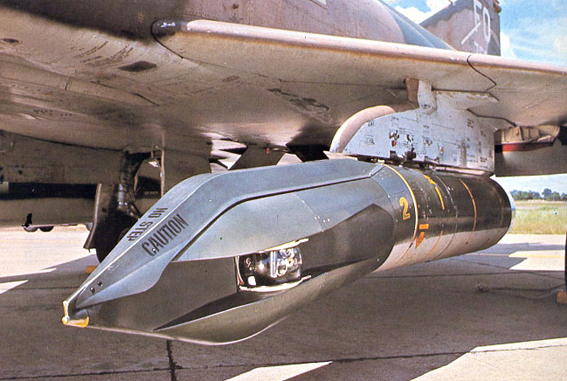
The AN/AVQ-10 Pave Knife, showing the camera/laser aperture
While the first laser-guided bombs were under development prior to the 1968 bombing halt, continued work by Texas Instruments had improved the method from the hand-held "Zot Box" that was used by the WSO while the Phantom flew a pylon turn around the target to podded systems in the form of the AN/AVQ-10 Pave Knife that allowed more flexible attack approaches to be made. The WSO used the laser in the Pave Knife pod to designate the target point for the laser-guided bombs. The 8th TFW at Ubon had six Pave Knife pods and it was decided to use them on the next day to revisit the Paul Doumer Bridge. Compared to the sixteen aircraft from the previous day, on 11 May 1972 only four F-4D Phantoms led by Captain Thomas Messett (who flew in the previous day's raid) would attack the bridge. One Phantom carried two 3,000 lb LGBs and the other three Phantoms carried two 2,000 lb LGBs. Only Captain Messett's F-4 carried a Pave Knife pod. The defenders of the bridge didn't think the four Phantoms were the main strike force and as they dived on the bridge, Messett and his WSO designated target points on the bridge and all eight bombs scored direct hits on the bridge, dropping the entire span on the Hanoi side of the bridge into the Red River. It would be a year before the Paul Doumer Bridge was usable again. 

The 3,000 lb GBU-11 added fins and laser guidance to the M118 bomb
The other bridge that was crucial to hitting at the North Vietnamese logistical support of the Easter invasion was the Thanh Hoa Bridge, an immensely tough rail bridge nicknamed "Dragon's Jaw" that crossed the Song Ma River and connected the rail shipment points from China to Hanoi. During Operation Rolling Thunder from 1965 to 1968 over 1,000 missions flew against the Dragon's Jaw, not one mission succeeding in bringing its spans down. The USAF even resorted to dropping floating bombs upstream of the bridge to try and bring it down in Operation Carolina Moon. Nothing worked, it was known as the toughest target in North Vietnam.  On 13 May 1972, two days after the Paul Doumer Bridge was dropped, the 8th TFW set out to drop the Thanh Hoa Bridge for good with fourteen Phantoms carrying nine 3,000 lb LGBs, fifteen 2,000 lb LGBs, and forty-eight 500 lb conventional bombs (due to a shortage of laser-guided bombs). Attacking through an intense flak barrage, direct hits by the LGBs put the entire western span of the Dragon's Jaw into the Song Ma River below. Before the end of Linebacker I in October, the Navy flew an additional eleven missions against the bridge and the USAF another two to insure the bridge was out for good. 

Post-strike recon photo of the Paul Doumer Bridge
It was a stunning debut for a new age of precision munitions. When the Pave Knife was used against the Paul Doumer and Thanh Hoa Bridges by the 8th TFW, it was technically still a developmental program and was rushed forward in response to Nixon's order to blunt the North Vietnamese invasion. Twelve pods were built for the testing program. When the preparations for Operation Linebacker started, three pods stayed stateside to continue the testing program. Three pods went to the US Navy for use on specially-wired Grumman A-6A Intruders and six pods went to the 8th TFW at Ubon for use on specially-wired F-4D Phantoms. Two pods were lost over North Vietnam during Linebacker I- the remaining four pods became quite valuable and after Paul Doumer and Thanh Hoa, were used only on the most critical and important targets. The commander of the Seventh Air Force, General John Vogt, reportedly told the pilots of the 8th TFW "Don't come back if you don't have that pod with you when you return!"

Source: The Linebacker Raids: The Bombing of North Vietnam, 1972 by John T. Smith. Arms and Armour Press, 1998, p61-75.