
In the fall of 1943, the Japanese military liaisons in Germany were given a demonstration of the Messerschmitt Me 163 Komet rocket fighter. They sent back enthusiastic reports on the potential of the Me 163 in defending against the predicted USAAF strategic bombing offensive that would start the following year. Despite their reports and the enthusiasm of some in the Japanese military of what the Komet might offer in the defense of the Home Islands, most of the Japanese military command had reservations about putting the Komet into service as the Japanese industry would have to master the production of large quantities of hydrogen peroxide and hydrazine. Synthesizing the two rocket fuels used by the Komet would require a significant amount of electrical power. Others in the military command questioned whether the Komet's short endurance was a liability, particularly as a point-defense fighter it would have reach up to higher altitudes to attack the B-29 Superfortress than the altitudes over Europe where the Komet's main prey were unpressurized B-17 Flying Fortresses and B-24 Liberators. Despite legitimate questions about the practicality of the Komet, negotiations for license production in Japan of the Me 163 proceeded which included not just the Komet airframe but also the Walter HWK 509A bi-fuel rocket motor. By 1 March 1944, the approval was reached and the Germans would supply Japan with complete blueprints and manufacturing data for the Me 163B variant as well as one complete airframe, two sets of sub-assemblies, and three complete rocket motors. A Japanese joint-service mission with Army and Navy representatives would also be sent to Germany to observe not just the manufacture of the Komet but also learn the procedures for operational use. As it was, events in Europe would keep the joint-service mission from arriving, but two Imperial Japanese Navy submarines were used to bring the cargo back home to Japan as a measure of redundancy in case one submarine was lost on the return voyage. The first submarine to depart was the former U-1224 which was handed over to the Japanese in February 1944 and named "Satsuki". The second submarine was I-29 "Matsu".
 |
| The Mitsubishi J8M1 Shusui. This one was brought to the US after the war. |
The Satsuki was sunk in the Atlantic by the destroyer escort USS Francis Robinson which was operating as part of the escort carrier USS Bogue's hunter-killer group. The Matsu, however, was able to reach Singapore on 14 July 1944 and its cargo was quickly flown to Tokyo for analysis. The staff of the 1st Naval Air Technical Arsenal met regularly at the naval base of Yokosuka to discuss whether to launch production of a Japanese Komet. The Battle of the Philippine Sea (the "Great Marianas Turkey Shoot") had just taken place which had all but eliminated Japan's carrier fleet. With the imminent capture of the Marianas, it was only a matter of time before B-29 bases within easy reach of the Home Islands became operational. Despite the decline in Japan's war fortunes that summer, many in the daily discussions were wary of committing Japan's industrial resources to so radical a weapon. The balance was tipped in favor of production when the commander of the Yokosuka arsenal decided in favor of the aircraft, stating something to the effect that desperate times would call for desperate measures.
Mitsubishi had been assigned the task of building the Komet as the J8M, but they refused to proceed with so much discord within the Japanese military command on the practicality of the aircraft. On 27 July 1944, a joint Army-Navy commission formally ordered the aircraft from Mitsubishi as the J8M Shusui ("Sword Stroke"). This is significant for Mitsubishi as the Imperial Japanese Navy and the Imperial Japanese Army took inter-service rivalry to new degrees that made the US armed services rivalry look like a minor disagreement. For both the IJN and IJA to jointly pursue a single design was nearly unprecedented and sent a message to Mitsubishi that they were serious about wanting a Japanese Komet. The Navy designation was J8M and the Army designation would be Ki-200 (though J8M is the more commonly referred to designation for the Shusui). From that point, the program took on a more serious effort and urgency. The cockpit mockup was reviewed on 8 September 1944 and the full scale mockup of the Shusui was reviewed 18 days later. A joint Army-Navy production schedule was drawn up with 155 aircraft to be delivered by March 1945, 1,300 by the following September and no fewer than 3,600 delivered by March 1946. Because of the loss of one of the submarine and the fact that joint-service commission never made it Germany to observe production, the Mitsubishi team had to make some educated guesses during the design process in preparing the Shusui for production. In addition, some of the basic equipment like batteries and radios were sized and weighed differently in Japan compared to German equipment, and this in turn affected not just airframe structure but also weight and balance of the aircraft.
 |
| Pilot (possibly Cdr Inuzuka) in front of the Akikusa trainer. |
In addition, the Shusui would have been the first tailless aircraft to be flown in Japan, so it was decided that the Yokosuka arsenal would build training gliders that were essentially unpowered Shusui aircraft. These gliders were designated MXY8 Akikusa ("Autumn Grass") and the first Akikusa glider was flown on 8 December 1944. The second Akikusa glider built was delivered to the Army for their own flight testing. On 1 December, the first structurally complete Shusui was reviewed and approved by both the Army and Navy. However, misfortune struck the program when an earthquake damaged Mitsubishi's plant in Nagoya and then a few days later the area was struck by B-29 Superfortresses. Despite the setbacks, Commander Toyohiko Inuzuka, who flew the first Akikusa gliders, made the first unpowered flight of the J8M Shusui on 8 January 1945. Other pre-production aircraft were test fitted with rocket motors while the unpowered Shusui flight test program continued.
Mitsubishi was also responsible for getting the rocket motor which was designated Toku Ro.2 into production, but on the day of the first bench test of the motor, B-29s attacked the plant. Numerous technical problems mounted in the motor development as the Japanese had to substitute some materials for others in the design which would later turn out to be unsuitable for a production motor. By April 1945, the Shusui aircraft were ready but the rocket motor program was already 3 months behind schedule. It was decided if the Toku Ro.2 could run for just two minutes, they'd attempt the Shusui's first powered flight on 22 April, but the engine exploded during a ground test. B-29 attacks exerted their toll on the program with the engineering groups having to move to new facilities periodically. Eventually two groups were set up, each tasked with getting the Toko Ro.2 running. By June, one group had their motor on the bench running four minutes and the other group had their motor bench tested to three minutes. It was decided that these bench tested motors would be used for the Shusui's first flight. Ground runs continued to reveal problems with the motor and it wasn't until 5 July 1945 that they were ready for the first powered flight.
 |
| Preparing for the J8M1's maiden flight or a ground test run. |
On 7 July 1945, Toyohiko Inuzuka started up the motor for the first Shusui powered flight. After an 11-second takeoff run, the Shusui became airborne and jettisoned its takeoff dolly as planned. At 1,150 feet, Inuzuka began to have engine problems as the motor began to sputter and then quit. He was able to reach 1,640 feet, where he leveled off and turned for the glide back to Yokuku Airfield. Releasing his remaining fuel via emergency release valves, he realized he had made too many S-turns and was going to come short of the airfield. Aware he was about to hit a house on the airfield perimeter, Inuzuka deliberately stalled the Shusui by abruptly pulling the nose up. The aircraft cartwheeled and missed the house, but it was destroyed and Inuzuka would die a few days later from his injuries. Analysis showed that he suffered fuel starvation during his climb- the acceleration and his angle of climb caused the fuel to slosh back and recede from the tank outlet. A few days later, two other motors that were being bench tested for the flight test program exploded. This left only one complete rocket motor that had been tested and this one was in the possession of the Army for the installation in their Shusui prototype. As the Army and Navy struggled to get the program back on track, Hiroshima was bombed on 6 August and three days later on 9 August Nagasaki was bombed. Six days later, Japan unconditionally surrendered.
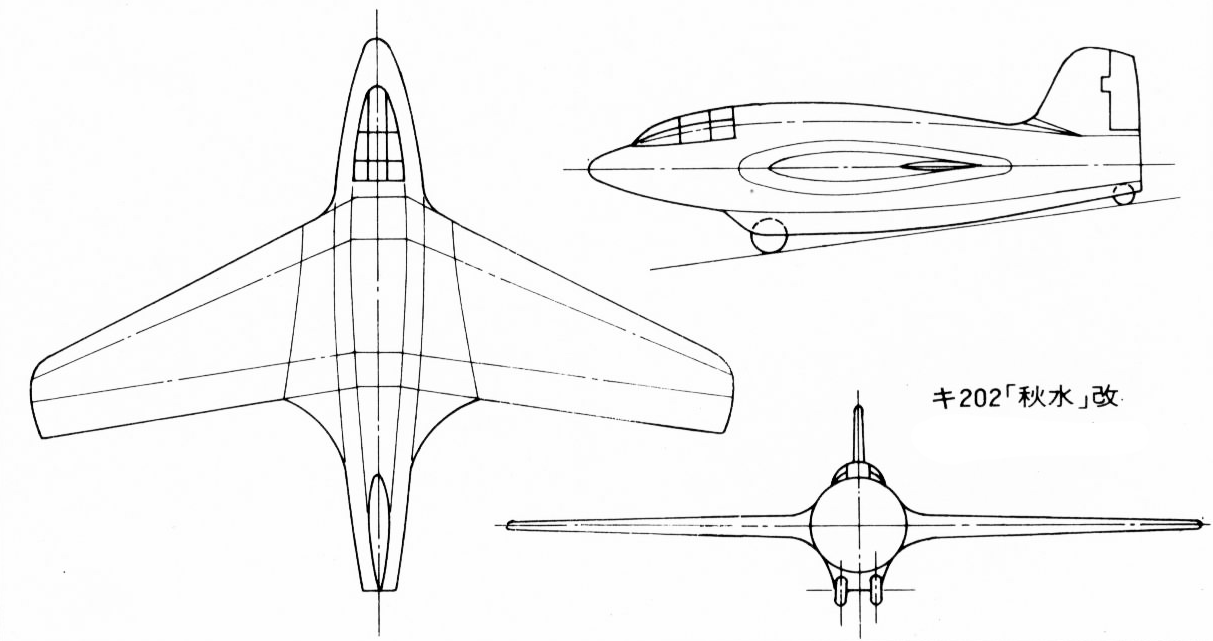 |
| The IJAAF's Ki-202 Shusui-Kai |
On the day of surrender, there were four finished J8M Shusui airframes and six more nearing completion on the assembly line. Four production Toku Ro.2 motors had been finished and were ready for testing with two nearing completion with components for another 20 motors ready. On the day of the surrender, the Navy was looking at a powered version of the MXY8 Akikusa training glider to allow longer sorties as well as to incorporate water ballast to better simulate a fully fueled Shusui. While both services were committed to producing a common aircraft, the Navy was already working on the J8M2 Shusui-Kai which deleted one wing cannon for an extra fuel tank to give it more endurance. Even more ambitious, the Army was working on their own Shusui-Kai variant designated Ki-202 which was a substantial redesign of the Me 163B that was longer with more endurance. The Army had planned to use the Ki-200 (J8M) as an interim type until they could put the Ki-202 in service starting in 1946.
 |
| From a model kit- the ones one the right are "what if" in service schemes |
Three J8M Shusui aircraft survived the war. Two of them were captured by US occupation forces and shipped to the United States. One was on display at NAS Glenview in Illinois but was scrapped on site in 1946. The other one is on display today at the Planes of Fame Museum in Chino, California. The third airframe was discovered in a cave in the 1960s in poor shape. It was on display for a while at Gifu AB where the JASDF's Air Development and Test Command is based. In 1999, Mitsubishi restored it and has it on display at their museum at their Komaki plant. While the story of the J8M is short and full of tragedy, when you consider that between the time the I-29 "Matsu" docked in Singapore with its precious cargo and the Japanese surrender, one year, one month, and one day elapsed. In that time despite the strain on Japanese industry by the B-29 attacks, they were able to get one aircraft to fly once, even though it did end badly. In his 1976 Air International article on the Shusui, author Yoshio Imagawa observed that "of Japanese national character that fanaticism and fatalism are innate ingredients." Given the growing desperation of the Japanese military in 1945, having their own version of the Messerschmitt Me 163 Komet seems almost pre-ordained.
Source: "Japan's Final Sword Stroke...The Story of Shusui" by Yoshio Imagawa. Air International, Volume 10, Number 6. June 1976, pp 283-288. Images: Wikipedia, Koku-Fan, Japanese aviation forums.


