Showing posts with label Imperial Japanese Navy. Show all posts

22 April 2016

CHECK SIX: Chikuhei Nakajima and his Aircraft Company


So here's something from the "Persons in Aviation History that Don't Get Enough Attention" Department- this is Chikuhei Nakajima, the founder of the Nakajima Aeroplane Company in Japan. Prior to World War II, there were three dominant aircraft manufacturers in Japan- Mitsubishi, Kawasaki, and Nakajima. Both Mitsubishi and Kawasaki were capitalized from their founding by government contracts for military aircraft. Nakajima, on the other hand, was the only major Japanese aircraft company of the time that not only was independent of any other industry (both Mitsubishi and Kawasaki were divisions of per-exisiting industrial corporations), it also was privately capitalized on account of its success with flying its aircraft on air mail routes within Japan. 

Nakajima was a former naval officer with a background in engineering. While he was still in the Navy, in 1912 he spent time in the United States as a student and observer of naval aviation. He spent time studying aircraft manufacturing with Curtiss Aircraft and even learned to fly during his time with the company. When he returned to Japan, he left the Imperial Japanese Navy and started Nakajima Aircraft in December 1917. His business connections helped him raise capital- while Mitsubishi and Kawasaki's aircraft manufacturing was funded by military orders, Nakajima focused on civilian designs that could fly air mail routes in Japan. By 1924, Nakajima was also designing and building his own aircraft engines. In 1931 he retired with his younger brother taking over the company. 

By the end of the war, only Mitsubishi had built more aircraft for the Japanese war effort than Nakajima. By the terms of the surrender agreement and subsequent military occupation of Japan postwar, aircraft companies were forbidden from aircraft development and production. This wasn't so bad for companies like Mitsubishi and Kawasaki which were diversified. Nakajima had to be dissolved, but many of its managers and engineers stayed together in smaller ventures until 1950 when they formed Fuji Heavy Industries. 

The Fuji T-1 jet trainer was Japan's first indigenous jet aircraft following World War 2 when aircraft production was allowed to resume. Fuji builds trainer aircraft for the JASDF and is a subcontractor for several US aerospace companies, but you all might know Fuji more from their automobile division, Subaru. Many of the Nakajima engineers who couldn't work in aviation after the war turned their attention to Japan's then-fledgling automobile industry. Subaru has been such an important part of Fuji Heavy Industries that the Subaru logo in 2003 became the official logo for Fuji itself.

Further reading: 

(Photo: Wikipedia)

12 April 2016

CHECK SIX: Ships Sunk or Damaged by the Yokosuka MXY7 Ohka

Hasegawa model kit box art showing a G4M releasing an Ohka
(Hasegawa Models)
The Yokosuka MXY7 Ohka ("Cherry Blossom") kamikaze flying bomb was conceived by Ensign Mitsuo Ohta of the 405th Kokutai of the Imperial Japanese Navy. He was considering how to overcome the dense anti-aircraft defenses of Allied warships. His design solution, aided by students from the University of Tokyo, was for a rocket propelled kamikaze aircraft that would be flying too fast in its terminal approach to the target to be shot down. He submitted his ideas to the IJN for consideration and his proposals were refined further by engineers at the IJN's Yokosuka Naval Air Technical Arsenal which resulted in the MXY7 design which was essentially an anti shipping missile with a 2600 lb warhead with a kamikaze pilot as its guidance system. 

The Ohka had three rocket engines which could be ignited at once or in sequence. Dropped by the Mitsubishi G4M "Betty", the Ohka had a range of approximately 23 miles and had a terminal approach speed between 580-620 mph, significantly faster than piston engined kamikazes. 

The Yokosuka arsenal would build 155 Ohkas while the Kamisagura Air Arsenal would built over 600 Ohkas. It was planned to debut the Ohkas at the Battle of Leyte Gulf, but the ships transporting the Ohkas to the Philippines were sunk enroute. The Ohka's operational debut would be in the Battle of Okinawa with mixed results:

12 April 1945: USS Mannert L. Abele, destroyer, sunk by one, possibly two Ohkas.
12 April 1945: USS Jeffers, a destroyer converted to a minesweeper, damaged.
12 April 1945: USS Stanly, a destroyer, damaged.
4 May 1945: USS Gayety, a minesweeper, damaged.
4 May 1945: USS Shea, a light destroyer coverted to a minelayer, damaged.
11 May 1945: USS Hugh W. Hadley, a destroyer, damaged.

Interestingly, the captain of a support vessel who witnessed the sinking of the USS Mannert L. Abele had this to say: "It is difficult to say what it was that hit the DD 733. This officer personally saw what appeared to be two (2) planes orbiting in a northerly direction from the DD 733, and then suddenly, what appeared to be, one plane, accelerated at a terrific rate, too fast for us to fire at. This plane dove at an angle of approximately 30 degrees, starting at about four miles [7.5 km] away. Since we had no air search radar, the above statements are merely my own conclusions."

That captain's report was the first to indicate that the Ohka was operational. 

Further reading:


13 January 2016

The Japanese Spruce Goose: The Kawanishi H11K Soku

Profile of the H11K from the Anigrand 1/144 scale kit
(Anigrand Craftswork)
By 1944, the US Navy's unrestricted submarine warfare against Japanese shipping had reached its highest totals in terms of shipping sunk and it was taking its toll on Japanese industry. As an island nation with few natural resources, Japan was dependent upon shipping for the importation of raw materials and oil for not just its industry but also for it military forces. The Imperial Japanese Army Air Force looked at using transport gliders to bring oil from Sumatra to Japan, but the fuel costs to do so outweighed the volume of oil brought in. The Imperial Japanese Navy, however, with its experience in operating large seaplanes, asked Kawanishi to develop a large transport seaplane to make up for the shipping losses. Kawanishi had already designed and put into production two large flying boats, the H6K (Allied code named "Mavis") and the H8K (Allied code named "Emily"). The H8K in particular was avery well-regarded flying boat design, even by the Allies. Kawanishi had also modified its production flying boats for the transport role as well. The transport version of the H8K was designated H8K-2L Seiku ("Calm Sky") and the company had built 36 for the IJN for transport duties aside from the prototype which was converted from a front line H8K. Most of the defensive positions were deleted to save weight save a 13mm machine gun position in the nose and a 20mm cannon in the tail position. The fuselage fuel tanks were reduced in size to allow for more cargo volume. An H8K-2L could carry up to 62 fully-equipped troops.

Overall configuration of the H11K Soku
(Airwar.ru)
The earlier H6K also had a transport version. It didn't have the space or load carrying capability of the larger and later H8K, but 20 aircraft designated H6K4-L were built and another two were converted from former front line H6K4 flying boats. And earlier production run of 18 aircraft designated H6K2-L were primarily passenger aircraft used by Japan's wartime airline, Dai Nippon Kokku. As passenger transports, they could accommodate 18 passengers and had sleeper berths.

Kawanishi's design for a large purpose-designed transport flying boat was designated H11K Soku ("Blue Sky"). Since metal alloys were desperately needed in the production of fighters for homeland defense, Kawanishi's H11K would have been made of wood wherever possible- making it in a sense a Japanese counterpart to the Hughes HK-1 "Spruce Goose". Starting out by scaling up the H8K but having a nearly identical fuselage keel, the H11K was powered by the same four Mitsubishi MK4Q Kasei 22 1,850-hp radial engines, each engine driving a large four-bladed propeller 14 feet in diameter. By comparison, the large Martin JRM Mars had 16 foot, 8 inch four bladed propellers. Most of the wings and fuselage made of wood. Under each wing was a fixed float for water stabilization. The fuselage had two decks- the upper deck had not just the flight deck but also quarters for the crew of five. The lower main deck could accommodate over 80 fully equipped troops, vehicles or an equivalent volume of cargo. To speed loading and unloading operations, the nose had split clamshell doors. Three machine gun positions were located in the fuselage for self-defense. 

The H11K mockup with its nose clamshell doors
(RC Groups Forum)
After presentation of the H11K proposal to the Imperial Japanese Navy, full design work began in 1944 with Kawanishi building a full-scale mockup of the H11K for inspection and review by the IJN at one of its facilities on the west coast of Japan. However, the deteriorating war situation meant that  the full-scale mockup which was nearly completed on was destroyed along with most of the Kawanishi facilities in a bombing attack on 1 April 1945. No further work was attempted on the H11K Soku after the attack.

Some comparisons with other large Second World War-era flying boats to give you an idea of the Soku's size:


Dimensions
Span: 47.97m 157.4ft
Length: 37.70m I23.7ft
Height: 12.55m 41.2ft
Wing area: 289.95m2 3,121ft2
Wing loading: 156.72kg/m2 32.1 lb/ft2

Weights
Empty: 26,405kg 58,213lb
Loaded: 45,550kg 100,420 Ib
Useful load 19,095kg 42,097b

Performance
Max speed: 470km/h 292mph at 5,000m at 16,404ft
Cruise speed: 369km/h 229mph
Landing speed: 144km/h 89mph
Range: 3,890km 2,417 miles
Climb: 11 min 30 sec to 3,000m (9,842ft)

Source:  Japanese Secret Projects: Experimental Aircraft of the IJA and IJN 1939-1945 by Edwin M. Dyer, III. Midland Publishing/Ian Allan Publishing, Ltd, 2009, p63-64.

29 September 2015

The Cheapest Aircraft of the Second World War: The Focke-Achgelis Fa 330

Poor quality video of the Fa 330 operating from a U-boat (YouTube)

Earlier this month I had written about the aircraft types that were operated off submarines in the First World War, albeit on a very limited operational basis, and some designs that never quite made it to sea. In the interwar period, there were several experiments and attempts at aircraft operations from submarines- some of which will be future topics here at Tails Through Time- but none ever really evolved into a useful operational system. As is often the case in wartime, the pressures and operational needs of combat sometimes rekindle old ideas and this certainly the case for the German Kriegsmarine's Ubootwaffe (U-boat arm) in the Second World War. The initial plans were for a light seaplane from the Arado Flugzeug Werke designated Ar 231. Arado had built observation floatplanes for the larger surface combatants of the Kriegsmarine and in 1940, they were issued a contract for six "U-Bootsaugen" or "submarine eyes". The Ar 231 was the result and it was a single seat high wing monoplane with a 160 hp six-cylinder engine. The wings folded back over the fuselage and the entire aircraft could fit into a container only six feet in diameter. However, sea trials showed the little floatplane couldn't take off in winds greater than 20 knots and much like the problems faced in 1917, only the calmest of sea states was needed for safe flight operations- this was an unrealistic expectation for the planned operational arena for the U-boats, in the harsh North Atlantic interdicting convoys bound for Great Britain from the United States. The idea for the "U-Bootsaugen" was quietly canceled with the Ar 231 fading into the footnotes of aviation history. However, following the entry of Japan into the Second World War after its attack on Pearl Harbor, the directive came down for the Kriegsmarine to find a way to join forces with the Imperial Japanese Navy. In the same year that IJN submarines began operating in the Indian Ocean interdicting British shipping, the idea was passed to the Kriegsmarine in December 1942 to base U-boats in Japanese occupied Malaya and the East Indies. A new U-boat variant based on the large ocean going Type IX submarine, the Type IXD2, was on the drawing boards at that time as an ideal submarine for what the Kriegsmarine called the "Monsun Gruppe" which were U-boats based at Penang in Malaya. 

The Fa 330 at the RAF Museum in Cosford (Wikipedia)
On the broad and calmer Indian Ocean (at least on the trade routes from Africa to Australia), the Kriegsmarine once again issued a limited requirement for some means to extend the visual range of a surfaced U-boat for targets of opportunity on the cruises around the Cape of Good Hope to Penang and back. Simplicity and ease of use were paramount, mindful of past pitfalls with operating aircraft from submarines had shown. The unique demands were met by one of the most unique aircraft of the Second World War, if not the simplest and cheapest, the Focke-Achgelis Fa 330. Heinrich Focke had founded Focke-Wulf in 1923. In the 1930s, Focke-Wulf had license built Juan de la Cierva's autogyro designs and from that experience, Heinrich Focke designed the Fw 61 helicopter. However, in 1936, he was ousted from Focke-Wulf. Several references indicate it was because he was considered politically unreliable the the Nazi regime, but in all likelihood it was to get him out of the way so that Focke-Wulf's production capacity could be used to build more Bf 109 fighters from his rival, Willy Messerschmitt. Despite this, the German Air Ministry was impressed with the Fw 61 which the German pilot Hanna Reisch had ably demonstrated by flying the helicopter indoors. They encouraged Focke to start a new company devoted to the development of his true interest, vertical flight. He teamed up with his helicopter test pilot, Gerd Achgelis (he flew the Fw 61 on its maiden flight in 1936) to start Focke-Achgelis and it was this outfit that created the Fa 330 to meet the Kriegsmarine requirement for an observation aircraft of utmost simplicity for use by the submarines of the Monsun Gruppe. 

Lacking its own power plant, the Fa 330 was really a gyro kite. It had a three-bladed 24-foot rotor and when fully assembled, the Fa 330 weighed only 180 lbs. The main body was essentially an upright welded steel tube to which the rotor was attached at the top. A longitudinal tube of smaller diameter was attached to the bottom to which the single seat, controls, tail surfaces and outrigger skids were attached. Each of the major components attached together with simple spring loaded pins which also made for easy disassembly. Two vertically-oriented containers attached to the conning tower housed the parts. With each rotor blade 12 feet long, that dictated the maximum depth of each storage compartment. Four men could assemble the Fa 330 in only 3 minutes in a reasonable sea state. A platform sat on the aft part of the conning tower where the Fa 330 was launched and recovered. With the pilot/observer ready, the U-boat would turn into the wind as 20 mph was needed to get the Fa 330 gyro kite airborne as the pilot used his controls to tilt the rotor head back to "catch the wind" like a kite with a steel cable which also carried a telephone line to allow the pilot/observer to communicate with the submarine's bridge. The operating speed was usually about 25 mph but the Fa 330 could stay airborne with as little as 17 mph of forward speed by the U-boat. Typical operating altitudes were between 200 to 500 feet, though in calm weather, the Fa 330 could be flown up to 1000 feet. In good visibility, this extended the U-boat's visual horizon out from the usual 12 miles to 50 miles. At an altitude of 600 feet, the visual horizon was 31 miles. Even at minimum operating speed, the Fa 330 could fly 200 feet up and that still gave the U-boat captain a visual horizon of about 20 miles. The Fa 330 was recovered by simply winding the cable back in until the Fa 330 could alight on the conning tower platform. Though Focke-Achgelis designed the Fa 330, it was built by another company, the Weser Flugzeugbau.

Model kit box art showing an Fa 330 being deployed by a U-boat (Mirage Hobby)
Pilot/observers were trained to fly powered gyrocopters at the French Aeronautical Experimental Establishment outside of Paris. Training on the Fa 330 itself was carried out inside a large wind tunnel with more advanced training taking place with the Fa 330 being towed by trucks on a runway before moving to being towed to higher altitudes by a gyrocopter. A proposal was floated to put a 60 hp engine on the Fa 330, but it never advanced far with the Kriegsmarine. About 200 Fa 330s were built. At sea, the pilot/observer was in an unenviable position should he have spotted a warship as that would have meant an immediate crash dive by the U-boat. If this were to happen, the pilot was to activate his escape mechanism which severed the rotor blades get them away from the pilot who then dropped away from what was left of the Fa 330, his parachute ripcord being pulled automatically by the departing blades as they fell away. That left the pilot to float down to the ocean and hope to be picked up when the submarine resurfaced. It's not known what happened to most Fa 330 pilot/observers, though Royal Navy patrols in the Indian Ocean did come across floating parts from the Fa 330. 

Only the U-boats with Monsun Gruppe in the Indian Ocean used the Fa 330 as the Allied air threat in the Atlantic was too great. Only one sinking is known to be attributed to Fa 330 operations when U-177 used its gyro kite to assist with the interception and sinking of the Greek steamer Ethalia Mari on 6 August 1943. Details of the use of the Fa 330 operationally are scant on account of so few U-boats surviving the war. Several U-boat captains, however, believed using the Fa 330 was too risky which may have ultimately prevented its more widespread use. The Allies found out about the Fa 330 after studying the submarine U-852 after it had run aground on the coast of Somalia after an air attack. While not impressed with its capabilities, they were suitably impressed with its simplicity and ease of use. 
The L-3 Valkyrie Virtual Mast unmanned gyro kite (Popular Science)
Interestingly in 2013, the defense company L-3 proposed a re-imagination of the Fa 330 concept with their Valkyrie "Virtual Mast" in which a carbon fiber gyro kite would carry aloft an electro-optical/IR sensor as high as 5000 feet on a steel cable for ships at sea. 

Sources: Strike From Beneath the Sea: A History of Aircraft-Carrying Submarines by Terry C. Treadwell. The History Press, 2009, pp 103-109. The Smithsonian National Air & Space Museum.

27 April 2015

The Mitsubishi J8M Shusui: The Tragic History of the Japanese Komet Fighter

In the fall of 1943, the Japanese military liaisons in Germany were given a demonstration of the Messerschmitt Me 163 Komet rocket fighter. They sent back enthusiastic reports on the potential of the Me 163 in defending against the predicted USAAF strategic bombing offensive that would start the following year. Despite their reports and the enthusiasm of some in the Japanese military of what the Komet might offer in the defense of the Home Islands, most of the Japanese military command had reservations about putting the Komet into service as the Japanese industry would have to master the production of large quantities of hydrogen peroxide and hydrazine. Synthesizing the two rocket fuels used by the Komet would require a significant amount of electrical power. Others in the military command questioned whether the Komet's short endurance was a liability, particularly as a point-defense fighter it would have reach up to higher altitudes to attack the B-29 Superfortress than the altitudes over Europe where the Komet's main prey were unpressurized B-17 Flying Fortresses and B-24 Liberators. Despite legitimate questions about the practicality of the Komet, negotiations for license production in Japan of the Me 163 proceeded which included not just the Komet airframe but also the Walter HWK 509A bi-fuel rocket motor. By 1 March 1944, the approval was reached and the Germans would supply Japan with complete blueprints and manufacturing data for the Me 163B variant as well as one complete airframe, two sets of sub-assemblies, and three complete rocket motors. A Japanese joint-service mission with Army and Navy representatives would also be sent to Germany to observe not just the manufacture of the Komet but also learn the procedures for operational use. As it was, events in Europe would keep the joint-service mission from arriving, but two Imperial Japanese Navy submarines were used to bring the cargo back home to Japan as a measure of redundancy in case one submarine was lost on the return voyage. The first submarine to depart was the former U-1224 which was handed over to the Japanese in February 1944 and named "Satsuki". The second submarine was I-29 "Matsu". 

The Mitsubishi J8M1 Shusui. This one was brought to the US after the war.
The Satsuki was sunk in the Atlantic by the destroyer escort USS Francis Robinson which was operating as part of the escort carrier USS Bogue's hunter-killer group. The Matsu, however, was able to reach Singapore on 14 July 1944 and its cargo was quickly flown to Tokyo for analysis. The staff of the 1st Naval Air Technical Arsenal met regularly at the naval base of Yokosuka to discuss whether to launch production of a Japanese Komet. The Battle of the Philippine Sea (the "Great Marianas Turkey Shoot") had just taken place which had all but eliminated Japan's carrier fleet. With the imminent capture of the Marianas, it was only a matter of time before B-29 bases within easy reach of the Home Islands became operational. Despite the decline in Japan's war fortunes that summer, many in the daily discussions were wary of committing Japan's industrial resources to so radical a weapon. The balance was tipped in favor of production when the commander of the Yokosuka arsenal decided in favor of the aircraft, stating something to the effect that desperate times would call for desperate measures. 

Mitsubishi had been assigned the task of building the Komet as the J8M, but they refused to proceed with so much discord within the Japanese military command on the practicality of the aircraft. On 27 July 1944, a joint Army-Navy commission formally ordered the aircraft from Mitsubishi as the J8M Shusui ("Sword Stroke"). This is significant for Mitsubishi as the Imperial Japanese Navy and the Imperial Japanese Army took inter-service rivalry to new degrees that made the US armed services rivalry look like a minor disagreement. For both the IJN and IJA to jointly pursue a single design was nearly unprecedented and sent a message to Mitsubishi that they were serious about wanting a Japanese Komet. The Navy designation was J8M and the Army designation would be Ki-200 (though J8M is the more commonly referred to designation for the Shusui). From that point, the program took on a more serious effort and urgency. The cockpit mockup was reviewed on 8 September 1944 and the full scale mockup of the Shusui was reviewed 18 days later. A joint Army-Navy production schedule was drawn up with 155 aircraft to be delivered by March 1945, 1,300 by the following September and no fewer than 3,600 delivered by March 1946. Because of the loss of one of the submarine and the fact that joint-service commission never made it Germany to observe production, the Mitsubishi team had to make some educated guesses during the design process in preparing the Shusui for production. In addition, some of the basic equipment like batteries and radios were sized and weighed differently in Japan compared to German equipment, and this in turn affected not just airframe structure but also weight and balance of the aircraft. 

Pilot (possibly Cdr Inuzuka) in front of the Akikusa trainer.
In addition, the Shusui would have been the first tailless aircraft to be flown in Japan, so it was decided that the Yokosuka arsenal would build training gliders that were essentially unpowered Shusui aircraft. These gliders were designated MXY8 Akikusa ("Autumn Grass") and the first Akikusa glider was flown on 8 December 1944. The second Akikusa glider built was delivered to the Army for their own flight testing. On 1 December, the first structurally complete Shusui was reviewed and approved by both the Army and Navy. However, misfortune struck the program when an earthquake damaged Mitsubishi's plant in Nagoya and then a few days later the area was struck by B-29 Superfortresses. Despite the setbacks, Commander Toyohiko Inuzuka, who flew the first Akikusa gliders, made the first unpowered flight of the J8M Shusui on 8 January 1945. Other pre-production aircraft were test fitted with rocket motors while the unpowered Shusui flight test program continued. 

Mitsubishi was also responsible for getting the rocket motor which was designated Toku Ro.2 into production, but on the day of the first bench test of the motor, B-29s attacked the plant. Numerous technical problems mounted in the motor development as the Japanese had to substitute some materials for others in the design which would later turn out to be unsuitable for a production motor. By April 1945, the Shusui aircraft were ready but the rocket motor program was already 3 months behind schedule. It was decided if the Toku Ro.2 could run for just two minutes, they'd attempt the Shusui's first powered flight on 22 April, but the engine exploded during a ground test. B-29 attacks exerted their toll on the program with the engineering groups having to move to new facilities periodically. Eventually two groups were set up, each tasked with getting the Toko Ro.2 running. By June, one group had their motor on the bench running four minutes and the other group had their motor bench tested to three minutes. It was decided that these bench tested motors would be used for the Shusui's first flight. Ground runs continued to reveal problems with the motor and it wasn't until 5 July 1945 that they were ready for the first powered flight. 

Preparing for the J8M1's maiden flight or a ground test run.
On 7 July 1945, Toyohiko Inuzuka started up the motor for the first Shusui powered flight. After an 11-second takeoff run, the Shusui became airborne and jettisoned its takeoff dolly as planned. At 1,150 feet, Inuzuka began to have engine problems as the motor began to sputter and then quit. He was able to reach 1,640 feet, where he leveled off and turned for the glide back to Yokuku Airfield. Releasing his remaining fuel via emergency release valves, he realized he had made too many S-turns and was going to come short of the airfield. Aware he was about to hit a house on the airfield perimeter, Inuzuka deliberately stalled the Shusui by abruptly pulling the nose up. The aircraft cartwheeled and missed the house, but it was destroyed and Inuzuka would die a few days later from his injuries. Analysis showed that he suffered fuel starvation during his climb- the acceleration and his angle of climb caused the fuel to slosh back and recede from the tank outlet. A few days later, two other motors that were being bench tested for the flight test program exploded. This left only one complete rocket motor that had been tested and this one was in the possession of the Army for the installation in their Shusui prototype. As the Army and Navy struggled to get the program back on track, Hiroshima was bombed on 6 August and three days later on 9 August Nagasaki was bombed. Six days later, Japan unconditionally surrendered. 
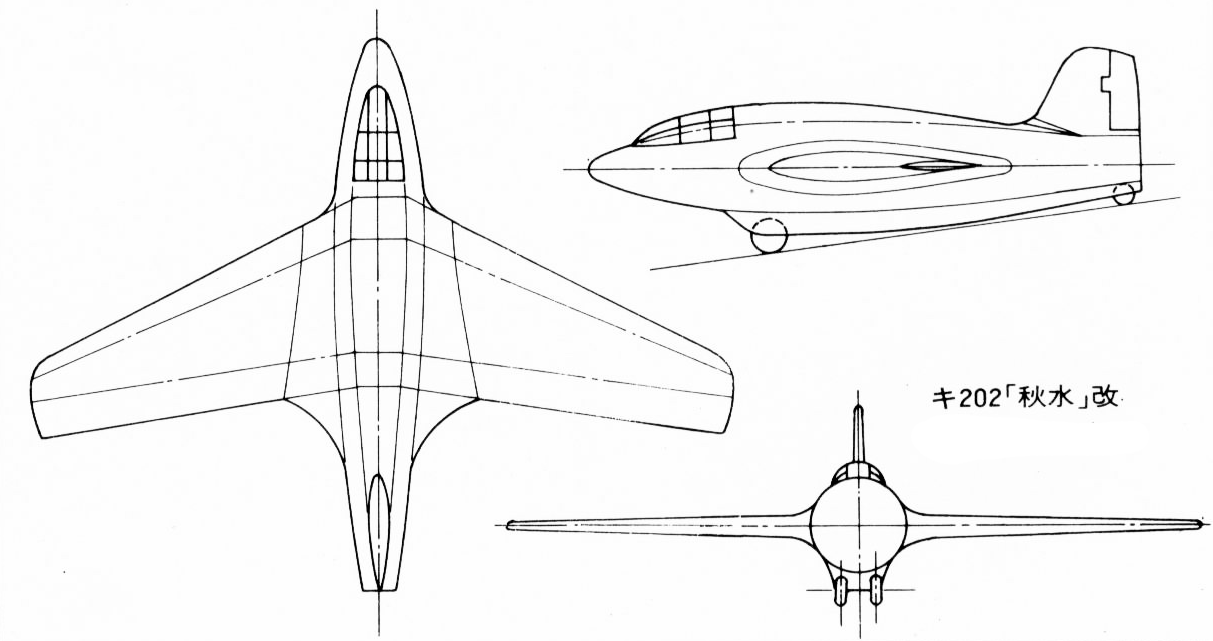
The IJAAF's Ki-202 Shusui-Kai
On the day of surrender, there were four finished J8M Shusui airframes and six more nearing completion on the assembly line. Four production Toku Ro.2 motors had been finished and were ready for testing with two nearing completion with components for another 20 motors ready. On the day of the surrender, the Navy was looking at a powered version of the MXY8 Akikusa training glider to allow longer sorties as well as to incorporate water ballast to better simulate a fully fueled Shusui. While both services were committed to producing a common aircraft, the Navy was already working on the J8M2 Shusui-Kai which deleted one wing cannon for an extra fuel tank to give it more endurance. Even more ambitious, the Army was working on their own Shusui-Kai variant designated Ki-202 which was a substantial redesign of the Me 163B that was longer with more endurance. The Army had planned to use the Ki-200 (J8M) as an interim type until they could put the Ki-202 in service starting in 1946. 

From a model kit- the ones one the right are "what if" in service schemes
Three J8M Shusui aircraft survived the war. Two of them were captured by US occupation forces and shipped to the United States. One was on display at NAS Glenview in Illinois but was scrapped on site in 1946. The other one is on display today at the Planes of Fame Museum in Chino, California. The third airframe was discovered in a cave in the 1960s in poor shape. It was on display for a while at Gifu AB where the JASDF's Air Development and Test Command is based. In 1999, Mitsubishi restored it and has it on display at their museum at their Komaki plant. While the story of the J8M is short and full of tragedy, when you consider that between the time the I-29 "Matsu" docked in Singapore with its precious cargo and the Japanese surrender, one year, one month, and one day elapsed. In that time despite the strain on Japanese industry by the B-29 attacks, they were able to get one aircraft to fly once, even though it did end badly. In his 1976 Air International article on the Shusui, author Yoshio Imagawa observed that "of Japanese national character that fanaticism and fatalism are innate ingredients." Given the growing desperation of the Japanese military in 1945, having their own version of the Messerschmitt Me 163 Komet seems almost pre-ordained. 

Source: "Japan's Final Sword Stroke...The Story of Shusui" by Yoshio Imagawa. Air International, Volume 10, Number 6. June 1976, pp 283-288. Images: Wikipedia, Koku-Fan, Japanese aviation forums. 

03 August 2012

The Coming Kamikaze Threat in World War II We Never Faced

The USS Callaghan, the last Allied ship sunk by kamikazes.
As the American fleet began to become proficient at meeting the kamikaze threat during the Second World War, night time was usually a period when sailors got a respite from the waves of suicide attackers- the vast majority of kamikaze attacks that took place were during the daylight hours. At night the fleet could repair damage from the day's attacks, sailors could get some rest, and ammunition and supplies for the next day's battles could be stocked. By the time of the invasion of Okinawa in April 1945, the Japanese were already in full swing preparing the Home Islands for the anticipated Allied invasion. Operation Olympic was the code name for the invasion of the southernmost of the Home Islands, Kyushu, and it was scheduled for November 1945. The size of the invasion fleet would dwarf not only what was used at Okinawa, but it would also dwarf the Allied landings at Normandy on D-Day in 1944. Approximately just over 2,700 ships and landing craft participated at Normandy; the invasion of Kyushu would have required over 4,000 ships. In twelve days, over 300,000 American troops came ashore at Normandy; on the beaches of Kyushu during Operation Olympic, it was planned that the same number of American troops would storm ashore in just the first *three* days. Therefore in Japanese defense planning for the defense of Kyushu, called "Ketsu-Go", kamikazes were a key part of disrupting the Pacific Fleet Amphibious Force/Task Force 51. Little known to most, though, is that the planned kamikaze threat would have been of a level of ferocity and technique not widely faced by the US Navy in the Pacific War. 

Through most of the war, the kamikaze threat consisted of primarily front-line aircraft. However, the submarine blockade of Japan made getting strategic materials like the ores used in metal increasingly difficult. Bauxite, for example, is an ore that is the main source of aluminum and the Japanese aircraft industry's main source for bauxite were open pit mines near Singapore. As early as 1943 thoughts began to shift towards the use of wood in new aircraft designs and the Germans had even provided the Japanese with plans for the De Havilland Mosquito, the Royal Air Force's "Wooden Wonder". Mosquito components that had been captured were even shipped to Japan aboard the Imperial Japanese Navy submarine I-29, but it was sunk in July 1944 near Japan. While the Japanese were aware of wood's natural radar defeating properties, any consideration at this point in using wood in aircraft designs was more a practical matter with the ore shortages; any benefits against Allied radars was seen rather remarkably as a secondary and less important benefit. 

Yokosuka K4Y1, probably the type that sank the Callaghan.
By the time the Battle of Okinawa was winding down, "Ketsu-Go" was in full swing on Kyushu and a key part of the defense was the use of massed kamikaze attacks. But the state of Japanese aircraft industry was in disarray with the B-29 attacks and the ongoing ore shortages. In July 1945 to meet the required numbers of kamikaze aircraft, all of the training units were converted to kamikaze units which added thousands of experienced pilots but over 5,000 antiquated biplane trainers made of wood and fabric. But again, at this point in the war, no one in Japan had realized that an elderly biplane trainer was a lot harder to spot on radar- plans at that point were to offset the slow performance of the biplane aircraft by shifting the kamikaze attacks to the night time, the traditional sanctuary period for the American fleet. However, somewhere in the Japanese command structure connected all the dots- on the night of 28 July 1945, the Fletcher-class destroyer USS Callaghan was on radar picket duty off the coast of Okinawa. In a time before the advent of airborne early warning aircraft, radar picket destroyers patrolled the edges of the fleet to search for inbound kamikazes. On this night, an elderly biplane floatplane, most likely a Yokosuka K4Y1 trainer, was warded off on its first pass, but it came around undetected for a second pass and struck the destroyer, sinking it with the loss of 47 sailors. The following night, another elderly biplane struck another radar picket, the USS Cassin Young- though not sunk, 22 sailors were killed and the ship had to withdraw from action for repairs. A third destroyer, the USS Prichett, was aiding the stricken Callaghan, was very nearly sunk by another elderly biplane on a kamikaze mission.

Yokosuka K5Y biplane trainer.
The destroyers had difficulty on downing the attackers for three reasons- it was night, not the usual time kamikazes attacked, secondly, the wood and fabric biplanes were difficult to spot and track on radar, and lastly the wood and fabric construction threw off the proximity fuses of the anti-aircraft guns- the proximity fuse's sensor that triggered the detonation of the round was optimized for metal aircraft; against the old wood and fabric biplanes, the proximity fuzes detonated the round too late, or in some cases, not at all. The action that night against those three radar picket destroyers changed thinking on the role of the 5,000+ elderly biplane aircraft that were going to be used as kamikazes for "Ketsu-Go". Here was an unexpected weapon that could counter the American technological advantages in radar and proximity-fuzed shells fired by anti-aircraft guns. American intelligence analysts had seen the massive change in the air forces of Japan in the summer of 1945 and were well aware of Japanese interests in wood, but it hadn't occurred to the Navy that this was a possibly game-changing combination that would have threatened initial phases of Operation Olympic. It was assumed that fuel shortages would keep most Japanese aircraft grounded and this misconception was reinforced by the increasing lack of air action against the B-29 raids and that US warships even managed to get close enough to the Home Islands to shell coastal targets without getting attacked. In fact, the Japanese had stockpiled fuel just for the use of the kamikazes in "Ketsu-Go". 

Tachikawa Ki-17 trainer aircraft.
At Okinawa, only one of the US Navy's carrier air wings was trained and equipped for night combat, that being Night Air Group 90 embarked aboard the USS Enterprise. By November 1945, only one additional night air group would be available for Operation Olympic, giving only 50 aircraft to defend the invasion fleet at night against well over 5,000 night kamikazes that would have been difficult to spot on radar, using the mountainous terrain of Kyushu to mask their approaches to the invasion fleet, and be of a construction that would probably render a large portion of the proximity-fuzed shells ineffective. 

It is perhaps a blessing that the Japanese surrender following the atomic bombings of Hiroshima and Nagasaki took place. The kamikaze plans for "Ketsu-Go" alone would have well resulted in significant casualties on the shores of Kyushu, but instead history is left with the USS Callaghan as the last Allied ship to be sunk by kamikazes- and that night on 28 July was a small preview of the storm facing the US fleet in the waters of the Home Islands.

Source: Hell to Pay- Operation Downfall and the Invasion of Japan, 1945-1947 by D.M. Giangreco. Naval Institute Press, 2009, p125-137. Photos: Wikipedia.

06 March 2010


By 1944, the US Navy's unrestricted submarine warfare against Japanese shipping had reached its highest totals in terms of shipping sunk and it was taking its toll on Japanese industry. As an island nation with few natural resources, Japan was dependent upon shipping for the importation of raw materials and oil for not just its industry but also for it military forces. The Imperial Japanese Army Air Force looked at using transport gliders to bring oil from Sumatra to Japan, but the fuel costs to do so outweighed the volume of oil brought in. The Imperial Japanese Navy, however, with its experience in operating large seaplanes, asked Kawanshi to develop a large transport seaplane to make up for the shipping losses.

Kawanshi had already designed and put into production two large flying boats, the H6K (Allied code named "Mavis") and the H8K (Allied code named "Emily"). Kawanshi had also modified its production flying boats for the transport role as well. Kawanshi's design for a large transport flying boat was designated H11K Soku ("Blue Sky").

Since metal alloys were desperately needed in the production of fighters for homeland defense, Kawanshi's H11K would have been made of wood wherever possible- making it in a sense a Japanese counterpart to the Hughes HK-1 "Spruce Goose". Starting out by scaling up the H8K but having a nearly identical fuselage keel, the H11K was powered by four 1,850-hp radial engines with most of the wings and fuselage made of wood. The two deck fuselage had a clamshell-opening nose to allow straight-in loading of cargo.

Kawanshi built a full-scale mockup of the H11K for inspection and review by the IJN at one of its facilities on the west coast of Japan. However, the deteriorating war situation meant that after design began in 1944, the full-scale mockup was nearly completed on 1 April 1945 when it was destroyed along with most of the Kawanshi facilities in a bombing attack. No further work was attempted on the H11K Soku after the attack.

Source: Japanese Secret Projects: Experimental Aircraft of the IJA and IJN 1939-1945 by Edwin M. Dyer, III. Midland Publishing/Ian Allan Publishing, Ltd, 2009, p63-64.

31 May 2009

The Northrop Gamma started out in 1933 as a private venture involving the latest advances in structural techniques that influenced later generations of aircraft. Later to be designated the A-17, the last military version to bear the name Gamma was the Gamma 5. Only three were built before Northrop switched over production the A-17.

The first Gamma 5 was sold with US government approval to Japan in October 1935. Shipped to Japan the following month, it was evaluated by both Mitsubishi and Nakajima on behalf of the Imperial Japanese Navy and designated the BXN1.

The third Gamma 5 was shipped (again with US government approval) to the Imperial Japanese Navy and designated by the IJN as the BXN2. It was then turned over to Nakajima for further evaluation and is believe to have influenced the design of the Nakajima B5N "Kate" torpedo bomber.

Source: Aerospace Modeler Magazine, No. 7/Summer 2007. "The Northrop Military Gamma Family: Part 1" by Geoff Hays, p36.