Showing posts with label Royal Air Force. Show all posts

28 January 2016

The Short Brothers' Empire Flying Boats

When the three Short brothers Eustace, Oswald, and Horace established the Short Brothers company to design and build aircraft in 1908, there was a difference of opinion in the early days of the company's history about getting into the flying boat business. Oswald and Eustace were keen to get into flying boats which were becoming popular during the First World War, but Horace, the eldest of the three, thought flying boats were "nonsense". When Horace passed away in 1917, the other two Short brothers wasted no time in securing a contract from the Admiralty to license build flying boats to gain experience before flying their own design, the Short N.3 Comarty in 1921. Over the next 15 years, Short Brothers designed and built progressively larger flying boats for both the Royal Navy and Imperial Airways for its far-flung routes throughout the British Empire. By 1932, Eustace had passed away, leaving Oswald Short in charge of the whole enterprise. Imperial Airways flying boat requirements called for progressively larger and more capable designs as the passenger demand as well as mail and freight shipments on the Empire routes continued to grow. In a bid to regain world leadership in aviation, the Empire Air Mail Scheme was established in 1934 that essentially shifted all first-class mail to air mail aboard Imperial Airways' flying boats. As a result of the EAMS, Imperial Airways needed more capable flying boats particularly on its trunk routes to South Africa, the Middle East, and Australia. 

In 1935, Imperial Airways approached Oswald Short for a vastly more capable flying boat than the previous large biplane designs Short had produced for the airline. The specification called for the transport of 24 passengers in comfort with 1 1/2 tons of mail and freight over a distance of 800 miles. but as far as 2,000 miles with a smaller payload. Short placed his chief designer, Arthur Gouge on the project. After seeing the entrants to the 1934 MacRobertson Air Race the prior year, particularly KLM's Douglas DC-2, Gouge had been considering a monoplane layout for his next flying boat design and the Imperial Airways requirement was the perfect opportunity. Designated the S.23, the preliminary design was shown to Imperial Airways who decided to skip the construction of two prototypes that had been originally planned and proceed with a production order of fourteen S.23 flying boats. Shortly afterwards, Imperial Airways upped their order to an unprecedented 28 aircraft- prior Short production runs for the airline had been in small numbers as low as three aircraft. 

Oswald Short was rightly apprehensive about the new terms despite the company's long pedigree of solid designs. He insisted on at least a single prototype, but Imperial Airways, seeing the growing competition from the Americans across the Atlantic,  felt time was of the essence and duly reminded Oswald Short this was the biggest contract yet for Short Brothers. He ultimately relented and put Arthur Gouge in charge to bring the S.23 or "C-Class" flying boats to production. The leap in performance and technology the new aircraft promised resulted in their more common name "Empire Boats" in reference to their importance the Empire Air Mail Scheme. 
Canopus G-ADHL, the first Short Empire flying boat
(Profile Publications)
Using as his staring point the specified cubic capacity per passenger laid down by Imperial Airways to insure comfortable accommodations and space for mail and freight, Gouge adopted a two deck layout that faired the wing neatly into the fuselage for drag reduction. In addition, the fuselage for the first time on a production Short design didn't flare out at the planing bottom of the hull like older designs. Instead, the fuselage sides were near vertical to the waterline which gave the Empire Boat a large internal volume. The new planing bottom developed for the hull cut down on water drag and gave the large aircraft a relatively short water run at takeoff. To further improve the takeoff and landing performance of what was one of the largest production aircraft of the day, Gouge invented a new type of flap called the Gouge flap. Similar to a Fowler flap that translates aft before pivoting down, the Gouge flap used a curved track to curve downward while translating aft that was mechanically simpler than a Fowler flap. A Short Scion Senior aircraft was converted to a near half-scale prototype for the Empire Boat to prove the water characteristics of the new hull design. 

No aircraft the size of the Empire Boat had ever been built by the British aircraft industry at the time. The wing spar had to be machined in sections that were then joined. Short engineers had to design many of their own tools and jigs to build the aircraft. The slab sided fuselage not only provided more internal volume, it also proved easier to produce than earlier Short designs that used more complex hull shapes. The fuselage interior was 17-feet deep and allowed for two decks- behind the cockpit (called the "bridge" by Short) was a long upper deck compartment that could carry as much as 3,000 lbs of mail and freight. Below the cockpit on the lower deck was the marine compartment that carried all the necessary water and mooring equipment. Behind the marine compartment was the forward passenger compartment followed by a long hallway to the middle passenger compartment. On one side of the lower deck hallway were the toilets and on the other side was the galley. Behind the middle passenger compartment was a spacious promenade cabin followed by the aft passenger compartment. Behind the aft compartment was another cargo space that extended nearly to the tail. 
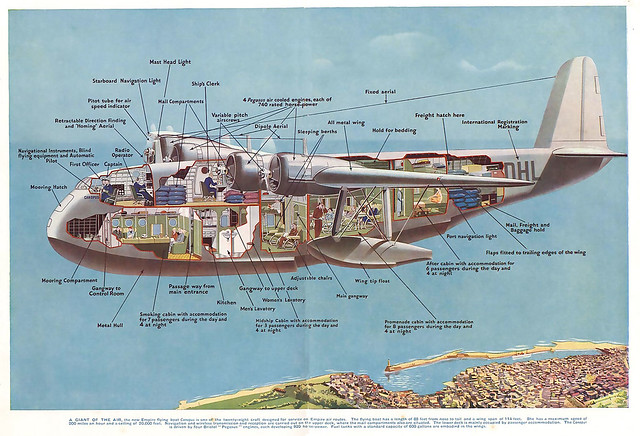
1936 ... Short 'Empire' flying boat
Interior configuration of the Short Empire flying boat
(Flickr)


The first Empire Boat to fly was Canopus G-ADHL on 4 July 1936. The flight test program revealed few issues with test pilots from Short and Imperial Airways pleased with the design. Canopus was delivered to Imperial Airways later that summer with the first commercial taking place 22-25 October (longer due to bad weather) on the London-Marseilles route. The second Empire Boat was Caledonia G-ADHM, first flying on 15 September 1936 and delivered to Imperial Airways on 4 December 1936. She had increased fuel tankage that allowed her to become the first Empire Boat to cross the Atlantic on 5 July 1937, beating the time of a Pan American Sikorsky Clipper by 34 minutes. From September 1936 onward, Short completed the Empire Boats at the rate of one a month. Such was the need to put them into service that subsequent aircraft were delivered to Imperial Airways after each airframe's maiden flight! The last Empire Boat of the original 28-aircraft order was Coorong G-AEVI, delivered on 26 February 1938. With the two Empire Boats that preceded it on the production line, Coogee G-AEUG and Corio G-AEUH, those last three aircraft were delivered to QANTAS for operation on the Australian portion of the Empire Air Mail Scheme. 
The predecessor to Air New Zealand, Tasman Airways had three Empire boats
(Air New Zealand)
Imperial Airways was so pleased with the Empire Boats that in 1937 another eleven aircraft were ordered from Short. The 39 aircraft total was the largest single order for British commercial aircraft at the time. The first three of the second order were built to the same production standard as the original 28-aircraft order- those three aircraft, Carpenteria, Coolangatta, and Cooee, were delivered to QANTAS to bring their fleet of Empire Boats up to six. The rest of the second production block were built to S.30 standard which involved a change to the Bristol Perseus engine (890 hp) versus the Bristol Pegasus (920 hp) used on the S.23 version. Though lower in horsepower and an increased weight from structural beef up in the hull, the S.30 versions had near-identical performance thanks to drag reduction. Champion G-AFCT was the first S.30 boat laid down, but it was Cabot G-AFCU that flew first as it was needed by Shorts for flight testing. The last three Empire Boats from this second order were delivered to Tasman Airways for use on the Sydney-Auckland portion of the Empire Air Mail Scheme. 

A single S.30 Empire Boat was ordered in 1939, Cathay G-AFKZ was delivered to Imperial Airways in March 1940 just before the airline was renamed British Overseas Airways Corporation or BOAC. Three more Empire Boats were ordered after Cathay was ordered, but those three aircraft reverted back to the original Bristol Pegasus engine and were designated S.33. Only two of those aircraft were completed and delivered in April and May 1940, Clifton G-AFPZ and Cleopatra G-AFRA. The third planned S.33 aircraft was never built. 

S.26/G-Class Empire Boat Golden Hind
(Profile Publications)
As the S.30/S.33 production began to wind down as most of the British aircraft industry turned its attention to wartime production and Short devoted more resources to the Sunderland program, a final development of the Empire Boats was ordered. The G-Class or S.26, was a scaled up variant of the original S.23/S.30/S.33 design that incorporated some of the Sunderland's design features. First to fly was Golden Hind G-AFCI on 14 July 1939 followed by Golden Fleece G-AFCJ on 8 July 1940 and finally the last Empire Boat built, Golden Horn G-AFCK on 21 January 1940. The larger size of these  three G-Class aircraft would have allowed nonstop trans-Atlantic services to Canada and the United States, but wartime demands had all three of these aircraft put into RAF service as VIP transports armed with defensive turrets. Only Golden Hind survived the Second World War. Used by the Ministry of Aviation postwar, she was returned to BOAC in 1948 but the airline wasn't in too much of a hurry to put her back in service as she was damaged during a 1954 storm and scrapped soon afterwards. 

No discussion of the Short Empire Boats would be complete without taking a look at the Short-Mayo Mercury/Maia composite piggyback aircraft, but that will be the subject of a future article!

There's a common misconception that the Short Sunderland was a military derivative of the Empire Boat. The aircraft were developed in parallel to two different but broadly similar specifications that allowed Short to share some design elements between the two designs. The Short Sunderland was the result of Air Ministry Specification R.2/33 issued on 23 September 1933 for a large four-engined flying boat for the Royal Air Force to use in the maritime patrol and anti-submarine role. Imperial Airways had started its discussions with Short but had not formalized anything until the 1934 passage the Empire Air Mail Scheme. This accounts for why work on the first Empire Boat went so smoothly and quickly from the 1935 to the first flight of Canopus the following year- Short had done plenty of *similar* engineering work on the Sunderland program already. While there was no Empire Boat prototype, much of the work already done on the Sunderland undoubtedly helped. The first Sunderland prototype flew 16 October 1937, about 15 months after the first flight of the Empire Boat Canopus

Sources: Sunderland: The RAF's Legendary Protector of the Sea Lanes, Aeroplane Icons, February 2012. "Sunderland Story" by Martyn Chorlton, pp 6-17. "The Short Empire Boats" by Geoffrey Norris. Profile Publications, No. 84, 1966. 

25 June 2012

The Luftwaffe Seenotdienst: The First Air Rescue Units

Cover of a German history book on the Seenotdienst.

Since the beginnings of military aviation air rescue operations had taken place, but the operations were quite ad hoc and improvised in most situations. That would change with the rise of the Luftwaffe which would be publicly acknowledged for the first time by Hermann Goering in 1935. As the Luftwaffe needed to expand rapidly as part of Germany's expansionist aims, the air arm could ill afford the loss of a highly trained pilot or flight crew member. Given that most of the Luftwaffe's taskings were in support of the Wehrmacht, it was expected that most crewmen would bail out over land. Despite this, the Luftwaffe did have a small number of seaplanes at bases in Baltic Sea and North Sea, both of which complicated the bail out from an aircraft in trouble. In 1935, Lt. Colonel Konrad Goltz, a supply officer based in Kiel, was tasked with organizing a system for recovering downed aircrew from the inhospitable waters of the surrounding seas. His initial command consisted of a flotilla of second-hand, if not run-down, boats with local commanders given authority to seek assistance from Kriegsmarine aircraft and local German lifeboat rescue societies. By the following year his units were designated the Ships and Boats Group- an unusual situation of a Luftwaffe officer commanding a fleet of ships!

By 1938 it was apparent to Luftwaffe planners that war with Great Britain was on the horizon and that Luftwaffe crews would be routinely traversing the English Channel and North Sea to strike British targets. In the following year the Ships and Boats Group acquired twelve old Heinkel He 59 float planes which were painted white with Red Cross markings. The aircraft were modified with a floor hatch and extendable ladders as well as a hoist to help lift injured crews into the aircraft. Medical gear, respirators and electrically-heated sleeping bags were also fitted to the old biplane aircraft. Renamed the Seenotdienst (Air-Sea Rescue Service), the Heinkels went into action on 18 December 1939 not to rescue Luftwaffe crews, but downed RAF crews from a Vickers Wellington force that was badly mauled after a bombing attack on the port of Wilhemshaven.

The Seenotdienst's first aircraft, the Heinkel He 59.
As the Reich conquered the Low Countries and Denmark and Norway, Seenodienst units were established in those countries for the rescue of downed aircrews. With the fall of France in 1940, captured French aircraft were added to the Seenotdienst fleet along with larger and more capable Dornier Do 24 flying boats. With the massing of Luftwaffe units in France for the anticipated invasion of Britain, German fighter ace and commander Adolf Galland stressed the importance of water survival to his flight crews- even single seat fighters were equipped with a survival raft and Luftwaffe crews were trained to ditch their aircraft and use the rafts as opposed to RAF crews who were trained to bail out and rely on their life vests. In addition, Luftwaffe general Ernst Udet had a series of rescue buoys placed throughout the English Channel- the buoys could hold four men and were stocked with blankets, dry clothes, food, water, and flares. Painted bright yellow and nicknamed "Lobster Pots" by the RAF, through the Battle of Britain both British and German patrol boats would check on the buoys and unusually, kept them stocked as they knew the buoys could save any downed aircrew regardless if they were British or German. The Luftwaffe also pioneered the use of fluorescein green dye to stain the waters around downed aircrew so as to make their positions more visible to rescue aircraft. The Luftwaffe Seenotdienst also pioneered the idea of a rescue task force with Messerschmitt Bf 110 twin engine fighters assigned the task of escorting and protecting the Seenotdienst aircraft.

Between February and August of 1941, of the over 1200 air crews from both sides that went down in the North Sea and English Channel, 444 of them were saved by the Seenotdienst. Of those 444, 78 were RAF crews. With painful awareness that British efforts were severely lacking in air-sea rescue during the Battle of Britain, in 1941 the RAF Coastal Command set about improving its air rescue capability and would use the Seenotdienst as a model. With the expansion of the US Army Air Forces in Britain, the RAF Coastal Command in turn assisted the United States in developing its air sea rescue capabilities.

Source: Search and Rescue in Southeast Asia by Earl H. Tilford, Jr. Center for Air Force History, 1992, p3-6.

13 December 2011

Violet Club: Quite Possibly the Worst Nuclear Bomb Ever Fielded

The warhead, or physics package, of the Violet Club bomb
When taking a look at the development of British nuclear weapons following the Second World War, it has to be viewed in the context of a piece of legislation in the United States that was passed in 1946- the McMahon Act or the Atomic Energy Act. Sponsored by Senator Brien McMahon of Connecticut who chaired the Senate Special Committee on Atomic Energy, this legislation is better known for its creation of the Atomic Energy Commission and the placement of nuclear weapons development and nuclear applications under civilian rather than military control. However, one consequence of the McMahon Act was the stipulation that nuclear weapons development be restricted from US allies- this affect the United Kingdom and Canada who had provided scientists and support to the wartime Manhattan Project. As a result of being shut out of American nuclear weapons development, the British set about to create their own air-dropped weapon which would be fielded in 1953 at RAF Witttering- though somewhat amusingly the first aircraft that could carry the bomb, designated Blue Danube, the Vickers Valiant, didn't become operational until a year later. The purpose of this wasn't just a message to the Soviets, but also to the United States that Britain was more than capable of fielding its own nuclear deterrent despite the McMahon Act. 

On 1 November 1952 the United States detonated its first fusion bomb (H-bomb) in the Ivy Mike test at Eniwetok Atoll in the Pacific. Given that the British were still shut out of US nuclear development by the McMahon Act, despite the fact that the Blue Danube fission bomb (A-bomb) was still a year out from being operational, strategic imperatives meant that Britain had to develop it's own H-bomb and the program was launched in 1954. In the UK, many military systems were assigned code names under the Ministry of Supply's "rainbow codes"- hence, "Blue Danube". In the development of an H-bomb, the casing had its own code name and the actual warhead, called the physics package, had another code name. The casing of the H-bomb was based on the Blue Danube casing and was designated Violet Club while the physics package was designated Green Grass. 

But before the code names had been settled upon, the British H-bomb had a different name- "Interim Megaton Weapon"- implying that it was a high-yield weapon but not a true thermonuclear or H-bomb/fusion weapon. And this is really at the heart of the history of the Violet Club and its historical legacy. First, it indicates that Violet Club was intended to be a temporary weapon and secondly, it wasn't a fusion bomb as was commonly believed by *both* the Soviet Union and the United States. 

The warhead or physics package of the bomb was based on earlier warhead designs that were named Orange Herald and Green Bamboo. Orange Herald was a lighter version of Green Bamboo and the designs were projected to be the new fusion warheads for the Royal Air Force's V-force, the Blue Steel stand-off missile, and the planned Blue Streak intermediate-range ballistic missile. Testing of Orange Herald showed that it had failed to boost the fission reaction to create a fusion reaction. The failure of the warhead designs left the British scrambling for a high-yield weapon and this became the Green Grass warhead of the Interim Megaton Weapon that was based on design elements of the earlier Green Bamboo and Orange Herald designs. As was the case in the United States, interservice rivalries in Great Britain meant that the Army wanted highly enriched uranium (HEU) for nuclear landmines in Europe and the Royal Navy wanted HEU for the reactors for its planned nuclear-powered submarine fleet. The Royal Air Force was of the feeling that the HEU that had so far been produced in British reactors had to be used or it would be lost to rival services, so that was one of several motivations to rush the Interim Megaton Weapon into service as it would use a significant amount of HEU.

Schematic of the Green Grass warhead showing how the ball bearings were used.
It was the design of the Green Grass warhead that went into the Violet Club that made it for all practical purposes a useless weapon. A hollow sphere of HEU was surrounded by a system of 72 explosive lenses that compressed the HEU to critical mass and detonation. But here was the problem. In the Green Grass warhead, the mass of HEU was in *excess* of the critical mass once compressed by the explosive lenses. That meant if the warhead were crushed or damaged during handling, it could partially detonate. American designs avoided this by having an HEU core that was inserted into the physics package usually by the bombardier once the bomber was in flight, thereby "arming" the bomb once the core was inserted. Without the core inserted, the HEU mass in the American designs was below the critical mass. The solution by British designers was to fill the center of the HEU sphere with 20,000 steel ball bearings to prevent the sphere from being crushed and reaching critical mass. To arm the bomb, a plastic plug was removed from the bottom of the warhead (accessible via a hatch on the underside of the Violet Club casing) that allowed the bearings to flow out, thereby arming the bomb. 

While it may sound like a creative solution, there were several issues: 
  • The weight of the ball-bearings increased the bomb's weight to 11,250 lbs which was greater than the capacity of not only the bomb release mechanisms of the V-bombers but also the ground-transport equipment of the bomb. 
  • The outflow of bearings took at least half an hour under ideal conditions- in cold weather, the bearings could freeze together, making arming the weapon near-impossible. 
  • Once the bomb was armed by allowing the ball-bearings to flow out of the center of the warhead, there was on way of making the weapon safe again. In fact, engine running was prohibited even with Violet Club "safed" as it was feared vibration would cause the plastic plug to fall out and inadvertantly arm the weapon. 
  • Because the bomb was armed irreversibly, airborne alerts were impossible because take off and landing were too hazardous to attempt with an armed Violet Club. 
  • Dispersal of the V-force to outlying fields was impossible as the bomb couldn't be flown to the dispersal airfield and the bomb transport equipment couldn't handle the Violet Club when it had its ball-bearings in place. 
The Blue Danube- the Violet Club looked similar externally.
While the Air Staff of the RAF ordered twelve Violet Club bombs, only five were made and as British author Chris Gibson put it in his book Vulcan's Hammer "From the RAF's point of view, that was five too many." With such an unwieldly weapon, why was it even fielded? First of all, remember that the British were classifying the Violet Club as megaton-class weapon by calling it the Interim Megaton Weapon. It definitely wasn't a megaton weapon, perhaps more 400 kilotons at best, but certainly the Operation Grapple tests at Christmas Island in 1957 did indicate to the Americans the British were succeeding at fielding their own H-bombs- even if those test detonations failed to created the desired thermonuclear reaction. So who was the target of the Violet Club? While serving notice to the Soviet Union that Britain was still a force to be reckoned with, it seems that perhaps the Americans were the target, so to speak- with a weapon in their inventory called Interim Megaton Weapon implying that newer designs forthcoming and the Grapple series of tests in 1957 making a good show of things despite failing to work as planned, in 1958 the United States repealed the McMahon Act and resumed full nuclear cooperation with the United Kingdom. The Green Grass warhead used in Violet Club would be the last all-British nuclear weapon as a new Mutual Defense Agreement signed as part of the repeal of the McMahon Act meant British designers now had access to more advanced and compact American designs. In fact, the successor to the much-despised Violet Club, the Yellow Sun Mk.2, used an Anglicized American Mk.28 thermonuclear warhead. But no other fission weapon ever fielded by any other nation approached the explosive yield of the Violet Club.
Source: Vulcan's Hammer: V-Force Projects and Weapons Since 1945 by Chris Gibson. Hikoki Publications, 2011, p47-51. http://www.nuclear-weapons.info/vw.htm, by Brian Burnell.